KLAUS KREISER.MareMagnum
Jérusalem
réf. 0666906203.Gpaperback. Good. Access codes and supplements are not guaranteed with used items. May be an ex-library book. paperback
Bonita · États-Unis60,87 $US≈ 54,38 €
2 122 résultats
1995New English Paperback. Pbo. Roy. 8vo. (24 x 17 cm). In German. [vi], 276 p. Istanbul und das osmanische Reich: Derwischwesen, Baugeschichte, Inschriftenkunde.
1831Very Good Turkish, Ottoman (1500-1928) Original manuscript autograph handwritten document sealed 'Hüsrev Mehmed' sent to (and responded by) Serkâtib Mustafa. Written in special paper with 'ahar'. 39x21 cm. In Ottoman script. Slightly tear on folded place and slightly stains. Otherwise a very good manuscript paper. The document was written in accordance with the Ottoman state correspondence tradition prior to modernization. However, it is an indication of modernization that it is written to the serkâtib of Humâyûn (head clerk of the Ottoman / Turkish court) and not to the Sultan directly. The importance of this document is that it has many hints of modernization movements of the last period of Empire, depiction of the division of the first modern Ottoman army (Asakir-i Mansure-i Muhammediye) that's before one year of Egyptian Campaign by Koca Husrev Pasha and before eight years of proclamation of Reform (Tanzimat) and after only 22 years of Turkish Magna Carta (Sened-i Ittifak). Husrev Pasha was 'serasker' (commandant and head) of Assakir-i Mansure-i Muhammediye Army in that year. Husrev's text starts as 'Devletlü, inayetlü, atufetlü, oglum.." in 'Elqab'. In the Ottoman diplomacy, first person who used 'oglum' [i.e. my son] in elqab of the documents was Koca Hüsrev Pasha. (Source: Osmanli Arsiv Belgeleri, Orhan Sakin). Koca Hüsrev Pasha (Khosrew Pasha) was an Ottoman Kapudan Pasha ("Grand Admiral") of the Ottoman Navy and statesman who reached the position of Grand Vizier rather late in his career, between 2 July 1839 and 8 June 1840 in the reign of Abdülmecid I. However, during the 1820s, he occupied key administrative roles in the fight against regional warlords, the reformation of the army, and the reformation of Turkish attire. In 1801, Hüsrev Pasha commanded the 6,000 Ottoman troops who assisted the British in removing the French from Rashid (Rosetta). For this, he was made governor of Egypt Eyalet (province), in which position he was charged with assisting Hüseyin Pasha in the killing or imprisoning the surviving leaders of the Mamluks. Many of these were freed by or fled with the British, while others held Minia between Upper and Lower Egypt. [.] He was later made governor again by Muhammad Ali for 2 days [.] After Diyarbekir and Salonica, in 1806 he was governor of Bosnia Eyalet, before being reappointed as governor of Salonica in 1808. Hüsrev Pasha held the rank of Kapudan Pasha of the Ottoman Navy from 1811 to 1818. He was then appointed governor of the Eyalet of Trabzon twice, during which time he conducted for the Black Sea region of Turkey the struggle the central Ottoman state was waging against local feudal rulers (Derebeys). During the Greek War of Independence, he was appointed Kapudan Pasha again in the end of 1822. In 1826, Husrev Pasha played vital roles both in the Auspicious Incident (the annihilation of the Janissary Corps in 1826) and in the formation of the new "Mansure Army" modeled after those of European Powers. Appointed as seraskier (commander the army) of the Mansure in May 1827, Husrev reformed and disciplined the corps. Himself ignorant of modern military methods, he assembled a staff of foreign experts and other personnel to assist him, the "Seraskeriye", which constituted the first staff in Ottoman history. Due to his early championing of military reform and virtual control over the new Ottoman army, Husrev was able to install many of his protégés in senior military positions. Husrev Pasha was also instrumental for the near-abandonment of the turban and the adoption of the fez as a universal headgear for Muslim men of the Ottoman Empire (excluding the religious classes) under Sultan Mahmud II. (Wikipedia). Möltke talks about him in famous book includes his personal letters as 'he is more powerful than sultan'. Following the suppression of the Janissaries in 1826, Sultan Mahmud II transferred the functions of the old Agha of the Janissaries to the seraskier.
2000Fine Greek, Modern (post 1453) Paperback. Roy. 8vo. (24 x 17 cm). In Greek. 91, [3] p., with CD. Leitourgikon. Periechou ta upo te tou diakouou tou Ierou kai tou Ieropsaltou eu ie agia kai iera Leitourgia psallomeua. Edited by H. Redias-Toubas. [With a CD]. Functional. I contained the sacred and holy Liturgy by the Divine and the Holy Ghost.
1991Fine English Paperback. Pbo. Roy. 8vo. (24 x 17 cm). In Turkish. 103 p., ills. Franz Liszt ve M[ahmut] R[agip] Gazimihal'in bir arastirmasi: 'Liszt'in Istanbul konserleri'. A study on Istanbul concerts of Franz Liszt, (1811-1886).
1950Very Good Greek, Modern (post 1453) Paperback. Cr. 8vo. (20 x 14 cm). In Greek. 80 p., 1 b/w portrait. Eutradeli Mousa.
2014New English Paperback. Pbo. Mint. Small 4to. In English. 116 p., color ills. "An Innocent City is an exhibition of stories and illustrations of the everyday objects of Istanbul. The objects presented here were inspired by objects on display in the cases of the Museum of Innocence in Çukurcuma. Graduate students from Koç University chose objects from the Museum and searched the streets of Istanbul to find the lives of these objects in the city today. A series of stories, illustrations, and everyday objects on loan from local community members, An Innocent City is a platform for considering the different meanings and shared significance of the everyday objects in our lives. It is our hope that this exhibition will prompt future responses from others wishing to collect and share their stories. We welcome you to enjoy the exhibition, read the strories, and if you would like, share a story of your own.".
1912Very Good English Modern aesthetic leather bound. Roy. 8vo. (24 x 17 cm). In Ottoman script. 200 p. Including Greek - Ottoman Turkish dictionary on last page. Roumi: 1328 = Gregorian: 1912. Ozege: 19912. First and only edition of Kritovulos' history in Ottoman world. OTTOMANIA Chronicle Ottoman history Byzantium Mehmed the Conqueror Conquest Istanbul - Constantinople.
2018New Turkish Paperback. Demy 8vo. (21 x 14 cm). In Turkish. 149 p., color and b/w ills., maps and documents. Osmanli-Meksika diplomatik iliskileri, (1864-1913): Elçilik raporlarinda Osmanlilarin Latin Amerika siyaseti. Ottoman - Mexican diplomatic relations between the years of 1864-1913: Turkish policy of Latin America based on embassy reports. Osmanisch-mexikanische diplomatische Beziehungen zwischen den Jahren 1864-1913: Die türkische Politik Lateinamerikas basiert auf Botschaftsberichten.
2018As New Turkish Paperback. Demy 8vo. (21 x 14 cm). In Turkish. 149 p., color and b/w ills., maps and documents. Osmanli-Meksika diplomatik iliskileri, (1864-1913): Elçilik raporlarinda Osmanlilarin Latin Amerika siyaseti. Ottoman - Mexican diplomatic relations between the years of 1864-1913: Turkish policy of Latin America based on embassy reports. Osmanisch-mexikanische diplomatische Beziehungen zwischen den Jahren 1864-1913: Die türkische Politik Lateinamerikas basiert auf Botschaftsberichten.
1997New New English Original bdg. Dust wrapper. 95, [1] p., 9 huge folding plans and maps. Color and b/w ills. Transmission water supplying lines to Topkapi Palace. Topkapi Sarayi'na su saglayan isale hatlari.
1997New New English Original bdg. Dust wrapper. 95, [1] p., 9 huge folding plans and maps. Color and b/w ills. Transmission water supplying lines to Topkapi Palace. Topkapi Sarayi'na su saglayan isale hatlari.
1991Fine Fine Turkish Yayincisinin özgün sömizli cildinde. 4to. (32 x 24 cm). In Turkish. 176 p. 25 adet büyük boy katlanir harita. Halkali sulari.", KÂZIM ÇEÇEN, ISKI / Istanbul Büyüksehir Belediyesi, Ist., 1991. -- Osmanli medeniyeti Istanbul Halkali Bizans Su kültürü Mimari Sehircilik.
1990Fine English Paperback. Pbo. Roy. 8vo. (24 x 17 cm). In Turkish. 88 p., b/w and color ills. Istanbul Teknik Üniversitesi'nin kisa tarihçesi. Short history of Technical University of Istanbul.
1984Fine English Paperback. Roy. 8vo. (24 x 17 cm). In Turkish and abstract in English. [xx], 292, [1] sayfa, 2 folding maps, numerous b/w plts. First Edition. Istanbul'da Osmanli devrindeki su tesisleri.= [Water intakes, water plants in Istanbul during the Ottoman period]. OTTOMANIA Water supply systems Ottoman culture Constantinople - Istanbul Byzantium Urbanization City planning.
1996Fine Fine English Original bdg. Dust wrapper. 4to. (30 x 21 cm). In English. 217, [1] p., color and b/w ills., 9 folding plans and maps. Sinan's water supply system in Istanbul. e.; Tugra of Sultan Suleiman the Magnificent.; Sinan's Tomb and Its Inscription.; The civilization of Water and Greenery: Recep Tayyip Erdogan Mayor of Greater Istanbul Municipality.; Water And Art: D. Veysel Eroglu.; Director General Istanbul Water and Sewage Disposal Administration.; preface. Water Supply System of Istanbul in the Late Roman and Byzantine Period. Raman and Byzantine Period 1.2. Documents on the Byzantine Period.; The Period of Suleiman the Magnificent and the Water Demand of Istanbul. 2.1 A General View of the Period of Suleiman the Magnificent 2.2.The Population of Istanbul at the Time of Suleiman the Magnificent and the Water Demand of the City 2.3. The Ottoman Water Supply Systems Built in Istanbul Before the Kirkcesme System 2.4. Sinan's Life 2.5. Sources of Information on the Construction of the Kirkcesme System 2.5.1. Architect Sinan and the Search for A Solution to the Water shortage in Istanbul at the Time of Suleiman the Magnificent 2.5.12 The Description of the Construction of the Kirkcesme Water System by Architect Sinan in Tezkiretü'l-Bünyan 2.5.2. Destruction of the Kirkcesme Water Supply by the Flood of 1563 2.5.3. Aqueducts Demolished by Floods (Topkapi Museum Archives E. 12005) 2.5.4. The Cost of the Kirkcesme System. III. The Kirkcesme Water Supply System Outside the City and the Water Supply Line 3.1. The Water Supply Line of the Kirkçesme System and the Related Documents 3.1.1. The East Branch of the Kirkcesme Water Supply Line. 3.1.2. The West Branch of the Kirkçesme Water Supply Line 3.1.3. Bashavuz (Mainpool) 3.1.4. The Water Supply Line from Bashavuz to Güzelcekemer Aqueduct 3.1.5. Cebecikoy Branch 3.1.6. The Water Supply Line from the Güzelcekemer (Gozlüce-Gonince) Aqueduct to the Egrikapi Distribution Chamber 3.2. Additional Lines of the Kirkcesme System 3.3. Monumental Aqueducts 3.3.1. The Uzunkemer Aqueduct 3.3.2. The Kovukkemer or Kirkkemer Aqueduct 3.3.3. The Maglova or Muallak "Suspended" Aqueduct 3.3.4. The Gozlücekemer or Güzelcekemer Aqueduct 3.4. Dams of the Kirkcesme System 3.4.1. Topuz Dam (Karanlik Dam, Komürcü Dam, Osmanli Dam) 3.4.2. The Büyük Dam (Belgrade Dam, Big Belgrade Dam) 3.4.3. The Kirazli Dam 3.4.4. The Ayvad Dam 3.4.5. The Cebecikoy Dam (Ahmed HI Dam) IV. The City Network and Fountains of the Kirkcesme Waters 4.1. General Information 4.2. City Distribution Network 4.2.1. Galleries4.2.2. The Service Regions of Kirkcesme 4.2.3. Main Distribution Chambers . 4.2.31. Savaklar (Egrikapi) Distribution Chamber 4.2.32. The Tezgahcilar Distribution Chamber 4.2.33. The Eyüp, Azaplar, Sulukule, Hagia Sophia Distribution Chambers 4.3. Documents Referring to the Distribution of the City Waters 4.3.1. The Distribution Book of the Kirkcesme and Kagithane Waters of Istanbul . Written by Architect Sinan in 976 H. (A.D. 1568-69) 4.3.2. The 1127 H. (A.D. 1715) Distribution Scheme of the Kutce§me Waters of Istanbul.
1996Fine Fine English Original bdg. Dust wrapper. 4to. (30 x 21 cm). In English. 217, [1] p., color and b/w ills., 9 folding plans and maps. Sinan's water supply system in Istanbul. e.; Tugra of Sultan Suleiman the Magnificent.; Sinan's Tomb and Its Inscription.; The civilization of Water and Greenery: Recep Tayyip Erdogan Mayor of Greater Istanbul Municipality.; Water And Art: D. Veysel Eroglu.; Director General Istanbul Water and Sewage Disposal Administration.; preface. Water Supply System of Istanbul in the Late Roman and Byzantine Period. Raman and Byzantine Period 1.2. Documents on the Byzantine Period.; The Period of Suleiman the Magnificent and the Water Demand of Istanbul. 2.1 A General View of the Period of Suleiman the Magnificent 2.2.The Population of Istanbul at the Time of Suleiman the Magnificent and the Water Demand of the City 2.3. The Ottoman Water Supply Systems Built in Istanbul Before the Kirkcesme System 2.4. Sinan's Life 2.5. Sources of Information on the Construction of the Kirkcesme System 2.5.1. Architect Sinan and the Search for A Solution to the Water shortage in Istanbul at the Time of Suleiman the Magnificent 2.5.12 The Description of the Construction of the Kirkcesme Water System by Architect Sinan in Tezkiretü'l-Bünyan 2.5.2. Destruction of the Kirkcesme Water Supply by the Flood of 1563 2.5.3. Aqueducts Demolished by Floods (Topkapi Museum Archives E. 12005) 2.5.4. The Cost of the Kirkcesme System. III. The Kirkcesme Water Supply System Outside the City and the Water Supply Line 3.1. The Water Supply Line of the Kirkçesme System and the Related Documents 3.1.1. The East Branch of the Kirkcesme Water Supply Line. 3.1.2. The West Branch of the Kirkçesme Water Supply Line 3.1.3. Bashavuz (Mainpool) 3.1.4. The Water Supply Line from Bashavuz to Güzelcekemer Aqueduct 3.1.5. Cebecikoy Branch 3.1.6. The Water Supply Line from the Güzelcekemer (Gozlüce-Gonince) Aqueduct to the Egrikapi Distribution Chamber 3.2. Additional Lines of the Kirkcesme System 3.3. Monumental Aqueducts 3.3.1. The Uzunkemer Aqueduct 3.3.2. The Kovukkemer or Kirkkemer Aqueduct 3.3.3. The Maglova or Muallak "Suspended" Aqueduct 3.3.4. The Gozlücekemer or Güzelcekemer Aqueduct 3.4. Dams of the Kirkcesme System 3.4.1. Topuz Dam (Karanlik Dam, Komürcü Dam, Osmanli Dam) 3.4.2. The Büyük Dam (Belgrade Dam, Big Belgrade Dam) 3.4.3. The Kirazli Dam 3.4.4. The Ayvad Dam 3.4.5. The Cebecikoy Dam (Ahmed HI Dam) IV. The City Network and Fountains of the Kirkcesme Waters 4.1. General Information 4.2. City Distribution Network 4.2.1. Galleries4.2.2. The Service Regions of Kirkcesme 4.2.3. Main Distribution Chambers . 4.2.31. Savaklar (Egrikapi) Distribution Chamber 4.2.32. The Tezgahcilar Distribution Chamber 4.2.33. The Eyüp, Azaplar, Sulukule, Hagia Sophia Distribution Chambers 4.3. Documents Referring to the Distribution of the City Waters 4.3.1. The Distribution Book of the Kirkcesme and Kagithane Waters of Istanbul . Written by Architect Sinan in 976 H. (A.D. 1568-69) 4.3.2. The 1127 H. (A.D. 1715) Distribution Scheme of the Kutce§me Waters of Istanbul.
1986Very Good English Paperback. Pbo. Roy. 8vo. (24 x 17 cm). In Turkish and abstract in English. [iv], 91 p., 19 folding plates. Süleymaniye suyollari.
1981réf. BN110682Dumbarton Oaks Center for Byzantine Studie 1981. 1981. Hardcover. Nicholas I. Patriarch of Constantinople : Miscellaneous Writings Nicholas I. Patriarch of Constantinople : Miscellaneous Writings Dumbarton Oaks Center for Byzantine Studie hardcover
réf. 52179N° 4 - Première année - octobre-décembre 1926 - Paris. Rédaction et administration : 45, boulevard Beaumarchais (IIIe) - revue illustrée - hors-texte - in-4 boché
réf. 0666906203.Gpaperback. Good. Access codes and supplements are not guaranteed with used items. May be an ex-library book. paperback
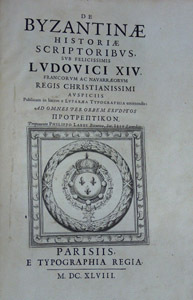
1648réf. HI246Parisiis, e typographia regia -curante Sebastiano Cramoisy- 1648. Folio, 1f, 59, 12, 220,, 161, 191, 1f. En-tetes, initiales decorees, pages de titre, culs-de-lampe, grandes vignettes graves sur cuivre. Textes grec et latin. Rel. plein veau contemp., ecusson de cardinal au milieu des plats, roulette doree, ex-libris grave, dos a nerfs decore, exemplaire propre, non-lave.
réf. 96662Paris, Librairie Archéologique de de Victor Didron, 1861, 1 volume in-folio de 320x250 mm environ, 240 pages + 3 planches (dont 2 double page), broché sous couverture illustrée, feuillets non coupés. Manque de papier sur le coin supérieur de la page de faux-titre, quelques rousseurs, couverture insolée avec dos fendillé, sinon bon état.
1720réf. PHO-9761720, à Paris chez Jean Baptiste Coignard , In-12,7ffnch - 398pp- relié plein veau brun, dos à nerfs orné, pièce de titre (petit manque) , tranches mouchetées , coiffes arasées , coins usés(Reliure de l'époque).
1926Very Good English In original cloth. HC. Small Roy. 8vo. (23 x 15 cm). In English. 224 p., 35 photographic ills. in 24 plates. Lady Dorothy Mills who started her Istanbul journey with a wrong train, noticed this in Budapest and got off the train in Romania border, after all succeeds to got on the Sofia Express. She became very happy when she arrived to Istanbul. However the pouring rain, her wet aching feet, cold wind of Bosphorus, seeing her dreams about the city were not real made her unhappy and she did not love Istanbul. Afterwards Istanbul, with its mosques especially Hagia Sophia (St. Sophia), its Grand Bazaar, Bosphorus and with its all other beauty impressed Doroty Mills. The writer continues her journey visiting Ankara, South Anatolia, Syria, Jerusalem, Tel-Aviv, Jordan and Iraq, wrote her observations about historical, geographical, cultural and social qualities of countries, qualities and traditions of nations of the countries that she travelled as a diary with a riveting style.
Fine English Sark mektuplari., Lady Montegü [Lady Montagu], translation and annotion: Ahmet Refik [Altinay], Hilmi kitabhanesi, Ist., 1933. Paperback. Pbo. Foolscap 8vo. (18 x 12 cm). Fine. First Turkish edition of 'Letters of Lady Montagu'. 144 p. Montagu's Turkish letters were to prove an inspiration to later generations of European women travellers to the Orient. In particular, Montagu staked a claim to the particular authority of women's writing, due to their ability to access private homes and female-only spaces where men were not permitted. The title of her published letters refers to "Sources that Have Been Inaccessible to Other Travellers". The letters themselves frequently draw attention to the fact that they present a different (and, Montagu asserts, more accurate) description than that provided by previous (male) travellers: "You will perhaps be surpriz'd at an Account so different from what you have been entertaind with by the common Voyage-writers who are very fond of speaking of what they don't know." Montagu provides an intimate description of the women's bathhouse, in which she derides male descriptions of the bathhouse as a site for unnatural sexual practices, instead insisting that it was ¿the Women¿s coffee house, where all the news of the Town is told, Scandal invented, etc¿. However, Montagu's detailed descriptions of nude Oriental beauties provided inspiration for male artists such as Ingres, who restored the explicitly erotic content that Montagu had denied. In general, Montagu consistently derides the quality of European travel literature of the 18th century as nothing more than "trite observations.superficial.[of] boys who only remember the best wine or the prettyest women." Montagu's Turkish letters were frequently cited by imperial women travellers, more than a century after her journey. Such writers cited Montagu's assertion that women travellers could gain an intimate view of Turkish life that was not available to their male counterparts. However, they also added corrections or elaborations to her observations. Julia Pardoe, in describing her own visit to a bathhouse, wrote "I should be unjust if I did not declare that I saw none of that unnecessary and wanton exposure described by Lady Mary Montagu. Either the fair Ambassadress was present at a peculiar ceremony, or the Turkish ladies have become more delicate and fastidious in the ideas of propriety." Emmeline Lott, who wrote a book about her experience working as a governess for the son of Ishamel Pasha, claimed that Montagu's aristocratic rank meant that she had seen only the most attractive elements of Oriental life: ".her handsome train, Lady Ambassadress as she was, swept but across the splendid carpeted floors of these noble Saloons of Audience, all of which had been, as is invariably the custom, well ¿swept and garnished¿ for her reception.