2 138 résultats
2000Fine English Paperback. Pbo. 4to. (29 x 21 cm). In French. 24 p., b/w ills. Les Albanais a Istanbul. (Programme de recherche 'Turquie - Caucase - Mer Noire'). Les dossiers de l'IFEA. Seri; La Turquie aujourd'hui., No. 3.
2010New English Paperback. Pbo. Roy. 8vo. (24 x 17 cm). In French. 312 p. Avant-Propos Chapitre I : Le langage des instructions I. "La voix du maître à travers les firmans de Soliman le Magnifique" dans Soliman le Magnifique et son temps. Actes des IXe rencontres de l'École du Louvre, Paris, 7-10 mars 1990, G. Veinstein, éd., La Documentation française, Paris, 1992, p. 127-144. II. « Comment Soliman le Magnifique préparait ses campagnes : la question de l'approvisionnement (1544-1545-1551-1552)» dans F. Bilici, I. Cândea, A. Popescu, éds., Enjeux économiques et militaires en mer Noire (XIVe-XXIe siècles), Braïla, éditions Istros, 2007, p. 487-532. III. "La dernière flotte de Barberousse" in The Kapudan Pasha, His Office and his Domain, Halcyon Days in Crete, IV. A Symposium held in Rethymnon, 7-9 january 2000, E. Zachariadou, éd., Crete University Press, p. 181-200 IV. "La grande sécheresse de 1560 au nord de la mer Noire : perceptions et réactions des autorités ottomanes" dans Natural Disasters in the Ottoman Empire, Halcyon days in Crete, III. A Symposium held in Rethymnon, 10-12 janvier 1997, Elizabeth Zachariadou, éd., Foundation for Research and Technology-Hellas. Institute for Mediterranean Studies, Crete University Press, Rethymnon 1999, p. 273-281 V. "Sur la draperie juive de Salonique (XVIe-XVIIe siècles)" dans Les Balkans à l'époque ottomane, sous la direction de D. Panzac, Revue du monde musulman et de la Méditerranée, 66, 1992/4, Aix-en-Provence, 1993, p. 55-62 Chapitre II : Les discours de justification I. "La politique hongroise du sultan Süleymân et d'Ibrâhîm pacha à travers deux lettres de 1534 au roi Sigismond de Pologne", Acta Historica Academiae Scientiarum Hungaricae, 33, 2-4, Budapest, 1987, numéro spécial Buda 1686, p. 177-191. Réédition augmentée dans Actes du VIIe symposium du Comité international des études pré-ottomanes et ottomanes, Ankara, Türk Tarih Kurumu, 1994, p. 333-380. II. "L'occupation ottomane d'Ocakov et le problème de la frontière lithuano-tatare (1538-1542)" dans Passé turco-tatar, présent soviétique, Mélanges en l'honneur d'Alexandre Bennigsen, Ch. Lemercier-Quelquejay, G. Veinstein et E.S. Wimbush éds., Éditions Peeters et Éditions de l'École des Hautes Études en Sciences Sociales, 1986, Paris, p. 221-237. III. "Une lettre de Selim II au roi de Pologne Sigismond-Auguste sur la campagne d'Astrakhan de 1569", Wiener Zeitschrift für die Kunde des Morgenlandes, 82, 1992, in memoriam Anton C. Schaendlinger, p. 397-420. IV. «Autour de la lettre de Selîm II aux Andalous et des origines de la guerre de Chypre» dans E Garcia Sanchez, P. M. Asuero, M. Bernardini, eds. Espana y el Oriente islamico entre los siglos XV y XVI (Imperio Otomano, Persia y Asia central), Actas del congreso Universita degli Studi di Napoli « l'Orientale » ; Naples 30 de septiembre-2 de octubre de 2004, Istanbul, Isis, 2007, p. 271-281. V. «Portugais et Ottomans», communication inédite dans le cadre du colloque international «L'empire portugais face aux autres empires, XVe-XIXe s.», organisé par le Centre culturel Calouste Gulbenkian et le Centre d'études du Brésil et de l'Atlantique sud (Université de Paris IV-Sorbonne), à Paris, les 13-14 décembre 2002. Chapitre III : Les figures de légitimation I. "Charles Quint et Soliman le Magnifique : le grand défi", in Carlos V. Europeismo y Universalidad. Los escnerarios del Imperio, III, Sociedad Estatal para la Conmemoración de los Centenarios de Felipe II y Carlo V, Madrid, 2001, p. 519-529. II. «La question du califat ottoman» in Le choc colonial et l'islam. Les politiques religieuses des puissances coloniales en terre d'islam, sous la direction de Pierre-Jean Luizard, Paris, éditions la Découverte, 2006, p. 451-468. III. «Le rôle des tombes sacrées dans la conquête ottomane» in Lieux de culte, lieux saints dans le judaïsme, le christianisme et l'islam, numéro thématique de la Revue d'histoire des religions , 222, IV, octobre-décembre 2005, p. 509-528. IV. «Retour à Salihiyya. Le Tom
1845Very Good French A fine original chromo-lithograph print from "Souvenirs de Constantinople" by Brindesi, printed in 1845. Framed, but will be sent no frame. 52x49 cm / 39x 44 cm print area. Stains on right bottom margins of the paper. The Ottoman navy, stationed in front of the Tophane Artillery barracks, is preparing to sail under the leadership of Kapudan Pasha's ship "Amiraute". Jean Brindesi was born in 1826 and worked primarily as a watercolour artist. During the Abdulmecid period (1831-1861), he worked on scenes involving soldiers in Istanbul. Two albums of lithographs after his drawings were produced by Lemercier in Paris: Elbicei Atika - Musee des Anciens Costumes Turcs de Constantinople, 1855, and Souvenirs de Constantinople, 1860; these two works are collections of picturesque views of the city of Constantinople. The originals are kept at the Istanbul Topkapi Palace Museum and at the University of Istanbul. (Source: Levantine Heritage).
1990Very Good English Paperback. Pbo. Cr. 8vo. (20 x 14 cm). In Turkish. 144 p. B/w ills. Memoirs of Scognamillo in Pera. First Ediion. Bir levantenin Beyoglu anilari.
1985Upper corners lightly bumped. Small chip to base of spine. Light dustsoiling to top of textblock. Mild Rippling to back panel of DJ. A couple of small tears to DJ. Light edgewear to DJ. ; London, Paris, Venice, New York, Rome, Constantinople - the cities of the world have captured man's imagination for generations. In this lively, sumptuously illustrated book, the author of the best-selling 'Life In The English Country House' takes us on a tour of cities and their people through the centuries. Focusing on carefully selected cities at crucial periods in their history, Mark Girouard looks at their architecture and design in the light of the needs of the men and women who lived in them. ; 401 pages; May require extra shipping to overseas locations.
2003Fine English Paperback. Pbo. Cr. 8vo. (20 x 14 cm). In French. 285 p. ". Fenetres d'Istanbul un univers a la fois realiste et poetique, loin des stereotypes sur la Turquie.". Fenêtres d'Istanbul. Conte moderne.
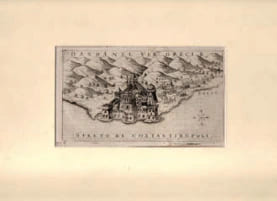
réf. GRA437Giacomo Franco, Venice 1598, gravure sur acier 32 x 25 cm sous passepartout
1980Thesis submitted to the Theological school st the University of Athens. Contents:Vioi hagion, Homiliai, Euchai. Apolesthenta, amphivallomena kai kakos apodothenta kai apodidomena eis ton Kalliston erga.377p. [32] leaves of plates : facsimiles, bibliography, index [WorldCat lists only 10 copies] Book
1998"Since the Turks first shattered the glory of the French crusaders in 1396, the Ottoman Empire has exerted a long, strong pull on Western minds. For six hundred years, the Empire swelled and declined. Islamic, martial, civilized, and tolerant, in three centuries it advanced from the dusty foothills of Anatolia to rule on the Danube and the Nile; at the Empire's height, Indian rajahs and the kings of France beseeched its aid. For the next three hundred years the Empire seemed ready to collapse, a prodigy of survival and decay. Early in the twentieth century it fell. In this dazzling evocation of its power, Jason Goodwin explores how the Ottomans rose and how, against all odds, they lingered on. In the process he unfolds a sequence of mysteries, triumphs, treasures, and terrors unknown to most American readers. This was a place where pillows spoke and birds were fed in the snow; where time itself unfolded at a different rate and clocks were banned; where sounds were different, and even the hyacinths too strong to sniff. Dramatic and passionate, comic and gruesome, Lords of the Horizons is a history, a travel book, and a vision of a lost world all in one."352p.illus bibliography.index Book
réf. 026454Constantinople: Imp. Tsitouris Freres 1928 0. Soft cover. Very Good. 8vo - over 7¾ - 9¾" tall. Paperback. Pbo. Cr. 8vo. 19 x 13 cm. In French. 8 1 p. Stamp on cover minor tear at bottom corner of front cover. Clean inside and covers. Otherwise a good copy. Rare pharmaceutical brochure booklet printed in Istanbul Constantinople. La lutte contre la Syphilis: Le noveau traitement de la Syphilis dans toutes ses manifestations. Le plus Efficace et le plus Inoffensif par le Bizmol Hydroxyde de Bismuth en suspension huileuse. Grand Laboratoire Pharmaceutique 'L'Orient' Istanbul Sirkedji Demirkapou No.10. Imp. Tsitouris Freres, [1928] 0 paperback
1922Very Good Armenian Original fine red cloth bdg. with decorative gilt on board. Spine is repaired masterfully. Large roy. 8vo. (25 x 18 cm). In Armenian. [24], 429 p., 1 folded Armenian map of Turkey (map size: 24x33 cm), 29 unnumbered full-page b/w plates (one is folded). Armenian Golgotha is a memoir written by Grigoris Balakian about his eyewitness account of the Armenian Events. The memoir was released in two volumes. Volume 1, about his life prior to and during the Armenian Deportation, was released in 1922. Volume 2, about his life as a fugitive after the Deportation, was released in 1959. Originally published in Armenian, the memoir was later published in various languages including an English translation by Peter Balakian, Balakian's great-nephew, with Aris Sevag. Grigoris Balakian [or, Palakean, Palakian, Balakean], was a bishop of the Armenian Apostolic Church, in addition to being a survivor and memoirist of the Armenian Events in the Ottoman Empire. Grigoris Balakian was born in Tokat in the Ottoman Empire and graduated from the Sanasarian College in Erzurum. He had been studying architecture in Germany for two years and got a degree in civil engineering. He became a celibate priest ordained under the monastic name Grigoris Balakian. On 24 April 1915, he was among the group of 250 leading Armenian figures of Constantinople who were arrested and deported. One group was deported to Ayas. Balakian was deported to Çankiri, north-east of Ankara with the rest of the 190 other deportees from the capital. Only 16 of them would survive. He marched with 48 deportees from Çankiri in the direction of Deir Al-Zor in the Syrian desert. On the way, Balakian won the confidence of captain of constabulary Shukri Bey and learned about the Ottoman government's plan to exterminate the whole Armenian population. Balakian was able to flee toward Islahie. He joined a group of workers on the Bagdad-railway where Turkish deserters did forced labor alongside Armenian refugees. While Armenian workers between Marash and Bartche were being slain, Balakian fled to another construction site on the Bagdad railway. He was helped by German engineers and finally succeeded - disguised as Herr Bernstein - in escaping from Constantinople to Paris. At the 1921 trial in Berlin against Soghomon Tehlirian, the murderer of Talât Pasha, Balakian appeared as a witness for the defendant together with Johannes Lepsius. Soghomon Tehlirian was ultimately acquitted. Balakian became prelate of Manchester, London, and finally bishop of Marseille. Two churches were built under his guidance in Marseille and Nice (St. Mary, 1928) as well as a number of chapels and schools. He died in Marseille. Balakian is the granduncle of Anna Balakian, an expert on symbolism and surrealism who chaired New York University's Department of Comparative Literature, and the great-granduncle of Peter Balakian, an Armenian-American writer and winner of the 2016 Pulitzer Prize for Poetry. Balakian's memoirs in Armenian Golgotha are an important eyewitness account of the Armenian Events. He describes his experiences during the deportation. Balakian was one of the few surviving leaders of the Armenian community who gave an account of the deportation. Komitas (Gomitas) Vartapet belonged to the same group of detainees as Balakian. His information about the traumatization of the famous composer and founder of modern Armenian classical music is of eminent importance. OCLC: 1137218025. First Armenian Edition. Rare.
réf. 16474BRENTANO"S. 1943. In-8Carré. Broché. Etat passable. Couv. ill. 304 p. Constantinople, Paris, la Russie.
1747réf. PHO-1539Paris, Mortier et Merigot & Piget, 1747. 2 volumes in-4, relié plein veau époque, dos à nerf orné avec pièce de titre et tomaison, tranches rouges, illustré de 16 planches dont 3 vues dépliantes, tome 1 ; manque la pièce de tomaison, coiffes et coins usés, début de fente, ressaut de feuillets, adhésif sur la page de garde, Tome 2 ; manque aux coins, coiffes usées, début de fente, traces de réparation aux cartes, déchirure sans manque, ressaut de feuillets.
1956Translated by D. L. B. Hartley. Index. 15 plates; 62 illustrations in the text. Previous owner's bookplate on front pastedown.
1962Translated into English by D.L.B.Hartley)228p. illus.index. Book
1856réf. 23492Paris, Auguste Aubry Editeur, Le Trésor des Pièces Rares ou Inédites, 1856, tiré à 250 exemplaires, exemplaire sur vergé. Cartonné et toilé, pièces de titre dorées, cachet de l’éditeur sur le premier plat, 12,5 cm x 19 cm, 69 pages. Chansons et Poèmes de Guillaume de Ferrières dit Le Vidame de Chartres. Textes la plupart inédits réunis pour la première fois avec les variantes de tous les manuscrits précédés d’une notice sur l’auteur par Louis Lacour. Très bon état
réf. boz_006269Guillaume Berggren - Photographie originale d'époque - XIXe - Rue de Scutari Très belle photographie d'époque, tirage albuminé de la fin du XIXème siècle, avec légende insolée dans le négatif en partie illisible signant le nom du photographe Guillaume Berggren. Constantinople, Istanbul, Turquie, Rue de Scutari (Üsküdar). Cette photographie offre un témoignage visuel riche et exceptionnel sur la vie quotidienne dans l'Empire ottoman. La vue représente une rue pavée de Scutari (aujourd'hui Üsküdar), le quartier historique majeur situé sur la rive asiatique de Constantinople. En arrière-plan, la silhouette d'un minaret s'élève au-dessus des toits. Dimensions : 20,2 x 26,2 cm État : Angles supérieurs émoussés, la photographie ne tient pas seule à plat. Présence d'une trace d'oxydation en marge droite. Voir photos pour plus de détails. Nombre de pages : 1 page
réf. boz_006456Guillaume Berggren - Le Sélamlik à la Mosquée Yıldız Hamidiye - Fin XIXème Très belle photographie d'époque, tirage albuminé de la fin du XIXème siècle, avec légende insolée dans le négatif « 226. Yildiz Kiosque - Sébah & Joaillier ». Empire Ottoman. Cette photographie à grand spectacle immortalise la cérémonie du Sélamlik au cours des dernières décennies de l'Empire ottoman, sous le règne du Sultan Abdulhamid II. Le Sélamlik était la procession solennelle et le cortège militaire hebdomadaire accompagnant le Sultan pour sa prière du vendredi. La prise de vue offre une vue panoramique plongeante exceptionnelle sur l'avant-cour de la Mosquée impériale Yıldız Hamidiye et les dépendances du Palais de Yıldız à Constantinople. Dimensions : 27 x 20,6 cm État : La photographie ne tient pas seule à plat. Présence d'une trace d'oxydation sur la bordure supérieure droite et de quelques rousseurs éparses . Voir photos pour plus de détails. Nombre de pages : 1 page
2015New English Original decorative red cloth bdg. Oblong folio. (30 x 34 cm). Panoramic photograph size: 27x270 cm., b/w panorama. Berggren acquires the techniques of photography in Berlin and holds different jobs in various European cities before arriving in Istanbul. Initially en route to Marseille, he disembarks from his ship in 1866 and settles in Istanbul, where he is to spend the rest of his life. In 1870, he opens a studio at 414, Grand Rue de Péra (present-day Istiklal Caddesi). He sends for his niece Hilda Ullin, who arrives from Sweden in 1883 to asist him. Prior to his monetary problems Berggren works intensely until 1900 and documents the recent developments in the modernizing Ottoman Empire, the shores of the Bosphorus, the streets of the city and its peoples through captivating compositions revealing his technical skills. To sustain himself for some time, he takes portraits, photographs of tourists and sells clichés to magazine. In 1914, he is forced to disperse his archieve for financial reasons and eventually dies in poverty at the age of 85. (Source: Pera Museum Blog). This panoramic photograph's original was taken by Berggren in 1870-1888.
1800Very Good French Original decorated map. Hand-coloured. Oblong elephant folio. (54 x 76 cm). In French. Shows Greece, Archipelago, Isle de Candie, Asia Minor (Western side), and East Mediterranean. Delisle od de l'Isle was a French cartographer known for his popular and accurate maps of Europe and the newly explored Americas. At 27, Delisle was admitted into the French Académie Royale des Sciences, an institution financed by the French state. After that date, he signed his maps with the title of "Géographe de l'Académie". Five years later, he moved to the Quai de l'Horloge in Paris, a true publishing hub where his business prospered. Delisle's progress culminated in 1718 when he received the title of Premier Géographe du Roi. He was appointed to teach geography to the Dauphin, King Louis XIV's son, a task for which he received a salary. Again, his father's reputation as a man of science probably helped the younger Delisle. Historian Mary Sponberg Pedley says, 'once authority was established, a geographer's name might retain enough value to support two or three generations of mapmakers'. Delisle's case, it could be said that his accomplishments surpassed his father's. Up to that point, he had drawn maps not only of European countries, such as Italy, Spain, Germany, Great Britain, Poland, and regions such as the Duchy of Burgundy, but he had also contributed to the empire's claims to recently explored continents of Africa and the Americas. Like many cartographers of his day, Delisle did not travel with the explorers. He drew maps mostly in his office, relying on a variety of data. The quality of his maps depended on a solid network to provide him first-hand information. Given his family's and his own reputation, Delisle had access to fairly recent accounts of travellers who were returning from the New World, which gave him an advantage over his competitors. Being a member of the Académie, he also kept current with recent discoveries, especially in astronomy and measurement. When he could not confirm the accuracy of a source, he would indicate it clearly on his maps. For instance, his Carte de la Louisiane shows a river that the baron of Lahontan claimed he discovered. As no one else could validate it, Delisle noted a warning to the viewer that it might not exist. (Source: Wikipedia). Tooley, p.43.
Locally produced illustrated guide to Istanbul in English nd. (c 1970-1980 ?) .90p. illus (col.) Book
1997Former owner's bookplate on inner cover. Appears to be bound upside down (as published? ) otherwise Fine. ; The armies of the Fourth Crusade that left Western Europe at the beginning of the thirteenth century never reached the Holy Land to fight the Infidel; they stopped instead at Byzantium and sacked that capital of eastern Christendom. Much of what we know today of those events comes from contemporary accounts by secular writers; their perspective is balanced by a document written from a monastic point of view and now available for the first time in English. The Hystoria Constantinopolitana relates the adventures of Martin of Pairis, an abbot of the Cistercian Order who participated in the plunder of the city, as recorded by his monk Gunther. Written to justify the abbot's pious pilferage of scared relics and his transporting them back to his monastery in Alsace, it is a work of Christian metahistory that shows how the sack of Constantinople fits into God's plan for humanity, and that deeds done under divine guidance are themselves holy and righteous. The Hystoria Constantinopolitana is one of the most complex and sophisticated historiographical work of its time, deftly interweaving moods and motifs, themes and scenes. In producing the first English translation and analysis of this work, Alfred Andrea has captured the full flavor of the original with its alternating section of prose and poetry. His introduction to the text provides background on Gunther's life and work and explores the monk's purpose in writing the Hystoria Constantinopolitana—not the least of which was extolling the virtues of Abbott Martin, who was sometimes accuse of laxity by his superiors in the Order. Gunther's work is significant for its effort to deal with problems raised by the participation of monks in the Crusades, making it a valuable contribution to both crusading and monastic history. The Capture of Constantinople adds to our knowledge of the Fourth Crusade and provides unusual insight into the attitudes of the participants and the cultural-intellectual history of the early thirteenth century. ; Middle Ages Series; 194 pages
1937Very Good Turkish Paperback. Cr. 8vo. (20 x 14 cm). In Turkish. 165 p. Rare Limited First Edition. A famous study on the Princes' Islands. 1000 copies were printed. Istanbul adalari. Leon Gustave Schlumberger was a French historian and numismatist who specialized in the era of the crusades and the Byzantine Empire. First Edition in French: 1884, under the original title "Les Iles des Princes" printed by Calmann Lévy, Paris. It's a history of the Princes' Islands under the Byzantines.
1996Fine Turkish Paperback. Roy. 8vo. (24 x 17 cm). In Turkish. 216 p., b/w ills. Prens Adalari. Blakerna Sarayi ve Kilisesi, Bizans'in büyük suru. [= Les iles des Princes. Le palais et l'eglise des Blachernes, la Grande muraille de Byzance]. Çeviri: Halûk Çaglayaner.", GUSTAVE SCHLUMBERGER, Iletisim Yayinlari, Ist., 1996. -- Istanbul Adalar Büyükada Prinkipo Referans Sosyal tarih Osmanli kültürü Halki Antigoni Proti Bizans mimarisi Dogu kilisesi Ortodoksluk.