Carlton, HarryMareMagnum

2 107 résultats
19286 pages. Average wear. A sound copy. Sheet music
1989réf. 85652Genève Athènes, Centre orthodoxe du patriarcat oecuménique , E. Tzaferis 1989 In-folio. Reliure pleine toile toile grenat, jaquette illustrée en couleurs, étui carton illustrée, 374 pp., 463 reproductions, plans et figures en couleurs. Emboîtage défectueux, sinon très bon.
réf. 057854Paris Chez Denné jeune, Libraire An VIII 1797 in 8 (22,5x14,5) 2 volumes reliures demi foncée de l'époque, dos lisses orné de guirlandes dorés, non rognés. Tome 1: VIII et 371 pages, avec une vue gravée dépliante en frontispice (La pointe du Sérail vue du palais de l'ambassadeur à Pera). Tome 2: 292 pages, avec une vue gravée dépliante en frontispice (Vue de la plaine de Troyes), et une carte gravée dépliante (Esquisse de la plaine de Troyes). James Dallaway, 1763-1834, historien et topographe britannique. Bel exemplaire
1972Remainder mark to bottom of textblock. Minor shelfwear. DJ has creasing along top edge now in plastic sleeve. ; Harvard Historical Studies, V. 88; 390 pages; At the age of twenty-two, Andronicus II became sole ruler of Byzantium. His father, Michael VIII, had been a dashing figure--a good soldier, brilliant diplomat, and the liberator of Constantinople from its fifty-seven-year Latin occupation. By contrast Andronicus seemed colorless and ineffectual. His problems were immense--partly as a result of his father's policies--and his reign proved to be a series of frustrations and disasters. For forty-six years he fought to preserve the empire against constant encroachments. When he was finally deposed in 1328 by his grandson and co-emperor, Andronicus III, almost all of Asia Minor had been lost to the Turks, Westerners had taken over the defense of the Aegean, and the Catalan army he had invited to help him fight the Turks remained to fight the emperor. In this penetrating account of Andronicus' foreign policy, Angeliki E. Laiou focuses on Byzantium's relations with the Latin West, the far-reaching domestic implications of the hostility of western Europe, and the critical decision that faced Andronicus: whether to follow his father's lead and allow Byzantium to become a European state or to keep it an Eastern, orthodox power. The author, who argues that foreign policy cannot be understood without examining the domestic factors that influence, indeed create, it, devotes a large part of her study to domestic developments in Byzantium during Andronicus' reign-the decline of the power of the central government; the spread of semi-independent regional authorities; the state of finances, of the army, of the church. She concludes that, contrary to common opinion, Andronicus II sincerely desired the union of the Greek and Latin churches, when, in the last years of his reign, he realized that the political situation made such a union necessary. Maintaining also that the conquest of Asia Minor by the Turks was not a foregone conclusion when Andronicus II came to the throne, she discusses at length the errors of policy and the manifold circumstances which combined to precipitate that loss.
2002New English Paperback. Pbo. 4to. (29 x 24 cm). In English. 331 p., b/w and color ills. Constantinople and the orientalists. Since the publication of our earlier study; 'Orientalism and Turkey', we have been exploring the ramifications of Orientalism in the Ottoman capital of Istanbul itself, or as it was generally known in the nineteenth and early twentieth century: Constantinople. The present study, documented by both visual and written records, including memories, reveals not only the ways in which Istanbul was perceived and portrayed by European artists in the nineteenth century, but it also tries to represent the contemporary city as it truly lived and breathed. In the present work, the reader will discover the identity of Western artists whose works pictorially limned the Ottoman capital, their favorite subjects ¿the harem, the bath, the coffeehouse, and the slave market- and the nature of their interpretation of these subjects.
2002Very Good English Paperback. Pbo. 4to. (29 x 24 cm). In English. 331 p., b/w and color ills. Constantinople and the orientalists. Since the publication of our earlier study; 'Orientalism and Turkey', we have been exploring the ramifications of Orientalism in the Ottoman capital of Istanbul itself, or as it was generally known in the nineteenth and early twentieth century: Constantinople. The present study, documented by both visual and written records, including memories, reveals not only the ways in which Istanbul was perceived and portrayed by European artists in the nineteenth century, but it also tries to represent the contemporary city as it truly lived and breathed. In the present work, the reader will discover the identity of Western artists whose works pictorially limned the Ottoman capital, their favorite subjects ¿the harem, the bath, the coffeehouse, and the slave market- and the nature of their interpretation of these subjects.
2002New New English Original bdg. Dust wrapper. 4to. (29 x 24 cm). In English. 331 p., b/w and color ills. Constantinople and the orientalists. Since the publication of our earlier study; 'Orientalism and Turkey', we have been exploring the ramifications of Orientalism in the Ottoman capital of Istanbul itself, or as it was generally known in the nineteenth and early twentieth century: Constantinople. The present study, documented by both visual and written records, including memories, reveals not only the ways in which Istanbul was perceived and portrayed by European artists in the nineteenth century, but it also tries to represent the contemporary city as it truly lived and breathed. In the present work, the reader will discover the identity of Western artists whose works pictorially limned the Ottoman capital, their favorite subjects ¿the harem, the bath, the coffeehouse, and the slave market- and the nature of their interpretation of these subjects.
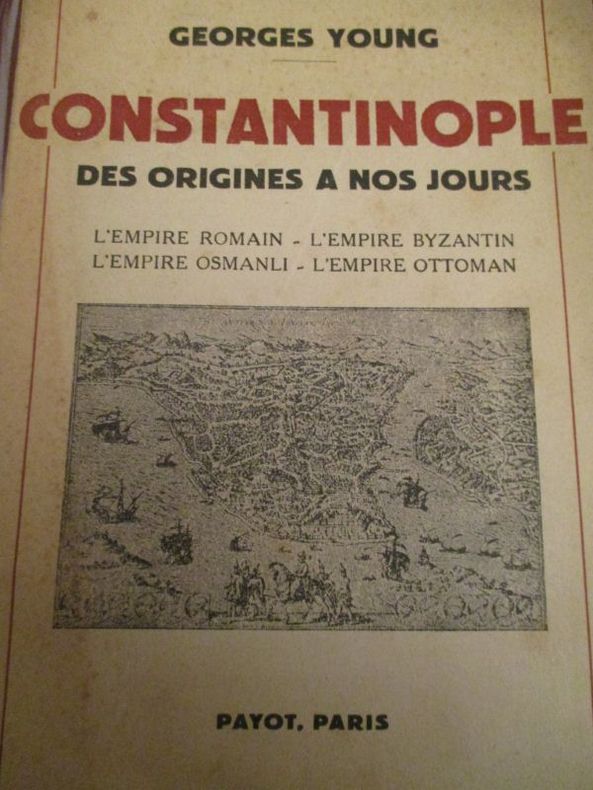
réf. 4104Broché - 14x22.5 - 391 pp - 1934 - éditions PAYOT, Paris. avec un plan de CONSTANTINOPLE.Traduit de l'anglais par M. DARD et M. TENINE.collection " bibliothèque historique".
réf. 2406payot 1948 in 8 broché 323 pages 1 plan
1939Fine English Paperback. 4to. (30 x 21 cm). In English. 49, [1] p., 16 numerous b/w plates, 1 folded map. Constantinople during the era of Mohammed the Conqueror, 1453-1481 (Maps, explanations, indices).
réf. 19158Editions Amphora, 2006. Ouvrage broché au format 12.5 X 19.8 cm, 55 pages. Nombreuse reproductions photographiques en vignettes en noir ( Stambou, Constantinople, scènes de rue..) Rare exemplaire.
2003New French Paperback. Pbo. Cr. 8vo. (20 x 14 cm). In French. 55 p., many b/w ills. Constantinople en 1890.
1990New English Paperback. Pbo. Oblong Roy. 8vo. (24 x 17 cm). In French. [viii], 51 p., 25 b/w photos. Constantinople en 1890. Texte présenté et annoté par Jacques Huré et illustré de photographies d'époque.
1858réf. 9835Paris Typographie De Gaittet et Cie 1858 In-8 Fort 374 pp, 5è édition revue et corrigée par Charles Hertz. Un portrait en frontispice et une carte dépliante gravés. Coupures et manques de papier au dos, brochage fragile ; ensemble du brochage passé et frotté. Rousseurs éparses, faible mouillure.
réf. 4388Paris, Imprimerie d'Adolphe Blondeau, 1854, deuxième édition revue et corrigée par Charles Hertz, reliure demi-basane vert foncé , dos lisse, titre et faux-nerfs dorés, 13,5x21,5 cm, 378 pages.
1856réf. 13674P., Henri et Charles Noblet, , 1856, in-8°, 374 pp, un portrait de l'auteur en frontispice, une gravure et une carte dépliante hors texte, reliure demi-chagrin vert, dos lisse à faux nerfs filetés et soulignés à froid, titres dorés (rel. de l'époque), qqs rousseurs, bon état (Lorentz IV, 615)
1855réf. 111244Paris, Belin-Leprieur et Morizot 1855 In-4 26,5 x 17 cm. Reliure plein chagrin cerise, dos à nerfs ornés d’un filet doré, caissons ornés d’un double cadre à froid, plats en cadrés d’un double filet à écoinçons, dorés, tranches dorées, XI-487 pp., 21 gravures à pleine hors texte sous serpentes, dont 6 coloriées, table des matières, placement des gravures. Reliure légèrement frottée avec accroc en tête dos, faibles rousseurs marginales, planches d’une grande fraîcheur, gouttière régulière.
1829réf. 32308Paris Moutardier 1829 Demi chagrin à coins récent, couvertures conservées, traces d'humidité claires sur les deux volumes planche dépliante ( vue de Constantinople ) et 2 gravures pour le premier volume et trois gravures coloriées pour le second , l'ouvrage, probablement longtemps resté broché a eu du mal à rentrer entre les plats d'une reliure moderne néanmoins d'aspect tout à fait correct Traduit de l'Anglais Par Nettement . IV - 369 + 314 - 4 ff catalogue éditeur )Chahine, guide Du livre orientaliste (2933 ) donne ce livre en 3 volumes en 2 tomes sans en préciser La pagination
réf. 3835In 8 demi-cuir vert,titre doré,filets à froid,faux-titre, frontispice illustré et gravé(massacre des Janissaires) titre,374 pages,une carte dépliante en couleurs (Basse-Egypte et Syrie)Charles Noblet 1856.Une mouillure angle inférieur droit en marge jusqu’à la page 93,rousseurs habituelles.Le frontispice et la page de titre ont été placés par erreur,par le relieur,après la page 16(?)
1984réf. 029060Leiden 1984 Brill Archive Hardcover 1st Edition
2015New New English Original bdg. Dust wrapper. 4to. (31 x 24 cm). In English and Turkish. [xxvi], 168 p., b/w and color ills. Constantinople, 1918.= Konstantiniyye, 1918. Introducttion by Ali Serim. In this book you will see a city, which was Capital to empires during its poorest days. Once there was greatness and glory as in the drawings of Melchior Lorichs. The Ottoman naval defeat at Lepanto in 1571 or for some other people the failure of the second siege of Vienna in 1683 was the beginning of the decline. The Empire was effectively ended by the World War I (WWI) and those concerned were not able to preserve the city in the appropriate form it deserved. I purchased the album containing these pictures a decade ago. It is understood that an mysterious French Officer who came to Constantinople during the occupation of the city by Allied Forces at the end of WWI in 1918. He took photographs of buildings and people capturing interesting scenes from social life documented the need for extensive restoration of the old city.
1895réf. 127521895 Paris, J. Mersch, 1895.in4 24,5:17 cm. VIII, 298(2) p. illustré de 101 bois gravés in Texte, 8 Photographies et 30 Photographies hors texte sous serpentes.
réf. 5422In "Les Villes d'Art célèbres", H. Laurens, Paris, 1913. Un volume in-8 broché, couverture illustrée, 180 pages, nombreuses illustrations en n&b. Plat inférieur tâché, intérieur frais.
2015New New English Original bdg. Dust wrapper. Roy. 8vo. (24 x 17 cm). In English. 608 p. The book is organized chronologically, by political history, and then by theme; a great deal of space is devoted to archaeological history, art history, and architecture. Also discusses the physical nature of the city: how the art, the growth of the streets, and the politics all affected the city's appearance today. The history, mythology, art, and décor of significant mosques in the city are included. Contains about 600 pages of analysis, with a great number of photographs and illustrations. Constantinople was "the most important treatise . . . that has yet appeared in English," wrote a reviewer in the Springfield Republican. "One of the books of the year." The New York Times said that Grosvenor was "uniquely suited to the task." This special edition of the book comprises two volumes, separately published in 1900 and 1895.
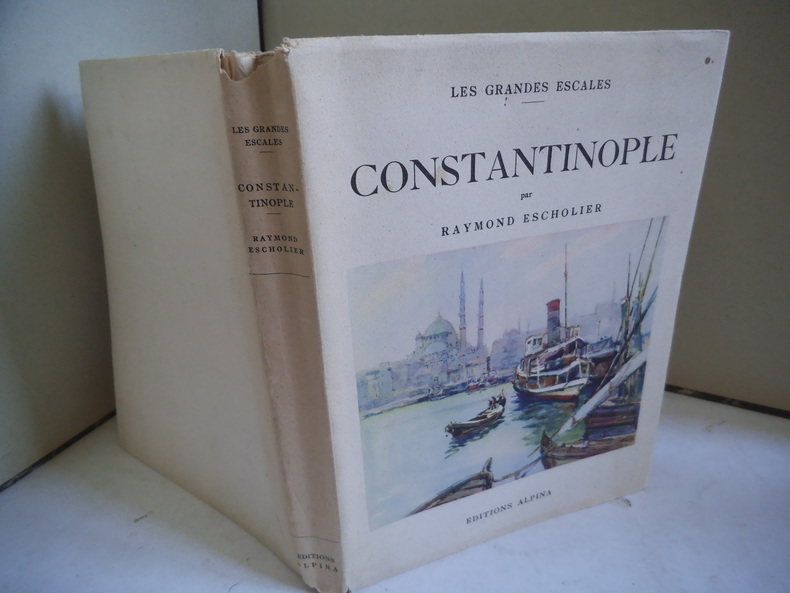
réf. 12921In 8 carré brioché, jaquette illustrée en couleurs. Faux-titre, titre, 152 pages, illustrations en couleurs hors-texte plus la couverture de Nicolas MARKOVITCH. Photos dans le texte et à pleine page. Edition Alpine Les grandes escales septembre 1935. Très bon état