EDHEM ELDEM.MareMagnum
Carlton, HarryMareMagnum
Constantinople - Sheet Music for Piano and Voice with Ukulele Chords
19286 pages. Average wear. A sound copy. Sheet music

RareNonFiction.com · Kanada49,95 €
2.133 Ergebnisse
2007New English Paperback. 4to. (26 x 20 cm). In English. 275, [1] p., fully color and b/ ills. Consuming the orient. From travel posters to cigarette packs, from postcards to ornaments, from advertisements to comic strips, the Orient has often been turned by the West into yet another commodity for mass consumption. A closer look at the way in which the Orient was represented in Western consumer societies reveals a number of images and stereotypes revolving around four major themes: exoticism, ethnography, eroticism, and history. From the late nineteenth century to our times, these images have greatly evolved, from rough clichés to more neutral visions. Nevertheless, the attraction exerted by the Orient on the greater public continues unabated, even in Turkey, where almost two centuries of Westernization has ended up creating the very particular phenomenon of "Oriental Orientalism". OTTOMANIA Social history Travel Voyage Orient Collection Objects History of the art Eastern culture Levant Graphic arts Orientalism Constantinople - Istanbul - Konstantinopel.
1988Very Good English Paperback. Pbo. 4to. (30 x 21 cm). In English and Turkish. 32 p. Color ills. Construction of Fatih Sultan Mehmet Bridge.= Fatih Sultan Mehmet Köprüsü insaati.
2006Fine English Paperback. Pbo. Roy. 8vo. (24 x 17 cm). In English. 93 p. Constantinople: The way it was and the Green Mosque at Bursa.
1998Mansel's sweeping narrative of the last five centuries of Constantinople reinterprets the history of the Ottoman Empire and provides an enthralling biography of "the city of the world's desire". "This is a work for the general reader which will also earn the admiration of all academic specialists in Ottoman history" 528p. bibliography index. Clean crisp tight copy Large format softcover weighs over 2 lbs. Book
2019New English Paperback. Roy. 8vo. (24 x 17 cm). In English. 856 p., ills., 1 folded reprint huge map. "Written in 1851-1869, Skarlatos Byzantios' three-volume masterpiece constitutes a feat of 19th c. scholarship, presented here for the first time in an annotated English translation. Drawing on Classical, Byzantine, Western European and Ottoman sources, Constantinople covers a vast period of over two and a half millennia, from the mythical foundation of Byzantium to Skarlatos' own time. A true polyglot and a keen observer, Skarlatos guides the reader through the neighbourhoods, monuments and social practices of his native city, assisted by detailed references to major historical events, personalities and long-forgotten anecdotes. His scholarly interests span across an impressive array of disciplines: political and social history, literature, architecture, epigraphy, urban planning, demography, ethnography, art and folklore. Above all, Skarlatos is a self-avowed devotee of the City of cities.". Contents: Foreword. Translator's Note. Dedication Page of the 1851 Edition. PREFACE. CHAPTER I: The Topographic Divisions of Constantinople and its Environs. CHAPTER II: The Climate, Constitution and Health Condition of the City's Inhabitants. CHAPTER III: Products. CHAPTER IV: Mythological and Historical Traditions; Byzantium's Foundation and Political Adventures. CHAPTER V: The Foundation of Constantinople. CHAPTER VI: Political and Administrative Division: a. Regiones; b. Population; c. Physical Appearance and Moral Character of the Inhabitants; d. Way of Life, Customs and Traditions.; CHAPTER VII: Public Buildings: a. Walls and Towers; b. Gates; c. Avenues, Smaller Streets and Squares or Markets(Lat./Byz.Gr.fora); d. Public Granaries (Lat horrea), Mills and Bakeries (Lat mancipia); e. Aqueducts, Cisterns, Fountains, Springs, Baths and Sewers (cloaques); f. Harbours (Gr neôria), Ports and Piers; g. Places of Worship; h. Palaces; i. Charitable Foundations Hospitals, Soup-kitchens, Nursing Homes, Guesthouses, etc.; j Schools and Libraries; CHAPTER VIII: A Detailed Description of Monuments. a. General Overview and Suggested Routes of Travelling within it; b. The Seraglio; c. The Mega Palation, or Great Palace; d. the Hippodrome (Tur At Meydan); e. The Church of the Holy Apostles; f. the Forum of Constantine (Tur Tavuk Pazar); g. The Augustaeum or Milion [Gr. Augustaion] [Tur Milyon Tasi]; h. the Hagia Sophia.
2009New English Paperback. Pbo. Demy 8vo. (21 x 15 cm). In French. 91, [1] p., b/w ills. Constantinople. Fin de siecle et la Mosquee verte a Brousse.
2015New New English Original bdg. Dust wrapper. Roy. 8vo. (24 x 17 cm). In English. 608 p. The book is organized chronologically, by political history, and then by theme; a great deal of space is devoted to archaeological history, art history, and architecture. Also discusses the physical nature of the city: how the art, the growth of the streets, and the politics all affected the city's appearance today. The history, mythology, art, and décor of significant mosques in the city are included. Contains about 600 pages of analysis, with a great number of photographs and illustrations. Constantinople was "the most important treatise . . . that has yet appeared in English," wrote a reviewer in the Springfield Republican. "One of the books of the year." The New York Times said that Grosvenor was "uniquely suited to the task." This special edition of the book comprises two volumes, separately published in 1900 and 1895.
2015New New English Original bdg. Dust wrapper. 4to. (31 x 24 cm). In English and Turkish. [xxvi], 168 p., b/w and color ills. Constantinople, 1918.= Konstantiniyye, 1918. Introducttion by Ali Serim. In this book you will see a city, which was Capital to empires during its poorest days. Once there was greatness and glory as in the drawings of Melchior Lorichs. The Ottoman naval defeat at Lepanto in 1571 or for some other people the failure of the second siege of Vienna in 1683 was the beginning of the decline. The Empire was effectively ended by the World War I (WWI) and those concerned were not able to preserve the city in the appropriate form it deserved. I purchased the album containing these pictures a decade ago. It is understood that an mysterious French Officer who came to Constantinople during the occupation of the city by Allied Forces at the end of WWI in 1918. He took photographs of buildings and people capturing interesting scenes from social life documented the need for extensive restoration of the old city.
1990New English Paperback. Pbo. Oblong Roy. 8vo. (24 x 17 cm). In French. [viii], 51 p., 25 b/w photos. Constantinople en 1890. Texte présenté et annoté par Jacques Huré et illustré de photographies d'époque.
2003New French Paperback. Pbo. Cr. 8vo. (20 x 14 cm). In French. 55 p., many b/w ills. Constantinople en 1890.
1939Fine English Paperback. 4to. (30 x 21 cm). In English. 49, [1] p., 16 numerous b/w plates, 1 folded map. Constantinople during the era of Mohammed the Conqueror, 1453-1481 (Maps, explanations, indices).
2002New New English Original bdg. Dust wrapper. 4to. (29 x 24 cm). In English. 331 p., b/w and color ills. Constantinople and the orientalists. Since the publication of our earlier study; 'Orientalism and Turkey', we have been exploring the ramifications of Orientalism in the Ottoman capital of Istanbul itself, or as it was generally known in the nineteenth and early twentieth century: Constantinople. The present study, documented by both visual and written records, including memories, reveals not only the ways in which Istanbul was perceived and portrayed by European artists in the nineteenth century, but it also tries to represent the contemporary city as it truly lived and breathed. In the present work, the reader will discover the identity of Western artists whose works pictorially limned the Ottoman capital, their favorite subjects ¿the harem, the bath, the coffeehouse, and the slave market- and the nature of their interpretation of these subjects.
2002New English Paperback. Pbo. 4to. (29 x 24 cm). In English. 331 p., b/w and color ills. Constantinople and the orientalists. Since the publication of our earlier study; 'Orientalism and Turkey', we have been exploring the ramifications of Orientalism in the Ottoman capital of Istanbul itself, or as it was generally known in the nineteenth and early twentieth century: Constantinople. The present study, documented by both visual and written records, including memories, reveals not only the ways in which Istanbul was perceived and portrayed by European artists in the nineteenth century, but it also tries to represent the contemporary city as it truly lived and breathed. In the present work, the reader will discover the identity of Western artists whose works pictorially limned the Ottoman capital, their favorite subjects ¿the harem, the bath, the coffeehouse, and the slave market- and the nature of their interpretation of these subjects.
2002Very Good English Paperback. Pbo. 4to. (29 x 24 cm). In English. 331 p., b/w and color ills. Constantinople and the orientalists. Since the publication of our earlier study; 'Orientalism and Turkey', we have been exploring the ramifications of Orientalism in the Ottoman capital of Istanbul itself, or as it was generally known in the nineteenth and early twentieth century: Constantinople. The present study, documented by both visual and written records, including memories, reveals not only the ways in which Istanbul was perceived and portrayed by European artists in the nineteenth century, but it also tries to represent the contemporary city as it truly lived and breathed. In the present work, the reader will discover the identity of Western artists whose works pictorially limned the Ottoman capital, their favorite subjects ¿the harem, the bath, the coffeehouse, and the slave market- and the nature of their interpretation of these subjects.
1972Remainder mark to bottom of textblock. Minor shelfwear. DJ has creasing along top edge now in plastic sleeve. ; Harvard Historical Studies, V. 88; 390 pages; At the age of twenty-two, Andronicus II became sole ruler of Byzantium. His father, Michael VIII, had been a dashing figure--a good soldier, brilliant diplomat, and the liberator of Constantinople from its fifty-seven-year Latin occupation. By contrast Andronicus seemed colorless and ineffectual. His problems were immense--partly as a result of his father's policies--and his reign proved to be a series of frustrations and disasters. For forty-six years he fought to preserve the empire against constant encroachments. When he was finally deposed in 1328 by his grandson and co-emperor, Andronicus III, almost all of Asia Minor had been lost to the Turks, Westerners had taken over the defense of the Aegean, and the Catalan army he had invited to help him fight the Turks remained to fight the emperor. In this penetrating account of Andronicus' foreign policy, Angeliki E. Laiou focuses on Byzantium's relations with the Latin West, the far-reaching domestic implications of the hostility of western Europe, and the critical decision that faced Andronicus: whether to follow his father's lead and allow Byzantium to become a European state or to keep it an Eastern, orthodox power. The author, who argues that foreign policy cannot be understood without examining the domestic factors that influence, indeed create, it, devotes a large part of her study to domestic developments in Byzantium during Andronicus' reign-the decline of the power of the central government; the spread of semi-independent regional authorities; the state of finances, of the army, of the church. She concludes that, contrary to common opinion, Andronicus II sincerely desired the union of the Greek and Latin churches, when, in the last years of his reign, he realized that the political situation made such a union necessary. Maintaining also that the conquest of Asia Minor by the Turks was not a foregone conclusion when Andronicus II came to the throne, she discusses at length the errors of policy and the manifold circumstances which combined to precipitate that loss.
19286 pages. Average wear. A sound copy. Sheet music
1990New English Paperback. Pbo. Roy. 8vo. (24 x 17 cm). In French. [2], 317, [1] p., 8 color plts. Constantinople - Istanbul en 1852. Texte presente et annote par Jacques Hure.
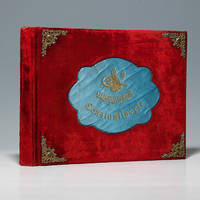
1890Best.-Nr. 1031341890. PHOTOCHROM ZURICH. Constantinople. Zrich: Photochrom Zrich circa 1890. Oblong folio 16 by 12 inches 30 photochrom images each measuring approximately 9 by 6-1/2 inches and mounted on heavy cardstock; original red velvet blue silk gilt-lettered title centerpiece on front cover brass cornerpieces. $4500.Rare photographic album of Constantinople circa 1890 by the renowned studio of Photochrom Zrich with 30 beautiful mounted vintage photochrom color prints offering exceptional views of majestic mosques palaces and plazas as well as the people of this great city in magnificent velvet binding with brass furniture.This splendid souvenir album of Constantinople contains exquisite color photographic prints of images taken at the turn of the 20th century produced by the revolutionary photochrom process. Photochrom also called the Ac process is ""a very successful form of color photolithography developed in the late 19th century by the Swiss firm of Orell Fssli and used mainly for topographical views; photochroms have almost the appearance of color photographs but through a glass will show a delicate ink pattern which was achieved by a combination of photographic and manual work on grained i.e. lithographic stones being a forerunner therefore of modern screenless offset lithography"" Gascoigne 206. In this process black and white photographic negatives were directly transferred onto lithographic printing plates to produce color prints. These photographs are a high point in late 19th-century photography when albums such as these captivated a world newly spellbound ""by photography's capacity to 'take them there' and bring them directly in contact with the long ago and far away"" Parr & Badger I:18. Each image captioned with a four-digit number followed by ""P.Z."" for Photochrom Zrich and then the title of the scene in French. A few instances of marginal spotting to mounts; photochrom prints clean and fine with vivid colors. Binding splendid. An about-fine copy of this lovely album. unknown books
1970Folio 89p., illus. Purnell Library of Knowledge series Hardcover Very good condition
1992Facsimile of the edition first published by Methuen, London 1926) 310p. index. Name of previous owner on ffep. else as new. Book
1965Fictional account of Constantine, and the conversion to Christianity after the Battle of Milvian Bridge. Book
1890Best.-Nr. 1031341890. PHOTOCHROM ZURICH. Constantinople. Zrich: Photochrom Zrich circa 1890. Oblong folio 16 by 12 inches 30 photochrom images each measuring approximately 9 by 6-1/2 inches and mounted on heavy cardstock; original red velvet blue silk gilt-lettered title centerpiece on front cover brass cornerpieces. $4500.Rare photographic album of Constantinople circa 1890 by the renowned studio of Photochrom Zrich with 30 beautiful mounted vintage photochrom color prints offering exceptional views of majestic mosques palaces and plazas as well as the people of this great city in magnificent velvet binding with brass furniture.This splendid souvenir album of Constantinople contains exquisite color photographic prints of images taken at the turn of the 20th century produced by the revolutionary photochrom process. Photochrom also called the Ac process is ""a very successful form of color photolithography developed in the late 19th century by the Swiss firm of Orell Fssli and used mainly for topographical views; photochroms have almost the appearance of color photographs but through a glass will show a delicate ink pattern which was achieved by a combination of photographic and manual work on grained i.e. lithographic stones being a forerunner therefore of modern screenless offset lithography"" Gascoigne 206. In this process black and white photographic negatives were directly transferred onto lithographic printing plates to produce color prints. These photographs are a high point in late 19th-century photography when albums such as these captivated a world newly spellbound ""by photography's capacity to 'take them there' and bring them directly in contact with the long ago and far away"" Parr & Badger I:18. Each image captioned with a four-digit number followed by ""P.Z."" for Photochrom Zrich and then the title of the scene in French. A few instances of marginal spotting to mounts; photochrom prints clean and fine with vivid colors. Binding splendid. An about-fine copy of this lovely album. unknown
Paris, Librairie de Firmin-Didot et Cie, 1882. In-4 ; demi-chagrin rouge, dos à 4 nerfs, plat avec l'écusson du Lycée Henri IV ; faux-titre, fronstipice couleurs et page de titre imprimée en noir et rouge - XXIV pp (préface, notice sur la présente édition, note explicative de la carte, observations sur les culs-de-lampe et autres ornements), 616 pp. Texte original avec la traduction en regard. Edition ornée de lettres intiales et de bordures empruntées aux manuscrits du XIIe et du XIIIe siècle et accompagné d'une carte géographique dépliante en noir et blanc sur fond vert, dressée par Auguste Longnon et gravée par Erhard (en fin d'ouvrage). Planches hors-texte, culs-de-lampe. Bel exemplaire (sans rousseurs).
1913Fine English Paperback. 12mo. (17 x 11 cm). In French. [8], 37, [5] p. Conclusions des reunions de la mission du 23 au 26 Juin, 1913. 2 stamps of 'Bibliotheque des Aug. de l'assomp., Kadi-Keuy'.
Best.-Nr. 5525ouvrage traduit de l’italien avec l’autorisation de l’auteur par Mme COLOMB.Petit in 4 pleine toile rouge d’éditeur titre et caissons dorés,titre doré sur le premier plat encadré d’un filet et d’une frise décorative.Faux-titre,portrait de l’auteur d’après RONJAT,titre en noir et rouge 452 pages,tranches dorées, 183 illustrations dans et hors-texte d’après les dessins pris sur nature par C. BISEO.Hachette & Cie 1883,rousseurs éparses plus ou moins fortes à certaines pages, ainsi qu'en début et fin de volume habituelles