Ghetto ScribeBiblio.com
369 résultats
réf. 145022394X.Gpaperback. Good. Access codes and supplements are not guaranteed with used items. May be an ex-library book. paperback
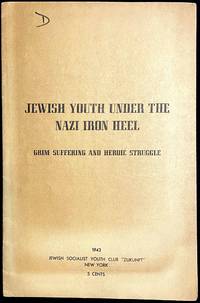
1942réf. 43351New York: Jewish Socialist Youth Club 1942. Paper Wrappers. Illustrated by 2 Facimilie Illustrations. 1st edition Original Paper Wrappers 8vo 16 pages another variant we have seen has 15 pages. From the year before the Warsaw Ghetto Uprising an early 1942 report by the American branch of the Bund on Jewish resistance by young people in Eastern Europe. "Hand in hand with the underground organizations of the General Jewish Labor Union and in contact with the organization of the Polish socialists the Youth Union 'Zukunfst' conducts an untiring and ramified activity which is preparing the ground for the open struggle of tomorrow against Hitlerism" p. 13. "Tsukunft or Cukunft or Zukunft Yiddish for future was the youth organization of the General Jewish Labor Union or Bund. It was founded in 1910 and in 1916 it was officially called Yugnt-Bund Tsukunft. Their newspaper was the Yugnt veker. In 1922 the organization changed its name to Yugnt-bund "Tsukunft" in poyln 'Youth Bund "Tsukunft" in Poland'.At the time of the sixth Tsukunft conference in 1936 the last before the outbreak of the Second World War the organization counted with 184 local groups. On the eve of the Second World War the organization had 15000 members. The Tsukunft took part in the Warsaw ghetto uprising as part of the Jewish Fighting Organization" Wikipedia. SUBJECTS: Jewish youth -- Poland. Holocaust Jewish 1939-1945 -- Jewish resistance. World War 1939-1945 -- Atrocities. OCLC: 6871875. Covers toning with pen notation to cover otherwise Very Good Condition B Holo2-139-22A-XAECC-'l. Jewish Socialist Youth Club unknown
réf. 8409841487.Gpaperback. Good. Access codes and supplements are not guaranteed with used items. May be an ex-library book. paperback
réf. Besekow, SamNot in perfect condition. unknown
réf. 1390624404.Gpaperback. Good. Access codes and supplements are not guaranteed with used items. May be an ex-library book. paperback
2017réf. 2-8868955156Edizioni Lswr 2017. Paperback. New. 554 pages. Italian language. 9.41x6.69x1.10 inches. Edizioni Lswr paperback
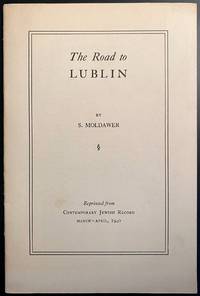
1940réf. 43325New York: American Jewish Committee 1940. 1st separate edition. Original paper wrappers. 8vo pages 119-133 14 pages total. “Reprinted from Contemporary Jewish Record March-April 1940.” Includes photo of “Armbands which Nazis are compelling the Jews to wear.” Moldawer’s story originally appeared in The Forward N.Y.C. Jan. 2-5 1940 in Yiddish. Moldawer a Polish Jew who had resided in Germany had been caught by the outbreak of the war in Hamburg on his way to the United States. Together with other Jews holding U.S. visas and steamship tickets on the Hamburg-America Line-which had suspended operations-he was deported to Lublin via Prague. Moldawer used his U.S. visa and left Poland in December 1939 and was able to issue this report which became important at the time for understanding what was happening to the Jews in Poland and is often cited in later analysis. “During the Holocaust 99% of the Jews from Lublin District in the General Governorate of German-occupied Poland were murdered along with thousands of Jews who had been deported to Lublin from elsewhere. There were three extermination camps in Lublin District Sobibor Belzec and Majdanek. The ghettoization of the Jews for the purpose of persecution terror and exploitation in the Nazi German controlled towns began immediately after the invasion of Poland….The number of major urban ghettos established in the General-Government in 1939–40 including those of Kraków and Warsaw reached one hundred before the end of the year. In the Lublin area the situation initially differed. Instead of their urban concentration some 10000 Polish Jews had been expelled from Lublin in early March 1940 to the rural towns where ghettos were not set up based solely on Globocnik's opposition to the Jewish people living near his staff headquarters. The remaining 40000 Jews of Lublin were forced into the Lublin Ghetto in May 1940” Wikipedia. SUBJECTS: Nazi concentration camps. World War 1939-1945 -- Jews. Concentration Camps Camps de concentration nazis. Guerre mondiale 1939-1945 -- Juifs. Majdanek Concentration camp. OCLC: 39753405. Touch of edgewear to rear wrapper Very Good Condition Overall. B HOLO2-162-15-AX-BB. New York: American Jewish Committee unknown
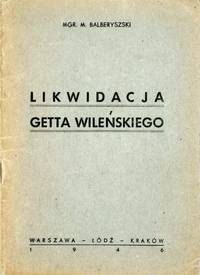
1946réf. 43329Warszawa; Lódz: Zaklady Graficzne WINW: Centralna Zydowska Komisja Historyczna 1946. 1st Edition. Original Paper Wrappers 8vo 40 pages. 21 cm. In Polish. Title translates as "The Liquidation of the Vilna Ghetto." Includes bibliographical references. Personal eyewitness account by Mendel Balberyszski 1894–1966 a prominent Vilna Jewish leader and later Holocaust survivor detailing life in the Vilna Ghetto and its destruction under German occupation. Balberyszski served on the Advisory Council of the “small ghetto” opposing Judenrat collaborationist policies. He survived both the liquidation of the ghetto and the Holocaust. Balberyszski a Lithuanian-Polish Jewish politician and journalist was prewar editor at Vilna’s Der Tog and active in the Folkspartei and later the Polish Democratic Party. After the war he emigrated to Melbourne where he became a leading communal figure. His memoir was later republished in English as Stronger than Iron: The Destruction of Vilna Jewry 1941–1945 2010. Pages 38-40 detail a list of 35 titles issued 1945–46 by the Historical Commission documenting early postwar Jewish testimony efforts. SUBJECTS : Holocaust Jewish 1939-1945 Lithuania Vilnius. Jewish ghettos Lithuania Vilnius. World War 19391945 Lithuania Vilnius Atrocities. Jews Lithuania Vilnius. OCLC: 13911170. Very Good Condition overall. B H2-3-5-VLGGAMPCCFE-XBB. Warszawa; Lódz: Zaklady Graficzne WINW: Centralna Zydowska Komisja Historyczna unknown
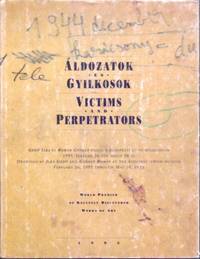
1995réf. 39266Budapest: Cultural Exchange Foundation 1995. Paperback. 1st edition. Original stiff paper wrappers with illustrated dust jacket 4to 122 pages. Includes llustrations and portraits ; 28 cm. Filled with drawings. Collection of 36 sketches drawn by Ilka Gedo in the Budapest Ghetto during Nazi occupation and sketches by Gyorgy Roman of defendants at war crimes trials held in Hungary after the war. OCLC: 34942605. Text is by several authors and is in English and Hungarian. Light edgewear and library marks to dust jacket otherwise Very Good condition with card pocket at rear no other markings. BK5 HOLO2-136-37--'e. [Budapest]: Cultural Exchange Foundation paperback
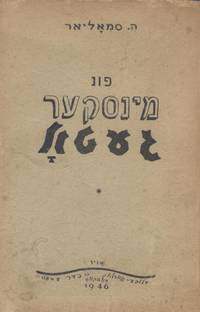
1946réf. 30905Moskve: Melukhe-farlag "Der Emes 1946. 1st edition. Original Printed Boards Small 8vo 167 pages. In Yiddish. Title translates as "From the Minsk Ghetto." Title also in Russian: Minskoe getto. In 1941 a group of Jews among them the Polish Jew Hersh Smolar; 1905–1993 the author organized a resistance movement in the ghetto in close connection with the Minsk Communist underground led by Isay Kazinets 1910–1942 and Masha Bruskina 1924–1941. Members of the resistance organized acts of sabotage and working together with the Judenrat led by Il’ia Mushkin diverted the production of the ghetto’s workshops and factories to the partisans. An underground printing press issued the leaflet Vestnik rodiny Homeland’s Messenger. The resistance enabled thousands of Jews to escape to the forests where they founded seven partisan brigades one of which in September 1943 organized the assassination of the governor-general of Belorussia Wilhelm Kube. Approximately 10000 Minsk Jews succeeded in escaping from the ghetto a proportion without parallel in Holocaust history. At liberation 13 Jews had survived the ghetto and about 5000 Jewish partisans and their families returned from the forests. In 1945 the first memorial to Jewish victims in Minsk—and the only one in the USSR with a Yiddish inscription explicitly mentioning the Jewishness of the victims—was erected” Bemporad YIVO Encyclopedia of Jews in Eastern Europe. SUBJECTS : Jews -- Persecutions -- Belarus -- Minsk. Holocaust Jewish 1939-1945 -- Belarus -- Minsk -- Personal narratives. World War 1939-1945 -- Jewish resistance -- Belarus -- Minsk. Named Person: Smolar Hersh 1905- Geographic: Minsk Belarus -- Ethnic relations. OCLC: 12284925. Small stain to title page Jewish institutional stamp on final page rear of title page and text block edges no other markings spine neatly rebacked new endpapers Good condition. B YID-17-15-ALBXGGCCOE. Moskve: Melukhe-farlag "Der Emes unknown
réf. 1456794744.Ghardcover. Good. Access codes and supplements are not guaranteed with used items. May be an ex-library book. hardcover
1988réf. 13119Stock 1988 455 pages in8. 1988. Broché. 455 pages. L'ouvrage retrace l'histoire du ghetto de Venise de sa création en 1516 jusqu'aux déportations de 1943-1944 en passant par l'émancipation française de 1797. L'auteur Riccardo Calimani mêle érudition historique et portraits sensibles des habitants mettant en lumière la richesse culturelle et intellectuelle de cette communauté juive
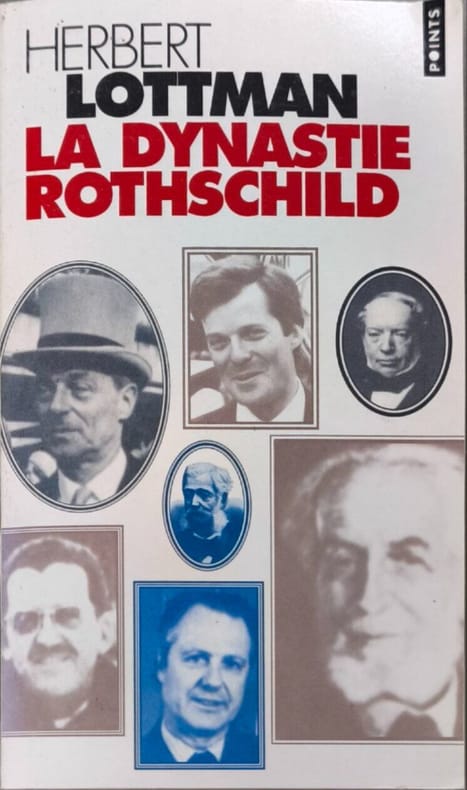
1996réf. 13245Seuil 1996 516 pages 10 8x2 4x17 2cm. 1996. broché. 516 pages. Ce livre retrace l'histoire de la famille Rothschild de ses débuts modestes dans le ghetto juif de Francfort au XIXe siècle à son ascension en tant que l'une des familles les plus influentes et riches d'Europe. Il raconte comment les descendants d'un juif du ghetto de Francfort sont devenus les Rothschild un nom synonyme de richesse et de puissance
réf. 2290relié avec jacquette - 21x26 - 111 pp - 1979 - publié par BEIT LOHAMEI HAGHETTAOT; Imprimé en ISRAËL.version française de Miriam STERENZY.
réf. 66021Musée de la Résistance nationale, supplémént à La Lettre des Résistants et Déporté Juifs de France n° 60, avril-mai 2003, 112 pp., broché, bon état.
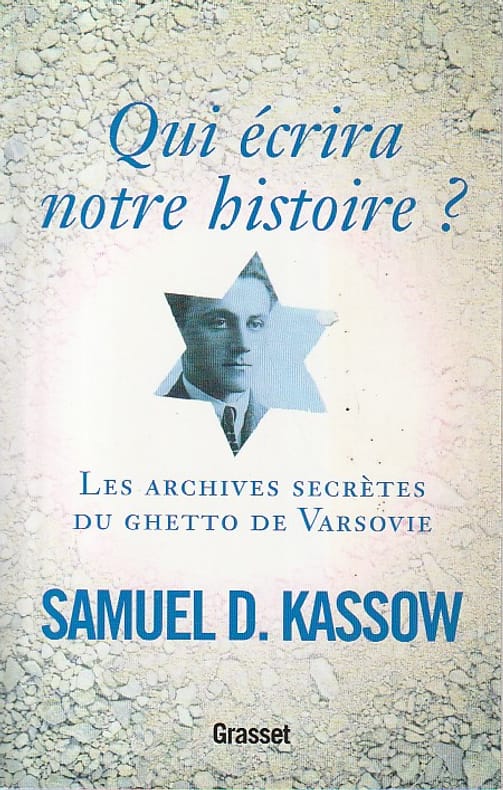
réf. 66930Grasset, 2011, 593 pp., broché, rousseurs sur la première page, bon état.
réf. 73091Coll. "10/18" n° 1657, Paris, éd. UGE, 1984, in-12, cartonnage souple, couv. photo coul. éd., 224 pp., traduction par Charles Mauron, revue et annotée par Marie-Brunette Spire, Une série de romans du Dickens juif, ici Les tragédies du ghetto. Très bon état
réf. 74754Coll. "L'indicible", Paris, éd. Ramsay, 2008, EDITION ORIGINALE, in-8, cartonnage souple, couv. photos en noir éditeur, 280 pp., 1 plan et photos en noir, bibliographie, table des matières, L'histoire du ghetto de Varsovie occupé par les allemands durant la Seconde Guerre mondiale. Le témoignage d'un des derniers occupant. Très bon état
réf. 980Paris, Plon - 1927 - In-8 ° broché - Avant-Propos I à VII - 282 pages; Etat moyen
réf. 14823Traduit de l'italien par Hélène Leroy - Lagrasse : Editions Verdier (Coll. "Terra d'altri"), 1989 - in-8 broché, 150 pages - bon état -
réf. 40314Warszawa : Panstwowe Wydawnictwo Naukowe, 1980 - un volume 17,3x24,4cm tolé sous jaquette illustrée, 412 pages illustrées en noir dans et hors texte - bon état -
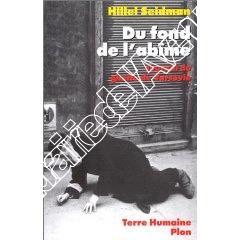
1998réf. 11368Plon 1998 In-12 broché, 702 pp.
1961réf. 100659Paris, Robert Laffont 1961 Reliure demi-basane fauve maroquinée, dos lisse, couvertures conservées, 683 pp., table des matières.Exemplaire en bon état.
1925réf. 104730Calmann-Lévy 1925 Édition originale In-12 broché 18,5 cm sur 12.281 pp+table. Couverture effrangée avec petit manque en quatrième de couverture. Dos noirci. Bon état d’occasion.
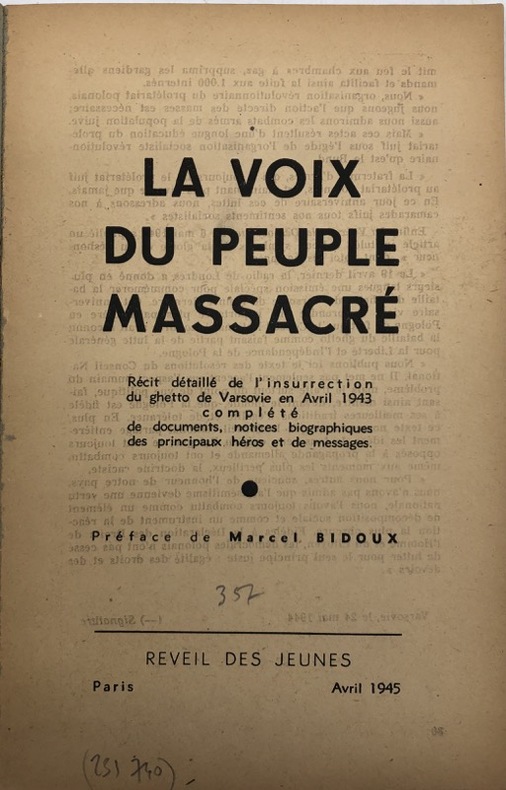
réf. 231740Paris, Réveil des jeunes, avril 1945 in-8, 80 pp., avec 7 figures dans le texte, broché.