Yannick HaenelLivre Rare Book
336 résultats
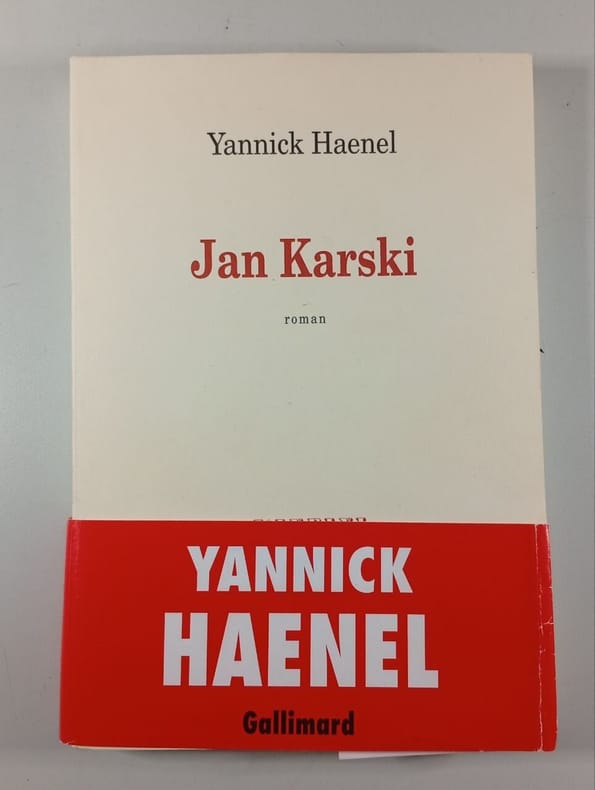
2007réf. 500384600Gallimard 2007 2007. Ce roman de Yannick Haenel retrace la vie de Jan Karski messager de la Résistance polonaise qui en 1942 pénètre clandestinement dans le ghetto de Varsovie pour témoigner de l'extermination des Juifs auprès des Alliés. L'ouvrage mêle documentaire et fiction s'appuyant notamment sur le film Shoah de Claude Lanzmann et le témoignage original de Karski
19578vo., First Edition, with portrait frontispiece, numerous plates and front endpaper street plan; red cloth, gilt back, red top, a very good, bright, clean copy. Classic and valuable eye-witness account of the Warsaw uprising of 1944. Enser, p.469.
19748vo., with plates and endpaper maps; blue cloth, backstrip lettered in silver, a very good, bright, clean copy in price-clipped dustwrapper. Much-needed reissue of the original UK edition of 1958. One of the best (and best illustrated) eye-witness accounts of the Uprising, with useful photographs not easily available elsewhere. The endpapers give a detailed street map of the Ghetto quarter. VERY SCARCE, ESPECIALLY IN THE DUSTWRAPPER. Enser, p.469 (recording the first edition).
réf. 73091Coll. "10/18" n° 1657, Paris, éd. UGE, 1984, in-12, cartonnage souple, couv. photo coul. éd., 224 pp., traduction par Charles Mauron, revue et annotée par Marie-Brunette Spire, Une série de romans du Dickens juif, ici Les tragédies du ghetto. Très bon état
1899pp. xix, 553, (1) [publisher's catalogue]. slightly damp stained and age stained. 12mo. original full green buckram binding, gold lettered spine. extremities slightly bumped. third edition. JUDAICA BOX 4
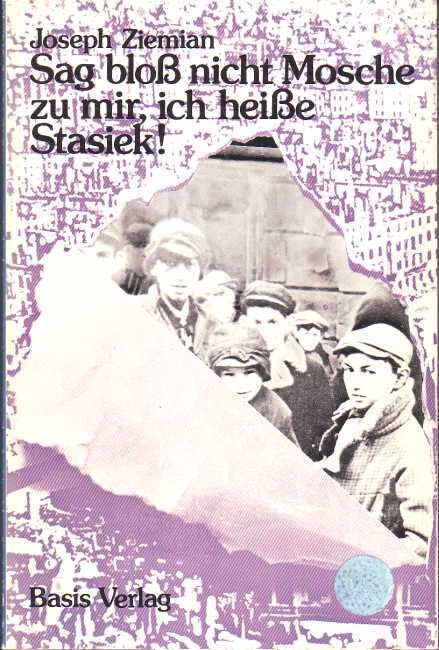
1979réf. 305887ABBerlin, Basis Verlag, 1979. 8°. 164 S. mit Fotos. Klappenbroschur. (guter Zustand).
1951réf. 34907ABBln., VVN Verlag GmbH. 1951. Erste Ausgabe. 8°. 121 S. 1 Bl., OHalbleinen m. Aufschrift a. Deckel u. Rü., Kopffarbschnitt, ExLibris Hans und Margot Zweig, gut erhalten. 1
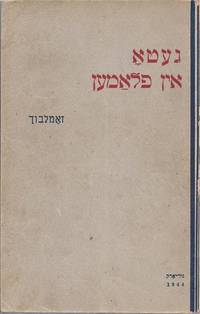
1944réf. 40092New York: Nyu-York: Amerikaner reprezentants fun "Bund" in Poyln 1944. Paperback. 1st edition. Original printed paper wrappers 8vo 206 pages. Includes illustrations & facsimiles. 21 cm. In Yiddish. Title translates as "Ghetto in Flames." Early report from the year following the Warsaw Ghetto Uprising published by one of the participating organizations the Jewish Bund. SUBJECTS: Jews -- Poland -- Warsaw. World War 1939-1945 -- Jews. Geographic: Poland -- History -- Occupation 1939-1945. Warsaw Poland -- History -- Warsaw Ghetto Uprising 1943. OCLC: 1227410408. Wear to corwn and foot of spine otherwise Very good Condition. Important. BER-1 HOLO2-98-26A-. Nyu-York: Amerikaner reprezentants fun "Bund" in Poyln paperback
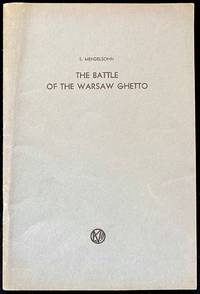
1944réf. 4620New York: Yiddish Scientific Institute 1944. Paperback. 1st separate edition. Original Paper Wrappers. 8vo. 28 pages. 23 cm. Wolff #I: 1441. Includes map in black red and white as the full-page center spread. Early report on the uprising: "It is as yet impossible to give a complete picture of the resistance in the Warsaw Ghetto.The material is as yet too scarce. " "This paper was read at the eighteenth annual conference of the Yiddish scientific institute on January 9 1944 .The paper was delivered in Yiddish and is published in the Yivo bleter Journal of the Yiddish scientific institute XXIII 1 January-February 1944." Very good condition. B HOLO2-65-17. Yiddish Scientific Institute paperback
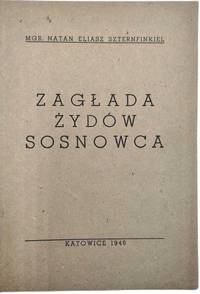
1946réf. 43546Katowice: Centralna Zydowska Komisja Historyczna 1946. 1st edition. Original printed paper wrappers 8vo 80 pages. Includes seven photos and fold out map of the Ghetto in Bedzin and Sosnowiec. In Polish. Title translates as "The Extermination of the Jews of Sosnowiec." From the series "Wydawnictwa Centralnej Zydowskiej Komisji Historycznej w Polsce" Nr. 25. Wiener Library I: 1352. Published under the Kolegium Redakcyjne with leadership from Filip Friedman & Jozef Wulf among others. "The Sosnowiec Ghetto German: Ghetto von Sosnowitz was a World War II ghetto set up by Nazi German authorities for Polish Jews in the Srodula district of Sosnowiec in the Province of Upper Silesia. During the Holocaust in occupied Poland most inmates estimated at over 35000 Jewish men women and children were deported to Auschwitz death camp aboard Holocaust trains following roundups lasting from June until August 1943. The ghetto was liquidated during an uprising a final act of defiance of its Underground Jewish Combat Organization ZOB made up of youth. Most of the Jewish fighters perished. Before the war there were about 30000 Jews in Sosnowiec making up about 20% of the town's population. Over the next two years the Germans resettled thousands of Jews from smaller towns to Sosnowiec temporarily increasing the size of the local Jewish community to 45000. By late 1942 Bedzin and nearby Sosnowiec which bordered Bedzin became the only two cities in the Zaglebie Dabrowskie region that were still inhabited by Jews. The city located on the pre-war Polish-German border was taken over by the Germans on the first day of the invasion of Poland. Arrests and beatings among more prominent Jews began the next morning. On 9 September 1939 the Great Synagogue in Sosnowiec was burned. Local Jews were being evicted from better homes and terrorized on the streets. Jewish businesses were plundered by individual soldiers and closed by the Nazis pending confiscation proceedings. Shootings and first mass executions followed soon afterwards. Forced relocations into crowded tenements slowly created a ghetto. Judenrat and the Jewish police were soon established on German orders; the head of the Sosnowiec Judenrat was Moshe Merin Mojzesz Merin in Polish. Food rationing was introduced. The Jews were prohibited from buying anything outside their own community. In the first months of 1940 the Zentrale der Jüdischen Ältestenräte in Oberschlesien Central Office of the Jewish Councils of Elders in Upper Silesia headed by Merin was created in Sosnowiec representing about 45 communities. For a time Merin became infamous as the dictator of the Jews of the Zaglebie region with the power of life and death over local Jews. A labour camp was established for the Jews deported to Sosnowiec from Czechoslovakia to work at the factory of the Shine brothers. Numerous forced labour facilities were established for the locals; making uniforms underwear corsets bags leather handbags and military boots. In 1940 some 2592 German war profiteers arrived in the city. By 1942 their number rose to 10749 settlers constituting 10% of the general population. Ever since the ghetto was established numerous deportation actions were organized by the Germans with the help of the Judenrat and Merin selecting healthy men for slave labor at the camps. Large transfers of Jews took part in May 1500 and June 1942 2000. Around October 1942 - January 1943 the ghetto was moved to the Srodula district. Srodula also bordered the site of the Bedzin Ghetto. At this point about 13000 Jews still lived in Sosnowiec. The creation of the Sosnowiec ghetto ended on 10 March 1943 when it was finally closed off from the outside world. Thousands of Jews were deported from Sosnowiec to Auschwitz in June 1943 during the major deportation action extending to nearby Bedzin. The ghetto was liquidated two months later in August whereas almost all remaining Jews were also deported to Auschwitz. A few hundred Jews remained in the Srodula ghetto which was liquidated in January 1944. Frumka Plotnicka age 29 led the uprising in the Bedzin Ghetto adjacent to SosnowiecThere had been considerable underground activity among the Jews in Sosnowiec and Bedzin Ghetto nearby organized by the youth organizations Ha-No'ar ha-Ziyyoni Gordonia and Ha-Shomer ha-Za'ir. During the final major deportation push in August 1943 the Jewish Combat Organization Polish: Zydowska Organizacja Bojowa ZOB in Bedzin and Sosnowiec staged an uprising against the Germans. The uprising which began on 3 August 1943 was led by Cwi Tzvi Brandes Frumka Plotnicka and the Kozuch brothers. It was the final act of defiance of the local population with no chance of success. Most of the young Jewish fighters perished 400 killed in action fighting the overwhelming German forces. The last Holocaust transport to Auschwitz-Birkenau with Jews forced to bury the dead left Sosnowiec on 15 January 1944. Resistance of the ghetto inhabitants is commemorated by one of the streets in Sosnowiec bearing the name "Street of the Ghetto Heroes" Ul. Bohaterów Getta. There is also Kozuch Brothers square Plac Braci Kozuchów with a ghetto memorial. The Catholic convent of Carmelite Nuns led by Mother Teresa Kierocinska aided the Jews in the ghetto and hiding. Kierocinska was awarded a medal of the Righteous 46 years after her death. She was declared 'heroic in virtue' by Pope Francis in 2013. The Carmelite Sisters run an orphanage at the monastery. They delivered free bread to Jews in hiding send food parcels to Auschwitz and rescued Jewish children by hiding them under false names among the Christian orphans. The convent was frequently inspected by the Gestapo on suspicion of illegal activities."Other local rescuers were later identified by surviving Jews and were named "Righteous Among the Nations." Wikipedia. SUBJECTS:World War 1939-1945 -- Poland -- Sosnowiec Wojewo´dztwo S´laskie Jews. Holocaust Jewish 1939-1945 -- Judenverfolgung Joden. OCLC: 769381.Toning as expected Very Good Condition much better than usually found. B HOLO2-63-36B-XLABBBCCE. Katowice: Centralna Zydowska Komisja Historyczna unknown
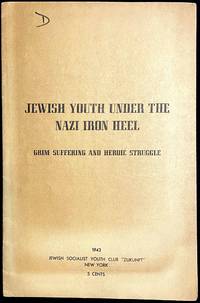
1942réf. 43351New York: Jewish Socialist Youth Club 1942. Paper Wrappers. Illustrated by 2 Facimilie Illustrations. 1st edition Original Paper Wrappers 8vo 16 pages another variant we have seen has 15 pages. From the year before the Warsaw Ghetto Uprising an early 1942 report by the American branch of the Bund on Jewish resistance by young people in Eastern Europe. "Hand in hand with the underground organizations of the General Jewish Labor Union and in contact with the organization of the Polish socialists the Youth Union 'Zukunfst' conducts an untiring and ramified activity which is preparing the ground for the open struggle of tomorrow against Hitlerism" p. 13. "Tsukunft or Cukunft or Zukunft Yiddish for future was the youth organization of the General Jewish Labor Union or Bund. It was founded in 1910 and in 1916 it was officially called Yugnt-Bund Tsukunft. Their newspaper was the Yugnt veker. In 1922 the organization changed its name to Yugnt-bund "Tsukunft" in poyln 'Youth Bund "Tsukunft" in Poland'.At the time of the sixth Tsukunft conference in 1936 the last before the outbreak of the Second World War the organization counted with 184 local groups. On the eve of the Second World War the organization had 15000 members. The Tsukunft took part in the Warsaw ghetto uprising as part of the Jewish Fighting Organization" Wikipedia. SUBJECTS: Jewish youth -- Poland. Holocaust Jewish 1939-1945 -- Jewish resistance. World War 1939-1945 -- Atrocities. OCLC: 6871875. Covers toning with pen notation to cover otherwise Very Good Condition B Holo2-139-22A-XAECC-'l. Jewish Socialist Youth Club unknown