369 résultats
2014pp. 287, cm 21x15, brossura, con 16 illustrazioni a colori fuori testo, I Libri di Viella, 187. Nuovo.
Firenze, Libreria Bodoniana (Via Panzani, 5), 1875, in-24, br. editoriale cilestrina con copertina posteriore fittizia, pp. 48. Almanacco dal tono beffardo (evidente fin dalla presentazione a firma d'un tale "Scelmò-Ben-Cimicì, che indica "Moscé Birbichim" come autore delle "canzoni" a seguire) che raccoglie testi già presenti nella memoria popolare fiorentina come antisemiti, ma con registro più irridente che insolente; Lo "Sposalizio" è una satira delle nozze ebraiche pubblicata per la 1a volta nel 1752 (si ricorda che il ghetto di Firenze, a ridosso del Mercato Vecchio, fu istituito da Cosimo I nel 1571 ed aperto nel 1835, per esser poi abbattuto nell'opera di risanamento di Firenze capitale); gli altri testi ebbero qualche edizione ottocentesca, sia a Lucca (F.Bertini), che a Bologna e Firenze (Salani); ultima versione dello "Sposalizio", ma con registro ben diverso è la commedia (una sorta di Acqua cheta" in versione yiddish) che Moshe David Cassuto e figli sotto lo pseudonimo di Bené Kedem, ne hanno tratto, valorizzando il tema popolare coll'uso del bagitto, dialetto usato dagli ebrei toscani. Molto raro.
19468vo., First Edition; red cloth, backstrip lettered in black, a near fine copy in unclipped dustwrapper. EXTREMELY SCARCE IN THIS CONDITION. Enser, p.345.
2023réf. EUROPEE95121123Paris, Editions du Félin, "Résistance - Liberté - Mémoire"", 2023, 14 x 22, 378 pages sous couverture souple illustrée. Avant-propos, traduction et notes de jean-Pascal Auvray.
1961320 pages. Name index. Subject index. "A shortened version of the second edition (1957) of a work first published in Polish under the title 'Dziennik Hansa Franka' (Hans Frank's Diary). Frank was a Minister of the Third Reich and Governor General of those areas of Poland occupied by Nazi Germany which were not incorporated into the Reich. At the International Military Tribunal in Nuremberg for the first time in the history of the world thousands of secret documents were revealed belonging to a state in the grip of the imperialist idea of world conquest. Among those documents Hans Frank's Diary occupies one of the leading positions both on account of its contents and on account of its more than ordinary length: 11,000 typwritten pages in foolscap, making up 38 volumes. Any study of the history of the last war must include a reading of Hans Frank's Diary." - Preface. Author was a member of the Polish delegation to the International Military Tribunal at Nuremberg. Usual library markings. Above-average wear. Front hinge taped. Back hinge going. A worthy reading copy of this very important work. LASKA 316, KEHR & LANGMAID 5385. Book
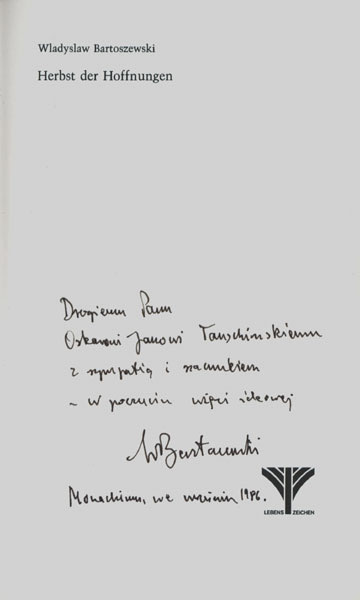
1986réf. 1994CBFreiburg Basel Wien, Herder, 1986. 8°. 142 (1) S. Illustr. OKt. Bedruckte Schleife., Bartoszewski, Herbst der Hoffnungen. Widmung
1993réf. 13580Wien, Selbstverlag, 1993. Kartoniert, gr-4°, 78 S., zahlreiche Abbildungen; -Kanten etwas bestossen, gutes Exemplar.
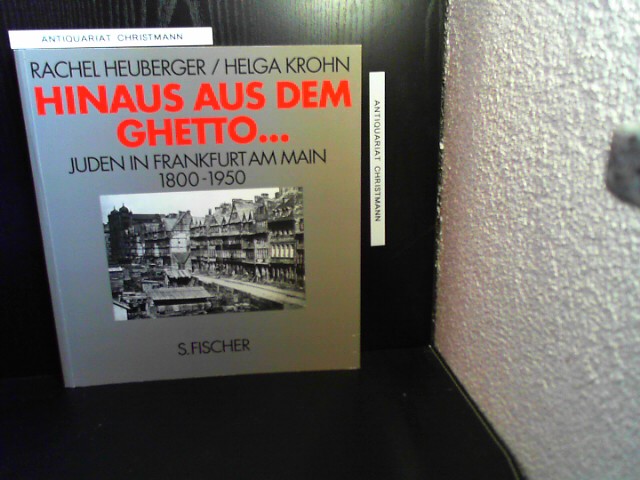
1988réf. BN258021Frankfurt am Main : S. Fischer 1988. 1988. Hinaus aus dem Ghetto : Juden in Frankfurt am Main ; 1800 - 1950 ; Begleitbuch zur ständigen Ausstellung des Jüdischen Museums der Stadt Frankfurt am Main. Rachel Heuberger ; Helga Krohn Hinaus aus dem Ghetto : Juden in Frankfurt am Main ; 1800 - 1950 ; Begleitbuch zur ständigen Ausstellung des Jüdischen Museums der Stadt Frankfurt am Main. Rachel Heuberger ; Helga Krohn Ghetto FFM - Heuberger Rachel und Helga Krohn Frankfurt am Main : S. Fischer unknown
1988réf. 4080Frankfurt am Main : S. Fischer 1988. 214 S. : mit über 300 Abbildungen. ; 26 cm kart., Softcover/Paperback, Exemplar in gutem Erhaltungszustand
1983réf. 112107ABBerlin, Evangelische Verlagsanstalt, (1983). 8°. 322 S. Original-Leinenband mit OUmschlag.
1969réf. 1093791969 Editions Calmann-Lévy, Collection "Liberté de l'Esprit" - 1969 - In-8, broché, couverture à rabats - XVI + 374 p.
1988réf. 13119Stock 1988 455 pages in8. 1988. Broché. 455 pages. L'ouvrage retrace l'histoire du ghetto de Venise de sa création en 1516 jusqu'aux déportations de 1943-1944 en passant par l'émancipation française de 1797. L'auteur Riccardo Calimani mêle érudition historique et portraits sensibles des habitants mettant en lumière la richesse culturelle et intellectuelle de cette communauté juive
in-8, 454 pp., broché, couv. ill. Bon état. [SO-3]
1989réf. 33351Paris Verdier 1989
réf. 14823Traduit de l'italien par Hélène Leroy - Lagrasse : Editions Verdier (Coll. "Terra d'altri"), 1989 - in-8 broché, 150 pages - bon état -
2001Birger, Trudi (Green, Jeffrey M.: Scritto con) Ho sognato la cioccolata per anni. Milano - Bergamo, Mondolibri S.p.A. - Nuovo Istituto Italiano d'Arti Grafiche (stampa) 2001 italian, in ottavo pp. 224 ed. aprile 2001 (ed. originale: A Doughter's Gift of Love. A Holocaust Memoir by Trudi Birger, 1992 - I ed. italiana: Casale Monferrato (AL), EDIZIONI PIEMME S.p.A. 1999). Traduzione di Maria Luisa Cesa Bianchi. VIII piccolo/224/cart./sovraccopeerta patinata (In sovraccoperta: foto © Agenzia Olympia). Stato buono (gora all'ultima pagina, non stampata e all'ultimo foglio di guardia - volume leggermente brunito nel complesso).
1985328 pages. "A significant document by which the author acquitted himself of the obligation bequeathed on the survivors of the Holocaust by its victims to tell the world what happened to the Jews during World War Two, when to be a Jew was a crime. The Memoirs based on the author's own experiences and reports told to him by his relatives and friends, survivors of the Holocaust, describe the fate of hundreds of thousands of Polish Jews, banished by the Russians to Siberia and in particular the lot of those who came under the Nazi regime... A rich source of first hand information about the life in the ghetto, the Judenrat, the Jewish Ghetto Police and the methods used by the Nazis in the destruction of the Jews." - dust jacket. Author lost his parents, wife and two sons in the Holocaust. Map endpapers. Black and white illustrations. Book clean and unmarked with light wear. Dust jacket lightly sunned at spine, bears several closed tears and is missing some small chips - now preserved in glossy new archival-grade Brodart cover. A sound copy.. Book
1950FIRST EDITION OF ELUARD'S RAREST BOOK, WITH AN ORIGINAL SIGNED DRAWING BY MAURICE MENDJIZKI. Includes a 5-page poem by Eluard and 31 extremely high-quality (Jacomet process?) full-page reproductions of drawings by Mendjizki depicting the suffering and heroism of the Warsaw Ghetto and the Uprising. Dedicated to the artist's son Claude, shot by the Nazis in 1944 for being a member of the Resistance. THIS FIRST EDITION STRICTLY LIMITED TO 100 COPIES, of which this is number 100, SIGNED BY ELUARD AND MENDJIZKY AND CONTAINING AN WONDERFUL ORIGINAL SIGNED DRAWING BY MENDJIZKY, depicting three people trying to sleep in very cramped quarters (200 additional unsigned copies were also printed, 100 in French and 100 in Yiddish, which are not part of the first edition.) Printed on fine wove paper. 4to. Original wraps FINE AND BRIGHT, LIKE NEW WITH NO DEFECTS, IN THE ORIGINAL BOARD CHEMISE AND SLIPCASE. A wonderful example of extremely rare and haunting 20th-century Judaica.
réf. 12375Paris, chez l'Auteur, 1950 ; in-4, broché. 6ff. de texte - 31 dessins pleine page en noir de Maurice Menjdjizki. Titre en rouge et noie. Couverture légèrement jaunie. Très bon état.
19488vo; 719 pages; 1st Yiddish. edition. Original cloth in illustrated dust jackets. "The epic of the Jews in Warsaw. A collection of reports and biographical sketches of the fallen. " In Yiddish. Robinson & Friedman # 2003 Vol II serves as a biographical dictionary of the fighters. This first Yiddish edition of Volume I is an expansion and revision of the two Hebrew editions published in 1946 & 1947. The English title page is not an accurate translation of the Yiddish title. The correct translation would be: "Destruction and uprising of the Jews in Warsaw: Reports and biographical sketches." An important work in its most desireable edition. Dust jacket for Vol I has small label on base of spine with clear tape; Very Good Condition in about Very Good- Jacket. Beautiful set. (H-43-5A)
1974Mm 140x220 Collana "Major paperbacks. Storia e politica". Volume cartonato con legatura editoriale in tela color arancio, sovraccoperta originale con tracce del tempo, fioriture leggere al taglio superiore e in apertura, ma non nel testo, 254 pagine. Esemplare in buone condizioni. SPEDIZIONE IN 24 ORE DALLA CONFERMA DELL'ORDINE.
Milano, Lerici Editori, 1966, in-16, br. editoriale, pp. 270, [6]. "Paperbacks Lerici", 5.
A clean, unmarked book with a tight binding. Previous owner's name inside. Full beige cloth boards with gilt and black drawing on cover. Previous owner's name inside. 7 3/8"w x 11"h. 82 pages. Color illustrations. Circa 1962.
1966IN-8°, PP. 202 (6), ILL. COL. N.T., TAVV. COL. N.T., CART. EDIT., COP. ILL. COL. (LIEVI SEGNI D'USO, PICCOLA ABRASIONE AL PIEDE DEL DORSO, ANGOLI CONTUSI), LEGGERISSIME BRUNITURE AI MARGINI DELLE CARTE, SCRITTA A PENNA AL FOGLIO DI GUARDIA VOLANTE ANT., STATO DI CONSERVAZIONE: MOLTO BUONO (VG), (I PREMIATI DEL MONDO). 143 I
1952Good Solid condition.; 8vo; 387 pages; In Yiddish. Not in Robinson & Friedman nor Wolff. Jewish partisan's memoirs of resistance against the Nazis in Poland. Illustrated with many photographs throughout. Inscribed by Kaczerginski in year of publication. Kaczerginski (19081954) was a Yiddish writer and cultural activist. Born in Vilna to a poor family and educated at that citys Talmud Torah, Shmerke (Pol., Szmerke) Kaczerginski lost both his parents during World War I. As a youth, he was involved with outlawed Communist groups and was arrested several times, serving a lengthy prison term. In the 1930s, two of his revolutionary poems became popular in Poland. He wrote short stories with a radical bent and was a correspondent and reporter for literary publications, including the semilegal leftist press in Poland and the New York Communist daily Morgn-frayhayt. Kaczerginski played a key role in shaping the writers and artists group Yung-Vilne; he organized its evening events and was the de facto publisher of its three miscellanies between 1934 and 1936. During the period of Soviet control over Lithuania in 19401941, he was even more active in the field of Yiddish culture, but at the same time experienced his first disappointments with the attitude of the Soviet regime toward Jewish culture. During the first period of Nazi occupation, Kaczerginski wandered through villages and towns posing as a deaf mute; after many difficulties, he ended up in the Vilna ghetto. Kaczerginski was very involved in the ghettos cultural activities. As a leader of its youth club, he wrote its Yugnt-himen (Youth Hymn), a song that immediately became popular. In 1943, he wrote the song Shtiler, shtiler in memory of the mass murders committed at Ponar. Set to music that Aleksander Volkoviski (later known as Aleksander Tamir) had submitted to a contest organized by the ghetto, the song was first heard at an evening performance there and over the years became one of the best-known songs of the Holocaust. With Avrom Sutzkever and others, Kaczerginski became part of a group of forced laborers whom the Germans designated to sort Jewish cultural treasures at YIVO and other locations. Known as the Papir-brigade (Paper Brigade), the groups members risked their lives to hide the most significant items, smuggling them back into the ghetto or entrusting them to non-Jewish acquaintances. Kaczerginski was a member of the Fareynikte Partizaner Organizatsye (United Partisans Organization; FPO), and, since YIVOs building was located outside the ghetto walls, he took part in smuggling weapons into the ghetto. In September 1943, Kaczerginski, along with Avrom and Freydke Sutzkever and other members of the FPO, escaped from the Vilna ghetto as part of an organized group of fighters just before its liquidation. They joined a Soviet partisan unit in the Naroch Forests, where Kaczerginski fought as a partisan until liberation in July 1944. Kaczerginskis books describe the destruction of Vilna, the partisan struggle, and his own experiences during the Holocaust period: Khurbn Vilne (The Destruction of Vilna; 1947), Partizaner geyen (Partisans on the Move; 1947), and Ikh bin geven a partizan (I Was a Partisan; 1952) (YIVO, 2010). Wear to cover and edges, very good condition. (HOLO2-87-3A)