336 resultados
1940ref. 32897Litzmannstadt [um 1940], (Buchhandlung S. Seipelt). Gefaltete Karte. 99 x 68 cm. Wenige Bruchstellen an den Falzen. Gering gebräunt. Guter Zustand.
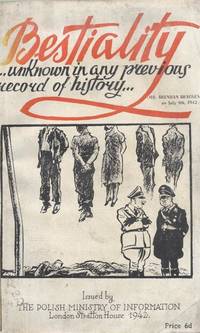
1942ref. 39727London: Stratton House 1942. with no dust jacket. First edition. Original illustrated wraps. 12mo. 56 pages. 19 cm. 'A Record of the German Barbarities in Poland in the First Six Months of 1942.' With two page map of concentration camps in Germany. Extremely detailed early report concerning Nazi atrocities executions concentration camps the extermination of the Lublin ghetto etc. Contents include: Introduction; Documents from Poland; General Sikorski's protest speech; Resolution of the Polish National Council; Press conference at the Ministry of Information; and Justice will be done: official statements and declarations. Included in in the "Documents from Poland" section is a piece on the "Destruction of the Jewish Population." "As early as 1940 the Government Delegate alerted London about the persecution of Jews in Poland. Thereupon the Polish government-in-exile sent a note on this subject to allied governments May 3 1941. Also in 1941 the Polish Ministry of Information in London published a booklet on the persecution of Jews in Poland entitled 'Bestiality Unknown in Any Previous Record of History' and based on information received from occupied Poland. In January 1942 the Ministry issued another publication 'The New German Order in Poland. ' Both publications created a stir throughout the allied world which after 1941 could no longer plead ignorance of the persecution of Jews in Poland. " "The Polish Underground State: A Guide to the Underground 1939-1945" Stefan Korbonski. The US Holocaust Museum keeps their copy in their Rare Book Room. Subjects: World War 1939-1945 - Poland. World War 1939-1945 - Atrocities. OCLC: 8022841. Staples show rust as generally found light rubbing to covers attractive and dramatic about Very Good Condition.B HOLO2-104-27C-MMACCBBE-I-'. London: Stratton House unknown
1943x, 214 pp. Index. Foldout map. Seven black and white plates. First published in the U.S. in 1942. "Compiled under the auspices of the Research Institute for Peace and Post War Problems of the American Jewish Committee, New York. [The author] is able to lay bare every step taken by the Nazis to impose their evil will upon Poland; he describes too the resistance and underground activities of the population in opposition to the invader. Poland is being used by the Nazis as a testing ground for their scheme for a future German colonial empire in Europe. This book is of the utmost importance as an analysis of the evil which the United Nations have to combat." - dust jacket. Moderate wear to publisher's black cloth which is lettered in silver with red trim upon backstrip. Binding sound. Gentle toning to clean and unmarked contents. Moderate wear to dust jacket now preserved in archival-grade Brodart. A quality copy of this important work compiled while the final outcome of WWII was unknown. Kehr & Langmaid 5414, Wiener Library Catalogue Seven 983. Book
19508vo., First Edition thus, with front and rear endpaper maps; handsomely bound in full dark red crushed morocco, sides with gilt frame borders, back with raised bands, second and fourth compartments lettered and ruled in gilt, all other compartments tooled in gilt, gilt top, hand-made endpapers, a most attractive copy ideal as a gift or for presentation. Detailed and inspiring history of the Polish Underground by its foremost leader. A cornerstone of the literature of Poland in WWII. VERY SCARCE. Enser, p.342.
1946ref. MMRM1658Varsovie:: American Joint Distribution Committee 1946. 1946. 8vo. 264 4 pp. 11 black and white photographic plates 50 tables charts index. Original printed wrappers; scotch tape along spine front and rear covers age-darkened first 3 pages including half title and last three blank end-papers are loose. Main body of work remains bound and in good condition. Loose pages have some slight area of extremities missing. Some fading and foxing to pages. Thus wrappers poor but text good to good plus. First edition. SEMINAL WORK IN MEDICAL CLINICAL RESEARCH & A CRITICAL ARTIFACT OF THE WARSAW GHETTO AND HOLOCAUST. Copies of the book are uncommon in part because of the fragile nature of the paper used to publish the report. In the immediate aftermath of World War II paper ink and binding facilities in Europe were scarce. The published report was done with economy in mind and with a rushed sense of needing to reveal to the world what happened. / Six articles report on the clinical research by 28 Jewish physicians and a student intern the 1946 book only records the names of 21 physicians and the student – subsequent research in the 1960s revealed the additional names who conducted the studies on adults and children at the two Jewish hospitals in the Ghetto. Abbreviated biographies of the physicians can be found in The Uses of Adversity: Studies of Starvation in the Warsaw Ghetto by Leonard Tushnet published in 1966. The physicians hoped to study these patients to somehow benefit humanity perhaps in the spirit of the Jewish concept of tikkun olam - to repair the world. The studies were conducted in secret since any scientific research in the Ghetto was prohibited by the Nazi overseers. It is also quite possible that many if not all the clinical physicians believed that granting children and others the status of being a patient would protect them by preventing their transport out of the ghetto to death camps. Theories also suggest that the physicians wanted to preserve a record of the atrocities being committed as well as advance medical research. The studies remain the most comprehensive research of the effects and progression of starvation in part because any contemporary studies would largely be blunted by existing ethical guidelines for informed consent and subject welfare. Contemporary debates about the ethical wisdom of conducting these studies remains contentious. / The Warsaw Ghetto occupied approximately 1.3 square miles 3.4km2 and its population was as much as 500000 men women and children. The Ghetto was a staging area for transporting Polish and Eastern European Jews to the death camps and a locale for starving to death Jews prior to transport. The average daily caloric intake of a resident of the Ghetto was 600 to 800 calories of low-protein food for adults. This amount was calculated by Adolf Eichmann to starve-to-death most of the residents in approximately nine months. The physicians performing the research were no exception to the plan. All were starving as they performed their studies. Equipment for clinical research was smuggled into the hospitals. / Each article in the book is devoted to specific results of these studies. Chapter V offers autopsy results on 710 patients; 492 died of starvation and 218 died of complications of secondary conditions. Chapter VI offers clinical observations of one-hundred adults who died from starvation. Chapter VII offers clinical observations of 40 children who died of starvation. Chapter VIII examines the effects of starvation on the cardiovascular system in adults and children. Chapter IX discusses changes in peripheral blood and bone marrow. Ophthalmic responses to starvation are discussed in Chapter X. Only one doctor engaged in the research Emil Apfelbaum survived the war. He arranged to have the studies smuggled out of the Ghetto to a Polish professor of medicine who released the reports after the liberation of Warsaw. After the war Apfelbaum edited the report for publication by the Joint Distribution Committee. He died a week before the book was published. / Research was performed at the two hospitals in the Ghetto from late February to July 22 1942. On July 22 the hospitals were closed and any patients unable to be transported were summarily executed regardless of age. The attending and clinical physicians were fully aware of the fate awaiting transported patients and in many instances they performed euthanasia on elderly and child patients who were scheduled for transport. Some of the physicians committed suicide rather than face transport. Other physicians accompanied their patients to the death camps providing whatever aid they could. / The studies were smuggled out of the ghetto in a manner befitting a Ken Follet thriller. A Jewish physician Henryk Fenigstein played a crucial role. "Before the war Henryk was a stamp collector. In fact he had one of the largest collections of Polish stamps in the country. One day two SS members arrived at the hospital and told Henryk to come with them to Gestapo headquarters. Of course he was terrified. Jews taken to Gestapo headquarters did not return. On arrival he was taken to the office of a senior officer who told him that he himself was an avid stamp collector. He took out a list and handed it to Henryk. He wondered if Henryk had these stamps and if not if he knew where to procure them. Henryk told him that he had many of the stamps including some of the very rare ones. He told him that he thought he could procure the rest. In order to do this he would need a pass to get out of the ghetto for a few hours each week. And of course the SS officer was welcome to those that he had. The officer agreed and even gave Henryk his phone number in case he needed any help. Thus Henryk Fenigstein a key member of the study team was able to leave the ghetto" 2005 lecture Myron Winick. During such an outing Fenigstein arranged for the smuggling of the reports. A pregnant woman reportedly was used to hide the documents and transport them out of the ghetto. / The supervising physician of the project Israel Milejkowski wrote in his Introduction to the studies that each author refused to allow the Nazis to destroy their work and that through the research and the publication of that research "Nous avons termine nos Recherches et nous les conserverons bien comme c'etait Ton desir. Les paroles immortelles que Tu a jetees "Non omnius Moriar" doivent etre en premier lieu appliquees a Toi! Gloire eternelle a Ta Memoire !" / The research as well as results from the Minnesota Semi-Starvation studies of 1944-1945 continues to benefit the millions of persons facing starvation each year. The participants in the Minnesota study lost an average of 25% of pre-test body weight and the final phase of the study included recovery techniques and methods. The Warsaw studies measured effects until death. This artifact of scientific integrity individual bravery and resistance to oppression is a rare opportunity to truly own a small piece of history illuminating the courage of physicians determined to use their craft to help the world and advance the memory of atrocities. American Joint Distribution Committee, 1946. unknown books
1950ref. 007299Paris O.L.B. 1950 In-4 Broché, couverture illustrée Edition originale
1985328 pages. "A significant document by which the author acquitted himself of the obligation bequeathed on the survivors of the Holocaust by its victims to tell the world what happened to the Jews during World War Two, when to be a Jew was a crime. The Memoirs based on the author's own experiences and reports told to him by his relatives and friends, survivors of the Holocaust, describe the fate of hundreds of thousands of Polish Jews, banished by the Russians to Siberia and in particular the lot of those who came under the Nazi regime... A rich source of first hand information about the life in the ghetto, the Judenrat, the Jewish Ghetto Police and the methods used by the Nazis in the destruction of the Jews." - dust jacket. Author lost his parents, wife and two sons in the Holocaust. Map endpapers. Black and white illustrations. Book clean and unmarked with light wear. Dust jacket lightly sunned at spine, bears several closed tears and is missing some small chips - now preserved in glossy new archival-grade Brodart cover. A sound copy.. Book
1961320 pages. Name index. Subject index. "A shortened version of the second edition (1957) of a work first published in Polish under the title 'Dziennik Hansa Franka' (Hans Frank's Diary). Frank was a Minister of the Third Reich and Governor General of those areas of Poland occupied by Nazi Germany which were not incorporated into the Reich. At the International Military Tribunal in Nuremberg for the first time in the history of the world thousands of secret documents were revealed belonging to a state in the grip of the imperialist idea of world conquest. Among those documents Hans Frank's Diary occupies one of the leading positions both on account of its contents and on account of its more than ordinary length: 11,000 typwritten pages in foolscap, making up 38 volumes. Any study of the history of the last war must include a reading of Hans Frank's Diary." - Preface. Author was a member of the Polish delegation to the International Military Tribunal at Nuremberg. Usual library markings. Above-average wear. Front hinge taped. Back hinge going. A worthy reading copy of this very important work. LASKA 316, KEHR & LANGMAID 5385. Book
1945ref. STAN0099Praha, Delnicke Nakladatelstvi 1945. 22x15cm. 80 unpaginierte lose Seiten, 27 ganzseitige photogr. Abb., in ill. OUmschlag. Umschlag gering randrissig u. rückseitig etwas stockfleckig, sonst sehr gut erhalten. Die erste Bilddokumentation aus dem befreiten KZ Theresienstadt. Von großer Seltenheit.
1950FIRST EDITION OF ELUARD'S RAREST BOOK, WITH AN ORIGINAL SIGNED DRAWING BY MAURICE MENDJIZKI. Includes a 5-page poem by Eluard and 31 extremely high-quality (Jacomet process?) full-page reproductions of drawings by Mendjizki depicting the suffering and heroism of the Warsaw Ghetto and the Uprising. Dedicated to the artist's son Claude, shot by the Nazis in 1944 for being a member of the Resistance. THIS FIRST EDITION STRICTLY LIMITED TO 100 COPIES, of which this is number 100, SIGNED BY ELUARD AND MENDJIZKY AND CONTAINING AN WONDERFUL ORIGINAL SIGNED DRAWING BY MENDJIZKY, depicting three people trying to sleep in very cramped quarters (200 additional unsigned copies were also printed, 100 in French and 100 in Yiddish, which are not part of the first edition.) Printed on fine wove paper. 4to. Original wraps FINE AND BRIGHT, LIKE NEW WITH NO DEFECTS, IN THE ORIGINAL BOARD CHEMISE AND SLIPCASE. A wonderful example of extremely rare and haunting 20th-century Judaica.
1944Signed and inscribed by Jan Karski upon front free endpaper. Karski [1914-2000] recounts his experiences when his homeland of Poland was rent asunder by the joint Nazi and Soviet invasion of 1939, and his harrowing subsequent life as a member of the Polish underground, during which he was captured by the Gestapo and severely tortured. Provides a ghastly eyewitness account of life in the Warsaw ghetto, into which Karski was smuggled so his observations could be reported to the outside world. Firearms advocates will cringe at Karski's account of what happened after he and a large group of Polish soldiers handed over their weapons to their 'comrades' from the Soviet Union. In 2012 Karski was posthumously awarded America's highest civilan honor, the Presidential Medal of Freedom, by President Obama. 391 pages. Moderate wear to publisher's red cloth. Dust jacket now preserved in archival-grade Brodart. Binding intact. A sound copy of this truly unforgettable WWII narrative. Laska 672, Kehr & Langmaid 5407, Weiner Library Catalogue Seven 997, Enser p.343. Book