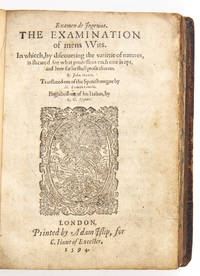
Examen de ingenios. The examination of mens vvits. In whicch sic by discouering the varietie of natures is shewed for what profession each one is apt and how far he shall profit therein. By John Huarte. Translated out of the Spanish tongue by M. Camillo Camilli. Englished out of his Italian by R.C. Esquire
1594ref. 3000London: : Printed by Adam Islip for C. Hunt of Excester 1594. FIRST EDITION IN ENGLISH translated from the 1582 Italian translation of Camillo Camilli d. 1615. . Quarto: . 19 x 14 cm. . 16 333 3 pp. A-Y8 Bound in 19th c. calf rebacked the boards ruled in gold. This is a fine copy; title a little dusty. Occasional marginal pencil notations in margins. “To Distinguish and discern these natural difference’s of man’s wit and to apply to each by art that science wherein he may profit is the intention of this my work.” “This sentence concisely summarizes the ultimate purpose of one of the most successful and influential Spanish scientific books published in the early modern period one with long-lasting influence upon the European intellectual world: the ‘Examen de Los Ingenios para Las Ciencias’ 1575 by the Spanish physician and philosopher Juan Huarte de San Juan 1529-1588… Huarte is now hailed as the precursor of several branches of pedagogy and psychology including differential pedagogy and differential psychology and their practical applications professional orientation and selection. Recently too Noam Chomsky recognized in Huarte a forerunner of the rationalist innatism and the linguistic theory of 17th-century French scholars notably Descartes. In the eyes of Chomsky the ‘Examen’ is the first scientific treatise to define human wit as a generative power that reveals the creative capacities of the human mind… “For Huarte wit denotes the totality of the psychological abilities of an individual; more precisely an individual ability or predisposition dependent on temperament linked to the qualities of the four basic elements earth air water and fire organically connected to the brain and under the influence of other organs. The starting point for Huarte’s theory of wits is that the temperature of the four qualities hot cold moist and dry of the elements has an impact upon the function of the rational as well as the ‘sensitive’ soul and that intemperate and ever-changing environmental conditions lead to a diversity of the wits. Wit is subject to age region of birth sex currents of air weather diet physical exercise and lifestyle in general since these factors have an impact upon the predominance in every individual of one of three powers of the intellective soul: memory imagination or understanding… Huarte’s goal is to clearly delineate what makes a man capable of one science and incapable of another to discover the number of differences of wits the arts and sciences that correspond to each and most importantly to illustrate how all this can be known. The Brain & Faculties of Mind “Contrary to the view of Aristotle and following Plato Hippocrates and Galen instead Huarte argues that ‘the brain is the principal seat of the reasonable soul.’ In his view in order for the reasonable soul to discourse and philosophize the brain ‘should be tempered with measurable heat and without excess of the other qualities’ and divided into four ventricles ‘distinct and severed each duly bestowed in his seat and place.’ Huarte describes the ventricles of the brain as four little hollows of ‘one self composition and figure without anything coming in between which may breed a difference.’ The three ventricles in the forepart of the head are used to ‘discourse and philosophize’ while the fourth ventricle deals with the least noble operations as it ‘hath the office of digesting and altering the vital spirits and to convert them into animal.’ The conviction that the three mental powers understanding imagination and memory necessarily work in collaboration with each other –to the extent that without one the rest would malfunction- makes Huarte conclude that ‘in every ventricle are all the three powers.’… Building a Better Society by Compulsion. “Huarte took his theories very seriously and believed that they could have practical repercussions upon the society of his time. His dedicatory to King Philip II of Spain suggests in fact a law by which subjects exclusively performed the profession art or science that corresponded to them by nature. Huarte envisioned appointing ‘men of great wisdom and knowledge who might discover each man’s wit at a tender age and cause him perforce to study that science which is agreeable to him not permitting him to make his own choice… to the end he may not err in choosing that which fitteth best with his own nature.’ Huarte’s reasoning was that if every man carried out the job that suited his natural capabilities best progress in the scientific artistic and technological production of Spain would promptly follow and a body of naturally accomplished and efficient professionals would ensue… “Huarte allows for a body of intellectuals defined by their merits and not by the social class into which they were born; nature should then be made the key for social mobility. Nobility by birth is no guarantee of sophisticated wits and Huarte remarks that precisely within the highest strata of society numerous witless children are born whereas poor families often produce witty offspring. Eugenics “The ‘Examination’ interacts with numerous treatises on midwifery and procreation in England in the early modern period. Indeed Chapter XV of the book is a short treatise on eugenesis i.e. the application of the biological laws of inheritance to the perfection of mankind particularly concerned with four issues: 1. ‘to show the natural qualities and temperature which men and women ought to possess to the end they may use generation’; 2. To discuss ‘what diligence the parents ought to employ that their children may be male and not female’ and 3. ‘how they may become wise and not fools’ and finally 4. ‘how they are to be dealt withal after their birth for preservation of their wit.’. This final chapter is of the utmost importance to Huarte who is of the opinion that ‘parents apply not themselves to the act of generation with that order and concert which is by nature established neither know the conditions which ought to be observed to the end their children may prove of wisdom and judgment.’ In other words ‘The Examination’ aims to prevent parents from engendering witless children out of ignorance and by so doing to remedy the problems of society prior even to the moment of conception: ‘if by art we may procure a remedy for this begetting witless children we shall have brought to the commonwealth the greatest benefit that she can receive.’”Rocío G. Sumillera “Richard Carew The Examination of Men's Wits” pp. 1-66 STC 2nd ed. 13892; Garrison-Morton 4964 1575 Spanish edition; Durling 2498. Hunter & Macalpine p. 46. Thorndike VI pp. 413-14 Printed by Adam Islip, for C. Hunt of Excester, unknown books
Liber Antiquus · Estados Unidos14.000,00 US$≈ 12.483,28 €