Thorne, AndrewMareMagnum

1 362 résultats
194652 pages. Profusely illustrated with wonderful photos. "Compresses into a brief pictorial review, the story of the Allies in Norway during the five momentous months after May 8 1945. With the American and British forces who took part in these events, there will remain many memories which we shall treasure - the warmth of the welcome extended to us, and the hospitality of Norwegian famillies." - Andrew Thorne, General, Head of the SHAEF Mission to Norway. A fascinating photographic history of how the Allies controlled, disarmed and evacuated the large German garrison from Norway at the end of WWII. Prior owner's name stamped atop half-title page, otherwise unmarked with average wear. Binding intact. A sound vintage copy. Book
réf. DADAX0387857834New unknown
1947400 pages. Index of people. Black and white photographic plates. Presents the biography of Haakon VII, King of NorwayAll text in Norwegian. Laid in are two large folded tables indicating lineage/family trees. Writing atop half-title page else clean and unmarked with very light wear. A large and handsome volume in pleasing condition. Book
1945Pages 521-548. Features: Great cover photo of Churchill celebrating with the masses in Whitehall; Photo of Churchill celebrating with Royal Family at Buckingham Palace; Five photos of celabratory night lights on London; Photos of vast crowds outside Buckingham Palace; Two pages of photos of the King and Queen with celebrating crowds, visiting bombed sites, at Thanksgiving services and among their subjects in South London; Photos of the Royals taking carriage to St. Paul's; Page of photos of the Royal Family and other distinguished personages at the national thanksgiving in St. Paul's Cathedral; Article "Field-Marshal Montgomery as a Soldier'; Three photos of captive German cruisers at Copenhagen and two photos of the first U-Boat, U-249, arriving at Portland; Six photos of unconditional German surrender signing at Rheims; Eight photos of the last act of German surrender ratified in Berlin; Twelve joyous centrefold photos of celebrations in Holland, Denmark, Belgium, and Norway; Twelve amazing post-war photos include Soviet troops planting their flag atop the Brandenburg Gate, Former French men and women political prisoners in striped garb walking home from Berlin, Field-Marshal Montgomery being saluted by cheering Copenhagen crowds, American soldier standing beside partially completed V-2 rocket underground at Nordhausen, German prisoners (opponents of the Nazi regime) in striped garb walking to freedom, Glum crowd of German civilians in Luneburg listening to reading of terms of surrender, and an amazing photo of an American soldier of the Seventh Army walking uphill toward a burning Berchtesgaden, Hitler's Bavarian home; Photo of captured Field-Marshal Von Rundstedt and his son after their capture by the Seventh Army; Photo of the notorious Seyss-Inquart - Reichskommissar of the Netherlands during the German occupation - who was captured in Hamburg by the Royal Welch Fusiliers; Pages of photos documenting the liberation of the Channel Islands - scenes of surrender and rejoicing; Photos of personalities of the week include Princess Elizabeth talking to R.S.M. J. Baker, Charles Sweeny, A.E. Saunders, Sir Basil Brooke, Jemadar Parkash Singh, V.C., Ingleby Oddie, Count Schwerin Von Krosigk, James Doolittle, and Field-Marshal shaking hands with "Johnny" Johnson; Page of photos of prominent captured Nazis and anti-Nazis including Kurt Von Schuschnigg, M. Leon Blum and his wife, Pastor Niemoller, Field-Marshal Kesselring, and five photos of Goering, without his medals, after his personal surrender to the U.S. Seventh Army; Photo of Hamburg radio station, made famous by Lord Haw-Haw, now operated by the British - showing desk and microphone; Amazing photo of gaping hole in 15' of reinforced concrete atop submarine pen caused by 22,000lb bomb; Page of six photos of vast celebrating crowds in Paris; Page of scenes of celebration in Denmark; Page of photos of distinguished prisoners released by the U.S. Seventh Army includes M. Reynaud, Mme. Weygand, General Gamelin, M. Daladier, and General Weygand, General Bor-Komorowski and his chief of staff, General Pelczynski, The Master of Elphinstone and Lord Lascelles, Colonel De La Rocque of the Croix de Feu, M. Jean Borotra, and M. Michel Clemenceau; nostalgic ads; and more. Unmarked. Average wear. Coverfold taped. A sound vintage copy. Book
194552 pages. Features: Nice cover painting by Adrian Dingle shows a typical rural winter scene - man pumping water from well with workhorses and barn in background; Austria's Underground Fights for Liberation; Canada in Washington - article and photos, including one of Ambassador Lester "Mike" Pearson; Until That Day (fiction); Dynamite Hockey - Article by Joe Primeau, coach of the St. Mike's Juniors - with two photos; "Stamp-Licker" Airstrip - the story of how Canadians invented the PBS airstrip which has revolutionized Allied airfield equipment in European battle areas; Your Glands and You; Woe to the Victor - the political situation in Italy, with photo of a black market; Swords for Slander (fiction); Goldfish King - George Aston produces more goldfish than all other breeders in the British Empire combined! - article with photos; Battle Close-Up (fiction); Vancouver Pin-up Yvonne de Carlo - photo with article; Nice colour comic strip-style ad for Chase & Sanborn coffee features Charlie McCarthy ice-skating on a lake; Kodak ad features colour photo of a maiden with very long fair hair flowing down her back; Nice colour-illustrated ad for Swift's Premium Bacon features little boy and butcher; Colour ad for Fry's cocoa shows mother and two children on sled; Nice colour Studebaker ad inside back cover features their tracked Weasel cargo carrier at military use in the Pacific islands; Old Dutch cleanser ad on back cover. Average wear. Unmarked. A nice vintage issue. Magazine
1944Features: Nice colour-illustrated military-themed Canada Post ad inside front cover; Assault on Normandy, by Maclean's War Correspondent L.S.B. Shapiro, with photos; "Stand By to Beach", by Commander Peter MacRitchie, RCNVR - D-Day Coverage - article with photos; Dinner for Four - fiction by Marguerite Eyssen; How Long will You Live?, by Dr. W.W. Bauer; So This is Rome, by Peter Stursberg - impressions of the eternal city after liberation; Britain After the War, by Rt. Hon. Malcolm MacDonald; 'Stardom's No Joke' says Judith Evelyn, 1,000 times a star in Angel Street; Interesting news bits from across the country; Have a Good Time, John - fiction by Alberta Pierson Hannum; Johnny Longden Up, by Jim Coleman, with photos; Brilliant Business - Canadians are proving they can master the ancient craft of diamond cutting; Wedding Bells for another Woodbury (Soap) Deb - the former Thelma Bertha Bowell of B.C. and Lieutenant Wilbert Kennith Carter - ad with photos; Colour Kodak ad explains colour printing; Lovely colour ad for Dr. West's toothbrushes; Nice colour ad for Nabisco Shredded Wheat; *RARE* full-page colour GM ad commemorates the contribution of the quarter-million vehicles they contributed to the war effort - caption reads "The First Billion Miles are the Hardest!; Similar colour ad by Ford Motor Company inside back cover shows their trucks at work in war and at home; Heintzman & Co. piano ad; *Wonderful* colour-illustrated Coke ad on back cover shows a sailor returning from war being welcomed to his industrial former place of work; Faint bit of writing and address label upon front cover. Moderate wear. A quality copy of this important wartime issue. Magazine
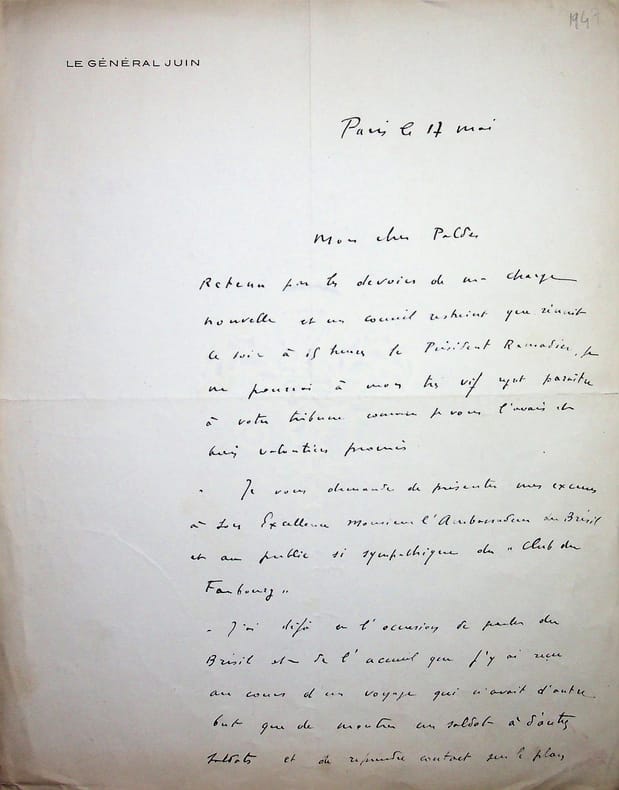
réf. 020647Alphonse Juin (1888-1967), général, maréchal de France en 1952, un des grands chefs de la Libération. L.A.S., Paris, 17 mai 1947, 2p in-4. A l'écrivain, militant socialiste puis communiste, fondateur du Club du Faubourg, Léo Poldès (1891-1970). « Retenu par les devoirs de [sa] charge nouvelle » - il vient d'être nommé résident général de la France au Maroc -, il ne pourra être là, avec le « président [du conseil] Ramadier », malgré sa promesse, en présence de l'ambassadeur du Brésil, Luiz Martins de Souzas Dantas (1876-1954). Suit alors un beau témoignage de son expérience avec le Brésil. Belle lettre, peu commun. [500]
réf. DADAX0415955572New unknown
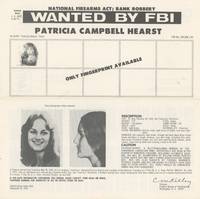
1974réf. List3214Washington D.C.: Federal Bureau of Investigation 1974. Mailer measuring 8 x 15 ¾ inches folded in fours. Yellow tape to seal; else Fine. An FBI mailer soliciting information about Emily Harris and Patricia Hearst of the Symbionese Liberation Army SLA a left-wing militant group based in California and responsible for several killings and bank robberies between 1973 and 1975. Hearst the granddaughter of publishing tycoon William Randolph Hearst had been kidnapped by the SLA in February of 1974; in April she turned up on surveillance video robbing a San Francisco bank with other members of the SLA. Harris was involved in Hearst’s kidnapping and was at the time this mailer was distributed on the run with her husband William Harris and Hearst and wanted for firearms violations. The mailer describes the three as “armed and very dangerous.” The trio was arrested in San Francisco in 1975. The Harrises served eight years in prison but were re-arrested in 2002 for the murder of Myrna Opsahl during a 1975 bank robbery. Hearst served two years of a seven-year sentence; her sentence was commuted by Jimmy Carter and in 2001 she was pardoned by Bill Clinton. Federal Bureau of Investigation unknown
1974réf. List3214Washington D.C.: Federal Bureau of Investigation 1974. Mailer measuring 8 x 15 ¾ inches folded in fours. Yellow tape to seal; else Fine. An FBI mailer soliciting information about Emily Harris and Patricia Hearst of the Symbionese Liberation Army SLA a left-wing militant group based in California and responsible for several killings and bank robberies between 1973 and 1975. Hearst the granddaughter of publishing tycoon William Randolph Hearst had been kidnapped by the SLA in February of 1974; in April she turned up on surveillance video robbing a San Francisco bank with other members of the SLA. Harris was involved in Hearst’s kidnapping and was at the time this mailer was distributed on the run with her husband William Harris and Hearst and wanted for firearms violations. The mailer describes the three as “armed and very dangerous.” The trio was arrested in San Francisco in 1975. The Harrises served eight years in prison but were re-arrested in 2002 for the murder of Myrna Opsahl during a 1975 bank robbery. Hearst served two years of a seven-year sentence; her sentence was commuted by Jimmy Carter and in 2001 she was pardoned by Bill Clinton. Federal Bureau of Investigation unknown books
1970réf. 9177Budapest 1970. First edition. 28x39cm 19 leaves laid loose in red padded leather portfolio. Table of contents introduction by Simon Peter and 17 etchings each signed in pencil by the respective artist. Tissue guards present plates in very bright near fine condition contents leaf and inner portfolio with some foxing. Rubbing to edges of folder otherwise a near fine set. Translated as "A Quarter Century of Liberated Hungary" this portfolio was issued in 1970 to commemorate 25 years since the end of World War II. The images in the Socialist-Realist style depict scenes such as the Provisional National Assembly in Debrecen cleaning rubble from the streets of Budapest following the war the birth of the Forint the working class voting during the 1947 parliamentary election in Borsod County factory nationalization and others. Artists include Gyula Hincz 1904-1986 Adam Würtz 1927-1994 Pásztor Gábor 1933–2012 Raszler Károly 1925–2005 and others. A scarce complete Cold War-era Hungarian graphic art portfolio with striking images from Nationalist artists. unknown
1970réf. 228751970. Lester Julius. Some Revolutionary Notes 1970 presents a critical intervention in Black liberation thought at the transition from the Civil Rights Movement to the era of Black Power and New Left fragmentation. Issued by the Institute for the Study of Nonviolence in Palo Alto the work supports research into African American political thought nonviolent philosophy and internal debates over strategy within late 1960s and early 1970s radical movements. Written in the aftermath of major political ruptures including the rise of the Black Panther Party and the killings of Fred Hampton and Mark Clark the essays examine the limits of both nonviolence and armed resistance within the struggle for Black liberation. Lester Julius. Some Revolutionary Notes. Palo Alto: Institute for the Study of Nonviolence 1970. First separate printing. Quarto. Side-stapled self-wrappers printed in black on white stock. The 13-page pamphlet compiles a series of essays originally published in Liberation magazine between late 1969 and early 1970. Opening with "To Recapture the Dream" Lester traces the trajectory of the Movement from the Montgomery bus boycott through the emergence of militant Black activism identifying generational and ideological divisions within the struggle. Subsequent essays dated January through March 1970 address the limitations of the anti-Vietnam War Moratorium the political implications of the deaths of Hampton and Clark and the philosophical tension between nonviolence and revolutionary violence. The text incorporates references to Gandhian principles of satyagraha arguing for a form of political transformation grounded in ethical and human development rather than retaliatory force. Graphic patterned borders frame each essay reinforcing the pamphlet's visual identity within radical print culture. Light handling wear with faint toning along edges and a small crease to lower front corner; otherwise clean and well preserved; overall near fine condition. Produced within a network of West Coast pacifist activism associated with figures such as Ira Sandperl and Joan Baez the pamphlet provides direct evidence of ideological reassessment within Black and multiracial movements offering a concise and historically grounded articulation of nonviolence as a contested but persistent framework in post-Civil Rights era political thought. unknown
1970réf. 228751970. Lester Julius. Some Revolutionary Notes 1970 presents a critical intervention in Black liberation thought at the transition from the Civil Rights Movement to the era of Black Power and New Left fragmentation. Issued by the Institute for the Study of Nonviolence in Palo Alto the work supports research into African American political thought nonviolent philosophy and internal debates over strategy within late 1960s and early 1970s radical movements. Written in the aftermath of major political ruptures including the rise of the Black Panther Party and the killings of Fred Hampton and Mark Clark the essays examine the limits of both nonviolence and armed resistance within the struggle for Black liberation. Lester Julius. Some Revolutionary Notes. Palo Alto: Institute for the Study of Nonviolence 1970. First separate printing. Quarto. Side-stapled self-wrappers printed in black on white stock. The 13-page pamphlet compiles a series of essays originally published in Liberation magazine between late 1969 and early 1970. Opening with "To Recapture the Dream" Lester traces the trajectory of the Movement from the Montgomery bus boycott through the emergence of militant Black activism identifying generational and ideological divisions within the struggle. Subsequent essays dated January through March 1970 address the limitations of the anti-Vietnam War Moratorium the political implications of the deaths of Hampton and Clark and the philosophical tension between nonviolence and revolutionary violence. The text incorporates references to Gandhian principles of satyagraha arguing for a form of political transformation grounded in ethical and human development rather than retaliatory force. Graphic patterned borders frame each essay reinforcing the pamphlet's visual identity within radical print culture. Light handling wear with faint toning along edges and a small crease to lower front corner; otherwise clean and well preserved; overall near fine condition. Produced within a network of West Coast pacifist activism associated with figures such as Ira Sandperl and Joan Baez the pamphlet provides direct evidence of ideological reassessment within Black and multiracial movements offering a concise and historically grounded articulation of nonviolence as a contested but persistent framework in post-Civil Rights era political thought. unknown books
1968réf. 930FAT'H 1968. First Edition. Wraps. Very good. VARIOUS Palestinian National Liberation Movement The Distinguished Ulemas of Islam are Asking the Muslims to Support Al Fat'H Comandos FAT'H 1968. 32pp 8vo. FIRST EDITION. "On the occasion of Balfour Declaration and after issuing the decision of the Islamic World League at Mecca and the Conference of Islamic Research at Cairo which have asked for Jihad to save the Holy Land ." p. 32. Testimonials by various educators imams and political leaders. CONDITION: Very good or better in stapled salmon-colored wraps. Light fading to cover. FAT'H paperback
réf. DADAX1612057233New unknown
réf. DADAX0415312353New unknown
réf. DADAX1920888454New unknown
1978réf. 239011978. Lesbian and gay movement print culture archive 1978 to 1993 tracing the passage from liberation era attacks on psychiatric authority to affirmative youth work lesbian feminist cultural criticism and the professional book trade built by independent presses. The earliest item is a 1978 Gay Liberation Information Service printing of Psychiatry and the Homosexual first published in 1973 by members of the London Gay Liberation Front's Counter Psychiatry Group while the sequence closes with Cleis Press's 1993 trade catalogue where lesbian studies sexual politics health fiction and other fields appear as an organized publishing list. Bridges of Respect and Marilyn Murphy's Are You Girls Traveling Alone document two additional routes by which lesbian and gay print entered broader institutional and intellectual settings: the American Friends Service Committee's national work with adults serving lesbian and gay youth and book length lesbian feminist writing drawn substantially from the periodical culture of Lesbian News. Archive of four publications 1978 to 1993 comprising one pamphlet one resource guide one first edition essay collection and one publisher catalogue. 1 Psychiatry and the Homosexual: A Brief Analysis of Oppression. Gay Liberation Pamphlet no. 1. London: Gay Liberation Information Service 1978. 32 pp. A collective critique of psychiatry's treatment of homosexuality opening with the declaration that "The oppression of homosexuality in Western society is total." 2 Whitlock Katherine. Bridges of Respect: Creating Support for Lesbian and Gay Youth. Philadelphia: American Friends Service Committee 1988. 97 pp. An affirmative resource guide for adults working with lesbian and gay youth grounded in AFSC's Quaker tradition of opposition to discrimination. 3 Murphy Marilyn. Are You Girls Traveling Alone Adventures in Lesbianic Logic. Los Angeles: Clothespin Fever Press 1991. First edition. 235 pp. With an introduction by Marilyn Frye. Murphy's essays many first published in Lesbian News combine humor personal narrative and lesbian feminist critique; Catherine O'Dette described her method as "the Lesbianic equivalent of the Socratic Method." 4 Cleis Press 1993. San Francisco and Pittsburgh: Cleis Press 1993. 23 pp. Trade catalogue organized into New Releases Fiction Lesbian Studies Sexual Politics Politics of Health and other sections with contributors and authors including Susie Bright Pat Califia bell hooks Carol A. Queen Andrew Ross and Michael Warner. The chronology begins with a British gay liberation text produced when activists were directly challenging psychiatry's authority to define and treat homosexuality. The Gay Liberation Front had identified psychiatry as a mechanism of oppression in its 1971 manifesto and its Counter Psychiatry Group formed partly in response to the continued use of aversion therapies; Psychiatry and the Homosexual emerged from that work and argued that homosexuality required neither cure nor therapeutic correction. PubMed Central PMC Ten years later Bridges of Respect shows an affirmative model operating inside a national service organization: AFSC later traced a direct line from the 1988 guide to its 1992 Bridges Project established as a national clearinghouse for LGBT youth and organizations serving them. Friends Journal Murphy's 1991 collection records another infrastructure the circulation of lesbian feminist argument through periodicals anthologies independent presses feminist bookstores and networks of writers including Frye Lyon Martin Dobkin Penelope and Valentine. The 1993 Cleis catalogue captures the trade end of that development. Cleis cofounder Felice Newman later recalled that the press began by hand addressing and shipping books from a basement and that late 1980s wholesaling arrangements brought its titles before national accounts including Barnes & Noble Borders and Ingram making the catalogue's sales and ordering apparatus evidence of a material change in how lesbian and gay books circulated. PublishersWeekly.com Moderate wrapper soiling and handling wear across the group; Psychiatry and the Homosexual and the Cleis catalogue show more pronounced surface soiling the Cleis rear wrapper retains mailing labels and adhesive residue and Murphy's front wrapper has a long diagonal crease with rubbing and edge wear; bindings remain intact and the visible interiors are clean. Overall good condition. unknown
1978réf. 239011978. Lesbian and gay movement print culture archive 1978 to 1993 tracing the passage from liberation era attacks on psychiatric authority to affirmative youth work lesbian feminist cultural criticism and the professional book trade built by independent presses. The earliest item is a 1978 Gay Liberation Information Service printing of Psychiatry and the Homosexual first published in 1973 by members of the London Gay Liberation Front's Counter Psychiatry Group while the sequence closes with Cleis Press's 1993 trade catalogue where lesbian studies sexual politics health fiction and other fields appear as an organized publishing list. Bridges of Respect and Marilyn Murphy's Are You Girls Traveling Alone document two additional routes by which lesbian and gay print entered broader institutional and intellectual settings: the American Friends Service Committee's national work with adults serving lesbian and gay youth and book length lesbian feminist writing drawn substantially from the periodical culture of Lesbian News. Archive of four publications 1978 to 1993 comprising one pamphlet one resource guide one first edition essay collection and one publisher catalogue. 1 Psychiatry and the Homosexual: A Brief Analysis of Oppression. Gay Liberation Pamphlet no. 1. London: Gay Liberation Information Service 1978. 32 pp. A collective critique of psychiatry's treatment of homosexuality opening with the declaration that "The oppression of homosexuality in Western society is total." 2 Whitlock Katherine. Bridges of Respect: Creating Support for Lesbian and Gay Youth. Philadelphia: American Friends Service Committee 1988. 97 pp. An affirmative resource guide for adults working with lesbian and gay youth grounded in AFSC's Quaker tradition of opposition to discrimination. 3 Murphy Marilyn. Are You Girls Traveling Alone Adventures in Lesbianic Logic. Los Angeles: Clothespin Fever Press 1991. First edition. 235 pp. With an introduction by Marilyn Frye. Murphy's essays many first published in Lesbian News combine humor personal narrative and lesbian feminist critique; Catherine O'Dette described her method as "the Lesbianic equivalent of the Socratic Method." 4 Cleis Press 1993. San Francisco and Pittsburgh: Cleis Press 1993. 23 pp. Trade catalogue organized into New Releases Fiction Lesbian Studies Sexual Politics Politics of Health and other sections with contributors and authors including Susie Bright Pat Califia bell hooks Carol A. Queen Andrew Ross and Michael Warner. The chronology begins with a British gay liberation text produced when activists were directly challenging psychiatry's authority to define and treat homosexuality. The Gay Liberation Front had identified psychiatry as a mechanism of oppression in its 1971 manifesto and its Counter Psychiatry Group formed partly in response to the continued use of aversion therapies; Psychiatry and the Homosexual emerged from that work and argued that homosexuality required neither cure nor therapeutic correction. PubMed Central PMC Ten years later Bridges of Respect shows an affirmative model operating inside a national service organization: AFSC later traced a direct line from the 1988 guide to its 1992 Bridges Project established as a national clearinghouse for LGBT youth and organizations serving them. Friends Journal Murphy's 1991 collection records another infrastructure the circulation of lesbian feminist argument through periodicals anthologies independent presses feminist bookstores and networks of writers including Frye Lyon Martin Dobkin Penelope and Valentine. The 1993 Cleis catalogue captures the trade end of that development. Cleis cofounder Felice Newman later recalled that the press began by hand addressing and shipping books from a basement and that late 1980s wholesaling arrangements brought its titles before national accounts including Barnes & Noble Borders and Ingram making the catalogue's sales and ordering apparatus evidence of a material change in how lesbian and gay books circulated. PublishersWeekly.com Moderate wrapper soiling and handling wear across the group; Psychiatry and the Homosexual and the Cleis catalogue show more pronounced surface soiling the Cleis rear wrapper retains mailing labels and adhesive residue and Murphy's front wrapper has a long diagonal crease with rubbing and edge wear; bindings remain intact and the visible interiors are clean. Overall good condition. unknown books
réf. 239344Stuttgart, Johann Scheible [Schnellpressendruck von Kreuzer - puis : Hofbuchdruckerei zu Guttenberg], 1849 - 1850 12 tomes en 4 vol. in-16, cartonnage Bradel de papier violine , pièces de titre noires (reliure de l'époque). Rousseurs. Quelques usures au cartonnage.
réf. 9668P., Cussac, (1918). Affiche de 116 x 80 cm pliée, ornée de deux drapeaux français entrecroisés.
1945réf. 20103Mexico, Poésie et Révolution, 1945 ; in-8 (197 x 141 mm), broché, [16] ff. non chiffré, le premier et le dernier blancs.
réf. 2081402109703279Not Available N.A. Soft Cover. Fine. The book is in fine condition. Not Available paperback
réf. 2081402109703450Not Available N.A. Soft Cover. Fine. The book is in fine condition. Not Available paperback
réf. DADAX0684836122New unknown