People's Prohibition MovementBiblio.com
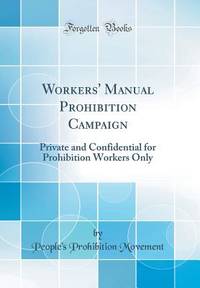
111 résultats
réf. 1396451382.Ghardcover. Good. Access codes and supplements are not guaranteed with used items. May be an ex-library book. hardcover
1940réf. 128149Self published 1940s. Circa late 1930s-40s. Vintage ink blotters featuring advertisements for the National Woman's Christian Temperance Union IL one of the largest and most influential groups of the late 19th century focusing primarily on Prohibition by 1900s. These blotters represent the Union's attitude towards all alcohol and cigarets but ultimately feel like cursed fortune cookie messages. Blotters were useful during the heyday of fountain pens device that tended to bleed ink to be placed behind the parchment to absorb the excess ink and keep safe any surfaces beneath. Other blotters featuring the Union's temperance ads include loyalty patriotism auto accidents drinking and driving and many are duplicated messages on different colors of stock. About 3 x 6 inches card stock printed on rectos plain verso. Very Good overall light foxing rubbing toning a few light bumps and small creases. Self published unknown
1992270 pages. "Documents the men and the ships of a little-known period in west coast history. Pays funny and fascinating tribute to the unsung heroes of an inglorious history." - from dust jacket. Clean, bright and unmarked with lightest wear. Dust jacket in Archival-quality Brodart cover. Beautiful copy. Book
1907réf. KULT0524Hambg., Vlg. v. Deutschlands Großloge 1907. gr.-8°, XV, 458 S., marmorierter HLn. d. Zt., schwach berieben, Rü. leicht geblichen, Vortit. etwas aus Faltung gerissen u. m. Buchhändlerstempel, die ersten Seiten schwach fingerfl. 2 Beigaben: Weisbart, Josef. Der Wunderquell und Rotnäschen. Zwei Märchen über den "Freund Alkohol". 2. Aufl. Berlin, Deutscher Arbeiter-Abstinenten-Bund 1925. 23(1) S., mit 3 Abb., ill. OKart, klammergeh./Die alkoholfreie Jugenderziehung. Heft 2. Mai 1938. S. 17-31, 2 Abb., OBrosch., klammergeh., Lichtspuren, schwache Knickspuren.
1991PLEASE NOTE: This copy is *not* signed, despite what you may read elswhere in this description. 551 pages including index, bibliography, references and black and white photographs. Tells us of the Prohibition years - how Sam and his brothers kept one step ahead of the law - and paints an entertaining portrait of the romantic era of bootlegging. Sam emerges himself as a larger-than-life character: irascible, authoritarian, volcanic, iron-willed - as well as a loving father and loving husband. A seductive portrayal of a Canadian legend. Wonderful unmarked copy with only faint signs of handling. Several drops of light-beige staining to top edge. Book
1957222 pages. "The entertaining life-history of a schooner, from her first appearance on the designing-board, through her gradual growth in the builder's yard and trials in the North Atlantic, to her cruel death indirectly at the hands of the U.S. Customs during the prohibition period." - dust jacket. Prior owner's name and date atop front free endpaper, otherwise contents clean and unmarked. Binding tight. Above-average wear to dust jacket which is now preserved in archival-grade Brodart. A sound vintage copy. Book
réf. 21374Paris, José Corti, 1934. In-4, LVIX-282 pp., broché, couverture originale imprimée (minuscules déchirures et taches à la couverture, papier jauni).
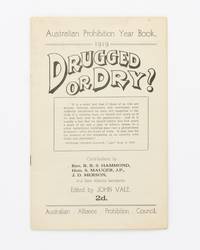
1919réf. 102605Melbourne: Australian Alliance Prohibition Council 1919. Very Good. Melbourne Australian Alliance Prohibition Council 1919. Octavo 32 pages including title-wrappers. Saddle-stapled; minimal signs of use and age; an excellent copy. The third year book issued by the Council. Australian Alliance Prohibition Council unknown
2011réf. 2090202120415058Published by the National Congress Against Atomic and Hydrogen Bombs 2011. Soft Cover. Fine. Number of books: 1 Published by the National Congress Against Atomic and Hydrogen Bombs paperback
1970réf. 2083002117402882Yale Publishing Company 1970. Soft Cover. Fine. Volume: 1 Yale Publishing Company paperback
1994réf. 2080302106800030Japan National Assembly Against Atomic and Hydrogen Bombs 1994. Soft Cover. Fine. Size: New book 246 pages Number of books: 1 Japan National Assembly Against Atomic and Hydrogen Bombs paperback
1994réf. 2090202120402037Japan National Congress Against Atomic and Hydrogen Bombs 1994. Soft Cover. Fine. Number of books: 1 Japan National Congress Against Atomic and Hydrogen Bombs paperback
1976réf. 2090502113717793Not Available 1976. Soft Cover. Fine. The book is in fine condition. Not Available paperback
1970Book show light shelf wear only. Binding is solid and square, covers have sharp corners, text/interior is clean and free of marking of any kind except for previous owner's note at front endpaper. 273 pages with b&w historical photos throughout. Chapters include: Doctor Boals, Garibaldi, Logs and lumber mill, Tales of Tillamook folks, Logging, Schools and kids, airies and cheese, Hunting, game and dogs, Prohibition. Book contains one page laid-in handwritten letter at back from author to Dr. Stevens describing the editorial process through which the book was written. Signed by author on front end paper under note from Stevens family.
réf. 98884 pp. in 4°, bandeau gravé.
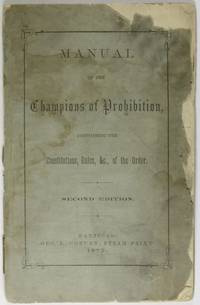
1872réf. 0000895Hartford Conn.: Geo. L. Coburn Steam Print. 1872. 24 33 pages. Original printed wraps. 17 x 11 cm. Chipping to wraps title and corners of a few other leaves not affecting text and a number of short marginal tears. Spine has mostly perished but gatherings are held by the original stitching. Wraps heavily stained not affecting legibility. Light marginal damp stains throughout; marginal soiling in a few places. A poor but complete copy. SECOND EDITION so stated on the front wrap expanded. The first edition of the previous year contained only the first part of this work the 24-page manual. The second edition includes a new section "Ritual" the second grouping of 33 pages. It contains a diagram of a lodge room and descriptions of ceremonies for opening meetings initiations recognizing visitors installing officers and instituting new lodges. At the end is a cipher being a number code for the alphabet and the common vocabulary used by the organization. In addition to the contents alluded to in the title the manual includes the lyrics to seven odes. Several ads are printed with the text all promoting Thomas H.L. Tallcott's diverse professional and business interests in Glastonbury and Hartford. One ad announces his services as a notary and justice of the peace and another his land surveying firm. He also advertises patent medicines Dickinson's Alternative Balsam and Discutient Ointment and a washing machine the Niagra Washer both of which he distributed. At the end of the manual is an ad for the New England Female Medical College Boston and the free dispensary offered by Dr. Samuel Gregory. Thomas Hyde Lord Tallcott 1829-1907 of Glastonbury was active in the temperance movement in Connecticut from his early adulthood belonged to several national prohibition organizations and was one of the founders of the Prohibition Party in Connecticut 1869. He was also an attorney justice of the peace Congregationalist minister and a prominent figure in the Templars. In 1849 he presented a petition to the Connecticut senate to prohibit alcohol. He was a leader in the Hartford County Temperance Society at least as early as 1852 when he issued a circular for the organization. In 1867 and 1868 he went to the Carolinas to organize lodges for the Templars. He established over a dozen lodges most of which were for African Americans. He founded the Champions of Prohibition in 1870 and served as the first president and secretary of the organization. Ref. Austin "Prohibition Leaders of America" 1895 p. 35. Obituary Hartford "Daily Courant" Sept. 30 1907 p. 2. Fahey "Temperance & Racism" pp. 61-62. Rare. OCLC locates only the Virginia Tech copy of this second edition; not in NUC. Of the first edition OCLC finds only two copies NYP and Harvard; NUC adds the LC copy. Geo. L. Coburn Steam Print. paperback
1934réf. 59731934. St. Paul Pioneer Press. May 10 1934 issue documents the federal prosecution of St. Paul bootlegger Leon Gleckman and the government's effort to connect Minnesota's illicit liquor economy with Al Capone's Chicago organization supporting research into Prohibition enforcement organized crime tax prosecutions and regional newspaper coverage of interstate criminal networks. Published during Gleckman's federal trial for attempting to evade income taxes for 1929 through 1931 the issue places a locally prominent defendant within the wider history of federal authorities using financial records and tax law against figures whose illegal enterprises were difficult to prosecute directly. Court records confirm that Gleckman's case concerned substantial unreported income and that his first trial began in April 1934. St. Paul Pioneer Press. St. Paul Minnesota. Thursday May 10 1934. Number of pages and measurements not stated. Front page carries the headline "AL CAPONE NAMED IN GLECKMAN TRIAL" with the subheading "Government Seeks to Show St. Paulite Sold Chicago Rum Baron Alcohol." The article reports the prosecution's attempt to establish that Gleckman supplied alcohol to Capone presenting the trial as evidence of commercial ties between St. Paul and Chicago during the final phase of national Prohibition enforcement. The headline's pairing of Capone's nationally recognized name with a St. Paul defendant also shows how the local press framed Gleckman's financial prosecution through the more publicly legible language of bootlegging and organized crime. The issue appeared five months after repeal of national Prohibition while federal authorities continued prosecuting income generated during the illegal liquor trade. Gleckman was subsequently convicted on two counts of tax evasion after a second trial and the resulting appellate decision preserved extensive evidence concerning unexplained bank deposits and his claimed interest in a distillery. Left-edge binding holes; otherwise clean with no additional defects reported; overall near fine. A sharply focused contemporary account of the federal effort to reconstruct the financial and commercial connections linking St. Paul bootlegging to the better-known Chicago underworld. unknown
1934réf. 59731934. St. Paul Pioneer Press. May 10 1934 issue documents the federal prosecution of St. Paul bootlegger Leon Gleckman and the government's effort to connect Minnesota's illicit liquor economy with Al Capone's Chicago organization supporting research into Prohibition enforcement organized crime tax prosecutions and regional newspaper coverage of interstate criminal networks. Published during Gleckman's federal trial for attempting to evade income taxes for 1929 through 1931 the issue places a locally prominent defendant within the wider history of federal authorities using financial records and tax law against figures whose illegal enterprises were difficult to prosecute directly. Court records confirm that Gleckman's case concerned substantial unreported income and that his first trial began in April 1934. St. Paul Pioneer Press. St. Paul Minnesota. Thursday May 10 1934. Number of pages and measurements not stated. Front page carries the headline "AL CAPONE NAMED IN GLECKMAN TRIAL" with the subheading "Government Seeks to Show St. Paulite Sold Chicago Rum Baron Alcohol." The article reports the prosecution's attempt to establish that Gleckman supplied alcohol to Capone presenting the trial as evidence of commercial ties between St. Paul and Chicago during the final phase of national Prohibition enforcement. The headline's pairing of Capone's nationally recognized name with a St. Paul defendant also shows how the local press framed Gleckman's financial prosecution through the more publicly legible language of bootlegging and organized crime. The issue appeared five months after repeal of national Prohibition while federal authorities continued prosecuting income generated during the illegal liquor trade. Gleckman was subsequently convicted on two counts of tax evasion after a second trial and the resulting appellate decision preserved extensive evidence concerning unexplained bank deposits and his claimed interest in a distillery. Left-edge binding holes; otherwise clean with no additional defects reported; overall near fine. A sharply focused contemporary account of the federal effort to reconstruct the financial and commercial connections linking St. Paul bootlegging to the better-known Chicago underworld. unknown books
1888réf. 78719New York NY.: The National Temperance Society and Publication House. Very Good. 1888. Softcover. Soft-bound in tan wrappers with black printing. The spine is chipped and torn with the covers loose but present. The covers show light soiling and wear/chipping to the edges and corners with loss to the top outer corner of the lower cover. The text-block is worn with the title-page loose but present. The contents are bright and clean. . The National Temperance Society and Publication House paperback
1888réf. 78719New York NY.: The National Temperance Society and Publication House. Very Good. 1888. Softcover. Soft-bound in tan wrappers with black printing. The spine is chipped and torn with the covers loose but present. The covers show light soiling and wear/chipping to the edges and corners with loss to the top outer corner of the lower cover. The text-block is worn with the title-page loose but present. The contents are bright and clean. . The National Temperance Society and Publication House paperback books
1910réf. 56456Westerville OH: The Anti-Saloon League of America 1910. 8vo. 256 pp. Numerous maps tables charts. Green ribbed publisher’s cloth gilt lettering stamped on front cover & spine very slight bumping to couple corners still a VG tight bright copy w/ long ALS on ffep. from Frank Richard Margetts fl. 1880-1910 a Spokane WA attorney and stalwart supporter of Prohibition and was the Washington District Superintendent who spearheaded the 1909 legislation to allow local Washington jurisdictions to enact their own temperance legislation. First edition of this polemic and fact book issued by the leading organization pushing Prohibision in the Progressive Era drawing heavy support from Protestant congrations throughout the country and by 1905 largely overshadowed the Woman’s Christian Temperance Union. Margetts writes in the presentation letter on the ffep. that “When a thousand years hence this book and its accompanying literature is brought forth . . . it treats of a gigantic curse which has long since been completely obliterated by an enlightened humanity through progress. . . .” After 1928 with the failures of Prohibition exposed through bootlegging and organized crime severely curtailed government tax revenue and failure to disassociate from the Ku Klux Klan the League would lose their power after the election of President Roosevelt. The Anti-Saloon League of America, hardcover
1861réf. 46401811Paris, Havard, 1861 ; petit in-12, demi-basane fauve, fil. dor., non rogné, couverture beige imprimée conservée. (Reliure moderne). 93 pp.Ce livre semble extrêmement rare, nous n’avons trouvé que trois exemplaires dans les bibliothèques françaises, tous à la date de 1861. Histoire du tabac depuis sa découverte par les Espagnols en 1520 chez les habitants de Tabasco, province du Yucatan, introduction en France, Jean Nicot, en Italie, en Orient, en Angleterre, usage du tabac en Amérique avant 1520, calumet de paix, sauvages de Virginie. Nombreuses guérisons opérées par le tabac ; les Chinois et le tabac, introduction en Hollande, pipes. Persécutions : en Angleterre par Jacques Ier, supplice de Rawlegh ; en Perse, Schah-Abbas ; en Tuquie, Amurat IV ; bulle d’Urbain VIII... Opinions des médecins du XVIIe siècle, conseils de Néander aux jeunes gens ; Simon Paulli et sa haine contre le tabac et le thé. Une thèse de 1699 intitulée “le tabac abrège t’il la vie ?” ; impôts sous Richelieu, Colbert, premier bail du tabac. Sous Louis XIV, Louis XV, et Louis XVI, les turgotines, la Révolution, la régie. Smith n°15.
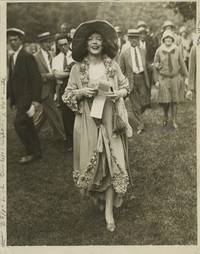
1927réf. List387654379New York City: Underwood & Underwood 1927. Press photo measuring 8 x 10 inches. With editorial marks recto and verso Underwood & Underwood stamps and caption verso. Excellent contrast. Some damage to margins and some small areas of ink staining not intersecting with subject. Overall very good to excellent. A glamorous shot of "Texas" Guinan in about 1927 attending opening day at Belmont Park a horse racing track just outside New York City. Guinan 1884-1933 was born Mary Louise Cecilia Guinan in Waco Texas. Trained in singing and horseback riding she typically played a gunslinging girl heroine in "Wild West" shows making it from New York to Hollywood in 1917. She returned east in the 1920s to sing and emcee in clubs-becoming known for her signature "Hello sucker!" greeting-in New York Chicago and Florida working closely with entrepreneur and rumrunner Larry Fay. During this time Guinan became infamous as an alleged though never proven bootlegger; clubs in which she worked were routinely raided throughout Prohibition though charges against her never stuck. She leveraged her fame as "Queen of the Night Clubs" as she is described on the verso of this photograph to return to Hollywood for several unsuccessful autobiographical films and then attempted to tour Europe where her reputation preceded her and her ship was denied entry at every port on which it called.1 1 Debbie Mauldin Cottrell "Mary Guinan: The Trailblazing Texas Star of Broadway and Hollywood" Texas State Historical Association Handbook of Texas Online accessed May 26 2026 https://www.tshaonline.org/handbook/entries/guinan-mary-louise-cecilia-texas. Underwood & Underwood unknown
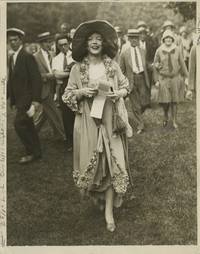
1927réf. List38121New York City: Underwood & Underwood 1927. Press photo measuring 8 x 10 inches. With editorial marks recto and verso Underwood & Underwood stamps and caption verso. Excellent contrast. Some damage to margins and some small areas of ink staining not intersecting with subject. Overall very good to excellent. A glamorous shot of "Texas" Guinan in about 1927 attending opening day at Belmont Park a horse racing track just outside New York City. Guinan 1884-1933 was born Mary Louise Cecilia Guinan in Waco Texas. Trained in singing and horseback riding she typically played a gunslinging girl heroine in "Wild West" shows making it from New York to Hollywood in 1917. She returned east in the 1920s to sing and emcee in clubs-becoming known for her signature "Hello sucker!" greeting-in New York Chicago and Florida working closely with entrepreneur and rumrunner Larry Fay. During this time Guinan became infamous as an alleged though never proven bootlegger; clubs in which she worked were routinely raided throughout Prohibition though charges against her never stuck. She leveraged her fame as "Queen of the Night Clubs" as she is described on the verso of this photograph to return to Hollywood for several unsuccessful autobiographical films and then attempted to tour Europe where her reputation preceded her and her ship was denied entry at every port on which it called.1 1 Debbie Mauldin Cottrell "Mary Guinan: The Trailblazing Texas Star of Broadway and Hollywood" Texas State Historical Association Handbook of Texas Online accessed May 26 2026 https://www.tshaonline.org/handbook/entries/guinan-mary-louise-cecilia-texas. Underwood & Underwood unknown
1927réf. List387654379New York City: Underwood & Underwood 1927. Press photo measuring 8 x 10 inches. With editorial marks recto and verso Underwood & Underwood stamps and caption verso. Excellent contrast. Some damage to margins and some small areas of ink staining not intersecting with subject. Overall very good to excellent. A glamorous shot of "Texas" Guinan in about 1927 attending opening day at Belmont Park a horse racing track just outside New York City. Guinan 1884-1933 was born Mary Louise Cecilia Guinan in Waco Texas. Trained in singing and horseback riding she typically played a gunslinging girl heroine in "Wild West" shows making it from New York to Hollywood in 1917. She returned east in the 1920s to sing and emcee in clubs-becoming known for her signature "Hello sucker!" greeting-in New York Chicago and Florida working closely with entrepreneur and rumrunner Larry Fay. During this time Guinan became infamous as an alleged though never proven bootlegger; clubs in which she worked were routinely raided throughout Prohibition though charges against her never stuck. She leveraged her fame as "Queen of the Night Clubs" as she is described on the verso of this photograph to return to Hollywood for several unsuccessful autobiographical films and then attempted to tour Europe where her reputation preceded her and her ship was denied entry at every port on which it called.1 1 Debbie Mauldin Cottrell "Mary Guinan: The Trailblazing Texas Star of Broadway and Hollywood" Texas State Historical Association Handbook of Texas Online accessed May 26 2026 https://www.tshaonline.org/handbook/entries/guinan-mary-louise-cecilia-texas. Underwood & Underwood unknown books