112 résultats
1934réf. 59731934. St. Paul Pioneer Press. May 10 1934 issue documents the federal prosecution of St. Paul bootlegger Leon Gleckman and the government's effort to connect Minnesota's illicit liquor economy with Al Capone's Chicago organization supporting research into Prohibition enforcement organized crime tax prosecutions and regional newspaper coverage of interstate criminal networks. Published during Gleckman's federal trial for attempting to evade income taxes for 1929 through 1931 the issue places a locally prominent defendant within the wider history of federal authorities using financial records and tax law against figures whose illegal enterprises were difficult to prosecute directly. Court records confirm that Gleckman's case concerned substantial unreported income and that his first trial began in April 1934. St. Paul Pioneer Press. St. Paul Minnesota. Thursday May 10 1934. Number of pages and measurements not stated. Front page carries the headline "AL CAPONE NAMED IN GLECKMAN TRIAL" with the subheading "Government Seeks to Show St. Paulite Sold Chicago Rum Baron Alcohol." The article reports the prosecution's attempt to establish that Gleckman supplied alcohol to Capone presenting the trial as evidence of commercial ties between St. Paul and Chicago during the final phase of national Prohibition enforcement. The headline's pairing of Capone's nationally recognized name with a St. Paul defendant also shows how the local press framed Gleckman's financial prosecution through the more publicly legible language of bootlegging and organized crime. The issue appeared five months after repeal of national Prohibition while federal authorities continued prosecuting income generated during the illegal liquor trade. Gleckman was subsequently convicted on two counts of tax evasion after a second trial and the resulting appellate decision preserved extensive evidence concerning unexplained bank deposits and his claimed interest in a distillery. Left-edge binding holes; otherwise clean with no additional defects reported; overall near fine. A sharply focused contemporary account of the federal effort to reconstruct the financial and commercial connections linking St. Paul bootlegging to the better-known Chicago underworld. unknown
1888réf. 78719New York NY.: The National Temperance Society and Publication House. Very Good. 1888. Softcover. Soft-bound in tan wrappers with black printing. The spine is chipped and torn with the covers loose but present. The covers show light soiling and wear/chipping to the edges and corners with loss to the top outer corner of the lower cover. The text-block is worn with the title-page loose but present. The contents are bright and clean. . The National Temperance Society and Publication House paperback
1910réf. 56456Westerville OH: The Anti-Saloon League of America 1910. 8vo. 256 pp. Numerous maps tables charts. Green ribbed publisher’s cloth gilt lettering stamped on front cover & spine very slight bumping to couple corners still a VG tight bright copy w/ long ALS on ffep. from Frank Richard Margetts fl. 1880-1910 a Spokane WA attorney and stalwart supporter of Prohibition and was the Washington District Superintendent who spearheaded the 1909 legislation to allow local Washington jurisdictions to enact their own temperance legislation. First edition of this polemic and fact book issued by the leading organization pushing Prohibision in the Progressive Era drawing heavy support from Protestant congrations throughout the country and by 1905 largely overshadowed the Woman’s Christian Temperance Union. Margetts writes in the presentation letter on the ffep. that “When a thousand years hence this book and its accompanying literature is brought forth . . . it treats of a gigantic curse which has long since been completely obliterated by an enlightened humanity through progress. . . .” After 1928 with the failures of Prohibition exposed through bootlegging and organized crime severely curtailed government tax revenue and failure to disassociate from the Ku Klux Klan the League would lose their power after the election of President Roosevelt. The Anti-Saloon League of America, hardcover
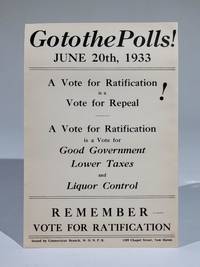
1933réf. 1172New Haven: Connecticut Branch W. O. N. P. R. 1933. Broadside. 7" x 10 1/4. Single sheet printed on one side. Slight age toning. Fine condition. This is an original handbill from a major women's group soliciting votes to repeal Prohibition in 1933. Women's organizations--particularly the Women's Christian Temperance Union--are strongly associated with passage of the 18th Amendment to the U. S. Constitution and the national ban on alcoholic beverages it brought in 1919. The major role women played in getting Prohibition repealed is not as widely recognized however. This handbill was issued by the Connecticut Branch of the Women's Organization for National Prohibition Reform W.O.N.P.R. The W.O.N.P.R. was organized in 1929 by women who could no longer ignore the destructive if unintended consequences of Prohibition. Here voters are asked to vote for ratification of the 21st Amendment reminding them that "A Vote for Ratification is a Vote for Repeal!" and "A Vote for Ratification is a Vote for Good Government Lower Taxes and Liquor Control." The efforts of the W.O.N.P.R. and other repeal groups were successful and Prohibition was repealed with the ratification of the 21st Amendment in December of 1933. A tangible piece of Prohibition and women's history. Connecticut Branch, W. O. N. P. R. unknown
1861réf. 46401811Paris, Havard, 1861 ; petit in-12, demi-basane fauve, fil. dor., non rogné, couverture beige imprimée conservée. (Reliure moderne). 93 pp.Ce livre semble extrêmement rare, nous n’avons trouvé que trois exemplaires dans les bibliothèques françaises, tous à la date de 1861. Histoire du tabac depuis sa découverte par les Espagnols en 1520 chez les habitants de Tabasco, province du Yucatan, introduction en France, Jean Nicot, en Italie, en Orient, en Angleterre, usage du tabac en Amérique avant 1520, calumet de paix, sauvages de Virginie. Nombreuses guérisons opérées par le tabac ; les Chinois et le tabac, introduction en Hollande, pipes. Persécutions : en Angleterre par Jacques Ier, supplice de Rawlegh ; en Perse, Schah-Abbas ; en Tuquie, Amurat IV ; bulle d’Urbain VIII... Opinions des médecins du XVIIe siècle, conseils de Néander aux jeunes gens ; Simon Paulli et sa haine contre le tabac et le thé. Une thèse de 1699 intitulée “le tabac abrège t’il la vie ?” ; impôts sous Richelieu, Colbert, premier bail du tabac. Sous Louis XIV, Louis XV, et Louis XVI, les turgotines, la Révolution, la régie. Smith n°15.
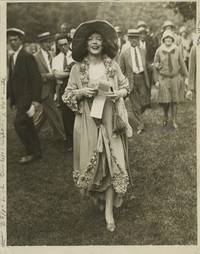
1927réf. List387654379New York City: Underwood & Underwood 1927. Press photo measuring 8 x 10 inches. With editorial marks recto and verso Underwood & Underwood stamps and caption verso. Excellent contrast. Some damage to margins and some small areas of ink staining not intersecting with subject. Overall very good to excellent. A glamorous shot of "Texas" Guinan in about 1927 attending opening day at Belmont Park a horse racing track just outside New York City. Guinan 1884-1933 was born Mary Louise Cecilia Guinan in Waco Texas. Trained in singing and horseback riding she typically played a gunslinging girl heroine in "Wild West" shows making it from New York to Hollywood in 1917. She returned east in the 1920s to sing and emcee in clubs-becoming known for her signature "Hello sucker!" greeting-in New York Chicago and Florida working closely with entrepreneur and rumrunner Larry Fay. During this time Guinan became infamous as an alleged though never proven bootlegger; clubs in which she worked were routinely raided throughout Prohibition though charges against her never stuck. She leveraged her fame as "Queen of the Night Clubs" as she is described on the verso of this photograph to return to Hollywood for several unsuccessful autobiographical films and then attempted to tour Europe where her reputation preceded her and her ship was denied entry at every port on which it called.1 1 Debbie Mauldin Cottrell "Mary Guinan: The Trailblazing Texas Star of Broadway and Hollywood" Texas State Historical Association Handbook of Texas Online accessed May 26 2026 https://www.tshaonline.org/handbook/entries/guinan-mary-louise-cecilia-texas. Underwood & Underwood unknown
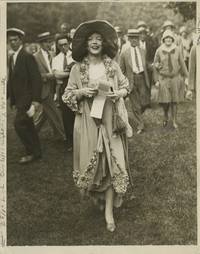
1927réf. List38121New York City: Underwood & Underwood 1927. Press photo measuring 8 x 10 inches. With editorial marks recto and verso Underwood & Underwood stamps and caption verso. Excellent contrast. Some damage to margins and some small areas of ink staining not intersecting with subject. Overall very good to excellent. A glamorous shot of "Texas" Guinan in about 1927 attending opening day at Belmont Park a horse racing track just outside New York City. Guinan 1884-1933 was born Mary Louise Cecilia Guinan in Waco Texas. Trained in singing and horseback riding she typically played a gunslinging girl heroine in "Wild West" shows making it from New York to Hollywood in 1917. She returned east in the 1920s to sing and emcee in clubs-becoming known for her signature "Hello sucker!" greeting-in New York Chicago and Florida working closely with entrepreneur and rumrunner Larry Fay. During this time Guinan became infamous as an alleged though never proven bootlegger; clubs in which she worked were routinely raided throughout Prohibition though charges against her never stuck. She leveraged her fame as "Queen of the Night Clubs" as she is described on the verso of this photograph to return to Hollywood for several unsuccessful autobiographical films and then attempted to tour Europe where her reputation preceded her and her ship was denied entry at every port on which it called.1 1 Debbie Mauldin Cottrell "Mary Guinan: The Trailblazing Texas Star of Broadway and Hollywood" Texas State Historical Association Handbook of Texas Online accessed May 26 2026 https://www.tshaonline.org/handbook/entries/guinan-mary-louise-cecilia-texas. Underwood & Underwood unknown
1924réf. 23615New York: League for Public Discussion 1924. First edition. 74 pages followed by 4 pages advertisements or notices 1 plate with a portrait of each of the contenders. 1 vols. 8vo. Original green stiff wrappers notice about the League on inside back cover. Some light wear and discoloration front cover detached. First edition. 74 pages followed by 4 pages advertisements or notices 1 plate with a portrait of each of the contenders. 1 vols. 8vo. Darrow vs. Holmes on Prohibition. League for Public Discussion unknown books
1932réf. Prohibition1932PROHIBITION American Drinks special issue 718 of LE RIRE. Text by Robert Dieudonné. Paris: Le Rire 5 November 1932. With 17 illustrations by Jean Bruller. Folio 20pp; entire issue in brown cloth binding front panel with duplicate pictorial cover image. Fine copy. First printing of this clever spoof on the secret consumption of alcohol during the American prohibition. Le Rire hardcover
1924réf. 23615New York: League for Public Discussion 1924. First edition. 74 pages followed by 4 pages advertisements or notices 1 plate with a portrait of each of the contenders. 1 vols. 8vo. Original green stiff wrappers notice about the League on inside back cover. Some light wear and discoloration front cover detached. First edition. 74 pages followed by 4 pages advertisements or notices 1 plate with a portrait of each of the contenders. 1 vols. 8vo. League for Public Discussion unknown
1932réf. R0840-01Bln.,Universitas (1932). 230,(2) S. Vlgsanz. Mit 8 phot. Abb. auf Taf. Ohln., leicht schiefgelesen, Schnitt min. angestaubt u. fleckig, innen ganz vereinzelt min. fingerfleckig, gutes Expl.
1991218 pages. Index. Footnotes. "The first systematic examination of government control of liquor in Canada. As the first province in English Canada to choose government control, British Columbia stood out as a North American experiment in the post-prohibition world of alcohol regulation. Analyzes liquor control from a variety of viewpoints: attitudes and access to alcohol; federal-provincial relations; cartels and patronage; and social reform. Reveals much about he intricacies of the state in economic life, particularly the apparent contradiction between promotion and regulation." - Preface. Former library copy with usual markings and front free endpaper removed. Dust jacket not included. Above-average wear to navy blue boards. Binding intact. A worthy reference copy of this 1991 first printing. Book
1932Features: Sanity, Prohibition, and the federal deficit; A gasser blows in - heroic measures necessary to combat flames in oil fields; Where diamonds earn their keep - interesting life of a diamond in an industrial plant - whence it comes, how it is used, and how it ends; Editorials - radium waters - Philippine Independence - Frightfulness in warfare; A Nerve center of communication - how your radio or cable message is speeded through; Eclipses and the Sund's atmosphere - solution of an outstanding solar problem; Flying as fast as sound - considerations of what the future may hold for aviation - some physiological and mechanical aspects of the question; An early Christian cemetary - the Libyan desert gives up further secrets of antiquity; Viscount Grey and Lord Haldane - conclusion of a study of two famous World War personalities; Power from pipe lines to wires - natural gas used as fuel in steam electric plant; Watching the creation of the stars - more concerning the evolution of the galaxies; Unusual fishes - they build nests, walk on land, live in dried mud, and breathe air; Forty-noners starved in the midst of plenty - survey of plants and animals in Death Valley shows that pioneers could have survived the trials of the desert; Modern alchemy - photographing the birth of an atom; What next in elevator technology?; Inter-glacial man in England - human remains and artifacts tell an interesting story of pre-glacial migrations to and from England. Unmarked. Average wear. Book
réf. 23092171like new. unknown
1889réf. 30728New York: The National Temperance Society and Publication House 1889. Original printed wrappers some edge and spine chipping rear wrapper detached but present and original staples. 36pp. Clean text. Except as noted Very Good. In 1881 Kansas enacted a constitutional amendment prohibiting the manufacture or sale of alcoholic beverages. Doing so was a misdemeanor punishable by fine or imprisonment. The amendment effectively rendered Peter Mugler who operated a brewery unemployed. He brought suit claiming that Kansas had unconstitutionally deprived him of his property in violation of the Fourteenth Amendment to the U.S. Constitution. Writing for the Court Justice Harlan-- who would issue a powerful dissent several years later in the notorious case of Plessy vs. Ferguson-- held that the amendment was a permissible exercise of the State's police powers which have always been reserved to the States as an attribute of their sovereignty. The rear wrapper advertises works sponsored by the National Temperance Society. OCLC locates eleven copies under two accession numbers as of November 2013. The National Temperance Society and Publication House unknown books
1889réf. 30728New York: The National Temperance Society and Publication House 1889. Original printed wrappers some edge and spine chipping rear wrapper detached but present and original staples. 36pp. Clean text. Except as noted Very Good. In 1881 Kansas enacted a constitutional amendment prohibiting the manufacture or sale of alcoholic beverages. Doing so was a misdemeanor punishable by fine or imprisonment. The amendment effectively rendered Peter Mugler who operated a brewery unemployed. He brought suit claiming that Kansas had unconstitutionally deprived him of his property in violation of the Fourteenth Amendment to the U.S. Constitution. Writing for the Court Justice Harlan-- who would issue a powerful dissent several years later in the notorious case of Plessy vs. Ferguson-- held that the amendment was a permissible exercise of the State's police powers which have always been reserved to the States as an attribute of their sovereignty. The rear wrapper advertises works sponsored by the National Temperance Society. OCLC locates eleven copies under two accession numbers as of November 2013. The National Temperance Society and Publication House unknown
1920réf. LIST120American 1920. Gelatin silver photograph 5 ½ x 3 ½ inches on Cyko stock photo paper. Very Good. A scarce photograph of a bootlegging operation c. early 1920s. The photograph is printed on Cyko stock which was used through the early 1920s. Few images of bootleggers have survived. The six men in the picture look quite serious in their work and it's difficult to imagine why they allowed a picture to be taken. A very good example with good contrast well preserved. unknown
1933réf. 157897Cincinnati: Romach and Groene 1933. Vintage photograph of the first legal whiskey produced in Ohio during prohibition at the Carthage Distilling Company in Cincinnati with contemporary annotations of location dates and personnel and a "Rombach and Groene Commercial Photographers Cincinnati Ohio" stamp on the verso. A fascinating prohibition artifact depicting fifteen men and one woman standing in a warehouse before a stack of three whiskey barrels the topmost barrel prominently marked "1" less than two months before the passage of the 21st Amendment December 5 1933 repealing prohibition. On the verso in a contemporary hand is written: "First Barrel Whiskey produced in the State of Ohio since the 18th amendment became effective / manufactured and produced at the Carthage Distilling Corpn. plant Cincinnati Ohio / mashed under date Oct. 20th 1933 / drawn and entered under date Oct. 23rd 1933." Cincinnati Ohio second only to Louisville Kentucky in the production of bourbon prior to the end of prohibition was best known during prohibition as the headquarters for the "King of Bootleggers" George Remus. Cincinnati was located within a 300 mile radius of 80 percent of all of America's bonded whiskeys making it an ideal location for a massive bootlegging enterprise as well as for the headquarters to the Schenley Distillery one of only six distilleries nationwide with a license to sell medicinal spirits during prohibition. An October 26 1933 article from the Cincinnati Enquirer entitled "Big Blending Plant Planned For Reading; First Legal Whisky In Ohio Is Produced" confirms the annotations on the photograph "Simultaneously with the actual production of medicinal whisky at its plant in Carthage-said to be the first legal whisky turned out in Ohio since prohibition-it became known yesterday that the National Distillers Products Corporation New York largest distiller in the country will locate one of its major blending and bottling plants in the immediate vicinity of Cincinnati." The article continues "The Carthage Distillery on Anthony Wayne Avenue Carthage is the only distillery now operating in the state of Ohio." In 1933 the Carthage Distilling Company was acquired by the National Distillers Products Corporation and in 1987 was bought by Jim Beam. Established in 1883 Cincinnati photographers Rombach and Groene specialized in commercial and landscape photography. In 2001 the Cincinnati Museum Center acquired the Rombach and Groene Collection a collection of over 6500 glass and film negatives and a hundred prints dating from 1870 to 1970. The company closed in 1973. 10 x 8 inches. Very Good with some modest creasing four small bruises and a small repair to the surface of the image to the center right. Romach and Groene unknown
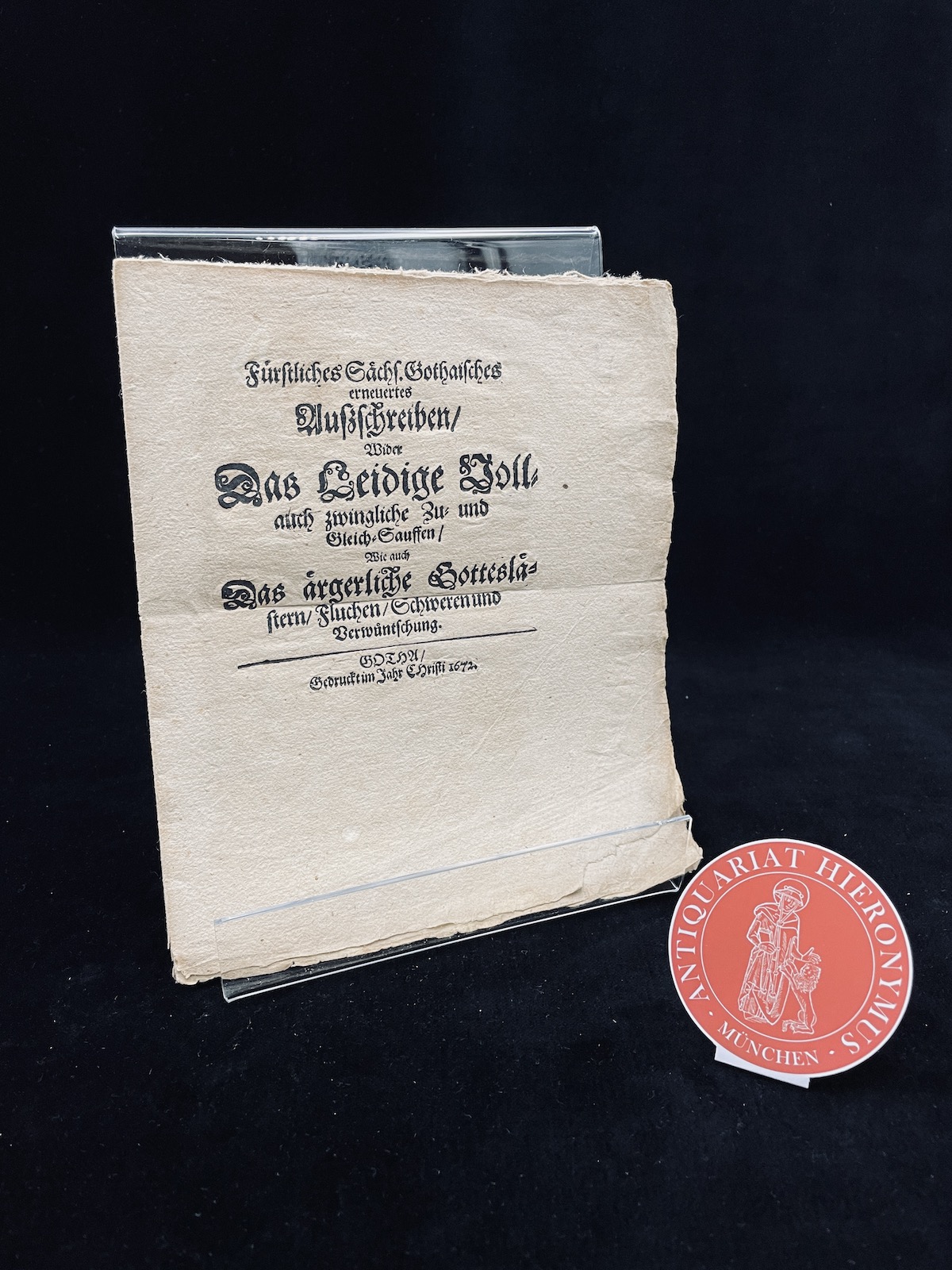
1672réf. 11411Gotha, [ohne Drucker], 1672. 8° (18,5-22,5 cm). 4 Bll. Broschur
1930réf. 64180Boston MA: Little Brown and Co. 1930. 8vo. xii 173 1 pp. Frontisp. numerous plates. Illustrated mustard-coloured publisher’s cloth wine glass illustration front cover w/ d.j. Art Deco cover art by Herold of drunken revelers minor shelfwear darkening to spine still NF/NF copy from the library of Eleanore Weinstock. First edition of this nicely illustrated and fascinating satirical examination of Prohibition Speakeasies Alcohol and the possible futures at the end of the Roaring 20’s as Americans invented a myriad of ways to keep drinking and socialize. Seldes has managed to inventively interweave a myriad of cocktail recipes into his observations along with a legion of cautionary and humorous tales. Little, Brown, and Co., hardcover
193158 pages. Features: Nice color ad for General Electric radios inside front cover; Hudson Essex car ad shows mother dropping kids at school; Nice full-page ad for Mimeograph; They'll Come Shooting (short story); Power and Glory - the gutsy story of Boies Penrose, one of the most prodigious figures in American political life - article with photos; Wild Geese (short story); A Lady of Resource (short story); Naughty Girl - Lenore Ulric serves allure in generous portions - article with photos; The Meanest Beast - battle between black leopard and shark; The Road Back (part VI of short story); You Couldn't Hate Patrick (short story); Thoughts that Win - Advice by champion golfer Jerome D. Travers - article with photo; Nice full-page color ad for Seald Sweet grapefruits; Full-page ad for Canada Dry ginger ales; The Scotty Dog (short story); Fantastic centerfold two-colour ad for Colorado tourism; Louisville & Nashville (L&N) Railroad full-page ad; Full-page ad for Philco radios features photos of Gary Cooper; Nice Chrysler ad; Full-page Fleischmann's Yeast ad encourages readers to eat three cakes per day (!); Back page article on prohibition; Attractive color Ford ad inside back cover shows doctor making housecall in the evening snow; Color Ipana ad on back cover. Average wear. Unmarked. A sound vintage copy. Book
1920réf. LIST120American 1920. Gelatin silver photograph 5 ½ x 3 ½ inches on Cyko stock photo paper. Very Good. A scarce photograph of a bootlegging operation c. early 1920s. The photograph is printed on Cyko stock which was used through the early 1920s. Few images of bootleggers have survived. The six men in the picture look quite serious in their work and it's difficult to imagine why they allowed a picture to be taken. A very good example with good contrast well preserved. unknown books
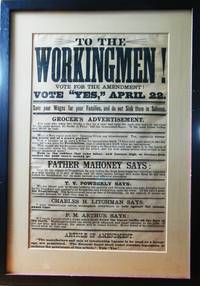
1918réf. 723Westerville OH: The American Issue Publishing Co. 1918. Very good. Vintage broadside. Image:12.75 x 20 in.; framed: 19 x 26 in. Custom dark brown wood frame matted under UV museum glass. Not examined outside of frame. Very good or better. Westerville Ohio was known as the "Dry Capital of the World" and home of the Anti-Saloon League -- the driving force behind the Prohibition movement in the United States. Some historians consider the league - founded in Oberlin Ohio in 1893 but based in Westerville from 1909 to 1973 - to be the first successful single-issue advocacy group a type of lobbying group common in the modern political landscape. This particular broadside from the prolific group admonishes men to "Save your wages for your families and do not sink them in saloons." There are quotes from Father Mahoney who testifies "Only let the claims of Prohibition be put before the Irish Americans and other Catholics in a way worthy of it and of them and all their tender feelings will make them be not only voters for Prohibition but its most earnest and effective guardians." There are further testimonies from anti-saloon advocates from the Knights of Labor and an author who wrote several books regarding the evils of drink. The American Issue Publishing Co. unknown
réf. 23092171-nnew. unknown
1930réf. 37586np 1930. Set of twelve postal envelopes complete in the "Jury Report On Prohibition" series. Each envelope depicts a Juror numbered 1 through 12 in satiric fashion with printed commentary. Minor occasional dusting Fine. Examples: Juror No. 1-- the foreman "A PROFESSIONAL REFORMER also active in the "anti-smoking crusade the Motorless Sabbath League Etc. Etc." Juror No. 2 - A Resort Proprietor. "I run a roadhouse and don't pay nothing to the Government." Juror No. 5 - Night Club Hostess. "Hello Suckers! We're all strong for Prohibition and HOW! Ever see so merry a party as this" Juror No. 8 - Bootlegger. "Prohibition is a Good Thing. I been in the business for twelve years and things are going along better than ever." Juror No. 9- Grape Grower. "Ever since da Prohibish I get a good a price for da grape." Juror No. 10- Machine-Gun Dealer. "Thanks to Prohibition I got a good steady job." Juror No. 12- Racketeer. "Prohibition give us our Big Chancest. unknown books