9 996 résultats
réf. 51-3840A Paris: De l'Imprimerie de P.G. Le Mercier Imprimeur-Libraire ordinaire de la Ville rue Saint Jacques au Livre d'Or. M.DCC.XL. Avec Privilege Du Roy. Large folio. 58.4 x 46.4cm. Contemporary half morocco and brown linen boards restored with new matching endpapers. 2 pages with manuscript flourishes with the name Lapie. Title page repaired in lower margin. Some pages with age stains in lower margins.ii 22 p. 13 pl. 8 dble.: 2 illus.; . Folio.General NoteSeven plates are unnumbered - pl. 2 3 5-7 10 11. The eight double pl. are nos. 1 2 8-13. Plate 4 has been bound in as a frontispiece. The two illus. are a t.p. vignette and headpiece at the head of the text.ContentsFrontis. t.p. - Text - Plates.Responsibility NoteAll plates are signed as drawn and engraved by J.F. Blondel. Most carry also the name of a designer - Salley pl. 1 2 6-9 12 13 Gabriel pl. 3 4 Servandony pl.5 or Rousset pl. 10 11. The title-page vignette is signed as drawn by Edm. Bouchardon and engraved by Soubeyran; the headpiece is signed as drawn and engraved by Jac. Rigaud.Summary NoteThe plates are a record of the celebrations mounted in Paris on the occasion of the marriage of Louise Elisabeth daughter of King Louis XV of France and Filippo Duke of Parma and son of King Philip V of Spain. The marriage itself took place in Spain at Alcala de Henares on 25 October 1739. The plates show: 1. Plan of the Seine; 2. Plan and elevation of a Temple of Hymen on Pont-Neuf; 3 & 4. Plan profile and elevation of the throne; 5. Plan and elevation of the Salon de Musique; 6 & 7. Boats decorated with lanterns; 8. Plan and elevation of the Louvre terrace showing tents; 9. Fireworks on the Seine; 10-13. Plans and sections of the Hôtel-de-Ville showing the courtyard illuminated for the ball.Important Parisian festival book” Bull. Morgand et Fatout 11011.The engraved plates by J.-Fr. Blondel represent: the flat map of the part of the Seine where the celebrations were given; le temple de l’Hymen the temple of the Hymen setting of the fire work placed on the platform of the Pont-Neuf; élévation géométrale du trône flat elevation of the throne built so Their Majesties would see the celebration executed after Gabriel’s drawings; le plan et l’élévation géométrale du salon de musique the map and flat elevation of the music room built in the middle of the river between the Pont-Neuf and the Pont-Royal ;les bateaux illuminés the illuminated boats. Plate 8 gives the élévation géométrale de la terrasse du bord de l’eau flat elevation of the terraces along the water where the tents were located for the retinue of their Majesties. Plate 9 gives us a vue générale de cette fête sur la Seine general view of the celebration on the Seine with all its settings illuminations and fireworks. Beside these thirteen plates the edition is illustrated with a fleuron drawn by Bouchardon and engraved by Soubeyran and with a large vignette used as letterhead drawn and engraved by J. Rigaud representing a joust on the Seine.These luxury works were covered more or less sumptuously. The sovereign and the princes of his family used to receive copies covered with dentelle morocco ministers morocco less richly decorated and the mere bishops volumes modestly bound with calf – all of them bearing though in the center of the covers the arms of the city that had financed the enterprise.OCLC Number: 560727468 A Paris,: De l'Imprimerie de P.G. Le Mercier, Imprimeur-Libraire ordinaire de la Ville, rue Saint Jacques, au Livre d'Or., M.DCC hardcover
2019réf. SBBIH-GED7MCNK2WLPEarth Pathways Co-operative 2019. spiral_bound. Good. Our good condition books are generally good for reading but not for gifting or collecting. They could have imperfections such as creasing fanning inscriptions margin notes yellowing staining on edge or cover or pages bumps scuffs etc etc sometimes multiple of these. It's a wide category that encompasses anything that isn't almost-new down to anything that is slightly better than poor. We would NOT recommend gifting Good books - these should be considered reading copies. Our books are dispatched from a Yorkshire former cotton mill. We list via barcode/ISBN so please note that the images are stock images and may not be the exact copy you receive furthermore the details about edition and year might not be accurate as many publishers reuse the same ISBN for multiple editions and as we simply scan a barcode or enter an ISBN we do not check the validity of the edition data when listing. If you're looking for an exact edition please don't order at least not without checking with us first although we don't always have time to check. We aim to dispatch prompty the service used will depend on order value and book size. We can ship to most countries see our shipping policies. Payment is via Abe only. Earth Pathways Co-operative unknown
1550réf. 4841Rome: Antonio Lafreri 1550. Hardcover. Fine. First state. With Lafreri's excudit: "Ant. LafrerI FormIs Romae MDL" at lower right. Watermark "Duck in a Circle"cf. Woodward 79-80. A fine impression rich in tone with light marginal foxing and light soiling particularly in the lower right corner and some trivial surface soiling to the image. An iconic image of the statue known as Pasquino by far the most famous of Rome's 'statue parlanti' talking statues and the eponymous originator of the pasquinade genre. The statue was discovered in 1501 in the Parione district of Rome. Cardinal Oliviero Carafa "the embodiment of humanist ideals centering on the revival of antiquity"Reynolds erected the statue next to his palace near Piazza Navona on the site of today's Palazzo Braschi where it stands to this day. As early as 1501 satirical poems in Latin and Italian variously celebrating or criticizing the pope clergy and nobility or lampooning private individuals were affixed to the statue. By 1508 the statue had become the focus of a yearly celebration held on St. Mark's Day during which the statue was dressed as a Roman deity or other mythological figure and anonymous writers attached to it poems written in the "voice" of the statue. In 1511 Pasquino was dressed as Grief mourning the death of Cardinal Carafa. In 1549 the year before this print was published Pasquino famously opined on the death of Pope Paul III: 'Here was buried a certain Paul/ a fraud a fox thief murderer;/ Here famous in the mouth of Pasquino/ There suffering in the mouth of the devil." The artist responsible for this print has included a number of pasquinades in Latin and Italian shown on bits of paper attached to the walls of Carafa's palace. The ground in front of the statue is strewn with props a reference to the costumes worn by Pasquino during the St. Mark's Day celebration. In the distance are two pairs of men the first standing in the piazza and the second strolling towards the statue. Carafa's arms are visible in the shadow on the statue's base. Lafreri's print is a close copy of one published in 1542 by Antonio Salamanca Lafreri's rival and eventual business partner. The identity of the artist is unknown. Among those to whom the plate has been attributed are Enea Vico and Nicolas Beatrizet. In the same year 1550 that he produced his Pasquino print Lafreri issued a related print the Marforio another of Rome's talking statues with whom Pasquino frequently held "conversations". The origin of the name "Pasquino" has been debated from the very early 16th century with no definitive conclusion having been reached. The sculpture itself comprises two figures believed to be either Menelaus cradling the dead Patroclus or Ajax holding the dead Achilles. The primary inscription is a sonetto caudato. Io non son come paio un Babbuino stroppiato senza piedi et senza mani Nemen con glialtri membri sconci et strani La simmia son di Niccolo Zoppino. Ma son quel famosissimo Pasquino Che tremar faccio i Signor piu soprani et stupir forastieri et Paesani quando compango in volgare o in Latino. La mia persona è fatta in tal maniera Per i colpi e hor questo hor quel in accocca Per ch'io dico i lor falli a buona cera. Ma infin ch'io ha l'usata lingua in bocca Non ne fo stima anchor che 'l resto pera et sempre cantaro Zara a chi tocca Che se la gente sciocca Non si vuol rimaner de i falli suoi Chi terrà me' che no 'l ridica poi. I am not as I seem a Babbuino crippled without hands or feet Nor with obscene and strange exotic parts am I the Ape of Nicolò Zoppino But I am that most famous Pasquino who makes the most prominent men shiver. and astonishes the out-of-towners and my fellow citizens when I compose in vernacular or in Latin. My persona was shaped in this way: by the blows I take from here and from there because I reveal their sins But as long as I have the use of the tongue in my mouth I do not care even if the rest of my body perishes and I will continue to sing whatever happens and the people who are offended must deal with it. Because if stupid people do not want to keep their sins to themselves Who is going to stop me from telling them The one that was sure to attract the most attention reads: Pasquin tu fuste et sarai semper un pazo Ti sai in ogni forma trasformate Se ti voi alle donne grato fare Per che non ti trasformi int' Vn Ca Pasquino you always were and always will be an idiot. You know how to transform yourself into any form If you want to please women Why don't you turn yourself into a dck Pasquino & Marforio: Witnesses to a Rivalry Prelude to a Partnership: The engravings of Rome's talking statues Pasquino and Marforio published in 1550 bear witness to the rivalry between the two leading Roman print publishers of the mid-16th c. Antonio Salamanca 1479-1562 and Antonio Lafreri 1512-1577 and to the vast publishing phenomenon that came to be known as the "Speculum Romanae Magnificentiae" The Mirror of Roman Magnificence". In the years following the sack of 1527 the Spanish emigree Antonio Salamanca began producing engravings of Roman subjects with regularity prior to the sack such prints were few and appeared sporadically. In the 1540s another emigree printer the Frenchman Antonio Lafreri Antoine Lafréry began a rival enterprise copying many of Salamanca's engravings. The Marforio and Pasquino images that Lafreri lifted from Salamanca both date to this period. In 1553 the two competing Roman publishers entered into a contractual alliance for twelve years "with the explicit purpose of printing and selling copperplate prints of ancient and modern subjects. When the contractual agreement between Salamanca and Lafreri was established in 1553 the underlying principle of the "Speculum" was in place: it was to be a corpus of documentary prints of ancient and modern Roman subjects mainly in folio."Parshall Lafreri's and Salamanca's engravings illustrating the ancient and modern marvels of Rome tombs temples palaces baths statuary obelisks columns inscriptions frescoes etc. were purchased by tourists as souvenirs studied by antiquarians used as models by artists and architects and circulated as virtual visits for armchair travelers beyond Rome. By the late 1570s collectors could also purchase an engraved title page while selecting prints for their own Speculum collections. As a result Lafreri's customers or those of his heirs Salamanca had died in 1562 and Parshall suggests that the title was only in use after Lafreri's death in 1577 collected images to suit their own needs or taste. After the death of Lafreri two-thirds of the existing copper plates went to his heirs and another third was sold to other publishers. These new owners continued to print the existing images while still producing new prints. The Marforio print offered here is in the second state with the name of one of these later publishers Pietro de Nobili added. "Print collecting in the Renaissance is not very well understood mainly because prints were numerous comparatively inexpensive and therefore rarely inventoried. They are less likely than other sorts of objects to come down to us with a clear indication of their original setting. Nevertheless the evidence of a few large collections from the sixteenth century does suggest some consistent patterns most notably that prints accumulated in substantial numbers tended to be compiled in albums where they were organized by subject- matter and scale. There is still much to learn about how such collecting practices evolved and the development of a market to serve them."Parshall "Antonio Lafreri's Speculum Romanae Magnificentiae" Print Quarterly March 2006 Vol. 23 No. 1 pp. 3-28. Antonio Lafreri hardcover
1550réf. 4841Rome: Antonio Lafreri 1550. Hardcover. Fine. First state. With Lafreri's excudit: "Ant. LafrerI FormIs Romae MDL" at lower right. Watermark "Duck in a Circle"cf. Woodward 79-80. A fine impression rich in tone with light marginal foxing and light soiling particularly in the lower right corner and some trivial surface soiling to the image. An iconic image of the statue known as Pasquino by far the most famous of Rome's 'statue parlanti' talking statues and the eponymous originator of the pasquinade genre. The statue was discovered in 1501 in the Parione district of Rome. Cardinal Oliviero Carafa "the embodiment of humanist ideals centering on the revival of antiquity"Reynolds erected the statue next to his palace near Piazza Navona on the site of today's Palazzo Braschi where it stands to this day. As early as 1501 satirical poems in Latin and Italian variously celebrating or criticizing the pope clergy and nobility or lampooning private individuals were affixed to the statue. By 1508 the statue had become the focus of a yearly celebration held on St. Mark's Day during which the statue was dressed as a Roman deity or other mythological figure and anonymous writers attached to it poems written in the "voice" of the statue. In 1511 Pasquino was dressed as Grief mourning the death of Cardinal Carafa. In 1549 the year before this print was published Pasquino famously opined on the death of Pope Paul III: 'Here was buried a certain Paul/ a fraud a fox thief murderer;/ Here famous in the mouth of Pasquino/ There suffering in the mouth of the devil." The artist responsible for this print has included a number of pasquinades in Latin and Italian shown on bits of paper attached to the walls of Carafa's palace. The ground in front of the statue is strewn with props a reference to the costumes worn by Pasquino during the St. Mark's Day celebration. In the distance are two pairs of men the first standing in the piazza and the second strolling towards the statue. Carafa's arms are visible in the shadow on the statue's base. Lafreri's print is a close copy of one published in 1542 by Antonio Salamanca Lafreri's rival and eventual business partner. The identity of the artist is unknown. Among those to whom the plate has been attributed are Enea Vico and Nicolas Beatrizet. In the same year 1550 that he produced his Pasquino print Lafreri issued a related print the Marforio another of Rome's talking statues with whom Pasquino frequently held "conversations". The origin of the name "Pasquino" has been debated from the very early 16th century with no definitive conclusion having been reached. The sculpture itself comprises two figures believed to be either Menelaus cradling the dead Patroclus or Ajax holding the dead Achilles. The primary inscription is a sonetto caudato. Io non son come paio un Babbuino stroppiato senza piedi et senza mani Nemen con glialtri membri sconci et strani La simmia son di Niccolo Zoppino. Ma son quel famosissimo Pasquino Che tremar faccio i Signor piu soprani et stupir forastieri et Paesani quando compango in volgare o in Latino. La mia persona è fatta in tal maniera Per i colpi e hor questo hor quel in accocca Per ch'io dico i lor falli a buona cera. Ma infin ch'io ha l'usata lingua in bocca Non ne fo stima anchor che 'l resto pera et sempre cantaro Zara a chi tocca Che se la gente sciocca Non si vuol rimaner de i falli suoi Chi terrà me' che no 'l ridica poi. I am not as I seem a Babbuino crippled without hands or feet Nor with obscene and strange exotic parts am I the Ape of Nicolò Zoppino But I am that most famous Pasquino who makes the most prominent men shiver. and astonishes the out-of-towners and my fellow citizens when I compose in vernacular or in Latin. My persona was shaped in this way: by the blows I take from here and from there because I reveal their sins But as long as I have the use of the tongue in my mouth I do not care even if the rest of my body perishes and I will continue to sing whatever happens and the people who are offended must deal with it. Because if stupid people do not want to keep their sins to themselves Who is going to stop me from telling them The one that was sure to attract the most attention reads: Pasquin tu fuste et sarai semper un pazo Ti sai in ogni forma trasformate Se ti voi alle donne grato fare Per che non ti trasformi int' Vn Ca Pasquino you always were and always will be an idiot. You know how to transform yourself into any form If you want to please women Why don't you turn yourself into a dck Pasquino & Marforio: Witnesses to a Rivalry Prelude to a Partnership: The engravings of Rome's talking statues Pasquino and Marforio published in 1550 bear witness to the rivalry between the two leading Roman print publishers of the mid-16th c. Antonio Salamanca 1479-1562 and Antonio Lafreri 1512-1577 and to the vast publishing phenomenon that came to be known as the "Speculum Romanae Magnificentiae" The Mirror of Roman Magnificence". In the years following the sack of 1527 the Spanish emigree Antonio Salamanca began producing engravings of Roman subjects with regularity prior to the sack such prints were few and appeared sporadically. In the 1540s another emigree printer the Frenchman Antonio Lafreri Antoine Lafréry began a rival enterprise copying many of Salamanca's engravings. The Marforio and Pasquino images that Lafreri lifted from Salamanca both date to this period. In 1553 the two competing Roman publishers entered into a contractual alliance for twelve years "with the explicit purpose of printing and selling copperplate prints of ancient and modern subjects. When the contractual agreement between Salamanca and Lafreri was established in 1553 the underlying principle of the "Speculum" was in place: it was to be a corpus of documentary prints of ancient and modern Roman subjects mainly in folio."Parshall Lafreri's and Salamanca's engravings illustrating the ancient and modern marvels of Rome tombs temples palaces baths statuary obelisks columns inscriptions frescoes etc. were purchased by tourists as souvenirs studied by antiquarians used as models by artists and architects and circulated as virtual visits for armchair travelers beyond Rome. By the late 1570s collectors could also purchase an engraved title page while selecting prints for their own Speculum collections. As a result Lafreri's customers or those of his heirs Salamanca had died in 1562 and Parshall suggests that the title was only in use after Lafreri's death in 1577 collected images to suit their own needs or taste. After the death of Lafreri two-thirds of the existing copper plates went to his heirs and another third was sold to other publishers. These new owners continued to print the existing images while still producing new prints. The Marforio print offered here is in the second state with the name of one of these later publishers Pietro de Nobili added. "Print collecting in the Renaissance is not very well understood mainly because prints were numerous comparatively inexpensive and therefore rarely inventoried. They are less likely than other sorts of objects to come down to us with a clear indication of their original setting. Nevertheless the evidence of a few large collections from the sixteenth century does suggest some consistent patterns most notably that prints accumulated in substantial numbers tended to be compiled in albums where they were organized by subject- matter and scale. There is still much to learn about how such collecting practices evolved and the development of a market to serve them."Parshall "Antonio Lafreri's Speculum Romanae Magnificentiae" Print Quarterly March 2006 Vol. 23 No. 1 pp. 3-28. Antonio Lafreri hardcover books
1915réf. 908941915. Gendai Haiga Shū ç¾ä»£ä¿³ç”»é›† A Collection of Modern Haiga Nakamura Fusetsu ä¸æ‘ä¸æŠ˜ et al artists Tokyo HaigadÅ 俳画堂 publisher Taisho 4-6 1915-17 4 volumes approx 25 x 16.5cm string-bound Japanese-style fukuro-toji thread-sewn Yamato binding. One volume is dated Taisho 4 1915 Spring one is 5 1916 Summer and two Fall and Winter are 6 1917. Three of the volumes are in the original decorated wrappers and one Spring is in plain wrappers. Compiled by Shimada Yukichi å³¶ç”°å‹‡å‰ and published by HaigadÅ 俳画堂 Tokyo. Printed by Abe NabegorŠ阿部é‹äº”郎 vol. 1 Matsui NaojirÅ æ¾äº•ç›´æ¬¡éƒŽ vols. 2-3 and Kishi Kageyoshi å²¸æ™¯å‰ vol. 4. 4 volumes of original color woodblock prints exploring the 4 seasons some featuring poems within the woodcut. Each volume has a Table of Contents in the front listing poems that reflect one of the seasons concluding words and a colophon. Spring has 28 full-page color woodcuts Summer has 31 and Autumn and Winter have 30 each for a total of 119. The Gendai Hanga Shū ç¾ä»£ä¿³ç”»é›† is a work of considerable skill and scarcity. The list of artists involved is a long one including Nakamura Fusetsu ä¸æ‘ä¸æŠ˜ Sazanami Iwaya å·–è°·å°æ³¢ Tomita Keisen Ishii Hakutei Hirafuku Hyakusui Ota Saburo Kosugi Misei Shimomura Izan and many other important figures in Western-style painting here working in their literati "haiga" mode. Mitchell had but one volume of the four the British Library only procured its own complete set within the last ten or fifteen years. Hillier seems to have missed the existence of the book completely. See Mitchell p. 266 Winter volume. Wear and dirt staining to covers. Toning on a few prints otherwise prints are in good condition. Very good printing. unknown
1915réf. 908941915. Gendai Haiga Shū ç¾ä»£ä¿³ç”»é›† A Collection of Modern Haiga Nakamura Fusetsu ä¸æ‘ä¸æŠ˜ et al artists Tokyo HaigadÅ 俳画堂 publisher Taisho 4-6 1915-17 4 volumes approx 25 x 16.5cm string-bound Japanese-style fukuro-toji thread-sewn Yamato binding. One volume is dated Taisho 4 1915 Spring one is 5 1916 Summer and two Fall and Winter are 6 1917. Three of the volumes are in the original decorated wrappers and one Spring is in plain wrappers. Compiled by Shimada Yukichi å³¶ç”°å‹‡å‰ and published by HaigadÅ 俳画堂 Tokyo. Printed by Abe NabegorŠ阿部é‹äº”郎 vol. 1 Matsui NaojirÅ æ¾äº•ç›´æ¬¡éƒŽ vols. 2-3 and Kishi Kageyoshi å²¸æ™¯å‰ vol. 4. 4 volumes of original color woodblock prints exploring the 4 seasons some featuring poems within the woodcut. Each volume has a Table of Contents in the front listing poems that reflect one of the seasons concluding words and a colophon. Spring has 28 full-page color woodcuts Summer has 31 and Autumn and Winter have 30 each for a total of 119. The Gendai Hanga Shū ç¾ä»£ä¿³ç”»é›† is a work of considerable skill and scarcity. The list of artists involved is a long one including Nakamura Fusetsu ä¸æ‘ä¸æŠ˜ Sazanami Iwaya å·–è°·å°æ³¢ Tomita Keisen Ishii Hakutei Hirafuku Hyakusui Ota Saburo Kosugi Misei Shimomura Izan and many other important figures in Western-style painting here working in their literati "haiga" mode. Mitchell had but one volume of the four the British Library only procured its own complete set within the last ten or fifteen years. Hillier seems to have missed the existence of the book completely. See Mitchell p. 266 Winter volume. Wear and dirt staining to covers. Toning on a few prints otherwise prints are in good condition. Very good printing. unknown books
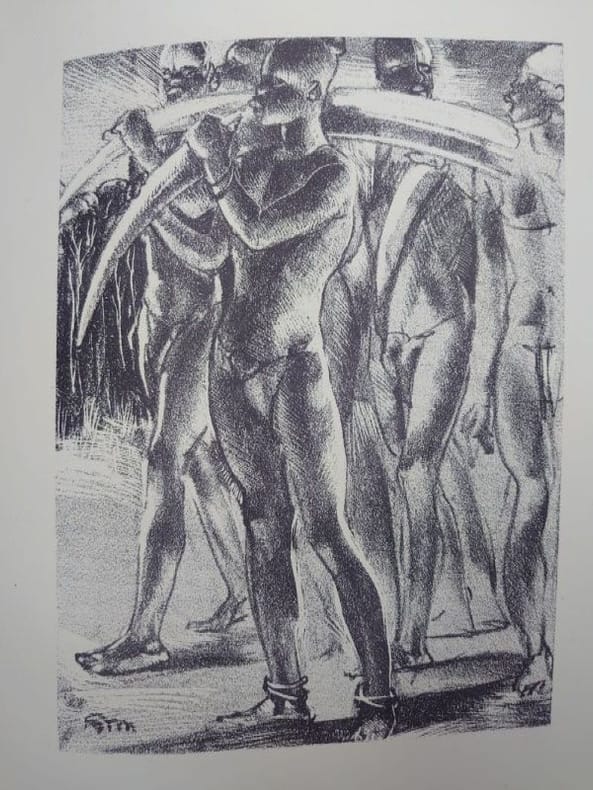
réf. 8177Liège, Union liégeoise du livre et de lestampe, 1934.33 x 25 cm, En feuilles, couv. imprimée et rempliée, chemise et emboîtage déditeur. Un des 75 exemplaires sur vélin à la forme Van Gelder destinés aux membres de lunion liégeoise (n°39 imprimé pour Henry Leclercq). Illustré de 41 lithographies de Mambour (complet). Étui avec de légères traces de frottement, exemplaire non coupé et intérieur très frais. Formé à lAcadémie des Beaux-Arts de Liège, Auguste Mambour, second prix de Rome en 1922. Il séjourne au Congo Belge de 1923 à 1926. Ce séjour sera déterminant pour lensemble de son oeuvre. En effet, tenté par lexpérience cubiste il en trouve un écho dans les « Sculptures vivantes » quil contemple en Afrique.
réf. 8177Liège, Union liégeoise du livre et de lestampe, 1934.33 x 25 cm, En feuilles, couv. imprimée et rempliée, chemise et emboîtage déditeur. Un des 75 exemplaires sur vélin à la forme Van Gelder destinés aux membres de lunion liégeoise (n°39 imprimé pour Henry Leclercq). Illustré de 41 lithographies de Mambour (complet). Étui avec de légères traces de frottement, exemplaire non coupé et intérieur très frais. Formé à lAcadémie des Beaux-Arts de Liège, Auguste Mambour, second prix de Rome en 1922. Il séjourne au Congo Belge de 1923 à 1926. Ce séjour sera déterminant pour lensemble de son oeuvre. En effet, tenté par lexpérience cubiste il en trouve un écho dans les « Sculptures vivantes » quil contemple en Afrique.
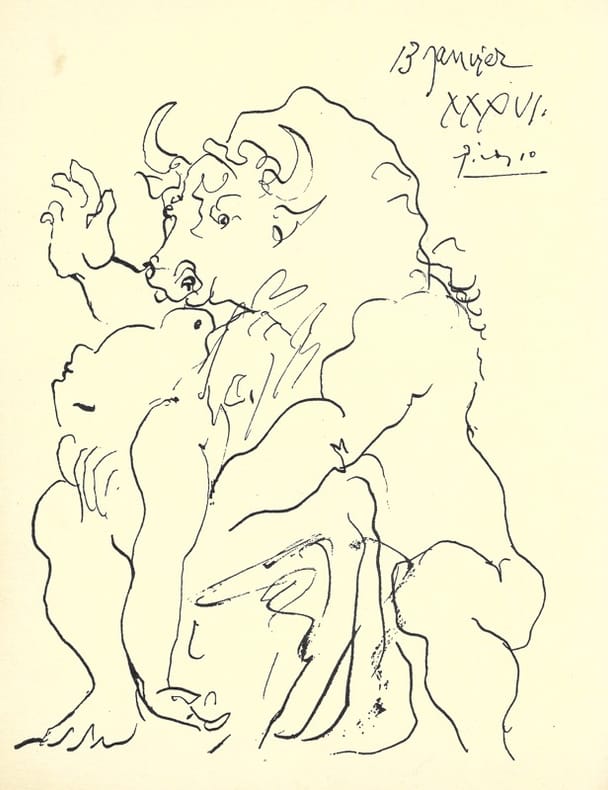
1936réf. 29759Frontispice de Picasso, envoi signé et épreuve par Man Ray Paris, GLM, coll. « Repères », n° 14, (mai) 1936. 1 vol. (190 x 250 mm) de [20] p. En feuilles, sous couverture rouge titrée. Édition originale. Frontispice de Picasso. Tirage unique à 70 exemplaires sur Normandy vellum teinté, justifié et signé par l’éditeur. Envoi signé : « à Suzanne Hugon, avec la vive sympathie et les compliments amicaux de René Char ».
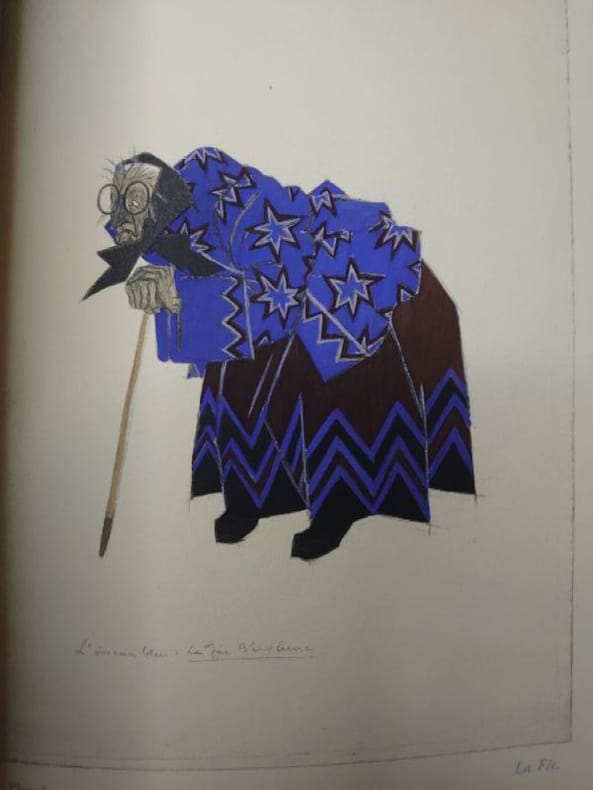
réf. 8194Paris, «Le Livre», 1925 (achevé d'imprimer daté 1924) et 1927. Deux volumes in-8 (16,4 x 24 cm). Deux volumes brochés, couvertures rempliées. Titre passé au dos du volume Décors et costumes avec une toute petite déchirure sur le bord de la couverture, sinon beaux exemplaires. Premier volume : [10], 212, [1], [1 bl.] pp. Édition ornée de 14 aquarelles reproduites au pochoir par G. Saudé: la vignette de couverture, 1 frontispice et 14 vignettes dans le texte. Tirage limité à 465 exemplaires numérotés plus 25 hors commerce. Un des 400 sur Arches. Le frontispice est contresigné par Lepape au crayon. Deuxième volume : [4], x, [1], [1 bl.], [1], [1 bl.] pp. Album de 61 planches dont 7 décors à double page mises en couleur au pochoir par J. Saudé. Tirage limité à 225 exemplaires numérotés plus 5 hors commerce. Un des 200 sur Arches.
réf. 8194Paris, «Le Livre», 1925 (achevé d'imprimer daté 1924) et 1927. Deux volumes in-8 (16,4 x 24 cm). Deux volumes brochés, couvertures rempliées. Titre passé au dos du volume Décors et costumes avec une toute petite déchirure sur le bord de la couverture, sinon beaux exemplaires. Premier volume : [10], 212, [1], [1 bl.] pp. Édition ornée de 14 aquarelles reproduites au pochoir par G. Saudé: la vignette de couverture, 1 frontispice et 14 vignettes dans le texte. Tirage limité à 465 exemplaires numérotés plus 25 hors commerce. Un des 400 sur Arches. Le frontispice est contresigné par Lepape au crayon. Deuxième volume : [4], x, [1], [1 bl.], [1], [1 bl.] pp. Album de 61 planches dont 7 décors à double page mises en couleur au pochoir par J. Saudé. Tirage limité à 225 exemplaires numérotés plus 5 hors commerce. Un des 200 sur Arches.
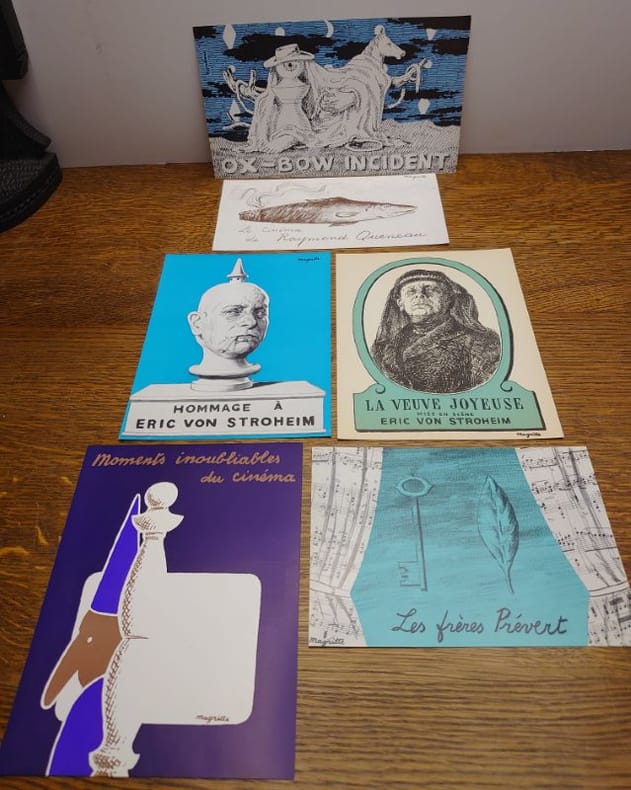
réf. 8639- La veuve joyeuse. Mise en scène Eric von Stroheim. Écran du Séminaire des Arts. Séance du 29 novembre 1955. Bruxelles, Palais des Beaux-Arts, 1955. Prospectus 18,5 x 14 cm, avec la reproduction en vert et noir d'un dessin de Magritte, signé en bas à droite. - Hommage à Eric von Stroheim. Écran du Séminaire des Arts. Séance des 8 et 22 octobre 1957. Bruxelles, Palais des Beaux-Arts, 1957. Prospectus 18,5 x 13,6 cm, avec un dessin reproduit en similigravure, signé Magritte en haut à droite. - Moments inoubliables di cinéma. Écran du Séminaire des Arts. Séance du 2 décembre 1958. Bruxelles, Palais des Beaux-Arts, 1958. Prospectus 18,5 x 14 cm, avec un dessin reproduit en similigravure, signé Magritte en bas à droite. - Oxbow Incident. Écran du Séminaire des Arts. Séance du 13 janvier 1959. Bruxelles, Palais des Beaux-Arts, 1959. Prospectus 13 x 22 cm, avec un dessin reproduit, signé Magritte en haut à gauche. - Les frères Prévert. Écran du Séminaire des Arts. Séance du 17 octobre 1961. Bruxelles, Palais des Beaux-Arts, 1961. Prospectus 12 x 17 cm, avec un dessin reproduit, signé Magritte en bas à gauche. - Le cinéma de Raymond Queneau. Écran du Séminaire des Arts. Séance du 17 mars 1964. Bruxelles, Palais des Beaux-Arts, 1964. Prospectus 10,3 x 19,6 cm, avec la reproduction d'un dessin Le Cinéma de Raymond Queneau, signé Magritte en haut à droite. Réf : Schwilden, Magritte et l'image, pages 57, 58, 59, 60. 138 [Fig. 37, 38, 39, 40, 41, 42]. Ancienne collection R.C.
réf. 8639- La veuve joyeuse. Mise en scène Eric von Stroheim. Écran du Séminaire des Arts. Séance du 29 novembre 1955. Bruxelles, Palais des Beaux-Arts, 1955. Prospectus 18,5 x 14 cm, avec la reproduction en vert et noir d'un dessin de Magritte, signé en bas à droite. - Hommage à Eric von Stroheim. Écran du Séminaire des Arts. Séance des 8 et 22 octobre 1957. Bruxelles, Palais des Beaux-Arts, 1957. Prospectus 18,5 x 13,6 cm, avec un dessin reproduit en similigravure, signé Magritte en haut à droite. - Moments inoubliables di cinéma. Écran du Séminaire des Arts. Séance du 2 décembre 1958. Bruxelles, Palais des Beaux-Arts, 1958. Prospectus 18,5 x 14 cm, avec un dessin reproduit en similigravure, signé Magritte en bas à droite. - Oxbow Incident. Écran du Séminaire des Arts. Séance du 13 janvier 1959. Bruxelles, Palais des Beaux-Arts, 1959. Prospectus 13 x 22 cm, avec un dessin reproduit, signé Magritte en haut à gauche. - Les frères Prévert. Écran du Séminaire des Arts. Séance du 17 octobre 1961. Bruxelles, Palais des Beaux-Arts, 1961. Prospectus 12 x 17 cm, avec un dessin reproduit, signé Magritte en bas à gauche. - Le cinéma de Raymond Queneau. Écran du Séminaire des Arts. Séance du 17 mars 1964. Bruxelles, Palais des Beaux-Arts, 1964. Prospectus 10,3 x 19,6 cm, avec la reproduction d'un dessin Le Cinéma de Raymond Queneau, signé Magritte en haut à droite. Réf : Schwilden, Magritte et l'image, pages 57, 58, 59, 60. 138 [Fig. 37, 38, 39, 40, 41, 42]. Ancienne collection R.C.
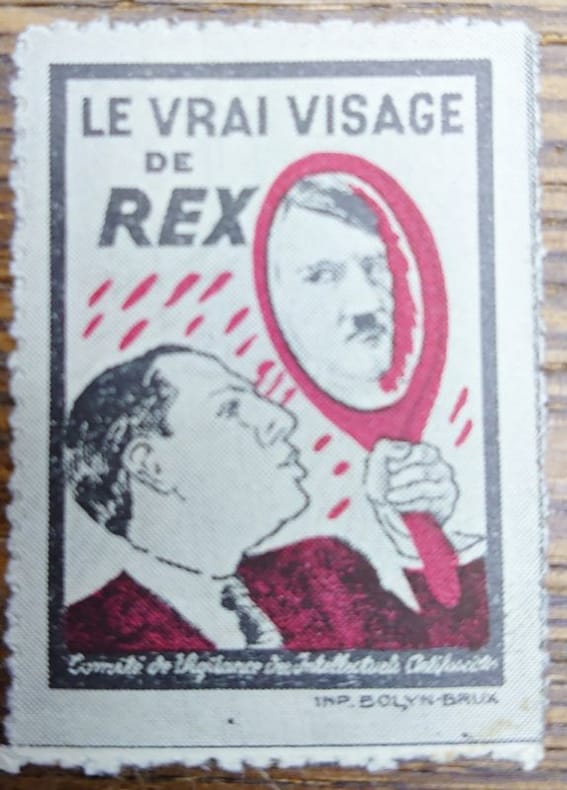
réf. 8642Photogravure, 5,3 x 3,3 cm, sur papier gommé. Bel état. Rarissime. Timbre inspiré d'une affiche réalisée par Magritte pour le Comité de vigilance des intellectuels antifascistes, probablement pour la campagne électorale de 1937. Léon Degrelle, chef du parti rexiste, se regarde dans un miroir où apparaît le visage de Hitler. Tiré en rouge et noir. Réf. pour l'affiche : Schwilden, Magritte et l'image, page 31, 74 [Fig. 94]. Ancienne collection R.C.
réf. 8642Photogravure, 5,3 x 3,3 cm, sur papier gommé. Bel état. Rarissime. Timbre inspiré d'une affiche réalisée par Magritte pour le Comité de vigilance des intellectuels antifascistes, probablement pour la campagne électorale de 1937. Léon Degrelle, chef du parti rexiste, se regarde dans un miroir où apparaît le visage de Hitler. Tiré en rouge et noir. Réf. pour l'affiche : Schwilden, Magritte et l'image, page 31, 74 [Fig. 94]. Ancienne collection R.C.
1991Nine signed and justified original aquatints on chine collÈ by Joan Hern·ndez Pijuan. The first three measure 56 x 76 cm (sheet) and the other six measure 28 x 38 cm (sheet). Edition limited to 50 impressions printed on fine, thick wove paper. Maluquer 311-319. FINE AND BRIGHT, like new. Price is for the set. Complete sets are of the greatest rarity; I have found no record of one ever being offered for sale. Individual prints may be available separately. Please inquire.
1930réf. 32150Reliure de Paul Bonet pour Carlos Scherrer Paris, Pour les Bibliophiles du Palais, 1930. 1 vol. (175 x 255 mm) de 164 p. et 2 f. Maroquin et veau verts formant un décor partagé sur les plats suivant une ligne brisée verticale, réhaussé d'un motif au filet or évoquant un sarment de vigne au premier plat et une branche de laurier au second plat, titre doré à la chinoise, tête dorée, couvertures et dos conservés, chemise et étui bordés (reliure signée de Paul Bonet [1931]). Nouvelle traduction par Louis Martin-Chauffier. Édition illustrée de 25 burins originaux de J.-É. Laboureur in et hors texte. Tirage à 200 exemplaires sur vélin de Rives, celui-ci nominatif pour Henri Reitlinger (n° 35). Conservé dans l'exemplaire : le menu illustré par Laboureur du 24 mars 1930 titré « Dîner de La Paix».
2025réf. 3165022 hommages à Pierre Boulez Rimini, Luigi Castiglioni Editore, (27 mars) 2025. 1 vol. (240 x 380 mm) de 234 p. Veau noir à décor, avec insert en aluminium sur le premier plat figurant le titre « Boulez», dos lisse, non rogné (Luigi Castiglione, 2025). Edition originale. Tirage unique à 200 exemplaires, imprimés en lithographie sur Fabriano Tiepolo, signés par les éditeurs.
1962réf. 25784Tirage confidentiel des photos de Sudre pour le récital Léo Ferré de l'ABC 1962 [Paris, ABC, décembre 1962]. 1 vol. (135 x 180 mm) de [2] f., [14] tirages photographiques originaux, 2 f. Broché, sous double couverture et rodhoïd. Édition unique composée de 15 photos dont 7 à double page. Tirage non précisé, à petit nombre, celui-ci exemplaire justifié et signé par le photographe «album n° 11» et signé et daté par Léo Ferré, « 5 décembre 1962 ».
1882réf. 17862Le premier livre de l'auteur, comportant un tendre envoi à sa mère Paris, Lemerre, [mai] 1882. 1 vol. (125 x 185 mm) de 2 et [1] f., 153 p. et 1 f. Broché, sous emboîtage (Goy et Vilaine). Édition originale. Frontispice en héliogravure de Gustave Moreau, «La jeune fille Thrace portant la tête d'Orphée». Un des 25 premiers exemplaires imprimés sur papier de Hollande, celui-ci non justifié. Envoi signé : «à toi, ma très douce et patiente mère, à toi à laquelle est échue cette croix lourde entre toutes d'avoir pour fils un être insupportable entre tous, fou pour les uns, idiot pour les autres, fantasque pour tous... puisqu'on veut bien m'appeler poète... ces vers sont encore plus tes enfants que les miens, puisque tu es leur aïeule, à toi donc le premier enfant de ton sang et du mien et puissé-je un jour à venir te faire oublier tous les mauvais mois et les dures années que t'ont fait et ma cervelle fantasque et les cruels instincts de tout être qui écrit. Ton Jean Paul. Juin 82 ».
réf. 864527,5 x 20,5 cm. Deux feuillets avec une trace de pliure légèrement roussie. Sinon bons exemplaires. Ces planches originales illustraient à pleine page un texte de Paul Nougé intitulé Les échecs vus par René Magritte, et ont été réalisées par Magritte sur stencils à l'aide d'une pointe sèche. - La première planche tirée à l'encre bleue représente trois bilboquets à museaux signée en bas à droite Magritte. - la deuxième planche tirée à l'encre bleue représente une feuille accolée à une main tenant un pion d'échecs signée en bas à droite Magritte.ces illustrations furent réalisées devant plusieurs témoins. Magritte les dessina à main levée sur des stencils à l'aide d'un vieux clou. Il en fut effectué trois tirages reconnaissable à l'encrage et au papier. Nos exemplaires sont du premier tirage, tirées à l'encre bleue. Malgré le tirage annoncé de la revue à 417 exemplaires, il est plus que probable qu'il fut beaucoup moins important. Il pourrait même n'avoir été que de 20 à 25 exemplaires au maximum ! (Schwilden pages 90 et 91). Réf. : Schwilden, Magritte et l'image, pages 90-91, 215 [Fig. 77 et 78]. Ancienne collection R.C.
réf. 864527,5 x 20,5 cm. Deux feuillets avec une trace de pliure légèrement roussie. Sinon bons exemplaires. Ces planches originales illustraient à pleine page un texte de Paul Nougé intitulé Les échecs vus par René Magritte, et ont été réalisées par Magritte sur stencils à l'aide d'une pointe sèche. - La première planche tirée à l'encre bleue représente trois bilboquets à museaux signée en bas à droite Magritte. - la deuxième planche tirée à l'encre bleue représente une feuille accolée à une main tenant un pion d'échecs signée en bas à droite Magritte.ces illustrations furent réalisées devant plusieurs témoins. Magritte les dessina à main levée sur des stencils à l'aide d'un vieux clou. Il en fut effectué trois tirages reconnaissable à l'encrage et au papier. Nos exemplaires sont du premier tirage, tirées à l'encre bleue. Malgré le tirage annoncé de la revue à 417 exemplaires, il est plus que probable qu'il fut beaucoup moins important. Il pourrait même n'avoir été que de 20 à 25 exemplaires au maximum ! (Schwilden pages 90 et 91). Réf. : Schwilden, Magritte et l'image, pages 90-91, 215 [Fig. 77 et 78]. Ancienne collection R.C.
réf. 4661 En feuillets, sous chemise à rabats illustrée de l'éditeur, très léger défaut à la couverture fort habilement restaurée. 33 x 24 cm, 1 f. double n.ch. + 10 pl. Bruxelles, Éditions de l'art décoratif C. Dangotte, Collection du Petit Artiste, 1918. Édition originale.
réf. 4661 En feuillets, sous chemise à rabats illustrée de l'éditeur, très léger défaut à la couverture fort habilement restaurée. 33 x 24 cm, 1 f. double n.ch. + 10 pl. Bruxelles, Éditions de l'art décoratif C. Dangotte, Collection du Petit Artiste, 1918. Édition originale.
1819réf. 007599London: H. R. Young. Printed by J. McCreery 1819. Second Edition. Full Straight-Grained Morocco. Cloth Slipcase. Very Good Plus. Folio 33 by 24 cm. xiv 2 306 4 239 13 pp. Also two engraved half-titles with illustration of tiger and with 40 hand-colored plates 20 in each volume. Contemporary dark green straight-grained full morocco binding with ornate gilt border decoration -- a repeat of vines and leaves contained within ruled lines and also a blindstamped band within this one. Five raised bands of spine with ruled lines denoting the raised areas and four gilt impressed vignettes of deer. Professionally rebacked both volumes with original spines retained and attached in a manner that the work is as inconspicuous as possible. The gilt decoration -- floral borders ruled edges turn-ins spine illustrations lettering has spots that are dulled but generally the gold remains bright. The leaves within both text and plates are also generally clean almost remarkably so notwithstanding the most occasional of spots of soiling. H. R. Young. Printed by J. McCreery unknown