19.010 resultados
1934ref. 56170Omaha NE: Northwestern Fur Company ca. 1934. Two vols. 4to. 15 1; 16 pp unpaginated. with numerous photo and text illustrations diagrams. Self-printed illustrated softcovers both with cover art of stylish young women wearing furs including one in front of an Art Deco screen both with centerfold creases as issued minor shelfwear rubbing still VG set retaining original mailing envelope addressed to A.lbert H.enry McConnell 1861-1939 Payette Valley Silver Fox Farm Fruitland ID formerly of Gunnison CO set up his fruit orchards ranching business and other opportunities in Idaho. First editions of these very rare fur fashion and furrier supply catalogues issued by the Northwestern Fur Co. of Omaha NE including in the first catalogue furs for sale such as chokers scarfs muskrat Northern Seal Hudson Seal Caracul Siberian Squirrel and others. Also included are listings for furriers’ tools and equipment taxidermy work fasteners and more while the second catalogue promotes the complete furrier course offered by the company. Elwood 1875-1947 with two partners Paul F. Greve and R.H. Smith incorporated the Northwestern Fur Company school of taxidermy and the Northwestern Fur Company furs mail order in 1903 and quickly expanded for the succeeding decades. Elwood had previously taught and been director at a trade school in Iowa before moving to Omaha NE and continued as the public face of the mail order company for decades eventually closing down in the 1980s. No copies located in Worldcat; See: Northwestern School of Taxidermy Northwestern Fur Company Nebraska State Historical Society Manuscript Finding Aid RG5451.AM. Northwestern Fur Company, paperback
1955ref. 56299Vienna: Wiener Modellgesellschaft M.B.H. Editions de Mode Fashion Publications 1955. Folio. 9 x 13 in. 23 colour plates in pochoir-inspired hand-coloured style. Printed beige softcovers minor creasing head of spine minor dustsoiling still VG bright copy. First edition thus of this beautifully rendered collection of haute couture summer dress designs issued by the Viennese fashion cooperative in the 1950s. These designs show the decided shift towards elegance and perfectly matched accessories for women during the 1950s with nipped-in waists full-skirted dresses as well as tailored fitted clothes with a hint of playfulness and exuberance inspired by the designs of Cristobal Balenciaga and Hubert de Givenchy as well as the feminine silhouette of Christian Dior. No copies in Worldcat of this issue. Wiener Modellgesellschaft, M.B.H., Editions de Mode, Fashion Publications], paperback
1936ref. 56297Vienna Austria & Paris: Les Editions Leon Claude 4 Rue mayran 1936. Folio. 10.75 x 14.6 in. 4 pp. With 25 colour fashion plates text printed in French English & German. Textured beige softcovers raised & embossed gilt lettering front cover black lettering for Leon Claude minor chipping head & foot of spine edgewear some scuffing still a VG copy w/ the fashion plates in bright condition. First edition of this very scarce and beautifully printed fashion design magazine from the mid 1930s produced by the publishing house which also published fashion publications such as Paris Chic La Coquette and Le Gout Parisien. These designs show the dominant influence of Elsa Schiaparelli’s fashions in the 1930s as she continued Chanel’s idea of comfortable jackets but with the emphasis on beautiful tailoring. The designs here include most in 3/4 length with some sporting shapes and belted jackets as well as fancy wraps made from leopard panther kid-astrakhan Buenos broadtail lamb beaver otter Persian lamb musk mink fox and others. The collars are voluminous and flaring all the way around and the linings are often chosen to complement and match the dresses worn by the models. These 1930s fashions show a dramatic drop in hem lengths the new French beret style hats worn at an angle and designs which inspired the Hollywood glamor look of the era popularized by Joan Crawford Carole Lombard and others. The designs are glamorous and chic with many having geometric patterns and reflecting the Art Deco influence. These fashion designs were issued only to subscribing specialty shops boutiques and fashion enthusiasts at the time with eight different issues on assorted subjects appearing annually. No copies of this issue located in Worldcat. Les Editions Leon Claude, 4, Rue mayran, paperback
1944ref. 56300Nice Paris & Maresille: A La Francaise May 1944. 4to. 78 14 pp. With numerous colour plates colour ads over 100 black & white text illustrations & photos. Colour-illustrated softcovers colour cover art on rear minor shelfwear slight rubbing light spotting to front cover and first couple leaves still VG- bright copy. First edition of this very scarce French fashion and luxury goods magazine published in occupied France a few months before the “liberation of Paris” and the Battle of Marseille. The lavish ads and articles tout the achievements of Parisian fashion designers French artists the cosmetics & perfume industry of Paris theatre productions Nazi-controlled French cinema and more. There are few of these occupied France publications surviving and Worldcat does locate a complete run at the Bibliotheque National. A La Francaise], paperback
1940ref. 56298Vienna Germany & Paris: La Mode Artistique S.A. 4 Rue mayran 1940. Folio. 10.75 x 14.6 in. 4 pp. With 28 colour fashion plates text printed in French English & German. Textured beige softcovers raised & embossed gilt lettering front cover black lettering for La Mode Artistique minor chipping head & foot of spine edgewear some scuffing still a VG copy w/ the fashion plates in bright condition. First edition of this very scarce and beautifully printed fashion design magazine issued in the opening years of World War II following the occupation of Paris in the summer of 1940 originally owned by Leon Claude. The firm had also published fashion publications such as Paris Chic La Coquette and Le Gout Parisien. These fashion designs show the growing restraint and conservatism of Nazi Germany and reflecting the desire by Adolf Hitler to extinguish French influence in European fashion. The designs here include most in 3/4 length with some sporting shapes and belted jackets as well as fancy wraps made from seal kid-astrakhan Buenos broadtail lamb beaver otter nutria ocelot Persian lamb musk mink fox and others. The collars are trimmer and the linings are often chosen to complement and match the dresses worn by the models. These 1940s fashions still show the dramatic drop in hem lengths feathered hats worn by Germans & Austrians and designs which inspired the Hollywood glamor look of the era popularized by Greta Garbo Joan Crawford Carole Lombard and others. These fashion designs were issued only to subscribing specialty shops boutiques and fashion enthusiasts at the time with eight different issues on assorted subjects appearing annually. No copies of this issue located in Worldcat. La Mode Artistique, S.A., 4, Rue mayran, paperback
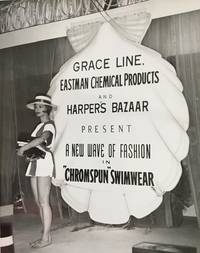
1959ref. 56594New York & Rochester NY: Grace Line Harper’s Bazaar & Eastman Chemical Products subsidiary of Eastman Kodak 1959. 4to. With 33 black & white photographs inserted in mylar sleeves. Recent flexible black vinyl cover portfolio NF exemplar w/ images having bright strong contrast. First edition of this remarkably scarce group of photos advertising the 1959 fashionable swimsuits made from Chromspun acetate yarn developed for textiles by Eastman Kodak in the early 1950s. Discovered while developing cigarette filters the yarn proved durable and elastic enough for swimsuits other apparel home furnishings and other applications. The swimsuits modeled in this show were influenced by and possibly included the very popular Rose Marie Reid line of swimwear which was heavily marketed by Harper’s Bazaar during the 1940s and 1950s and was considered to be the quintessential California swimsuit worn by such stars as Jane Russell and Sandra Dee in the first Gidget movie produced by Columbia in 1959. Represented in these photos are the swimsuits included the strapless bikini princess bubble Baby Doll often with stripes and cover-ups. Although not indicated in the photographs this fashion show was probably held on one of the new Grace Line ocean liners the Santa Rosa which was delivered in 1958 and serviced the Caribbean South America and traveled through The Saint Lawrence Seaway into the Great Lakes. See: Rose Marie Reid Glamour by Design Special Collections Exhibit Brigham Young University 2015-2016; Michael Grace The Grace Line History Cruising the Past Travel and Social History 2009; Jean Was a “Young American Goddess of Paris Couture” Jean Patchett Prose on Genesis 2020. Grace Line, Harper’s Bazaar, & Eastman Chemical Products, subsidiary of Eastman Kodak, unknown
1887ref. 55685New Haven CT & Pittsburgh PA: L. Candee & Co. H. Childs & Co. 1887. 8vo. 28 pp. Decorated title page lithographed illustrations throughout. Embossed & decorated softcovers front cover decorated & illustrated in gilt & burgundy w/ peacock feather above lettering and nicely executed lithograph on back cover of young saleswoman standing next to a rack of rubber boots & shoes for sale minor toning shelfwear very slight tidemark at upper fore-edge front cover still a VG copy. First edition of this nicely printed Victorian catalogue for rubber boots and shoes. The nicely executed lithographs promote the Hip Boots hip waders thigh high sporting boots double thick Pebble Leg Boots and Fairy Boots reminiscent of cowboy boots as well as the rubber Duck or Canvas Boot for hunting. Also included are many different styles and varieties of rubber shoes for women and children including No Heel Imitation Sandals Gossamer Imitation Sandals Buskins with cotton flannel lining Opera Dew Drop Feather Weight and many others. The company also produced tennis rubber soled shoes croquet shoes as well as heavy duty Stalwart Lumbermen’s Shoe intended to fit over logger’s Wool Boots or German Socks. Leverett Candee 1795-1863 obtained early patent rights from Goodyear for manufacturing rubber shoes as early as 1844 and by 1852 had organized the large Candee Rubber Co. factory with the Hotchkiss Brothers in New Haven and Timothy Lester. No copies located in Worldcat; See: Davis The New England States Vol. I pp. 344-346 1897; Joseph Kane Famous First Facts 1950. L. Candee & Co., [H. Childs & Co.], paperback
1910ref. 56013Chicago & Tacoma: Hart Schaffner & Marx; Dege & Milner 1910. Sml. 4to. 32 pp unpaginated. Black & white plates throughout. Colour-illustrated softcovers cover art with initials S.N.A. of young colonial woman carrying basket full of lobsters by two Redcoats slight dustsoiling minor shelfwear still an excellent copy. First edition of this scarce and nicely illustrated catalogue for Hart Schaffner & Marx clothing before World War I. The company was well known for their lavish use of colour lithography in advertising and especially their catalogues. This includes a series of exceptional artwork displaying overcoats formal dress sportswear automobile travel clothes for men and more. These motoring coats were clearly being marketed to young men and college students increasingly taking to the roads during the Brass Era. This copy was printed for the Dege & Milner department store in downtown Tacoma which was operated from 1901-1915 by James H. Dege and his partner William Milner before Dege opened the James H. Dege Co. store. Hart Schaffner & Marx; Dege & Milner, paperback
1906ref. 56017Tacoma WA: Dickson Bros. Co. 1120-1122 Pacific Ave. The Quick Print 1906. 8vo. 42 2 pp. With woodcut-engraved illustrations throughout. Pictorial light green softcovers front cover art rendering of the Dickson Bros. front facade before expansion and young college men wearing suits in Cornell dorm room minor toning to fore-edges minor curling to textblock 1 very small tear still a VG copy. First edition of this exceedingly scarce Washington department store catalogue for the Dickson Bros. Co. which expanded quickly at 1120-1144 Pacific Ave. in Tacoma WA during the first 30 years of the 20th Century. The company flourished by emphasizing ready-to-wear lines of clothing rather than tailored clothing selling Adler Bros. and Stein-Bloch suits and clothing based out of Rochester NY Stetson Hats and more. They also sold heavy denim work clothes such as Keystone railroad overalls and jackets trunks traveling bags boots shoes and more. George Dickson 1851-1935 was an active outdoorsman mountaineer and merchant in Tacoma. No copies located in Worldcat; See: George L. Dikcson’s Narrative Tacomian Jan. 7 1893. Dickson Bros. Co., 1120-1122 Pacific Ave., The Quick Print, paperback
1910ref. 56014New York & Tacoma: Samuel W. Peck & Co.; Dege & Milner 1910. 8vo. 12 pp unpaginated. Colour-illustrated title 7 colour plates text printed in red & blue w/ decorations. Gray pictorial softcovers cover art image of Atlas holding a globe in blue & gilt embossed gilt lettering & decoration fine copy. First edition of this wonderfully illustrated fashion catalogue targeting the young college man in the decade before World War I. This inventive catalogue positions models wearing Sampeck suits in front of the ancient Wonders of the World including the Pharos Lighthouse of Alexandria Pyramids of Egypt Colossus of Rhodes and more. Sampeck clothes were targeted to the virile aggressive young college man competeing with the Hart Schaffner & Marx Varsity line. This copy was printed for the Dege & Milner department store in downtown Tacoma which was operated from 1901-1915 by James H. Dege and his partner William Milner before Dege opened the James H. Dege Co. store. No copies located in Worldcat; See: Daniel Clark Creating the College Man: American Mass Magazines and Middle-Class Manhood pp. 169-170. Samuel W. Peck & Co.; Dege & Milner, paperback
1910ref. 56016New York & Tacoma: Samuel W. Peck & Co.; Dege & Milner Printed by Sherman & Bryan Inc. 1910. Sml. 4to. 16 pp unpaginated. Colour-illustrated borders & plates throughout with artwork reminiscent of children’s book illustrator Virginia Keep. Colour-illustrated softcovers cover art image of boys tossing down apples from a tree fine copy. First edition of this wonderfully illustrated fashion catalogue targeting the young boys in the decade before World War I. The illustrations depict young boys in knickers short coats and capes running carving Jack-o-Lanterns for Halloween playing with a dog and collecting chestnuts. This copy was printed for the Dege & Milner department store in downtown Tacoma which was operated from 1901-1915 by James H. Dege and his partner William Milner before Dege opened the James H. Dege Co. store. No copies located in Worldcat. Samuel W. Peck & Co.; Dege & Milner, (Printed by Sherman & Bryan, Inc.), paperback
1910ref. 56015New York & Tacoma: Alfred Benjamin & Co.; Dege & Milner 1910. 8vo. 16 pp unpaginated. Black & white plates throughout including double-page centerfold pen & ink reminiscent of work of Charles Dana Gibson. Colour-illustrated softcovers cover art of horse-drawn sleigh in the snow slight dustsoiling minor shelfwear still an excellent copy. First edition of this scarce and nicely illustrated catalogue for Alfred Benjamin & Co. fashions for men before World War I. Benjamin Clothes were famed during the opening two decades of the 20th Century for emphasizing their cosmopolitan styling and that they were wholly manufactured and tailored in New York of the highest quality. The plates show well-dressed Benjamin men on the steps of The Met next to the Franz Sigel Statue on Riverside Drive in front of their Brass Era automobile at The Abbey on Lafayette and more. This copy was printed for the Dege & Milner department store in downtown Tacoma which was operated from 1901-1915 by James H. Dege and his partner William Milner before Dege opened the James H. Dege Co. store. No copies located in Worldcat. Alfred Benjamin & Co.; Dege & Milner, paperback
1874ref. 54872Boston: C.F. Hovey & Co. 1874. Folio. 13.5 x 11 in. 36 pp. 1 59 1 leaves. first 36 pp. incorporating title Memorandum pages several ALS letters and invoices on letterhead 8 pp. on graph paper w/ samples incorporated into the text 2 additional leaves of tissue thin manuscript copies from blotter 925 original fabric samples pinned-in glued-in and laid in sized from .5 x .5 in. up to 6 x 13 in. including a myriad of colours tartans plaids flannels silk blends cottons poplin cottons woolens etc. Original plum-coloured factory sample book purchased by Hovey from stationer P.L. Morin Paris who specialized in producing blank scrapbooks for factory sample cards printing & stationery registers w/ label mounted on front pastedown worn rubbing spine perished hinges loosed somewhat shaken still a remarkable unsophisticated exemplar preserved in folding case. This exceptional Victorian fabric sample order book assembled by a buyer for C.F Hovey & Co.’s fall fashion season furnishes an invaluable time capsule of colours textures and preferences in the 1870s. This era in women’s fashion driven by Parisian and other European design houses demanded extraordinary amounts of fabrics with an emphasis on the back of the skirt long trains and fabric draped up into bustles with an abundance of flounces and ruching. More significantly there was a tremendous growth in patterned poplin fabrics bright cotton & silk fabric blends as well as brilliant jewel colours. This order book with hundreds of different samples also offers a fantastic peek into the Victorian obsession with tartans and plaids driven by the mystique and example of Queen Victoria the ever-growing popularity with the historical romances of Sir Walter Scott celebrating the Highlanders and the poetry of Robert Burns. Tartan and plaid patterns were used in gowns dresses shawls veils hats purses and many fashion houses would often choose a particular clan pattern to celebrate and promote in their sales literature. Men’s suits coats and jackets were buttoned high on the chest the woolens became lighter weight and more durable as well of better quality and fashion designers for Hovey & Co. also incorporated rough finish woolens twills and tweeds into their clothing offered for sale. Many of the fabrics were also sold in Hovey & Co. fabric department in assorted lengths as well as ends for uses by Victorian women in home craft projects. Johnson focused on buying in the major wholesale textile dealers and markets of Europe during the 1870s including Stavert Tigomala & Co. one of the largest textile commission houses in Bradford UK; Firth Booth & Co. who specialized in bright cotton poplin plaids tartans wool blends and moire; Chamberlin Donner & Co. of Manchester one of the largest wholesale merchant houses shippers & traders in the British Empire; A. Van Bergen & Co. in Paris France whose beautifully patterned cotton and silk blends and woolens were enhanced by the award-winning dyes of Blanche at Puteaux; Les Fils de Th. Le Grand with wool blends twills and rough finish woolens. The sizes of the orders were remarkable and show the strength of Hovey’s customer base with one pair of invoices showing orders from Firth Booth & Co. totaling £ 7785 or over £ 855000 in present day value. However as evidenced by letter from Charles Kretschmann in Berlin who notes that Johnson in his June 24 1874 visit was “not pleased with the Berlin style of garments for this season and ordered only a very small lot”C.F. Hovey & Co. was founded by Charles Fox Hovey in 1833 as a dry goods merchant and with in a few years became a large department store located on Summer St. Through the years up to his death in 1859 he brought on many partners and was an ardent abolitionist and supporter of women’s rights establishing the Hovey Fund. After his death in 1859 Thomas Mack and Augustus De Puyster took over the running of the company and expansion through the Civil War. Johnson 1839-1927 was a Harvard grad clerk for Hovey & Co. and Civil War Veteran who rose from 1st Lieutenant in Co. H. Massachusetts 44th Infantry to Full Adjutant before mustering out right before Gettysburg. Hovey & Co. survived the massive fire of 1872 by employees soaking all the woolen blankets on the sales counters in water and placing over the roof and windows to protect the building from the flowing cinders expanded into store fronts on Chauncy and Avon Streets and was the first retailer to adopt the policy of requiring monthly payments on credit accounts. See: The History of the House of Hovey 1919; Charles Boston Looking Back at C.F. Hovey’s of Boston Shopping Days in Retro Boston May 6 2011; History of Fashion 1840-1900 Victoria and Albert Museum 2016. C.F. Hovey & Co., hardcover
1965ref. 54883Tilburg Holland & Thurles Ireland: Wolspinnerij “De Phoenix” n.v.; Phoenix Yarns Ireland Ltd. ca. 1965. Folio. 34 pp. on thick paper stock 7 of the leaves with gilt lettering specific weight colour information as well as warp & weft thread counts with 54 samples of spun wool yarns and finished woven fabrics tipped-in & mounted a number in bright vivid “Mod” colours. Original black 4-ring binder gilt lettering stamped on front cover leaves hole-punched at gutter margin minor shelfwear still an excellent copy. First edition thus of this beautiful and extremely scarce salesman sample catalogue for the splendid 1960s wool yarns and fabrics produced by the noted Dutch spinning mills. The Feitz’s founded the company in Tilburg in 1958 taking over the former textile firm of J.A. Blomjous in Tilburg and also quickly set up a yarn mill in Great Britain. However due to the high import duties the company was moved to Ireland by 1961 and through the popularity of their yarns and Taslan yarn textiles by the end of the 1960s were producing large quantities of high-end fabrics upholstery fabrics and interior decorating textiles for curtains and wall hangings. Their company focused on producing boucle yarns frotte yarns loops and other twisted fancy wool yarns and specialized knitting yarns. After the recession in the 1980s the company ceased woolen yarn production. No copies located in Worldcat. Wolspinnerij “De Phoenix” n.v.; Phoenix Yarns Ireland, Ltd., unknown
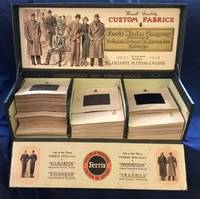
1937ref. 54988Chicago: Ferris Woolen Co. Successor to Detmer Brewer & Mason Wawak Co. Inc. 1937. Sample case. 27.75 x 11 x 7.5 in. Containing 172 thick cards w/ black & red advertising lettering stock & style Nos. with 172 woolens worsted wool imported wool samples some preshrunk all mounted on the cards. Original sample display case w/ green textured cloth over boards divided into 3 compartments nickel plate slider hinges printed advertising on inner lid and drop front reinforced corners some minor wear insect predation around fore-edges of a few samples still a remarkable display case from the John the Tailor Shop Suits and Overcoats made to order Wausau WI w/ stamp on top Wawak sample card. First edition of this spectacular tailoring sample counter display for men’s suits and overcoats in the Fall & Winter of 1937-1938. Ferris Woolen Company a subsidiary of Wawak Woolens was originally founded in 1922 in Chicago along with Detmer Woolen Co. Bruner Woolen Co. Mason & Hanson Inc. and Salter & Wolf to supply woolens & trimmings to tailors and department stores across the United States. The companies were known for their high-quality wools at a reasonable price and often incorporated imported wool wool silk blends gabardines and tweeds especially from Scotland Wales France and Great Britain. In 1933 the Wawak Co./Ferris Woolen Co. purchased the exclusive right to all the Detmer Bruner Co. customers West of the Mississippi. They quickly began commissioning and producing display cases reflecting the change and proved very successful with the Ferris Woolen Co. catering to the trade into the 1960s. These sample cases were very expensive to produce and so were most often found in department stores mercantiles and men’s stores which would have these display on the sales floor for two seasons or more often adding or subtracting fabrics as they became available. The samples included with this case offer invaluable textile reference for the colours and fabrics during the era of fashion influenced by the elegance and glamor of Hollywood films and film noir at the time. The styles depicted on the inside of the lid and the drop-down front are reminiscent of the very popular Thin Man fashions worn by William Powell and Myrna Loy at the time. No copies located in Worldcat. Ferris Woolen Co., Successor to Detmer, Brewer & Mason, Wawak Co., Inc., hardcover
1950ref. 54848Cincinnati OH: The Melville Company ca. 1950. 4to. 39 8.5 x 11 in. fashion plates with 97 tipped-in fabric samples including cotton cotton blends cotton-rayon blends satin nylon for men & women’s fashions dresses lingerie pants suits skirts. order blank booklet preserved in original cardboard portfolio w/ company design logo on rear flap an excellent collection. First edition of this scarce and unusually complete salesman sample sales kit for women’s dresses fashions coats lingerie as well as men’s overcoats underwear & socks and even women’s outerwear rubber pocket books and overcoats in post-World War II America. The Melville Company was a coordinated direct-sales fashion company supplied by Harford Frocks Inc. which maintained a large mail order tailoring operation in Ohio from the early 1920s up through the 1970s employing 100s of tailors and seamstresses to fill orders together with J.C. Field & Son Inc. direct marketing firm. The company focused on “plus sizes” while maintaining how these fashions emphasized trim appearances survived on a constant sales force composed primarily of young women and house wives earning extra money willing to peddle door-to-door and created a high-quality product. The catalogue offers invaluable illustrated historical reference for the colours styles and fabrics during the explosion and impact of Christian Dior’s new designs reflecting the refined femininity with severely cinched waists extra padding to the hips longer and decidedly more romantic skirts and dresses as well as nicely fitted jacket-and-skirt tailored suits. Israel 1901-1991 built and ran this very successful mail order dressmaking operation which also owned the Fashion Frocks Dress Company as well and operated out of the Oesterlein Machine Company historic building in Cincinnati OH now home to the American Sign Museum. The Melville Company, unknown
1880ref. 54558Amsterdam: A. Jager ca. 1880. 12mo. 3.5 x 5.25 in. 12 hand-coloured albumen carte de visite images sized 2.25 x 3.5 in. mounted on thick 3 x 5 in. cards text in lower fore-edge of board bound in leporello accordion-style format linen hinges renewed. Original publisher’s decorated red cloth over beveled boards elaborate gilt decorated front cover and lettering minor rubbing edgewear minor bumping to corners still VG exemplar w/ most images retaining strong contrast and colour bookseller’s label of Joh. G. Stemler Cz. Algemeene Goekhandel Amsterdam on rear pastedown. Early printing of this charming photographic souvenir with hand-coloured albumen CDV photos illustrating the styles of folk costumes in different regions of the Netherlands. The villages and regions include Marken North Holland a fisherwoman carrying basket on her head from Scheveningen a fishing port a middle class orphan girl from Amsterdam a young girl wearing elaborate hat from Krommenie North Holland northeast of Haarlem. Jager 1825-1905 published many different series of these souvenir fashion photos as well as images of scenes in and around Amsterdam often as stereoviews some working with Dutch photographer Pieter Oosterhis. See: Maartje van den Heuvel The Rise of Dutch Landscape Photography. How a Vision of Painting Entered Photography Depth of Field Vol. 6 No. 1 July 2015. A. Jager, hardcover
1972ref. 54492Chicago & New York: Montgomery Ward Steinthal Sample Co. Inc. 1972. Folio. 13 x 11.5 in. 50 pp unpaginated. printed on Harvest Gold Avocado Green and blue tinted textured papers. Numerous fashion plates and fashion sketches throughout w/ 89 fabric samples tipped-in Carol Brent label mounted. Black vinyl metal spiral wire binding as issued gilt lettering and logo stamped on front cover rounded corners minor foxing to pastedowns otherwise an excellent copy. First edition of this scarce and fascinating salesman’s sample catalogue for men and women’s suits leisure wear and formal tuxedos offered by Montogmery Ward at the beginning of the 1970s. This line of clothing featured English fabrics from Herbert Gladson Inc. tailored portions by Imperial in New York some Jacquard fabrics from David H. Small Co. in New York assembled for tailored clothing bearing Carol Brent Lady Brummell and the Designer’s Showcase labels. The men’s suits feature the slim fit with early bell bottoms wide lapels loud and vivid colour linings reverse welt hip pockets cardigans and even matching belts. Women’s clothing featured flared skirts double-breasted suit coats belted coats five-button pantsuits and fly front topcoats. No copies located in Worldcat. Montgomery Ward, Steinthal Sample Co., Inc., hardcover
1895ref. 54146New York: Standard Fashion Company June 1895. 4to. 96 pp. 1 large folding colour chromolithograph frontisp. sized 21.5 x 10.75 in. 1 colour chromolithograph plate over 150 woodcut text illustrations & engravings. Gold-coloured printed softcovers brick-red lettering minor dustsoiling light wear to creases of folding frontisp. still VG copy. First edition of this scarce and beautifully printed fashion magazine which was published under this title only from 1894 through 1896 when it was forced to change the name to The Standard Designer after losing a lawsuit brought by the Butterick Publishing Co. against Frank Koewing d. 1933 their former western sales manager for Butterick. Founded in 1887 the Standard Fashion Co. would eventually become a serious rival to the Butterick Pattern Co. appropriating the “Delineator” for his magazine poaching employees and eventually building the company to issuing over 100000 cut patterns a week. While often facing bankruptcy and litigious to a fault the company was acquired as a subsidiary in 1900 by Butterick and the combined companies would thrive through the ensuing decades. Each of the Standard Delineator magazine issues featured a large chromolithograph frontispiece of the latest fashions as well as a smaller one of millinery designs. Worldcat locates primarily microfilm copies however individual issues are held by Notre Dame and Davidson College; See; A Man of the Hour Frank Koewing The Bookseller and Newsman Vol. 13 1896 pp. 4-5; Carol Ann Dickson Patterns for Garments: A History of the Paper Garment Pattern Industry in America 1979. Standard Fashion Company, paperback
1939ref. 53215New York: Singer Sewing Machine Manufacturing Co. Departamento de Educacion January 1941; 1939. Two vols. 1st - Tall 8vo. 225 1 pp. Over 150 colour and black & white photo illustrations diagrams. Black textured softcovers gilt lettering & decoration printed on front cover edgewear bumping to corners minor soiling old tape repairs to front cover still G- copy; 2nd -- Oblong 4to. 12 x 7.75 in. 54 pp. on pink-tinted paper with 57 tipped-in fabric embroidered sewing samples including over on linen silk lace satin and wool textiles each w/ school stamp approving sample. Half-blue cloth post-binder over blue goards gilt lettering stamped on front cover sewn at gutter margin w/ white silk ribbon soiling minor dampstain curving to covers from the bulk of the tipped-in samples on the leaves still a VG exemplar. Both preserved in blue textured cardboard box & lid minor edgewear faint tidemark to lower fore-edge 1 corner. Fourth revised edition of this well-illustrated embroidery guide on stitches to be learned and executed on Singer Sewing Machines together with a beautifully done sample book showing Ms. Alos’ skills in learning the necessary skills in her Singer school in Villa Canas Argentina. The Singer Sewing Machine company developed special Singer Sewing Academia in Argentina Mexico and many other South American countries as well as Spain between the World Wars. These special private schools for professional dressmakers using the Singer manuals allowed female-owned dressmaking businesses to grow and create professional spaces separte from men. In addition these academias allowed women to pay by the class and embroidery was one of the advanced skills which commanded higher wages for women at the time. Singer actively encouraged this movement in order to develop home-based businesses and academias which in turn increased their sales of sewing machines. The sample book begins with a number of decorative types of embroidery stitches monograms and then displays floral patterns spider-web patterns laces a beautifully embroidered red roses and carnations on purple silks and satins. Worldcat locates 2 copies of the Libro Singer Bibliotecas del Tecnologico de Monterrey Mexico; British Library 3rd editions; See: Ketteler Sewing through the years in art women and society; Paula de la Cruz-Fernandez Atlantic Threads: Singer in Spain and Mexico 1860-1940 pp. 198-210. Singer Sewing Machine Manufacturing Co., Departamento de Educacion, paperback
1924ref. 53221New York: The Charles William Stores Inc. 1924-1925. Two vols. 4to. 548 8; 518 8 pp. With numerous colour plates colour-tinted text illustrations over 1000 black & white text illustrations diagrams. Colour-illustrated softcovers minor soiling wear slight sunning front cover of vol. 1 creasing to spine; minor creasing shelfwear vol. 2 light uniform interior toning as usual still VG- set. First edition of the complete year of Jazz Age catalogues from the Charles William Stores which offered a treasure trove of everyday fashions work clothes and household and consumer goods during the Roaring 20s offering the glamour and style of New York to the rest of the country. Their fashions were intended for the average American with emphasis on the more “endowed” woman and “stout” man during the Jazz Age emphasizing chic styles and well-woven fabrics. These catalogues detail the high grade work pants riding breeches denim jeans corduroy work pants along with triple-sewed work denim overalls and coats which could be purchased as well as those made out of Wabash Stripe Stifel denim cloth noted for its durability. No copies located in Worldcat of Spring & Summer 1925; 3 copies located of Fall & Winter 1925 Henry Ford Harvard American Textile History Museum. The Charles William Stores, Inc., paperback
1939ref. 53220South Conventry CT & New York: The Tioga Yarn Company 1939. Folio. 86 2 pp. With over 60 photo plates all w/ facing knitting instructions. Colour-illustrated softcovers Tioga trademark cover art of women knitting in red & black minor dustsoiling edgewear minor creasing to lower right corner still VG- copy. First edition of this scarce yarn catalogue and instruction book including directions on specific yarn needs as well as necessary stitches for the sweaters and other projects featuring fashion designs by Perrin based on the Hollywood glamour of the 1930s. These fashions reflect the accentuated high waist designs intended for slim hips longer mid-calf or floor length hemline and wiode soldiers. However since most women were not blessed with slim hips and narrow waists shoulders were exaggerated ruffled sleeves and long flowing capes. Worldcat locates 2 copies Univ. of Illinois NYPL. The Tioga Yarn Company, paperback
1950ref. 52053Amsterdam: International Textiles 1950. Folio. 212 pp. With 100s of text illustrations plates diagrams photos many in colour 1 w/ tipped-in fabric sample of red velvet. Colour-illustrated softcovers cover art by Jean Colin showing the European dove of peace dangling a tailoring manikin below while flying over the Americas plexiglass spiral binding as issued minor shelfwear light soiling to fore-edges still VG copy. First edition of this very rare installment of this post-World War II fashion textiles trade magazine filled with advertising and articles detailing how Europe intended to wean itself off the Marshall Plan aid in order to rebuild. The article on Parisian fashion includes dress designs by Jean Desses Jacques Fath Pierre Balmain and others. There is a remarkable article on seersucker patterns offered for the 1951 season by Cloques which includes photos of the actual factory sample catalogue leaves showing patterns and tipped-in fabric swatches. In addition there are lavish advertisements and beautifully illustrated articles filled with fashion window displays from the Swiss Industries Fair in 1950 revealing the tremendous explosion of Mid-Century Modern designs out of European fashion design houses. International Textiles, paperback
1911ref. 52192Paterson NJ Allentown PA Williamsport PA Dundee Lake NJ: National Silk Dyeing Company 1911. 8vo. 4 leaves of thick card stock bound in accordion-style format which fold out into 9 x 25.5 in panorama with 178 tipped-in colour skein silk samples in rainbow of colours a few discontinued colours removed along with their inventory numbers. Black cloth gilt lettering on front cover metal snap closure minor shelfwear some rubbing still G reference copy. First edition thus of this excellent sample catalogue filled with dyed silk thread samples including such Edwardian colour names as Desdoux Aloes Salambo Eclipse Champignon Glycine Pistache Oseille Cuite Myrthe and Matelot. The National Silk Dyeing Company began life as the Auger & Simon Silk Dyeing Works which was moved to Paterson in 1884 and grew quickly during the Victorian era but in 1908 Charles Auger chose to merge operations with five other Paterson NJ dye works forming the National Silk Dyeing Company. They would enter bankruptcy during the Great Depression. Worldcat locates 1 copy of 1913 Dyeing catalogue Brooklyn Museum. National Silk Dyeing Company, hardcover
1953ref. 52352Boston: Houghton Mifflin Co. 1953. 8vo. 86 2 pp. Illustrated half-title illustrated title page numerous text illustrations & plates 3 colour plates colour-illustrated endpapers. Blue-green coloured cloth illust. of doll in yellow holding parasol on front cover yellow lettering on spine very minor shelfwear minor rubbing & very slight bumping to lower corners w/ d.j. cover art of fashion doll by Bannon minor chipping head & foot of spine wear to corners minor rubbing upper corner clipped $ 2.25 price written in lower corner in pencil VG/VG copy. First edition of this remarkably rare and beloved children’s book surrounding the mystery and treasurer hunt for a 19th-century fashion doll in Peterborough NH by a young girl hidden by her ancestor in a secret room. Fashion dolls also called Queen Anne Dolls were often made of wood plaster or bisque with a fashionable hairstyle in flax or wool and dressed in miniature clothes showcasing the latest couture of the day. The most desirable dolls in the 19th-century were the French bisque dolls distributed all over Europe and were originally modeled on teen girls or adult women although these eventually changed over into child like bisque doll babies which would dominate the market from the 1860s onward. Bannon 1895-1963 was inspired to write this work while staying at the famed MacDowell Art Colony in Peterborough NH which carried a legend of a secret room in the MacDowell farmhouse. Original copies of this work have become quite scarce especially first editions. Houghton Mifflin Co., hardcover