Le courrier de la modeBiblio.com
813 résultats
1865réf. 162861865. Le monde élégant courrier de la mode Revue mode. Paris 1865-1866. In/4 reliure demi-basane 100 gravures en noir et majoritairement en couleur. Gravures souvent débrochées reliure défraîchie. unknown
1870réf. 162901870. Journal des Demoiselles Revue Mode Journal Paris 1870/71. In/4 reliure demi-basane marine dos à filets et titres dorés 17 gravures couleurs. unknown
réf. 12009Revue de mode : La Toilette de Paris 1978/79 - Les modes Parisienne 1979 - La mode pour tous 1879 - La mode Française janvier à décembre 1880. In folio reliure souple amateur dos en percaline rouge illustrations en noir in-texte 53 gravures couleurs dont plusieurs dépliantes 416 pages. Rousseurs éparses ; premier feuillet déchiré sans manque. Nombreux modèles de mode broderies expliquées coiffures chapeaux. Illustrations en noir à la gravure très fine. unknown
1788réf. 42077London: Fores 1788. Framed and glazed. Fores unknown
1848réf. 229448Paris 1848. First editions. Engraved fashion plates 677 of which are hand-colored. Many entitled "Modes de Paris". 16 vols. 4to. Bound in marbled boards with paper spine labels. First editions. Engraved fashion plates 677 of which are hand-colored. Many entitled "Modes de Paris". 16 vols. 4to. Periodical issued bi-weekly then weekly. Volumes for 1832-1836 have 24 issues 1837 has 26 and 1838-1848 have 52 issues each. unknown
1932réf. 25922Paris: Au Printemps 1932. 1 vols. Image 11-1/2 x 8 inches matted to 17-1/2 x 14 inches. 1 vols. Image 11-1/2 x 8 inches matted to 17-1/2 x 14 inches. Reynaldo Luza 1893-1978 pre-eminent fashion artist was born in Lima Peru. He began training as an architect at the University of Louvain Belgium but returned to Peru at the outbreak of World War I where he changed his studies from architecture to art. In 1918 he came to the United States where he earned his living by contributing drawings to several fashion publications principally VOGUE HARPERS BAZAAR and VANITY FAIR. In 1921 he joined HARPERS BAZAAR as the principal fashion artist a position he was to hold for 27 years. He divided his time between New York Paris and London working closely with all of the leading fashion designers of the times--Poiret Patou Lelong Paquin Douillet Doucet Cheruit Worth Drecoll Callot Soeurs Redfern Martial et Amand Premet Reboux Chanel Vionnet Molyneaux Schiaparelli Hartnell Steibel and Balenciaga among others. In 1940 Luza made New York his principal base where over the next few years he continued his activities at Harpers as well as creating fabric and furniture designs and the costumes for the movie "The Bridge of San Luis Rey". Among other distinctions he received several honorary appointments from the government of Peru including that of Artistic Director of the Paris Exposition of 1938 and the New York World's Fair of 1939-40; he also did the interior design of the new Lima airport. In 1950 Luza returned to Peru where he began a second career as a portrait painter exhibiting his work over the next few years in Paris New York and Washington D.C. Au Printemps unknown
1913réf. 218820London: Sampson Low Marston & Company Ldt 1913. First edition. 155 colored plates several in black and white which are printed on both sides. 1 vols. 4to. Green morocco-backed boards. Very good. First edition. 155 colored plates several in black and white which are printed on both sides. 1 vols. 4to. An excellent survey of French and English mode of dress between 1786 and 1912. Colas 2426; Hiler & Hiller p. 722 placing date as 1912 Sampson Low, Marston & Company Ldt unknown
réf. 120235Paris boulevard des Capucines. 1909- 1914. 3 catalogues dépliants. 21x11 Cm. Broché. Chaque catalogue de cette maison de couture se développe en accordéon et présente la collection de mode d'une saison portée sur 20 mannequins de femmes été 1909; hiver 1911-12 et été 1914. Catalogues très bien conservés. Paris, boulevard des Capucines. 1909- 1914. unknown
réf. OJ-H9DM-4C01Audio CD. Very Good. 1993 Release. GEMA. Running time 60:34 Flawless Disc in original rubbed case. Quick Daily Shipping with Tracking! L-12A unknown
réf. ria9781350245907_inpPaperback / softback. New. New Book; Fast Shipping from UK; Not signed; Not First Edition; N/A paperback
réf. ria9781350299436_inpPaperback / softback. New. New Book; Fast Shipping from UK; Not signed; Not First Edition; N/A paperback
réf. ria9781118027066_inpPaperback / softback. New. New Book; Fast Shipping from UK; Not signed; Not First Edition; Now in full-color throughout the second edition of Packaging Design offers fully up-to-date coverage of the entire packaging design process including the business of packaging design design principles the creative process and pre-p paperback
réf. ria9781501374364_inpPaperback / softback. New. New Book; Fast Shipping from UK; Not signed; Not First Edition; N/A paperback
réf. ria9781501362996_inpPaperback / softback. New. New Book; Fast Shipping from UK; Not signed; Not First Edition; N/A paperback
réf. ria9780415644563_inpPaperback / softback. New. New Book; Fast Shipping from UK; Not signed; Not First Edition; Fully revised and updated; the second edition of Sustainable Fashion and Textiles: Design Journeys continues todefine the field of design in fashion and textiles. paperback
réf. ria9781609015350_inpHardback. New. New Book; Fast Shipping from UK; Not signed; Not First Edition; N/A hardcover
réf. ria9781419726484_inpHardback. New. New Book; Fast Shipping from UK; Not signed; Not First Edition; The first book to document the history of the runway and to offer an unprecedented look behind the scenes of Fashion Week hardcover
réf. ria9781501335259_inpMultiple-component retail product. New. New Book; Fast Shipping from UK; Not signed; Not First Edition; N/A unknown
réf. 33765Leipzig Koehler & Amelang 1968. 8° 212 S. 86 Abb. Kart. Tadell. 010 Leipzig, Koehler & Amelang, 1968 unknown
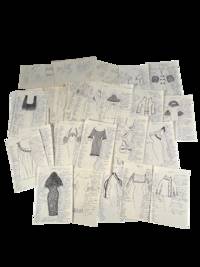
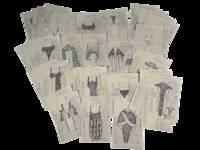
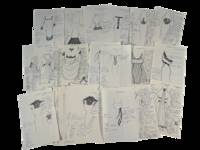
1950réf. 218281950. Fashion design archive likely 1950s to 1960s documenting women's garment design during the mid-century through original working sketches that preserve both style development and the practical language of dressmaking. The archive is strongest as evidence of how women's fashion was conceived on paper before production with repeated attention to silhouette trim fabric and construction. Dresses blouses coats and eveningwear appear throughout placing the material within the visual world of postwar American fashion as it moved from structured elegance toward sharper and more decorative later mid-century forms. Archive of over 100 original hand-drawn fashion sketches on individual sheets measuring approximately 6.5 x 9 inches. The drawings are executed in ink and depict a wide range of women's clothing including fitted dresses capes blouses coats and formal designs with careful attention to drape proportion neckline sleeve treatment and surface embellishment. Many sheets are accompanied by dense handwritten notes in the margins or on the reverse recording measurements fabric suggestions and pattern or construction instructions. The combination of illustration and notation gives the sheets the character of working designs rather than purely display drawings and suggests use in dressmaking training or client planning. The archive belongs to the history of women's fashion not only as a record of finished styles but as evidence of the design process itself preserving the intermediate stage between idea and garment. Such working sketches show how fashion circulated through manual skill technical knowledge and close attention to fabric and form in the decades before design became fully digitized. Light general wear from use; overall very good. A substantial mid-century design archive that preserves the visual and technical vocabulary of women's fashion making across more than one hundred original sketches. unknown
1950réf. 218261950. Fashion design archive. 1950s-1960s. This group documents mid-century women's fashion design practice through a sustained body of original sketches and working notes showing how garments were conceived annotated and prepared for construction during a period of stylistic transition in American dress. The material provides direct evidence of design thinking at the level of silhouette fabric selection and pattern planning including repeated attention to cocktail wear outer garments and formal dress. It captures the movement from structured postwar styles toward more experimental and decorative approaches associated with later mid-century fashion with particular emphasis on the technical and aesthetic decisions made by a designer or dressmaker. Archive of over 100 original hand-drawn fashion sketches on individual sheets measuring approximately 6.5 x 9 inches executed in ink with extensive handwritten annotations on rectos versos and margins. The drawings depict a range of women's garments including dresses blouses coats and evening wear with recurring titles such as "cocktail dress" "cocktail cape" and "dress." The figures are rendered with attention to line proportion and textile texture often emphasizing drape fitted bodices and surface embellishment. Annotations provide detailed construction guidance including measurements fabric types and pattern instructions. One design for a strappy dress specifies "Pattern: leopard or zebra fur attached.fabric velveteen.color red -- orange -- black." indicating experimentation with bold materials and color combinations. The consistent pairing of image and instruction suggests use as a working portfolio either for client presentation dressmaking production or formal training. Mid-century fashion in the United States expanded through department stores home sewing and professional dressmaking with designers and students producing working sketches that translated style into reproducible garments. The presence of detailed technical notes alongside finished illustrations places this archive within that production process linking aesthetic design to practical construction. Light wear from handling; overall very good. A concentrated record of mid-century women's fashion design practice preserving both the visual language and technical methods used to create garments during a period of evolving style. unknown
1950réf. 218271950. Fashion illustration archive circa 1950s-1960s documenting women's garment design and construction practices in the mid-twentieth century. The archive reflects shifting silhouettes and decorative approaches associated with mid-century fashion including structured postwar forms and emerging streamlined influences. Archive comprises over 100 original fashion illustrations each executed in ink on sheets measuring approximately 6.5 x 9 inches. The drawings depict a range of garments including cocktail dresses coats suits blouses and eveningwear with attention to silhouette drapery and surface embellishment. Many sheets include handwritten annotations in cursive along margins and versos detailing construction elements such as measurements fabric choices and stylistic variations. Examples include labeled designs such as "cocktail dress" "coat" and "suit" with notes specifying features like "turtle neck - bare cut out - colors - gold" and "square low neckline with studded pearls. colors - purple - gold." The annotations suggest iterative design thinking with references to materials color palettes and structural adjustments indicating use as a working portfolio rather than presentation-only sketches. This archive provides detailed evidence of mid-century fashion design practices at the level of individual garment planning bridging artistic representation and technical instruction. The combination of visual sketches and written notes demonstrates how designers translated aesthetic concepts into wearable forms contributing to the study of dressmaking textile use and women's fashion history during a period of stylistic transition. The volume and consistency of the material suggest sustained use potentially within a professional or training context. Light wear and minor handling marks; overall very good condition. A substantial working archive illustrating mid-twentieth-century women's fashion design and construction methods. unknown
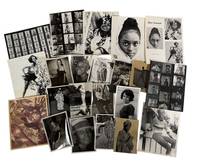
1950réf. 211751950. Archive of fashion photography documenting African American women's participation in commercial and editorial modeling from the 1950s through the 1980s a period in which the American fashion and advertising industries remained overwhelmingly centered on white beauty standards and limited Black representation in print media. Working in Cultural / Representational Mode the material illustrates changing presentations of Black femininity glamour and natural beauty across several decades of American fashion culture. The photographs provide visual evidence of evolving aesthetic conventions surrounding race cosmetics hairstyles leisure and commercial image-making during the postwar and Civil Rights eras. Particularly notable are several 1970s images depicting Black models with natural hairstyles and minimal cosmetic styling reflecting broader cultural shifts associated with Black pride movements and changing representations of African American identity in fashion and advertising imagery. Collection comprises 23 silver gelatin photographs and one color photograph produced by several professional photographers between the 1950s and 1980s. Images include editorial fashion shoots casting and publicity photographs scanned negatives and studio portraiture featuring predominantly Black women alongside several white models photographed by the same studios. Two 1970s editorial images depict a lean Black model with closely cropped natural hair posed in a leopard-print wrap. Four photographs focus specifically on Black women including close-up portraits emphasizing natural presentation and informal styling. One younger woman appears without visible makeup wearing a bandana and t-shirt while another is photographed in a straw hat with hoop earrings and patterned sash. Additional photographs include a Black model posed in a bikini atop the rim of a classical fountain featuring Aphrodite imagery. Four professional photographs and one casting card depict singer and actress Sylvia Vanderbeilt in commercial studio poses. Several scanned negatives portray a Black female model in multiple outfits and poses characteristic of 1970s fashion photography including one sequence featuring both the model and a young Black girl during apparent test shoots. The latest material consists of scanned negative strips from an apparent 1980s fashion session featuring a Black model with a sleek bob hairstyle modeling padded blazers and contemporary commercial attire. Other photographs depict white women in evening gowns fur wraps and casual mid-century fashions including two images by photographer Lee Brian showing the same model posed in mid-length evening gowns amid neoclassical architectural settings one with an elaborate mink shawl. Several photographs bear photographer or studio stamps on the verso including L.W. Ward of Cedar Rapids Iowa and Lee Brian of Palm Beach Florida. The archive traces substantial shifts in fashion photography and racial representation across three decades of American commercial imagery from heavily stylized mid-century glamour photography to the more natural aesthetics associated with 1970s fashion editorials and Black cultural self-presentation. The inclusion of both editorial and test photography offers insight into the production practices of commercial modeling studios as well as the visual conventions used in presenting Black women to advertising and fashion audiences during a period of gradual but uneven industry integration. Minor wear and light handling marks throughout; photographs otherwise remain in very good condition overall. A visually strong grouping documenting African American representation within postwar American fashion photography and commercial image culture. unknown
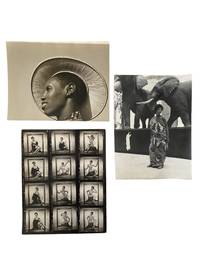
1950réf. 206231950. Archive of three black and white silver gelatin photographs of black models dating from the 1950s-70s. Photographs measure approx. 8" x 10". This archive includes a press photo from 1974 showing model Beverly Bradshaw posed in front of a museum display of elephants wearing a traditional Nigerian Ibo wrapped dress designed by Angie Ihejirika. Article on verso from the Chicago Sun Times details Mrs. Ihejirika's demonstration of the art of African wrapping at the Field Museum of Natural History. Photo has a bald patch on left side not affecting subject matter. Also included is a print of twelve Kodak film cells showing actress and model Nancy Westbrook in a series of poses sitting within a large picture frame. Seven images show Westbrook in a bikini and five wearing only a fur stole. These photographs date to the early 1950s and least one the third down on the left appeared in Jet Magazine with a short profile of Ms. Westbrook in 1953. Another photograph undated shows a black model in profile from the neck up smiling in a sun hat tilted away from camera to frame her head with a halo-like effect. Modeling in fashion and print has historically been dominated by white women reflecting a bias in beauty standards in the United States. These images show black women claiming space in the often exclusionary fashion world of the mid-late 20th century. Overall very good condition. Three images of black fashion models in the US 1950s-70s. unknown
1940réf. 196571940. African American Black Models in Commercial Print: Philadelphia Studio Fashion Photoshoot 1930s-1940s Archive of 4 Original Vintage Photographs. Each black and white silver gelatin photograph measures 3.5" x 4.5". All photographs were captured at Condax Studio in Philadelphia. Condax Studios was associated with the Models' Guild of Philadelphia which served as a "central resource of information for commercial photographers connecting them with professional models for television fashion and convention work". All photographs capture a black woman striking various poses in two contrasting outfits. In two photographs she poses in a black dress and heels glamorous jewelry and a rose. Her eyes are slightly covered by a black birdcage veil. In the remaining two photographs she sports a posh blazer and skirt set glamorous jewelry heels and an umbrella. Until the middle of the 1940s consumer advertising completely ignored the black consumer and virulent racial segregation in the United States meant that Black people's needs were not being satisfied. Thus traditional advertisers were reluctant to associate the image of a black person with their products. At this point in time they perceived it may lead to a loss in sales by the way Black people were viewed in society. These photographs capture an early instance of a Black print model in an era where there was little representation. Two photographs are minority wrinkled not affecting image quality. This photo archive is expressive and in very good condition overall. unknown