The Ottoman Hijaz Railway projectBiblio.com
331 469 résultats
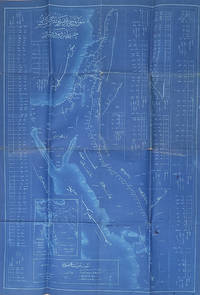
1915réf. 00024286x59 cm. Prepared by Ashraf Eşref - the draftsman of the technical department of the Hejaz Railway Title: Şam'dan Medine-i Münevvere Hattı Haritası Map of the Railway Line from Damascus to Medina. Date: 1331 1915 Scale: 1:2100000 clearly printed in the title cartouche. Language and script: Ottoman Turkish in Arabic script. Printing method: Cyanotype blueprint identified by the deep blue background with white lines and lettering. The map covers the entire Hejaz Railway route including: Damascus Şam Daraa Amman Ma'an Tabuk Madâin Sâlih Al-'UlÄ Medina Medine-i Münevvere It also depicts: The branch line to Haifa on the Mediterranean. The Gulf of Aqaba and the Red Sea. The Sinai Peninsula. Important towns wadis and geographic features along the railway. Insets and vertical profiles showing elevations along sections of the railway. This was an engineering and operational map prepared for the Ottoman administration of the Hejaz Railway. The elevation profiles and detailed station information indicate that it was intended for railway planning and operation rather than for general public use. Technical Department of the Hejaz Railway
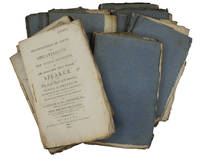
réf. AQ17706Dublin Edinburgh and London: vs. 1789-1801 51 volumes. Preserved in the original states; the vast majority stitched as issued many uncut and in the original plain paper wrappers. A remarkably fresh collection of pamphlets relating to Ireland and - largely - the proposed and later completed political union between Ireland and Great Britain dating from the final decade of the eighteenth- and first decade of the nineteenth- centuries. Included are historical and literary works references to the 1798 Irish Rebellion and numerous speeches made by Irish and British politicians during the long debates in both Houses of Parliament. Highlights include: - AN INDEPENDENT OBSERVER REDFOORD Archibald. Union necessary to security. Addressed to the loyal inhabitants of ireland. Dublin. Printed for J. Archer 1800. 8vo. 2 106pp. Uncut and partially unopened in original publisher's powder blue wrappers. Occasional inked corrections to text some dampstaining to margins. Presentation copy inked inscription to head of title: 'For William Smith Esq. / from his sincere friend / The Author'. ESTC T194733. - AN OFFICER. TAYLOR Sir Herbert. Impartial relation of the military operations which took place in Ireland in consequence of the landing of a body of French troops under general Humbert in august 1798. Dublin. Printed for J. Milliken 1799. 8vo. 2 69pp 1. With two engraved folding plates and a folding table. Uncut and partially unopened in original publisher's marbled wrappers. ESTC T114958. - A REAL FRIEND. A letter to the people of Ireland which they all can understand and ought to read. Dublin. Printed for J. Milliken 1799. 8vo. 3 6-33pp 1. In this edition the text ends on p.34 with 'I am your real friend. Finis'. Uncut and unopened in original publisher's powder blue wrappers. Foxed. ESTC records a single copy of this edition in North America Missouri and none elsewhere. From the collection - recently dispersed - of the Marquesses of Lothian who also held the Earldom of Ancram at Newbattle Abbey; many were presumably acquired by William Kerr 5th Marquess of Lothian 1737-1815 British soldier and peer. A full list of the contents of this collection is available on request. . [vs., 1789-1801] unknown
1789réf. AQVBF88vo. 51 volumes. Preserved in the original states; the vast majority stitched as issued many uncut and in the original plain paper wrappers. A remarkably fresh collection of pamphlets relating to Ireland and - largely - the proposed and later completed political union between Ireland and Great Britain dating from the final decade of the eighteenth- and first decade of the nineteenth- centuries. Included are historical and literary works references to the 1798 Irish Rebellion and numerous speeches made by Irish and British politicians during the long debates in both Houses of Parliament. Highlights include: - AN INDEPENDENT OBSERVER REDFOORD Archibald. Union necessary to security. Addressed to the loyal inhabitants of ireland. Dublin. Printed for J. Archer 1800. 8vo. 2 106pp. Uncut and partially unopened in original publisher's powder blue wrappers. Occasional inked corrections to text some dampstaining to margins. Presentation copy inked inscription to head of title: 'For William Smith Esq. / from his sincere friend / The Author'. ESTC T194733. - AN OFFICER. TAYLOR Sir Herbert. Impartial relation of the military operations which took place in Ireland in consequence of the landing of a body of French troops under general Humbert in august 1798. Dublin. Printed for J. Milliken 1799. 8vo. 2 69pp 1. With two engraved folding plates and a folding table. Uncut and partially unopened in original publisher's marbled wrappers. ESTC T114958. - A REAL FRIEND. A letter to the people of Ireland which they all can understand and ought to read. Dublin. Printed for J. Milliken 1799. 8vo. 3 6-33pp 1. In this edition the text ends on p.34 with 'I am your real friend. Finis'. Uncut and unopened in original publisher's powder blue wrappers. Foxed. ESTC records a single copy of this edition in North America Missouri and none elsewhere. From the collection - recently dispersed - of the Marquesses of Lothian who also held the Earldom of Ancram at Newbattle Abbey; many were presumably acquired by William Kerr 5th Marquess of Lothian 1737-1815 British soldier and peer. A full list of the contents of this collection is available on request. [vs.].
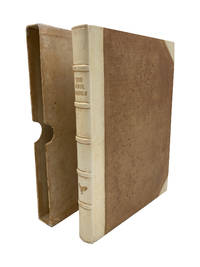
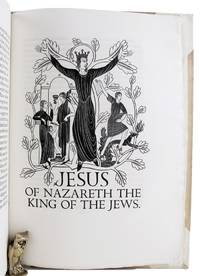
1931réf. 001546London: The Golden Cockerel Press 1931. 270pp 2. Original half pigskin and buckram over boards raised bands spine in six panels title in gilt to second panel cockerel device to fifth t.e.g. remainder untrimmed. Spine slightly rubbed usual light foxing to cloth covers internally bright and clean. Bookplate of Victor Alberts to front pastedown. Number three hundred and thirty-three of five hundred copies on paper with another twelve on vellum. Binding is by Sangorski and Sutcliffe. In the original slipcase which has Japanese paper repairs to edges and corners. The Four Gospels is widely regarded as one of the best private press books. Cave and Manson 78; Chanticleer 78 "a flower among the best products of English romantic genius"; A Century for the Century 26; Gill 285. First Thus. Half Pigskin and Buckram. Very Good. Illus. by Gill Eric. Folio. Private Press. The Golden Cockerel Press Hardcover
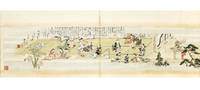
réf. 6222Many finely drawn illustrations in brush ink & colors. Scroll 285 x 9310 mm. 23 joined sheets some inoffensive worming carefully repaired. Japan: copied before 1857. A finely illustrated scroll created in the witty and refined realistic style of Yamato-e and Ukiyo-e brush work depicting the route taken — a distance of about 4 km. — by pleasure-seekers from Ryogoku Bridge to Shin Yoshiwara the center of prostitution in the city of Edo. By the 18th century it was the home to some 1750 women. This was an extremely busy section with a strong commercial tradition in what is today’s central Tokyo. Our scroll is an early copy of the original scroll; we do not know if that earlier scroll still exists. It was created by Bunyo Tozaka 1783-1852 a prominent Nanga-style artist who studied with Buncho Tani and specialized in kachoga pictures of flowers and butterflies. The author of the notes was Hirokata Yashiro 1758-1841 the influential historian of Japan and great book collector he had more than 50000 Chinese and Japanese books housed in a series of three buildings in Ueno known at the Shinobazu Bunko. The beginning of our copied scroll depicts several boats holding men including samurai and women making their way along the Sumida River from Ryogoku Bridge to Shin Yoshiwara. They disembark at Kumagatado adjacent to Asakusa Bridge. From there the men — clearly samurai — mount rented horses Daiden Horse Co. with very inadequate saddles and continue their journey. There are images of high-ranking men with their faces hidden by large hats in order to conceal themselves. Their family crests on their kimono are also hidden. They pass through Raijin Gate today’s Kaminarimon which belongs to Tokyo’s oldest temple Senso-ji. There is a merchant depicted along the side of the road selling dumplings the famous Yone manju. Finally the samurai dismount and board small boats at an embankment to cross some wetlands at the Nihon zutsumi. They arrive at a commercial area called Doromachi “Mud Town” where the travellers wash their feet and tidy themselves before entering Shin Yoshiwara and all its pleasures. Then we see several samurai “interviewing” prostitutes. Heading north there is a gate through which the samurai enter Shin Yoshiwara. Women are standing waiting to meet their customers. Some women are serving tea there is a man carrying a portable lending library on his back and we see men with hidden faces entering buildings with women waiting inside. There is another building with women sitting being “showcased” to passing potential clients. Next we have a scene of women entertaining with musical instruments; men are standing outside making their selections. The following scene shows men upstairs being entertained by dancers and musicians with food and drinks being served. A garden is shown. Women are seen on the street aggressively soliciting men. There are always suggestions of rooms behind rooms ready for the clients and their women. The next scene is the kitchen with men preparing octopus lobsters and shrimp. Another man is cutting up fish. Women carry the prepared food to another room where men are being served and entertained. At the end we see a man taking a nap. At the end there are notes — collector’s thoughts — regarding the manuscript: he tells who the original artist and author were and that this is a detailed description of a past time painted in a style similar to Morunobu Hishikawa and Iccho Hanabusa. The collector considered our scroll to be “finely done” and he has signed his name “Choton Kishi” with his seal which might be painted not stamped. Throughout the artist’s sense of perspective and design is extremely fluid and imaginative. Many of the figures and landscapes have been heightened with lacquer gold silver and mica. As we move through the scroll there is also a sense of the day passing to evening. With the seal of the founder of the Kishi Library Choton Kishi d. 1857 the distinguished book collector and natural historian. This fine scroll was offered for sale by the great bookseller Shigeo Sorimachi in 1977 in his 50th anniversary catalogue. The scroll has been carefully backed in the past century. Preserved in a box with Mr. Sorimachi’s handwriting on the upper cover. unknown
réf. 6222Many finely drawn illustrations in brush ink & colors. Scroll 285 x 9310 mm. 23 joined sheets some inoffensive worming carefully repaired. Japan: copied before 1857. A finely illustrated scroll created in the witty and refined realistic style of Yamato-e and Ukiyo-e brush work depicting the route taken — a distance of about 4 km. — by pleasure-seekers from Ryogoku Bridge to Shin Yoshiwara the center of prostitution in the city of Edo. By the 18th century it was the home to some 1750 women. This was an extremely busy section with a strong commercial tradition in what is today’s central Tokyo. Our scroll is an early copy of the original scroll; we do not know if that earlier scroll still exists. It was created by Bunyo Tozaka 1783-1852 a prominent Nanga-style artist who studied with Buncho Tani and specialized in kachoga pictures of flowers and butterflies. The author of the notes was Hirokata Yashiro 1758-1841 the influential historian of Japan and great book collector he had more than 50000 Chinese and Japanese books housed in a series of three buildings in Ueno known at the Shinobazu Bunko. The beginning of our copied scroll depicts several boats holding men including samurai and women making their way along the Sumida River from Ryogoku Bridge to Shin Yoshiwara. They disembark at Kumagatado adjacent to Asakusa Bridge. From there the men — clearly samurai — mount rented horses Daiden Horse Co. with very inadequate saddles and continue their journey. There are images of high-ranking men with their faces hidden by large hats in order to conceal themselves. Their family crests on their kimono are also hidden. They pass through Raijin Gate today’s Kaminarimon which belongs to Tokyo’s oldest temple Senso-ji. There is a merchant depicted along the side of the road selling dumplings the famous Yone manju. Finally the samurai dismount and board small boats at an embankment to cross some wetlands at the Nihon zutsumi. They arrive at a commercial area called Doromachi “Mud Town” where the travellers wash their feet and tidy themselves before entering Shin Yoshiwara and all its pleasures. Then we see several samurai “interviewing” prostitutes. Heading north there is a gate through which the samurai enter Shin Yoshiwara. Women are standing waiting to meet their customers. Some women are serving tea there is a man carrying a portable lending library on his back and we see men with hidden faces entering buildings with women waiting inside. There is another building with women sitting being “showcased” to passing potential clients. Next we have a scene of women entertaining with musical instruments; men are standing outside making their selections. The following scene shows men upstairs being entertained by dancers and musicians with food and drinks being served. A garden is shown. Women are seen on the street aggressively soliciting men. There are always suggestions of rooms behind rooms ready for the clients and their women. The next scene is the kitchen with men preparing octopus lobsters and shrimp. Another man is cutting up fish. Women carry the prepared food to another room where men are being served and entertained. At the end we see a man taking a nap. At the end there are notes — collector’s thoughts — regarding the manuscript: he tells who the original artist and author were and that this is a detailed description of a past time painted in a style similar to Morunobu Hishikawa and Iccho Hanabusa. The collector considered our scroll to be “finely done” and he has signed his name “Choton Kishi” with his seal which might be painted not stamped. Throughout the artist’s sense of perspective and design is extremely fluid and imaginative. Many of the figures and landscapes have been heightened with lacquer gold silver and mica. As we move through the scroll there is also a sense of the day passing to evening. With the seal of the founder of the Kishi Library Choton Kishi d. 1857 the distinguished book collector and natural historian. This fine scroll was offered for sale by the great bookseller Shigeo Sorimachi in 1977 in his 50th anniversary catalogue. The scroll has been carefully backed in the past century. Preserved in a box with Mr. Sorimachi’s handwriting on the upper cover. unknown books
1583In-folio, two volumes. Later vellum over pasteboards with handwritten title on spine, slightly stained. Leaves [70], pp.583; pp. 772, ll.[6]. Roman, italic and Greek character. With a full-page woodcut portrait of Mattioli, 3 printer's devices and over 900 three-quarter-page figures (cm. 22x16) engraved in wood in the text, depicting plants, herbs, animals, insects and distillation procedures, of which two are colored by contemporary hand. Edit16 CNCE 35759 - Nissen BBI 1395 - Pritzel 5985 - Adams D 675 - Hunt 145.
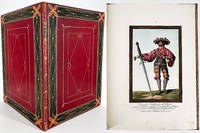
1790réf. 1485Basel: C. de Mechel 1790. First Edition. Fine. Chrétien de Mechel after Hans Holbein. Folio 14 1/8 x 10 1/2 inches 360 x 263 mm; hand-colored aquatint title and 12 etchings & aquatint plates with hand-colroing in watercolor by Chrétien de Méchel after Hans Holbein the Younger. Handsome contemporary mosaic binding in red morocco inlaid dark green border with red and yellow dots and yellow corner piece designs gilt board edges and turn-ins gilt designs on spine and green label with gilt title spine a little rubbed marbled endpapers a.e.g.; preserved in a slipcase with marbled paper and red morocco profiles a little rubbed and faded. Cohen / deRicci 493; Colas 1462; Rahir Bibliothèque de l'Amateur p. 661; Brunet III 251-252; Cicognara 2044; Bobins 490; Vinet 2177. Housed in a stunning mosaic binding this rare folio contains a complete suite of 12 magnificently-colored plates the third part of a series of 4 comprising Holbein's oeuvre published in Basel by Chrétien de Méchel from 1780 to 1792 and usually found in uncolored state. The Swiss civil and military costumes originally drawn by Hans Holbein the Younger 1497 - 1543 and housed in the Basel Public Library. Chrétien de Méchel renders these drawings in a robust and precise manner for this edition featuring 6 women and 6 men some in military costume. More commonly encountered lacking the hand-coloring en bistre each of these scarce engravings appears fresh and in superb condition with excellent saturation and extensive bright coloration. An excellent exemplar of this rare hand-colored volume. A copy can be found in the Robert Wylie Lloyd collection at the British Museum inv. 1958.0712.3056.1-12. C. de Mechel unknown
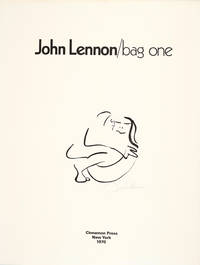
1970réf. 144022New York: Cinnamon Press 1970. Rare Bag One lithograph signed by Beatles icon John Lennon. One page the title page from Lennon's Bag One Portfolio. Signed by him beneath the image. From the collection of Jonathan Cott author and editor of numerous books predominately focusing on music and who has written articles for varied publications such as Rolling Stone The New York Times The New Yorker The Los Angeles Times The Village Voice Vogue Esquire and The Wall Street Journal. This was presented by John Lennon to Jonathan Cott who interviewed Lennon and Yoko Ono several times and whose December 5 1980 interview with Lennon was the final solo interview conducted before his death on December 8th of that year. Lennon had created the "Bag One" drawings depicting his wedding and honeymoon with Yoko Ono and presented them to her in 1969. Framed. Rare and desirable and with noted provenance. In 1969 as a wedding gift for Yoko John drew the 'Bag One Portfolio'—a chronicle of their wedding ceremony honeymoon and their plea for world peace in the Bed-In. The following year the artwork was produced in a series of three hundred portfolios of fifteen signed prints each. The majority depict John and Yoko's most intimate private moments—upon their first exhibition in London more than half were deemed 'indecent' and confiscated by Scotland Yard. The rare title page features perhaps the most famous and recognizable print of the suite. Cinnamon Press unknown
réf. 5166Hardcover. Fine. Johann Locher was an Observant Franciscan at Ulm who later became a vociferous advocate of Luther's program of reform. Persecuted for his reformist sympathies he eventually took refuge in Zwickau where he published extensively between 1523 and 1524 writing against the injustices visited upon the lower classes and the corruption of the Church. He left Zwickau for Munich in late 1524 just as the Peasants' War was breaking out. He was arrested and executed in November 1524 becoming one of the first evangelical martyrs. These two books both extremely rare are bound in modern uniform quarter-vellum bindings. It is clear that they were previously bound together and so are now being offered as a pair. The brief descriptions of the books presented below are followed by an in-depth discussion of the works. I. LOCHER'S FIRST LETTER TO KARSTHANS: Locher Johann d. 1524 Ein Claglicher Sendtbrieff des Baurnveyndts zu Karsthannsen seynem Pundtgnossen mit Radt vnd Trost Die ganntz Christenhayt belangendt. Zwickau: 'Gedruckt durch Johann Locher von München' but Jörg Gastel for Johann Schönsperger the Younger 1524 Quarto: 17.6 x 14.1 cm. 9 lvs. A4 B2 C4 -blank C4 ONE OF TWO EDITIONS both by Gastel for Schönsperger see Reske/Benzing 1055. Bound in modern uniform quarter parchment and drab boards. A very good crisp copy with a few sidenotes lightly shaved and some light fraying in the inner margin of the title page. With a small woodcut of a Christian knight on the title within a decorative woodcut frame and printed manicules in the text. No copies traced in North America. This is the first of two letters by Locher writing under the pseudonym Hans Rott addressed to "Karsthans" "Hans of the Hoe" the folk figure most closely associated with the plight of the German peasants who yearned for social justice and championed the cause of Church Reform. Originally a character of derision Karsthans "became symbolic of the simple hard-working unsophisticated peasant whose common sense simple trust in God love of truth and Biblical knowledge confounded trained theologians."Packull "The provocative words of abuse by Johann Locher against the conditions of his time reach their climax in his two epistles to Karsthans in which he angrily calls for open resistance in both the secular and religious realms. On the title of the first incendiary letter the author strangely describes himself as an 'enemy of the peasants' although throughout the text he proves himself to be their friend. The two epistles. are among the most passionate outbursts of the grumbling 'little people' of the cities and the agitated peasants of the countryside." Schottenloher Wer ist Johann Locher von München in: Der Buchdrucker Hans Schobser 1925 pp. 120 ff. "Locher's letters are among the loudest harbingers of the Peasants' War. The author uses the harshest language against the Emperor: 'Oh you poor Christian what is your name My name is I thirst for human blood. I must increase the devil's kingdom by shedding blood and that is why I am cursed by God and despised by men.' He describes how bailiffs and henchmen seek the sweat of the poor day and night exploiting and 'shaming' them. Wild game created by God freely and for the benefit of all people is more strictly forbidden to the peasants than adultery brawling and fornication." Rosen Cat. Neufforge no. 91 VD 16 3384; Panzer p. 382 no. 2777; Claus Der deutsche Bauernkrieg im Druckschaffen der Jahre 1524-1526 no. 45; Claus Die Zwickauer Drucke des 16. Jahrhunderts Vol. I no. 66. II. LOCHER'S SECOND LETTER TO KARSTHANS: Locher Johann d. 1524 Ein vngewonlicher vnd der Ander Sendtbrieff deß Baurnfeyndts zu Karsthannsen Der doch nit allein wider ynn Sunder der Gantzen Christenhayt entgegen ist. Zwickau: Jörg Gastel for Johann Schönsperger the Younger 1524 Quarto: 17.6 x 14.1 cm. A4 B2 C4 -blank leaf C4 FIRST EDITION. Modern half vellum and drab boards. With a title woodcut of a German peasant with his threshing flail by Master HS is based on the work of Erhard Schön. The farmer's face has been cut out and carefully re-inserted almost imperceptibly the transition added with pen strokes that are barely visible. One corner has water stains otherwise very well preserved and fresh. One copy traced in North America Harvard. In this second letter to Karsthans Locher gives voice to the rage grievances and frustration of the German underclass. Revolution is inevitable. "Things cannot go on as they have done" writes Locher "the game has been carried on long enough and both citizens and peasants are tired of it. Everything will change." Locher laments the prevalence of senseless violence even among blood relatives. The roads are perilous and one would do well to have a bodyguard. He decries the hypocrisy of Christian symbols being used in the context of warfare and bloodshed which contradicts their intended meaning of peace and reconciliation. Locher argues that the ruling hierarchy from the highest to the lowest conspires to exploit and oppress the poor. He condemns the brutality inflicted upon peasants including torture mutilation and execution simply for defending their crops. Free Hans and His Flail: From 1521 to 1525 the woodcut of a peasant with his threshing flail was a popular emblem of the "common man" ready to champion the Reformation cause and to defend himself from social injustice. He was a figure closely related to the aforementioned "Karsthans" "Hans of the Hoe" whom Locher addresses in this letter. In certain depictions Karsthans was also depicted with a threshing flail separating the wheat of Luther's Reformed theology from the chaff of Catholic doctrines that have no basis in Scripture. In this context the presence of the rosary in the peasant's other hand seems incongruous. With the success of Karsthans a second figure emerged "in a poem entitled Fryhans 'Free Hans' that suggested lower-class readiness to use the threshing flail against opponents of reform. Hereafter the Karst and Flegel the two-pronged hoe and the threshing flail of the peasant became symbols that underscored popular support for the Reformation."Packull The image on the title page of this pamphlet then is an instance of the blurring of the two figures. The Gathering Storm: Locher's letters to Karsthans appeared on the eve of the Peasants' War one of the bloodiest chapters in the turbulent early history of the German Reformation. The uprising began in upper Swabia in early 1524 and quickly spread to southern and western Germany as well as to parts of Switzerland and Austria. By 1524 peasants had formed into territorial democratic groups known as Haufen - bands each with its own governing body the Ring which agreed on laws maintained order and directed the actions of the rest. The peasants were motivated by a number of factors: crushing taxation lack of a voice in government no recourse to the courts crop failure and helplessness in the face of their feudal masters' demands. But whereas these conditions had resulted in smaller uprisings in the past the massive rebellion of 1524-5 was also a result of the turbulent upheaval caused by the nascent Reformation. By the time the rebellion was crushed in late 1525 some 100000 combatants and civilians had been killed. Reprisals were carried out for the next two years and the peasants' demands as outlined in their Twelve Articles came to nothing. VD 16 R 3387; Claus Der deutsche Bauernkrieg im Druckschaffen der Jahre 1524-1526 no. 46; and Die Zwickauer Drucke des 16. Jahrhunderts Vol. I no. 67; Knaake 967; Panzer DA 2377; Schottenloher Schobser p. 123 ff.; Weller 2965; Laube Bauernkriegzeit 580 Overview: "Of Locher's known publications. two were addressed directly to Karsthans who reappears in these two missives as a symbolic leader of the peasants. Locher assumes the role of ally and advisor although by some strange logic he introduces the letters as the work of an enemy of the peasants. Thus the first open letter carried the title 'A Woeful Missive of the Peasant Enemy to Karsthans his Confederate with Advice and Comfort Concerning the Whole of Christendom' Ein Claglicher Sendtbrieff des Baurnveyndts zu Karsthannsen seynem Pundtgnossen mit Radt und Trost Die ganntz Christenhayt belangendt. "It was written with foreboding early in 1524. Astrologers and apocalyptical seers predicted floods famine war insurrection and even the end of the world for 1524. However Locher's primary concern seemed to be with the retarded progress of the Reformation. The problem rested with the 'grossen Hansen' prosperous and socially powerful individuals often belonging to the upper middle class such as wealthy merchants well-off artisans or influential burghers i.e. citizens of free imperial cities who instead of helping to erect a Christian order continued to support the kingdom of Antichrist. The reasons were not hard to find. The upper estates feared that religious reform could spill over into the social-political sphere. Locher wrote: 'I suppose they think it will go too far. They see the handwriting on the wall that the pomp pride and presumption of the 'grossen Hansen' has as little foundation and no better legitimacy than that of the heretical followers of the Whore of Babylon and her regiment. "Thus Locher had come to the view that a Reformation as he envisaged it ran counter to the self-interests of the 'grossen Hansen' who abused their God-given office to enhance their own position while exploiting the poor. But Locher recognized that oppression was not a monopoly of the great. Even among peasants in small hamlets with no more than three residents one sought to dominate the others. All this seemed unchristian and contrary to the claims of the gospel. The latter was understood as divine law normative for all relationships in a would-be Christian society. Fully aware of the potential implications should the common man adopt such a reading of the gospel Locher feared bloodshed unless the authorities finally initiated appropriate reforms. Previous appeals had fallen on deaf ears and time was running out. "Not that he advocated violence. He advised Karsthans against avarice arrogance and selfish action. God's cause was not child's play. Divine favour could be expected only if the peasants made a true Christian order their priority. Otherwise Locher feared that Karsthans and his allies would find themselves once again the butt of ridicule. He admonished Karsthans to keep the 'poor simple flock' out of quarrels between the grossen Hansen; for he feared that the common man would become a scapegoat and his adversaries unite and 'wash their hands in his blood.' "These prophetic statements indicate that Locher's sympathies were decidedly on the side of the common man. His appeal to Karsthans constituted a qualified summons to the third estate. The Reformation he sought went beyond doctrinal and ecclesiastical matters to a reform of the whole society. The Second Letter to Karsthans: "This becomes clear in the second missive entitled 'An Unusual Missive of the Peasant Enemy to Karsthans' Ein ungewonlicher vnd der Ander Sendtbrieff deß Baurnfeyndts zu Karsthannsen Der doch nit allein wider ynn Sunder der Gantzen Christenhayt entgegen ist. The letter constitutes a general indictment of wide spread violence in the existing order. As Locher described it the roads were no longer safe unless one could afford a bodyguard: 'One chokes the other without cause even though he has never met him before and the victim has done him no harm. Even among blood relations it has become common to settle differences with violence.Merciful God could there be anything more despicable said about us Christians What greater insult to Christ than the sign of the cross on helmets standards and armor What could be more vexing to God than that the sign of peace and reconciliation of our beloved Christ has been raised for discord quarrel dissention and the shedding of blood' "Hardest hit by this unchristian disorder were the poor. It seemed that all from the highest to the lowest in the established hierarchy conspired day and night to exploit and grind the poor schinden und schaben. On their behalf Locher registered specific protests that found an echo a few months later in the programs of rebellious peasants. Why were wild animals permitted to roam the fields from which peasants were expected to pay the tithe and rent Why were the peasants not allowed to protect their livelihood Was it not pitiful yes shameful and against all reason Christian charity and Scriptures that peasants were tortured had their eyes gouged out or even beheaded for protecting their crops Was it Christian that two four or ten consumed and squandered what could sustain ten to forty thousand Thus for Locher the Christian mandate carried social implications. Engagement for the kingdom of Christ meant engagement for social and economic justice. The former Franciscan had become a spokesman for a reformation of the common man. "Locher's sympathy for the common people his outspoken critique of the grossen Hansen remain strikingly radical even by twentieth century standards: 'When the lords and grossen Hansen pluck each other the poor must lend the hair. / Only little thieves are hanged. The hat is tipped to the great. / But you lords whoever you may be this will be your judgment: As you will have mercy on the poor/ so also will God have mercy on you.' "And yet the vision of this former Franciscan remained in some ways medieval. True he no longer idealized poverty-seeking but instead the elimination of its cause-human exploitation. But Locher's ideal was informed by a medieval vision of a reformed Corpus Christianum. The modern separation of church and state advocated by some of the post-1525 radicals was alien to him. With a previous generation of humanists he shared an anachronistic dream of a revitalized Christian empire. The emperor was to retain his constitutional position. Territorial rulers were to be compensated for legitimate administrative expenses. A council or committee ruling with the consent of the estates which presumably included representatives of the peasants ausschuss des regiments durch gemeine tierwilligung der landtschajft was to exercise real authority. "Should these proposals go unheeded Locher feared that 'peasants in town and country would unite' for the 'game had gone too far. The cities as well as the peasants were weary of it.' Revolution seemed inevitable. In part these predictions proved correct. Only a few months after Locher's execution peasants and townsmen shook the foundation of the empire in the Revolution of the Common Man. "Locher's two last missives illustrate a shift in the Karsthans image from its religious polemical function to a symbol of social agitation. To be sure Locher admonished Karsthans not to reach for the flail but that admonition stood in contrast to his own pessimistic conclusions. In his appeal to the common man in his critique of society in general and of the grossen Hansen in particular Locher with other radical pamphleteers contributed to the ideological mobilization of the common man. In this endeavor he became an unconscious ally of Thomas Müntzer for it is in the writings of these two men more so than elsewhere that we find the erratic pulsebeat of the popular phase of the Reformation."Packull The Image of the "Common Man" in the Early Pamphlets of the Reformation 1520- 1525 in Historical Reflections / Réflexions Historiques Summer 1985 Vol. 12 No. 2 Summer 1985 pp. 253-277. hardcover
réf. 5166Hardcover. Fine. Johann Locher was an Observant Franciscan at Ulm who later became a vociferous advocate of Luther's program of reform. Persecuted for his reformist sympathies he eventually took refuge in Zwickau where he published extensively between 1523 and 1524 writing against the injustices visited upon the lower classes and the corruption of the Church. He left Zwickau for Munich in late 1524 just as the Peasants' War was breaking out. He was arrested and executed in November 1524 becoming one of the first evangelical martyrs. These two books both extremely rare are bound in modern uniform quarter-vellum bindings. It is clear that they were previously bound together and so are now being offered as a pair. The brief descriptions of the books presented below are followed by an in-depth discussion of the works. I. LOCHER'S FIRST LETTER TO KARSTHANS: Locher Johann d. 1524 Ein Claglicher Sendtbrieff des Baurnveyndts zu Karsthannsen seynem Pundtgnossen mit Radt vnd Trost Die ganntz Christenhayt belangendt. Zwickau: 'Gedruckt durch Johann Locher von München' but Jörg Gastel for Johann Schönsperger the Younger 1524 Quarto: 17.6 x 14.1 cm. 9 lvs. A4 B2 C4 -blank C4 ONE OF TWO EDITIONS both by Gastel for Schönsperger see Reske/Benzing 1055. Bound in modern uniform quarter parchment and drab boards. A very good crisp copy with a few sidenotes lightly shaved and some light fraying in the inner margin of the title page. With a small woodcut of a Christian knight on the title within a decorative woodcut frame and printed manicules in the text. No copies traced in North America. This is the first of two letters by Locher writing under the pseudonym Hans Rott addressed to "Karsthans" "Hans of the Hoe" the folk figure most closely associated with the plight of the German peasants who yearned for social justice and championed the cause of Church Reform. Originally a character of derision Karsthans "became symbolic of the simple hard-working unsophisticated peasant whose common sense simple trust in God love of truth and Biblical knowledge confounded trained theologians."Packull "The provocative words of abuse by Johann Locher against the conditions of his time reach their climax in his two epistles to Karsthans in which he angrily calls for open resistance in both the secular and religious realms. On the title of the first incendiary letter the author strangely describes himself as an 'enemy of the peasants' although throughout the text he proves himself to be their friend. The two epistles. are among the most passionate outbursts of the grumbling 'little people' of the cities and the agitated peasants of the countryside." Schottenloher Wer ist Johann Locher von München in: Der Buchdrucker Hans Schobser 1925 pp. 120 ff. "Locher's letters are among the loudest harbingers of the Peasants' War. The author uses the harshest language against the Emperor: 'Oh you poor Christian what is your name My name is I thirst for human blood. I must increase the devil's kingdom by shedding blood and that is why I am cursed by God and despised by men.' He describes how bailiffs and henchmen seek the sweat of the poor day and night exploiting and 'shaming' them. Wild game created by God freely and for the benefit of all people is more strictly forbidden to the peasants than adultery brawling and fornication." Rosen Cat. Neufforge no. 91 VD 16 3384; Panzer p. 382 no. 2777; Claus Der deutsche Bauernkrieg im Druckschaffen der Jahre 1524-1526 no. 45; Claus Die Zwickauer Drucke des 16. Jahrhunderts Vol. I no. 66. II. LOCHER'S SECOND LETTER TO KARSTHANS: Locher Johann d. 1524 Ein vngewonlicher vnd der Ander Sendtbrieff deß Baurnfeyndts zu Karsthannsen Der doch nit allein wider ynn Sunder der Gantzen Christenhayt entgegen ist. Zwickau: Jörg Gastel for Johann Schönsperger the Younger 1524 Quarto: 17.6 x 14.1 cm. A4 B2 C4 -blank leaf C4 FIRST EDITION. Modern half vellum and drab boards. With a title woodcut of a German peasant with his threshing flail by Master HS is based on the work of Erhard Schön. The farmer's face has been cut out and carefully re-inserted almost imperceptibly the transition added with pen strokes that are barely visible. One corner has water stains otherwise very well preserved and fresh. One copy traced in North America Harvard. In this second letter to Karsthans Locher gives voice to the rage grievances and frustration of the German underclass. Revolution is inevitable. "Things cannot go on as they have done" writes Locher "the game has been carried on long enough and both citizens and peasants are tired of it. Everything will change." Locher laments the prevalence of senseless violence even among blood relatives. The roads are perilous and one would do well to have a bodyguard. He decries the hypocrisy of Christian symbols being used in the context of warfare and bloodshed which contradicts their intended meaning of peace and reconciliation. Locher argues that the ruling hierarchy from the highest to the lowest conspires to exploit and oppress the poor. He condemns the brutality inflicted upon peasants including torture mutilation and execution simply for defending their crops. Free Hans and His Flail: From 1521 to 1525 the woodcut of a peasant with his threshing flail was a popular emblem of the "common man" ready to champion the Reformation cause and to defend himself from social injustice. He was a figure closely related to the aforementioned "Karsthans" "Hans of the Hoe" whom Locher addresses in this letter. In certain depictions Karsthans was also depicted with a threshing flail separating the wheat of Luther's Reformed theology from the chaff of Catholic doctrines that have no basis in Scripture. In this context the presence of the rosary in the peasant's other hand seems incongruous. With the success of Karsthans a second figure emerged "in a poem entitled Fryhans 'Free Hans' that suggested lower-class readiness to use the threshing flail against opponents of reform. Hereafter the Karst and Flegel the two-pronged hoe and the threshing flail of the peasant became symbols that underscored popular support for the Reformation."Packull The image on the title page of this pamphlet then is an instance of the blurring of the two figures. The Gathering Storm: Locher's letters to Karsthans appeared on the eve of the Peasants' War one of the bloodiest chapters in the turbulent early history of the German Reformation. The uprising began in upper Swabia in early 1524 and quickly spread to southern and western Germany as well as to parts of Switzerland and Austria. By 1524 peasants had formed into territorial democratic groups known as Haufen - bands each with its own governing body the Ring which agreed on laws maintained order and directed the actions of the rest. The peasants were motivated by a number of factors: crushing taxation lack of a voice in government no recourse to the courts crop failure and helplessness in the face of their feudal masters' demands. But whereas these conditions had resulted in smaller uprisings in the past the massive rebellion of 1524-5 was also a result of the turbulent upheaval caused by the nascent Reformation. By the time the rebellion was crushed in late 1525 some 100000 combatants and civilians had been killed. Reprisals were carried out for the next two years and the peasants' demands as outlined in their Twelve Articles came to nothing. VD 16 R 3387; Claus Der deutsche Bauernkrieg im Druckschaffen der Jahre 1524-1526 no. 46; and Die Zwickauer Drucke des 16. Jahrhunderts Vol. I no. 67; Knaake 967; Panzer DA 2377; Schottenloher Schobser p. 123 ff.; Weller 2965; Laube Bauernkriegzeit 580 Overview: "Of Locher's known publications. two were addressed directly to Karsthans who reappears in these two missives as a symbolic leader of the peasants. Locher assumes the role of ally and advisor although by some strange logic he introduces the letters as the work of an enemy of the peasants. Thus the first open letter carried the title 'A Woeful Missive of the Peasant Enemy to Karsthans his Confederate with Advice and Comfort Concerning the Whole of Christendom' Ein Claglicher Sendtbrieff des Baurnveyndts zu Karsthannsen seynem Pundtgnossen mit Radt und Trost Die ganntz Christenhayt belangendt. "It was written with foreboding early in 1524. Astrologers and apocalyptical seers predicted floods famine war insurrection and even the end of the world for 1524. However Locher's primary concern seemed to be with the retarded progress of the Reformation. The problem rested with the 'grossen Hansen' prosperous and socially powerful individuals often belonging to the upper middle class such as wealthy merchants well-off artisans or influential burghers i.e. citizens of free imperial cities who instead of helping to erect a Christian order continued to support the kingdom of Antichrist. The reasons were not hard to find. The upper estates feared that religious reform could spill over into the social-political sphere. Locher wrote: 'I suppose they think it will go too far. They see the handwriting on the wall that the pomp pride and presumption of the 'grossen Hansen' has as little foundation and no better legitimacy than that of the heretical followers of the Whore of Babylon and her regiment. "Thus Locher had come to the view that a Reformation as he envisaged it ran counter to the self-interests of the 'grossen Hansen' who abused their God-given office to enhance their own position while exploiting the poor. But Locher recognized that oppression was not a monopoly of the great. Even among peasants in small hamlets with no more than three residents one sought to dominate the others. All this seemed unchristian and contrary to the claims of the gospel. The latter was understood as divine law normative for all relationships in a would-be Christian society. Fully aware of the potential implications should the common man adopt such a reading of the gospel Locher feared bloodshed unless the authorities finally initiated appropriate reforms. Previous appeals had fallen on deaf ears and time was running out. "Not that he advocated violence. He advised Karsthans against avarice arrogance and selfish action. God's cause was not child's play. Divine favour could be expected only if the peasants made a true Christian order their priority. Otherwise Locher feared that Karsthans and his allies would find themselves once again the butt of ridicule. He admonished Karsthans to keep the 'poor simple flock' out of quarrels between the grossen Hansen; for he feared that the common man would become a scapegoat and his adversaries unite and 'wash their hands in his blood.' "These prophetic statements indicate that Locher's sympathies were decidedly on the side of the common man. His appeal to Karsthans constituted a qualified summons to the third estate. The Reformation he sought went beyond doctrinal and ecclesiastical matters to a reform of the whole society. The Second Letter to Karsthans: "This becomes clear in the second missive entitled 'An Unusual Missive of the Peasant Enemy to Karsthans' Ein ungewonlicher vnd der Ander Sendtbrieff deß Baurnfeyndts zu Karsthannsen Der doch nit allein wider ynn Sunder der Gantzen Christenhayt entgegen ist. The letter constitutes a general indictment of wide spread violence in the existing order. As Locher described it the roads were no longer safe unless one could afford a bodyguard: 'One chokes the other without cause even though he has never met him before and the victim has done him no harm. Even among blood relations it has become common to settle differences with violence.Merciful God could there be anything more despicable said about us Christians What greater insult to Christ than the sign of the cross on helmets standards and armor What could be more vexing to God than that the sign of peace and reconciliation of our beloved Christ has been raised for discord quarrel dissention and the shedding of blood' "Hardest hit by this unchristian disorder were the poor. It seemed that all from the highest to the lowest in the established hierarchy conspired day and night to exploit and grind the poor schinden und schaben. On their behalf Locher registered specific protests that found an echo a few months later in the programs of rebellious peasants. Why were wild animals permitted to roam the fields from which peasants were expected to pay the tithe and rent Why were the peasants not allowed to protect their livelihood Was it not pitiful yes shameful and against all reason Christian charity and Scriptures that peasants were tortured had their eyes gouged out or even beheaded for protecting their crops Was it Christian that two four or ten consumed and squandered what could sustain ten to forty thousand Thus for Locher the Christian mandate carried social implications. Engagement for the kingdom of Christ meant engagement for social and economic justice. The former Franciscan had become a spokesman for a reformation of the common man. "Locher's sympathy for the common people his outspoken critique of the grossen Hansen remain strikingly radical even by twentieth century standards: 'When the lords and grossen Hansen pluck each other the poor must lend the hair. / Only little thieves are hanged. The hat is tipped to the great. / But you lords whoever you may be this will be your judgment: As you will have mercy on the poor/ so also will God have mercy on you.' "And yet the vision of this former Franciscan remained in some ways medieval. True he no longer idealized poverty-seeking but instead the elimination of its cause-human exploitation. But Locher's ideal was informed by a medieval vision of a reformed Corpus Christianum. The modern separation of church and state advocated by some of the post-1525 radicals was alien to him. With a previous generation of humanists he shared an anachronistic dream of a revitalized Christian empire. The emperor was to retain his constitutional position. Territorial rulers were to be compensated for legitimate administrative expenses. A council or committee ruling with the consent of the estates which presumably included representatives of the peasants ausschuss des regiments durch gemeine tierwilligung der landtschajft was to exercise real authority. "Should these proposals go unheeded Locher feared that 'peasants in town and country would unite' for the 'game had gone too far. The cities as well as the peasants were weary of it.' Revolution seemed inevitable. In part these predictions proved correct. Only a few months after Locher's execution peasants and townsmen shook the foundation of the empire in the Revolution of the Common Man. "Locher's two last missives illustrate a shift in the Karsthans image from its religious polemical function to a symbol of social agitation. To be sure Locher admonished Karsthans not to reach for the flail but that admonition stood in contrast to his own pessimistic conclusions. In his appeal to the common man in his critique of society in general and of the grossen Hansen in particular Locher with other radical pamphleteers contributed to the ideological mobilization of the common man. In this endeavor he became an unconscious ally of Thomas Müntzer for it is in the writings of these two men more so than elsewhere that we find the erratic pulsebeat of the popular phase of the Reformation."Packull The Image of the "Common Man" in the Early Pamphlets of the Reformation 1520- 1525 in Historical Reflections / Réflexions Historiques Summer 1985 Vol. 12 No. 2 Summer 1985 pp. 253-277. hardcover books
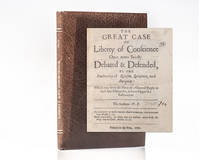
1670réf. 149562London 1670 i.e. 1671. Rare second edition of one of the most persuasive defences of liberty and “the free and uninterrupted exercise of our consciences"William Penn. Quarto bound in full modern morocco gilt titles and ruling to the spine inner dentelles elaborately stamped in blind. A powerful argument for toleration and against the intrusion of civil authority into religious matters this second edition was revised and enlarged from the first edition during Penn's imprisonment at Newgate in 1670 a defining episode in his lifelong defense of religious liberty. This is evidently a 2nd edition being much enlarged from the 1st which may be seen on comparison; and "J." for Junior is here omitted in the Title page and also the Dedication to the King which the first contains -- and an address "to the Supream Authority of England" dated "Newgate the 7th of the 12th monteth called February 1670." -- and a Preface added; also new matter in the work" Smith Friends' Books II p.286-7. In very good condition. Bookplate of William Tarun Fehsenfeld to the pastedown. The Great Case of Liberty of Conscience Once More Briefly Debated & Defended by the Authority of Reason Scripture and Antiquity constitutes one of William Penn’s earliest and most systematic expositions of the principle of religious toleration. This second edition revised and enlarged during his imprisonment in Newgate Prison in 1670 following his arrest for preaching at an unlawful Quaker meeting develops and refines arguments first articulated in the initial printing. Drawing on reason Scripture and early Christian authority Penn maintains that civil government possesses no jurisdiction over matters of faith and that coercion in religion violates both divine and natural law. Produced during a formative period of persecution the text articulates a mature defense of liberty of conscience that would later inform Penn’s political philosophy and the legal and religious framework of his American colony. unknown
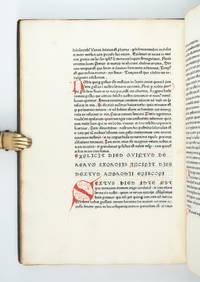
1472réf. ST21102Augsburg: Johann Schüssler ca. 5. May 1472. EDITIO PRINCEPS. 315 x 222 mm. 12 1/2 x 8 3/4". 76 leaves. COMPLETE. Single column 35 lines in gothic type. Excellent vaguely retrospective modern brown pebble-grain morocco covers with intricate gilt frame enclosed by blind rules raised bands gilt lettering to spine panels. Paragraph marks in red capitals struck in red numerous initials in red: three of these five- to six line five four-line and 56 two-line. Final leaf with contemporaneous ink inscription indicating this book was the property of the Dominican convent in Vienna. Goff A-555; BMC II 329; Poynter 44; ISTC ia00555000. Isolated trivial stains or finger smudges but A FINE UNWASHED COPY the text clean fresh and bright with stately margins and in an appealing binding showing virtually no signs of use. Fully rubricated and with expansive margins this is a very attractive copy of the first printing of a greatly important work of biblical exegesis that had lasting influence. St. Ambrose of Milan ca. 339-97 composed the Hexameron a commentary on the Book of Genesis discussing the six days of Creation in the 380s. He drew on theological sources particularly the Hexameron of St. Basil as well as on more secular inspiration: the lengthy descriptions of the natural world were adapted from Pliny among others. The Hexameron was an enormously influential piece of exegesis helping shape the interpretation of Genesis for the next millenium of religious scholars notably influencing the Venerable Bede but it also had an impact on works of literature such as Lactantius' "De Ave Phoenice" and the related ninth century English poem "The Phoenix." This first edition was the work of the second Augsburg printer Johann Schussler fl. 1470-73. His very pleasing gothic type which appears in the present volume was apparently the same type as was used by Günther Zainer the first Augsburg printer until January 1470. Our copy's probably early 16th century ownership inscription indicates it belonged to the Dominican Convent in Vienna which was founded in 1226 and is still an inhabited monastery. Clearly its monastic and later owners took excellent care of this volume which has come down to the present day in a fine state of preservation crisp and clean with wide margins. Copies in any kind of condition appear infrequently in the marketplace: besides ours we were able to trace just three that have been sold at auction since 1977 all in modern bindings all for the equivalent of approximately $10300 in 2014 to $12600 the Broxbourne copy in 2010; and we find no other dealer currently offering a copy on line. Johann Schüssler unknown
1472réf. ST21102Augsburg: Johann Schüssler ca. 5. May 1472. EDITIO PRINCEPS. 315 x 222 mm. 12 1/2 x 8 3/4". 76 leaves. COMPLETE. Single column 35 lines in gothic type. Excellent vaguely retrospective modern brown pebble-grain morocco covers with intricate gilt frame enclosed by blind rules raised bands gilt lettering to spine panels. Paragraph marks in red capitals struck in red numerous initials in red: three of these five- to six line five four-line and 56 two-line. Final leaf with contemporaneous ink inscription indicating this book was the property of the Dominican convent in Vienna. Goff A-555; BMC II 329; Poynter 44; ISTC ia00555000. Isolated trivial stains or finger smudges but A FINE UNWASHED COPY the text clean fresh and bright with stately margins and in an appealing binding showing virtually no signs of use. Fully rubricated and with expansive margins this is a very attractive copy of the first printing of a greatly important work of biblical exegesis that had lasting influence. St. Ambrose of Milan ca. 339-97 composed the Hexameron a commentary on the Book of Genesis discussing the six days of Creation in the 380s. He drew on theological sources particularly the Hexameron of St. Basil as well as on more secular inspiration: the lengthy descriptions of the natural world were adapted from Pliny among others. The Hexameron was an enormously influential piece of exegesis helping shape the interpretation of Genesis for the next millenium of religious scholars notably influencing the Venerable Bede but it also had an impact on works of literature such as Lactantius' "De Ave Phoenice" and the related ninth century English poem "The Phoenix." This first edition was the work of the second Augsburg printer Johann Schussler fl. 1470-73. His very pleasing gothic type which appears in the present volume was apparently the same type as was used by Günther Zainer the first Augsburg printer until January 1470. Our copy's probably early 16th century ownership inscription indicates it belonged to the Dominican Convent in Vienna which was founded in 1226 and is still an inhabited monastery. Clearly its monastic and later owners took excellent care of this volume which has come down to the present day in a fine state of preservation crisp and clean with wide margins. Copies in any kind of condition appear infrequently in the marketplace: besides ours we were able to trace just three that have been sold at auction since 1977 all in modern bindings all for the equivalent of approximately $10300 in 2014 to $12600 the Broxbourne copy in 2010; and we find no other dealer currently offering a copy on line. Johann Schüssler unknown books
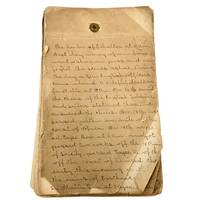
1899réf. 0012049Donsol Pilar Manila Philippines New York Malta. Poor with no dust jacket. 1899-1901. Other. On offer is an unbelievable handwritten account of 19 months of action on the frontlines of the Philippine Insurrection the Philippine-American War between November 1899 and June 1901. An unknown American soldier writes of his experiences in a level of detail that cannot be overstated. This diary places the reader in the Philippines with shocking realism making this diary exceedingly rare. The 139 pages of this journalled account of events have been removed from a larger document and someone has pinned these loose pages together. This writing begins at the end of a sentence penned on presumably November 17 1899 and concludes half way through a sentence written on June 23 1901. There seem to be very few missing pages from within the journal and it reads very smoothly. The content is outstanding. The diary opens with our soldier diarist sailing from New York to the Philippines via the British Naval base at Gibraltar and the Suez Canal. He describes his experiences sailing sharing about a stop ashore in Malta a Thanksgiving spent at sea a concert enjoyed aboard the gunboat Nashville on the way to Manila and more. He arrives with his regiment in Manila on Dec 22 1899. The troops explore Manila and meet Filipino locals. In early January of 1900 they receive orders to head to southern Luzuon on the Kobbe Expedition which refers to General William Kobbes Expedition to Bicolandia. This expedition was in response to an urgent order from Washington to open up hemp ports of Southern Luzon due to an American hemp shortage. The problem was the port towns were largely controlled by Filipino Insurgents. Our diarist provides absolutely remarkable detail about Americas role in defeating the Insurgents and the tragedy of the Filipino peoples experience. Context indicates that our diarist was possibly a member of the 43rd Volunteer Infantry Regiments USV Company A. An excerpt that provides a sense of how our soldier explains the circumstances in the Philippines follows: Jan 16th we got the order to pack up and get ready to leave Mikata and to proceed to the Southern part of Luzon we were put aboard the transport Hancock which was at anchor in the Bay of Manila All combined we were named the Kobbe Expedition to the Southern Luzon to open up the Hemp ports and protect the natives from the Insurgents down there On the 21st of Jan 1900 our boats dropped anchor in a bay named the bay of Sorsogon in the Province of Albay All over this province there are large gangs of Insurgents holding the towns so at many towns our boys had a hard fight with the Insurgents before they could take the towns and the gun boat had to shell many of the towns. Our Regt. Occupied nine towns. Our detachment of A and D. Co. Were taken to a town named Donsol the gunboat Helena took us ashore from the Hancock On their arrival ashore they were met by a crowd of Philippinos. They had an order from the officers of the Insurgents it read saying that they would not haul down their colors nor surrender for three days. So our Major returned to the gunboat and a short conversation was held with the officers of the gun-boat and it was decided to prepare the gun boat for action and land all of us. If the Insurgents fired one shot at us the gun-boat would shell the town The hills were full of fleeing people. A detail of men were sent out on the hills at once then the Insurgents fired their first shot at us. Our boys had a warm fight for 15 minutes. They found the hills well entrenched and also found one big cannon. Lots of spears Bolas and wooden guns. They returned to town bringing in a few prisoners. A scouting party was seent and they saw a lot of Philippinos fleeing to the mountains. This town had a population of 10000 and three hundred were Insurrectors. The next thing we done was to find ourselves some good houses to live in. Outposts were put out all around the town. A few natives came across our post for a few nights and on the 22th Jan the Insurgents paid our town a visit setting fire to one of the big houses where our men were sleeping. Our men got out of the house without anyone being hurt. We surrounded the town fired a few volleys . Later in January our soldiers regiment goes on the first of many missions all of which he describes in glaring detail. On this mission the troops attempt to leave Donsol for Pilar when they run into trouble as the connecting bridge was destroyed by Insurgents. They make it to Pilar and find the town has been deserted. As they march back to Donsol they find someone has lit the bridge ablaze: Jan 28th We had a very hard time crossing the bridge burning our shoes and legs but we got safely on the Donsol side before the bridge fell with a crash into the river. We marched on we heard several shots from the Mauser and Remington rifles. Next we discovered a big fire and a call to arms and fire call was sounded The fire of the Insurgents got heavier. Our Major gave an order not to fire. He was going out in the front of our lines. He went out with a detail of men and discovered that our town was surrounded and the hills were full of Insurgents. He fired a few volleys then he came into town. The Insurgents answered him by firing a cannon. Then the Insurgents gave a yell and started to advance and we kept quiet and let them get close to our lines. Then we got the order to commence firing and the boys opened up all around the town and we soon put the Insurgents to flight firing a few shots as they ran. Next morning we discovered a few dead Insurgents close to our lines. The Insurgents almost always carry their dead and wounded along with them in their flight Our soldier does an absolutely phenomenal job of describing not only the day-to-day in Donsol where he spends majority of his time but also the various missions in which he participates. His words paint a fulsome picture of the war: 21st Feb at noon our Major asked for a detachment of men to volunteer to go up the river on a scouting expedition. I along with 12 more men went out of our company and 12 out of D. Co. Along with Capt. Hart of D. Co. And our Major left Donsol in a hard paddle boat and one white boat in tow On our way up the river we could see high hills on each side and the river was very narrow. There were many Insurgents outposts in the high trees all the way up and we fired at every one we saw. We went up a distance of 8 miles before we thought of coming home as it was getting late We had traveled one mile on our homeward way when the Insurgents fired on us from the left hand ashore. Our men in the rear boat fired a volley into the two Insurgents and were taking good aim for a second volley when the hills fairly echoed with the yells from the Insurgents. They then opened up on the right hand side which was aimed at the white boat hitting one of our men our company in the head and he was killed instantly. Then we answered their shots from each of our boats and from that time until we got back to Donsol we were under the hot fire of the Insurgents we could see the hills full of Insurgents and we had plenty to shoot at. We made every shot count. The insurgents even fired rocks at us from the high hills . More texture is added when our soldier discusses aspects of the war that dont involve active fire. Some examples follow: March 5th Gen Kobbe of the 8th Army Cor was here on a visit and he said these two companies were a very industrious lot of men and that the building of the stocade and trenches was a very sensible work he also brought us 17 of the Battery G 3rd Artillery men and one Hotch Kiss gun for reinforcements. April 10th the mail boat was here bringing the report of Gen. Pawa likely Jose Ignacio Paua an Insurgent Gen in Command of the Insurgent troops through this province. He surrender to our Colonel in Legaspi Legazpi and was sent to the Military Prison in Manila. April 21st We took a long march across the hills in a round about manner to a town named Sevilla merely an Insurgent camp. The town was deserted on our arrival. Fires were still burning in the houses. Everything was just as they had dropped it in their flight. We passed through the town and discovered many traps laid in the roads for us. One trap was an arrow trap on each side of the path in the bushes and by pulling a strong the arrows would stick into anyone going down the path. None of their traps caught us. Our soldier writes frequently about expeditions for which he volunteers. He describes a mission to Banningaran sic. En route the men captured Captain Hernandiz sic; possibly Adriano Hernández y Dayot and his family before being caught unprepared by the Insurgents who severely injured one of the American sargeants. On their hike back to Donsol they are again attacked by the Insurgents this time caught off guard as they attacked from the rear. And so it goes for many more months. Our author describes the movements of the men with whom he is stationed his commanding officers and the various wins and setbacks of both the Americans and the Insurgents. In May of 1901 our soldier and his regiment begin the process of boarding a ship to return to America. There is of course never a straightforward path and there are many bumps in the road. However our soldier does eventually board a ship and begins again to describe his journey in detail. The diary cuts off abruptly mid-sentence on June 23 1901 as our soldier is describing being at sea with nothing but a sailboat in sight for miles. While we do not know our soldiers identity we do know he was safely heading home at the conclusion of his diary. We know he was a highly motivated volunteer soldier who displayed total buy-in to the mission of the Americans in the Philippines and we know he was a gifted writer penning his experiences with such texture and realism that the reader feels as though they too have been on the front lines of a bloody wet miserable war in the Philippines - fighting for America and for the displaced Philippino people forced to flee from the Insurgents to the mountains. This journal measures 8x5 inches and contains 139 single-sided sheets. The pages were all loose so the author has pinned them together with a single round-headed fastener post. There are no covers to this journal. As a result the first and last few pages show obvious and significant wear and tear including a large corner of the first page being completely ripped off obstructing the text. The handwriting is quite legible. Overall Fair to Poor. ; Manuscripts; 8vo 8" - 9" tall; 139 pages . unknown
1931réf. 162756London: The Golden Cockerel Press 1931. With decorations by Eric Gill. Pp. ii270last blank2colophon verso blank 645 wood-engraved illustrations and decorative initials 4 full page large cockerel device on title page; f'cap. folio; half white pigskin spine lettered and ruled in gilt with five raised bands maize buckram boards lightly foxed as often bottom fore-corner of upper board faintly bruised very slight signs of professional cleaning to spine; t.e.g. others uncut; within the original card slipcase which is lightly soiled and worn the edges splitting with signs of early repairs; binder's stamp at foot of upper pastedown and bookseller's sticker on lower pastedown a couple of tiny spots to endpapers; The Golden Cockerel Press London 1945. One of 488 numbered copies thus bound printed on Batchelor hand-made paper total edition 500. Chanticleer 78; Gill 285. The first book printed from the 18-point size of the Golden Cockerel type designed by Eric Gill; regarded as one of the greatest 20th century English private press books and the masterpiece of the Golden Cockerel Press. 'The book among all books in which Roman type has been best mated with any kind of illustration' Chanticleer page 36. Chanticleer states 65 woodcuts but Evan Gill page 119 notes the decorative initial N on page 8 although from 2 separate blocks forms one illustration. The Golden Cockerel Press unknown
réf. Wivel, Mikael and Hanne FIn Pristine Condition. unknown
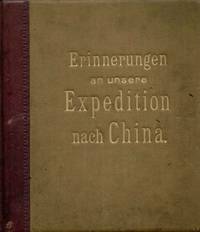
réf. 24054401China ca.1900-1901. 3/4 Gilt-stamped leather over buff cloth very good 25 x 29 cm. 30p. 26p. with photos 2 per side = total of 104 photographs16 x 11 cm. all very clean albumen type bit of fading but clear strong images. RARE! . . . ORIGINAL PHOTOGRAPHS OF THE BOXER REBELLION 1900 . . THE GERMAN RECORD OF THEIR ACTION IN PEKING . . This is a wonderful quite rare original period photo album. . It shows the German contingent sent to China to join in the defense of foreign embassies in Peking during the 1900 uprising of the siege of the Boxers. . The work begins with the group aboard the S.S. Strassburg from Bremen and their landing in the German colony of Tsingtao Tsingtau. From there it was a long trek down to Peking in the snowy winter. . Classic photos posed for the camera & history 4 in all. Arrival in China with more classic poses of the German troops before Chinese sights and in a temple where they were stationed. . One shows large wooden cases of their supplies stacked up in the temple garden with the commanders posing for a lovely memorial photos. Well taken photographs by the group's photographic officer nicely composed and carefully taken these are NOT tourist snap shots ! These average two photos per page. . A group of German military men pose before a wide variety of Chinese pagodas and sights some in long capes spiked helmets with Chinese officials ! Their arrival in Peking during a heavy snowfall in 1900 is documented by a series of superb & rare photographs from the Summer Palace where the lake is frozen ! Magnificent but frozen Peking sights architectural views palaces Germans on the move with horse and carts through the snow as they deployment on orders to defend the foreign legations. . Inside a legation taking lunch tiffin; outside two or three Chinese Boxers were executed hands bound they lay face down in the snow. More photos of travel along the way wonderful Chinese scenery & buildings architecture snowed in barracks their visit to the Great Wall in the dead of winter with snow sprinkled all over. . A passage through Chinese villages and towns with long columns of German troops. One comic and lovely image of a German dressed in Chinese clothes another in a Chinese garden. . A German celebration Chinese and German open-air trial where the accused Chinese are on their knees before a magistrate Germans playing badminton leisure time in a garden soldiers packing medical supplies on horses and German headquarters &c. . PEKING: A lovely series of photos showing the great sites of Peking and the Imperial Palace large battalion of German soldiers on parade another shows them marching to a great hall destruction of Chinese buildings superb views of fine Chinese architecture lakes bridges & bas-reliefs. . The Great Buddha with soldiers taking a memorial snap shot. A fascinating photo of "Coal Hill" and stunning panoramic bird's eye view of the Forbidden City. Interiors of the Forbidden city Temple of Heaven Emperor's throne & the great walled city. Germans guarding Chinese buildings Japanese Embassy Chinese gates and walls showing Chinese children saluting a German officer. . Magnificent temples with Fu-dogs Germans playing tourists taking commemorative photos before many great sights. . Fascinating photographs of ordinary Chinese who pose for the German camera with a German officer standing in the background and pagodas. Chinese officials and photos of the German cemetery with tribute paid to fallen comrades. Huge temple guardians stone bride & others. . A final pair of photos grace the last page the upper shows a large contingent of Germans on parade as they are reviewed by their officers on horse-back the lower shows them aboard a train in preparations for departure back to Germany thus ending the album. The remaining five pages are blank. . This album is an excellent example of the German contingent in China during the historic Boxer Rebellion 1900-1901. It is also a primary record of what they did where they went acting as tourists during free moments. Recording photos of the great and small wonders in China the people and their exotic culture. . This excellent album is in remarkable condition with tissue guards over each page intact all are photos neatly laid down and centered their condition is flawless. While the images have some degree of fading they are nevertheless still clear and sharp photographs taken by an officer with an excellent Leila German camera. . This bright officer had the great foresight to record this great adventure showing himself and his comrades-in-arms on their sojourn through China to Peking. We thank him for leaving this superb album for posterity. . Color photos are posted to our website. . . unknown
réf. 24054401China ca.1900-1901. 3/4 Gilt-stamped leather over buff cloth very good 25 x 29 cm. 30p. 26p. with photos 2 per side = total of 104 photographs16 x 11 cm. all very clean albumen type bit of fading but clear strong images. RARE! . . . ORIGINAL PHOTOGRAPHS OF THE BOXER REBELLION 1900 . . THE GERMAN RECORD OF THEIR ACTION IN PEKING . . This is a wonderful quite rare original period photo album. . It shows the German contingent sent to China to join in the defense of foreign embassies in Peking during the 1900 uprising of the siege of the Boxers. . The work begins with the group aboard the S.S. Strassburg from Bremen and their landing in the German colony of Tsingtao Tsingtau. From there it was a long trek down to Peking in the snowy winter. . Classic photos posed for the camera & history 4 in all. Arrival in China with more classic poses of the German troops before Chinese sights and in a temple where they were stationed. . One shows large wooden cases of their supplies stacked up in the temple garden with the commanders posing for a lovely memorial photos. Well taken photographs by the group's photographic officer nicely composed and carefully taken these are NOT tourist snap shots ! These average two photos per page. . A group of German military men pose before a wide variety of Chinese pagodas and sights some in long capes spiked helmets with Chinese officials ! Their arrival in Peking during a heavy snowfall in 1900 is documented by a series of superb & rare photographs from the Summer Palace where the lake is frozen ! Magnificent but frozen Peking sights architectural views palaces Germans on the move with horse and carts through the snow as they deployment on orders to defend the foreign legations. . Inside a legation taking lunch tiffin; outside two or three Chinese Boxers were executed hands bound they lay face down in the snow. More photos of travel along the way wonderful Chinese scenery & buildings architecture snowed in barracks their visit to the Great Wall in the dead of winter with snow sprinkled all over. . A passage through Chinese villages and towns with long columns of German troops. One comic and lovely image of a German dressed in Chinese clothes another in a Chinese garden. . A German celebration Chinese and German open-air trial where the accused Chinese are on their knees before a magistrate Germans playing badminton leisure time in a garden soldiers packing medical supplies on horses and German headquarters &c. . PEKING: A lovely series of photos showing the great sites of Peking and the Imperial Palace large battalion of German soldiers on parade another shows them marching to a great hall destruction of Chinese buildings superb views of fine Chinese architecture lakes bridges & bas-reliefs. . The Great Buddha with soldiers taking a memorial snap shot. A fascinating photo of "Coal Hill" and stunning panoramic bird's eye view of the Forbidden City. Interiors of the Forbidden city Temple of Heaven Emperor's throne & the great walled city. Germans guarding Chinese buildings Japanese Embassy Chinese gates and walls showing Chinese children saluting a German officer. . Magnificent temples with Fu-dogs Germans playing tourists taking commemorative photos before many great sights. . Fascinating photographs of ordinary Chinese who pose for the German camera with a German officer standing in the background and pagodas. Chinese officials and photos of the German cemetery with tribute paid to fallen comrades. Huge temple guardians stone bride & others. . A final pair of photos grace the last page the upper shows a large contingent of Germans on parade as they are reviewed by their officers on horse-back the lower shows them aboard a train in preparations for departure back to Germany thus ending the album. The remaining five pages are blank. . This album is an excellent example of the German contingent in China during the historic Boxer Rebellion 1900-1901. It is also a primary record of what they did where they went acting as tourists during free moments. Recording photos of the great and small wonders in China the people and their exotic culture. . This excellent album is in remarkable condition with tissue guards over each page intact all are photos neatly laid down and centered their condition is flawless. While the images have some degree of fading they are nevertheless still clear and sharp photographs taken by an officer with an excellent Leila German camera. . This bright officer had the great foresight to record this great adventure showing himself and his comrades-in-arms on their sojourn through China to Peking. We thank him for leaving this superb album for posterity. . Color photos are posted to our website. . . unknown books
1756réf. 378310Philadelphia: Benjamin Franklin and David Hall 1756. Partly-printed certificate on vellum the blanks accomplished in manuscript in brackets above signed by Treasurer Charles Norris paper covered wax seal intact. Matted. Provenance: Dr. John Hansell. Partly-printed certificate on vellum the blanks accomplished in manuscript in brackets above signed by Treasurer Charles Norris paper covered wax seal intact. Founded in 1751 Pennsylvania Hospital is among the oldest public hospitals in the United States. Established by Benjamin Franklin and Thomas Bond and financed through private donations and a matching grant from the Pennsylvania Assembly the cornerstone of the hospital's permanent structure at 8th and Pine was laid in 1755 and it officially opened for patient care in December 1756. The Pennsylvania Hospital chartered for the care of those in need free of charge was one of Franklin's most effective ideas for civic improvement. "Franklin was a prime force in founding the institution its first secretary and later chairman of its trustees; in his Autobiography . he wrote that he could remember no maneuver the success of which gave him at the time more pleasure than that of persuading the citizens and assembly to contribute matching funds to start the hospital initially" Miller. By the terms of its 1751 charter anyone who donated at least £10 to the hospital became a voting member of its corporation vested with the power to elect a Board of Managers and a treasurer to oversee the hospital's operations. By the mid 1750s there were approximately 120 members of the Corporation of Contributors each of whom would have received a certificate like the present signed by the Hospital Treasurer and indicating the amount and date of their gift. Each would have been affixed with the paper covered wax seal of the hospital originally engraved by James Turner the fragile nature of such seals makes its survival here of note. Printing of the certificates is ascribed by Miller and others to Franklin and Hall based on type and the printer's ornamental factotum not to mention Franklin's intimate involvement with its founding. The printing date is dated as early as 1751 when the hospital was incorporated though examples survive dated in manuscript between 1754 and 1761. Interestingly it is among the earliest examples of American printing on vellum. The present certificate was issued to Benjamin Chew 1722-1810 noted early American lawyer who represented the descendants of William Penn and the interests of the Proprietors of the colony. He would serve as Attorney General of Pennsylvania and as the Recorder of Philadelphia and later serve as the Chief Justice of the Supreme Court of Pennsylvania. A wealthy landowner and enslaver during the Revolution he would befriend George Washington and John Adams though his Quaker pacifism and long service to the Crown made him a suspected Loyalist. After the war he is credited with providing legal counsel and advice to the framers of the Constitution. Miller notes five extant examples of this certificate: Yale Pennsylvania Historical Society Pennsylvania Hospital Archives and two examples at the University of Pennsylvania. We also locate an example in the Harmar Papers at the Clements Library. We find only the Stuart E. Karu example in the auction records issued to Robert Greenway selling at Sotheby's New York June 16 1992 lot 63 $2750. Miller 597 [Benjamin Franklin and David Hall] unknown
1756réf. 378310Philadelphia: Benjamin Franklin and David Hall 1756. Partly-printed certificate on vellum the blanks accomplished in manuscript in brackets above signed by Treasurer Charles Norris paper covered wax seal intact. Matted. Provenance: Dr. John Hansell. Partly-printed certificate on vellum the blanks accomplished in manuscript in brackets above signed by Treasurer Charles Norris paper covered wax seal intact. Founded in 1751 Pennsylvania Hospital is among the oldest public hospitals in the United States. Established by Benjamin Franklin and Thomas Bond and financed through private donations and a matching grant from the Pennsylvania Assembly the cornerstone of the hospital's permanent structure at 8th and Pine was laid in 1755 and it officially opened for patient care in December 1756. The Pennsylvania Hospital chartered for the care of those in need free of charge was one of Franklin's most effective ideas for civic improvement. "Franklin was a prime force in founding the institution its first secretary and later chairman of its trustees; in his Autobiography . he wrote that he could remember no maneuver the success of which gave him at the time more pleasure than that of persuading the citizens and assembly to contribute matching funds to start the hospital initially" Miller. By the terms of its 1751 charter anyone who donated at least £10 to the hospital became a voting member of its corporation vested with the power to elect a Board of Managers and a treasurer to oversee the hospital's operations. By the mid 1750s there were approximately 120 members of the Corporation of Contributors each of whom would have received a certificate like the present signed by the Hospital Treasurer and indicating the amount and date of their gift. Each would have been affixed with the paper covered wax seal of the hospital originally engraved by James Turner the fragile nature of such seals makes its survival here of note. Printing of the certificates is ascribed by Miller and others to Franklin and Hall based on type and the printer's ornamental factotum not to mention Franklin's intimate involvement with its founding. The printing date is dated as early as 1751 when the hospital was incorporated though examples survive dated in manuscript between 1754 and 1761. Interestingly it is among the earliest examples of American printing on vellum. The present certificate was issued to Benjamin Chew 1722-1810 noted early American lawyer who represented the descendants of William Penn and the interests of the Proprietors of the colony. He would serve as Attorney General of Pennsylvania and as the Recorder of Philadelphia and later serve as the Chief Justice of the Supreme Court of Pennsylvania. A wealthy landowner and enslaver during the Revolution he would befriend George Washington and John Adams though his Quaker pacifism and long service to the Crown made him a suspected Loyalist. After the war he is credited with providing legal counsel and advice to the framers of the Constitution. Miller notes five extant examples of this certificate: Yale Pennsylvania Historical Society Pennsylvania Hospital Archives and two examples at the University of Pennsylvania. We also locate an example in the Harmar Papers at the Clements Library. We find only the Stuart E. Karu example in the auction records issued to Robert Greenway selling at Sotheby's New York June 16 1992 lot 63 $2750. Miller 597 [Benjamin Franklin and David Hall] unknown books
1800réf. 52601Canada 1800. Graphite pen-and-ink and grey wash on wove paper watermarked "W. Elgar 1796". 13 5/8 x 20 inches. Corners clipped outside the image verso toned. Graphite pen-and-ink and grey wash on wove paper watermarked "W. Elgar 1796". 13 5/8 x 20 inches. Along the falls of a tree-lined river two First Nations men are pulling a canoe into the water directed by another in an elaborate feather headdress; a wigwam with mother and child is on the same shore to their left; across the river a longhouse and structure for smoking fish with another group of native people can be seen; at the far left a First Nations man is standing in his canoe fishing with a pole in the water just below the rapids. Although the 1796 watermark on the paper is consistent with drawings by Heriot the unfinished quality of this work make attribution difficult. However it is somewhat reminiscent of a smaller grisaille watercolor signed by Heriot titled FALLS OF THE POQUISQUE ON THE RIVER ST JOHN on verso sold at Waddington's March 15 2018 lot 137. Furthermore this scene is reminiscent of one described by Heriot in his Travels in the Canadas 1807 in which he describes Native American fishing on the cacasdes of St. Mary nine miles below the entrance to Lake Superior: "It is at the bottom of the rapids and even among their billows which foam with ceaseless impetuosity that innumerable quantities of excellent fish may be taken from the spring until the winter; the species which is found in the greatest abundance is denominated by the savages atticameg or white fish; the Michilimakinac trout and pickerell are likewise caught here. These aflford a principal means of subsistence to a number of native tribes. No small degree of address as well as strength is employed by the savages in catching these fish; they stand in an erect attitude in a birch canoe and even amid the billows they push with force to the bottom of the waters a long pole at the end of which is fixed a hoop with a net in the form of a bag into which the fish is constrained to enter. They watch it with the eye when it glides among the rocks quickly ensnare it and drag it into the canoe. In conducting this mode of fishing much practice is required as an inexperienced person may by the efforts which he is obliged to make overset the canoe and inevitably perish." Trained by Paul Sandby at the Royal Military Academy Woolwich London Heriot worked as a clerk for Board of Ordnance. "In 1792 Heriot was posted to Quebec and promoted clerk of the cheque in the Ordnance department. Heriot was to remain in Lower Canada until 1816 except apparently for two periods of absence in 1796-97 and in 1806. His first years at Quebec are not well documented. Sketches record visits in and about Quebec and Montreal perhaps on Ordnance business. In November 1792 he published a sketch of Jersey in the Quebec Magazine and the following year he prepared a view of Quebec perhaps also intended for publication. When he returned to Britain in 1796 he resided in London travelled to the south coast and made at least one sketching foray into Wales . A watercolour prepared from his sketches of Wales and two Canadian views were accepted by the Royal Academy of Arts for exhibition in the spring. Heriot probably sailed for Lower Canada soon afterwards taking notes and making sketches on the voyage. The impact of his visit to Britain was considerable. While there he had been stimulated by the art he had seen and by his success as an artist. He returned with a fresh enthusiasm for the Canadas; he began to read about their past and to make elaborate notes and numerous sketches of the places he visited and the peoples he encountered. His sojourn abroad had affected his artistic vision of the Canadas; his drawings and water-colours assumed a new confidence and his landscape forms developed a new strength and grandeur. In London he had probably studied the simply handled and remarkably strong water-colours of younger British artists such as Thomas Girtin Joseph Mallord William Turner and John Varley. Either in Britain or in Lower Canada he had also become familiar with Lieutenant George Bulteel Fisher's Six views of North America . London 1796. He was influenced by this work especially by Fisher's use of the Picturesque in depicting Canadian landscape" Dictionary of Canadian Biography. unknown
1800réf. 52601Canada 1800. Graphite pen-and-ink and grey wash on wove paper watermarked "W. Elgar 1796". 13 5/8 x 20 inches. Corners clipped outside the image verso toned. Graphite pen-and-ink and grey wash on wove paper watermarked "W. Elgar 1796". 13 5/8 x 20 inches. Along the falls of a tree-lined river two First Nations men are pulling a canoe into the water directed by another in an elaborate feather headdress; a wigwam with mother and child is on the same shore to their left; across the river a longhouse and structure for smoking fish with another group of native people can be seen; at the far left a First Nations man is standing in his canoe fishing with a pole in the water just below the rapids. Although the 1796 watermark on the paper is consistent with drawings by Heriot the unfinished quality of this work make attribution difficult. However it is somewhat reminiscent of a smaller grisaille watercolor signed by Heriot titled FALLS OF THE POQUISQUE ON THE RIVER ST JOHN on verso sold at Waddington's March 15 2018 lot 137. Furthermore this scene is reminiscent of one described by Heriot in his Travels in the Canadas 1807 in which he describes Native American fishing on the cacasdes of St. Mary nine miles below the entrance to Lake Superior: "It is at the bottom of the rapids and even among their billows which foam with ceaseless impetuosity that innumerable quantities of excellent fish may be taken from the spring until the winter; the species which is found in the greatest abundance is denominated by the savages atticameg or white fish; the Michilimakinac trout and pickerell are likewise caught here. These aflford a principal means of subsistence to a number of native tribes. No small degree of address as well as strength is employed by the savages in catching these fish; they stand in an erect attitude in a birch canoe and even amid the billows they push with force to the bottom of the waters a long pole at the end of which is fixed a hoop with a net in the form of a bag into which the fish is constrained to enter. They watch it with the eye when it glides among the rocks quickly ensnare it and drag it into the canoe. In conducting this mode of fishing much practice is required as an inexperienced person may by the efforts which he is obliged to make overset the canoe and inevitably perish." Trained by Paul Sandby at the Royal Military Academy Woolwich London Heriot worked as a clerk for Board of Ordnance. "In 1792 Heriot was posted to Quebec and promoted clerk of the cheque in the Ordnance department. Heriot was to remain in Lower Canada until 1816 except apparently for two periods of absence in 1796-97 and in 1806. His first years at Quebec are not well documented. Sketches record visits in and about Quebec and Montreal perhaps on Ordnance business. In November 1792 he published a sketch of Jersey in the Quebec Magazine and the following year he prepared a view of Quebec perhaps also intended for publication. When he returned to Britain in 1796 he resided in London travelled to the south coast and made at least one sketching foray into Wales . A watercolour prepared from his sketches of Wales and two Canadian views were accepted by the Royal Academy of Arts for exhibition in the spring. Heriot probably sailed for Lower Canada soon afterwards taking notes and making sketches on the voyage. The impact of his visit to Britain was considerable. While there he had been stimulated by the art he had seen and by his success as an artist. He returned with a fresh enthusiasm for the Canadas; he began to read about their past and to make elaborate notes and numerous sketches of the places he visited and the peoples he encountered. His sojourn abroad had affected his artistic vision of the Canadas; his drawings and water-colours assumed a new confidence and his landscape forms developed a new strength and grandeur. In London he had probably studied the simply handled and remarkably strong water-colours of younger British artists such as Thomas Girtin Joseph Mallord William Turner and John Varley. Either in Britain or in Lower Canada he had also become familiar with Lieutenant George Bulteel Fisher's Six views of North America . London 1796. He was influenced by this work especially by Fisher's use of the Picturesque in depicting Canadian landscape" Dictionary of Canadian Biography. unknown books
1937réf. 004544Tokyo: Kokusai Bunka Shinkokai The Society for International Cultural Relations 1937. First edition. Leporello. Hardcover boards paper pastedown. Very Good. The Japanese photobook equivalent of a Leni Riefenstahl movie! Deemed "arguably the high point of both the Japanese propaganda and the modernist photo book" by Parr and Badger in "The Photobook: A History". Oblong folio 27 by 30 cm. 64 pp. or 32 double-page back-to-back photomontages configured as an accordion fold-out and a deliberate attempt to adapt the traditional Japanese pillow book to a more modern usage. Text captions in English French and German. The photographers involved were also staff photographers of the Japanese photo magazine "Nippon". The black and white photos have an extraordinary dynamism and three dimensionality achieved by the artful juxtapositions and there is a cumulative power to the whole enterprise. Just as the photos themselves are able to convey movement the message of the whole is that Japan itself was on the march forward into a new dawn! And virtually every aspect of Japanese life is presented -- economic religious cultural architectural artisanal rural urban etc. Only two of the montages relate to the military -- one the army one the navy -- and this is in sharp contrast to similar publications emanating from Germany and Italy at the time. Japan had by then actually embarked on its program of foreign aggression and conquest whereas for the other Fascist regimes that still lay in the future. The scarce book was probably never for sale but rather was given as a gift to foreign dignitaries. Scarce with the only known institutional copies at the British Museum the Library of Congress. Two folds professionally and discreetly repaired with very minor loss a very thin sliver along those joints. A quarter sized infill to where there was a corner chip to the silver Japanese paper pastedown on the front cover. The front blue blank or endpaper does not have a title label pastedown which has been seen in other copies but it is obvious that there never was such a label pasted into this copy. Kokusai Bunka Shinkokai (The Society for International Cultural Relations) hardcover