The Beatles (written by Paul McCartney)Biblio.com
130 114 résultats
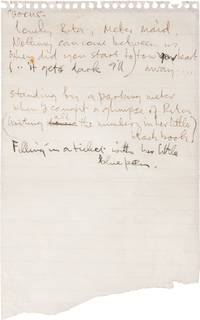
1967réf. 2451967. Paul McCartney's handwritten working manuscript as Beatle for "Lovely Rita" from the album Sgt. Pepper's Lonely Hearts Club Band. the most famous album in the entire panorama of modern music. This is the very first rough draft 10 lines in ink all in Paul's handwriting and all written on a single side of an irregular scrap of lined paper 7 1/2" X 5" torn from a spiral notebook. 7 lines in black are Paul's first concept. 3 lines of changes have been added later in blue such as "writing all the numbers in her little black book" changed to "filling in a ticket with her little blue pen" and still later recorded as "filling in a ticket in her little white book." Near fine condition. Lavishly matted and framed with a full size uncorrected 1st state proof photograph of the album cover varying in that McCartney is kneeling the band instruments have been passed around and 2 people are among the onlookers who would not sign releases and therefore did not appear on the published album. Ex-Butterfield's Dec. 12 1993. Rare. Icon time. Beatles manuscripts from Sargent Pepper held all the rock & roll world records until Bob Dylan's Like a Rolling Stone sold at auction for $2000000 in 2014. But it's been a while now and another Sgt. Pepper manuscript will take the record back eventually and someday soon the only way to see one will be in a museum at the end of a long line behind velvet ropes. The last authentic Sgt. Pepper manuscript at auction A Day in the Life admittedly a greater song sold for $1202500 at Sotheby's in 2010. The last real McCartney manuscript of a Beatles song at auction was an abridged later fair copy of 10 condensed lines from Hey Jude that he wrote out to be used as a key by the band at a recording session $910000 at Julian's in 2020 and again $1016000 at Christie's 2026 and that one in contrast to ours was not a working manuscript carrying his thoughts inner debates and changes. The handwritten lyrics to "Lovely Rita Meter Maid" represent an intimate window into The Beatles' conceptual shift during their psychedelic period showcasing McCartney's evolving storytelling approach. Unlike their earlier love songs centered on direct romantic sentiments this track exemplifies their move toward character-driven narratives with whimsical scenarios and playful humor. This creative direction coincided with broader cultural movements challenging conventional structures and celebrating the previously overlooked aspects of daily life. The track's transformation of a mundane authority figure into the subject of amorous pursuit subtly subverted social norms while maintaining a façade of innocent charm-a hallmark of the band's distinctive cultural impact during this period. McCartney's composition emerged during a pivotal moment in Western society when art was increasingly blurring distinctions between "high" and "low" culture. The Beatles' work on "Sgt. Pepper" helped legitimize popular music as culturally significant with songs like "Lovely Rita" demonstrating how seemingly simple pop compositions could contain nuanced social observation. The character sketch format allowed the band to adopt personas and perspectives outside their own experiences expanding their artistic range while connecting with the era's interest in identity exploration and social role-playing. This approach positioned the band as both participants in and commentators on the rapid social changes reshaping 1960s culture making even their lighthearted works like "Lovely Rita" meaningful cultural documents of their time. unknown
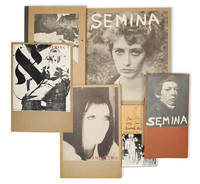
réf. 111661Los Angeles Larkspur and San Francisco self-published 1955-1964. . Semina 1. 10426 Crater Lane Los Angeles California 1955. First and only edition; colophon 5 sheets of different printed papers in various sizes gelatin silver photograph signed by Charles Brittin in blue ink on verso gelatin silver photograph signed by Walter Hopps in blue ink on verso gelatin silver photograph mounted on card signed by Cameron in black ink on verso loose in a brown card wallet 191 x 101 mm 7½ x 4 in short splits to folds with a gelatin silver photograph mounted on upper side initialled by Berman beneath photograph near-fine. Edition of 150 with contributions by Wallace Berman E. I. Alexander Robert Alexander Charles Brittin Cameron Jean Cocteau Marion Grogan Hermann Hesse Walter Hopps and David Meltzer. Semina 2. Los Angeles and Jackson Street San Francisco self-published Dec. 1957. First and only edition inscribed by Berman in red ink on upper cover verso with a note in the same ink on the inside rear cover crediting Charles Brittin for the cover image and a printed label 'handset with miscellaneous available type & papers; 8vo 212 x 139 mm 8¼ x 5½ in; printed sheets of different sizes on various papers mounted throughout; saddle-stapled in card covers with photographic reproduction mounted on upper side and titled in red printed sheet to lower minor wear and toning near-fine; 28pp. Inscribed: 'Walter Shirley / make it up for a / visit / W'. Curator and museum director Walter Hopps and his wife Shirley Hopps an art historian founded the Ferus Gallery 1957-1966 on La Cienaga Boulevard initially with Edward Kienholz then Irving Blum. Contributions by Charles Brittin Wallace Berman Herman Hesse Paul Éluard Jack Anderson Mike McClure Jean Cocteau Zack Walsh Eric Cashen Pantale Xantos Wallace Berman Walace Berman Lynn Trocchi Idell T. Romero J. B. May Charles Baudelaire translated by Hyman Lopez Charles Bukowski Peder Carr Judson Crews John Reed Marion Grogan Paul Valery translated by R. Rand Walter Hopps Alexander Trocchi Lewis Carroll David Meltzer John Altoon Marcia Jacobs Wallace Berman Cameron Rabindranath Tagore and Wallace Berman. Statement by Berman on lower cover: During the second week of a scheduled month exhibit of my paintings and sculpture members of the vice squad entered the Ferus art gallery and confiscated a copy of 'Semina 1' which was exhibited as an important part of a work entitled 'Temple'. Brought before the righteous judge Kenneth Holiday who taking the allegorical drawing out of context declared me guilty of displaying lewd and pornographic matter. I will continue to print 'Semina' from locations other than this city of degenerate angels.' Semina 3. Peyote Poem. Scott Street San Francisco self-published 1958. First and only edition; 1 sheet folded three times and tipped in; paper covers 280 x 228 mm 11 x 9 in with illustrated sheet mounted on upper light toning chipping and wear to edges limitation label now laid in very good. Edition of 200 with contributions by Wallace Berman and Mike McClure. Semina 4. Scott Street San Francisco self-published 1959. First and only edition; 25 sheets of different printed papers plus one duplicate in various sizes loose in a printed interior pocket with title information; card covers with photographic reproduction mounted on upper side light wear near-fine. Contributions by Wallace Berman I. E. Alexander Robert Alexander Wallace Berman William Blake Ray Bremser William Burroughs Peder Carr John Chance Beverly Collins Judson Crews Charles Foster Allen Ginsberg Pierre Jean Jouve translated by Howard Shulman Robert Kaufman Philip Lamantia Ron Lowenisohn Michael McClure David Meltzer Stuart Perkoff 2 copies John Reed Charles Stark Idell T. Romero Su Shi translated by Charles Guenther Jules Supervielle translated by Charles Guenther John Wieners W. B. Yeats and Pantale Xantos Wallace Berman. Burroughs' contribution: 'Excerpt from Pantapon Rose' Maynard & Miles C11 an excerpt from Naked Lunch. Semina 5 Mexico isssue. Scott Street San Francisco Self-published Winter 1959. First edition; 18 sheets of different printed papers two folding in various sizes loose in an interior pocket stamped in red; black-and-white photo-illustrated card folder 189 x 123 mm 7½ x 4¾ in light marking and wear tear at fold very good. Edition of 350 with contributions by Charles Brittin Miguel Cabrera Antonin Artaud John Chance Kirby Doyle Lawrence Jordan John Hoffman Sor Juana Ines de la Cruz translated by Philip Lamantia Robert Kaufman Philip Lamantia Christopher MacLaine William Margolis Michael McClure Anne McKeever David Meltzer John Reed Keith Sanzenbach Ruth Weiss John Wieners Pantale Xantos Wallace Berman. Semina 6 The Clown. Larkspur California self-published 1960. First edition; 14 hand-printed sheets loose in an interior pocket stamped in red; black-and-white photo-illustrated card covers 216 x 154 mm 8½ x 6 in 'Art is Love is God' stamped in red on lower light wear and foxing very good. Edition of 335 with contributions by Wallace Berman and David Meltzer. Semina 7. ALEPH / a gesture involving photographs drawings & text by Wallace Berman. Larkspur California self-published 1961. First edition; 18 sheets of different printed and papers in various sizes loose in an interior pocket stamped in black; cardboard covers with a black-and-white photographic reproduction mounted on upper side and titled in red fine. Edition of 200 copies all contributions by Wallace Berman. Semina 8. Los Angeles self-published 1963. First edition; 3 gelatin silver photographs 13 sheets of different printed papers in various sizes one folding 10 with mounted gelatin silver photographs loose in an interior pocket stamped in green; thick board covers black tape spine photographic reproduction mounted on upper side Aleph stamped in black on lower hole punched at fore-edge with remnant of twine ties very good. Edition of 149 copies with contributions many of which are initialled in black ink by Dean Stockwell Antonin Artaud Cameron Robert Duncan Wallace Berman Kirby Doyle John Reed William House Jess Jerry Katz Michael McClure Aya Tarlow Patricia Jordan Elias Romero Lyn Foulkes John Wieners and Zack Walsh. Semina 9. Crater Lane Los Angeles self-published Summer 1964. First edition; 1 printed sheet in a manila envelope with a gelatin silver photograph mounted on upper side addressed in black pen to 'Don / 1176 San Ysidro / Beverly Hills' with postage stamp and post office cancel ink doodles on lower a very good copy. With contributions by Wallace Berman and Michael McClure. A complete set Semina 2 inscribed by Berman to Ferus Gallery co-founders Walter and Shirley Hopps A complete set of Semina Wallace Berman's seminal assemblage publication comprising poetry aphorisms and images distributed by hand and mail to collaborators friends and like-minded acquaintances in editions of 150 to 350 copies. Semina Two inscribed to Ferus Gallery co-founders Walter and Shirley Hopps: 'Walter Shirley / make it up for a / visit / W'. In 1957 Berman included some of the items from the first issue of Semina in an installation at the Ferus Gallery which was notoriously raided by the vice squad. Berman was arrested and the exhibition closed on obscenity charges. Subsequently Berman retired from exhibiting his work publicly and entered a self-imposed exile. At the end of 1957 he completed a second issue of Semina and relocated to San Francisco where he focused on his family and friends. The core of Berman's circle lived in Los Angeles and the San Francisco Bay Area but it also included avant-garde poets and artists at Black Mountain College and New York poets and filmmakers. In addition to Berman contributors include Charles Bukowski William S. Burroughs Diane DiPrima Kirby Doyle Robert Duncan Cameron Allen Ginsberg Dennis Hopper Walter Hopps Jess Bob Kaufman Michael McClure Taylor Mead David Meltzer Jack Smith Dean Stockwell Russ Tamblyn Alexander Trocchi and John Wieners. Burroughs' contribution: issue 4 'Excerpt from Pantapon Rose' Maynard & Miles C11; Goodman & Coley B.46; Schottlaender v.4 C12; Schottlaender v.5 C12. Clay & Phillips pp78-79; In Numbers: Serial Publications by Artists Since 1955 pp339-344. Los Angeles, Larkspur, and San Francisco, [self-published], 1955-1964. unknown
réf. TM 767MEDIEVAL SERMON MANUSCRIPT IN A FIFTEENTH-CENTURY CHAINED BINDING CHAIN INTACT decorated manuscript on parchment in Latin Austria Vienna or Southern Germany c. 1275-1300. 182 x 127 mm. 190 folios complete written in a rapid Gothic hand with cursive influence in two columns of thirty-two to thirty-seven lines justification 141-143 x 96-100 mm. parchment ruled in brown ink quire signatures guide notes for rubrication red rubrics capitals and names of cited authorities stroked in red rhymed phrases underlined in red red paraphs two- to three-line plain red initials two-line red initial with pen flourishing in red f. 131v occasional scribal corrections and marginalia. BINDING: Fifteenth-century blind-tooled and -stamped red calf with eight engraved and bossed cornerpieces intact fore-edge clasp and chain hasp with intact chain with two manuscript fragments serving as front flyleaf and lower pastedown. Chained libraries were a late medieval solution to the problem of providing access to needed books in an institution while at the same time preventing theft and we can assume many late medieval volumes were once chained. Most however have been rebound or survive without the chain and other metalwork and intact chained bindings such as this one are uncommon. TEXT: This extensive collection includes more than one hundred sermons from the Sermones de sanctis et de communi sanctorum of the early Franciscan writer Conrad of Saxony d. 1279 together with his very popular text the Speculum beatae Mariae virginis all copied not long after their composition. This is however not simply a copy of Conrad's sermon cycle since some of his sermons are omitted and six sermons by contemporary Dominican authors Martinus Polonus Aldobrandinus de Calvacantibus and Antonius Azaro de Parma as well as eight sermons by unidentified authors were also included. It seems likely this is an example of a re-working of Conrad's texts for a Dominican audience who would have prized it as a preaching aid and for its pronounced Marian focus. Marginal annotations attest to the early use of these sermons most likely by preachers. PROVENANCE: Written in Southern Germany or Austria at the end of the thirteenth century as suggested by evidence of spelling script and decoration. Belonged to the Dominican house attached to the Church of St. Maria Rotunda in Vienna as indicated by two fifteenth-century inscriptions; here it was probably part of the house's chained library. Belonged to a Dominican convent at KosiÄe in present-day Slovakia as indicated by a sixteenth-century inscription. Belonged to Maurice Burrus 1882-1959 Alsatian philatelist; his ex libris on the front pastedown. CONDITION: Slight rust stains and corrosion in the outer margins of ff. 184-188 margins trimmed away overall in good condition. Full description and photographs available TM 767. books
1715réf. 48763Augsburg.: Jeremias Wolff. c.1715. Full contemporary blond calf boards with elaborate neo-classical decorative borders composed of rules foliate floral and rope-work tools vase tools at head and foot and mask corner tools all to surround a central lozenge with a decorative composition of floral foliate and mask tools later banded spine with elaborate decorative tooling in gilt in seven compartments turn-ins tooled in gilt red speckled edges. Folio. 554 x 423 mm. Engraved allegorical title with Latin and German text leaf with letterpress text in German in double columns and 56 engraved allegorical plates all after the Deckers by various engravers see below. Sheet size: 435 x 560 mm. An exceptional copy of Decker’s very rare suite of engravings – here in-plano and with exceptional additional colouring and highlighting in gilt by hand – illustrating the battles of the War of the Spanish Succession.Decker’s suite depicts the battles of the complex series of engagements that became known as the War of the Spanish Succession 1701–1714. Prompted by the death of the last of the Spanish Habsburg Kings the childless Charles II and with a shifting group of alliances and a field of warfare that included not only Continental Europe and the Mediterranean but also the Caribbean and North America the War of the Spanish Succession has a case to be a true world war. In part an attempt to check French hegemony the war featured a number of outstanding victories for the Duke of Marlborough and Prince Eugene of Savoy including Blenheim although the war was ultimately at best indecisive.Each of Decker’s magnificent plates features a single engagement depicted in the central portion of the plate the whole image surrounded with a decorative border composed of architectural allegorical and armorial symbols and motifs in the Baroque manner and a descriptive text concerning the battle. Many of the plates feature an additional small vignette of the battlefield keyed to the descriptive text and illustrating the placement of the armies and the most significant figures involved.The colouring and highlighting by hand of the present copy is remarkable. The painstaking detailing and the additional ornamentation in liquid gold is lavish and in combination with the binding suggests this copy was important and worthy of presentation. The printed text 'Kurze Beschreibung des Spanisch Successions-Krieg . &c.' here and unusually in German gives a detailed outline of the origins and history of the conflict and concludes with the list of plates and the engagements they depict. The text appears in other copies in other languages suggesting a commercial flexibility of distribution.It is a measure of the importance attached to Decker’s suite that the painter Ignaz Preissler used Decker’s plates as the basis for the decoration of an important tea service and garniture now at least partly in the collection of the Metropolitan Museum in New York see ‘Repraesentatio Belli ob successionem in Regno Hispanico . A Tea Service and Garniture by the Schwarzlot Decorator Ignaz Preissler’ by Maureen Cassidy-Geiger.‘Such commemorative series were considered works of art as well as encapsulations of recent events and were highly valued by collectors of the period who acquired them for their libraries or print cabinets.’ Maureen Cassidy-Geiger.Decker’s suite is very rare outside Germany: COPAC lists copies at the British Library and V & A only while KVK lists copies at the Polish National Library the Bibliothèque Nationale and the Université de Charles de Gaulle Lille in France and the Rijksmuseum Amsterdam; the only traceable copy in North America is at Brown University. We can locate no other copies with contemporary colouring or highlighting by handBerlin 103 incomplete; Bobins III 1165; Brunet V 626 for the French edition. Jeremias Wolff. hardcover
1938réf. 69823New York:: The Macmillan Company 1938. Reprint of the 1936 first edition. original gray cloth stamped in blue in dust jacket. Ink stamp of Selznick International Pictures Inc. to verso of rear free endpaper; a little browning to the hinges from binder's adhesive; some shelfwear to the bottom edge; but a bright copy. The jacket is chipped at extremities of the backstrip and has a few other tiny chips; good to very good. The framed certificate of appreciation is somewhat rippled and there is some fading to some of the signatures. . 8vo and framed artwork measuring 25 x 21 inches overall. Denoted in pencil "Copy #1" this was Assistant Director Eric Stacey's copy signed by David Selznick Director Victor Fleming and 28 members of the motion picture cast including Vivien Leign Clark Gable and Olivia de Havilland. Eric Stacey has added his ownership signature in pencil on the half-title. Accompanying the book is a framed gift presented to Eric Stacey "In appreciation for his cooperation and unfailing interest during the darker days of "Gone With the Wind." Created by Atlanta artist Jack Conner the signatures of 82 members of the motion motion picture production staff are surrounded by a decorative cartouche in colors featuring Aeolus the Keeper of the Winds as a pair of cherubs amid scrolls the sun moon and stars. In the decorative title lettering "Gone" is windblown. The Macmillan Company, hardcover
1960réf. 69825Philadelphia:: J. B. Lippincott Company 1960. Thirteenth impression. publisher's cloth-backed boards in dust jacket. Preserved in a quarter morocco folding box. Fresh and bright: better then very good in a very good jacket with the usual rubbing and edgewear. 8vo. This book was a gift for Helen Grotke who was the schoolteacher on the motion picture set tutoring the school-age actors. Inscribed by Harper Lee and twelve members of the cast including Gregory Peck Robert Duvall and the children. Many of the actors have written the names of their characters under their inscriptions. Mary Badham's reads "To Miss Grotke my favorite teacher. Mary Badham Scout." J. B. Lippincott Company, hardcover
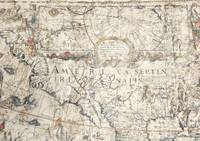
1673réf. 12722Bologna Guiseppe Longihi Pietro Todeschi 1673. Nova et accurata totius Americae tabula auct. G. I. Blaeu America quarta pars orbis quam plerunq nuvum orbem apellitant primo detecta est anno 1492 a Christophoro Columbo . A hand-coloured engraved wall map printed on 4 joined sheets. Size: 86 x 110 cm. / 33.9 x 433 inch. Large very rare hand coloured copy of Willem Blaeu's famous wall map of the Americas which is considered ""one of the most influential maps of America ever made"" Burden. The map is based on the latest explorations and shows everything known at the time about the American continent as well as the north and south poles which are included on two inset maps. As the wall map was in great demand but expensive and difficult to transport it was also printed by various French and Italian publishers for the local market. Like Blaeu's edition the French and Italian editions are very scarce as it is highly unusual for wall maps from this period to survive. We have only been able to trace 4 other copies of the present edition in sales records of the past hundred years of which only 1 is also hand coloured. Willem Janszoon Blaeu 1571-1638 first published the wall map in 1608 together with similar maps of Asia Africa and Europe. He spared no expenses for this project and hired Hessel Gerritsz 1580-1632 a great cartographer in his own right to both design the maps and research the latest sources exhaustively to create the most accurate depiction of the continents possible. Although the Americas were drawn too wide due to the inadequate methods of determining longitude at the time the shapes and most of the coastline are already very well defined. Central and South America were drawn according to Portuguese and Spanish sources and ""Nova Scotia"" on the Atlantic coast was based on the voyages of Samuel de Champlain and Pierre Gua de Monts from 1604. After the first edition in 1608 the four continents were subsequently published in 1612 and in 1624 they were reissued by Hendrik Hondius and in 1655 by Nicholas Visscher. The third state included changes to the Strait of Magellan based on Le Maire's findings from his expedition in 1615-1617. The map has been beautifully decorated with cartouches and small engravings. The cartouche in the lower right tells how the New World was discovered and is flanked by the figures of Christopher Columbus and Amerigo Vespucci. Below are four roundels containing the portraits of the four circumnavigators: Ferdinand Magellan Sir Francis Drake Sir Thomas Cavendish and Olivier Van Noort. The Atlantic features a beautiful depiction of King Philip III of Spain riding a sea chariot supposedly on a figurative visit to his New World possessions and in the Pacific Poseidon with his wife Amphitrite and son Triton can be found amidst battle ships and sea monsters. Elephants rhinoceroses camels and ostriches roam the continent. Some copies of the present map include a decorative border with illustrations of native people and sometimes also a textual border with descriptions which are not present here. It appears that these borders were engraved on separate copper plates and were not always included. Blaeu's wall maps were first printed in Italy in 1646 probably by Stefano Mozzi Scolari 1598-1650 in Venice which were based on the third state from 1624. The present copy was engraved by Pietro Todeschi dates unknown around 1670 and published in Bologna in 1673 probably by Giuseppe Longhi who had worked on similar projects with Todeschi before. It closely resembles the Venetian edition which was most likely used as the model. Todeschi's edition is however clearly recognizable because of the misspelling of Mar del Norte as Mar del Noi and the fact that California has been drawn as an island. It is the only edition known to do so. The map has been reinforced on the back and is somewhat browned and stained; the surface has faded the work has been professionally restored: the colouring has been retouched some of the losses have been filled in. Otherwise in good condition. Burden II 433; Schilder Monumenta cartographica Neerlandica V p. 195; cf. Burden I 156 Blaeu map. Bologna, Guiseppe Longihi, Pietro Todeschi unknown
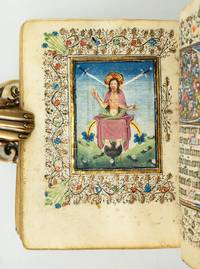
1450réf. ST20835Flanders ca. 1450. 109 x 81 mm. 4 1/4 x 3 1/8". Single column 14 lines in a gothic book hand. 161 leaves. COMPLETE. Contents: Calendar f. 1r; Mass of the Holy Spirit f. 14r; Mass of the Holy Cross f. 23r; Requiem Mass f. 30r; Prayer on the Seven Last Words of Christ by the Venerable Bede f. 36v; Passion according to John f. 40v; blank f. 53; Hours of the Holy Cross f. 55r; Mass of the Virgin Mary f. 60r; Gospel Lessons f. 66v; Hours of the Virgin f. 73r; Penitential Psalms f. 126r; Litany f. 138r; Office of the Dead f. 144r. PLEASING NEAR-CONTEMPORARY BLIND-ROLLED CALF apparently with some old skilled restoration to joints spine and corners covers with rolled vine border surrounding a panel of three columns bearing a roll with parts of the inscription "AVE MARIA GRACIA PLENA" each word separated by one of four small motifs a flower a human profile the lamb of god and a sitting animal--perhaps a lion raised bands compartments with part of the same inscription roll. Lacking the original ties. Housed in a very attractive custom-made brown calf folding case with blind-stamped lettering on the spine interior lined in suede the whole within a calf-lipped suede-lined matching slipcase. Rubrics in red numerous one-line initials in blue with red penwork or gold with dark blue penwork many two-line initials in burnished gold on pink and blue ground with white embellishments several larger "I" initials between four and 11 lines in burnished gold on pink and blue ground with white embellishments 12 six- to seven-line initials some painted pink or blue with white embellishments and filled with flowers and tendrils on a gold ground or the initial in burnished gold on pink and blue ground with white embellishments EIGHT LARGE MINIATURES each inside a thin gold frame and with a three-quarter border of gilt leaves hairline vines and floral spays each facing page with a similar three-quarter border the subjects of the miniatures being: the Holy Spirit in the form of a dove f. 13v; St. Helena and the True Cross f. 22v; Raising of Lazarus f. 29v; Crucifixion f. 54v; Virgin and Child Enthroned f. 59v; Annunciation f. 72v; Last Judgment f. 125v; Funeral Mass f. 143v. Prickings visible in fore margins. See: Defoer et. al "The Golden Age of Dutch Manuscript Illumination" pp. 75-86. Just minor wear to the solid very pleasing early binding. A little chipping almost always mild to four of the miniatures with square frames the fifth the Annunciation somewhat rubbed and faded the three domed miniatures perfectly intact vellum with minor soiling and thumbing in places especially in lower corners of leaves in second half other trivial imperfections but overall a very well-preserved manuscript with no major issues. This enchanting little prayer book features eight attractive miniatures large gleaming burnished gold initials and a pleasing period binding--all in an excellent state of preservation. The miniature program here can be attributed to the so-called Masters of Otto van Moerdrecht the name given to a variety of Dutch artists active in the 1430s and '40s all working in a similar mode rather than to a specific master or workshop. According to Defoer et al. the work of these miniaturists "exhibit varied compositional formulas and bright highly contrasting colors . . . . The small somewhat doll-like figures appear rather wooden but their expressive gestures give the scenes a varied and vivid character." Two artistic hands are responsible for the present miniatures. The artist behind the first three miniatures all set within domed gilt frames the Holy Spirit St. Helena and Raising of Lazarus shows particular skill with a very smooth application of color figures with long eloquent hands and faces with subtle white highlighting. A second artist was responsible for the remaining five miniatures set within square golden frames Crucifixion Virgin and Child Enthroned Annunciation Last Judgment and Funeral Mass. Though this hand is less polished and the miniatures slightly smaller in size the scenes are all quite charming and attractively colored with vivid splashes of bright orange bubblegum pink sky blue and pale green. It is worth noting that the miniatures differ not only because of the artists' degree of success but also because of their condition: whereas the five are generally well preserved the other three are in a virtually perfect state. In addition to the central text of the Hours of the Virgin this manuscript contains several Masses each of which is preceded by a miniature. Perhaps the most interesting of these is the Mass of the Holy Cross which is paired with a miniature of St. Helena mother of Constantine the Great. According to Christian tradition Helena found the wooden cross used in the Crucifixion while she was travelling in Jerusalem in the fourth century. Constantine built the Basilica of the Holy Sepulchre in its honor and installed the relic there to be venerated. Britannica says that the adoration of the True Cross led to wide-spread sale of its fragments sought after as objects of devotion. It is unusual to find St. Helena depicted in a Book of Hours and this image is especially appealing with Helena in a beautiful red robe crown and halo embracing a large wooden cross in the center of the composition. The background is reminiscent of the work of the Gold Scrolls group with small swirls of liquid gold swimming in a scarlet sky the same scrolling motif graces the Holy Dove miniature. There is no indication of former ownership in this manuscript although the Calendar presents a few unusual saints that confirm a Flanders connection. These include St. Amandus in red known as the "Apostle of Flanders" on 2 February; St. Guido known as the "Poor Man of Anderlecht" on 9 September; St. Bavo in red patron saint of Ghent where a Cathedral is named in his honor on 10 October; and St. Eligius patron saint of goldsmiths and metalworkers on 1 December. The binding here is very close to contemporary and probably dates to the late 15th century. Neither the floral roll nor the "Ave Maria" roll seems to appear in EBDB. Similar rolls include r001954 r000623 and r000670 but ours is the only one with four different and charming tools one of each used between every "Ave" and "Maria." For a manuscript only slightly bigger than the palm of one’s hand this Book of Hours has a great deal to offer. In addition to its early binding and lovely illumination by an influential group of artists great care has been put into its preservation so that it resolutely endures for our pleasure and for owners in the centuries to come. unknown
réf. NYBF15Amsterdam Nicolas Visscher 1660. Large folio 535 x 358 mm of 9 double-pages with 36 engravings bound in 18th century paperboards. Complete copy printed on large paper in sumptuous contemporary colouring of the baroque atlas of the Netherlands. In the last 60 years auction records mention only 2 copies of the standard issue one from the first edition of 1657 the other one from the present edition of 1660. A third copy which was incomplete was sold in 1987. The present compilation contains 36 engravings printed by groups of 4 on the recto of double folios that illustrate baroque architecture of the Netherlands in the middle of the 17th century. The prints not only depict towns canals ports village scenes mains monuments but also precarious housing return from the market hunting scenes sailing castles churches convents wind mills as well as ornamental gardens the whole entirely enhanced with warm contemporary colouring. Hollstein Schut 32; Hollstein Publ. Clae Claesz Visscher I 7 The present copy printed on large-paper is the only one recorded from this de luxe edition. In the posterior editions the Ottens ones for instance engravings were cut and presented separately and so printed in a 4to format. The Visscher family is famous in the history of printing Atlases in the Netherlands in the 17th century. Nicolas Visscher I the editor of the present atlas was born in Amsterdam in 1618. Only son of Claes Jansz Visscher he got married in 1643. When his father died in 1652 he carried on the activity and settled in the Kalverstraat in Amsterdam until his passing in 1679. Français Amsterdam Nicolas Visscher 1660. Grand in-folio de 9 double-pages regroupant 36 estampes cartonnage du XVIIIè siècle. 535 x 358 mm. Exemplaire complet imprimé sur grand papier en somptueux coloris de l'époque de l'Atlas baroque des pays bas. Depuis 60 ans le répertoire des ventes publiques ne mentionne que 2 exemplaires en tirage normal l'un de la première édition de 1657 l'autre de la présente édition de 1660 un troisième incomplet fut vendu en 1987. Ce recueil présente 36 estampes gravées groupées par 4 vues imprimées au recto d'un double folio -illustrant l'architecture baroque des Pays Bas au milieu du XVIIè siècle. Sont dessinés et peints avec bonheur les villes canaux ports scènes villageoises les principaux monuments mais aussi l'habitat précaire le retour du marché les scènes de chasse la navigation les châteaux églises couvents moulins ainsi que les jardins d'agrément le tout rehaussé en chaleureux coloris de l'époque. Hollstein Schut 32 ; Hollstein Publ. Clae Claesz Visscher I 7 Le présent exemplaire imprimé sur grand papier est le seul répertorié dans ce tirage de luxe. Dans les éditions postérieures par exemple les éditions Ottens les gravures furent coupées et présentées séparément et donc imprimées au format in-4. La famille Visscherest célèbre dans l'histoire de l'imprimerie des Atlas aux Pays Bas au XVIIè siècle. Nicolas Visscher I l'éditeur du présent atlas est né à Amsterdam en 1618. Fils unique de Claes Jansz Visscher il se maria en 1643. A la mort de son père en 1652 il poursuivit l'activité et s'établit sur la Kalverstraat jusqu'à sa mort survenue en 1679. hardcover
réf. TM 796MEDIEVAL ILLUMINATED MANUSCRIPT IN ITALIAN ON PAPER Northeastern Italy Veneto Venice c. 1474. Dimensions 328-332 x 230 mm. 188 folios missing at least three leaves written in brown ink in an Italian cursiva libraria script EIGHT ILLUMINATED INITIALS of seven lines one-line paraphs in red or blue simple two- to four-line in red or blue initials. BINDING: re-cased using original binding materials of brown half leather over bevelled wooden boards with three double bands remains of four straps present. TEXT: Italian translation of Gregory the Great's Moralia in Job one of the most important and widely copied texts of the Middle Ages. Though forty copies of this translation survive this volume is unusual in its incorporation of Venetian dialectal forms. All other copies are in European institutions and have not been on the market for the last century. PROVENANCE: scribal colophon on f. 190v provides a date for this manuscript's completion and helps localize its production within Italy: "Scripto per mi zuane de zane zoielier condam per simon et chi li lezeranno priegi dio per lo scriptore. MCCCCLXXIIII" Written by me Zuane de Zane jeweler once for Simon and may whoever will read it pray to God for the writer. 1474. There is no Zuane de Zane on record elsewhere as a scribe; the name itself is Venetian and evidence of the manuscript's watermark and decoration also suggest an origin in the region of Veneto and possibly Venice specifically. The manuscript was later acquired by a private European collection. CONDITION: slight tears in the lower margin of f. 25 and upper margin of ff. 37 and 160 from f. 161 to the end there is a slight loss to the upper outer corner slight water staining visible parchment reinforcement present prickings visible. Full description and images available. TM 796 Northeastern Italy, Veneto (Venice?), dated 1474
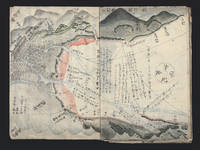
réf. 5611"Hishu" today Saga Prefecture: 1841-45. A very rare Japanese manuscript sea chart of the sea routes from Saga Prefecture a major trading area in the west to Osaka through the Inland Sea which is more than 400 km. long and includes in excess of 3000 islands. The Inland Sea one of the main trade routes for the Japanese in the Edo period has numerous areas of turbulence and navigating through the numerous islands and rocky outcroppings presented enormous problems in the era before modern navigation systems. In the early 1840s the central government in Edo ordered each fiefdom to prepare maps of coastal routes to facilitate trade and shipping. Our manuscript was prepared by Tsugihei Miyachi a high level sea pilot "mite kako" in the Saga Prefecture shipping office as an employee of the Nabeshima Clan. The map were it to be unbound is about 11340 mm. long about 37 feet depicting Saga in the west to Osaka in the east. It is finely drawn in black ink heightened with wash in green purple blue grey and red. Five of the openings have folding extension sections pasted onto the lower margins of the leaves. Blue lines depict safe sailing routes for smaller ships. The map depicts in very great detail areas of turbulence there are famous whirlpools in the Inland Sea numerous islands rock formations and landscapes for orientation anchorages harbors and fishing areas. Each section of the map has been annotated by the compiler with notes on distances characteristics of rivers landmarks for navigation tidal activities the route to Nagasaki etc. The first map opening depicts Saga and the final opening Osaka. The sea chart is prepared with considerable local knowledge of castles and temples. A series of notable castles each is labeled with name of the lord assets etc. are depicted along the shores and Miyachi describes harbors for anchoring and to get fresh water. The routes are drawn from a "bird's-eye view" perspective with lovely vistas of mountains and islands and villages and towns. The two leaves of manuscript text at the beginning in the style of a dedicatory letter to the fiefdom lord describes the compiler's efforts over a five-year period to prepare the map. He writes that it is based on his own personal experiences as a sea pilot. He states that purple denotes routes he has taken red denotes shallows blue lines denote the routes for large ships grey for land and green for mountains and forests. The eleven pages of text at the end provide details on prevailing weather patterns and how to prepare for inclement weather how to navigate by landmarks and the stars wind and tidal patterns and the history of the preparation of this map "it took me five years of daily observation to prepare this work". He provides a list of his voyages to different cities on this route. On the final page the author states that three copies were made: the first for the fiefdom lord the second for a cabinet member and the third for Miyachi's divisional chief. A modern scholar has laid-in a note describing this sea chart as one of those three. Japanese sea charts are rare survivals and we know of no other similar example outside of Japan. ❧ The sea pilot Miyachi's log books are preserved in the Nabeshima clan's archives see the Saga kenritsu toshokan database. unknown books
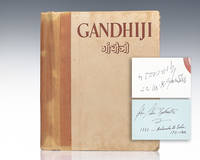
1944réf. 149272Bombay: Keshav Bhikaji Dhawale October 2 1944. First unabridged edition of this tribute to Gandhi with introductions by Gandhi and Jawaharlal Nehru and a biographical essay by Albert Einstein. Quarto original publisher's half cloth patterned endpapers illustrated with black and white photographs and tipped-in color plates frontispiece. Boldly signed by Mahatma Gandhi on the half-title page. Association copy additionally signed by John Kenneth Galbraith opposite the copyright page "John Kenneth Galbraith 1987 -- Ambassador to India 1961-1963." Although he remains best known as an iconoclast in the field of economics John Kenneth Galbraith was very active in Democratic Party politics serving in the administrations of Franklin D. Roosevelt Harry S. Truman John F. Kennedy and Lyndon B. Johnson. During his time as an adviser to President John F. Kennedy Galbraith was appointed United States Ambassador to India from 1961 to 1963. Kennedy considered India to be important not just in its own right but also because an Indian diplomat always served as the chief commissioner of the International Control Commission ICC. Thus Galbraith came to be involved in American policy towards Southeast Asia from his perch as an ambassador in New Delhi. During his tenure in India Galbraith developed close ties with Prime Minister Jawaharlal Nehru and engaged deeply with the political and cultural life of the country. He expressed admiration for India’s experiment in democratic socialism and non-alignment and he frequently drew comparisons between Nehru’s political legacy and that of Mahatma Gandhi. While Galbraith did not interact directly with Gandhi—who had been assassinated in 1948—he often invoked Gandhian ideals in his reflections on India’s development and its moral role in the post-colonial world. His writings and diplomatic efforts emphasized the importance of non-violence civil society and moral leadership themes closely associated with Gandhi’s philosophy. In very good condition. A wonderful association copy very rare and desirable signed by Gandhi and even more so with the addition of Galbraith's signature. Published in 1944 to both commemorate Mahatma Gandhi’s 75th birthday and support the Kasturba Gandhi National Memorial Fund Gandhiji: His Life and Work contains essays by various contemporaries examining Gandhi’s political career social reform efforts and influence on Indian society as well as a curated selection of Gandhi’s own writings including speeches and letters. Although Gandhi generally declined to participate in birthday commemorations he wrote a preface for this volume citing its charitable purpose. As a mid-career publication released during Gandhi’s lifetime the book reflects the contemporary reception of his work and offers early interpretations of his role in the Indian independence movement. "Generations to come it may be will scarce believe that such a one as this ever in flesh and blood walked upon this earth" Albert Einstein On Gandhi. Keshav Bhikaji Dhawale hardcover
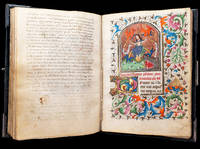
1450réf. 0226BOOK OF HOURS USE OF SARUM In Latin and French illuminated manuscript on parchment. Bruges Flanders c. 1450 with substantial additions made in France in the late fifteenth and sixteenth centuries. Five miniatures by the Masters of the Gold Scrolls subgroup of the Master of Berlin Kunstbibliothek MS Grisebach 4 and one later French miniature in the artistic milieu of Antoine de Lonhy fl. c. 1446–1490. 193 × 134 mm. vi 124 leaves. Written principally in textualis formata in brown ink with rubrics in red and numerous initials in burnished gold blue and rose with penwork and foliate decoration. FIVE HALF-PAGE MINIATURES from the original Bruges campaign set within burnished-gold arches and surrounded by elaborate borders of scrolling vines acanthus flowers gold ivy leaves and bezants. ONE THREE-QUARTER-PAGE MINIATURE of the Mass of Saint Gregory was added in France at a later date. Made in Bruges around 1450 for the English market as demonstrated by its calendar for the Use of Sarum. The five surviving original miniatures depict the Massacre of the Innocents f. 7 Virgin and Child f. 13v Funeral Mass f. 38v Adoration of the Magi f. 57v and Resurrection f. 73. Gregory T. Clark attributes the illumination to a refined subgroup of the Masters of the Gold Scrolls centered around the Book of Hours Berlin Kunstbibliothek MS Grisebach 4. After reaching France the manuscript was extensively personalized. A striking miniature of the Mass of Saint Gregory with a kneeling female patron and impaled arms was added to the front of the volume. Stylistically it belongs to the immediate artistic milieu of Antoine de Lonhy and may possibly be by the artist himself. Additional French and Latin prayers protective texts healing charms and two versions of the Obsecro te—one for a female supplicant and another for a male—document its continued use by successive owners. Offsets from former pilgrimage badges preserved between its pages provide particularly evocative evidence of medieval devotional practice. An early ownership inscription appears most likely to read "I. Damas" or "H. Damas" while a later red-wax armorial seal appears to correspond with the heraldic tradition of the Damas family suggesting a possible long or recurring association with the family although continuous ownership cannot presently be demonstrated. The manuscript contains the Calendar Use of Sarum; Hours of the Virgin imperfect; Short Hours of the Cross; Mass of the Virgin; Seven Penitential Psalms; Litany; Office of the Dead; and substantial supplementary devotional material. Several leaves and miniatures are lacking particularly within the Hours of the Virgin. Nineteenth-century black silk velvet binding over pasteboards fitted with four pierced silver corner pieces and an elaborate silver clasp depicting the Agnus Dei beneath the Banner of the Resurrection. Housed in a twentieth-century red cloth clamshell box. Parchment generally sound with occasional stiffness and cockling moderate soiling and staining and occasional rubbing to initials and marginal decoration. The five original Bruges miniatures remain exceptionally fresh retaining brilliant color and crisp execution. The later Mass of Saint Gregory miniature has significant rubbing and wear to the background with minor modern interventions and restoration. PROVENANCE: Produced in Bruges for the English market c. 1450; unidentified female French patron later fifteenth century; Damas family late fifteenth or early sixteenth century and possibly later; subsequent female and male users documented by added prayers; private collection Switzerland. FOR FULL DESCRIPTON PLEASE SEE MY WEBSITE Illuminated Manuscript / Book of Hours
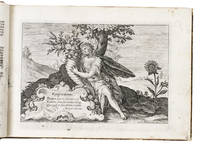
1614réf. ABC_48468Utrecht 1614. Oblong folio ca. 18.5 x 26.5 cm. for Crispijn van de Passe Later half calf decorated paper sides gold-tooled spine and red sprinkled edges. With a full-page plate of Flora embracing the cornucopia in a landscape with an epigram by Arnoldus Buchelius in a cartouche in the left hand corner engraved by Simon van de Passe after Crispijn van de Passe 2 different frontispieces both appearing twice of ideal gardens full of flowers and 174 full-page engraved plates of flowers fruits fruit trees and medicinal plants mainly by Crispijn van de Passe the Younger 3 by his brother Willem van de Passe. 2 parts in 1 volume the first in 4 sections. 26 pp. 118 engraved ll.; 1 1 blank pp. 61 engraved ll. Very rare first Dutch edition of this famous book on horticulture including beautifully engraved plates of flowers organised according to the season in which they bloom and frontispieces showing the ideal garden. The work was first published in Latin under the following title: Hortus floridus in quo rariorum & minus vulgarium florum icones . without text published in Arnhem by Jan Jansz. in 1614. The expertly engraved plates were also sold separately and were constantly updated and amended by adding various details insects other animals or simply different numbers to meet demand. While the present first Dutch edition contains short explanations of the plates on separate typographical leaves the same information was only added to the Latin version of the work in its second edition 1616 - the corresponding text then appearing on the verso of each engraved plate. The text was written by Arnoldus Buchelius or Aernout van Buchel 1565-1641 a Dutch scholar and humanist from Utrecht who is now most known for specialising in genealogy and heraldry.This Dutch edition was soon followed by English and French editions. The Hortus floridus including translations was considered without question the most popular florilegium ever published An Oak Spring Flora and "Blunt calls this the most celebrated and influential of the early florilegia and one of the finest Hunt.The emphasis of the plates is on the common garden flowers with a preponderance of spring bulbs. The book was intended to provide inspiration for garden lovers who were invited to colour the black and white copperplate engravings themselves according to the colours they found in their own gardens. The introduction is enlarged with details on how to colour the plates. Many of the flowers shown are tulips hyacinths crocuses and other bulb plants mirroring the new enthusiasm and passion for bulbs which eventually led to the tulip mania of the years 1636-37 when contract prices for some bulbs reached extraordinarily high levels leading to the first recorded speculative bubble in history.As the plates were printed then modified and assembled at different times between 1614 and 1617 almost no two copies are the same - consisting of various numbers of plates with different title pages and prefaces. Our copy seems to be a practically complete copy of the Dutch edition containing an unmatched number of plates the only plate not present in this copy which is sometimes included in others is the engraved plate frontispiece of the Latin quotation from Matthew 6 Cognoscite lilia in part 2. The four sections of part 1 include 113 plates of flowers including the 99 that are called for in the preface organised per season: spring: 41; summer: 20; autumn: 26; winter: 12. The extra plates are as follows: 1: an addition to spring with plate 42 = second copy of plate 2 of summer 2: 12 plates depicting tulips numbered 43-54 and 3: an addition to autumn: a plate depicting two metal cylinders for growing flowers 1 with a tulip not found in any other copy consulted but possibly called for by Nissen "Garten Instruments".The second part includes 61 plates depicting 120 numbered depictions of fruits fruit trees and medical plants. This part included in most copies of the Latin edition and in some of the Dutch edition had been published already by Crispijn van de Passe the Elder around 1600-1604 when he was in Cologne in association with the publisher Hans Woutneel.The quality of the engravings is exceptionally fine and delicate representing real masterpieces of horticultural art executed by a leading family of engravers and publishers in the first half of the Dutch Golden Age.With a 19th-century round stamp with double eagle and the initials "H.C.P.S.G." and a red stamp "Ex libris J. Visser Rotterdam" on the title page with the red ex libris stamp also on the divisional title page of the second part. Lacking the engraved plate frontispiece of the Latin quotation from Matthew 6 Cognoscite lilia in part 2. The binding is very slightly rubbed the bottom outer corner of the back board is slightly damaged the typographical leaves are slightly soiled the head margin of the title page is cut short and restored with paper lightly foxed some very slight foxing and/or soiling throughout mainly to the outer edges of the margins some small marginal tears some restored in several leaves plate 44 spring with a repaired tear plate 43/44 in part 2 is repaired in the head margin. The verso of 45 plates show minute pricked holes in the leaf following the outlines of the depicted flowers and plants as a way of tracing the images on another leaf of paper or possibly another copperplate. Otherwise in good condition.l Franken 1881 no. 1346; Hunt no. 199; Nissen BBI no. 1494; Oak Spring Flora 12; Saunders Picturing Plants pp. 36-37; Savage The Hortus Floridus in: Transactions Bibiogr. Society Second series IV 1923 pp.181-206; Segal Flowers and Nature 1990 pp. 165-166; Soultrait 17th century 226; STCN 308020359 3 copies incl. 1 incomplete; USTC 1022789 4 copies incl. 1 incomplete; 3 the same as STCN; cf. Veldman Crispijn de Passe and his Progeny 1564-1670: a century of print production 2001 pp. 205-212. ABE CAT Art History ART ARCHITECTURE & PHOTOGRAPHY DRAWINGS PRINTS & WATERCOLOURS NATURAL HISTORY / Botany Art & Art History Flowering Plants Horticulture Prints & Print Series unknown
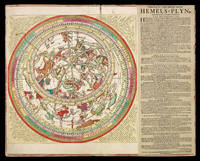
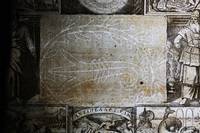
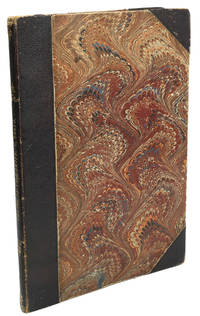
1722réf. 1992Amsterdam: Jochem Hasebroek c1722. 500 by 630mm. 19.75 by 24.75 inches. Large engraved celestial chart by Stampioen with a rotating printed paper ring volvelle or rete on an off-centre axis to indicate the part of the sky visible at any date and time and to make a variety of celestial calculations all for the Netherlands' latitude of 52 degrees. With letterpress instructions by Calman on a separate slip at the right. The sky image 33 cm in diameter; the whole chart with the letterpress slip as mounted 49 x 61.5 cm. A string with a bead serves as a pointer for aligning the scales in the stationary and rotating parts. Coloured by a contemporary hand and mounted on contemporary boards covered with marbled paper apparently by the publisher so that it can be folded in half for carrying. The chart is here in its third state but we have located no complete example of any earlier version. The Boerhaave Museum in Leiden has the chart without volvelle or instructional text published by Doncker but the 1664 edition described in Doncker's advertisement clearly included the volvelle and instructional text. Perhaps the surviving chart is the 1684 version mentioned but not seen by Bierens de Haan who provides neither a detailed description nor a source for his information. They and the present version printed from Doncker's plate c1722 seem to have appeared only as separate publications hence their great rarity. The circular border around the sky image and the outer part of the volvelle include scales with several kinds of data so that the chart can be used for various purposes. One can use the string to align the time in the volvelle with the date in the border of the chart so that the part of the sky visible at that moment appears inside the volvelle. The chart with its volvelle scales and string can also be used to calculate times for the rising and setting of constellations at various dates or to calculate the present time based on the position of the stars. Fifty-three constellations are numbered quarter by quarter 15 9 14 and 15 with a Dutch key identifying them in each corner. Calman's instructional text printed letterpress on a separate slip 495 by 185 cm and mounted to the right of the chart itself describes the different scales etc. then presents nine "proposals" giving examples of the use of the chart. If the volvelle is turned with 12 midnight to the right the boards can be folded to each other like a portfolio protecting the chart and making it easier to carry. It may have been published in this form for the only other copy located at the Adler Planetarium in Chicago is similarly mounted. The marbled paper covering the portfolio similar to Wolfe 33-35 was common in the Netherlands in the late seventeenth and early eighteenth centuries. In the plate of the star chart itself is engraved "Auct. J. Stampioen. 't Amsterdam by Iochem Hasebroek" but Hasebroek's name is larger and in a different style than the rest of the lettering and one can see traces of an earlier name under it. Although the older name cannot be deciphered one can see that "Hendrick Doncker" would fit with traces of the h and Do and marks where the ascenders to the d k and k would have been making it clear that the present chart is printed from Doncker's original plate. Calman advertised his Amsterdam boarding school for calligraphy mathematics etc. in 1722 and Hasebroek 1682- 1756 is recorded as a sea chart publisher and instrument maker from 1714 to 1743. Koeman IV p. 5 no location noted; cf. p. 153; Warner Sky Explored p. 260 no. 1c no location noted; cf. p. 247; Alder Planetarium on-line database A-259; cf. Bierens de Haan 4516 1684 ed. not seen: see his Bouwstoffen II pp. 386 & 429 note 5; E.O. van Keulen et al. "In de Gekroonde Lootsman" item 4 & illustration between pp. 64 & 65 1680/1696 Vooght/Van Keulen ed.; not in BMC Printed Maps; Zinner Astron. Instrumente; NCC/Picarta; OCLC WorldCat. Jochem Hasebroek, hardcover
1938réf. 16060JBurbank: Warner Brothers Pictures 1938. Original 322 page private in-studio conductor’s score printed in purple ink With occasional annotations and markings in pencil. Additionally each musical sequence is marked with red pencil for recording. This score was presented to Hal Wallis the producer of the film with a large remarkable two page Korngold written inscription: “To Hal Wallis with many thanks in friendship and admiration Erich Wolfgang Korngold Hollywood 4.18.1938”. On the facing second page Korngold has written out the first bars of music for six of the film’s musical themes “Robin Hood” “Robin Hood’s Company””Lady Marian” Lionheart England” “Sir Guy” “Love Theme”. Beneath which Korngold has written “One minute - one page” --”One hour - a million of notes” The beginning of each sequence is marked in print CONDUCTOR. Beautifully bound in dark green Niger leather with gilt-stamping. The volume measures 10 1/2 inches wide by 12 1/2 inches tall. It is enclosed in a custom clamshell full linen cloth box. Hal B. Wallis 1899-1986 was one of Hollywood’s greatest film producers whose additional accomplishments include the films Casablanca The Maltese Falcon Yankee Doodle Dandy Dark Victory and many others. The resulting film has come down to us as one of Hollywood’s greatest classics and stars Errol Flynn Olivia de Havilland Claude Rains and Basil Rathbone. Korngold won the Academy Ward for Best Original Score for The Adventures of Robin Hood. The American Film Institute chose Robin Hood as number eleven in its list of the top 25 best American film scores. This score is included in any of the serious lists of the greatest film scores of all time. Warner Brothers Pictures hardcover
1938réf. 16060JBurbank: Warner Brothers Pictures 1938. Original 322 page private in-studio conductor’s score printed in purple ink used by Erich Wolfgang Korngold in recording his musical score for the classic film Robin Hood. With occasional annotations and markings by Korngold in pencil. Additionally each musical sequence is marked with red pencil for recording. This score was presented to Hal Wallis the producer of the film with a large remarkable two page Korngold written inscription: “To Hal Wallis with many thanks in friendship and admiration Erich Wolfgang Korngold Hollywood 4.18.1938”. On the facing second page Korngold has written out the first bars of music for six of the film’s musical themes “Robin Hood” “Robin Hood’s Company””Lady Marian” Lionheart England” “Sir Guy” “Love Theme”. Beneath which Korngold has written “One minute - one page” --”One hour - a million of notes” The genning of each sequence is marked in print CONDUCTOR. Beautifully bound in dark green Niger leather with gilt-stamping. The volume measures 10 1/2 inches wide by 12 1/2 inches tall. It is enclosed in a custom clamshell full linen cloth box. Hal B. Wallis 1899-1986 was one of Hollywood’s greatest film producers whose additional accomplishments include the films Casablanca The Maltese Falcon Yankee Doodle Dandy Dark Victory and many others. The resulting film has come down to us as one of Hollywood’s greatest classics and stars Errol Flynn Olivia de Havilland Claude Rains and Basil Rathbone. Korngold won the Academy Ward for Best Original Score for The Adventures of Robin Hood. The American Film Institute chose Robin Hood as number eleven in its list of the top 25 best American film scores. This score is included in any of the serious lists of the greatest film scores of all time. Warner Brothers Pictures hardcover books
réf. 03009040 items 47 pages various sizes ranging from small sheets to folio in Dutch both High and Low Swedish and English the documents have various condition issues damp-stains old tape stains soiling tears and loss associated with over three hundred years of neglect but they are generally legible. The collection of documents and papers offered here pertain to the earliest European settlers on the Delaware River – the colony of New Sweden and one family of settlers in particular the Nilsson family- Jonas Nilsson and his children. These settlers Swedes Finns and Dutch constituted the majority of the population on the South River as they called the Delaware before the Quaker "invasion" that began with John Fenwick's group in 1675 and culminated with William Penn's 23 ships in 1681-1682. The bulk of the papers in this collection date from two periods when the colony was in transition: first from Swedish to Dutch control and then from Dutch to English control. Paper and documents from New Sweden are exceedingly rare many of the records generated by the colony simply did not survive. Most of the materials which did survive have been housed in institutions for generations if not centuries. Collections such as this one essentially the three hundred plus year old Nilsson family papers simply do not appear in the market. The collection contains the signatures and marks of many "ancient Swedes." The collection contains a document bearing what is only the second known signature of one of them: "Laurentius Caroli Lutheran minister" Pastor Lars Carlsson Lock. The collection also includes documents signed by Hendrick Coleman one of the leaders of the "Long Finn Rebellion" the first armed insurrection against the English in America. For many historians the colony of New Sweden 1638-1655 is perceived as an insignificant blip in American colonial history. One of the reasons is that few records have survived in America for the Swedes Finns and Dutch who were the first permanent European settlers in the region. Between 1637 and 1656 Sweden equipped thirteen passenger voyages for the South Delaware River which departed with about 800 prospective settlers. Eleven vessels and some 600 passengers reached their intended destination. The present collection of documents relates to one of those settlers Joen Jonas Nilsson and his family. Nilsson arrived in the New World on the fourth ship in 1643. Nilsson like many of his fellow settlers was illiterate so while there is no correspondence the collection contains the sort of documents and papers that deal with aspects of everyday life legal matters land disputes and other matters mainly involving his neighbors in Kingsessing in what is now present day Philadelphia. The collection documents what daily life was like over 300 years ago in the lost colony of New Sweden and gives a picture of conditions and domestic life facing the first settlers in the mid-Atlantic over 300 years ago. Biographical Sketch of Joen Jonas Nilsson 1620-1693 "Jonas Nilsson from Skaraborg County Sweden came to New Sweden as a soldier in 1643 and married Gertrude daughter of Sven Gunnarsson. His seven sons used the patronymic Jonasson which evolved into Jones. Their family in 1671 included Nils b. 1655 Judith b. 1658 Gunilla b. 1661 Måns b. 1663 Anders b.c. 1666 Christina b. 1668 and John b.1670. Subsequent children were Peter Jonas Brigitta and Jonathan. Jonas Nilsson died in October 1693 at the age of 73. Lovelace's patent to Jonas Nilsson dated 18 May 1672 named Hans Månsson Peter Andersson widow Dalbo Anders Boon and Mr. Otto Ernest Cock as owners of land adjoining his several parcels." Craig Peter Stebbins "1671 Census of the Delaware" page 21 Philadelphia: Genealogical Society of Pennsylvania 1999 Joen Nilsson was one of the many soldiers accompanying Governor Printz on the Fourth Expedition to New Sweden. Nilsson of Skåning hundred Skaraborg län would later become better known under the name of Jonas Nilsson. Born in 1621 Jonas was a tailor by trade. He was an imposing character reported to be six and a half feet tall. He began his voyage to New Sweden from Stockholm in September 1642. After arriving at Fort Christina 15 February 1643 he was one of many men assigned to help build Fort Elsborg where he was subsequently stationed. Nilsson served governor Printz faithfully as a soldier and also served the colony as a tailor for eleven years until 1653. But when Printz returned to Sweden in 1653 Nilsson did not go with him. He obtained his discharge and became a Freeman. After Governor Rising arrived in 1654 Nilsson was able to secure passage to Sweden to collect the moneys due him. New Sweden was essentially a barter economy where the currency consisted of beaver skins half-beaver skins and sewant. To collect real money for one's services it was necessary to go to Sweden. Most of the settlers in New Sweden owed money to the New Sweden Company and had no incentive to return. Before he left Nilsson signed the Freemen's Loyalty Oath on June 9 1654 and married Gertrude Svensdotter in 1654. She was the daughter of Sven Gunnarson and was born in 1636 in Sweden she immigrated to New Sweden in 1639 on the ship Kalmar Nyckel. Jonas left his young bride in mid-July 1654 to return to Sweden on the ship Eagle. He collected the back wages due him and returned to New Sweden on the Mercurius which arrived in March 1656.Meeting the ship were his wife Gertrude and his eldest son Nils who was born during his absence. Nilsson then became one of the first settlers in Kingsessing where he established an Indian trading post on Kingsessing Creek southwest of the Schuylkill River in present day West Philadelphia. Kingsessing was a Swedish village on the north bank of a creek known as Minqua Kill or Kingsessing there were four households in this village when the 1671 census was taken- one was Nilsson's. Nilsson was a friend protector and business advisor of Armegot Printz daughter of the former governor Johan Printz Jonas was a witness to her sale of a church bell to the Swedish church on 24 May 1673. In Philadelphia near the present day 77th and Laycock streets stood a house built by Jonas Nilsson c. 1650s. Nilsson for some years before building this house had dwelt in a cave the site of which is still preserved in the side of the hill which slopes from the front door of the cottage to what was originally the bank of a navigable creek. Ships from the Delaware brought up merchandise to the front door of the cottage and the cave the first home of Jonas Nilsson where he reared his eleven children became a storehouse for the goods brought up for his trade with the Indians. The old house with its two rooms and garret was hardly larger than a packing box. The ground floor room had an immense fireplace walled up which extended almost the entire width of the room and nearly to the ceiling which was scarcely more than seven feet high. George Washington later sat in front of that fireplace. Sessions of court were held wherever a building was available and the old Jonas Nilsson cottage was one of the earliest places in America where trial by jury was held. A trail that led to the house from the direction of Tinicum Island has appeared on maps of the city from the very beginning as Jones's Lane. Nilsson's home and trading post was the center of trade with the Minquas Indians arriving from the west via the Great Minquas trail. Nilsson made his fortune by bartering and trading goods for furs with the Minquas. Jonas Nilsson lived for his entire married life in Kingsessing West Philadelphia where he raised his family of eleven children. Besides his trade with the Indians he was a successful farmer on his tract of 200 acres. He also acquired an additional 270 acres of land at nearby Aronameck from Peter Yocum land which he divided among his three eldest sons. Each of Nilsson's sons took the patronymic Jonasson which evolved into Jones. Jonas's wife Gertrude was a formidable woman. Her outspoken criticism of defamatory remarks by the English against the Swedes was at least once the subject of court notice. Her father Sven Gunnarson and her brothers – the Svenson's which later evolved into Swanson- were later to play a unique role in the early history of both Philadelphia and Pennsylvania. In August 1639 the Swedish government needing settlers for its New Sweden colony sent word to the governors of Elfsborg Dalsland and Varmland to capture deserted soldiers and others who had committed some slight misdemeanor and to send them to America. Among the "convicts" rounded up in this effort was Sven Gunnarsson. When the Swedish War Ship the Kalmar Nyckel left Goteborg in September 1639 he was aboard with his pregnant wife and two small children. Initially in New Sweden Sven was stationed at the Fort Christina plantation where he was found in 1644 working on the New Sweden tobacco farm and his son Sven still a boy was herding cattle at the same location. By 1654 Sven Gunnarsson and his family had moved to Kingsessing. In October 1654 he was finally granted freedom from his servitude and joined other freemen residing at Kingsessing now West Philadelphia Here he was known as Sven the Miller as he operated the first gristmill built in New Sweden on the present Cobbs Creek. Being a freeman in New Sweden was like being a peasant under the tyrannical rule of Governor Johan Printz. Like other freemen Sven was required to work without pay at Printz's Printzhof plantation whenever the Governor demanded was prohibited from trading with the Indians and forced to buy all necessities at the company store. Like other freemen he fell heavily into debt. Another such freeman Lasse Svensson the Finn and his wife Carin had their plantation seized by Printz who renamed it Printztorp Both Lasse the Finn and his wife were forced to live without shelter in the woods. Both perished leaving several impoverished children. It was not surprising; therefore that Sven Gunnarsson was one of the 22 freemen who signed a petition of grievances that they submitted to Governor Printz in the summer of 1653. Printz called it a "mutiny" and returned to Sweden. Sven the Miller fared better under Governor Rising 1654-1655. He even volunteered to help defend Fort Christina against the Dutch invasion on August 31 1655. A pitched battle was averted when Rising decided to surrender the colony. Conditions proved to be even better under Dutch rule. Stuyvesant allowed the Swedes living north of the Christina River to organize their own government. That government known as the Upland Court treated Sven Gunnarsson well. After the Dutch takeover of New Sweden Sven Gunnarsson moved with his family across the Schuylkill to Wicaco a former Indian settlement where Sven's 1125-acre plantation embraced what would become the future City of Philadelphia. On May 5 1664 the Dutch Governor Alexander D'Hinoyossa granted him and his three sons' acres at Wicaco which was confirmed 31 May 1671 by a grant from Governor Francis Lovelace after the territory came under English rule. Here on his land the first log church at Wicaco now Gloria Dei Church was built by 1677. The last known reference to Sven occurs in the Upland Court minutes of 13 November 1677 where he withdrew a lawsuit after the defendant settled out of court. And he appeared on the list of tydables in the court's jurisdiction as living with his son Anders. Sven Gunnarsson died about 1678 and probably was one of the first to be buried at the Wicaco church. In the spring of 1683 Sven's three sons agreed to provide the northern part of Wicaco for William Penn's planned new city to be called Philadelphia. The sons who had adopted the patronymic Svensson which evolved into the anglicized Swanson were left with 230 acres apiece. Sven Svensson Swanson was the eldest son of Sven Gunnarsson he was born in Sweden. He was a Wicaco Church warden and a justice on the Upland court in 1681-82 and was elected to the Pennsylvania Assembly in 1683. They sold William Penn the land upon which the city of Philadelphia was laid out. "Having promised in July 1681 to lay out a "large town or city in Pennsylvania" William Penn drew up his specifications for his town. He named his cousin William Crispin 1627-1681 and Nathaniel Allen d. 1692 and John Bezar d. 1684 two Quakers from the western part of England as his commissioners and instructed them to set aside 10000 acres on the best site for a port along the Delaware… William Penn's commissioners however were not able to acquire enough land to carry out many of Penn's plans because the Swedish Dutch and English inhabitant's had already taken up most of the river frontage along the west bank of the Delaware from New Castle to the Falls opposite present day Trenton New Jersey. The commissioners concluded that the best site for William Penn's town was a few miles north of the mouth of the Schuylkill River on land patented by the Swanson family and in the spring of 1682 they obtained 300 acres of river frontage from the Swansons … in which to lay out his capital city."1 "One of William Penn's most important and most difficult tasks was to lay out his capital city. Originally he wanted to set aside 10000 acres for Philadelphia but since all of the choicest riverfront property along the western bank of the Delaware was already patented William Penn's commissioner's had to settle for a much smaller site. In early 1682 they bought a tract extending a mile along the Delaware River from three Swedes the Swanson brothers of Wicaco. Dissatisfied with this cramped area William Penn acquired a mile of river frontage on the Schuylkill from two other Swedes Peter Cock and Peter Rambo parallel to his frontage on the Delaware. This gave him a rectangle of 1200 acres stretching two miles in length from east to west between the two rivers and one mile in width from north to south. Within this rectangle Surveyor-General Thomas Holme plotted his famous grid plan of the city."2 Records prove that Sven also had two daughters including Gertrude Svensdottar who was born in Sweden in 1638 and who married Jonas Nilsson in 1654 she died in Kingsessing in 1695 survived by eleven children. Jonas Nilsson died October 23 1693 and is buried at Gloria Dei Old Swedes Church Burial Ground in Philadelphia. Brief History of New Sweden In March 1638 two ships Kalmar Nyckel and Fogel Grip brought to the Delaware River twenty-three Swedish soldiers and two officers to establish the first and only Swedish colony in the New World. They built a fort on the shore of a small river emptying into the Delaware which stream they named Christina Kill after their queen. The site was the first permanent settlement in the entire Delaware River Valley including Delaware New Jersey and Pennsylvania and is now within the boundaries of the present city of Wilmington Delaware. Having bought from the Indians a tract of land on the western side of the Delaware extending from Sanikan Trenton New Jersey to Cape Henlopen at the mouth of Delaware Bay they claimed this territory for their country calling it New Sweden. In 1640 a second expedition arrived with supplies and new colonists their first governor Peter Hollandaer and the first clergyman Rev. Reorus Torkillus. Another expedition arrived in 1641 and a fourth in 1643 bringing a new governor Johan Printz. Printz started at once to extend his domain building small forts on the eastern or New Jersey side of the Delaware at Tinicum near the present site of Philadelphia at Upland Chester Pennsylvania and at the mouth of the Schuylkill River. More ships came and more colonists the forests were cleared farms cultivated a village Christinahamn was laid out behind Fort Christina their first establishment. Johan Printz ruled New Sweden with despotic power. Military leader as well as civil governor lawgiver chief judge and head of all the colony's activities he was supreme over the whole Delaware Valley south of Sanikan. He was "a man of brave size weighing over 400 pounds" headstrong tyrannical rough violent overbearing arrogant and arbitrary but an intelligent man a brave soldier a strict disciplinarian an able administrator. In all he was a colonial governor whose achievements have been overshadowed by aspects of his character and conduct. He monopolized the fur trade driving out English who came from New Haven and Dutch who came from New Amsterdam seeking to establish trading posts and settlements. By successive expeditions the colony increased to nearly 400 people. Pieter Stuyvesant Dutch governor of New Amsterdam built a fort at Sandhook New Castle Delaware called Casimir. Printz's successor Johan Rising in 1653 captured it and again gave Sweden the control of the whole valley. This so angered the Dutch in Holland that in 1655 they sent a warship to New Amsterdam where it was joined by six others. With 300 fighting men Stuyvesant came down from Manhattan took his fort back again and after a ten days' bloodless siege captured Fort Christina as well. Thus New Sweden disappeared from the map and a Dutch province took its place. The collection consists of documents bills receipts legal documents pertaining to Joen Jonas Nilsson. The earliest dated documents in the collection date from 1656 when Nilsson returned to New Sweden aboard the Mercurius. Traveling aboard along with the 130 colonists was Hendrick Huygen the Dutch supercargo of the Swedish expedition. Huygen was the nephew of Peter Minuit the legendary early director of New Netherland and purchaser of Manhattan who had also offered his services to the Swedish government and had guided the first Swedish expedition in 1637 and had decided where to plant the Swedish flag. Huygen had served as commissary to the colony of New Sweden and had earlier left the colony briefly his return on the Mercurius resulted in one of the first rifts between the Dutch and the Swedes after the Dutch takeover of the colony. The collection includes a document pertaining to Nilsson dated May 17 1656 signed by Huygen while aboard the Mercurius. The rift began in March 1656: "…A shipload of 130 Swedes and Finns arrived on the South River expecting to join the Swedish colony. Dutch authorities decided that the settlers "for grave reasons" were an unwelcome addition and ordered the ship the Mercurius to return to Sweden. Meanwhile the commander of the river reported that some of the remnant Swedes had proved "troublesome or very dangerous" namely by holding "secret intelligence with the savages." To prevent more unrest the council ordered the troublemakers to New Amsterdam twelve soldiers on the Delaware and any Swedes who had not taken the oath to do so or face deportation. Hendrick Huygen … had helped the Swedes many times before. Although he tried to resolve the dispute in "a friendly conference" the Dutch commander detained him as "a traitor and enemy of his state." Huygen appealed to the council for permission to settle the colonists temporarily at an uninhabited place until a resolution could be obtained from the home governments. He did not wish them to be dispersed through the Dutch colony for fear that families would be separated and that "they must altogether be deprived of their worship of God and live under a foreign nation whose language and manners are not known to them." While Huygen negotiated at Manhattan and Stuyvesant's council continued to insist that the Swedes leave after a stop at New Amsterdam for supplies some Swedes Finns and Indians boarded the Mercurius and sailed it past Fort Casimir contrary to orders and landed up river. Whether it was an effort by the Swedes to liberate their country people or just some of the goods on board the Dutch reacted quickly to restore order. They suspected that "some of the principal men of the Swedes were at the bottom of it and that also most of the other Swedes who had taken the oath of loyalty had in their opinion been stirred up or misled." With the additional soldiers and the warship de Waagh the Dutch eventually drove off the Swedish ship and concentrated on resolving the "differences jealousies and dissensions" that flourished along the Delaware between Indians Swedes and Dutch. The Mercurius affair heightened Dutch suspicions that the Swedes were not to be trusted. When the council appointed a vice-director to oversee the Delaware region of New Netherland it instructed him to keep the Swedes and Indians out of Fort Casimir as much as possible and to prohibit "the free people especially the Swedes" from spending the night inside without his knowledge and consent. In general "he must look well after the Swedes who still are there" weed out any "who are not well affected towards the Honble Company and our native country" and "with all possible politeness make them leave … to prevent any more dissatisfaction." From the Swedes perspective they were the conquered living among the conquerors. They remained hopeful that the States General would return the colony to Sweden. In the meantime they asserted their rights and remained a close-knit community."3 The Dutch were persuaded to grant the Swedes and Finns a measure of self-government north of the Christina River. And in August 1656 the Swedes own law courts were approved. This first court consisted of Olof Stille Mats Hansson Peter Cock and Peter Rambo. The collection includes some very early legal documents before these and other early court members pertaining to legal cases involving Jonas Nilsson when the court was in session at Kingsessing in September 1665 and at Upland. The collection includes a document dated 5 September 1665 signed by Laurentius Carels 1624-1688. Carels was one of the first settlers of Delaware County Pennsylvania and one of the first Swedish Lutheran clergymen in New Sweden. As was typical among Swedish ministers he generally used a Latinized version of his name Laurentius Caroli Lockenius. He is listed in historical records under several different names most commonly Lars Carlsson Lock. This document bears only the second known signature of Lock. The only other signature of Lock's appears on a 1662 letter to Peter Stuyvesant. Lars Carlsson was born in Sweden in 1624. In September 1647 at the age of 23 Lars Carlsson sailed from Göteborg to New Sweden arriving in early 1648. He subsequently adopted the surname Lock from his place of origin Lockerud near Mariestad in Skaraborg County Sweden. In the colony he replaced the veteran minister John Campanius. He was based at a church on Tinicum Island built by Johan Printz the governor of New Sweden. At the start of his ministry he served about 200 members. Pastor Lock is believed to have been the author of the July 27 1653 Settlers' Petition to Governor Printz This is because Lock was one of the few settlers who was literate and served as the scrivener he is also believed to have composed the July 7 1654 Settlers' Supplemental Complaint against Printz. These complaints lead to the return of Printz to Sweden. The Swedish colony of New Sweden ended during the summer of 1655. The Swedish settlement was incorporated into Dutch New Netherland on September 15 1655. The Swedish settlers were allowed to retain a pastor of their confession. Reverend Lars Lock remained but the other pastors returned to Sweden. His congregation was widely scattered extending from the Schuylkill River on the north to the Christina River on the south. His role as the only minister on the Delaware River did not end until 1677 when the Swedish settlers living northeast of Darby Creek built a new log church at Wicaco present day Philadelphia now Gloria Dei Old Swedes' Church and invited Jacob Fabritius to be their pastor. Jacob Fabritius a native of Grosglogau in Silesia had arrived in New York in 1669 to serve the Dutch Lutheran churches along the Hudson River. Lars Carlsson Lock continued to serve in the pulpits of both the Tinicum church and the Crane Hook church until his death at Upland Creek in September 1688. There are a series of documents from 1673 which seem to involve legal questions involving land. Various Swedes are mentioned in these documents including Peter Jegoe Jan Claasen and Anders Svensson Bonde Bonde was one of Nilsson's Kingsessing neighbors he lived on Boon's Island. Anders Svensson born in 1620 in Sweden came to New Sweden in 1639-40 on the Kalmar Nyckel having been hired in Gothenburg as laborer at a wage of five guilders per month. Later adopting the surname of Bonde "farmer" in Swedish he was promoted on 1 May 1643 to the position of gunner. He would have served alongside Jonas Nilsson who was also a soldier. In 1653 he returned to Sweden with Governor Printz only to return to America again on the Mercurius in 1656. Nilsson sailed along with him on the return voyage. By 1660 he had married a woman named Anna parents not identified who had been born in Nya Kopparberget Ljusnarsberg parish Örebro län. Under English rule the second syllable of his surname was dropped so that the surname became "Boon" in most civil records. The collection also includes a document dated 1677 which comprise accounts for Jonas Nilsson's services assisting William Tom the High Sheriff for the Delaware in making peace with the Indians: "Mr. William Tom Debt To Jonas Nielson For expenses of wyne & beare by yr order att ye time when the Indians had killed 2 Christians and you made peace wth them att Kingsess…" The document lists the various amounts and the costs of brandy and other spirits as well as gun powder and one canoe Nilsson seeks payment of the amount from the estate of William Tom deceased. Dated 9 13th 1677. William Tom came to New Castle in 1664 with John Carr's company. In 1671 he was the High Sheriff for the Delaware and owned considerable property. While under house arrest for debt he wrote his will 3 January 1677/8 and died that month leaving his entire estate after payment of debts to his godson Richard Cantwell. When the estate was finally settled 22 February 1682/3 nothing was left for Richard. There is a document in the collection dated Wikako May 7 1680 concerning Jonas Nilsson and the church at Wicaco now Gloria Dei Old Swedes Church in present day Philadelphia. The document is signed by Jacob Fabritius the minister of the Wicaco Church and also by Sven Gunnarsson and his son Sven Svensson with their "marks". Gunnarsson and Svensson were respectively Nilsson's father and brother in law. These two men owned the land upon which present day center city Philadelphia is located. Their last name was anglicized to Swanson with the arrival of the English. Sven Svensson Swanson sold 300 acres of land to William Penn. Sven Gunnarsson who was sent to America for punishment arrived in New Sweden with his wife and several small children on the Kalmar Nyckel in 1640. After becoming a freeman he settled in Kingsessing and was one of the freemen signing the 1653 complaint against Governor Printz. Before 1664 he moved with his three sons to Wicaco where according to Peter Stebbins Craig he died "circa 1678." But Gunnarsson was still alive in May of 1680 as evidenced by this document. He had two known daughters Gertrude who married Jonas Nilsson and a daughter who married Peter Månsson son of Måns Svensson Lom and moved to Cecil County Maryland. His three sons were Sven Svensson born in Sweden Olle Svensson born on the Kalmar Nyckel in 1640 and Anders Svensson born in New Sweden in 1644. Sven Svensson Swanson was a Wicaco church warden Sven Svensson was the eldest and sole surviving son of Sven Gunnarsson in 1693 when the Census of Swedes on the Delaware was taken. He was born in Sweden and his wife Catherine parents not identified was born near Stockholm. Svensson was a justice on the Upland court in 1681-82 and was elected to the Pennsylvania Assembly in 1683. His will of 21 July 1696 proved 8 October 1696 named four daughters: Birgitta who in 1693 was married to Sven Bonde; Margaret born 1671; Barbara 1674; and Catharine 1682. His only known son Lars Svensson died unmarried by 1693. Sven's widow Catharine was allegedly 92 years old when she was buried 19 August 1720. The collection also includes a copy of a portion of Jonas Nilsson's will the sheet has been trimmed along the left edge. Peter Stebbins Craig states in his 1693 Census of the Swedes on the Delaware that: "Jonas Nilsson being "very sick of body" signed his will on 14 Jan. 1691 and died in October 1693." In it Nilsson notes how his lands in Kingsessing and in Aronameck were to be divided amongst his wife and children. The text is in English and likely dates from January 1691 Nilsson indicates in the first sentence that he was "verie sick and weak of bodie" the document was signed and sealed in the presence of Robert Longshore. Robert Longshore who was one of Nilsson's Kingsessing neighbors was an Englishman and deputy surveyor for William Penn. Robert Longshore became part of the Swedish community when he married Margaret Cock born 1667 the daughter of Peter Larsson Cock. In 1693 their household of four included two children: Euclid and Alice Elsa. Longshore died intestate and letters of administration were issued to his widow Margaret on 12 March 1694/5. There are two copies of an undated document circa 1670-1671 concerning Jonas Nilsson signed by Hendrick Coleman with his mark Jan Gustafsson and one other individual. Hendrick Andersson Coleman was a Finn of Swedish ancestry. He gained considerable notoriety as one of the principal figures accused in the Long Finn Rebellion. Coleman was the principal accomplice of Marcus Jacobson the "Long Finn" who urged the Swedes and Finns to take up arms against the English. The Long Finn rebellion was the first insurrection against the English in America. On August 2 1669 the governor issued an order for his arrest noting that Henry Coleman well versed in the Indian language had abandoned his plantation including cattle and corn and was hiding in the woods with the Indians. He was arrested and fined 930 guilders. Coleman is reputed to have married the daughter of an Indian chief. In 1671 he resided at Carkoen's Hook Kingsessinga but moved in 1675 with Peter Larsson alias Putcan to a 100 acre tract on the northwest side of Mill Darby Creek opposite Carkoen's Hook. After the death of his brother Lars Hendrick moved to Gloucester County to live on the farm he inherited. He died about 1697 survived by his wife Anna and one daughter also named Anna. a. Coleman is found in Kingsessing on: "A 1671 List of the Inhabitants from Matiniconk Island to New Castle. New York Historical Manuscripts Dutch Volumes XX-XXI Delaware Papers English Period p. 306 Johan Gustafsson was from the Kinnekulle area Skaraborg lan came to New Sweden in 1643 as a soldier under Governor Printz. on the same ship as Jonas Nilsson. Printz' successor Governor Rising promoted him to the position of a gunner and as such he was stationed at Fort Trinity New Castle in 1655 when Captain Sven Skute surrendered the fort to the Dutch. Another undated document is signed by Anders Homman the trumpeter of New Sweden and Carl Anderson for whom no information can be found. Anders Andersson Hommann was born December 1620 in Sollentuna parish Stockholm lan Anders Hommann came to New Sweden on the Swan in 1643 as a soldier. Effective march 1 1648 he was promoted to the position of trumpeter. After the surrender of New Sweden he chose to remain in America and married Catharine parents unknown who was born in Finland. He was one of the original patentees of Carkoens Hook in Kingsessing and served as constable of the Upland court 1678-80. On 26 March 1684 Anders Anderson of "Carkas Hook" was granted 150 acres on Repaupo Creek in Gloucester County New Jersey. Frequently thereafter this creek was called Trumpeter's Creek or Hoeman's Creek after its first resident. He had eight known children: Matthias Lars Rebecca Olof Peter Anders Michael and Birgitta most of whom were living at home in 1693 when the census was taken. Anders was buried in the old Glebe burial ground at Upland Chester on 9 September 1700. His will left his entire estate to his son Matthias who was charged with the duty of maintaining his mother Catharine during the remainder of her life. Carl Anderson may have been a son of Anders. There is an undated document circa 1656-1679 concerning Jonas Nilsson Kingsessing and one of his neighbor's there Peter Andersson. Peter Andersson came to New Sweden as a farm hand in 1640. In 1671 his family included his wife Gunilla a son Anders Petersson b. 1657 and probably daughters not yet identified. Peter died circa 1679 after which his son adopted the surname Longacre Långåker in Swedish meaning long field. Peter Andersson's patent issued by Governor Nicolls on 1 Jan. 1667/8 mentioned that Peter Andersson's land obtained from Peter Rambo adjoined lands owned by Sven Gunarsson Anders Dalbo and Jonas "Sweer" which must be an alias for Jonas Nilsson. The document is signed by Nilsson and Andersson with their marks. The document may also bear the signature of Andersson's wife Gunilla. There is an undated document in the collection signed by Olle Svensson and mentioning two individuals for whom I can find no information Hakan Jenk and Hendrick Andris Dalbo. John Olleson Svensson Swanson was one of the sons of Sven Gunarsson. Although Olle Svensson "Wolla Swanson" was still carried on the 1693 tax list he had died in the summer of 1692. Born on the Kalmar Nyckel in 1640 Olle had married Lydia Ashman daughter of Robert Ashman and sister of Lasse Cock's wife. Olle served as justice on the Upland court 1673-1680. In 1693 all of his children still lived at home with their mother Lydia: John 1668; Swan; Maria; Birgitta; Lydia 1680; Catharine; and Judith 1688. The collection contains an undated document concerning Jonas Nilsson and two of the most venerable of the "ancient Swedes": Peter Rambo and Peter Cock. It is signed at the end by Jonas Nilsson with his mark. Peter Gunnarsson Rambo heads the list of the 1693 Census of the Swedes on the Delaware. Peter Rambo a revered citizen of New Sweden was from Hisingen near Gothenburg and had arrived in New Sweden on the second voyage of the Kalmar Nyckel in 1639-40. Employed initially as a farm hand at ten guilders a month Peter sent part of his wages home to his father Gunnar Petrsson. On 1 November 1644 Peter Rambo became a freeman and settled in Kingsessing. In 1653 he joined other freemen in signing the complaint against Governor Printz. Under Governor Rising's rule he served on the Council of New Sweden. He also served on the court under Swedish Dutch and English rule for 29 years. On April 7 1647 Peter Rambo married Brita Mattsdotter from Vasa. By 1669 they had moved to a 300 acre plantation at Passyunk. They had four sons and four daughters one of whom died at the age of eight. Two other daughters married Anders Bengtsson and Peter Mattson. The third married daughter has not been identified; she died by August 1694. Peter Rambo's wife died 12 October 1693 and Peter himself was buried on 29 January 1698 at the age of 85. Peter Larsson Cock was born at Bångsta Turinge parish Stockholm län in 1610 and adopted the surname of Kock meaning "cook" in Swedish in 1641 when having been sent as an imprisoned soldier to New Sweden he became the cook on the ship. On the same voyage was Måns Svensson Lom with his wife two "almost grown up daughters" and a small son. Peter's wife Margaret whom he married in 1643 was likely one of these daughters. They had thirteen children one of whom died young. There were six sons. Three daughters married sons of Peter Rambo three others married Anders Petersson Longacre Robert Longshore and Bengt Bengtsson. After becoming a freeman Peter Cock settled on an island at the mouth of the Schuylkill River. In July 1651 he witnessed two Indian affidavits confirming that the Swedes were owners of the land on which Stuyvesant had built Fort Casimir his name being erroneously copied as Peter Bock instead of Kock. Governor Printz accused him of illegally trading guns with the Indians and after Cock had been exonerated by the jury sentenced him to three months of hard labor anyway. This incident was one of the grievances in the freeman's 1653 complaint against Printz which Peter Cock signed. Under Governor Rising Cock served as a judge on the court a position that he retained under Dutch and English rule until succeeded by his eldest son Lars in 1680. Frequently called upon to handle negotiations with the Indians Peter Cock also won favor with the English by capturing Marcus Jacobsson the instigator of the "Long Finn Rebellion" of 1669. Peter Cock died at his island which he called "Kipha" 10 November 1687. His widow Margaret who had been born in Roslagen Sweden was buried 13 February 1703 at the age of 77. During the 18th century the family surname evolved into Cox. The collection has an undated document likely circa 1690-93 in English headed: "An accompt of what goods and moneys that Jonas Nielsons children have taken from him at severall times as followeth:" The document lists silver and pieces of Spanish Gold various textiles a silver spoon livestock and two guns as well as their respective values which Nilsson's children Gunilla Andrew Jones and John Jones had "taken" at "severall times." And lastly there is a small manuscript note dating from circa 1693 headed: A List of papers belonging to ye Executors of Jonus Nelson It is an inventory likely including many of the papers in the present collection of Jonas Nilsson's papers at the time of his decease. "15 – papers in duch or sweads & some English out of use One deed of peeter yocom for land 130 acres On pattin from York On will of Jonus Nelson & administration One deed of 270 acres of Land sind & delivered to Neils Jones 2 inventory paper On ragod note of som goods took One noat in ye custody of Margrot Longshor ordered to deposit by Jonas Nelson of som goods took from Kingsesing now dd to Justa Gustison A noat of part of ye occupants mony dd to gustevso A petition to ye …ward one A paper of survey of Lands On pass in sweads suposod Two tax receipts Two quitrent receipts Two papers in dutz or swead On atzon in demand one paper" 1. Soderland Jean R. ed. William Penn and the Founding of Pennsylvania: A Documentary History Philadelphia: University of Pennsylvania 1983 p. 82 2. Soderland Jean R. ed. William Penn and the Founding of Pennsylvania: A Documentary History Philadelphia: University of Pennsylvania 1983 p. 204 3. Williams James H. The Fall of New Sweden: Political Takeovers Cultural Makeovers 2004 http://www.mceas.org/Williams.pdf References: Craig Peter Stebbins 1671 Census of the Delaware Philadelphia: Genealogical Society of Pennsylvania 1999 Craig Peter Stebbins The 1693 Census of the Swedes on the Delaware Family Histories of the Swedish Lutheran Church Members Residing in Pennsylvania Delaware West New Jersey & Cecil County Md. 1638-1693 Winter Park Florida: SAG Publications Studies in Swedish American Genealogy 3 1993 Craig Peter Stebbins and Williams Kim-Eric eds. Colonial Records of the Swedish Churches in Pennsylvania Volume 1 The Log Churches at Tinicum Island and Wicaco 1646-1696 Philadelphia: Swedish Colonial Society 2006 Gehring Cahrles T. trans. And ed. New York Historical Manuscripts Dutch Columes XVIII-XIX Delaware Papers Dutch Period A Collection of Documents Pertaining to the Regulation of Affairs on the South River of New Netherland 1648-1664 Baltimore: Clearfield Company 2000 Gehring Charles T. ed. New York Historical Manuscripts Dutch Volumes XX-XXI Delaware Papers English Period A Collection of Documents Pertaining to the Regulation of Affairs on the Delaware 1664-1682 Baltimore: Genealogical Publishing Co. Inc. 1977 books
1962réf. 87436Chicago: University of Chicago Press 1962. First edition of Friedman's magnum opus. Octavo original blue cloth. Association copy inscribed by the author on the front free endpaper to colleague and friend "For Merton Miller with many thanks for his assistance Milton Friedman." Fine in a very good dust jacket with light rubbing. Housed in a custom half morocco clamshell box. An exceptional association linking these two Nobel Prize-winning economists and giants in the field as Friedman revolutionized economic theory with his free-market free-from-government principles and Miller changing the way markets assess a company's value. "Friedman a laissez-faire economist and professor at the University of Chicago is considered one of the leading modern exponents of liberalism in the 19th-century European sense. In Capitalism and Freedom he argued for a negative income tax or guaranteed income to supersede centralized bureaucratized social welfare services which in his view are inimical to the traditional values of individualism and useful work" Britannica. Selected by the Times Literary Supplement as one of the "hundred most influential books since the war". It also placed tenth on the list of the 100 best non-fiction books of the twentieth century compiled by National Review and on Time Magazine's top 100 non-fiction books written in English since 1923. University of Chicago Press hardcover books
1787 + 1790. 4to. Leaves measuring 19 x 15,5 cm. Both works bound together in one simple, but very nice nice full vellum binding (19,7 x 16,5 cm). Very well preserved. Occasional minor browning or soiling. Overall very nice indeed. Haldorsson: 91 ff. Written in a beautiful, steady hand, in easily legible Icelandic script, in dark brown ink throughout. Illustrated and beautifully illuminated in blue, green, red, and yellow. 22 lines to a page (occasionally 21 or 23). Catchwords and running titles. Title written in blue, yellow, red, and brown ink, within a hand-painted ornamental border in yellow, blue, and red. Verso of title-page with a hand-painted ornamental border in yellow, blue and red, within which a large miniature illustration in brown ink, with title (Luc. 2. v. 11. 13) and four lines of text underneath inserted into ""frame"". Text and illustration also within a hand painted frame, in red. The insterted ""plate"" measures 14 x 8,7 cm. Hand-painted opening header to preface, large hand-painted initial and ornamental vignette to end of preface, all three in multiple colours. Opening of text in red paint, with a large initial in red and yellow. First line of each new chapter painted in either red, blue, green or yellow, same as ""AMEN"" at the end of each. The end of the text with a large half-page crest-like vignette with birds and flowers painted in red, blue, yellow, and green. The two leaves with ""Nijars=Psalmur"" at the end with hand-painted opening header, large opening initial, and large vignette at the end. In all ca. 60 large hand-painted multi-coloured initials throughout, in different sizes, measuring roughly, in cm 6x5 (9)" 5x5 (5) 4x4 (24) " 3x3(or 2,5) (21). 1 blank leaf between the two works. Meisner/Svevus: 95 ff. (including full-page illustrations). Written in a beautiful, steady hand, in easily legible Icelandic script, in brown ink throughout. Illustrated and beautifully illuminated in blue, green, red, yellow, and black. 23 lines to a page (occasionally 22). Catchwords. Title written in red, blue, and brown within an elaborately illustrated ornamental border in red, yellow, green, and black. Verso of title-page with a large miniature illustration in brown ink, with title (Luc. 2. Cap V. 7) and three lines of text underneath, within a handpainted ornamental border in red, yellow, green, and black. The miniature measures 11,5 x 7 cm. Hand-painted opening header to preface in red an black and large illustrated intial in red, green, yellow, and black. Each new section with a large, elaborately painted multi-coloured initial. First section with a large, elaborate end-vignette, followed by an illuminated leaf with a large ornamental border (almost in Grolier-style) in red, blue, yellow, and green, inside which a miniature in brown ink, from Luc 2. Cap, with two lines of text above and three underneath. Miniature itself measuring 4,3x5,5 cm. Verso blank. Next section with multi-coloured header, large opening initial, several large initials, and large end-vignette. One leaf with ""Inneleg"" with red and green header, large initial, and pretty end-vignette, followed by an illuminated leaf with an ornamental border in red, yellow, and green, inside which a miniature in brown ink, from Joh. II. v. 25. 26, with three lines of text underneath. Miniature itself measuring 11x7 cm. Verso blank. Following opening with an ornamental border in black, green, red, and yellow, a large opening initial, large, elaborate initials, and large end-vignette, followed by a leaf with a hand-painted ornamental border in yellow, black, green, and red, within which a large miniature illustration in brown ink has been inserted, with two lines of text above. The insterted ""plate"" measures 11 x 9 cm. Next opening with hand-painted ornamental header in black, green, and red, large opening initial, several elaborate initials, and a crowned end-vignette in red, blue, green, and yellow, followed by a full-page miniature-painting in blue, red, green, yellow, black and brown ink. Verso blank. Following section opening with a large initial, with several large, elaborate initals, and ending with a red ornamental vignette, followed by an illuminated leaf with a large ornamental border in red, black, yellow, and green, inside which a miniature (of Jesus on the closs) in brown ink with touches of red and yellow from Esaiae 53. v. s., with four lines of text underneath. Miniature itself measuring 10 x 7 cm. Verso blank. Final section with red, green, and black header, large opening initial, several elaborate, large initials, first line of each new section in red, as well as ""AMEN"" at the end, and half-page end-vignette in red, green, yellow, and black. In all 46 large, multi-coloured initials, most of them measuring approximately, in cm, 7-9 x 6-8 (35), some a bit smaller - 6x6 (7), 5x5 (3), and 4 x 3,5 (1). 6 miniature illustrations in all. One blank leaf at the end.
1627réf. 18927Frankfurt: Matthaeus Merian 1627. First edition. Hardcover. Very good. Matthaeus Merian. Oblong folio leaves: 20.6 by 31.2 cm; plates: 10 to 11.5 by 14.5 to 15.5 cm. Engraved titlepage borders without letterpress; 231 of 233 engraved plates printed on the rectos with no printed text depicting biblical scenes from the Old and New Testaments lacks Gen. XIX: Lot and his daughters after the destruction of Sodom and Gomorrah; Exod. VIII & IX: The plague of frogs. Recent marbled calf lightly rubbed at extremities bordered in blind; gilt-tooled spine with raised bands gilt lettering pieces. Occasional light stains and smudges especially at the outermost leaves and almost entirely restricted to the blank margins; old mostly marginal repairs and reinforcement of tears to about 30 leaves Matt. IV plate with loss of about 10 words of manuscript text. Protected by wide margins the plates are clean fresh and bright with relatively few minor blemishes. Housed and protected in a custom luxurious modern leather clamshell box. Rare suite of biblical illustrations printed before letter perhaps as proofs comprising 231 of 233 engraved plates from the Icones Biblicae of Matthaeus Merian the elder 1593-1650. The engravings are printed on large paper and lack any printed text. They are preceded by a leaf of the engraved title borders to the first part in which the central cartouche which would have contained a letterpress title and imprint is here blank. Neat manuscript annotations appear throughout: atop each engraving is a brief title along with a notation of the biblical book and chapters; beneath each engraving are six-lines of rhyming verse in German; at the top corners are leaf numbers in Arabic numerals. All are penned in black ink in the same old cursive German hand. The engraved title leaf is not included in the manuscript foliation. The first three leaf numbers and several others among the first 23 leaves are obscured by wear or later marginal repairs. The foliation ends at leaf 233 and is discontinuous where one would expect to find numbers 15 and 38 corresponding to the missing plates noted above. As noted by Wütrich only four of the 233 plates are signed by Merian all in the New Testament series. Each of these signed plates appears in our suite: Matthaei I. - page 7; Johannis VIII. - page 65; Matthaei XXVII. - page 101; Apocalyps. IX. - page 145 header titles and page numbers from the first edition. The first editions were published at Frankfurt in four parts between 1625 and 1627. The Pentateuch series was published in 1625. The second part illustrating the Old Testament books from Joshua to Kings appeared in 1626. These first two series were published under the name of Merian's father-in-law the printer and bookseller Johann Theodor de Bry 1561-1623 whose heirs retained title to the business. The third part illustrates the remainder of the Old Testament and Apocrypha; the fourth the New Testament. These last two parts were published in 1627 under the engravers's own name. Verses in Latin German and French accompany each plate in the three Old Testament series the French verses being omitted in the 1627 New Testament series. While the eminent Swiss draughtsman and engraver Matthaeus Merian is best known for his topographical depictions of the German speaking lands which appeared in the Theatrum Europaeum his novel selection of biblical stories and innovative stylistic approach revealed in the present series of plates proved highly influential ushering in a new age of copperplate engraving in Bible illustration. Merian broke with the century-long tradition of woodcuts which had accompanied countless editions of Luther's German Bible. Even as he drew on the Bible illustrations of Jost Amman Hans Holbein Virgil Solis and Tobias Stimmer Merian greatly expanded the traditional iconographic and compositional repertoire. The Old Testament alone contains 23 prints depicting stories that had never before been the subject of an engraver. While earlier New Testament woodcuts focused on the Book of Revelation Merian now provided a rich series of plates to illustrate the Gospels and Acts of the Apostles as well. Merian had an obvious preference for crowd scenes and battles along with some of the novelistic features of the Old Testament such as Jacob's lentil dish Solomon and Shulamit in the Song of Songs or the apocryphal story of the Dragon in Babylon. Merian sometimes provides local color from his home town of Basel as in his depiction of Solomon's Temple Consecration in which despite the baroque redesign the Basel Cathedral with the old choir is easily recognizable. The costumes and gestures of Merian's biblical characters display a baroque fantasy of the ancient Near East as reflected in the theater of his day; in depicting cities and buildings however Merian generally prefers to follow contemporary models. In individual cases such as Bathsheba's Bath he succumbed to the temptation as an engraver and artist to show off his skills in a magnificent fashionable palace and garden complex. All-in-all Merian's engravings initiated a development in Bible illustration "that led further and further away from the didactic Reformation purpose of Bible pictures to purely artistic-representational purposes and finally ended in the well-known pathos of the German Romantic Nazarenes" Schmidt. In the first few decades after their appearance these Bible plates were widely copied throughout Europe especially in the Netherlands and France Poortman. The first folio Bible to use Merian's copper plates to illustrate the text was published by the heirs of Lazarus Zetzner at Strasbourg in 1630. Subsequent editions of the "Merian Bible" were published at Frankfurt where Merian had taken over his father-in-law Johann de Bry's business. For over a century as Merian's heirs continued to publish new editions this would become "the most widespread German illustrated Bible in southern Germany Basel and Alsace primarily in wealthy households" Schmidt. After the demise of the Merian publishing house in 1727 the bookseller Philip Heinrich Hütter acquired the copper plates which he used to illustrate a Catholic Bible edition published at Frankfurt in 1740 Poortman. A very notable instance of transposing Merian's biblical engravings into another context occurs in the famous and oft-reprinted Amsterdam Haggadah the ritual for the Jewish Passover meal first published in 1695. The engravings were made by Abraham ben Jacob a former Protestant preacher who converted to Judaism. Introducing skills he had earlier acquired when working outside the Jewish community Abraham ben Jacob "widened the scope of Jewish book illustration" Rosenau and introduced new elements into the traditional iconography of the Haggadah. "He chose many of the same incidental scenes as had appeared in the Venice Haggadot 1599-1604 but he drew them afresh basing his work on the biblical pictures in the Icones Biblicae by Matthew Merian" EJ. Among them was the image of the Temple of Solomon in Jerusalem. As Merian used a wide variety of prototypes Rosenau suggests that the two free-standing columns Jachin and Boaz depicted at the front porch of the Temple in Merian's engraving and Abraham ben Jacob's adaptation may have ultimately been derived from the woodcuts which accompany Estienne's Bible Paris 1540 based upon the scholarship of Franciscus Vatablus. In Das druckgraphische Werk von Matthaeus Merian d. Ae. 1993 L. H. Wüthrich describes a "Spezialausgabe ohne Drucktext" complete with 233 biblical engravings located in Darmstadt at the Hessische Landesbibliothek 31/643. This "separate edition without text or a series of proofs" which he describes has three notable features: 1 an undated first edition title page of the second part Pars II of the Old Testament which has been "corrected. by crossing out or shaving" to read "Pars I"; 2 the first edition title page of the New Testament series dated 1627; 3 an engraving of the The Fall of Man probably after Johann Theodor de Bry which later appears in Gottfried's Chronicle part 1 1629/1630 but which differs from that found in most copies of the first edition Wütrich 1a. The copies containing this plate after de Bry Wütrich 1aa. were likely printed in 1626. Further research perhaps locates only one other suite of Merian plates without text at the Herzog August Bibliothek Wolfenbüttel catalogued under two call numbers: the Old Testament series dated 1626-1627 comprising 157 leaves including an engraved title A: 30.1 Geom. 2 "Ausg. ohne Text von Ps. 1 und 2." = VD17 23:289608V and the New Testament series dated 1627 comprising 78 leaves including an engraved title A: 30.1 Geom. 3 "Ausg. ohne Text" = VD17 23:655618H. The catalogue entry for the Old Testament series references Wütrich's "Spezialausgabe ohne Drucktext." Surprisingly the key images provided for this entry illustrate the same three notable features of the "Spezialiausgabe" which Wütrich located at Darmstadt !. Our suite of plates is provided with a single blank engraved title leaf the one used for the first series of the Old Testament plates which lacks any letterpress. The third plate which depicts the Fall of Man is here in Merian's style and is the image more commonly found in the first printings Wütrich 1a. In the first edition of the Icones Biblicae the title page notes "Mit Versen und Reymen in dreien Sprachen geziert und erkläret Durch Johann Ludwig Gottfried" decorated and described with verses and rhymes in three languages by Johann Ludwig Gottfried. In the first three parts of Icones Biblicae Gottfried's German verses are in four lines with a rhyme scheme of ABBA. In the fourth part the New Testament the German verses are modified to six lines with a rhyme scheme of AABCCB. The manuscript verses in German which accompany each of the 231 plates in our suite differ from both of these formats being composed in six lines of iambic hexameter with a rhyme scheme of ABABCC. To give a sense of how these versions differ the four lines of the German printed verses which accompany the first plate The Creation may be compared with the following transcript of the written verses which describe this scene in our set. in the first edition of Merian's Bilderbibel Im Anfang Gott Erschuff den Himmel und die Erden Die Wasser und das Meer das Liecht der Sternenschein Die Vögel Fisch Gewürm alle Thier groß und klein Warauß sein Gütigkeit und Kraft erkant mag werden. the hand of anonymous versifier Im Anfang schuff der Herr den Himmel und die Erden Das Licht die Sonn den Mond die Sternen und das Meer Gras Bäume Laub und Kraut und was genannt mag werden Von Thieren Vögel Fisch in ihrem grosen Heer Nur durch ein einig Wort: Ich kan hieraus erkennen O Gott! dein ew'ge Krafft und dich den Schöpffer nennen. Watermark: flambeau surrounded by garland Provenance: laid-in typed description on a half-sheet bearing the early twentieth-century letterhead of Harry A. Levinson Rare Books: "There appears to be no record of another such copy of proofs before letter." References: L. H. Wüthrich Das druckgraphische Werk von Mattaeus Merian d. Ae. Basel: Bärenreiter 1993 vol. 3 p.16: "Spezialausgabe ohne Drucktext;" Enc. Jud. 2nd ed. 8:215; W. C. Poortman Bijbel en Prent 's-Gravenhage 1986 2:56-59; H. Rosenau Vision of the Temple London: Oresko 1979 pp. 135; 146f. Ph. Schmidt Die Illustration der Lutherbibel Birsfelden/Basel 1977 pp. 304-329; VD17 23:289608V and 23:655618H. [Matthaeus Merian] hardcover
1796réf. ABC_49403Various places including Saudi Arabia and Yemen 1796. Contemporary or slightly later half black morocco marbled boards. Small folio ca. 19 x 30.5 cm. English manuscript on watermarked paper. With a loosely inserted manuscript map titled A Chart shewing the Track of HMS Ship Myrtle of the Bay of Biscay and Portugal and a hand-coloured manuscript signal chart. A detailed description of the voyage of the East India company vessel the Swift from 1794-1795 featuring visits to both Saudi Arabia and Yemen. Twelve pages of observations are dedicated to Jeddah alone witnessed at the height of the influx of pilgrims during the Hajj followed by a description of Mocha also Mokha in Yemen. Other ports visited include those of Brazil South Africa India the Nicobar Islands Malaysia and Sri Lanka.Jeddah the author says "has a very pleasant appearance as you approach it from the sea . The houses are all of stone of the coral kind." However as the Swift had arrived in the midst of the Hajj and its crew found provisions difficult to acquire as thousands of pilgrims poured into Jeddah: "It is astonishing the number of Mahometans arriving from all parts of the world to attend the yearly ceremony at Mecca called Hadgi from thence to Medina." Several accounts are given of particular Muslim practices through occasionally somewhat confused British eyes: "When near Geddah all the Pilgrims going their first journey altered their dress assuming what is called the Ihhram a piece of linnen ! which is wrapped round the loins leaving the rest of the body naked in this state they proceed through the rest of the pilgrimage till they have visited the Kaaba at Mecca; the other garment they are then suffered to wear is a cloth of linen over their shoulders. . Some of them carry a trade of muslins and some other little articles which if they are not robbed by the Bedouins wild Arabs they make out tolerably well . The landing of the pilgrims with their wives and household utensils would have been an excellent view for the inimitable Hogarth."The Swift appears to be one of the ships which accompanied the Suffolk a 64-gun ship to escort a convoy to India under the command of Captain Peter Rainier 1741-1808 later Admiral of the Blue and namesake of Mount Rainier. This particular voyage was in itself notable as a trial for the implementation of a citrus diet for sailors to ward off scurvy which was ultimately successful and became Admiralty policy the following year. On the first page of the account we find the following: "The beer being expended ordered the Company to be served wine mixed with 1oz of sugar and oz of lemon juice to every pint it was very nice tipple."The boards show mild traces of use. With a few small smudges on some of the leaves. Otherwise in excellent condition. hardcover
1491réf. 3742Nürnberg Nuremberg: Peter Wagner 1491. First edition. Spine rubbed with minor wear to corners. Bound in a later half-leather binding spine with gilt fillets; buckram-covered boards. Bookplate of Joseph Prill presumably the German theologian and scholar 1852-1935 on the inner front board. Spine rubbed with minor wear to corners. First and last leaves reinforced probably at the time the present binding was made. 19th-century shelf marks and pencil annotations on the pastedown; old collection stamp on the title page and the date "1490" added in pencil. Occasional early marginal annotations throughout. Some light browning mostly marginal. Complete and internally sound overall a very good copy. Title page with full page woodcut illustration. Title page with full page woodcut illustration. First edition. Spine rubbed with minor wear to corners. Bound in a later half-leather binding spine with gilt fillets; buckram-covered boards. 4to. a-m8 n10 = 106 unnumbered leaves. One of only three incunable editions transmitted under the name of Bede combining a late medieval scholastic core with a humanist Ciceronian addendum. The Repertorium auctoritatum Aristotelis traditionally attributed to Bede the Venerable is an alphabetically arranged florilegium of philosophical auctoritates. It consists of brief excerpts drawn primarily from Aristotle each accompanied by a short explanatory or paraphrastic comment. Conceived as a practical tool for reference and instruction it was well suited to late medieval scholastic teaching and preaching. The attribution to Bede is made explicit on the opening page which states "a reverendissimo et venerabili Beda presbitero edita" a formulation that contributed to the work's long-standing acceptance under his authorship. The title page is illustrated with a full-page woodcut depicting a scholastic lecture scene showing a master reading at a lectern before a group of students visually underscoring the book's pedagogical function. The main scholastic compilation is followed by the appended Auctoritates Ciceronis introduced separately and preceded by a dedicatory epistle to Sebald Schreyer by Peter Danhauser and the volume concludes with a short Latin poem functioning as a conventional closing piece. The Aristotelian material is presented without distinction between authentic and spurious works a feature characteristic of medieval Aristotelian transmission. Aristotle is treated as a unified authority without philological discrimination. Alongside him the compilation draws extensively on other philosophical auctoritates notably Boethius Avicenna Averroes and Porphyry with Seneca also cited particularly in moral contexts. In later manuscript and printed traditions Senecan material becomes increasingly prominent. The present Nuremberg edition printed by Peter Wagner was prepared under the direction of Peter Danhauser of Nuremberg an editor and organizer of learned texts active in the 1490s and connected with the humanist and scholarly circles of Nuremberg and Vienna including Hartmann Schedel Conrad Celtis and Sebald Schreyer see Worstbrock. In this edition Danhauser appended the humanist Auctoritates Ciceronis to the scholastic Repertorium. This Ciceronian section is introduced by the standard preface praising Cicero as studii humanitatis maximus cultor taken verbatim from Albrecht von Eyb's Margarita poetica and is preceded by a dedicatory epistle addressed to Sebald Schreyer church administrator of St. Sebald and a prominent Nuremberg patron. In the dedication Danhauser presents the Ciceronian excerpts as a moral and pedagogical aid for students and young readers and frames the addition as a humanist offering connected to Schreyer's cultural and bibliophilic activity. The Repertorium was later reissued without the Ciceronian appendix and continued to circulate independently into the sixteenth century. Bede the Venerable ca. 673-735 an Anglo-Saxon monk of Wearmouth-Jarrow was among the most influential scholars of the early Middle Ages best known for the Historia ecclesiastica gentis Anglorum and numerous biblical and chronological works. Modern scholarship has demonstrated that the attribution of the Repertorium to Bede is untenable: its reliance on Aristotelian texts Arabic commentators such as Avicenna and Averroes and later scholastic authorities places its composition firmly in the late Middle Ages. The work is therefore regarded as Pseudo-Bede. This book is one of only three known incunable editions transmitted under the name of Bede the Venerable. According to the Incunabula Short Title Catalogue ISTC these comprise the Historia ecclesiastica gentis Anglorum and two editions of the Repertorium: the present first edition which includes the appended Auctoritates Ciceronis and the later Cologne edition issued by Quentell in 1495. Although the Repertorium is now recognized as a pseudo-Bedan work it nonetheless belongs to this strictly delimited incunable corpus and occupies a defined position within the earliest printed tradition of works attributed to Bede offering a clear example of late medieval scholastic compilation with a limited humanist overlay. Scarce. ISTC records 45 surviving copies of which only four are held in the United Kingdom Glasgow University Library; British Library; Wellcome Collection imperfect; Bodleian Library Oxford and three in the United States Southern Methodist University Bridwell Library; University of Rochester Rush Rhees Library; Library of Congress. With the exception of the present copy no other example appears to have been offered for sale according to Rare Book Hub RBH. References: ISTC ib00294000; Goff B-294; HC 2733 = H 1926; GW 3757; Klebs 164.1; Grabmann M. 2022. Methoden und Hilfsmittel des Aristotelesstudiums im Mittelalter Der Text des Neusatzes folgt der Ausgabe »Sitzungsberichte der Bayerischen Akademie der Wissenschaften« Philosophisch-historische Abteilung Jahrgang 1939 Heft 5 Verlag der Bayerischen Akademie der Wissenschaften München 1939. Boer Verlag; Worstbrock F. J. 2015. Deutscher Humanismus 1480-1520 Verfasserlexikon. Walter de Gruyter De Gruyter . [Peter Wagner] unknown
1873réf. 55762Hertford: Printed by Stephen Austin and Sons 1873. Hardcover. vg to fine. Quarto. 11 1/4 x 8 3/4". 7 1 12pp. Period full pebbled green morocco with elaborate gilt tooling and ruling on covers. Housed in a custom green cloth slipcase. 7 pages of text in English left to right followed by 12 pages in Persian right to left. Lavishly decorated binding with Islamic motifs produced by the publisher Stephen Austin and Sons. Each page contains elaborate decorative borders in gilt along with either red or purple framing the text. Title page includes a printed image of the Qajar Dynasty coat of arms with the Lion and Sun motif. This extremely scarce text printed in both English and Persian was presented by a delegation of the Anglo-Jewish Association to Nasar al-Din 1831-1896 the fourth Shah of Qajar Iran during an audience at Buckingham Palace on June 24th 1873. An exceedingly lavish copy of the bound text was gifted to the Shah which included the Qajar Dynasty coat of arms inlaid to the middle of the front cover and was signed by the members of the delegation in the area following the end of the Persian text. According to contemporary reporting in the Jewish Chronicle the English text was translated into Persian by a Syd Abdullah. Our book is one of a very limited but unknown number of additional copies of this bilingual text likely printed for the members of the delegation and/or other members of the Shah's entourage. It is possible than less than 10 of these additional copies were produced and we have currently only been able to confirm one other extant copy. The Shah's visit to the United Kingdom was part of his European tour of that year which was significant in that it marked the first time a modern Persian monarch had traveled to the continent. On numerous stops in various cities throughout Europe the Shah was presented with Jewish appeals from local representatives of their respective communities advocating for the improvement of the conditions of the Jews in Iran. Most notably in addition to the British Jewish delegations in June the Shah met with a member of the Rothschild family likely Baron Alphonse de Rothschild and Adolphe Crémieux head of the Alliance Israélite Universelle in Paris in July. On the 24th of June two delegations of prominent members of the British-Jewish community visited the Shah at Buckingham Palace for the same purpose. The first group consisted of members of the Board of Deputies of British Jews comprising Sir Moses Montifiore Joseph Meyer Montefiore Morris S. Oppenheim and Sir Joseph Sebag-Montefiore. The second delegation who presented this text was from the Anglo-Jewish Association and comprised Sir Julian Goldsmid Sir John Simon Baron George de Worms Frederick David Mocatta Reuben David Sassoon and Herbert G. Lousada. In the text here presented to the Shah the delegation of the Anglo-Jewish Association states that advocacy on behalf of our "brethern-in-faith" in promoting their "moral social and intellectual well-being" is the organization's aim. Presented is a list of eight grievances on behalf of the Jewish community of Iran relating to their systemic religious legal and economic persecution in the country often originating in the long held pervasive Islamic belief in the ritual impurity of Jews. Ideas for increased civil rights and economic opportunities for Jews are advanced in the text with specific remedies for some these issues proposed especially in regard to taxation and prejudice in the judicial system. The history of anti-Semitic persecution in Europe and the subsequent emancipation of Jews in the modern period is held up as an example for an enlightened ruler. Jewish contributions to broad social improvements and economic success in their respective countries is discussed as a positive result of such changes. The text extolls their "industry energy and integrity" as well as "their loyal devotion to their sovereign and their country. There is scarcely a trade profession or art in which they do not excel; and in the various spheres of intellectual distinction the countries of Europe derive a considerable portion of their renown from the activity and perseverance of their Jewish citizens." The tone of the text consistently appeals to the just enlightened and modern nature of the Shah and draws a clear lineage of rule between Cyrus the Great of the ancient Persian Empire liberator of the Jews and the then current monarchy of Iran. Bilingual text in English and Persian. Interior with some smudging to the endpapers. Ex-libris ink stamps at the bottom of the interior covers. Binding in near fine interior in very good slipcase in fine condition overall. Ex-libris ink stamps of Dr. Eugen Meyer. A card with printed text 'Ex-libris Eugen Meyer' and some notes in ink below laid in. Meyer served as a district Rabbi in Zweibrücken Germany. Title text in Persian: حيدا شاهنشاه خورشید کلاه Ùلك بارگاه جهان پناه Ú©Ù‡Ù امن و امان نوشیروان زمان وارث ملك سليمان مولى الملوك العرب والعجم سلطان البر و البحر خد يوكشور ستان اعني اعلیٰ حضرت قدر قدرت ØاÙظ شریعت غÙرا و ناصر ملت بیضا السلطان ابن السلطان الخاقان ابن الخاقان ناصر الدین شاه قاجار Bibliographic sources: The Jewish Chronicle London No. 222 June 27th 1873;. Printed by Stephen Austin and Sons hardcover
1914réf. ABE-1790936838455An irreplaceable primary source document for institutional special collections Sinologists and Asian art historians this monumental archival discovery represents Langdon Warner's personal presentation master copy of his 1914 report to the Smithsonian Institution proposing a permanent American archaeological institute in Peking following a 15-month survey across Europe and Republican China. Bound carbon-copy typescripts 28.321.6 cm in original quarter calf boards binder: 28.922 cm leaves punched and secured by string featuring very occasional annotations and corrections in both manuscript and typewriter. The volume collation comprises 227 leaves total typed to rectos only: i title/cover sheet with Warner's autograph MS title 137 pp. Main Report i Part II Suggestions and Recommendations 51 pp. 55 including 4 extra bis leaves for pp. 17–20 6 pp. Itinerary 1 blank flyleaf and 26 heavy watermarked interleaved sheets with 48 tipped-in original silver prints with typed captions. While the quarter calf boards show natural age-toning and shelfwear the internal contents remain remarkably crisp and firm with bright photographic prints. Distinct from the machine-typed institutional copy at the Smithsonian Institution Archives SIRI: 283452 this primary master volume features Warner's handwritten title and signature in dark ink on the title page—"Proposed American School of Archaeology in Peking. Report of Langdon Warner." verified against contemporary holographs at the Theodore Roosevelt Digital Library. The 48 tipped-in silver prints capture crucial East Asian heritage sites prior to mid-20th-century destruction and looting notably documenting the Kung Hsien Cave Temples with its cliff Buddhas in pristine state the Kaifengfu Iron Pagoda Hei Hsih Kwan Ming Tombs Changtefu Temple and Angkor Wat. Excellent unbroken provenance is established by the original blue inkstamp to the title page verso dated January 5 1942: "Gift Mrs. Mitchell Carroll" wife of the General Secretary of the Archaeological Society of Washington. The text foundational to Republican-era Sinological record chronicles Warner's high-level consultations with European Sinologists including Aurel Stein Paul Pelliot Edouard Chavannes and R. L. Hobson as well as diplomatic engagements in China with figures such as President Yuan Shikai laying out the strategic blueprint for American archaeological and ethnographic expansion in Asia. More photos available upon request. Executive Committee of the Proposed American School of Archaeology in Peking, Smithsonian Institution, 1914 hardcover