THE TWOPENY FAMILYBiblio.com
435 630 résultats
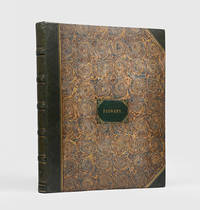
1835réf. 180768Rochester Kent: 1835. Beautiful botanical studies by hand A finely executed album of 35 watercolours notable for their technical accuracy and delicate colouring by the women of the Twopeny family highly regarded for their artistic talent. The expert brushwork showcases a rich assortment of flora - both native and non-native - observed in the hedgerows cultivated gardens and greenhouses of 19th-century England. The sprawling Twopeny family lived in Rochester Kent during the late 18th and 19th centuries. Many of its members were artistically accomplished including the prolific architectural draughtsman William 1797-1873 whose collection is in the British Museum. These flower paintings are most likely by his sisters Susanna 1796-1879 and Charlotte 1801-1874 although they are also occasionally attributed to their cousin Sarah 1788-1817 of Little Casterton Rutland. The contemporary binding is gilt-lettered "C.T." at the tail of the spine pointing to Charlotte's involvement and the second study of the pink mallow flower is initialled "S.T." in pencil in the lower right-hand corner. Three other flowers are annotated with their Latinate names in pencil. Another brother David 1803-1875 was also an amateur artist and collector; the sale of his collection at Christie's London on 29 February 1976 included a series of fine engravings after Turner portraits after Reynolds and etchings by Rembrandt. David gifted a collection of individual botanical watercolours to his cousin Mary in 1832. It is possible that this album was assembled at the same time and for the same purpose though there are no markings to confirm this. This superb album features species native to England including anemones bindweed and tree mallow which might be found in hedgerows or moorlands. Other watercolours demonstrate the popularity of non-native varieties many of which were introduced to England between 1500 and 1800. South African flowers such as the calla lily trailing ice plant and amaryllis belladonna are skilfully rendered as are East Asian species like the camellia and the clematis patens. Several plants from the Americas are also depicted such as the nasturtium and evening primrose. The Victorian enthusiasm for cacti is evidenced by the inclusion of a hedgehog cactus first brought to Europe by Columbus and the popular red orchid cactus. One of the most highly worked watercolours includes a stonework background and a card overlay to add depth. Other flora represented suggests that the Twopeny family was aware of recently arrived flowers and trends in horticulture. Fuchsias were not cultivated in Europe until the late 1780s and the cobea scandens was introduced as late as 1789. Folio album 522 x 441 mm. 35 watercolours on card colours intensified with gum arabic. Mounted on rectos of 32 pages sizes varying from 489 x 355 mm to 174 x 147 mm. Plus 1 loose watercolour. Contemporary green gilt-edged half roan by Colnaghi & Sons spine separated by five gilt- and blind-tooled raised bands dated in Roman numerals at foot marbled paper sides green morocco title label to front cover white coated endpapers edges gilt. Spine and extremities professionally repaired sides with a few faint scratches patch of loss to marbled paper on rear cover spots of foxing to contents. In very good condition the watercolours remaining vivid. hardcover
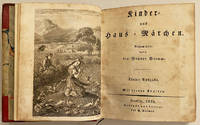
1825réf. BB116GRIMM Jacob 1785-1863 and GRIMM Wilhelm 1786-1859. Kinder- und Haus-Märchen. Berlin: G. Reimer 1825. Seven page illustrations by Ludwig Emil Grimm 1790-1863 comprising scenes from Mary's Child Hansel & Gretel Cinderella Little Red Riding Hood Sleeping Beauty Snow White and the Goose Girl. Thick 12mo. iv 316 pp.; early 3/4 red leather marbled boards. The spine title misspelt "Hans Märchen" instead of "Haus". This is the very rare first "Kleine Ausgabe" i.e. Popular Edition of Grimm's fairy tales intended specifically for children to read themselves. Inspired by the success of Cruikshank's popular English edition the Grimms released this version comprising a selection of 50 of their most popular tales in pocket-size format omitting the critical apparatus of earlier editions and adding illustrations. The earliest version of their Fairy Tales 1812-1815 was chiefly philological and unillustrated; the next edition 1819 was re-edited and written for parents to read these stories aloud to the child. G. Reimer hardcover
1825réf. BB116GRIMM Jacob 1785-1863 and GRIMM Wilhelm 1786-1859. Kinder- und Haus-Märchen. Berlin: G. Reimer 1825. Seven page illustrations by Ludwig Emil Grimm 1790-1863 comprising scenes from Mary's Child Hansel & Gretel Cinderella Little Red Riding Hood Sleeping Beauty Snow White and the Goose Girl. Thick 12mo. iv 316 pp.; early 3/4 red leather marbled boards. The spine title misspelt "Hans Märchen" instead of "Haus". This is the very rare first "Kleine Ausgabe" i.e. Popular Edition of Grimm's fairy tales intended specifically for children to read themselves. Inspired by the success of Cruikshank's popular English edition the Grimms released this version comprising a selection of 50 of their most popular tales in pocket-size format omitting the critical apparatus of earlier editions and adding illustrations. The earliest version of their Fairy Tales 1812-1815 was chiefly philological and unillustrated; the next edition 1819 was re-edited and written for parents to read these stories aloud to the child. G. Reimer hardcover books
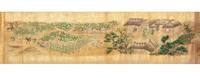
réf. 6984Japan: early mid-Edo. The theme of the four seasons of rice cultivation has had an extensive presence within Japanese art and literature. These two luxury festive scrolls beautifully depict the year-long cycle of rice growing in Japan along with the ancillary activities that took place during the year in the countryside including falconry growing vegetables and fruits seasonal festivals ways of relaxation and the annual tribute of rice to the fiefdom lord. The activities shown on these scrolls have much in common with Brueghel paintings and vividly depict country life. We learn from the labels and handwriting on the original box protecting these two scrolls that they were once owned by two prominent women members of the famous Nabeshima family. The first owner was Teiju in 1699-1752 wife of Muneshige Nabeshima 1687-1755 fifth lord of the Hizen Kashima han Hizen Kashima fiefdom. The later owner was Tokusei in or Kashioka 1798-1877 widow of Naonori Nabeshima 1793-1826 ninth lord of the same fiefdom. Tokusei in was particularly interested in the development of agriculture of the fiefdom and invented the form of brocading known as Saga nishiki. An educated woman she was also a book collector and her library is now kept intact in the Yutoku Inari Shrine in Kashima City in Saga Prefecture. Written on one of the old labels on the box is: “Shiki no kosaku” “Rice Cultivation through the Four Seasons”. This type of scroll was oftentimes produced as part of a wealthy bride’s dowery as a symbol of a good harvest and therefore good fortune to the new couple. Another label on the original box states in trans.: “scroll of images of our territory.” The scrolls are very richly painted with copious clouds of gold flakes at top and bottom throughout. On both scrolls the actual images of the ground and background have gold-heightened effects kinsunago or “golden sand” or have been painted with gold. The folds and borders of the figures’ clothes are heightened with gold and silver giving extra nuance. The coloring and detail of each person’s face and clothing is quite refined and subtle with very delicate and highly detailed tiny brush strokes. We also note that the crowns of the trees have been carefully painted to depict every individual leaf. Clearly the artist was highly accomplished and went to great lengths to create these scrolls. SCROLL ONE: The first scroll covers all aspects of spring and summer activities. The first scene is clearly early spring with the plum trees in blossom. The farmers are preparing the unhulled grains of “seed rice” from last year’s harvest to germinate in preparation for planting this year’s crop. Everyone from the very young to old is participating. Many animals including horses and cows are in evidence. The next scene shows farmers “waking up” the dry paddies by tilling the soil. The following scene later in the spring with cherry blossoms in full bloom shows the farmers removing the weeds from the dry field and in an adjacent flooded paddy planting the rice seeds in the now-prepared seed beds. In the magnificent landscape shown behind we see a waterfall demonstrating the freshness of the water soon to flood the fields. Next we see the farmers planting the seedlings in another paddy now flooded. The farmers are supported by a band of musicians who are standing in the adjacent paddy celebrating the all-important transplantation ritual. During the summer water must be continually added to the fields. In the next extended scene we see a farmer using a hand-cranked hydraulic device to lift water to the paddies and other farmers tending and weeding the fields during a wind-driven rainstorm. The way the artist subtly depicts the rain reveals his great skills. The following scene shows a number of farmers and locals celebrating the summer growing period by dancing and playing musical instruments in front of a shrine. They have offered mochi to the shrine praying for rain and hoping for a good harvest. The next several scenes show the farmers growing and harvesting vegetables and beans and picking fruit from large orchards. We see a samurai passing through with his entourage en route to visit the fiefdom lords. SCROLL TWO: The second scroll begins by showing more of country life. Farmers are shown delivering vegetables and a group of samurai are engaged in falconry accompanied by a considerable entourage. Geese attracted by the now harvested fields fly by clearly intended as the prey of the falcons. There are several farmers fishing by the river and another group is resting after the day’s work drinking water. We can sense they are all waiting for the crucial rice harvest. Now the autumnal harvest season arrives with a wonderful and complex scene of farmers cutting the rice stalks in the drained fields with sickles. The gathered stalks are bundled into tight sheaves and hung upside-down to dry. Now we see the dried sheaves loaded onto boats for transport. The now-empty paddies are filled with birds picking at the remaining rice kernels. We also see two fishermen catching fish in the river. In the next scene the sheaves are stacked before being transported by horse human and oxen to another area where the sheaves are further dried. In the following scene quite complex we see the rice stalks being processed to separate the rice grains from the shells and then dehusked. The next scene shows the grains of rice laid out on mats to dry. Samurai and farmers are having their own separate picnics celebrating the harvest. We also see a blind musician being escorted by two friends a fish monger and a firewood merchant going to the celebration shown next. The next scene depicts an elaborate harvest festival with farmers proceeding to a shrine to give thanks. They are observed by many spectators. The maple trees have turned color to brilliant reds and oranges. Finally we see farmers carrying their share of taxable rice to the warehouse where they will present the rice to the heads of the village who are recording the farmers’ annual tributes in a ledger book. Many rice bales are in evidence. In fine and fresh condition. There is a minor loss of image at the end of the second scroll where two sheets of paper are joined. Occasional minor worming and discoloration. unknown
réf. 6984Japan: early mid-Edo. The theme of the four seasons of rice cultivation has had an extensive presence within Japanese art and literature. These two luxury festive scrolls beautifully depict the year-long cycle of rice growing in Japan along with the ancillary activities that took place during the year in the countryside including falconry growing vegetables and fruits seasonal festivals ways of relaxation and the annual tribute of rice to the fiefdom lord. The activities shown on these scrolls have much in common with Brueghel paintings and vividly depict country life. We learn from the labels and handwriting on the original box protecting these two scrolls that they were once owned by two prominent women members of the famous Nabeshima family. The first owner was Teiju in 1699-1752 wife of Muneshige Nabeshima 1687-1755 fifth lord of the Hizen Kashima han Hizen Kashima fiefdom. The later owner was Tokusei in or Kashioka 1798-1877 widow of Naonori Nabeshima 1793-1826 ninth lord of the same fiefdom. Tokusei in was particularly interested in the development of agriculture of the fiefdom and invented the form of brocading known as Saga nishiki. An educated woman she was also a book collector and her library is now kept intact in the Yutoku Inari Shrine in Kashima City in Saga Prefecture. Written on one of the old labels on the box is: “Shiki no kosaku” “Rice Cultivation through the Four Seasons”. This type of scroll was oftentimes produced as part of a wealthy bride’s dowery as a symbol of a good harvest and therefore good fortune to the new couple. Another label on the original box states in trans.: “scroll of images of our territory.” The scrolls are very richly painted with copious clouds of gold flakes at top and bottom throughout. On both scrolls the actual images of the ground and background have gold-heightened effects kinsunago or “golden sand” or have been painted with gold. The folds and borders of the figures’ clothes are heightened with gold and silver giving extra nuance. The coloring and detail of each person’s face and clothing is quite refined and subtle with very delicate and highly detailed tiny brush strokes. We also note that the crowns of the trees have been carefully painted to depict every individual leaf. Clearly the artist was highly accomplished and went to great lengths to create these scrolls. SCROLL ONE: The first scroll covers all aspects of spring and summer activities. The first scene is clearly early spring with the plum trees in blossom. The farmers are preparing the unhulled grains of “seed rice” from last year’s harvest to germinate in preparation for planting this year’s crop. Everyone from the very young to old is participating. Many animals including horses and cows are in evidence. The next scene shows farmers “waking up” the dry paddies by tilling the soil. The following scene later in the spring with cherry blossoms in full bloom shows the farmers removing the weeds from the dry field and in an adjacent flooded paddy planting the rice seeds in the now-prepared seed beds. In the magnificent landscape shown behind we see a waterfall demonstrating the freshness of the water soon to flood the fields. Next we see the farmers planting the seedlings in another paddy now flooded. The farmers are supported by a band of musicians who are standing in the adjacent paddy celebrating the all-important transplantation ritual. During the summer water must be continually added to the fields. In the next extended scene we see a farmer using a hand-cranked hydraulic device to lift water to the paddies and other farmers tending and weeding the fields during a wind-driven rainstorm. The way the artist subtly depicts the rain reveals his great skills. The following scene shows a number of farmers and locals celebrating the summer growing period by dancing and playing musical instruments in front of a shrine. They have offered mochi to the shrine praying for rain and hoping for a good harvest. The next several scenes show the farmers growing and harvesting vegetables and beans and picking fruit from large orchards. We see a samurai passing through with his entourage en route to visit the fiefdom lords. SCROLL TWO: The second scroll begins by showing more of country life. Farmers are shown delivering vegetables and a group of samurai are engaged in falconry accompanied by a considerable entourage. Geese attracted by the now harvested fields fly by clearly intended as the prey of the falcons. There are several farmers fishing by the river and another group is resting after the day’s work drinking water. We can sense they are all waiting for the crucial rice harvest. Now the autumnal harvest season arrives with a wonderful and complex scene of farmers cutting the rice stalks in the drained fields with sickles. The gathered stalks are bundled into tight sheaves and hung upside-down to dry. Now we see the dried sheaves loaded onto boats for transport. The now-empty paddies are filled with birds picking at the remaining rice kernels. We also see two fishermen catching fish in the river. In the next scene the sheaves are stacked before being transported by horse human and oxen to another area where the sheaves are further dried. In the following scene quite complex we see the rice stalks being processed to separate the rice grains from the shells and then dehusked. The next scene shows the grains of rice laid out on mats to dry. Samurai and farmers are having their own separate picnics celebrating the harvest. We also see a blind musician being escorted by two friends a fish monger and a firewood merchant going to the celebration shown next. The next scene depicts an elaborate harvest festival with farmers proceeding to a shrine to give thanks. They are observed by many spectators. The maple trees have turned color to brilliant reds and oranges. Finally we see farmers carrying their share of taxable rice to the warehouse where they will present the rice to the heads of the village who are recording the farmers’ annual tributes in a ledger book. Many rice bales are in evidence. In fine and fresh condition. There is a minor loss of image at the end of the second scroll where two sheets of paper are joined. Occasional minor worming and discoloration. unknown books
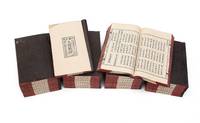
réf. 1094021 vols. of 24; see below. Small folio 305 x 197 mm. orig. dark brown wrappers edges dyed red lower fore-edges with titles volume numbers & number of parts in manuscript stitched. Hà Nội: Linh Quang Tự Bà Äá 1929. A very rare set of the woodblock-printed Sutra of the Heap of Jewels Skt. MahÄratnakūṭa Sūtra T. 0310 from northern Vietnam here in 21 volumes our set lacks Vols. 1 13 & 20. We identify only one other surviving copy in the Institute of Sino-Nôm Studies in Hanoi Viện nghiên cứu Hán Nôm AC.666/1-24. We do not know if that set is complete. “The MahÄratnakūṭa Sūtra is not a single Buddhist work but a large collection of forty-nine works which in its present Chinese form was compiled in the T’ang dynasty by Bodhiruci a South Indian Brahman and illustrious Tripiṭaka master who arrived in China in 693” K. Priscilla Pedersen “Notes on the Ratnakūṭa Collection” Journal of the International Association of Buddhist Studies 3.2 1980 p. 60. In 1926 the first year of the Bảo Äại reign a meeting was held among the high-ranking monks of modern-day Hanoi to continue a project left behind in 1917 by the deceased abbot of the Linh Quang Tự éˆå…‰å¯º temple which was to carve a set of woodblocks for printing the MahÄratnakūṭa Sūtra or the Sutra of the Heap of Jewels. Led by Bhikṣu Thông Mệnh 通命 of the Äà o Xuyên tự 桃å·å¯º temple and Bhikṣu Thanh Thứ æ¸…æ• of the Linh Sóc tự éˆæœ”寺 temple the project was very much a product of its time. Rather than merely reprinting the Sutra as it was already known to Vietnamese Buddhists the monks were delighted to discover — and incorporate into their edition — two further versions of the text one being from the Japanese Buddhist Canon held at the colonial Bác cổ trÆ°á»ng åšå¤å ´ i.e. l’École française d’Extrême-Orient in Hanoi the other being a Chinese copy brought by Bhikṣu Tâm Trí 心智. The three versions — referred to as the “southern version” nam bổn å—本 the “northern version” bắc bổn 北本 and the “Japanese version” nhật bổn 日本 — were carefully compared and collated by the editors whose notes at the end of each chapter list all textual variants down to the page and line numbers Preface transcribed in Phạm Lê Huy “Nihon no kanyaku DaizÅkyÅ” 日本ã®æ¼¢è¨³å¤§è”µçµŒ Riterashī shi kenkyū リテラシーå²ç ”究 14 2021 p. 97. The resulting edition of the Sutra of the Heap of Jewels despite the traditional-seeming xylographic form and the use of Sinographs which were being quickly replaced by the Latin-based quốc ngữ after the abolition of the civil service exams in 1919 is therefore a product of its time enabled by the forces of colonial modernity and partaking in the Buddhist revival movements that were to unfold over the next few decades across the Asiatic world. The carving of the 1300 woodblocks for this Sutra was an expensive affair and the final volume ends by listing the names affiliations and contributions of over 100 donors mostly monks and nuns of various temples who had contributed to its making. Their donations ranged from 300 Indochinese piastre from Bhikṣu Tâm Trí himself to one piastre the contribution of many nuns placed at the end of the list. The woodblocks were kept — and might still be kept — at the Linh Quang Tự temple in Hanoi which based on a recent count preserves about 2600 woodblocks to this day Nguyễn Tuấn CÆ°á»ng et al. “Buddhist Print Culture in Nineteenth-Century Northern Vietnam” Journal of Vietnamese Studies 13.3 2018 pp. 74–75. Finally a note on Vietnamese books in general. Despite the country’s long history of Buddhist and Confucian learning woodblock-printed books published within Vietnam are far fewer in number than their Chinese or Japanese counterparts. This scarcity was due to the high cost of domestic production. According to the estimate of Kathlene Baldanza as late as the 19th century “the labor cost of printing in Vietnam was five to ten times higher than in China. Even ink and brushes were more expensive to produce in Vietnam.” Extensive international trade between northern Vietnam and southern China — where plentiful numbers of books were printed at very low costs — meant that “it was generally cheaper to purchase books from China than to buy them locally” “Publishing Book Culture and Reading Practices in Vietnam” Journal of Vietnamese Studies 13.3 2018 pp. 10–11. Beyond the limited cases of official and temple-based publishing Vietnamese publishers were pushed toward niche genres such as Sino-Vietnamese dictionaries ritual manuals or morality books. Regardless of genre woodblock-printed books from Vietnam are very difficult to find today outside a few major collections such as the Institute of Sino-Nôm Studies in Hanoi and l’École française d’Extrême-Orient in Paris. We will not focus on the massive destruction of the nation’s cultural heritage during its long war of independence in the post World War II period. Fine and fresh set. ⧠Yuenan Hannan wenxian ziliaoku 越å—漢喃文ç»è³‡æ–™åº« Academia Sinica. unknown
réf. 1094021 vols. of 24; see below. Small folio 305 x 197 mm. orig. dark brown wrappers edges dyed red lower fore-edges with titles volume numbers & number of parts in manuscript stitched. Hà Nội: Linh Quang Tự Bà Äá 1929. A very rare set of the woodblock-printed Sutra of the Heap of Jewels Skt. MahÄratnakūṭa Sūtra T. 0310 from northern Vietnam here in 21 volumes our set lacks Vols. 1 13 & 20. We identify only one other surviving copy in the Institute of Sino-Nôm Studies in Hanoi Viện nghiên cứu Hán Nôm AC.666/1-24. We do not know if that set is complete. “The MahÄratnakūṭa Sūtra is not a single Buddhist work but a large collection of forty-nine works which in its present Chinese form was compiled in the T’ang dynasty by Bodhiruci a South Indian Brahman and illustrious Tripiṭaka master who arrived in China in 693” K. Priscilla Pedersen “Notes on the Ratnakūṭa Collection” Journal of the International Association of Buddhist Studies 3.2 1980 p. 60. In 1926 the first year of the Bảo Äại reign a meeting was held among the high-ranking monks of modern-day Hanoi to continue a project left behind in 1917 by the deceased abbot of the Linh Quang Tự éˆå…‰å¯º temple which was to carve a set of woodblocks for printing the MahÄratnakūṭa Sūtra or the Sutra of the Heap of Jewels. Led by Bhikṣu Thông Mệnh 通命 of the Äà o Xuyên tự 桃å·å¯º temple and Bhikṣu Thanh Thứ æ¸…æ• of the Linh Sóc tự éˆæœ”寺 temple the project was very much a product of its time. Rather than merely reprinting the Sutra as it was already known to Vietnamese Buddhists the monks were delighted to discover — and incorporate into their edition — two further versions of the text one being from the Japanese Buddhist Canon held at the colonial Bác cổ trÆ°á»ng åšå¤å ´ i.e. l’École française d’Extrême-Orient in Hanoi the other being a Chinese copy brought by Bhikṣu Tâm Trí 心智. The three versions — referred to as the “southern version” nam bổn å—本 the “northern version” bắc bổn 北本 and the “Japanese version” nhật bổn 日本 — were carefully compared and collated by the editors whose notes at the end of each chapter list all textual variants down to the page and line numbers Preface transcribed in Phạm Lê Huy “Nihon no kanyaku DaizÅkyÅ” 日本ã®æ¼¢è¨³å¤§è”µçµŒ Riterashī shi kenkyū リテラシーå²ç ”究 14 2021 p. 97. The resulting edition of the Sutra of the Heap of Jewels despite the traditional-seeming xylographic form and the use of Sinographs which were being quickly replaced by the Latin-based quốc ngữ after the abolition of the civil service exams in 1919 is therefore a product of its time enabled by the forces of colonial modernity and partaking in the Buddhist revival movements that were to unfold over the next few decades across the Asiatic world. The carving of the 1300 woodblocks for this Sutra was an expensive affair and the final volume ends by listing the names affiliations and contributions of over 100 donors mostly monks and nuns of various temples who had contributed to its making. Their donations ranged from 300 Indochinese piastre from Bhikṣu Tâm Trí himself to one piastre the contribution of many nuns placed at the end of the list. The woodblocks were kept — and might still be kept — at the Linh Quang Tự temple in Hanoi which based on a recent count preserves about 2600 woodblocks to this day Nguyễn Tuấn CÆ°á»ng et al. “Buddhist Print Culture in Nineteenth-Century Northern Vietnam” Journal of Vietnamese Studies 13.3 2018 pp. 74–75. Finally a note on Vietnamese books in general. Despite the country’s long history of Buddhist and Confucian learning woodblock-printed books published within Vietnam are far fewer in number than their Chinese or Japanese counterparts. This scarcity was due to the high cost of domestic production. According to the estimate of Kathlene Baldanza as late as the 19th century “the labor cost of printing in Vietnam was five to ten times higher than in China. Even ink and brushes were more expensive to produce in Vietnam.” Extensive international trade between northern Vietnam and southern China — where plentiful numbers of books were printed at very low costs — meant that “it was generally cheaper to purchase books from China than to buy them locally” “Publishing Book Culture and Reading Practices in Vietnam” Journal of Vietnamese Studies 13.3 2018 pp. 10–11. Beyond the limited cases of official and temple-based publishing Vietnamese publishers were pushed toward niche genres such as Sino-Vietnamese dictionaries ritual manuals or morality books. Regardless of genre woodblock-printed books from Vietnam are very difficult to find today outside a few major collections such as the Institute of Sino-Nôm Studies in Hanoi and l’École française d’Extrême-Orient in Paris. We will not focus on the massive destruction of the nation’s cultural heritage during its long war of independence in the post World War II period. Fine and fresh set. ⧠Yuenan Hannan wenxian ziliaoku 越å—漢喃文ç»è³‡æ–™åº« Academia Sinica. unknown books
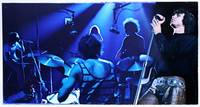
1970réf. 3038Los Angeles: Elektra Records 1970. first edition. Very Good. STUNNING ORIGINAL DYE-TRANSFER PRODUCTION PHOTOGRAPH used in the preparation of the cover for the band’s first—and only—live album issued during Jim Morrison’s lifetime. With important provenance. Original vintage color dye-transfer print 12 x 23 inches dry-mounted to Bainbridge Bristol Board with visible period blue art-department retouching along the upper and lower edges; accompanied a backing board signed and inscribed in 1975 by Bob Heimall the art director/designer for the album to music-industry executive Stephen Dessau: “To: Stephan sic P. Dessau as in Nassau / Happy Holiday Diamond Studs! / Remember – your sic in over your head! / Bob Heimall ’75”. Issued by Elektra on July 20 1970 Absolutely Live was the Doors’ first live album and the only one released during Jim Morrison’s lifetime; Morrison would be dead in Paris less than a year later on July 3 1971. As such the album occupies a singular place in the group’s history: the sole contemporaneous live statement through which audiences could hear the Doors officially present themselves as a concert act while Morrison was still alive. Compiled by producer Paul A. Rothchild from performances recorded in 1969 and 1970 including material from the Aquarius Theatre and Felt Forum the album captured the band in the form for which many admirers considered them most powerful—improvisatory theatrical blues-driven and unstable in the best sense. It also contained the first full official release of “Celebration of the Lizard” among the most mythic and elusive works in the Doors canon. The present dye-transfer print with extremely rich color preserves the underlying live image taken by photographer Frank Lisciandro used in the preparation of the cover prior to the addition of typography and logo design. Morrison – in a superimposed image taken at an earlier date – appears at right isolated at the microphone with the remaining members of the band receding into a saturated blue stage space behind him. The image possesses the nocturnal theatricality appropriate to the band at this moment while the object itself retains the physical traces of period record-cover manufacture: board mount hand retouching and signs of studio handling. Contemporary and later accounts held that Elektra initially favored a grainy bluish rear-view stage image from the Aquarius Theatre performances but judged it insufficiently exciting for commercial use. A different earlier more conventionally iconic image of Morrison was then incorporated into the final design. Morrison is said to have hated the final version. By 1969–70 his appearance had changed markedly: heavier bearded and far removed from the lean black-leather rock-star persona through which he had first entered the popular imagination. The dispute reflected a deep struggle over who would determine Morrison’s public image at the end of the Doors’ great period: Morrison himself or the commercial machinery that preferred the older myth. Provenance: From the art director for the album Bob Heimall to music-executive Stephen P. Dessau. With an additional CBS memorandum dated 1979 identifying Dessau as Director of Product Management East Coast Epic/Portrait/CBS Associated Labels and a copy of the album. Los Angeles: Elektra Records 1970. Original vintage color dye-transfer print 12 x 23 inches. Only the most trivial wear with absolutely no fading - the colors are superbly rich. A remarkable survival. Elektra Records unknown
1970réf. 3038Los Angeles: Elektra Records 1970. first edition. Very Good. STUNNING ORIGINAL DYE-TRANSFER PRODUCTION PHOTOGRAPH used in the preparation of the cover for the band’s first—and only—live album issued during Jim Morrison’s lifetime. With important provenance. Original vintage color dye-transfer print 12 x 23 inches dry-mounted to Bainbridge Bristol Board with visible period blue art-department retouching along the upper and lower edges; accompanied a backing board signed and inscribed in 1975 by Bob Heimall the art director/designer for the album to music-industry executive Stephen Dessau: “To: Stephan sic P. Dessau as in Nassau / Happy Holiday Diamond Studs! / Remember – your sic in over your head! / Bob Heimall ’75”. Issued by Elektra on July 20 1970 Absolutely Live was the Doors’ first live album and the only one released during Jim Morrison’s lifetime; Morrison would be dead in Paris less than a year later on July 3 1971. As such the album occupies a singular place in the group’s history: the sole contemporaneous live statement through which audiences could hear the Doors officially present themselves as a concert act while Morrison was still alive. Compiled by producer Paul A. Rothchild from performances recorded in 1969 and 1970 including material from the Aquarius Theatre and Felt Forum the album captured the band in the form for which many admirers considered them most powerful—improvisatory theatrical blues-driven and unstable in the best sense. It also contained the first full official release of “Celebration of the Lizard” among the most mythic and elusive works in the Doors canon. The present dye-transfer print with extremely rich color preserves the underlying live image taken by photographer Frank Lisciandro used in the preparation of the cover prior to the addition of typography and logo design. Morrison – in a superimposed image taken at an earlier date – appears at right isolated at the microphone with the remaining members of the band receding into a saturated blue stage space behind him. The image possesses the nocturnal theatricality appropriate to the band at this moment while the object itself retains the physical traces of period record-cover manufacture: board mount hand retouching and signs of studio handling. Contemporary and later accounts held that Elektra initially favored a grainy bluish rear-view stage image from the Aquarius Theatre performances but judged it insufficiently exciting for commercial use. A different earlier more conventionally iconic image of Morrison was then incorporated into the final design. Morrison is said to have hated the final version. By 1969–70 his appearance had changed markedly: heavier bearded and far removed from the lean black-leather rock-star persona through which he had first entered the popular imagination. The dispute reflected a deep struggle over who would determine Morrison’s public image at the end of the Doors’ great period: Morrison himself or the commercial machinery that preferred the older myth. Provenance: From the art director for the album Bob Heimall to music-executive Stephen P. Dessau. With an additional CBS memorandum dated 1979 identifying Dessau as Director of Product Management East Coast Epic/Portrait/CBS Associated Labels and a copy of the album. Los Angeles: Elektra Records 1970. Original vintage color dye-transfer print 12 x 23 inches. Only the most trivial wear with absolutely no fading - the colors are superbly rich. A remarkable survival. Elektra Records unknown books
2013réf. 2081502111903553Gaku en 2013. Soft Cover. Fine. The book is in fine condition. Gaku en paperback
réf. 14292Paris, Charles L'Angelier, 1550.
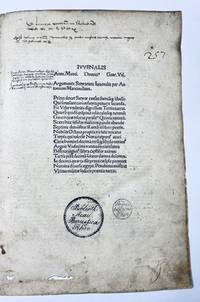
1497réf. 898Nurnberge: Antonium Koberger 1497. Folio 30.8 x 21.5 cm. Signatures : A8a–z8&6. This copy is bound in its original blind stamped half pigskin over wooden boards lacking clasps. . This copy has been densely annotated by a German humanists circa 1511. This is an important edition with three commentaries from the end of the 15th century by great figures of Italian humanism and following the Venetian edition o. •On the title page two references to Italian miscellanea of the end of the 15th century: one to the freedom of poets to slander which refers to Pietro Crinito’s De honestis disciplinis lib. 20 ca. IX and the other to a complicated passage of Juvenal explained in chapter 33 of the Miscellanea of Ange Politien Expositio hujus carminis Juvenalis scilicet occidit miseros Crambe repetita magistros in Miscellaneis ca. 33 This chapter of the Miscellanea explains the very graphic proverb Occidit miseros Crambe repetita magistros which appears in Juvenal’s Satire VII v. 154 which can be translated literally by “It is from this cabbage unceasingly re-served that unhappy masters die” to denounce the repetition to which masters are forced. Hain; 9711; CIBN; J-368; IGI; 5601; IBP; 3322; Kotvan; 743; Arnoult; 938a; Zehnacker; 1378; Goff; J664; ISTC online Provenance: 1.German reader early 1510s. 2. Transfer stamp ” Vend. ex bibl. acad. Rhen.” “Sold by the Prussian Academy Library” former library of the University of Bonn the stamp “Bibliotheca Accademiae Borussicae Rhenanae” was apparently used in the period 1818-1828. 3. 17th century owner note on title page with reference to the in-12 Juvenal-Perse published in Amsterdam with Farnabius’ notes in 1631. 4. Marquis Giuseppe Terzi of Bergamo 1790-1819. It does not appear in the catalogs of the sales held in Paris between March 11 and 23 1861. 5 Joseph Nève lawyer and bibliophile from Brussels 1857-1940 6. The book is later in the collection of Jean-Baptiste Colbert de Beaulieu 1905-1995 ex-libris. 7. It is then in the collection of Jean Stefgen Joinvillele Pont 1927-2017 bookplate. A copy profusely annotated up to satire 6 by a German reader in the first decade of the sixteenth century as indicated by the diacritical sign above the u’s its spelling Yason for Jason apoptegmata without ‘h’. This incunabulum is found in its interesting first binding Rhenish half pigskin stamped and bound over wooden boards .Our German reader most likely annotated the work while it was still in quires and disbound but maybe sewnindeed some notes aredeepin the inner margin. The work was probably annotated before being bound which caused some minimal trimming of the outside marginal notes. The sources used by the annotator display a strong knowledge in Rhenish humanism around 1511. This reader was obviously educated in a circle close to the young Beatus Rhenanus and most likely Jakob Wimpfeling at the crossroads of classical and Christian culture. His reading is indeed a mixture of Italian philological and historical commentaries and works of northern humanism Reisch Erasmus. Several notes reveal the use of a series of editions published in Strasbourg in 1511: the Hymni heroici tres of Jean-François Pico de la Mirandole with the annotation of Beatus Rhenanus the collection of ps. Bérose published by Grüninger with a text of pseudo Xénophon. Our anonymous reader reads Erasmus’ Adages in an edition by Schürer c. 1511 and the Praise of Folly the first editions of which also date from 1511 Paris Gilles de Gourmont and then M. Schürer. XXI v. The annotator also has recourse to contemporary Italian encyclopedias Enneades by Sabellico Commentarii by Volaterranus to which he adds the reading of Reisch’s Margarita philosophica the jewel of northern humanism the editio princeps dates from 1504. The annotator refers to a passage of this work Book VII chapter VII where Atlas is presented as the inventor of astronomy note on f. CXIIIr: “Atlantem caeliferum fuisse negat Lucrecius. Lege invenies in Margarita ex Plinio li 7 ca 2” etc. These readings and references to the editions of 1511 make us think that the annotator plausibly followed a university course held in Strasbourg around 1511 always in the close circles frequented by Beatus Rhenanus. The humanist commentary here focuses on word radicals lexiconand context the annotator mobilizes printed commentaries with little interest in figures. He shows a predilection for natural history Pliny and Solinus very much in demand and Roman history in general the annotator resorts as well to Suetonius as to modern commentaries such as Philippe Béroalde and Sabellico see page 58 of this catalogue whose Enneads he quotes several times f. XXIV v for example. This erudite reader sometimes commits approximations in his references: he confuses for example a title of the pseudo-Xenophon with a collection of the pseudo-Beroses. A long quotation of a passage that he attributes to Philippo Beroaldus the Elder on f. XXVIIr comes in fact from the Annotationes centum and not from his commentary on Suetonius see Anthony Grafton “On the Scholarship of Politian” Journal of the Warburg 1977 p. 166. He recopies from memory incorrectly on f. VI a licentious epigram by Martial book VI 67 & notes in the margin still on this verse but this time about eunuchs: “Martialis / Cur tantium eunuchos uxor tua Caelia quaeris / Pannice vult futui Caelia non parere.” The annotator also has recourse to the vast Latin poetic heritage: Ovid and Seneca on f. II Vide Ovidium Transformationum… Vide Senecam in Agammemnone; Horace Satire VI I on f. XVr. Also to some poets of late Latinity like Sidoine Apollinaire through an incunabula edition 1498 with commentary. He also gives some suggestions for corrections to the text: f. LIX r to the lemma “caldum” he refers to the Attic Nights of Aulu Gelle: “emendatius caldus haud … quam calidum apud Gellium caldam saepeponitur li 19 ca 4″.Some other notes are:•A reference to the practice of hunts venationes in the circus under Domitian with an anecdote of a certain Maevia descended the pointrine naked in the arena f. V r. It reproduces the words of an ancient scholiast of Juvenal: ” Alia indignatio in mulierum impudentiam quae temporibus Domitiani descendebant in venationes et pugnas theatrales ” words of the scholiast of Juvenal.on the title page two references to Italian miscellanea from the end of the 15th century. Antonium Koberger unknown
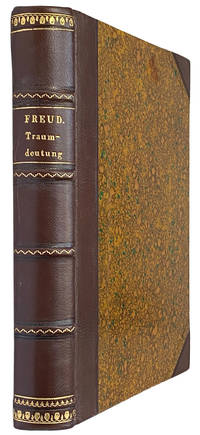
1900réf. 42501Leipzig und Wien: Franz Deuticke 1900. tall8vo. 23.3cm The First Edition 371iv1p. colophon in plain contemporary dust worn wrappers spine cap frayed and the center of the panel is mostly wanting wrappers loose early pencil notation in Germany on the cover see below text is shaken but holding the text is clean the rare first edition of this most important of books in contemporary style clam shell box designed by Red Bone Bindery in crushed brown morocco grain calf gilt decorated raised bands and spine borders gilt titles matched marbled boards fine. Provenance: The first recorded owner was Dr. Robert Drill. The following is written in pencil now faded in German: "Elgen. Von Dr. Drill mit der Bemerkung übergeben es sei wert aufbewahrt zu werden. Mitte der 30er Jahre". Elgen. By Dr. Drill handed over with the comment that it was worth keeping. mid 30s. The present owner found an article published in 1927 that quotes something Drill wrote in the Frankfurter Zeitung undated praising Freud. In der "Frankfurter Zeitung" schreibt Dr. Robert Drill: "Freud ist ein Entdecker und Wiederentdecker. Großen Formats. Seine Enträtselung des. Traumes ist von menschheitsgeschichtlicher Bedeutung. Hier ist ein Wissen -wiedergefunden das mit der Antike untergegangen war. Freud ist ein Geschenk der Natur an die seelisch Leidenden."- In the "Frankfurter Zeitung" Dr. Robert Drill: "Freud is an explorer and rediscoverer. Large format. His unraveling of the dream is of significance for human history. Here is some knowledge-rediscovered which had disappeared with antiquity. Freud is a gift from nature to those who suffer mentally.". Mid-1930s: Wilhelm & Elizabeth Hollbach received the book from Dr Robert Drill who was Jewish and fleeing Germany with minimal possessions moving to South Africa. Dr Drill and Wilhelm Hollbach were colleagues and friends. Dr Robert Drill worked at the Frankfurter Zeitung newspaper with Reiner Hollbach's father Wilhelm Hollbach link is to wikipedia page about Wilhelm - he was editor of the newspaper and acting mayor of Frankfurt immediately after the war. Post-WW II: In Germany Elgen Hollbach received the book from their mother Elizabeth Hollbach after the Second World War when she Elgen became interested in psychotherapy and later became a licensed psychotherapist. The inscription see above is assumed to be written by Elizabeth Hollbach. Mid-1990s: The book was received by Canadian relatives from Elgen Hollbach from Germany. Franz Deuticke unknown
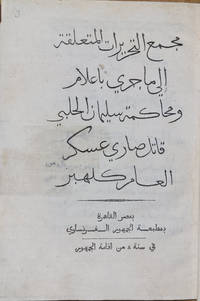
1800réf. 000228EGYPT – NAPOLEONIC PERIOD – ARABIC PRINTING A Compilation of the Decisions Relating to the Condemned Criminal and the Judgments Passed upon Him the Killer of the Commander-in-Chief the Renowned Kléber Cairo: مطبعة الجمهور الÙرنساوي Press of the French Republic Year 8 of the Republic 1800–1801. Rare and historically significant Arabic imprint produced during the French occupation of Egypt documenting the trial judgment and execution of SulaymÄn al-Ḥalabī the assassin of General Jean-Baptiste Kléber Commander-in-Chief of French forces in Egypt. This work constitutes the official Arabic-language publication of judicial decrees and legal decisions issued by the French military authorities in Cairo following the assassination of Kléber in June 1800. It was intended for circulation among the Arabic-speaking population serving both as a legal record and as an instrument of political communication and authority. Printed at the Press of the French Republic in Cairo one of the earliest European-operated printing presses in Egypt the book forms part of the pioneering Napoleonic effort to employ Arabic typography for governance law and propaganda. The text reflects the adaptation of French revolutionary legal concepts into Arabic juridical language making it a landmark in the history of Arabic legal printing. The publication corresponds to a French counterpart titled Traduction Arabe des pièces relatives à la procédure et au jugement de Soleyman el-Haleby confirming its role within a bilingual documentary corpus produced by the occupation authorities. Historical Significance Primary source for the assassination of Kléber one of the most consequential events of the Egyptian Expedition Early example of state-sponsored Arabic printing under European colonial rule Key document in the history of Franco-Arabic legal translation Important witness to the emergence of modern political and legal Arabic print culture Rarity Extremely scarce. Arabic imprints from the French Egyptian press 1798–1801 are notably rare and judicial publications relating specifically to the Kléber assassination are seldom encountered on the market. Examples are held in a small number of institutional collections; private ownership is exceptional. References Cf. Galland Imprimerie arabe du Caire; Napoleon in Egypt bibliographies; WorldCat records under variant French and Arabic titles. Press of the French Republic hardcover
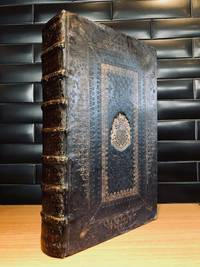
1717réf. 7186Oxford: John Baskett 1717. First Edition Thus. Royal binding in full morocco. Very Good. John Sturt. Two volumes in one. Large stout folio. Double column with columns separated by double rule. Text ruled in red and title pages printed in red and black. Engraved vignette title pages for Old and New Testaments the latter dated 1716. With the engraved additional general title page by cartographer and renowned illustrator John Sturt 1658-1730. With striking copper-engraved vignette head- and tail-pieces and many engraved historiated initials. Complete with Apocrypha. Marbled endpapers. All edges gilt. Bound in contemporary full black morocco rebacked with original elaborate gilt-tooled spine neatly laid-down gilt-tooled arms of King George II featuring the motto "Most Noble Order of the Garter" as centerpieces and his monogram in spine compartments raised bands and gilt-decorated borders. Only moderate wear to the splendidly complete royal binding. First edition of the monumental illustrated "Vinegar Bible" with additional title page engraved by John Sturt including the vignette of a church interior featuring the figures of Moses Aaron et al. per Darlow and Moule. According to the DNB Sturt "specialized in miniature work and it was said that he could engrave the creed on a silver penny but could also work on a large scale and in 1692 he produced a notable engraving of Britannia the royal first capital ship of England printed on four sheets". Presented in a handsome King George II armorial binding. Carter notes that " . Bibles with the royal arms may have come from one of the Royal Chapels - but they may equally have come from any loyal parish church" ABC p. 157. That said a limited print run coupled with the high cost of Baskett's elaborate opus would suggest the former. In 1709 printer John Baskett secured the exclusive royal patent to print Bibles in England. Of those he and his family published this is the most magnificent being a triumph of legible elegant type that contributes to an easy readability accessible today. Alas a typographical error in the running head of Luke XX among other typos rendered the parable of the vineyard as the "parable of the vinegar" overshadowing Baskett's magnificent achievement. A scarce and stately copy of a high spot in 18th-century printing. DARLOW & MOULE 736-B "the engravings differ considerably from those in A". John Baskett unknown
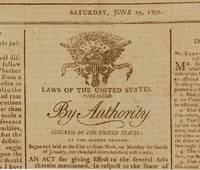
1790réf. 52510New York: John Fenno no. 41 Broad-Street near the Exchange 1790. First edtion. Softcover. Fine. Two leaves folio 16.25 by 10 in. Edges slightly trimmed; a touch of mild foxing else a fine crisp copy. Housed in linen clamshell box with gilt paper label at spine and previous owner's dediction pasted to inside cover. The first known published appearance of Jewish support for the newly elected president of the United States George Washington. One week after Washinton's inauguration Levi Sheftall on behalf of the newly reorganized Savannah Hebrew Congregation wrote him an elegant and effusive letter of congratulation. This letter along with Washington's reply was published for the first time by the United States Gazette: "Sir We have long been anxious of congratulating you on your appointment. and of testifying our unbounded confidence in your integrity and unblemished virtue. Your unexampled liberality and extensive philanthropy have dispelled that cloud of bigotry and superstition which has long as a veil shaded religion -- unrivetted the fetters of enthusiasm -- enfranchised us with all the privileges and immunities of free citizens and initiated us into the grand mass of legislative mechanism. May the great Author of worlds grant you all happiness and a continuance of guardianship to that freedom which under the auspices of heaven your magnanimity and wisdom have given these States." Washington's reply is undated but addressed "To the Hebrew Congregation of the City of Savannah." After accepting their congratulations he extends this hope: "May the same wonder-working Deity who long since delivering the Hebrews from their Egyptian Oppressors planted them in the promised land -- whose providential agency has lately been conspicuous in established these United States as an independent nation -- still continue to water them with the dews of Heaven and to make the inhabitants of every denomination participate in the temporal and spiritual blessings of that people whose God is Jehovah. George Washington." Provenance: old entry of . Hopkins at top margin first leaf trimmed. Six weeks later References: Enc. Jud. first ed. 1972 vol. 16; Evans Amer. Bibl. vol. 8; From the Ends of the Earth Judaica Treasures of the Library of Congress. John Fenno, no. 41 Broad-Street, near the Exchange unknown
1790réf. 52510New York: John Fenno no. 41 Broad-Street near the Exchange 1790. First edtion. Softcover. Fine. Two leaves folio 16.25 by 10 in. Edges slightly trimmed; a touch of mild foxing else a fine crisp copy. Housed in linen clamshell box with gilt paper label at spine and previous owner's dediction pasted to inside cover. The first known published appearance of Jewish support for the newly elected president of the United States George Washington. One week after Washinton's inauguration Levi Sheftall on behalf of the newly reorganized Savannah Hebrew Congregation wrote him an elegant and effusive letter of congratulation. This letter along with Washington's reply was published for the first time by the United States Gazette: "Sir We have long been anxious of congratulating you on your appointment. and of testifying our unbounded confidence in your integrity and unblemished virtue. Your unexampled liberality and extensive philanthropy have dispelled that cloud of bigotry and superstition which has long as a veil shaded religion -- unrivetted the fetters of enthusiasm -- enfranchised us with all the privileges and immunities of free citizens and initiated us into the grand mass of legislative mechanism. May the great Author of worlds grant you all happiness and a continuance of guardianship to that freedom which under the auspices of heaven your magnanimity and wisdom have given these States." Washington's reply is undated but addressed "To the Hebrew Congregation of the City of Savannah." After accepting their congratulations he extends this hope: "May the same wonder-working Deity who long since delivering the Hebrews from their Egyptian Oppressors planted them in the promised land -- whose providential agency has lately been conspicuous in established these United States as an independent nation -- still continue to water them with the dews of Heaven and to make the inhabitants of every denomination participate in the temporal and spiritual blessings of that people whose God is Jehovah. George Washington." Provenance: old entry of . Hopkins at top margin first leaf trimmed. Six weeks later References: Enc. Jud. first ed. 1972 vol. 16; Evans Amer. Bibl. vol. 8; From the Ends of the Earth Judaica Treasures of the Library of Congress. John Fenno, no. 41 Broad-Street, near the Exchange unknown books
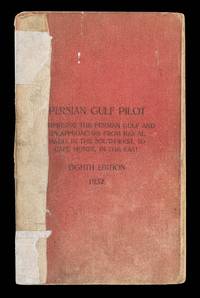
1932réf. 15952London: Published for the Hydrographic Department Admiralty J.D. Potter Agent for the Sale of Admiralty Charts 145 Minories E.C.3 1932 additions to 1936. 4to 245 by 150mm 4 i-ii 2 iii-xxx 328pp 2 charts 26 plates numerous manuscript annotations in red and black ink text from the annual supplements tipped in throughout the work red buckram boards title to upper board spine strengthened with old cloth. A detailed pilot of the Arabian Gulf with extensive manuscript annotations and additional text and views of Dubai and Abu Dhabi from the 1936 supplement. The present work is the eighth edition of a pilot first published according to the 'advertisement' in 1864 from the remarks and surveys of Commander Charles Constable and Lieutenant Arthur Stiffe. Constable and Stiffe served in the Indian Navy and travelled through the Middle East between 1857-1860 conducting hydrographic surveys. The pilot also shows the influence of Commander Banes-Bruck who had conducted the first systematic survey of Arabian waters while stationed in the Gulf as a member of the Indian Navy in the 1820s. This eighth edition has been compiled by "Commander G. C. Glen D.S.O. O.B.E. R.N. and contains the latest information received in the Hydrographic Office". Published in the same year as oil was discovered in Bahrain the pilot captures the Gulf just before the boom that would transform it into a region of immense global importance. Even before the Middle Eastern oil trade began its rapid expansion however its waters remained an important thoroughfare for European trade and travel with a constant flow of British ships through the Suez canal. The pilot begins with a number of introductory sections explaining how it is to be used and outlining the updates made to the latest edition. There follows a list of illustrations a glossary of terms from various local languages including Arabic Hindustani and Persian and general information about the use and composition of Admiralty charts. The main body of the pilot systematically describes the Persian Gulf from all approaches with information about its marine features political and administrative divisions trade navigational routes and potential hazards from shoals to pirates. Although most of the pilot's 328 pages are dominated by text there are regular illustrations and maps found throughout. These views are different from the typical Admiralty charts being far less technical and some even reproductions of popular watercolours. They nonetheless indicate the profile of the land as well as significant topographical features and important anchorages. The maker assures the ready of the accuracy of the information provided in the pilot since "It is most difficult to get trustworthy information from the Arabs and but the little that they impart can be relied upon". The present edition of the Persian Gulf Pilot is extremely rare. We have been able to trace only five institutional examples: the British Library National Maritime Museum United Nations Library University of Chicago Library and State Library of New Soth Wales. Furthermore we have been unable to trace any editions of the pilot appearing at auction. Published for the Hydrographic Department, Admiralty, J.D. Potter, Agent for the Sale of Admiralty Charts, 145, Minories, E.C.3, hardcover
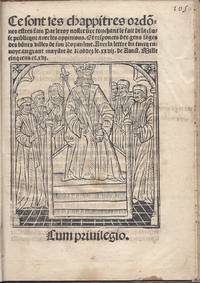
1516réf. 1704S.l.: s.n. 1516. First edition. Title page with large woodcut illustration showing the King on his throne surrounded by the delegates. In Bastarda type with two floral woodcut initials. In later hard paper. Gilt title vignette on spine damaged. Concise marginal notes and page-numbers in ink by a contemporary hand throughout. Trimming of the leaves slightly affects the glosses with no effect to legibility otherwise the margins are wide. Title page crinkled at the upper right corner with a small tear that only affects the margin. Narrow inkblot to the lower margin throughout. B4 with two light brown stains C1 crinkled at lower corner. Bookplates on the inner front panel G. J. Arvanitidi; Antoine Mouradian. Overall in very good condition. First edition. Title page with large woodcut illustration showing the King on his throne surrounded by the delegates. In Bastarda type with two floral woodcut initials. In later hard paper. Gilt title vignette on spine damaged. 20 p. A bibliographically unrecorded early sixteenth-century French book about royal ordinances regarding the commonwealth along with the French translation of Sultan Selim I's letter of conquest fethname addressed to the Grand Master of Rhodes. The first and major part of the book presents nine concepts of orders of Francis I 1494-1547 King of France from 1515 until his death regarding the commonwealth chose publique. The drafts concern such topics as the commerce of spices and drugs wool cloth and other goods chapter 1-4 the weights and equivalents of coins and the recognized foreign currencies chapter 5 the recognized units of measures chapter 6 the regulation of the extravagance of clothing chapter 7 the inn trade chapter 8 and the money that goes to Rome for obtaining Bulls chapter 9. The second section comprises the responses to the aforementioned concepts of the representatives of the Good Cities Bonnes Villes Provence and Dauphiné who had been previously assembled in Paris by the order of the King in March 1516. In most cases they requested a delay of reply to discuss the matters with those who they were representing. The third section presents the grievances and requests delivered to the King by the delegates regarding the provincial councils conciles provinciaux the prolixity of the trials the tariffs the public officers the superior courts cours souveraines the land taxes tailles and the abuse and plunder by the soldiers crossing the kingdom. These sections were recorded and written down by the court clerk Jean Hesselin Seigneur of Girodon. Hesselin mentions himself twice p. 14 and 17 once by name p. 14 within the text. The final part is the French translation of the Ottoman Sultan Selim I's fethname letter of conquest sent on 27 August 1516 from Aleppo to Fabrizio del Carretto 1455-1521 Grand Master Magnus Magister of the Knights Hospitaller in Rhodes between 1513 and 1521. The fethname accordingly to its genre details Selim's expedition and the conquest and emphasizes the power and grandeur of the Sultan and his army. Selim I 1470-1520 ascended the throne as the Sultan of the Ottoman Empire in 1512. He is remembered for the enormous expansion of the Empire during his reign thus raise the Ottomans to the leaders of the Muslim world. Selim's most notable deed was the conquer of the Mamluk Sultanate which included Levant Hejaz and Egypt in 1516 and 1517 at the Battles of Marj Dabiq and Ridaniya. The Battle of Marj Dabiq near Aleppo took place on August 24 1516 where Selim defeated the Mamluk Sultan Al-Ashraf Qansuh al-Ghuri. This was a decisive victory of the war between the Ottoman Empire and the Mamluk Sultanate which ended in the conquest of much of the Middle East. Such an expansion of the Ottoman territory was a clear threat to Rhodes which was the nearest Christian possession to the coast of Asia halfway between Constantinople and Egypt. At the time the Grand Master in Rhodes was the Italian admiral Fabrizio del Carretto 1455-1521; Grand Master from 1513 to 1521 for a short interlude of a course of fifty-five years of Frenchmen serving as the supreme heads of the Order. Selim announced his victory and forecasted his threat to del Carretto in a fethname presented here in French translation however eventually he did not have the time to conduct the campaign against Rhodes. It was his successor Suleiman I who conquered the island in 1522 thus gained control over the eastern Mediterranean for the next centuries. By the time of the siege the commander of the Order was again a Frenchman Grand Master Philippe Villiers de L'Isle-Adam 1464-1534. Suleiman allowed him and the surviving knights to leave unmolested and eventually the Hospitallers were quartered permanently on Malta in 1530. To the best of our knowledge the original fethname has not survived and we could not trance any other printed version or edition of the French translation. We could find one surviving copy of a Spanish translation of Selim's letter which was addressed to Pope Leo X titled Carta de nuevas grandes buenas y ciertas embiada a nuestro s. padre Leon X de las cosas que han passado en Levante entre el gran turcho y el gran solda Valencia Juan Viñao 1517; Norton 1256 IB 11215 USTC 344377 kept at Cambridge University Library F151.d.8.12. Provenance: Bookplate of Georgios Arvanitidis 1876-1953 a noted Constantinopolitan collector of books on Turkish and Greek history. Bookplate with the motto "On abuse du vrai" of Antoine Mouradian. Ref.: Bibliographically unrecorded. Bibl.: Setton K. M. Hazard H. W. ed.: A History of the Crusades. Vol. 3. Wisconsin: The University of Wisconsin Press 1975. pp. 332-335. Pedani-Fabris M. P.: Ottoman Fetihnames. The Imperial letters announcing a Victory. In: Tarih İncelemeleri Dergisi 13 1998. 181-192. . [s.n.] unknown
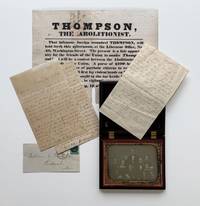
réf. 9998Boston: October 1835. Letterpress broadside 8.875" x 12 sheet size. Early ink inscription on verso reading: "Return to C.C. Mason of the Me Cong. the M.E. Ch." CONDITION: Good old folds a few tissue repairs on verso to small holes loss along fold in lower margin just nicking "2" in "2 o'clock" a few small losses to lower edgesome toning and foxing. with Garrison William Lloyd. Autograph letter signed to William E. Gould regarding the confrontation with the pro-slavery mob in October 1835. Boston 8 December 1877. 2 pp. 7.75" x 5" with original cover addressed to Gould with 3 cent stamp and Boston postmark. Written in response to Gould's letter requesting information on the Thompson broadside see below. CONDITION: Very good old folds. with Gould Emma Maynard Dow. Autograph letter signed by Emma Maynard Dow Gould William Gould's wife to John likely John Mead Gould William's brother regarding the broadside and Garrison letter offered here. Probably Boston 2 May 1892. 1 p. 7.75" x 4.875". CONDITION: Very good old folds. with Half plate daguerreotype of the Gould family. Portland Maine 1853. Housed in a thermoplastic case. CONDITION: Very good image clear and un-touched mat tarnished case fully intact and attractive. An exceptionally rare broadside relating to one of the most notorious moments in the history of abolitionism accompanied by a letter of William Lloyd Garrison providing an account of events and referring to his "ruffianly seizure" by the pro-slavery mob with a related family letter and Gould family daguerreotype. In 1835 one of the leading British abolitionists George Thompson 1804-1878 traveled from the United Kingdom for a lecture tour of the United States in response to an invitation from William Lloyd Garrison whom he had met in 1832 in Scotland where the two became friends. In the 1877 ALS included here Garrison recalls the events surrounding the broadside: "On the 21st of October 1835 the Boston Female Anti-Slavery Society attempted to hold its annual meeting. At that time George Thompson the eloquent and successful advocate of British West India Emancipation was laboring here with the Abolitionists and by their invitation to effect a similar deliverance for the Southern slave population. To intensify the popular pro-slavery spirit against him he was falsely and maliciously branded by the press as a British emissary who had been sent here by the British Government with his pockets lined with British gold 'for the purpose of overthrowing our Glorious Union' etc etc." The broadside explicitly intended to incite a mob yet attempting to characterize its purpose as patriotic calls for the pro-slavery supporters to seize and tar Thompson: That infamous scoundrel THOMPSON will hold forth this afternoon at the Liberator Office No. 48 Washington Street. The present is a fair opportunity for the friends of the Union to snake Thompson out! It will be a contest between the Abolitionists and the friends of the Union. A purse of $100 has been raised by a number of patriotic citizens to reward the individual who shall first lay violent hands on Thompson so that he may be brought to the tar kettle before dark. Friends of the Union be vigilant! Aware of the gathering mob Thompson did not attend the meeting as scheduled and Garrison instead went to speak to the Society. Garrison continues with his description of the events unfolding including fascinating details of the author and publisher of the inciting broadside: "It was deemed prudent by ladies for his own personal safety that he should not attend the meeting aforesaid; nevertheless it was rumored that he was to be present and this led to the issuing of the mob-exciting placard which you have copied in your letter and about which you express a wish to be further informed. That placard was written by James L. Homer editor of the Boston Gazette and printed in his office and distributed throughout the city!" Garrison concludes with his own experience on the day: "The result was the gathering of a mob of five thousand persons the breaking up of the ladies meeting my ruffianly seizure and being dragged through the streets finally rescued by the city constabulary and incarceration in Leverett Street jail to save my life." Garrison was indeed seized by the pro-slavery mob and was dragged through the streets with a rope around his waist with the intent of tarring and feathering him or worse. Boston Mayor Theodore Lyman II intervened and confined Garrison for his own safety. The example of the broadside offered here at one time owned by Reverend C. C. Mason of the Methodist Episcopal Church was subsequently given to William Gould whose curiosity regarding events surrounding it led him to write to Garrison. Gould's letter penned from Portland Maine on November 14th 1877 is in the Boston Public Library's Anti-Slavery Collection MS A.1.2 v.39 p. 154A. He writes in part: "I have copied upon the page annexed a sheet sent me by an old minister. It is so very different from the state of things today that I want to frame it for my Library & I would be very glad to frame also any reply you may be pleased to make to me when I now ask you if you will. Kindly tell me what year this was. What was the result of the appeal and if it is known who was the author of the document." Also included here is an 1892 letter from Gould's wife Emma 1836-1918 to his brother John offering the collection of items to him: "Edw. has framed a relic which he thinks you may like. It is a placard printed in Boston in Feb. sic 1835 intended to incite a pro-slavery mob at the time of an anti-slavery meeting with it is an autographed letter from Wm. Loyd sic Garrison explaining it which he wrote Edw. in reply to one from him asking information about the affair. If you would like it perhaps Theo will come for it. I am breaking up and packing and it will be one thing out of my way. If you do not come for it he will give it to the Historical Society." Emma refers here to her husband by his middle name Edward. Lending additional interest to this lot is a half plate daguerreotype of the Gould family of Portland Maine. Edward Gould 1805-1894 and his wife Althea Chase Gould 1808-1894 are seated at center surrounded by their six children. William E. Gould the eldest son stands at the center his hand resting on his father's shoulder. To the left of William is his brother John Mead Gould who would go on to achieve distinction in the Civil War. Although often cited in accounts of the abolitionist movement the Thompson broadside is exceptionally rare. We locate just two copies in institutions at The National Museum of African American History & Culture and the Massachusetts Historical Society. OCLC records a copy at the Library of Congress dated 1851 in the record but it is pictured on the LC site and appears to be a reproduction of some sort. An important group of items documenting the conflict in Boston surrounding abolitionism in the 1830s and a wonderful example of private historical preservation. Provenance: Reverend Charles C. Mason b. ca. 1820 to William E. Gould 1837-1919 to his brother John Mead Gould 1839-1930. Boston: [October, 1835] unknown
réf. 9998Boston: October 1835. Letterpress broadside 8.875" x 12 sheet size. Early ink inscription on verso reading: "Return to C.C. Mason of the Me Cong. the M.E. Ch." CONDITION: Good old folds a few tissue repairs on verso to small holes loss along fold in lower margin just nicking "2" in "2 o'clock" a few small losses to lower edgesome toning and foxing. with Garrison William Lloyd. Autograph letter signed to William E. Gould regarding the confrontation with the pro-slavery mob in October 1835. Boston 8 December 1877. 2 pp. 7.75" x 5" with original cover addressed to Gould with 3 cent stamp and Boston postmark. Written in response to Gould's letter requesting information on the Thompson broadside see below. CONDITION: Very good old folds. with Gould Emma Maynard Dow. Autograph letter signed by Emma Maynard Dow Gould William Gould's wife to John likely John Mead Gould William's brother regarding the broadside and Garrison letter offered here. Probably Boston 2 May 1892. 1 p. 7.75" x 4.875". CONDITION: Very good old folds. with Half plate daguerreotype of the Gould family. Portland Maine 1853. Housed in a thermoplastic case. CONDITION: Very good image clear and un-touched mat tarnished case fully intact and attractive. An exceptionally rare broadside relating to one of the most notorious moments in the history of abolitionism accompanied by a letter of William Lloyd Garrison providing an account of events and referring to his "ruffianly seizure" by the pro-slavery mob with a related family letter and Gould family daguerreotype. In 1835 one of the leading British abolitionists George Thompson 1804-1878 traveled from the United Kingdom for a lecture tour of the United States in response to an invitation from William Lloyd Garrison whom he had met in 1832 in Scotland where the two became friends. In the 1877 ALS included here Garrison recalls the events surrounding the broadside: "On the 21st of October 1835 the Boston Female Anti-Slavery Society attempted to hold its annual meeting. At that time George Thompson the eloquent and successful advocate of British West India Emancipation was laboring here with the Abolitionists and by their invitation to effect a similar deliverance for the Southern slave population. To intensify the popular pro-slavery spirit against him he was falsely and maliciously branded by the press as a British emissary who had been sent here by the British Government with his pockets lined with British gold 'for the purpose of overthrowing our Glorious Union' etc etc." The broadside explicitly intended to incite a mob yet attempting to characterize its purpose as patriotic calls for the pro-slavery supporters to seize and tar Thompson: That infamous scoundrel THOMPSON will hold forth this afternoon at the Liberator Office No. 48 Washington Street. The present is a fair opportunity for the friends of the Union to snake Thompson out! It will be a contest between the Abolitionists and the friends of the Union. A purse of $100 has been raised by a number of patriotic citizens to reward the individual who shall first lay violent hands on Thompson so that he may be brought to the tar kettle before dark. Friends of the Union be vigilant! Aware of the gathering mob Thompson did not attend the meeting as scheduled and Garrison instead went to speak to the Society. Garrison continues with his description of the events unfolding including fascinating details of the author and publisher of the inciting broadside: "It was deemed prudent by ladies for his own personal safety that he should not attend the meeting aforesaid; nevertheless it was rumored that he was to be present and this led to the issuing of the mob-exciting placard which you have copied in your letter and about which you express a wish to be further informed. That placard was written by James L. Homer editor of the Boston Gazette and printed in his office and distributed throughout the city!" Garrison concludes with his own experience on the day: "The result was the gathering of a mob of five thousand persons the breaking up of the ladies meeting my ruffianly seizure and being dragged through the streets finally rescued by the city constabulary and incarceration in Leverett Street jail to save my life." Garrison was indeed seized by the pro-slavery mob and was dragged through the streets with a rope around his waist with the intent of tarring and feathering him or worse. Boston Mayor Theodore Lyman II intervened and confined Garrison for his own safety. The example of the broadside offered here at one time owned by Reverend C. C. Mason of the Methodist Episcopal Church was subsequently given to William Gould whose curiosity regarding events surrounding it led him to write to Garrison. Gould's letter penned from Portland Maine on November 14th 1877 is in the Boston Public Library's Anti-Slavery Collection MS A.1.2 v.39 p. 154A. He writes in part: "I have copied upon the page annexed a sheet sent me by an old minister. It is so very different from the state of things today that I want to frame it for my Library & I would be very glad to frame also any reply you may be pleased to make to me when I now ask you if you will. Kindly tell me what year this was. What was the result of the appeal and if it is known who was the author of the document." Also included here is an 1892 letter from Gould's wife Emma 1836-1918 to his brother John offering the collection of items to him: "Edw. has framed a relic which he thinks you may like. It is a placard printed in Boston in Feb. sic 1835 intended to incite a pro-slavery mob at the time of an anti-slavery meeting with it is an autographed letter from Wm. Loyd sic Garrison explaining it which he wrote Edw. in reply to one from him asking information about the affair. If you would like it perhaps Theo will come for it. I am breaking up and packing and it will be one thing out of my way. If you do not come for it he will give it to the Historical Society." Emma refers here to her husband by his middle name Edward. Lending additional interest to this lot is a half plate daguerreotype of the Gould family of Portland Maine. Edward Gould 1805-1894 and his wife Althea Chase Gould 1808-1894 are seated at center surrounded by their six children. William E. Gould the eldest son stands at the center his hand resting on his father's shoulder. To the left of William is his brother John Mead Gould who would go on to achieve distinction in the Civil War. Although often cited in accounts of the abolitionist movement the Thompson broadside is exceptionally rare. We locate just two copies in institutions at The National Museum of African American History & Culture and the Massachusetts Historical Society. OCLC records a copy at the Library of Congress dated 1851 in the record but it is pictured on the LC site and appears to be a reproduction of some sort. An important group of items documenting the conflict in Boston surrounding abolitionism in the 1830s and a wonderful example of private historical preservation. Provenance: Reverend Charles C. Mason b. ca. 1820 to William E. Gould 1837-1919 to his brother John Mead Gould 1839-1930. Boston: [October, 1835] unknown books
1718réf. 3874591718. Unbound. Near Fine. A remarkable archive of 24 letters from Admiral of the Fleet George Byng sent to Rear Admiral George Delaval who commanded the Blue Squadron under Byng’s command along with associated documents from George Saunders and Josiah Burchett Secretary of the Admiralty relating to the British naval campaign of 1718 in the Mediterranean culminating in the Battle of Cape Passaro Sicily on the 11th August. A mix of quarto and folio sheet with many folded once to form four pages. Each letter is Signed by Byng with one signed twice. Despite their age the letters are near fine or better with only light wear and housed in a custom cloth chemise with printed labels. The Battle of Cape Passaro resulted in the defeat of the Spanish by the British Fleet under Sir George Byng four months before the War of the Quadruple Alliance. The Spanish refused to re-embark their army from the Sicilian mainland. Despite war not having been formally declared Byng correctly anticipated approval from home and attacked and routed the Spanish fleet thwarting their ambitions to take Italy and Sicily. The subject matter of the letters is concerned with supplies day-to-day naval matters and continuing hostilities against the Spanish and includes details of several rendezvous for meeting up in the event of separation owing to bad weather. Common problems are mentioned such as desertion and shortage of food and more particularly wine. The earliest is dated May 17th concerning the mobilization of troops and pressed men for the campaign. The letter of May 29th regards the Line of Battle detailing ships ordnance and men commanders and formation and pennants and the signals to be used. On July 3rd Byng gives orders to oppose the landing of the Spanish in Italy with a warrant order of operations to “take sink burn or destroy” the King of Spain’s ships; the last of the series dates from the December 9th from the Admiralty office not by Byng congratulating Delaval on his safe arrival at Spithead and requesting him to escort the fireship Griffin to Deptford. Byng sent mail from on board his ship the Barfleur whilst at sea and also from the Admiralty office in London. Byng was sent on subsequent diplomatic missions on behalf of England to negotiate with Italian princes and states and was instrumental in the acceptance of the terms of the Quadruple Alliance by Spain. In 1718 Byng was already a respected member of the establishment having supported the accession of William and Mary at the Glorious Revolution contributed to the burning of the French fleet at Vigo and leading the bombardment squadron during the capture of Gibraltar. He was rewarded with a knighthood and a regular promotion. After the success of 1718 this included membership in the Privy Council admittance to the Order of the Bath and the title of Viscount Torrington which his descendants still bear today. In 1727 Byng was made First Lord of the Admiralty and the Royal Naval College at Portsmouth was founded in his memory. Delaval also had a distinguished naval and diplomatic career from a young age with victory at the Battle of Malaga in 1704 and missions to Spain and Portugal as well as his promotion to Rear Admiral and leadership of The Blue Squadron. He is perhaps best known for rebuilding his ancestral seat the celebrated Seaton Delaval Hall in Northumberland now a National Trust property with architect Sir John Vanbrugh. It is important to note that Admiral George Byng should not be confused with his fourth son John Byng also present at the Battle of Cape Passaro as a 13 years old who built a respectable career as a naval officer and became an Admiral but was court-martialed and shot by firing squad on 14 March 1757. A remarkable collection of letters from the First Lord of the Admiralty during the reign of King George II. A detailed list of the correspondence is available upon request. unknown
1718réf. 3874591718. Unbound. Near Fine. A remarkable archive of 24 letters from Admiral of the Fleet George Byng sent to Rear Admiral George Delaval who commanded the Blue Squadron under Byng’s command along with associated documents from George Saunders and Josiah Burchett Secretary of the Admiralty relating to the British naval campaign of 1718 in the Mediterranean culminating in the Battle of Cape Passaro Sicily on the 11th August. A mix of quarto and folio sheet with many folded once to form four pages. Each letter is Signed by Byng with one signed twice. Despite their age the letters are near fine or better with only light wear and housed in a custom cloth chemise with printed labels. The Battle of Cape Passaro resulted in the defeat of the Spanish by the British Fleet under Sir George Byng four months before the War of the Quadruple Alliance. The Spanish refused to re-embark their army from the Sicilian mainland. Despite war not having been formally declared Byng correctly anticipated approval from home and attacked and routed the Spanish fleet thwarting their ambitions to take Italy and Sicily. The subject matter of the letters is concerned with supplies day-to-day naval matters and continuing hostilities against the Spanish and includes details of several rendezvous for meeting up in the event of separation owing to bad weather. Common problems are mentioned such as desertion and shortage of food and more particularly wine. The earliest is dated May 17th concerning the mobilization of troops and pressed men for the campaign. The letter of May 29th regards the Line of Battle detailing ships ordnance and men commanders and formation and pennants and the signals to be used. On July 3rd Byng gives orders to oppose the landing of the Spanish in Italy with a warrant order of operations to “take sink burn or destroy” the King of Spain’s ships; the last of the series dates from the December 9th from the Admiralty office not by Byng congratulating Delaval on his safe arrival at Spithead and requesting him to escort the fireship Griffin to Deptford. Byng sent mail from on board his ship the Barfleur whilst at sea and also from the Admiralty office in London. Byng was sent on subsequent diplomatic missions on behalf of England to negotiate with Italian princes and states and was instrumental in the acceptance of the terms of the Quadruple Alliance by Spain. In 1718 Byng was already a respected member of the establishment having supported the accession of William and Mary at the Glorious Revolution contributed to the burning of the French fleet at Vigo and leading the bombardment squadron during the capture of Gibraltar. He was rewarded with a knighthood and a regular promotion. After the success of 1718 this included membership in the Privy Council admittance to the Order of the Bath and the title of Viscount Torrington which his descendants still bear today. In 1727 Byng was made First Lord of the Admiralty and the Royal Naval College at Portsmouth was founded in his memory. Delaval also had a distinguished naval and diplomatic career from a young age with victory at the Battle of Malaga in 1704 and missions to Spain and Portugal as well as his promotion to Rear Admiral and leadership of The Blue Squadron. He is perhaps best known for rebuilding his ancestral seat the celebrated Seaton Delaval Hall in Northumberland now a National Trust property with architect Sir John Vanbrugh. It is important to note that Admiral George Byng should not be confused with his fourth son John Byng also present at the Battle of Cape Passaro as a 13 years old who built a respectable career as a naval officer and became an Admiral but was court-martialed and shot by firing squad on 14 March 1757. A remarkable collection of letters from the First Lord of the Admiralty during the reign of King George II. A detailed list of the correspondence is available upon request. unknown books
1800réf. ST17757London: William Miller; T. M'Lean; William Bulmer 1800-18. 370 x 270 mm. 14 1/2 x 10 1/2". Seven volumes. Uniformly bound in stately contemporary dark burgundy straight-grain morocco covers with gilt palmette-and-wheat-sheaf border inner frame of blind-stamped grapevine raised bands spine compartments densely gilt with repeating botanical tools gilt lettering gilt-rolled turn-ins all edges gilt. Two engraved titles with hand-colored vignettes not included in plate count and 356 FULL-PAGE HAND-COLORED PLATES FEATURING COSTUMES OCCUPATIONS AND SOCIAL INTERACTION OF VARIOUS NATIONS. Volume I-III V and VI with text in French as well as English. Front pastedown with armorial bookplate of Edward Gordon Douglas-Pennant 1st Baron Penrhyn. Abbey Life 430; Abbey Travel 71 244 370 373 532 533. Joints and extremities lightly rubbed one board with a couple of faint scratches two rear boards with neat older repairs to short tears at tail edge but the bindings quite sound and most attractive on the shelf. Flyleaves a little foxed minor offsetting from plates to text leaves occasionally more pronounced but never offensive isolated minor marginal foxing to plates otherwise very fine WITH CLEAN BRIGHT PLATES. This is a collection of major early 19th century color plate books with well-drawn and richly-colored engravings in bindings that make a handsome appearance on the shelf. All of these works have appealing plates where the costumes of the various social strata are carefully and colorfully delineated. And two of the volumes--those showing British costumes and the book on Chinese punishments--contain in addition a good deal of diverting background detail that serves as a revealing context for each of the costumes depicted. The content of each of the volumes is worth noting. With a few exceptions the plates in the "Costumes of China" portray ordinary working-class men and women toiling at their trades. We see a bookseller with his wares spread out on a mat women sewing and embroidering a butcher a fisher a barber a man with a "magic lantern" show and a "man striking a small gong during an eclipse" an ancient ritual that the author tells us he was privileged to witness on 17 November 1789. The "Punishments of China" volume is filled with almost gleefully painful depictions of all degrees of disciplinary action from the relatively minor twisting of the ears or chaining to an iron pole to the humiliating ordeal of the wooden collar to methods of execution by beheading or by crucifixion using a cord. The opulent and brightly colored costumes in Dalvimart's volume on Turkey are mostly those of the ruling classes although also represented is a wide variety of native dress from the many regions of the vast Turkish empire of the day which included Bosnia Albania Syria Egypt and parts of Greece. It is particularly interesting to contrast the clothing of the very heavily veiled Turkish and Egyptian women with the much more relaxed style of the Greek women and the nearly immodest garb of the female Bedouin. We also are shown a eunuch an odalisque from the harem a grand vizier various royal functionaries and government officials all splendidly attired. The Russian costumes based on engravings done by C. W. Müller at the request of Empress Catherine the Great are focused on the ethnic dress of the empire's many holdings. The Laplanders and Finns wear clothing that would look familiar to most Europeans but the Mongols in their Oriental dress would be quite exotic. The clothing of the northern tribes such as the Kamchatkans Aleutians Koriaks and Tungoosi will impress the modern reader with their similarity to the traditional dress of Native American and First Nation peoples. The Tchutski woman is even depicted naked to display her tattoos. Bertrand de Moleville's Austrian costumes also illustrate the native dress of the empire's citizens but the illustrations here are less fashion plates than romanticized scenes: peasant couples are shown courting and dancing; Croatian women gossip beside a stream; and a wild-haired Bohemian gypsy whose "profession is not hard to guess" from her state of "déshabillé" flees with her naked and no doubt illegitimate child. Pyne's "Costumes of Great Britain" is one of the most highly praised works in this set and for good reason: the simple working men and women of Britain it depicts are always shown going about their daily tasks in the midst of a well-realized scene. The woman selling "salop" a hot morning beverage is seated at her cart with its urn judiciously located by the watchman's stall surrounded by customers including soldiers and a woman with her market basket. A fireman with an ax and a torch hurries toward his engine company while they unwrap their hose. The potter is at his wheel the tanner is cleaning skins and the bill-sticker posts the winning lottery numbers. The clothing while carefully detailed is almost secondary to the depictions of everyday life. The "Military Costumes of Turkey" illustrates the official regalia "uniform" is much too drab a word for these outfits worn by officers in various regions of the empire. Perhaps the most intriguing plate here is that of the Ladle Bearer a post that was also illustrated in "Costumes of Turkey." What appears to be a man with a giant spoon is in fact the holder of an important military position equivalent to the color-bearer in a western army. We are told that the loss of its ladles is the greatest disgrace that can befall a Turkish regiment: if the two great ladles the size of a grown man that are borne into battle at the head of the troops are captured the regiment must be disbanded and formed anew. Former owner Edward Gordon Douglas-Pennant 1st Baron Penrhyn 1800-86 was a leading figure in the Welsh slate industry; he owned the Penrhyn Quarry the largest slate quarry in the world at the end of the 19th century. He was known for his paternalistic attitude to his employees creating the "model village" of Llandegai to house the quarry workers. It was notable for having "no corrupting alehouse." He was ruthless enough to fire 80 men in 1868 because they did not vote for his son George who was running for a seat in Parliament. Single volumes from this set appear with frequency in the marketplace; full sets show up much less often; sets as handsome and well preserved as the present are rarely seen. William Miller; T. M'Lean; William Bulmer unknown
1800réf. ST17757London: William Miller; T. M'Lean; William Bulmer 1800-18. 370 x 270 mm. 14 1/2 x 10 1/2". Seven volumes. Uniformly bound in stately contemporary dark burgundy straight-grain morocco covers with gilt palmette-and-wheat-sheaf border inner frame of blind-stamped grapevine raised bands spine compartments densely gilt with repeating botanical tools gilt lettering gilt-rolled turn-ins all edges gilt. Two engraved titles with hand-colored vignettes not included in plate count and 356 FULL-PAGE HAND-COLORED PLATES FEATURING COSTUMES OCCUPATIONS AND SOCIAL INTERACTION OF VARIOUS NATIONS. Volume I-III V and VI with text in French as well as English. Front pastedown with armorial bookplate of Edward Gordon Douglas-Pennant 1st Baron Penrhyn. Abbey Life 430; Abbey Travel 71 244 370 373 532 533. Joints and extremities lightly rubbed one board with a couple of faint scratches two rear boards with neat older repairs to short tears at tail edge but the bindings quite sound and most attractive on the shelf. Flyleaves a little foxed minor offsetting from plates to text leaves occasionally more pronounced but never offensive isolated minor marginal foxing to plates otherwise very fine WITH CLEAN BRIGHT PLATES. This is a collection of major early 19th century color plate books with well-drawn and richly-colored engravings in bindings that make a handsome appearance on the shelf. All of these works have appealing plates where the costumes of the various social strata are carefully and colorfully delineated. And two of the volumes--those showing British costumes and the book on Chinese punishments--contain in addition a good deal of diverting background detail that serves as a revealing context for each of the costumes depicted. The content of each of the volumes is worth noting. With a few exceptions the plates in the "Costumes of China" portray ordinary working-class men and women toiling at their trades. We see a bookseller with his wares spread out on a mat women sewing and embroidering a butcher a fisher a barber a man with a "magic lantern" show and a "man striking a small gong during an eclipse" an ancient ritual that the author tells us he was privileged to witness on 17 November 1789. The "Punishments of China" volume is filled with almost gleefully painful depictions of all degrees of disciplinary action from the relatively minor twisting of the ears or chaining to an iron pole to the humiliating ordeal of the wooden collar to methods of execution by beheading or by crucifixion using a cord. The opulent and brightly colored costumes in Dalvimart's volume on Turkey are mostly those of the ruling classes although also represented is a wide variety of native dress from the many regions of the vast Turkish empire of the day which included Bosnia Albania Syria Egypt and parts of Greece. It is particularly interesting to contrast the clothing of the very heavily veiled Turkish and Egyptian women with the much more relaxed style of the Greek women and the nearly immodest garb of the female Bedouin. We also are shown a eunuch an odalisque from the harem a grand vizier various royal functionaries and government officials all splendidly attired. The Russian costumes based on engravings done by C. W. Müller at the request of Empress Catherine the Great are focused on the ethnic dress of the empire's many holdings. The Laplanders and Finns wear clothing that would look familiar to most Europeans but the Mongols in their Oriental dress would be quite exotic. The clothing of the northern tribes such as the Kamchatkans Aleutians Koriaks and Tungoosi will impress the modern reader with their similarity to the traditional dress of Native American and First Nation peoples. The Tchutski woman is even depicted naked to display her tattoos. Bertrand de Moleville's Austrian costumes also illustrate the native dress of the empire's citizens but the illustrations here are less fashion plates than romanticized scenes: peasant couples are shown courting and dancing; Croatian women gossip beside a stream; and a wild-haired Bohemian gypsy whose "profession is not hard to guess" from her state of "déshabillé" flees with her naked and no doubt illegitimate child. Pyne's "Costumes of Great Britain" is one of the most highly praised works in this set and for good reason: the simple working men and women of Britain it depicts are always shown going about their daily tasks in the midst of a well-realized scene. The woman selling "salop" a hot morning beverage is seated at her cart with its urn judiciously located by the watchman's stall surrounded by customers including soldiers and a woman with her market basket. A fireman with an ax and a torch hurries toward his engine company while they unwrap their hose. The potter is at his wheel the tanner is cleaning skins and the bill-sticker posts the winning lottery numbers. The clothing while carefully detailed is almost secondary to the depictions of everyday life. The "Military Costumes of Turkey" illustrates the official regalia "uniform" is much too drab a word for these outfits worn by officers in various regions of the empire. Perhaps the most intriguing plate here is that of the Ladle Bearer a post that was also illustrated in "Costumes of Turkey." What appears to be a man with a giant spoon is in fact the holder of an important military position equivalent to the color-bearer in a western army. We are told that the loss of its ladles is the greatest disgrace that can befall a Turkish regiment: if the two great ladles the size of a grown man that are borne into battle at the head of the troops are captured the regiment must be disbanded and formed anew. Former owner Edward Gordon Douglas-Pennant 1st Baron Penrhyn 1800-86 was a leading figure in the Welsh slate industry; he owned the Penrhyn Quarry the largest slate quarry in the world at the end of the 19th century. He was known for his paternalistic attitude to his employees creating the "model village" of Llandegai to house the quarry workers. It was notable for having "no corrupting alehouse." He was ruthless enough to fire 80 men in 1868 because they did not vote for his son George who was running for a seat in Parliament. Single volumes from this set appear with frequency in the marketplace; full sets show up much less often; sets as handsome and well preserved as the present are rarely seen. William Miller; T. M'Lean; William Bulmer unknown books