THE TWOPENY FAMILYBiblio.com
130 115 résultats
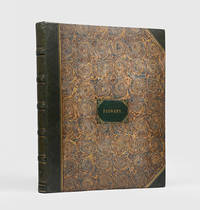
1835réf. 180768Rochester Kent: 1835. Beautiful botanical studies by hand A finely executed album of 35 watercolours notable for their technical accuracy and delicate colouring by the women of the Twopeny family highly regarded for their artistic talent. The expert brushwork showcases a rich assortment of flora - both native and non-native - observed in the hedgerows cultivated gardens and greenhouses of 19th-century England. The sprawling Twopeny family lived in Rochester Kent during the late 18th and 19th centuries. Many of its members were artistically accomplished including the prolific architectural draughtsman William 1797-1873 whose collection is in the British Museum. These flower paintings are most likely by his sisters Susanna 1796-1879 and Charlotte 1801-1874 although they are also occasionally attributed to their cousin Sarah 1788-1817 of Little Casterton Rutland. The contemporary binding is gilt-lettered "C.T." at the tail of the spine pointing to Charlotte's involvement and the second study of the pink mallow flower is initialled "S.T." in pencil in the lower right-hand corner. Three other flowers are annotated with their Latinate names in pencil. Another brother David 1803-1875 was also an amateur artist and collector; the sale of his collection at Christie's London on 29 February 1976 included a series of fine engravings after Turner portraits after Reynolds and etchings by Rembrandt. David gifted a collection of individual botanical watercolours to his cousin Mary in 1832. It is possible that this album was assembled at the same time and for the same purpose though there are no markings to confirm this. This superb album features species native to England including anemones bindweed and tree mallow which might be found in hedgerows or moorlands. Other watercolours demonstrate the popularity of non-native varieties many of which were introduced to England between 1500 and 1800. South African flowers such as the calla lily trailing ice plant and amaryllis belladonna are skilfully rendered as are East Asian species like the camellia and the clematis patens. Several plants from the Americas are also depicted such as the nasturtium and evening primrose. The Victorian enthusiasm for cacti is evidenced by the inclusion of a hedgehog cactus first brought to Europe by Columbus and the popular red orchid cactus. One of the most highly worked watercolours includes a stonework background and a card overlay to add depth. Other flora represented suggests that the Twopeny family was aware of recently arrived flowers and trends in horticulture. Fuchsias were not cultivated in Europe until the late 1780s and the cobea scandens was introduced as late as 1789. Folio album 522 x 441 mm. 35 watercolours on card colours intensified with gum arabic. Mounted on rectos of 32 pages sizes varying from 489 x 355 mm to 174 x 147 mm. Plus 1 loose watercolour. Contemporary green gilt-edged half roan by Colnaghi & Sons spine separated by five gilt- and blind-tooled raised bands dated in Roman numerals at foot marbled paper sides green morocco title label to front cover white coated endpapers edges gilt. Spine and extremities professionally repaired sides with a few faint scratches patch of loss to marbled paper on rear cover spots of foxing to contents. In very good condition the watercolours remaining vivid. hardcover
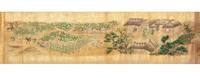
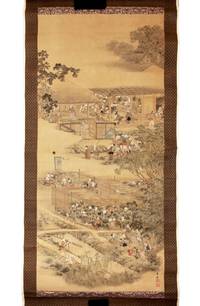
réf. 6984Japan: early mid-Edo. The theme of the four seasons of rice cultivation has had an extensive presence within Japanese art and literature. These two luxury festive scrolls beautifully depict the year-long cycle of rice growing in Japan along with the ancillary activities that took place during the year in the countryside including falconry growing vegetables and fruits seasonal festivals ways of relaxation and the annual tribute of rice to the fiefdom lord. The activities shown on these scrolls have much in common with Brueghel paintings and vividly depict country life. We learn from the labels and handwriting on the original box protecting these two scrolls that they were once owned by two prominent women members of the famous Nabeshima family. The first owner was Teiju in 1699-1752 wife of Muneshige Nabeshima 1687-1755 fifth lord of the Hizen Kashima han Hizen Kashima fiefdom. The later owner was Tokusei in or Kashioka 1798-1877 widow of Naonori Nabeshima 1793-1826 ninth lord of the same fiefdom. Tokusei in was particularly interested in the development of agriculture of the fiefdom and invented the form of brocading known as Saga nishiki. An educated woman she was also a book collector and her library is now kept intact in the Yutoku Inari Shrine in Kashima City in Saga Prefecture. Written on one of the old labels on the box is: “Shiki no kosaku” “Rice Cultivation through the Four Seasons”. This type of scroll was oftentimes produced as part of a wealthy bride’s dowery as a symbol of a good harvest and therefore good fortune to the new couple. Another label on the original box states in trans.: “scroll of images of our territory.” The scrolls are very richly painted with copious clouds of gold flakes at top and bottom throughout. On both scrolls the actual images of the ground and background have gold-heightened effects kinsunago or “golden sand” or have been painted with gold. The folds and borders of the figures’ clothes are heightened with gold and silver giving extra nuance. The coloring and detail of each person’s face and clothing is quite refined and subtle with very delicate and highly detailed tiny brush strokes. We also note that the crowns of the trees have been carefully painted to depict every individual leaf. Clearly the artist was highly accomplished and went to great lengths to create these scrolls. SCROLL ONE: The first scroll covers all aspects of spring and summer activities. The first scene is clearly early spring with the plum trees in blossom. The farmers are preparing the unhulled grains of “seed rice” from last year’s harvest to germinate in preparation for planting this year’s crop. Everyone from the very young to old is participating. Many animals including horses and cows are in evidence. The next scene shows farmers “waking up” the dry paddies by tilling the soil. The following scene later in the spring with cherry blossoms in full bloom shows the farmers removing the weeds from the dry field and in an adjacent flooded paddy planting the rice seeds in the now-prepared seed beds. In the magnificent landscape shown behind we see a waterfall demonstrating the freshness of the water soon to flood the fields. Next we see the farmers planting the seedlings in another paddy now flooded. The farmers are supported by a band of musicians who are standing in the adjacent paddy celebrating the all-important transplantation ritual. During the summer water must be continually added to the fields. In the next extended scene we see a farmer using a hand-cranked hydraulic device to lift water to the paddies and other farmers tending and weeding the fields during a wind-driven rainstorm. The way the artist subtly depicts the rain reveals his great skills. The following scene shows a number of farmers and locals celebrating the summer growing period by dancing and playing musical instruments in front of a shrine. They have offered mochi to the shrine praying for rain and hoping for a good harvest. The next several scenes show the farmers growing and harvesting vegetables and beans and picking fruit from large orchards. We see a samurai passing through with his entourage en route to visit the fiefdom lords. SCROLL TWO: The second scroll begins by showing more of country life. Farmers are shown delivering vegetables and a group of samurai are engaged in falconry accompanied by a considerable entourage. Geese attracted by the now harvested fields fly by clearly intended as the prey of the falcons. There are several farmers fishing by the river and another group is resting after the day’s work drinking water. We can sense they are all waiting for the crucial rice harvest. Now the autumnal harvest season arrives with a wonderful and complex scene of farmers cutting the rice stalks in the drained fields with sickles. The gathered stalks are bundled into tight sheaves and hung upside-down to dry. Now we see the dried sheaves loaded onto boats for transport. The now-empty paddies are filled with birds picking at the remaining rice kernels. We also see two fishermen catching fish in the river. In the next scene the sheaves are stacked before being transported by horse human and oxen to another area where the sheaves are further dried. In the following scene quite complex we see the rice stalks being processed to separate the rice grains from the shells and then dehusked. The next scene shows the grains of rice laid out on mats to dry. Samurai and farmers are having their own separate picnics celebrating the harvest. We also see a blind musician being escorted by two friends a fish monger and a firewood merchant going to the celebration shown next. The next scene depicts an elaborate harvest festival with farmers proceeding to a shrine to give thanks. They are observed by many spectators. The maple trees have turned color to brilliant reds and oranges. Finally we see farmers carrying their share of taxable rice to the warehouse where they will present the rice to the heads of the village who are recording the farmers’ annual tributes in a ledger book. Many rice bales are in evidence. In fine and fresh condition. There is a minor loss of image at the end of the second scroll where two sheets of paper are joined. Occasional minor worming and discoloration. unknown
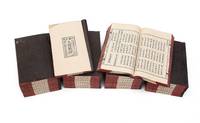
réf. 1094021 vols. of 24; see below. Small folio 305 x 197 mm. orig. dark brown wrappers edges dyed red lower fore-edges with titles volume numbers & number of parts in manuscript stitched. Hà Nội: Linh Quang Tự Bà Äá 1929. A very rare set of the woodblock-printed Sutra of the Heap of Jewels Skt. MahÄratnakūṭa Sūtra T. 0310 from northern Vietnam here in 21 volumes our set lacks Vols. 1 13 & 20. We identify only one other surviving copy in the Institute of Sino-Nôm Studies in Hanoi Viện nghiên cứu Hán Nôm AC.666/1-24. We do not know if that set is complete. “The MahÄratnakūṭa Sūtra is not a single Buddhist work but a large collection of forty-nine works which in its present Chinese form was compiled in the T’ang dynasty by Bodhiruci a South Indian Brahman and illustrious Tripiṭaka master who arrived in China in 693” K. Priscilla Pedersen “Notes on the Ratnakūṭa Collection” Journal of the International Association of Buddhist Studies 3.2 1980 p. 60. In 1926 the first year of the Bảo Äại reign a meeting was held among the high-ranking monks of modern-day Hanoi to continue a project left behind in 1917 by the deceased abbot of the Linh Quang Tự éˆå…‰å¯º temple which was to carve a set of woodblocks for printing the MahÄratnakūṭa Sūtra or the Sutra of the Heap of Jewels. Led by Bhikṣu Thông Mệnh 通命 of the Äà o Xuyên tự 桃å·å¯º temple and Bhikṣu Thanh Thứ æ¸…æ• of the Linh Sóc tự éˆæœ”寺 temple the project was very much a product of its time. Rather than merely reprinting the Sutra as it was already known to Vietnamese Buddhists the monks were delighted to discover — and incorporate into their edition — two further versions of the text one being from the Japanese Buddhist Canon held at the colonial Bác cổ trÆ°á»ng åšå¤å ´ i.e. l’École française d’Extrême-Orient in Hanoi the other being a Chinese copy brought by Bhikṣu Tâm Trí 心智. The three versions — referred to as the “southern version” nam bổn å—本 the “northern version” bắc bổn 北本 and the “Japanese version” nhật bổn 日本 — were carefully compared and collated by the editors whose notes at the end of each chapter list all textual variants down to the page and line numbers Preface transcribed in Phạm Lê Huy “Nihon no kanyaku DaizÅkyÅ” 日本ã®æ¼¢è¨³å¤§è”µçµŒ Riterashī shi kenkyū リテラシーå²ç ”究 14 2021 p. 97. The resulting edition of the Sutra of the Heap of Jewels despite the traditional-seeming xylographic form and the use of Sinographs which were being quickly replaced by the Latin-based quốc ngữ after the abolition of the civil service exams in 1919 is therefore a product of its time enabled by the forces of colonial modernity and partaking in the Buddhist revival movements that were to unfold over the next few decades across the Asiatic world. The carving of the 1300 woodblocks for this Sutra was an expensive affair and the final volume ends by listing the names affiliations and contributions of over 100 donors mostly monks and nuns of various temples who had contributed to its making. Their donations ranged from 300 Indochinese piastre from Bhikṣu Tâm Trí himself to one piastre the contribution of many nuns placed at the end of the list. The woodblocks were kept — and might still be kept — at the Linh Quang Tự temple in Hanoi which based on a recent count preserves about 2600 woodblocks to this day Nguyễn Tuấn CÆ°á»ng et al. “Buddhist Print Culture in Nineteenth-Century Northern Vietnam” Journal of Vietnamese Studies 13.3 2018 pp. 74–75. Finally a note on Vietnamese books in general. Despite the country’s long history of Buddhist and Confucian learning woodblock-printed books published within Vietnam are far fewer in number than their Chinese or Japanese counterparts. This scarcity was due to the high cost of domestic production. According to the estimate of Kathlene Baldanza as late as the 19th century “the labor cost of printing in Vietnam was five to ten times higher than in China. Even ink and brushes were more expensive to produce in Vietnam.” Extensive international trade between northern Vietnam and southern China — where plentiful numbers of books were printed at very low costs — meant that “it was generally cheaper to purchase books from China than to buy them locally” “Publishing Book Culture and Reading Practices in Vietnam” Journal of Vietnamese Studies 13.3 2018 pp. 10–11. Beyond the limited cases of official and temple-based publishing Vietnamese publishers were pushed toward niche genres such as Sino-Vietnamese dictionaries ritual manuals or morality books. Regardless of genre woodblock-printed books from Vietnam are very difficult to find today outside a few major collections such as the Institute of Sino-Nôm Studies in Hanoi and l’École française d’Extrême-Orient in Paris. We will not focus on the massive destruction of the nation’s cultural heritage during its long war of independence in the post World War II period. Fine and fresh set. ⧠Yuenan Hannan wenxian ziliaoku 越å—漢喃文ç»è³‡æ–™åº« Academia Sinica. unknown
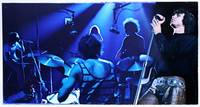
1970réf. 3038Los Angeles: Elektra Records 1970. first edition. Very Good. STUNNING ORIGINAL DYE-TRANSFER PRODUCTION PHOTOGRAPH used in the preparation of the cover for the band’s first—and only—live album issued during Jim Morrison’s lifetime. With important provenance. Original vintage color dye-transfer print 12 x 23 inches dry-mounted to Bainbridge Bristol Board with visible period blue art-department retouching along the upper and lower edges; accompanied a backing board signed and inscribed in 1975 by Bob Heimall the art director/designer for the album to music-industry executive Stephen Dessau: “To: Stephan sic P. Dessau as in Nassau / Happy Holiday Diamond Studs! / Remember – your sic in over your head! / Bob Heimall ’75”. Issued by Elektra on July 20 1970 Absolutely Live was the Doors’ first live album and the only one released during Jim Morrison’s lifetime; Morrison would be dead in Paris less than a year later on July 3 1971. As such the album occupies a singular place in the group’s history: the sole contemporaneous live statement through which audiences could hear the Doors officially present themselves as a concert act while Morrison was still alive. Compiled by producer Paul A. Rothchild from performances recorded in 1969 and 1970 including material from the Aquarius Theatre and Felt Forum the album captured the band in the form for which many admirers considered them most powerful—improvisatory theatrical blues-driven and unstable in the best sense. It also contained the first full official release of “Celebration of the Lizard” among the most mythic and elusive works in the Doors canon. The present dye-transfer print with extremely rich color preserves the underlying live image taken by photographer Frank Lisciandro used in the preparation of the cover prior to the addition of typography and logo design. Morrison – in a superimposed image taken at an earlier date – appears at right isolated at the microphone with the remaining members of the band receding into a saturated blue stage space behind him. The image possesses the nocturnal theatricality appropriate to the band at this moment while the object itself retains the physical traces of period record-cover manufacture: board mount hand retouching and signs of studio handling. Contemporary and later accounts held that Elektra initially favored a grainy bluish rear-view stage image from the Aquarius Theatre performances but judged it insufficiently exciting for commercial use. A different earlier more conventionally iconic image of Morrison was then incorporated into the final design. Morrison is said to have hated the final version. By 1969–70 his appearance had changed markedly: heavier bearded and far removed from the lean black-leather rock-star persona through which he had first entered the popular imagination. The dispute reflected a deep struggle over who would determine Morrison’s public image at the end of the Doors’ great period: Morrison himself or the commercial machinery that preferred the older myth. Provenance: From the art director for the album Bob Heimall to music-executive Stephen P. Dessau. With an additional CBS memorandum dated 1979 identifying Dessau as Director of Product Management East Coast Epic/Portrait/CBS Associated Labels and a copy of the album. Los Angeles: Elektra Records 1970. Original vintage color dye-transfer print 12 x 23 inches. Only the most trivial wear with absolutely no fading - the colors are superbly rich. A remarkable survival. Elektra Records unknown
réf. 14292Paris, Charles L'Angelier, 1550.
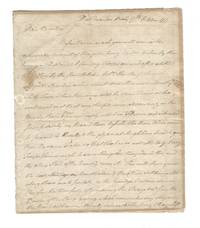
1777réf. BB002CLINTON George First Governor of New York State 1777-1795 1801-1804; also 4th Vice-President of the United States 1805-1812 under Thomas Jefferson and James Madison. "Kingston laid in ashes by the Enemy" . 8vo 7-3/4 x 6-1/2 inches 1-1/2 pages on laid paper with integral address leaf remnants of wax seal some fading to text and signature scattered minor It should be noted that Clinton was sworn in as New York's first governor on 9th July 1777 shortly after Kingston was established as its first capitol 20th April 1777. Thus the burning of Kingston and change of capitol to eventually Albany was a consequence of the War for Independence. Remarkable handwritten manuscript explaining that the British troops arrived at Kingston before his own re-enforcements whereupon 1000 men burned the town and immediately returned to their ships warning that a similar fate awaits the settlements along the shore and that forage and property should be moved from the path of the enemy reminding him to take the sleigh from the barn as it is all the personal property that remains to him after the destruction in Kingston noting that the enemy is advancing up the river to Saugerties with Tryon commanding on the east side and Vaughn on the west. Transcript Head Quarters Hurley 17th October 1777 Dear Brother "Before this can reach you you will receive the – disagreeable account of Kingston being laid in ashes by the Enemy. They landed before my troops arrived after a little opposition by the few militia Cols Pawling & Snyder could collect and marched about 1000 Men immediately up to Town - where they were told by some Tories who continued in it that my People were advancing on the Hurley Road & they immediately set it in Flames and extracted precipitately on Board their Vessels tho their Orders were to proceed to Hurley & the adjacent Neighborhoods to give them the same Fate so that tho I was not able to get my Troops Time enough to save Kingston they saved this and the other Parts of the Country near it. This will show you the Fate New Windsor & the other settlements along shore are to partake on the Enemy's Return down. Therefore the Necessity of removing the Forage &c from the Banks of the River among which remember my Slay in the Barn as it is now the only moveable Property I have left the Best being removed to Kingston shared its Fate tho indeed a great share of Property has been saved out of Town. The enemy sailed up the River this Morning as high as Saghertyes burning along Shore as they go. When they go a little higher I will follow them. They have Parties on both Sides of the River. Tryon commands those on the East & Vaughan on the West Side of the River. Yours Sincerely Geo Clinton On Friday evening 16 October 1777 a British fleet commandeered by James Wallace and John Vaughn the latter on board the 'Friendship' which had anchored near Easopus Island the day before came into the mouth of Rondout Creek and engaged the gallery "Lady Washington". Shortly after noon the British landed on Rondout Creek and the Cove above Columbus Point. Vaughn personally led the march capturing and forcing a negro to lead them into town without meeting resistance. The troops went through the streets in parties led by Tories setting the whole place on fire in response to the occasional resistance lodged by residents from within their houses. There was looting and vandalism. Meanwhile part of the fleet went a bit up the River and creek to destroy landings and sloops. By the time George Clinton arrived into Kingston the whole town was ablaze and the British party had set out to return to their ships. In a letter on 18 October penned at Little Britain NY in response to this letter his brother B. Genl. James Clinton writes: D'r Brother Yours of yesterday's Date I have just received. I am sorry for the Loss of Kingston &c. Five of the Enemy's Shipping Returned Down the River last night without Doing any Damage Except fireing Some Cannon and small arms at our men and wounding one of ours on Board of a Ferry Boat…" The war became personal for the governor specially after what had happened to Kingston. In a letter to William Smith @ 31 October 1777 his sentiments and commitment are laid bare: "The Cruelties as well Cowardice with which this Warr has been conducted ag't us must I think be sufficient at this late Hour to convince every Man that all connection with Great Britain is at an End…" Reference: Public Paper of George Clinton First Governor of New York War of the Revolution Series. New York: Wynkoop Hallenbeck Crawford Co. 1900. Volume II pp. 457-459. Our letter of 17 October 1777 appears to be unknown to the editors of the Clinton papers although they do list and transcribe the 18th October response by his brother James. Consequently our letter appears to be the only firsthand account by the governor of New York on the actual burning of Kingston an event historically reenacted locally each year within Ulster County. Autograph Letter Signed, “Geo Clinton”, written to his brother Gen. James Clinton in New Windsor (“Dear Brother”), from books
réf. 6984Japan: early mid-Edo. The theme of the four seasons of rice cultivation has had an extensive presence within Japanese art and literature. These two luxury festive scrolls beautifully depict the year-long cycle of rice growing in Japan along with the ancillary activities that took place during the year in the countryside including falconry growing vegetables and fruits seasonal festivals ways of relaxation and the annual tribute of rice to the fiefdom lord. The activities shown on these scrolls have much in common with Brueghel paintings and vividly depict country life. We learn from the labels and handwriting on the original box protecting these two scrolls that they were once owned by two prominent women members of the famous Nabeshima family. The first owner was Teiju in 1699-1752 wife of Muneshige Nabeshima 1687-1755 fifth lord of the Hizen Kashima han Hizen Kashima fiefdom. The later owner was Tokusei in or Kashioka 1798-1877 widow of Naonori Nabeshima 1793-1826 ninth lord of the same fiefdom. Tokusei in was particularly interested in the development of agriculture of the fiefdom and invented the form of brocading known as Saga nishiki. An educated woman she was also a book collector and her library is now kept intact in the Yutoku Inari Shrine in Kashima City in Saga Prefecture. Written on one of the old labels on the box is: "Shiki no kosaku" "Rice Cultivation through the Four Seasons". This type of scroll was oftentimes produced as part of a wealthy bride's dowery as a symbol of a good harvest and therefore good fortune to the new couple. Another label on the original box states in trans.: "scroll of images of our territory." The scrolls are very richly painted with copious clouds of gold flakes at top and bottom throughout. On both scrolls the actual images of the ground and background have gold-heightened effects kinsunago or "golden sand" or have been painted with gold. The folds and borders of the figures' clothes are heightened with gold and silver giving extra nuance. The coloring and detail of each person's face and clothing is quite refined and subtle with very delicate and highly detailed tiny brush strokes. We also note that the crowns of the trees have been carefully painted to depict every individual leaf. Clearly the artist was highly accomplished and went to great lengths to create these scrolls. SCROLL ONE: The first scroll covers all aspects of spring and summer activities. The first scene is clearly early spring with the plum trees in blossom. The farmers are preparing the unhulled grains of "seed rice" from last year's harvest to germinate in preparation for planting this year's crop. Everyone from the very young to old is participating. Many animals including horses and cows are in evidence. The next scene shows farmers "waking up" the dry paddies by tilling the soil. The following scene later in the spring with cherry blossoms in full bloom shows the farmers removing the weeds from the dry field and in an adjacent flooded paddy planting the rice seeds in the now-prepared seed beds. In the magnificent landscape shown behind we see a waterfall demonstrating the freshness of the water soon to flood the fields. Next we see the farmers planting the seedlings in another paddy now flooded. The farmers are supported by a band of musicians who are standing in the adjacent paddy celebrating the all-important transplantation ritual. During the summer water must be continually added to the fields. In the next extended scene we see a farmer using a hand-cranked hydraulic device to lift water to the paddies and other farmers tending and weeding the fields during a wind-driven rainstorm. The way the artist subtly depicts the rain reveals his great skills. The following scene shows a number of farmers and locals celebrating the summer growing period by dancing and playing musical instruments in front of a shrine. They have offered mochi to the shrine praying for rain and hoping for a good harvest. The next several scenes show the farmers growing and harvesting vegetables and beans and picking fruit from large orchards. We see a samurai passing through with his entourage en route to visit the fiefdom lords. SCROLL TWO: The second scroll begins by showing more of country life. Farmers are shown delivering vegetables and a group of samurai are engaged in falconry accompanied by a considerable entourage. Geese attracted by the now harvested fields fly by clearly intended as the prey of the falcons. There are several farmers fishing by the river and another group is resting after the day's work drinking water. We can sense they are all waiting for the crucial rice harvest. Now the autumnal harvest season arrives with a wonderful and complex scene of farmers cutting the rice stalks in the drained fields with sickles. The gathered stalks are bundled into tight sheaves and hung upside-down to dry. Now we see the dried sheaves loaded onto boats for transport. The now-empty paddies are filled with birds picking at the remaining rice kernels. We also see two fishermen catching fish in the river. In the next scene the sheaves are stacked before being transported by horse human and oxen to another area where the sheaves are further dried. In the following scene quite complex we see the rice stalks being processed to separate the rice grains from the shells and then dehusked. The next scene shows the grains of rice laid out on mats to dry. Samurai and farmers are having their own separate picnics celebrating the harvest. We also see a blind musician being escorted by two friends a fish monger and a firewood merchant going to the celebration shown next. The next scene depicts an elaborate harvest festival with farmers proceeding to a shrine to give thanks. They are observed by many spectators. The maple trees have turned color to brilliant reds and oranges. Finally we see farmers carrying their share of taxable rice to the warehouse where they will present the rice to the heads of the village who are recording the farmers' annual tributes in a ledger book. Many rice bales are in evidence. In fine and fresh condition. There is a minor loss of image at the end of the second scroll where two sheets of paper are joined. Occasional minor worming and discoloration. hardcover books
1780réf. 63128Head Quarters Bergen County NJ 1780. Folio one page approximately 125 words in part: "I perceive . that you had collected about two hundred Cattle more and that a further number might be obtained . I cannot of right command the services of the militia . let the commanding officers know how distressed the Army has been and is likely to be for provisions and that it will be rendering splendid service to us and distressing the enemy to remove the Cattle from those parts of the Coast which furnish the New York Markets." Very good. Browned one small piece detached one word of text easily repaired. After Washington's victory at Monmouth June 1778 during which battle Forman had served as an advisor to Charles Lee the war settled into stalemate with Washington's army in New Jersey and the British forces content to remain in New York both sides keeping an eye on each other while trying to provide for their soldiers the American forces suffering deprivation similar to that of Valley Forge. Meanwhile on the day this letter was written word reached Washington of the complete rout of Horatio Gates and his troops at Camden South Carolina opening Virginia to British invasion from the South. Bolstered by American victories at Kings Mountain Oct. 1780 and Cowpens Jan. 1781 and the depletion of Cornwallis's army at its victory over Nathaniel Green at Guilford Court House Washington in conjunction with his French allies moved south to envelop Yorktown earning the British surrender in October 1781 effectively ending the war. General David Forman 1745-1797 born and raised in Monmouth County New Jersey was appointed colonel of a New Jersey regiment that reinforced Washington at New York in June 1776. After suppressing a loyalist uprising later that year during which time he earned the nickname "Devil David" he was chosen to lead a regiment in the Continental army and in 1777 was commissioned brigadier general to lead the New Jersey militia commanding that force in the battle of Germantown Oct. 1777. Disagreements with the New Jersey legislature led to his resignation from that command and he spent the rest of the war running listening posts especially along the coast of New Jersey providing Washington with intelligence on the movements of the British fleet and army a service he was providing at the time of this letter. see DAB Tench Tilghman 1744-1786 born and raised in Talbot County Maryland graduated from the precursor to the University of Pennsylvania in 1761 taking up a mercantile business until the outbreak of the revolution. After serving briefly as a captain in the army he joined Washington as a volunteer and served continuously as an aide-de-camp to the general for the balance of the war. "The amount of secretarial work in addition to military duties that he performed for Washington was prodigious" DAB and he was granted a regular commission of lieutenant-colonel in 1781. After the victory at Yorktown Tilghman was chosen by Washington to carry the announcement of the surrender of Cornwallis to the Continental Congress. Provenance: When recently purchased the letter was in an old frame and removal revealed an autograph note inside the backing included here as follows: "This letter was bought by me about 1860 of Miss Brown residing at 92 Columbus Street Albany New York. She was a sister of an old minister of St. Peters Church. This Miss Brown was a client of Orlando Meads and myself and found this letter in a barrel in the garret of the home occupied by her sister at Manalapan New Jersey formerly owned by General David Forman. signed Dexter Reynolds / Albany Sept. 7 1902. Presented to my son Marcus T. Reynolds." A newly discovered Washington letter shedding light on the general's relationship to state militias and his concerns for providing for his troops while disrupting the supply lines of the British. Not in Fitzgerald or the Founders Online from the National Archives which lists 57 other Washington letters to Forman 1777-1782 showing a gap from 24 July 1780 to 17 May 1781 and two others post-war. 9836. unknown books
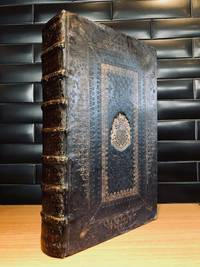
1717réf. 7186Oxford: John Baskett 1717. First Edition Thus. Royal binding in full morocco. Very Good. John Sturt. Two volumes in one. Large stout folio. Double column with columns separated by double rule. Text ruled in red and title pages printed in red and black. Engraved vignette title pages for Old and New Testaments the latter dated 1716. With the engraved additional general title page by cartographer and renowned illustrator John Sturt 1658-1730. With striking copper-engraved vignette head- and tail-pieces and many engraved historiated initials. Complete with Apocrypha. Marbled endpapers. All edges gilt. Bound in contemporary full black morocco rebacked with original elaborate gilt-tooled spine neatly laid-down gilt-tooled arms of King George II featuring the motto "Most Noble Order of the Garter" as centerpieces and his monogram in spine compartments raised bands and gilt-decorated borders. Only moderate wear to the splendidly complete royal binding. First edition of the monumental illustrated "Vinegar Bible" with additional title page engraved by John Sturt including the vignette of a church interior featuring the figures of Moses Aaron et al. per Darlow and Moule. According to the DNB Sturt "specialized in miniature work and it was said that he could engrave the creed on a silver penny but could also work on a large scale and in 1692 he produced a notable engraving of Britannia the royal first capital ship of England printed on four sheets". Presented in a handsome King George II armorial binding. Carter notes that " . Bibles with the royal arms may have come from one of the Royal Chapels - but they may equally have come from any loyal parish church" ABC p. 157. That said a limited print run coupled with the high cost of Baskett's elaborate opus would suggest the former. In 1709 printer John Baskett secured the exclusive royal patent to print Bibles in England. Of those he and his family published this is the most magnificent being a triumph of legible elegant type that contributes to an easy readability accessible today. Alas a typographical error in the running head of Luke XX among other typos rendered the parable of the vineyard as the "parable of the vinegar" overshadowing Baskett's magnificent achievement. A scarce and stately copy of a high spot in 18th-century printing. DARLOW & MOULE 736-B "the engravings differ considerably from those in A". John Baskett unknown
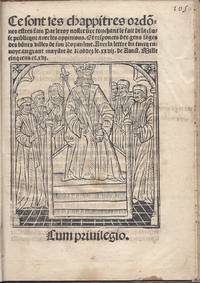
1516réf. 1704S.l.: s.n. 1516. First edition. Title page with large woodcut illustration showing the King on his throne surrounded by the delegates. In Bastarda type with two floral woodcut initials. In later hard paper. Gilt title vignette on spine damaged. Concise marginal notes and page-numbers in ink by a contemporary hand throughout. Trimming of the leaves slightly affects the glosses with no effect to legibility otherwise the margins are wide. Title page crinkled at the upper right corner with a small tear that only affects the margin. Narrow inkblot to the lower margin throughout. B4 with two light brown stains C1 crinkled at lower corner. Bookplates on the inner front panel G. J. Arvanitidi; Antoine Mouradian. Overall in very good condition. First edition. Title page with large woodcut illustration showing the King on his throne surrounded by the delegates. In Bastarda type with two floral woodcut initials. In later hard paper. Gilt title vignette on spine damaged. 20 p. A bibliographically unrecorded early sixteenth-century French book about royal ordinances regarding the commonwealth along with the French translation of Sultan Selim I's letter of conquest fethname addressed to the Grand Master of Rhodes. The first and major part of the book presents nine concepts of orders of Francis I 1494-1547 King of France from 1515 until his death regarding the commonwealth chose publique. The drafts concern such topics as the commerce of spices and drugs wool cloth and other goods chapter 1-4 the weights and equivalents of coins and the recognized foreign currencies chapter 5 the recognized units of measures chapter 6 the regulation of the extravagance of clothing chapter 7 the inn trade chapter 8 and the money that goes to Rome for obtaining Bulls chapter 9. The second section comprises the responses to the aforementioned concepts of the representatives of the Good Cities Bonnes Villes Provence and Dauphiné who had been previously assembled in Paris by the order of the King in March 1516. In most cases they requested a delay of reply to discuss the matters with those who they were representing. The third section presents the grievances and requests delivered to the King by the delegates regarding the provincial councils conciles provinciaux the prolixity of the trials the tariffs the public officers the superior courts cours souveraines the land taxes tailles and the abuse and plunder by the soldiers crossing the kingdom. These sections were recorded and written down by the court clerk Jean Hesselin Seigneur of Girodon. Hesselin mentions himself twice p. 14 and 17 once by name p. 14 within the text. The final part is the French translation of the Ottoman Sultan Selim I's fethname letter of conquest sent on 27 August 1516 from Aleppo to Fabrizio del Carretto 1455-1521 Grand Master Magnus Magister of the Knights Hospitaller in Rhodes between 1513 and 1521. The fethname accordingly to its genre details Selim's expedition and the conquest and emphasizes the power and grandeur of the Sultan and his army. Selim I 1470-1520 ascended the throne as the Sultan of the Ottoman Empire in 1512. He is remembered for the enormous expansion of the Empire during his reign thus raise the Ottomans to the leaders of the Muslim world. Selim's most notable deed was the conquer of the Mamluk Sultanate which included Levant Hejaz and Egypt in 1516 and 1517 at the Battles of Marj Dabiq and Ridaniya. The Battle of Marj Dabiq near Aleppo took place on August 24 1516 where Selim defeated the Mamluk Sultan Al-Ashraf Qansuh al-Ghuri. This was a decisive victory of the war between the Ottoman Empire and the Mamluk Sultanate which ended in the conquest of much of the Middle East. Such an expansion of the Ottoman territory was a clear threat to Rhodes which was the nearest Christian possession to the coast of Asia halfway between Constantinople and Egypt. At the time the Grand Master in Rhodes was the Italian admiral Fabrizio del Carretto 1455-1521; Grand Master from 1513 to 1521 for a short interlude of a course of fifty-five years of Frenchmen serving as the supreme heads of the Order. Selim announced his victory and forecasted his threat to del Carretto in a fethname presented here in French translation however eventually he did not have the time to conduct the campaign against Rhodes. It was his successor Suleiman I who conquered the island in 1522 thus gained control over the eastern Mediterranean for the next centuries. By the time of the siege the commander of the Order was again a Frenchman Grand Master Philippe Villiers de L'Isle-Adam 1464-1534. Suleiman allowed him and the surviving knights to leave unmolested and eventually the Hospitallers were quartered permanently on Malta in 1530. To the best of our knowledge the original fethname has not survived and we could not trance any other printed version or edition of the French translation. We could find one surviving copy of a Spanish translation of Selim's letter which was addressed to Pope Leo X titled Carta de nuevas grandes buenas y ciertas embiada a nuestro s. padre Leon X de las cosas que han passado en Levante entre el gran turcho y el gran solda Valencia Juan Viñao 1517; Norton 1256 IB 11215 USTC 344377 kept at Cambridge University Library F151.d.8.12. Provenance: Bookplate of Georgios Arvanitidis 1876-1953 a noted Constantinopolitan collector of books on Turkish and Greek history. Bookplate with the motto "On abuse du vrai" of Antoine Mouradian. Ref.: Bibliographically unrecorded. Bibl.: Setton K. M. Hazard H. W. ed.: A History of the Crusades. Vol. 3. Wisconsin: The University of Wisconsin Press 1975. pp. 332-335. Pedani-Fabris M. P.: Ottoman Fetihnames. The Imperial letters announcing a Victory. In: Tarih İncelemeleri Dergisi 13 1998. 181-192. . [s.n.] unknown
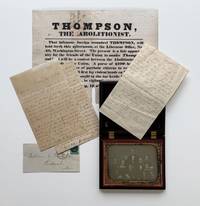
réf. 9998Boston: October 1835. Letterpress broadside 8.875" x 12 sheet size. Early ink inscription on verso reading: "Return to C.C. Mason of the Me Cong. the M.E. Ch." CONDITION: Good old folds a few tissue repairs on verso to small holes loss along fold in lower margin just nicking "2" in "2 o'clock" a few small losses to lower edgesome toning and foxing. with Garrison William Lloyd. Autograph letter signed to William E. Gould regarding the confrontation with the pro-slavery mob in October 1835. Boston 8 December 1877. 2 pp. 7.75" x 5" with original cover addressed to Gould with 3 cent stamp and Boston postmark. Written in response to Gould's letter requesting information on the Thompson broadside see below. CONDITION: Very good old folds. with Gould Emma Maynard Dow. Autograph letter signed by Emma Maynard Dow Gould William Gould's wife to John likely John Mead Gould William's brother regarding the broadside and Garrison letter offered here. Probably Boston 2 May 1892. 1 p. 7.75" x 4.875". CONDITION: Very good old folds. with Half plate daguerreotype of the Gould family. Portland Maine 1853. Housed in a thermoplastic case. CONDITION: Very good image clear and un-touched mat tarnished case fully intact and attractive. An exceptionally rare broadside relating to one of the most notorious moments in the history of abolitionism accompanied by a letter of William Lloyd Garrison providing an account of events and referring to his "ruffianly seizure" by the pro-slavery mob with a related family letter and Gould family daguerreotype. In 1835 one of the leading British abolitionists George Thompson 1804-1878 traveled from the United Kingdom for a lecture tour of the United States in response to an invitation from William Lloyd Garrison whom he had met in 1832 in Scotland where the two became friends. In the 1877 ALS included here Garrison recalls the events surrounding the broadside: "On the 21st of October 1835 the Boston Female Anti-Slavery Society attempted to hold its annual meeting. At that time George Thompson the eloquent and successful advocate of British West India Emancipation was laboring here with the Abolitionists and by their invitation to effect a similar deliverance for the Southern slave population. To intensify the popular pro-slavery spirit against him he was falsely and maliciously branded by the press as a British emissary who had been sent here by the British Government with his pockets lined with British gold 'for the purpose of overthrowing our Glorious Union' etc etc." The broadside explicitly intended to incite a mob yet attempting to characterize its purpose as patriotic calls for the pro-slavery supporters to seize and tar Thompson: That infamous scoundrel THOMPSON will hold forth this afternoon at the Liberator Office No. 48 Washington Street. The present is a fair opportunity for the friends of the Union to snake Thompson out! It will be a contest between the Abolitionists and the friends of the Union. A purse of $100 has been raised by a number of patriotic citizens to reward the individual who shall first lay violent hands on Thompson so that he may be brought to the tar kettle before dark. Friends of the Union be vigilant! Aware of the gathering mob Thompson did not attend the meeting as scheduled and Garrison instead went to speak to the Society. Garrison continues with his description of the events unfolding including fascinating details of the author and publisher of the inciting broadside: "It was deemed prudent by ladies for his own personal safety that he should not attend the meeting aforesaid; nevertheless it was rumored that he was to be present and this led to the issuing of the mob-exciting placard which you have copied in your letter and about which you express a wish to be further informed. That placard was written by James L. Homer editor of the Boston Gazette and printed in his office and distributed throughout the city!" Garrison concludes with his own experience on the day: "The result was the gathering of a mob of five thousand persons the breaking up of the ladies meeting my ruffianly seizure and being dragged through the streets finally rescued by the city constabulary and incarceration in Leverett Street jail to save my life." Garrison was indeed seized by the pro-slavery mob and was dragged through the streets with a rope around his waist with the intent of tarring and feathering him or worse. Boston Mayor Theodore Lyman II intervened and confined Garrison for his own safety. The example of the broadside offered here at one time owned by Reverend C. C. Mason of the Methodist Episcopal Church was subsequently given to William Gould whose curiosity regarding events surrounding it led him to write to Garrison. Gould's letter penned from Portland Maine on November 14th 1877 is in the Boston Public Library's Anti-Slavery Collection MS A.1.2 v.39 p. 154A. He writes in part: "I have copied upon the page annexed a sheet sent me by an old minister. It is so very different from the state of things today that I want to frame it for my Library & I would be very glad to frame also any reply you may be pleased to make to me when I now ask you if you will. Kindly tell me what year this was. What was the result of the appeal and if it is known who was the author of the document." Also included here is an 1892 letter from Gould's wife Emma 1836-1918 to his brother John offering the collection of items to him: "Edw. has framed a relic which he thinks you may like. It is a placard printed in Boston in Feb. sic 1835 intended to incite a pro-slavery mob at the time of an anti-slavery meeting with it is an autographed letter from Wm. Loyd sic Garrison explaining it which he wrote Edw. in reply to one from him asking information about the affair. If you would like it perhaps Theo will come for it. I am breaking up and packing and it will be one thing out of my way. If you do not come for it he will give it to the Historical Society." Emma refers here to her husband by his middle name Edward. Lending additional interest to this lot is a half plate daguerreotype of the Gould family of Portland Maine. Edward Gould 1805-1894 and his wife Althea Chase Gould 1808-1894 are seated at center surrounded by their six children. William E. Gould the eldest son stands at the center his hand resting on his father's shoulder. To the left of William is his brother John Mead Gould who would go on to achieve distinction in the Civil War. Although often cited in accounts of the abolitionist movement the Thompson broadside is exceptionally rare. We locate just two copies in institutions at The National Museum of African American History & Culture and the Massachusetts Historical Society. OCLC records a copy at the Library of Congress dated 1851 in the record but it is pictured on the LC site and appears to be a reproduction of some sort. An important group of items documenting the conflict in Boston surrounding abolitionism in the 1830s and a wonderful example of private historical preservation. Provenance: Reverend Charles C. Mason b. ca. 1820 to William E. Gould 1837-1919 to his brother John Mead Gould 1839-1930. Boston: [October, 1835] unknown
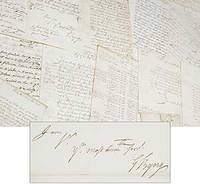
1718réf. 3874591718. Unbound. Near Fine. A remarkable archive of 24 letters from Admiral of the Fleet George Byng sent to Rear Admiral George Delaval who commanded the Blue Squadron under Byng’s command along with associated documents from George Saunders and Josiah Burchett Secretary of the Admiralty relating to the British naval campaign of 1718 in the Mediterranean culminating in the Battle of Cape Passaro Sicily on the 11th August. A mix of quarto and folio sheet with many folded once to form four pages. Each letter is Signed by Byng with one signed twice. Despite their age the letters are near fine or better with only light wear and housed in a custom cloth chemise with printed labels. The Battle of Cape Passaro resulted in the defeat of the Spanish by the British Fleet under Sir George Byng four months before the War of the Quadruple Alliance. The Spanish refused to re-embark their army from the Sicilian mainland. Despite war not having been formally declared Byng correctly anticipated approval from home and attacked and routed the Spanish fleet thwarting their ambitions to take Italy and Sicily. The subject matter of the letters is concerned with supplies day-to-day naval matters and continuing hostilities against the Spanish and includes details of several rendezvous for meeting up in the event of separation owing to bad weather. Common problems are mentioned such as desertion and shortage of food and more particularly wine. The earliest is dated May 17th concerning the mobilization of troops and pressed men for the campaign. The letter of May 29th regards the Line of Battle detailing ships ordnance and men commanders and formation and pennants and the signals to be used. On July 3rd Byng gives orders to oppose the landing of the Spanish in Italy with a warrant order of operations to “take sink burn or destroy” the King of Spain’s ships; the last of the series dates from the December 9th from the Admiralty office not by Byng congratulating Delaval on his safe arrival at Spithead and requesting him to escort the fireship Griffin to Deptford. Byng sent mail from on board his ship the Barfleur whilst at sea and also from the Admiralty office in London. Byng was sent on subsequent diplomatic missions on behalf of England to negotiate with Italian princes and states and was instrumental in the acceptance of the terms of the Quadruple Alliance by Spain. In 1718 Byng was already a respected member of the establishment having supported the accession of William and Mary at the Glorious Revolution contributed to the burning of the French fleet at Vigo and leading the bombardment squadron during the capture of Gibraltar. He was rewarded with a knighthood and a regular promotion. After the success of 1718 this included membership in the Privy Council admittance to the Order of the Bath and the title of Viscount Torrington which his descendants still bear today. In 1727 Byng was made First Lord of the Admiralty and the Royal Naval College at Portsmouth was founded in his memory. Delaval also had a distinguished naval and diplomatic career from a young age with victory at the Battle of Malaga in 1704 and missions to Spain and Portugal as well as his promotion to Rear Admiral and leadership of The Blue Squadron. He is perhaps best known for rebuilding his ancestral seat the celebrated Seaton Delaval Hall in Northumberland now a National Trust property with architect Sir John Vanbrugh. It is important to note that Admiral George Byng should not be confused with his fourth son John Byng also present at the Battle of Cape Passaro as a 13 years old who built a respectable career as a naval officer and became an Admiral but was court-martialed and shot by firing squad on 14 March 1757. A remarkable collection of letters from the First Lord of the Admiralty during the reign of King George II. A detailed list of the correspondence is available upon request. unknown
réf. 6951Japan: ca. 1840-50. Two large and fine paintings in hanging scroll format depicting all the steps in the production of the finest Uji tea by the Kanbayashi family to be sent to the Tokugawa shogun in Edo. These scrolls are of very great beauty and complexity and were surely painted by a master artist see below. The production and drinking of tea in Japan has a long and rich history extending back to the Nara period 710-94 when tea was brought back by diplomatic missions from China. Emperor Saga was served tea in 815 and afterwards ordered the establishment of several tea plantations near the capital of Kyoto. It was soon discovered that Uji a village located south of Kyoto was the ideal location to produce excellent tea leaves due to its rich soil and high-quality water. It became Japan's first major tea-producing region and has maintained its reputation for superior tea. In the 15th century the cultivation and production of tea in Uji underwent several transformations: the technique was introduced of covering young tea buds shielding them from the sun during the last weeks before plucking to improve their flavor ooishita saibai; and the quality of the tea was steadily improved through careful processing. Various shoguns including Hideyoshi Toyotomi 1536-98 and Ieyasu Tokugawa 1543-1616 supported the tea growers and processors in Uji. By the early 17th century an annual procession to celebrate the Shogunate's acquisition of its annual stocks of tea from Uji - Ochatsubo dochu "Travelling of the Shogun's Tea Jar" - was formalized as an official ritual event akin to political theater and thereby reinforcing Tokugawa authority. A delegation - Uji saichashi "Uji tea-picking envoy" including a "Tea Specialist" sukiya gashira and two subordinate "Tea Monks" chabozu - was sent with empty jars by the shogun each spring to observe the harvest and participate in the processing and selection of the tea leaves for the shogun. After many laborious steps of processing and selection as we shall see the tea leaves were placed in large jars. A few of these jars were sent as an offering to the Imperial Court Chatsubo shinken in Kyoto and the remainder were carried to Edo Castle in the autumn. The round-trip procession was a highly elaborate and publicized event. When the envoys returned to Edo the leaves were ground and made into powdered green tea for consumption at formal events at Edo Castle. During the last part of the 16th century and early years of the 17th century members of the Kanbayashi or Kamibayashi family found favor with several shoguns and eventually served as exclusive suppliers to the shoguns and the great daimyo the company established in 1558 still exists as Kanbayashi Shunsho honten and is affiliated with Coca-Cola. The family was given the honorific title of On cha todori "president of the Uji tea industry" and was also known as On mono chashi or Omono chashi "tea suppliers to the imperial family and shogun and leading nobility". They were allowed to wear samurai clothing and carry swords. Our scrolls beautifully depict all the steps of harvesting processing selecting and packing the tea leaves for transportation to the shogun in Edo. SCROLL ONE: This is composed of five different scenes. The first depicts two men erecting poles at the sides of a tea field preparing to cover the tea bushes shielding them with netting from the sun. Across the river the second image shows a member of the Kanbayashi family with sword at hip discussing the current crop with an employee who has a ledger book in front of him. They are being served tea while another employee is showing the just-harvested leaves. Behind them we see several women picking through the plucked leaves searching for impurities. The next scene is splendid: it shows many women harvesting the young tea leaves from the bushes which have been covered by netting supported by poles. It is a "beehive" of activity with about ten women working assisted by young men carrying the leaves away in buckets. A woman in the background is taking a break and nursing her child. The fourth scene shows another member of the Kanbayshi family leading a group of workers to the fields. A senior assistant is carrying a flag with the Kanbayashi family symbol. The final scene offers valuable information regarding the steps of processing. We see a large roofed building and on the right side is the heating room where steam is produced to heat the harvested leaves. To the left is a room where the actual steaming of the leaves is taking place. The leaves are then spread out in bins and cooled by women using fans. Further to the left we see men sifting to separate the smallest and finest leaves from stems and larger leaves. The final product is being weighed on a scale and placed into fine wooden boxes. The "story" of this first scroll with five scenes has been artfully constructed starting at the bottom and weaving its way upwards. The brushwork is highly refined and detailed: the faces showing a wide range of expression the leaves individually painted and the coloring extremely subtle. SCROLL TWO: This is also composed of five scenes. The first at bottom shows Kanbayashi employees further drying the leaves and placing them into large flat baskets which are carried to the next room. On top of the basket is a piece of paper describing the quality of the leaves. Yet another sifting and inspection of leaves takes place. The next scene upstairs shows a group of women spreading the leaves over a large table and picking through the leaves by hand again removing any impurities. These leaves are then passed to two inspectors for further review. The third scene shows several women yet again examining the leaves and removing further impurities this time with chopsticks. They turn and present the trays holding the leaves to a high-level Kanbayashi employee for approval. In turn the trays are then presented to the representatives from the shogun who are carrying swords and wearing masks and official attire. They use chopsticks to further cull undesirable leaves. In the background are large jars holding tea in a storage room. The fourth scene is that of a tea ceremony room where members of the Kanbayashi family and government officials are meeting and conducting a tasting. The final scene at the top of the scroll shows a formal room with government officials observed by other members of the delegation presumably the "Tea Specialist" and the two "Tea Monks" packing the tea in small envelopes and placing them in large jars. In the back is a beautiful garden. We can attribute with some confidence these hanging picture scrolls to Kagaku Ozawa fl. 1840-50 painter draftsman and poet in Kyoto. He was a follower of Kazan Yokoyama 1781-1837. The two scrolls are in fine and fresh condition preserved in a wooden box. The second scroll suffers from minor worming. ❧ Much of our description is based on the wonderful article by Prof. Taka Oshkiri "The Shogun's Tea Jar: Ritual Material Culture and Political Authority in Early Modern Japan" in The Historical Journal Cambridge Univ. Press 59 2016 pp. 927-45. hardcover books
1931réf. 001618London: The Golden Cockerel Press 1931. 7 6-268pp 4. Original half pigskin and buckram over boards by Sangorski and Sutcliffe raised bands spine in six panels title in gilt to second panel cockerel device to fifth t.e.g. remainder untrimmed. Spine very slightly rubbed usual light foxing to cloth covers internally bright and clean and signed by Eric Gill to title 'Eric G' within a small illustration of a ball and chain attached to the foot of the cockerel vignette on the title page. Number three hundred and seventy-two of five hundred copies on paper with another twelve on vellum. Now housed in a drop back box made by Temple Bookbinders. The Four Gospels is widely regarded as one of the best private press books. Cave and Manson 78; Chanticleer 78 "a flower among the best products of English romantic genius"; A Century for the Century 26; Gill 285. Signed by Illustrator. First Thus. Half Pigskin and Buckram. Very Good. Illus. by Gill Eric. Folio. Private Press. The Golden Cockerel Press hardcover
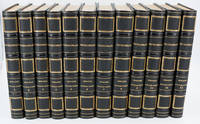
1849réf. 91066Paris: EugèneVictor Penaud frères 1849. Fine. With plates from the first illustrated edition and a letter by Chateaubriand: ""but I am dead utterly dead"" Eugène Victor Penaud frères Paris 1849-1850 ; 14 avril 1839 lettre manuscrite 13.7 x 21.2 cm 12 volumes reliés et une lettre signée Rare and sought-after first edition first issue with exceptionally added plates from the first illustrated edition published that same year. 34 full-page engravings after Demoraine Gagnier Staal and engraved by F. Delannoy. Includes the subscribers list and the foreword which will be removed for the second issue when the remainder of this edition was bought by another publisher Dion-Lambert. It also features the pagination error in volume two: page 164 instead of 364. With a scribal letter by the author bearing his autograph signature. One page written in black ink on a leaf. Slightly darkened at the upper edge with occasional foxing and the usual folds. Black half-morocco bindings flat spines with double gilt fillets and double blind-stamped compartments black paper boards slight superficial rubbing to some boards marbled paper pastedowns and endpapers sprinkled edges; contemporary bindings. Sparse foxing. Exceptional prophetic and macabre letter by François-René de Chateaubriand. Signed with the authors faltering hand this apparently unpublished letter was penned by his secretary. Black half-morocco bindings flat spines with double gilt fillets and double blind-stamped compartments black paper boards slight superficial rubbing to some boards marbled paper pastedowns and endpapers sprinkled edges; contemporary bindings. Sparse foxing. You will recognise the hand of Pilorge whom I employ to replace my own suffering from gout. I shall read your recollections with the greatest pleasure but as for me I am dead utterly dead and if I were required to write a single word in a paper I would sooner be buried a thousand feet underground. I am done with life; it would be a sweet thing indeed to rise again if only to be of some use to you Rest assured that no one will take a more genuine interest nor share more wholeheartedly in your success than I shall. Entirely yours from the depths of my grave Chateaubriand 14 April 1839. This letter was dictated by the author to his secretary who provided invaluable assistance in the very preparation of the Mémoires: Having remained in Chateaubriands service for twenty-five years Hyacinthe Pilorge was the principal hand behind the transcription of the Mémoires doutre-tombe. His task was to make a legible copy of Chateaubriands texts progressively transcribing everything his master wrote or dictated. Chateaubriand revised and corrected from these copies and when the newly written pages became excessively amended Pilorge would write a new copy. Pilorge was tasked in 1840 of transcribing the first complete copy of the Mémoires doutre-tombe. For many years this manuscript served as the reference text. It comprised over four thousand pages assembled by quires and kept in cardboard folders with each leaf designed to be corrected moved or replaced at will. Once this monumental task was completed in 1841 Chateaubriand set his work aside for some time. Yet thanks to its highly adaptable structure the Mémoires doutre-tombe continue to stand as a living evolving work a perpetual work in progress. Bibliothèque nationale de France The recipient of the letter is the author of Souvenirs which Chateaubriand here declines to promote. The writer speaks as though from beyond the grave almost ten years before his actual death: as for me I am dead utterly dead and if I were required to write a single word in a paper I would sooner be buried a thousand feet underground. I am done with life; it would be a sweet thing indeed to rise again if only to be of some use to you. These masterful lines carry the humour so often encountered in the pages of the Mémoires which André Lebois describe EugèneVictor Penaud frères hardcover
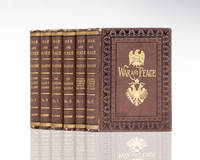
1886réf. 149532New York: William S. Gottsberger Publisher 1886. First edition in English of Tolstoy's masterpiece a pillar of world literature. Octavo six volumes in the publisher's original pictorial brown cloth stamped in gilt and black brown coated endpapers with the cursive imprint in each part. Translated by Clara Bell. In near fine condition. Housed in two custom marbled slipcases. An exceptional set of Tolstoy's masterpiece one of the finest we have seen. Widely considered the greatest novel ever written War and Peace is at once an epic of the Napoleonic Wars a philosophical study and a celebration of the human spirit. Tolstoys genius is seen clearly in the multitude of characters in this massive chronicleall of them fully realized and equally memorable. Out of this complex narrative emerges a profound examination of the individuals place in the historical process one that makes it clear why Thomas Mann praised Tolstoy for his Homeric powers and placed War and Peace in the same category as the Iliad: "To read him . . . is to find ones way home . . . to everything within us that is fundamental and sane." "There remains the greatest of all novelists--for what else can we call the author of War and Peace" Virginia Woolf. William S. Gottsberger, Publisher hardcover
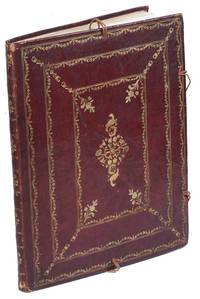
1800réf. ABC_48443The Netherlands 1800. Splendid late 18th-century ca. 1790 gold-tooled red morocco sewn on 4 supports with a smooth spine bound by the so-called Second Dissertation Bindery Leiden ca. 1780-ca. 1794; Storm van Leeuwen IIA pp. 350-358 with 4 closing loops on the front board 1 top edge 2 fore-edge 1 bottom edge connecting to 4 closing knotted buttons on the back board. Both boards show 3 gold-tooled floral frames built up from 2 different rolls with small corner pieces in between the inner frame with 4 larger floral corner pieces and a large lozenge shaped centrepiece built up from multiple impressions of 5 different floral and animal stamps. Further with a gold-tooled spine and board edges gilt edges and marbled endpapers. Large 4to. With 162 signatures on 160 vellum or paper cuttings mostly vellum including 2 cuttings with 2 signatures each mostly from the 17th century some from the 18th century and a few from the early 19th century. Further with one large printed coat of arms of the Wassenaer family on the verso of the title-page an engraving ca. 9.5 x 7 cm showing the house of Jacob Cats on the verso of leaf 34 and with 19 printed coats of arms on the versos of several leaves 16 depicting a coat of arms with the name of the family below and 3 blank shields. The title page headings and captions all in a very neat late-18th-century or early 19th-century cursive script written in Dutch using brown ink. Remarkable collection of 162 signatures of mainly 17th-century 16th- to early 19th century Dutch and international prominent people - from statesmen like Stadtholder Maurice of Orange Count of Nassau etc. and Grand Pensionary of Holland Johan de Witt 1625-1672 royals like King Philip II of Spain 1527-1598 and William III of Orange Stadtholder of the Dutch Republic and later King of England Scotland and Ireland 1650-1702 and government officials like "Griffier" to the States General François Fagel 1629-1746 the most important clerk of the Dutch Republic's government to authors poets and scholars like P.C. Hooft 1581-1627 and Nicolaas Tulp 1593-1674. For each individual mentioned in the present work their signature - on a separate vellum or paper cutting mounted on the recto of the leaf - appears next to a short biographical description. Some biographical descriptions are more extensive than others but two names appear without any further information. The first is Caspar Clotterbooke leaf 30 who is listed as a secretary for the council of the States of Holland in the 18th century 1778. He was born in The Hague in 1720 held several high positions in the councils of Haarlem and the States of Holland as a representative of that city and died childless in 1817. The second is Hendrik Nobel who is listed in the second part among royals statesmen military commanders scholars and others. He lived from 1568 to 1649 and was appointed as "bewindvoerder" administrator or governor of the Rotterdam Chamber of the Dutch East India Company VOC. In two cases one cutting contains two signatures - those of Johan van Hoorn and Abraham van Riebeek appear together as well as those of Adriaan Valkenier and Johannes Thedens; all four were Governor General of the Dutch East Indies resp. from 1704-9 1709-13 1737-41 and 1741-43. In the case of William III two signatures are included for one single individual - the first is his signature as Prince of Orange and the second is his signature as King of England Scotland and Ireland "William R.". The work was bound by the so-called Second Dissertation Bindery in Leiden which was active at the end of the 18th-century between ca. 1780-1794 Storm van Leeuwen. The work was most likely produced as an album with blank leaves to be used as a notebook or scrapbook album of some sort at a later date. The paper used in the album is clearly watermarked throughout for example a lion within a crowned medallion pro patria eiusque libertate countermarked J. Honig & Zoonen. The firm Honig or Honigh Zaandam the Netherlands was active from the late 17th century until the late 19th century but was known as J. Honig & Zoonen during the 18th century. The paper is most likely contemporary to the binding. While several of the cuttings containing signatures are also dated - as part of the signature itself or separately added - these dates represent the exact or otherwise approximate date the particular signature was produced. The majority of the signatures can be traced back to the 17th century but were probably cut from official hence the vellum documents to be sold as collector's items around the beginning of the 19th century.The present work was part of the collection of A.M. van den Broek 1932-1995 an antiquarian book print and art collector from Haarlem. His collection mainly contained works focussed on Haarlem and its surroundings. The present work includes 7 signatures from prominent Haarlem representatives in the "Commons" the council of the States of Holland during the 17th- and 18th centuries.The binding shows very slight signs of wear two scratches on the front board some rubbing along the spine and closing knotted buttons on the back board the gutter of the first and second front flyleaves is slightly exposed without affecting the integrity of the binding. Further with some minor offsetting on the blank versos of the leaves from the signature cuttings. Otherwise in very good condition. A remarkable collection of signatures from mainly 17th century prominent Dutch and international statesmen and other famous people.l Cf. for the binding: Storm van Leeuwen IIA pp. 350-358. hardcover
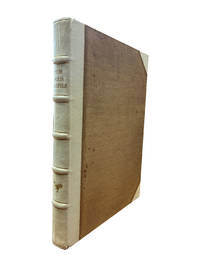
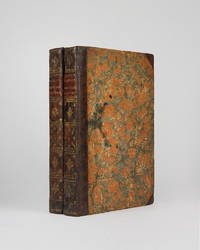
réf. 121437London Printed by Adam Islip 1601. . First edition in English first issue with the Islip imprint; 2 vols folio 30.5 x 20.7 cm; 2 title pages each with woodcut allegorical device woodcut head- and tailpieces decorative initials last leaf with errata on recto and colophon on verso one or two instances of early marginalia; lacking first blank leaf in each volume scattered light foxing and staining a few marginal open and closed tears scattered small rust holes costing a few letters faint dampstaining to a few gatherings; late 18th-century half calf over marbled paper-covered boards edges speckled red sometime rebacked with original spines laid down gilt tooling to spines red morocco title labels to spines lettered in gilt; a handsome copy. Handsome first edition of Philemon Holland's renowned English translation 'Over and over again it will be found that the source of some ancient piece of wisdom is Pliny.' PMM 5 A handsome first edition first issue of Philemon Holland's renowned English translation of Pliny's Natural History. The most popular of Holland's translations it had never before been printed in English and would not be attempted again for another 250 years. One of the greatest translators of the Elizabethan age Holland's Pliny was an important source for Shakespeare. 'In Othello's allusion to the Pontic Sea Shakespeare was clearly drawing upon Pliny's Historie as translated by Holland Similarly Pliny has also been cited as a source for Othello's reference to the "medicinal gum" of "the Arabian trees"' Payne Search for Meaning 63 and many trace Caliban in The Tempest to Holland's Pliny. 'The importance of Pliny lay not so much that he was an inexhaustible source for monsters eclipses and the stranger habits of all created things but that in the pages of Philemon Holland's translation Shakespeare found that emphasis on Nature which he employed and re-interpreted in the tragedy' Evans The Language of Shakespeare's Plays. STC 20029.5; Pforzheimer 496; ESTC S115918; Brueggemann 670; Lowndes 1885; cf. PMM 5. London, Printed by Adam Islip, 1601. hardcover
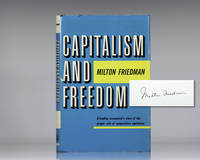
1962réf. 23005Chicago: University of Chicago Press 1962. First edition of Friedman's magnum opus. Octavo original blue cloth. Signed by Milton Friedman on the front free endpaper in a contemporary hand. Fine in a very good dust jacket with light rubbing. Housed in a custom half morocco clamshell box made by the Harcourt Bindery. Rare signed. "Friedman a laissez-faire economist and professor at the University of Chicago is considered one of the leading modern exponents of liberalism in the 19th-century European sense. In Capitalism and Freedom he argued for a negative income tax or guaranteed income to supersede centralized bureaucratized social welfare services which in his view are inimical to the traditional values of individualism and useful work" Britannica. Selected by the Times Literary Supplement as one of the "hundred most influential books since the war". It also placed tenth on the list of the 100 best non-fiction books of the twentieth century compiled by National Review and on Time Magazine's top 100 non-fiction books written in English since 1923. University of Chicago Press hardcover
1601réf. 3078London: Impensis G. Bishop 1601. FIRST EDITION second issue with cancel title page. Hardcover. Fine. Bound in contemporary English calfskin ruled in blind re-backed and re-cornered in morocco. An excellent copy internally with very minor faults. A few signatures have very marginal damp-stains there are occasional rust spots minor marginal tears and a few natural paper flaws no loss to text. The first title page features an elaborate architectural border with Solomonic columns. "The 'Natural History' of Pliny the Elder is more than a natural history: it is an encyclopaedia of all the knowledge of the ancient world. It comprises 37 books with mathematics and physics geography and astronomy medicine and zoology anthropology and physiology philosophy and history agriculture and mineralogy the arts and letters. The 'Historia' soon became a standard book of reference; abstracts and abridgements appeared by the third century. Bede owned a copy Alcuin sent the early books to Charlemagne and Dicuil the Irish geographer quotes him in the ninth century. It was the basis of Isidore's Etymologiae and such medieval encyclopedias as the Speculum Majus of Vincent of Beauvais and the Catholicon of Balbus. One of the earliest books to be printed at Venice the centre from which so much of classical literature was first dispensed it was later translated into English by Philemon Holland in 1601 and twice reprinted a notable achievement for so vast a text. Over and over again it will be found that the source of some ancient piece of knowledge is Pliny." PMM 5 "Holland's first book the first complete rendering of Livy into English was published in 1600 when he was nearly fifty. It was a work of great importance presented in a grand folio volume of 1458 pages and dedicated to the queen. . "The Livy was followed in the next year by an equally huge translation of the elder Pliny: The Historie of the World Commonly called the Naturall Historie. This encyclopaedia of ancient knowledge about the natural world had already had a great indirect influence in England as elsewhere in Europe but had not been translated into English before and would not be again for 250 years."ODNB. Impensis G. Bishop hardcover
1974réf. 78309Washington DC: U. S. Government Printing Office 1974. Presumed First Edition First printing. Wraps. Good/No dust jackets present. This is a complete set of the Statement of Information--28 separately bound items. The July 12 1974 the Committee released of its accumulated evidence on the case which ran to thousands of pages. Book I: Events Following the Watergate Break-in June 19 1972-March 1 1974 ix 1 242 pages; Book II: Department of Justice-ITT Litigation ix 1 208 6 pages; Book III: Political Contributions by Milk Producers Cooperatives: The 1971 Milk Price Support Decision ix 1 217 1 pages; Book IV: White House Surveillance Activities ix 1 225 1 pages. Book II: Events Following the Watergate Break-in June 17 1972-February 9 1973 xii 680 4 pages; Book III Part 1 Events Following the Watergate Break-in June 20 1972-March 22 1973 xii 687 5 pages; Book III Part 2 Events Following the Watergate Break-in June 20 1972-March 22 1973 iii 1 689-1281 3 pages; Book IV Part 1 Events Following the Watergate Break-in March 22 1973--April 30 1973 xii 551 5 pages; Book IV Part 2 Events Following the Watergate Break-in March 22 1973-April 30 1973 iii 555-1080 pages; Book IV Part 3 Events Following the Watergate Break-in March 22 1973--April 30 1973 iii 1 1081-1659 1 pages spine discolored; Book V--Part 1 Department of Justice/ITT Litigation--Richard Kleindienst Nomination Hearings xii 477 1; Book V--Part 2 Department of Justice/ITT Litigation--Richard Kleindienst Nomination Hearings ii 2 479-980 4; Book VI--Part 1 Political Contributions by Milk Producers Cooperatives: The 1971 Milk Price Support Decision ix 1462 pages; Book VI--Part 2 Political Contributions by Milk Producers Cooperatives: The 1971 Milk Price Support Decision iii 1463-984 2 pages; Book VII--Part 1 White House Surveillance Activities and Campaign Activities xii 522 2 pages; Book VII--Part 2 White House Surveillance Activities and Campaign Activities iii 1 523-1177 3 pages; Book VII--Part 3 White House Surveillance Activities and Campaign Activities iii 1 1179-1613 1 pages; Book VII--Part 4 White House Surveillance Activities and Campaign Activities iii 1 1615-2090 2 pages; Book VIII: Internal Revenue Service xii 440 4 pages; Book IX--Part 1: Watergate Special Prosecutors Judiciary Committee's Impeachment Inquiry April 30 1973-July 1 1974 xii 521 3 pages; Book IX--Part 2: Watergate Special Prosecutors Judiciary Committee's Impeachment Inquiry April 30 1973-July 1 1974 iii 1 523-1069 1 pages; Book X: Tax Deduction for Gift of Papers vii 1 552 pages; Book XI: Bombing of Cambodia xii 599 1 pages; Book XII: Impoundment of Funds Government Expenditures on President Nixon's Private Properties at San Clemente and Key Biscayne vii 1 187 1 pages; Appendix I: Presidential Statements on the Watergate Break-in and Its Investigation iv 110 2 pages; Appendix II: Papers in Criminal Cases Initiated by The Watergate Special Prosecution Force June 27 1973-August 2 1974 iv 379 3 pages; Appendix III: Supplementary Documents: White House Edited Transcripts April 4 1972 March 22 1973 June 23 1972; John Ehrlichman Handwritten Notes: Affidavit of Bruce A. Kehrli ii 2271 1 pages; and Appendix IV: Political Matters Memoranda August 13 2972-September 18 1972 v 1 151 3 pages. The impeachment process against Richard Nixon began in the United States House of Representatives on October 30 1973 following the series of high-level resignations and firings widely called the "Saturday Night Massacre" during the course of the Watergate scandal. The House Committee on the Judiciary set up an impeachment inquiry staff and began investigations into possible impeachable offenses by Richard Nixon the 37th president of the United States. The process was formally initiated on February 6 1974 when the House granted the Judiciary Committee authority to investigate whether sufficient grounds existed to impeach Nixon of high crimes and misdemeanors under Article II Section 4 of the United States Constitution. This investigation was undertaken one year after the United States Senate established the Select Committee on Presidential Campaign Activities to investigate the break-in at the Democratic National Committee headquarters at the Watergate office complex during the 1972 presidential election and the Republican Nixon administration's attempted cover-up of its involvement; during those hearings the scope of the scandal became apparent and the existence of the Nixon White House tapes was revealed. On May 9 1974 formal hearings in the impeachment inquiry of Nixon began culminating July 27-30 1974 when the Judiciary Committee approved three articles of impeachment. These articles charged Nixon with: 1 obstruction of justice; 2 abuse of power; and 3 contempt of Congress. These articles were reported to the House of Representatives for final action with members of the committee voting in favor of one or more of the articles. Republican congressional leaders met with Nixon and told him that his impeachment and removal were all but certain. Thereupon Nixon gave up the struggle to remain in office resigning the presidency on August 9 1974 before the full House could vote on the articles of impeachment. The House brought the impeachment process against him to an official close two weeks later. U. S. Government Printing Office paperback
1503In-folio (28,8 x 20,5 cm.); 10 cc.nn., 59 cc., 1 bl., 14 cc.nn, 1 bl.; with two woodcuts (15,8 x 12,9 cm) and 30 full-page calligrams in red and black, poems arranged in such a way that it forms a thematically related image. Bound in XVIII century half-leather.
1533réf. 1027Coloniae Köln: apud Peter Quentel 1533. First edition. In later gilt burgundy maroquin. Gilt floral ornaments and title on spine. Marbled endpapers. Gilt edges. Green silk bookmark. Two leaves misbound: Oov–vi after Qqiiii. Pages trimmed that occasionally effects the printed marginals and page headers. Two wormholes effects the upper part of the last four signatures slightly the text as well partly restored with old paper. Otherwise clean. Engraved bookplate and printed bibliographic reference on inner front panel. Collection vignette on front and rear endpapers. Collection inscription and stamp on additional endpaper. Overall in fine condition. With two large woodcut illustrations the Virgin and Child on verso of title and woodcut of the author at end. Woodcut initials. With two large woodcut illustrations the Virgin and Child on verso of title and woodcut of the author at end. Woodcut initials. First edition. In later gilt burgundy maroquin. Gilt floral ornaments and title on spine. Marbled endpapers. Gilt edges. Green silk bookmark. 16 628 i.e. 626 2 p. Pages 113 and 178 omitted in pagination. Signatures: AA8 A-Z8 Aa-Nn8 Oo10 Pp-Qq8. First edition of Denis the Carthusian’s treatise against Islam with numerous quotations from the Qurʼan. Preceded the earliest complete Latin edition of the Qurʼan by ten years. “Contra Alchoranum” the anti-Islamic work of the Carthusian monk Dionysius 1402–1471 was written around 1454 but only printed some eighty years later in this edition. It was edited by Petrus Blomeuenna whose dedicatory epistle is addressed to Emperor Ferdinand I. The laudatory poem about Dionysius Carthusianus that closes the book was written by Nicolas van Essche 1507–1578. Dionysius cites passages of the Qur’an in the Latin translation of Robert of Ketton and counters them by biblical quotations he places these Qur’anic theses and biblical antitheses in the mouths of a Christian and a Saracen as a fictitious dialogue. He also encourages crusades against the Ottoman Turks who shortly before he wrote this treatise had conquered Constantinople. “Contra Alchoranum” is considered to be the first printed source in Latin of the legend of Bahira or Sergius the Nestorian Monk who according to the story together with three Jews conveyed the text of the Qur'an to Mohammed with massive falsification of the Biblical traditions. The book has been published ten years earlier than the first printed version of the entire text of the Qurʼan in Latin translation Machumetis Saracenorum principis; Basel 1543 and uses the same translation by the English scholar Robert of Ketton Robertus Ketenensis; 1110–1160. In 1540 a paraphrased abridged German translation of “Contra Alchoranum” was published in Strasbourg under the title “Alchoran. Das ist des Mahometischen Gesatzbuchs …” whose translator was probably Heinrich von Eppendorff. Bibl.: Francisco A.: Martin Luther and Islam. A Study in Sixteenth-Century Polemics and Apologetics. Leiden; Boston: Brill 2007. pp. 16–17. VD 16 D 1863.; USTC 626366.; Adams D 539. . apud Peter Quentel unknown
1813réf. 032473London: T. Egerton 1813. Book. Very Good. Quarter Leather. 2nd Edition. 12mo - over 6¾ - 7¾" tall. Three volumes. 2nd edition thus. Contemporary quarter brown calf with marbled boards gilt rules. Decorative gilt and bands to spine with labels expertly replaced. Brown top stain. Half titles not present. Armorial paper bookplate to endpaper. Sporadic foxing to endpapers and occasional inside leaves; otherwise text blocks are clean and square. Slight edge wear. Housed in fine sturdy brown slipcase. A very good rare set. . T. Egerton Hardcover
2022réf. 125005Book shows average shelfwear at the cover edges there is some curling at the corners the pages inside are clean and in great condition. paperback