331 469 résultats
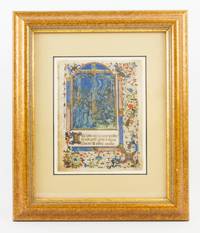
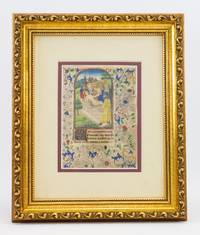
réf. ST19540bSouthern Netherlands Bruges third quarter of 15th century. Matted leaf: 150 x 150 mm. 5 7/8 x 4 3/8". Frame: 307 x 258 mm. 12 x 10 1/4". Single column with four lines below the miniature and the obverse with 17 lines in a batarde hand. Attractively matted and framed the leaf slightly shifted in the mat revealing top and side edges but in no danger of damage. Rubrics in red four one-line initials and three three-line initials all but one in burnished gold on blue and red ground with white tracery the initial beneath the miniature painted pink on a burnished gold ground and filled with painted ivy vines AN ARCH-TOPPED LARGE MINIATURE DEPICTING THE ENTOMBMENT the body of Christ surrounded by seven other people depicted in an outdoor setting with the turrets of a walled city in the background the miniature in a double frame of gold and pink surrounded by A FULL BORDER composed of hairline vines acanthus colorful flowers and gilt bezants and inhabited by a small bird. Minor soiling and a faint thumb print to borders but IN VERY FINE CONDITION THE MINIATURE BEAUTIFULLY PRESERVED. This is a beautifully rendered and deeply touching scene depicting the entombment of the crucified Christ and the pathos experienced by those at his side. Holding the sheet on which the body is lowered into the sarcophagus are on the far left the richly clothed Joseph of Arimathea and on the far right Nicodemus who dons an especially lovely yellow garment with delicate embroidery. Between the two men in the foreground but behind the body are the Virgin Mary who presses the hand of her deceased son to her lips; John the Evangelist whose body is turned toward the Virgin in a gesture of support but whose gaze is focused on the Savior; and Mary Magdalene who holds a small ointment jar. Two other women with halos stand closely behind them consoling one another. The artist has done a masterful job at creating a composition that captures the emotional gravity of the scene: Christ's body gently cradled in a white sheet is on full display with blood still trickling from the wounds on his head and side. Despite there being seven people crowded around him our attention is drawn to the action between Christ and the Virgin who gently grasps his hand with motherly affection and bids him a final farewell. Flickers of different emotions appear on the faces of his followers including pity sorrow stoicism and disbelief--echoing perhaps the viewer's own range of feelings upon viewing this image. The level of detail excellence of composition care seen in the molded bodies and faces and the convincing setting suggest that the artist was quite practiced and that the original manuscript from which the leaf comes was of very high quality. unknown books
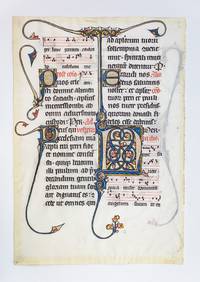
réf. ST20214Northern France perhaps Beauvais or Amiens late 13th or early 14th century. 286 x 199 mm. 11 1/4 x 7 3/4". Double column containing a mixture of staves and text approximately 21 lines in an excellent formal gothic book hand. Attractively matted. Rubrics in red chant text containing black penwork initials with red and yellow geometric elaboration BEAUTIFULLY ILLUMINATED with five two-line initials painted blue or pink with white tracery on a ground in the contrasting color two of the initials filled with grotesques and swirling vines and two with the filler design traced out but never completed each initial with blue and pink extensions terminating in orange leaves or spiky shapes; the verso featuring AN IMPRESSIVE SIX-LINE "N" 58 x 50 mm. in the same style filled with an intricate knotwork design and orange leaves with long extensions including a horizontal extension across the upper margin. Margins with light offsetting of the designs from the facing leaf; remnants of mounting tape on recto corners and bottom edge; verso apparently with a barely visible Medieval "14" in lower margin. An area measuring 5 mm. at edges just faintly yellowed from mat burn but IN FINE CONDITION the vellum otherwise quite bright the paint rich and the gold brightly glittering. This sumptuously decorated leaf--which is beautifully preserved and contains a particularly large and handsome initial--comes from the last volume of a three-volume Missal presented to Beauvais Cathedral by Canon Robert de Hangest d. 1356. The Missal remained at the cathedral at least through the 17th century when it is noted in an inventory but was removed from the church at some point likely in the aftermath of the French Revolution. The parent volume eventually entered the collection of Henri-Auguste Brölemann 1775-1854 of Lyon who passed it to his grand-daughter Etienne Mallet who then sold it at Sotheby's in 1926. It was then acquired for the collection of William Hearst where it remained for the next 25 years. In 1941 it was again sold at auction and subsequently dismembered. Though long thought to have been the work of famed biblioclast Otto Ege recent scholarship suggests that it was actually Phillip Duschnes who was responsible for breaking up the book keeping some leaves for himself and selling others on to his colleague Ege for inclusion in his portfolios of "Fifty Original Leaves from Medieval Manuscripts." The Beauvais Missal has been a subject of interest for many notable scholars chief among them being Christopher de Hamel--see: "Otto Ege and the Beauvais Missal" in "Gilding the Lilly: A Hundred Medieval and Illuminated Manuscripts in the Lilly Library" and it is currently the focus of a major effort to "reconstruct" the manuscript digitally--a project spearheaded by Lisa Fagin Davis. Other leaves from the parent volume are in the collections of the Morgan Library the Metropolitan Museum of Art the Cleveland Museum of Art and the Houghton Library at Harvard among many others. Although there is some dispute among art historians the illumination has been tentatively attributed to the artist of the Hours of Yolande of Soissons produced in Amiens ca. 1280 and now held by the Morgan Library MS M.729. It is worth noting that the town of Hangest home to the original owner is only 10 miles from Amiens and is a likely place of origin for the Missal. The present leaf contains a text for a major feast day and thus contains a large and extravagantly decorated initial for its opening "'Nunc scio vere." It is not too much to say that the decoration here is masterful but curiously--and of special interest to us from a modern perspective--the illuminators seem to have forgotten to put the finishing touches on the two smaller initials above which still contain sketches of the preliminary design. unknown books
1440réf. ST19540aMetz ca. 1440. Leaf: 162 x 124 mm. 6 3/8 x 4 7/8". Frame: 308 x 258 mm. 12 1/8 x 10 1/8". Single column three lines of text under the miniature obverse with 18 ruled lines five of which contain text in a gothic book hand. Attractively matted and framed. Recto with one three-line initial in gold on pink and blue ground WITH A LARGE MINIATURE OF THE CRUCIFIXION WASHED IN BLUE Christ on a painted gold cross flanked by two thieves on painted gold crosses surrounded by throngs of people including the Virgin St. John Mary Magdalene and numerous soldiers all in an arched gold frame inside a three-sided painted and gilt baguette and a FULL BORDER of colorful vine sprays and flowers inhabited by a peacock. See: "The Jeanne Miles Blacburn Collection of Manuscript Illuminations" nos. 29-38; Avril & Reynaud pp. 182 & 190. Minor soiling/browning right at inner edge away from border and image otherwise IN VERY FINE CONDITION THE MINIATURE REMARKABLY WELL PRESERVED WITHOUT ANY LOSS OF PAINT. This stunning miniature with its memorable nocturnal scene comes from a very fine Book of Hours probably executed by Henri d'Orquevaulz or d'Orquevaulx or a member of his workshop. D'Oquevaulz was active during the second quarter of the 15th century in Metz the cultural and commercial capital of Lorraine during the period and the center of a growing book trade. According to the catalogue of the Jeanne Miles Blackburn Collection in the Cleveland Museum of Art which owns 10 leaves from the original manuscript the parent Book of Hours can be localized based on the Lorraine dialect found in the French text on some of the leaves including the present example and because the calendar singled out two bishop-saints of Metz Clement and Arnoul. Although little is known about d'Orquevaulz his dated signature in the colophon of a Livy manuscript that he illuminated for an alderman of Metz indicates that he was active in that city in 1440. Artistic affinities with northern European styles make it possible that d'Orquevaulz had emigrated from the Netherlands or Germany to Lorraine; another possibility one that Avril and Renaud suggest is that the master himself was from Metz but that he had German associates perhaps from the Rhineland area. According to these two scholars the painter's use of large flat areas of colors is more typical of the Rhineland the Netherlands or Bohemia than of France; in any case they praise his "exquisite color harmonies." The artist has outdone himself in the present miniature rising to the height of pathos and making it one of the most extraordinary leaves we have ever offered for sale. In contrast to the bright colors used in Books of Hours even to depict the most serious scenes the present leaf presents a remarkable visual nocturne with the figures and buildings painted in the same shades of blue as the sky suggesting that heaven itself is darkening at the death of Christ. Mary Magdalen kneels at the foot of the cross while St. John supports the devastated Virgin as a soldier pierces the Savior's side with a lance. The miniature is crowded with figures we see well-defined faces of no fewer than 18 persons and two horses but the artist has not lost his dramatic focus as Christ on his cross of brushed gold dominates the scene. In choosing to make this a darkened composition the artist has risked obscuring detail but his skill has been equal to his concept here as he has used a diluted blue paint that allows for a very successful delineation in various shades almost like grisaille this technique not incidentally has prevented the cracking and erosion so commonly seen with the normal thick applications of typical cobalt blue. The result of the decision to show the world in eclipse at Christ's death is to heighten and universalize the drama here to such an extent that the scene leaves a powerful and lasting impression. The text on this leaf is entirely in French in rhyming verse. Roughly it translates as: "Jesus on the cross did hang / And took upon himself our sins / Gave to humankind redemption / Rendered up his soul to God. / The sunshine lost its glowing light / The earth did tremble and did crack / Grieving for the bitter death / Suffered by the son of God." Although the original Book of Hours was dismembered some time in the 20th century extant leaves suggest that its visual program was much bigger than usual and probably the result of an important commission by a wealthy patron--something likely to be painted by one of the chief artists in the workshop. Illuminated manuscripts from Metz--let alone examples of this quality--are uncommonly seen on the market. unknown books
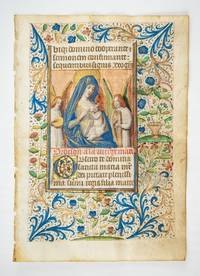
1500réf. ST20810MParis ca. 1500. 165 x 115 mm. 6 1/2 x 4 1/2". Single column verso with 18 lines in a gothic book hand. Rubrics in red one three-line initial in blue filled with foliage on burnished gold ground verso with panel border of colorful flowers a vase and acanthus recto with A MINIATURE OF THE VIRGIN AND CHILD flanked by two angels framed by gold and painted bars on three sides and A FULL BORDER of acanthus flowers a vase and gold bezants. Minor soiling to vellum but in excellent condition the miniature especially well preserved. This especially intimate and tender scene shows the so-called Virgo Lactans or Nursing Madonna the Virgin suckling the infant Christ; it accompanies the text for "Obsecro te" a popular Marian prayer appealing to the Virgin for protection and intercession. The prayer is not always accompanied by a miniature and the present illustration being rather large and skillfully done is a particularly appealing example. The Virgin's facial features are especially excellent with beautiful molding and shading that give her visage deep complexity and emotional resonance. The use of gold in this miniature adds to its richness; delicately highlighted garments tresses and angel wings catch the light and seem to shimmer as one moves the page. The high-quality illumination liberal use of gold and robust borders all suggest that the original manuscript must have been the product of an accomplished workshop. unknown books
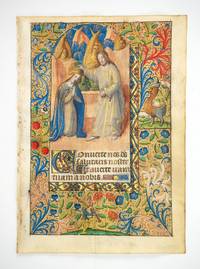
1500réf. ST20810RParis ca. 1500. 163 x 115 mm. 6 1/2 x 4 1/2". Single column 18 lines in a gothic book hand. Rubrics in red line fillers in blue and pink with gold bezant six one-line initials in burnished gold on pink and blue ground two two-line initials in blue on gold ground with a flower in the center one three-line initial in blue filled with ivy on gold ground verso with panel border of colorful flowers and acanthus recto with A LARGE ARCH-TOPPED MINIATURE OF THE CORONATION OF THE VIRGIN with an "L" shaped frame of burnished gold and painted flowers and A FULL BORDER of acanthus flowers a man playing a bagpipe and a hybrid creature wearing a hat all on a painted gold ground. Very minor wrinkling to vellum but the leaf IN LOVELY CONDITION with the gold everywhere gleaming brightly. From a luxuriously appointed Book of Hours this leaf features a handsome miniature of the Coronation of the Virgin attributed to the workshop of Jean Pichore fl. ca. 1502-20 a major figure among illuminators of the period and one of the most sought-after artists in France at the turn of the 16th century. Executed with imagination and delicacy the miniature features the traditional subject associated with the hour of Compline showing the Virgin being crowned Queen of Heaven following her Death and Assumption. The composition here is quite intimate with the Virgin kneeling before her son as she accepts with humility the crown he lays upon her head. Christ is depicted barefoot and slightly bowed toward his mother in a gentle display of respect. The artist creates a wonderful backdrop for this scene composed entirely of seraphim painted gold blue light pink and green closely packed together. Two of the seraphim hold up light pink draperies behind the central figures as if to shield this tender moment from prying eyes. The borders here are a source of delight featuring a figure wearing a jester-like cap and playing the bagpipe as well as a creature with the body of a bird and the face of a human donning a rather fashionable bycocket cap. The illumination here is of high quality features a liberal use of gold and contains unique marginal details suggesting that the original manuscript must have been a costly commission for a wealthy patron. unknown books
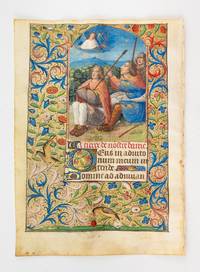
1500réf. ST20810PParis ca. 1500. 165 x 117 mm. 6 1/2 x 4 5/8". Single column 18 lines in a gothic book hand. Rubrics in red line fillers in blue and pink with gold bezant five one-line initials in burnished gold on pink and blue ground one two-line initial in blue on gold ground with a flower in the center one three-line initial in blue filled with ivy on gold ground recto with panel border of colorful flowers vase and acanthus verso with A LARGE ARCH-TOPPED MINIATURE OF THE ANNUNCIATION TO THE SHEPHERDS surrounded by A FULL BORDER of acanthus flowers and two birds all on a painted gold ground. Slight soiling to vellum but a very well-preserved leaf in fine condition. From what was surely a costly Book of Hours this leaf features a charming and skillfully painted miniature of the Annunciation to the Shepherds attributable to the workshop of Jean Pichore fl. ca. 1502-20 a major figure among illuminators of the period and one of the most sought-after artists in France at the turn of the 16th century. Depicting the traditional subject associated with the hour of Terce our miniature portrays as usual an angel appearing to shepherds tending their flock bringing news of the birth of Christ. Although the biblical narrative suggests that the shepherds were startled by the angel's appearance the three figures in this miniature appear remarkably unmoved--in fact only one of them seems to take any notice at all. The first shepherd sits on the ground looking straight ahead; the second holds his hands in prayer but looks little more than well prayerful at the angel in the sky; and a third figure maintains a slightly aloof expression taking no particular interest in the unfolding miraculous event. What may seem to be indifference can be explained easily enough by the artist's successful portrayal of nighttime cold! All three shepherds are thickly dressed one with his arms pressed tightly against his chest another with a hood partly covering his face and the sheep are tightly huddled together into one woolly white cluster. Another manifestation of the artist's success here is seen in the particularly well done molding of the faces with subtle shading attractively rendered features and clear individuation. Moreover although the shepherds seem essentially unmoved their garments are dusted with a glistening gold radiance from above a further subtle touch revealing a high level of achievement on the part of the painter. Finally the borders are one last source of delight with a small bird shown in mid-flight and a second one investigating a single strawberry that seems to have been placed there just for him. All of these indications of sophistication suggest that the original manuscript must have been commissioned by a patron able to pay a premium for the work of a highly skilled atelier. unknown books
réf. DADAX0520221613New unknown
réf. DADAX0520221583New unknown
réf. DADAX0976260832New unknown
réf. DADAX1436886767New unknown
réf. DADAX0451461665New unknown
réf. 2080202103704732Mitsushima Town Hall N.A. Soft Cover. Fine. Page: 302p Image 3p Size: 19cm B6 Mitsushima Town Hall paperback
1996réf. 2090202120413784KMS 1996. Soft Cover. Fine. Number of books: 1 KMS paperback
1985réf. 2091202132702078Izumi shoin 1985. Soft Cover. Fine. The book is in fine condition. Izumi shoin paperback
réf. 2080202103702067Kamo ga wa N.A. Soft Cover. Fine. Page number: 63p Size: 21cm A5 Kamo ga wa paperback
1981réf. 2111902158904188Contemporary Journalism Publishing Association 1981. Soft Cover. Fine. Volume: 1 Contemporary Journalism Publishing Association paperback
1982réf. 2111902158901559Contemporary Journalism Publishing Association 1982. Soft Cover. Fine. Volume: 1 Contemporary Journalism Publishing Association paperback
1981réf. 2111902158903388Contemporary Journalism Publishing Association 1981. Soft Cover. Fine. Volume: 1 Contemporary Journalism Publishing Association paperback
réf. 2091502133536620Hyoron-sha N.A. Soft Cover. Fine. Number of books: 1 Hyoron-sha paperback
1983réf. 2091202133212877Sanseido 1983. Soft Cover. Fine. Volume: 1 Sanseido paperback
1975réf. 2090202120414903Agune 1975. Soft Cover. Fine. Number of books: 1 Agune paperback
1996réf. 2091502134000555Kamogawa Publishing 1996. Soft Cover. Fine. Number of books: 1 Kamogawa Publishing paperback
1991réf. 2091502135421834A meeting to investigate the problem of human bones discovered at the site of the military medical school 1991. Soft Cover. Fine. Number of books: 1 A meeting to investigate the problem of human bones discovered at the site of the military medical school paperback
1978réf. 2110502150312628A meeting to present the record of the atomic bombing to children in the world 1978. Soft Cover. Fine. Volume: 1 A meeting to present the record of the atomic bombing to children in the world paperback
1986réf. 2111902160500952Not Available 1986. Soft Cover. Fine. Number of copies: Meeting to honor the same Not Available paperback