• 33 [The Founder of Zeta Beta Tau Writes About a Proto-Nazi in 1892] Gottheil, Richard, J HBiblio.com

191 569 résultats
1892réf. 43454Washington D.C.: American Oriental Society 1892. 1st separate edition Original printed paper wrappers detached 8vo ccxxix 2 pages; 22 cm. "Reprinted from the proceedings of the American Oriental Society Washington April 21-23 1892." "Paul Anton de Lagarde was a German biblical scholar and orientalist sometimes regarded as one of the greatest orientalists of the 19th century. Lagarde's strong support of anti-Semitism vocal opposition to Christianity his Social Darwinism and his anti-Slavism are viewed as having been among the most influential in supporting the ideology of Nazism." wikipedia. Gottheil "was an English American Semitic scholar Zionist founding father of Zeta Beta Tau fraternity and one of the founders of the Jewish Institute of Religion in New York." He was also "president of the American Federation of Zionists from 1898 to 1904 and worked with both Stephen S. Wise and Jacob De Haas as organizational secretaries. Gottheil attended the second Zionist Congress in Basel establishing relationships with Theodor Herzl and Max Nordau" Wikipedia. SUBJECTS: Bibliography. OCLC: 21968572. Wrappers have grown brown and fragile with expected separation. Internal paper remains bright and strong. Good Condition Thus. BAMR-68-5A-DB. Washington (D.C.): American Oriental Society unknown
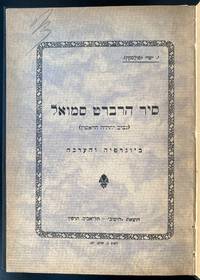
1926réf. 43378Tel Aviv: Hotsa'at "ha-Yishuv 1926. 1st edition. Period boards with original printed paper wrappers bound in 8vo 11 127 pages. Includes illustrations. 22 cm. In Hebrew. Title translates as “Sir Herbert Samuel the First Governor of Judah: Biography and Assessment.” Herbert Louis Samuel 1st Viscount Samuel 1870-1963 “was a British Liberal politician who was the party leader from 1931 to 1935. He was the first nominally-practising Jew to serve as a Cabinet minister and to become the leader of a major British political party. Samuel had promoted Zionism within the British Cabinet beginning with his 1915 memorandum entitled The Future of Palestine. In 1920 he was appointed as the first High Commissioner for Palestine in charge of the administration of the territory” Wikipedia. Poleskin was born in the Ukraine in 1886 and relocated to Palestine in 1905 where he worked on some of the earliest kibbutzim though he found himself exiled to America during the first world war. He returned to Palestine in 1920 and wrote as an overseas journalist for the Forverts. SUBJECTS: Statesmen -- Great Britain -- Biography. Zionism -- History. Hommes d'E´tat -- Grande-Bretagne -- Biographies. Politics and government -- History -- 20th century. Great Britain -- Politique et gouvernement -- 20e sie`cle. Grande-Bretagne --Middle East. OCLC: 19201104. Date stamp on final blank endpaper toning as expected Very Good Condition. B Zion2-4-9-BECCMZZ-'lxgg. Tel Aviv: Hotsa'at "ha-Yishuv unknown
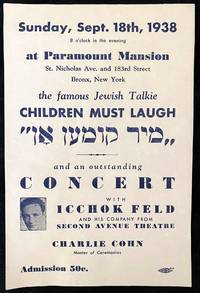
1938réf. 43522New York: No Publisher Paramount Mansion 1938. 1st edition. 5.5x8.5 inches blue on white photographic flyer in English with Yiddish film title. The film title "Mir Kumen On" can be translated directly as "We are Coming" though in the US the title was translated as "Children Must Laugh" and in France and Belgium as "Nous Arrivons." The restored film is viewable online at www.youtube.com/watchv=vozD_XbGHGA and was featured at the Museum of Modern Art's To Save and Project: The 14th MoMA International Festival of Film Preservation in 2016. "A rare record of Jewish life in Poland before World War II this 1936 film Children Must Laugh was produced in several language versions as an international fundraiser for the Medem Sanatorium near Warsaw a clinic sponsored by the General Union of Jewish Workers the Bund that provided care and an escape from urban poverty for some 10000 children between 1926 and 1939. Directed in a Soviet-influenced style by Alexander Ford a committed Communist who later became the head of Poland's National Film School the film follows three children as they gradually overcome their emotional withdrawal and distrust and enter the communal life of the institution" MoMA 2016. Full text: Sunday Sept. 18 1938 8 o'clock in the evening At Paramount Mansion St. Nicholas Ave and 183rd Street Bronx New York The famous Jewish Talkie CHILDREN MUST LAUGH "MIR KUMEN ON" And an outstanding CONCERT WITH ICCHOK FELD AND HIS COMPANY FROM SECOND AVENUE THEATRE CHARLIE COHN Master of Ceremonies Admission 50c. A massive fundraising campaign for the Medem Sanitorium was undertaken in 1937-38 and the film was shown internationally as a way to build support and solicit funds. We were able to locate no copies using OCLC nor with a google search. Apparently an unrecorded promotional flyer for a very important film. Near Fine Condition. Important displayable and exceedingly rare. PBERL-1-10-XX. New York: No Publisher [Paramount Mansion?] unknown
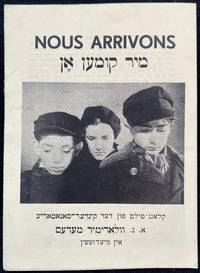
1938réf. 43520No Place Paris: No Publisher The Bund 1938. No Date 1938. 1st edition. Single fold pamphlet 12mo 3 pages. Includes photo on cover & inside. All text in Yiddish. Title translates as "We are Coming. A Sound-Film from the Children's Sanatorium Vladimir Medem in Miedzshin" a neighborhood in Warsaw. Promotional pamphlet for use in France and Belgium and possibly elsewhere for Aleksander Ford's 1936 film re-released in 1937-1938 for fundraising purposes on the children of the Medem Sanatorium entitled "Mir Kumen On" which translates literally as "We are Coming." For the English release of the film the title was instead translated as "Children Must Laugh;" it is viewable online at www.youtube.com/watchv=vozD_XbGHGA. The restored film was featured at the Museum of Modern Art's To Save and Project: The 14th MoMA International Festival of Film Preservation in 2016. "A rare record of Jewish life in Poland before World War II this 1936 film Mir Kumen Onwas produced in several language versions as an international fundraiser for the Medem Sanatorium near Warsaw a clinic sponsored by the General Union of Jewish Workers the Bund that provided care and an escape from urban poverty for some 10000 children between 1926 and 1939. Directed in a Soviet-influenced style by Alexander Ford a committed Communist who later became the head of Poland's National Film School the film follows three children as they gradually overcome their emotional withdrawal and distrust and enter the communal life of the institution" MoMA 2016. From the pamphlet text: "Narrow and dark streets of Greater Warsaw. Crowded and wet attics attics and cellars. 'Apartments' filled with people who lack mother's breasts for the always screaming child. An unemployed father. And - children everywhere many children. Children - withered rickety with crooked legs sunken chests and pale faces they - the children - know all the bitterness of life from a very early age. Often very often they are already 'earners' themselves - in a poor workshop in the street or until late at night they sell th apples and 'hot warm bagels'. And now from this environment the children arrive at the Medem sanatorium: Hanale from the Jewish secular school the pale Zalmanka from Cheder and Laser - the bagel seller. In the beginning everything is strange to them in the 'strange' Medem-Sanatorium: no one punishes no one shouts no one is angry. Everything is friendly to them everyone strives to understand them as their best friend. Joy and freedom mixed with free independent work rule over everything here. And our three heroes quickly got used to the new life-forms. They flourish. They become stronger physically and mentally they actively participate in the work of the 'self-management' of children they begin to understand that the world does not have to be like that as they realized in Warsaw that they can and must be someone else someone free someone equal someone beautiful. The children are taken in by the spirit of true friendship they begin to understand that person's suffering and get an aspiration to help that person. And when their daily newspaper brings news that the coal miners are on strike in Zaglembia that their children are starving they are deeply moved. Because - who can understand better than them what a strike means and feel more than them what is called hunger And at a general meeting the children according to their own proposal give each one a day of their time in the sanatorium so that the 180 children - create 180 days for their brothers in Zaglembia Times flies in the sanatorium. And now we see our 3 'heroes' as they drive off back home. The faces of all 3 are drawn. A deep sadness lies on the young childish faces." Both the pamphlet and the film end with the song "Mir Kumen On"--We Are Coming-the words by Nokhem Yud 1888-1966 and music by Yankl Troupianski 1909-1944. The film's theme song was also used by Camp Hemshekh in New York as its anthem in the 1960s & 1970s. "Everything in the film is factual and authentic. There is not a single artist in the film - everything is performed by the participating children of the Medem Sanatorium." We were unable to locate any copies using OCLC nor with a google search. An unrecorded promotional brochure for a very important film. Near Fine Condition. Very important. Exceedingly rare. PBERL-1-9-XX. No Place [Paris?]: No Publisher [The Bund?] unknown
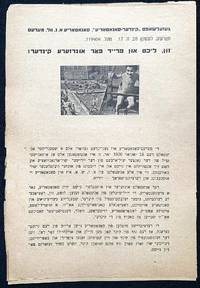
1938réf. 43519Gezelshaft "Kinder-Sanatorye" Sanatorye A.N. Vl. Medem 1938. No Date 1938. 1st edition. Original photographic paper wrappers 12mo 5 pages. In Yiddish. Title translates as "Sun Light and Joy for our Children!" A rare Holocaust-era fundraising brochure for the Medem Children's Sanatorium in Warsaw "the only Jewish Children's Sanatorium in Poland." The 1938 fundraising campaign was accompanied by the re-release with an English-language prologue of Aleksander Ford's 1936 Yiddish-language Film on the children of the Sanitorium entitled "Mir Kumen On." The title translates as "We are Coming" but for the film was translated into English as "Children Must Laugh" and is viewable online at www.youtube.com/watchv=vozD_XbGHGA. The restored film was featured at the Museum of Modern Art's To Save and Project: The 14th MoMA International Festival of Film Preservation in 2016. The Medem Sanatorium was an "Educational and clinical facility for children and young adults at risk for tuberculosis. This sanatorium which functioned in Miedzeszyn near Warsaw between 1926 and 1942 was named after Bundist leader Vladimir Medem 1879-1923 and was the best-known establishment of the Bund and of TSYSHO the Central Yiddish School Organization in Poland. The clinic was funded by donations from Jewish unions in Poland and American Jewish workers' organizations" as well as the Joint Bund Melbourne. The pamphlet describes the harsh realities of life for Jewish children before they come to the Sanatorium reporting that "Up to 75% come from proletarian and working classes" with many coming from homes where 6 7 8 even 10 12 or 16 people live together in one room. "More than 65% of the total number of children do not experience a separate bed. Over 45% of Warsaw's children live in apartments without electricity without plumbing and without sewerage. it is therefore no wonder that tuberculosis is spreading among these children to such a terrible extent. The history and philosophy of the Sanatorium are also described in detail: "The environment and language of education is Yiddish.The healing resources of the Institution are: air sun nutrition good self-esteem of children constant medical and sanitary supervision an atmosphere of rationalism etc. A quartz lamp local pharmacy laboratory red carpet forest dentist's cabinet etc. are available for use by the children. The educational methods of the sanatorium are based on the basic idea that the child's body can be healed and cured only when the self-esteem of the child and his mood are happy and satisfied therefore in caring for the welfare of the weak child his spirit is constantly taken care of. The educational strategies of the sanatorium are: creating appropriate groups of people: raising the cultural level of the children; Encouraging the children to take charge of the institution; bring them closer to nature; develop their aesthetic and musical sense; develop the necessary areas of hygiene acquaint the children with the world and Jewish literature; Develop in them love and understanding for sports; Make the life of the children useful and pleasant." Across multiple buildings and acres of fields and woods the slots for 130 children in the Winter and 200 in the Summer provide access to "the natural history museum a building for chicken breeding.a fruit orchard and a garden with one farm.a toboggan gate skating rink skiing etc. In all these facilities like chickens bees silk breeding etc. the children take an active part." The fundraisers note that as of January 1 1938 7563 children had been served over 21 years-and every year that number is growing with 755 children served in 1937 alone. They explain that while the majority of children come from Warsaw over 1100 had come from the provinces a number which "is constantly growing." The proposal then is for expansion of a property purchased in Warsaw the year prior as well as the development of centers in other Jewish centers in Poland. In the now dystopian year of 1938 the Medem Sanatorium wants to develop these new urban complexes "mainly for children who come back from the sanatorium but their health condition their social situation requires the necessity of continued medical and general assistance and supervision." In this new center in urban Warsaw already "the children spend half a day they receive food medical and dental assistance hygienic and educational supervision help in preparing the school lessons" as well as training in workshops art classes musical auditions a choir etc. are also introduced. "The popularity of this new institution is despite the short time of its existence enormous. Unfortunately we are also not in a position to satisfy even a part of the requests which are constantly growing in number. The management of the sanatorium therefore decided in the near future to establish another similar institution in Warsaw and 3 similar institutions in the province. In the first phase in Lodz Bialystock and Lublin. The economic crisis and the particularly difficult situation in which the Jewish masses find themselves has a grave impact the health condition of the masses of Jewish children" and the center is deluged with "Thousands of messages from parents.This situation demands for the management of theSanatorium A new task: to expand and rebuild the institution in order to to enable additional thousands of children to enter the friendly and joyful walls of the Medem sanatorium." Goals for the coming Spring of 1938 include: "A new pavilion with 100 seats." A sports and play area arranged according to the requirements of the latest medicine and hygiene. The construction of the new building will enable the admission of 230 children in the winter and 350 in the summer." So a fundraising campaign is underway already being "conducted throughout the country and everywhere with great success. Everywhere in all strata of the population it was met with a lot of sympathy with a much warmer and sincere relationship." We appeal to all those who follow these lines of thinking.For the construction of the Medem sanatorium. We know the situation and are clear-eyed about it: the time is difficult and the task to which we set ourselves is not an easy one. But we are sure of its success because this action is an action for the health for the future of our children." We were unable to locate any copies anywhere on OCLC nor using standard online searches. Bottom quarter of the final page is removed-as it is on the one other example of this pamphlet we have examined. This suggests either a tear-off donation coupon or perhaps a removed section referencing a now-passed event. We present this rare pamphlet as "complete as issued." Toning as expected very light edgewear to outer margin about Good Condition. Exceedingly rare. PBERL-1-8-XX. Gezelshaft "Kinder-Sanatorye" Sanatorye A.N. Vl. Medem unknown
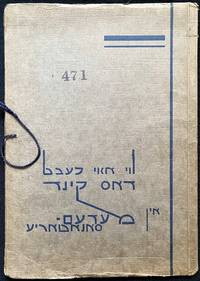
réf. 43517Varshe Warsaw: Aroysgegebn Farvaltung fun Medem-Sanatorye 1932. 1st edition. Original printed stiff paper wrappers with additional rear flap 31 pages. Overflowing with 32 photos on glossy plate paper. 24 cm. In Yiddish. TItle Translates as: "Medem Sanitorium in Miedzeszyn" a neighborhood in Warsaw. Ref: See Dokumenty zycia spolecznego Zydów polskich 1918-1939 w zbiorach Biblioteki Narodowej; page 367. The Medem Sanatorium was an "Educational and clinical facility for children and young adults at risk for tuberculosis. This sanatorium which functioned in Miedzeszyn near Warsaw between 1926 and 1942 was named after Bundist leader Vladimir Medem 1879-1923 and was the best-known establishment of the Bund and of TSYSHO the Central Yiddish School Organization in Poland. The clinic was funded by donations from Jewish unions in Poland and American Jewish workers' organizations" as well as the Joint Bund Melbourne. The Children of the Sanitorium were the subject of Aleksander Ford's 1936 Yiddish-language Film entitled "Mir Kumen On" which translates as "We are Coming" but for the Film was translated into English as "Children Must Laugh." The film is viewable online at www.youtube.com/watchv=vozD_XbGHGA. The film was re-released in 1938 as part of a massive fundraising campaign for the Sanitorium; the restored film was later featured at the Museum of Modern Art's To Save and Project: The 14th MoMA International Festival of Film Preservation in 2016. "In June 1926 a group of 70 children at risk of tuberculosis was accepted for a summer camp. The sanatorium began its statutory operations in September of the same year accepting the first group of 50 patients. The association's board of directors was located in Warsaw at 28 Leszno Street in 1933 at 41 Nowolipki Street. Its most important facility was the complex on Lokalna Street formerly Wiazowska Street in Miedzeszyn. The sanatorium occupied a large area of wooded dunes.The brick main pavilion resembled a large single-story manor house. In front of the façade rose a two-story porch/terrace used for summer meals. The building contained classrooms research laboratories exercise rooms and a dining room. Next to the 'manor house' stood a large partially two-story wooden building with glass verandas designed in the so-called Nadswidrzanski style. It housed dormitories. The sanatorium in Miedzeszyn was designed to accommodate 160 patients which were to be expanded through subsequent expansions. According to its statute it was a medical and educational facility offering classes special interest groups including art clubs and a library. Instruction was conducted primarily in Yiddish. Life at the sanatorium was organized by a ten-member democratically elected children's council. Some of the staff including the head physician Natalia Lichtenbaum-Szpilfogel commuted from the capital. In 1935 the Children's Sanatorium Association applied to the Ministry of Social Welfare for further loans for expansion and renovation. It was emphasized that thanks to the Ministry's subsidies the facility's operations were secured and its most urgent needs were met. However the matter was postponed due to the needs of other institutions which were receiving less assistance than the sanatorium. The Ministry however granted the Association's request to send insured Jewish children to the sanatorium in Miedzeszyn. Correspondence between the Ministry of Social Welfare and the sanatorium indicates that this decision caused dissatisfaction among the insurance company's management. The average treatment lasted 2-3 months and cost approximately 120 zloty per month. Partial discounts were offered for poorer patients and the Social Insurance Institution covered the fees for insured children. This led to conflicts as the institution found it more profitable to treat patients in its own sanatoriums. Obtaining a place at the facility was not a problem both in the interwar period and during the occupation. Between 1926 and 1939 the Miedzeszyn sanatorium treated 7700 children 85% of whom came from the poorest sections of Warsaw's Northern District and approximately 20% from smaller towns. The institution's undoubted success was its educational and pedagogical achievements. The sanatorium collaborated with the Union of Jewish Schools. Throughout the treatment period hygiene schools were run alongside instruction. Children were employed in household chores which served educational purposes but also reduced maintenance costs. The Association of Children-Friends of the Wlodzimierz Medem Sanatorium operated at the sanatorium. During World War II the Miedzeszyn sanatorium was incorporated into the Falenica ghetto. The facility was physically located outside the ghetto but it was also surrounded by a fence and the entrance was guarded by Jewish police. Food smuggling was easier and less expensive here than in Warsaw and the Germans avoided contact with tuberculosis patients which ensured the facility's smooth operation. During the war the facility was financed by subsidies from Jewish charities in Warsaw and Krakow distribution of foreign donations and fees paid by parents usually reduced fees. The situation in the hospitals within the Warsaw ghetto was much more difficult and the Miedzeszyn facility remained virtually the only center for the treatment of Jewish children with tuberculosis. During the occupation the facility was run by Mrs. Zygielbojm wife of Szmul a member of the Polish National Council in London Mrs. Muszkat Dr. Eugenia Gottfryd-Hotwatt Dr. Wolf Masewicki and Dr. Tenenbaum. The staff enjoyed widespread public respect which meant that the Jewish police in Falenica overlooked them during roundups for labor camps and special events. Only indirect data on the results of treatments provided at the sanatorium survive from this period. The young people often recovered despite a low-protein diet which meant returning to the ghetto often destitute where they shared the fate of the ghetto population. After the Jewish district was closed the staff of the Miedzeszyn facility were housed in small but significantly better patient rooms than those in the Falenica ghetto. Living conditions were improved by expanding the vegetable garden raising chickens and rabbits and operating local workshops. For the past year the workers had not received their wages. Just before the "evacuation" some workers already prepared to flee managed to escape. On August 20 1942 the entire Jewish population was deported from Falenica and Miedzeszyn. According to some sources the children from the sanatorium were treated quite well - they were allowed to pack their bags and were not beaten. In contrast at the sanatorium in Otwock the Germans killed the most seriously ill the mentally ill and the doctors who had not left the facility. However we know from elsewhere that the older children were called to a meeting at which teacher Friedman urged them to save themselves by escaping to the nearby forests. Apparently one girl named Hochberg was saved by a Polish neighbor. The remaining 200 children along with the staff were herded by the Germans to a square near the Falenica station where after a day's wait they were loaded onto a train to Treblinka along with a crowd of local Jews. The sanatorium complex existed for several decades after the war. After 1945 it housed a kindergarten then a training center. Demolition took place in 1970 in an attempt to erase traces of the site's past. In 2016 on the 150th anniversary of the establishment of the Wawer commune and the 90th anniversary of the opening of the Wlodzimierz Medem Sanatorium in Miedzeszyn the Emanuel Ringelblum Jewish Historical Institute prepared the exhibition 'GAN EDEN-PARADISE The Medem Sanatorium in Miedzeszyn'" medemsanatorium.wordpress.com/wystawa Translated from sztetl.org.pl See also: - Majewski J. S. Miedzeszyn - sanatorium im. Medema https://warszawa.wyborcza.pl/warszawa/7975964194355.html. - Zablotniak R. Sanatorium Dziecka im. Wlodzimierza Medema w Miedzeszynie „Archiwum Historii i Filozofii Medycyny" 1992 nr 55 z. 3-4 ss. 317-322 - W sloncu i radosci. Dziecko w Sanatorjum im. Wl. Medema w Miedzeszynie Warszawa1933 - Szwarcman-Czarnota B. Niezwykle przedwojenne sanatorium dzieciece w Miedzeszynie online www.polityka.pl/tygodnikpolityka/historia/16620241niezwykle-przedwojenne-sanatorium-dzieciece-w-miedzeszynie.read. OCLC: 15249040. OCLC locates only 5 copies worldwide NYPL YIVO UTexas-Austin Royal Danish Library Ntl Lib Poland none at any Ivy League Institution. Paper and internal binding including photo pages are excellent. Light wear to wrappers small stamp on covers Internally very good Very Good- Condition overall. PBERL-1-6-XX-LEXBFS. Varshe [Warsaw]: Aroysgegebn Farvaltung fun Medem-Sanatorye unknown
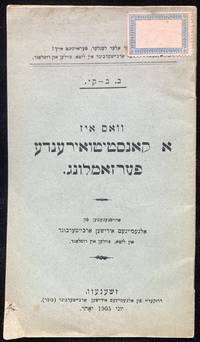
1905réf. 43539Zhenev Geneva: Aroysgegeben fun Algemaynem Idishen arbayterbund in Lita Poylen un Rusland Bund 1905. First edition. Original color paper wrappers 8vo 39 pages. 18 cm. In Yiddish. Title translates as "What Is a Constitutional Assembly" Essay on governmental organization by Boris Benski-Levinson published by the Bund in during the 1905 Russian Revolution during which it was a dominant revolutionary force and "the largest socialist group in the Russian Empire" Mendes Philip. The Rise and Fall of the Jewish Labor Bund jewishcurrents.org November 30 2013. "Levinson-Benski ca. 1880-1923 "was born in Lepel Lepiel Vitebsk district Byelorussia into a poor family.he studied at the Vilna Yiddish teachers' institute and after graduation was 1900-1901 the administrator of a Talmud Torah in Great Tokmak southern Russia.While still in the teachers' institute he joined the Bund. In 1905 the central committee of the Bund summoned him from abroad to Vilna to work with the newly established legal organ of the party Der Veker The Awakener and later Di Folkstsaytung The People's Newspaper. During Passover in 1907 he played a major role at the illegal conference of Jewish teachers in Vilna which ended with the arrest of all the participants. His principal interest lay in the nationality issue and its ramifications in various parts of the Bundist program. He was an adherent of ethnic trade unions of workers wrote articles on national-cultural autonomy Jewish education and the Yiddish language and about the Jewish community among other topics in Bundist dailies as well as in Bundist anthologies.Over the years 1917-1920 he contributed to the Bundist press in Petrograd Minsk and Kiev" Leksikon fun der Nayer Yidisher Literatur. SUBJECTS: Socialism. Jewish socialists. OCLC: 19313587. OCLC locates only 4 copies in North America YIVO UCal LOC Harvard. Minimal institutional marks uncut pages. Very Good Condition attractive. Scarce and important PSB-1-26-XX. Zhenev [Geneva]: Aroysgegeben fun Algemaynem Idishen arbayterbund in Lita, Poylen un Rusland [Bund] unknown
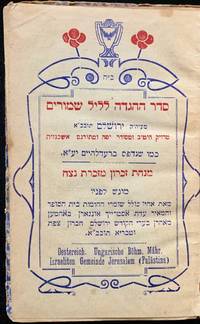
1900réf. 43365Jerusalem: 'Adat Ostrikh Hungarn Bohemen Mahrn be-'are ha-kodesh 1900. No Date ca 1900 Later binding 8vo 41 pages. 15 cm. In Hebrew and Judeo-German and Yiddish. Yaari 2573. Originally published in 1822. Title translates as: “Haggadah Seder; Narrative of the Exodus of Israel from Egypt. ” An edition of the famous Heidenheim German-Hebrew Haggadah published in the Land of Israel around 1900 by the Association for the Austro-Hungarian Bohemian-Moravian Community of Jerusalem Palestine. Heidenheim's German-Hebrew hagadah became the standard hagadah in householdsacross Germany for much of the 19th and early 20th Century. Wolf Heidenheim 1757–1832 is among the most recognizable Jewish publishers and exegetes of the 19th century. In 1798 he received a license to establish a German and Hebrew press in partnership with Baruch Baschwitz. In 1800 Heidenheim began the publication of his most famous work the nine-volume edition of the mahzor Sefer Kerovot Roedelheim 1800–02 which went through numerous printings. The work included the first pure German translation in Hebrew characters of the liturgical poems for the festivals a Hebrew commentary and a literary historical introduction. Heidenheim devoted great care to typographical setup as well as to the restoration of the correct text of the prayers. SUBJECTS: Haggadot -- Texts. Judaism -- Liturgy -- Texts. Passover -- Prayers and devotions. Judaism -- Liturgy. OCLC: 83892178. OCLC locates only 1 copy of this edition or any edition of Heidenheim’s hagadah published in Jerusalem at Harvard. Some wear to edges and spine. Tape on internal spine. Some wine stains throughout. Good- Condition. Rare. HAG-27-4. Jerusalem: 'Adat Ostrikh, Hungarn, Bohemen, Mahrn be-'are ha-kodesh unknown
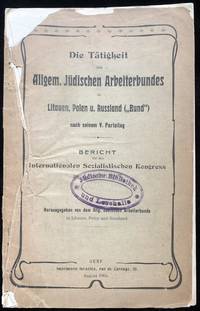
1904réf. 43497Genf Geneva: Imprimerie Israelite 1904. First edition. Original paper wrappers 8vo 31 pages. 21 cm. In German. Title translates as "The Activities Of The General Jewish Workers' Association In Lithuania Poland And Russia." A report from the 1904 International Socialist Congress in Amsterdam covering the activities of the Bund in Lithuania Poland and Russia. The 1904 Conference was a defining event of the Second International. "The International Socialist Congress Amsterdam 1904 was the Sixth Congress of the Second International. It was held from 14 to 18 August 1904. This congress called on 'all Social Democratic Party organisations and trade unions of all countries to demonstrate energetically on the First of May for the legal establishment of the eight-hour day for the class demands of the proletariat and for universal peace.'" Wikipedia SUBJECTS: Jews. International organizations; political; socialist; Second International 1889 -- 1914; congress; reports resolutions proceedings; Amsterdam 1904. OCLC: 37896880. OCLC locates only 3 copies in North America Cornell Yale YIVO none outside the Northeastern US. A bit of edgewear to front cover but binding is good and pages are clean. Good Condition PSB-1-13. Genf [Geneva]: Imprimerie Israelite unknown
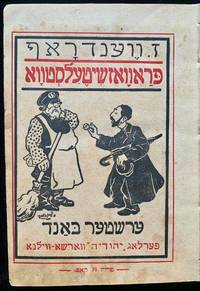
1912réf. 43506Varshe-Vilne Warsaw-Vilnius: Farlag Yehudiah 1912. First edition. Period boards with original color illustrated wrappers bound in 8vo Volume I: 2016201818322420 pages; Volume II: 14201514221418141516 pages 330 pages total. 20 cm. In Yiddish. Title translates as "The Right of Residence: Narratives Stories and Pictures." Humorous stories by Soviet Yiddish writer Zalmen Wendroff with gorgeous cartoon illustrated covers. "Born in Slutsk Belorussia into a family of a ritual slaughterer Zalmen Vendrof commonly rendered Zalman Wendroff received a traditional Talmudic education and studied with private teachers but ultimately failed his secondary school examinations. From the age of 16 he lived in Lodz where he worked at a factory. From the early 1900s Vendrof traveled the world trying different jobs such as peddling teaching and typesetting. His peripatetic youth included a stint in England 1901-1905 a brief spell in Moscow as an English teacher 1905 and another period as a Yiddish journalist in America. In London he became a friend of anarchist leader Rudolf Rocker and wrote for anarchist Yiddish periodicals. .In 1908 Vendrof returned to Russia where he replaced Philip Krantz as Warsaw correspondent for Morgen-zhurnal Morning Journal the second-largest New York Yiddish daily. He lived in Warsaw until 1915 contributing to the Yiddish newspapers Haynt Today and Idishes tageblat Jewish Daily. He became one of the best-selling Yiddish prose writers and a number of his works were translated into Russian. His 14 titles many of them from the cycle Pravozhitelstvo Right of Residence were published in Warsaw and Vilna in 1912 and 1913 this work. His critical portrayals of life in the Pale of Jewish Settlement had a strong if short-lived resonance among Jewish and Russian readers and were quoted in the Russian Duma's polemics" YIVO. SUBJECTS: Yiddish wit and humor. Short stories Yiddish. OCLC: 41893717 Ex-library with some markings staining and foxing throughout. Good Condition. YID-48-119-'mexlccgg. Varshe-Vilne [Warsaw-Vilnius]: Farlag Yehudiah unknown
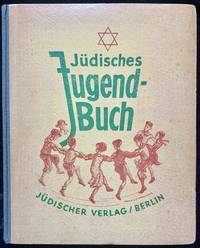
1935réf. 43481Berlin: Judischer Verlag 1935. First edition. Original printed boards 4to 108 pages includes illustrations 21 cm. Text in German. Title translates as "Jewish Youth Book." Nazi-era German Jewish children's publication "The Jüdischer Kinder und Jugendkalender series was designed to educate German-Jewish children about Jewish culture and traditions in a playful manner. It aimed at fostering a positive and confident German-Jewish identity. From its first appearance in 1928 the almanac enjoyed great popularity amongst German-Jewish families. In its early editions the publication presented German-Jewish culture as part of German culture. This presentation changed dramatically after 1933. Cohn's compendium of texts presented the reader with a diverse scope of literary genres and included interactive elements alongside traditional biblical stories children's plays factual texts music and poetry written in German as well as Hebrew. The volumes also featured riddles humorous texts photographs crosswords and last but certainly not least beautiful illustrations. The almanac introduced the young reader to diverse layers of Jewish history and culture ranging from Jewish magicians to adaptations of Chassidic stories as well as reflections on the history of Jewish surnames. .The ascent of National Socialism however led Cohn to change the content of his almanac. This shift is evident in the 1934 edition with the appearance of texts on subjects such as emigration." Leo Baeck Institute. SUBJECTS: Jewish almanacs -- Germany -- Juvenile literature. Almanacs Children -- Germany. Jewish almanacs. OCLC: 6959967 Very Good Condition. Excellent Copy. BK YID-48-108-GG-'mexlcc. Berlin: Judischer Verlag unknown
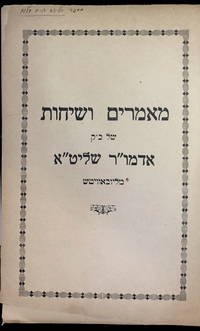
1934réf. 40226Riga and Varsha: No Publisher 1934. Hardcover. 1st edition. Original boards. 8vo. 26 62 32 52 28 8 18 20 25 24 11 56 15 pages. Includes 15 parts in one volume. 24 cm. In Hebrew. Title translates as "Articles and Conversations with the Rebbe from Lubavitch." A collection of homilies from the sixth Lubavitcher Rebbe from the interwar period. Contents include: --2 Derushe hatunah 689 --10 Ma'amre Hasidut Riga 691 --11 S´ihot Admor shlita bi-se'udat S´imhat Torah ve-19 Kislev 691 --12 Ma'amarim shel Admor shlita li-lemod ba-rabim be-yom 2 Nisan 691 --13 Kuntres Ma'amarim ve-s´ihot 3 ma'amarim she-ne'emru be-Lita 691 --14 Ma'amarim le-limud ba-rabim bi-yeme hag ha-ge'ulah 12-13 Tamuz 691 --15 Kuntres Ma'amarim ve-s´ihot 691 --16 Kuntres Ma'amarim ve-s´ih'ot 692 -- 17 Ma'amarim le-limud be-rabim be-yom 2 Nisan 692 --18 Ma'amarim le-limud be-rabim bi-yeme hag ha-ge'ulah 12-13 Tamuz 692 --23 S´ihah bi-seudah de-yom 2 de hag ha-Shavuot 693 --24 Ma'amarim shel Admor shelita le-limud be-rabim be-yom 2 Nisan 694 --25 Ma'amre Hasidut Riga 694 --26 Ma'amarim le-limud be-rabim bi- yeme hag ha-ge'ulah 12-13 Tamuz 694 --27 Ma'amre Hasidut Varsha 694. Joseph Schneersohn 1880-1950 was the sixth Rebbe of the Chabad Lubavitch chasidic movement and "was one of the most remarkable Jewish personalities of the twentieth century. In his seventy years he encountered every conceivable challenge to Jewish life: the persecutions and pogroms of Czarist Russia Communism's war on Judaism and melting-pot America's apathy and scorn toward the Torah and its precepts. The Rebbe was unique in that he not only experienced these chapters in Jewish history - as did many of his generation - but that as a leader of his people he actually faced them down often single-handedly and prevailed. The young Rabbi Yosef Yitzchak in full-length chassidic garb was a familiar figure in the receiving rooms of the government officials ministers and nobles of Moscow and Petersburg. He demanded the repeal of anti-Jewish decrees the stopping of pogroms and the cessation of the government's program of forced 'enlightenment' of traditional Jewish life." His father appointed him the first executive director of the first Lubavitch Yeshivah; "It was there in the hamlet of Lubavitch in pre-soviet White Russia that Rabbi Yosef Yitzchok trained the army of the faithful torchbearers who under the impossible conditions of the decades to come would literally give their lives to keep the flame of Jewish life ablaze throughout the Soviet Union. Upon his father's passing in 1920 Rabbi Yosef Yitzchak assumed the leadership of Russian Jewry just as Communism's all-out war on Jewish life was moving into high gear. He dispatched teachers and rabbis to the farthest reaches of the Soviet Empire establishing a vast underground network of schools mikvaos and lifelines of material and spiritual support. In 1927 he was arrested beaten sentenced to death and exiled; but he stood his ground and by force of international pressure he was finally allowed to leave the country. But in leaving the boundaries of the Soviet Union he left his emissaries and their infrastructure of Jewish life behind. When the all-powerful communist regime began to crumble in the closing years of the '80s Rabbi Yosef Yitzchak's network of children's schools outreach centers and supply lines of kosher food and religious services simply moved out of cellars and attics into emptied Communist Party buildings. Upon arriving in New York after his rescue from Nazi-occupied Warsaw in 1940 Rabbi Yosef Yitzchak took on a no less formidable challenge: the frigid spiritual atmosphere of the western world. There was no telling Rabbi Yosef Yitzchak that his was a losing battle; from his wheelchair he rallied the Jewish young of America under the cry that 'America is no different' that also in this bastion of materialism the timeless truths of Torah can take root and flourish. He established yeshivas and day schools a publishing house for Jewish books a social service organization and community support networks throughout the country. By the time of his passing in 1950 he had laid the foundation for the global renaissance of Torah-true and chassidic-flavored Jewish life heralded by his son-in-law and successor Rabbi Menachem M. Schneerson" Chabad 2018. SUBJECTS: Hasidism. Habad. OCLC: 40404938. OCLC lists 2 copies worldwide JTS Harvard. Boards are worn and chipped. Pages are toning all contents are very good. Overall Good Condition. Rare especially as a complete set. BER-1 RAB-64-65. Riga [and] Varsha: [No Publisher] hardcover
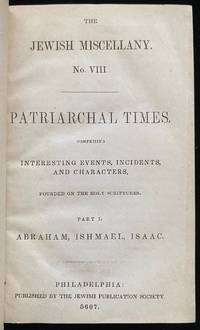
réf. 42790Philadelphia: Jewish Publication Society 5607. 1st Jewish Publication Society edition with new preface by "The Committee" Probably Isaac Leeser. Period cloth 16mo small vi 108 pages. Singerman 0994. Rosenbach: American Jewish bibliography; 612 633. Comprises Nr 8 of "The Jewish Miscellany. " Includes Part 1 Abraham Ishmael Isaac but not Part 2: Jacob Esau Joseph Benjamin would be pages 110-319. One of the few publications from the first Jewish Publication Society founded by Isaac Leeser and which lasted only 3 years from 1845-1848. No copies appearing at major auction in the last century. SUBJECTS : Patriarchs Bible -- Fiction. OCLC: 970980302. OCLC-Worldcat lists only 6 copies worldwide Penn HUC AJHS YU Temple Princeton. Jewish institutional bookplate period paper label on front board wear to blank inside rear cover internally clean and nice Good Condition. KH-9-8A-DB. Philadelphia: Jewish Publication Society unknown
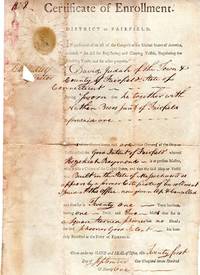
1791réf. 43559Fairfield CT: Port of Fairfield 1791. Single sheet printed on front manuscript content on both sides.A 1791 Certificate of Enrollment for David Judah of Fairfield CT. Judah was a Fairfield merchant who had fought in the American Revolution in Capt. Gregory's Company Connecticut Line 1776 a member of the first Jewish family to settle in Westport Connecticut. His home still stands in Westport see connecticutcreativeplaces.org/places/david-judah-house. Capt. Gregory's Company was a military unit belonging to the Connecticut Line during the American Revolutionary War. It was a part of the Continental Army made up of regiments raised by the state of Connecticut for service under George Washington. A "Certificate of Enrollment" at a port is an official maritime document issued by a customhouse or port collector that formally registers a commercial vessel for domestic coastal trade or fishing. It proves a ship's nationality ownership and legal right to engage in domestic trade or commercial fishing along a country's coasts and internal waters. Family History: Baruch Judah arrived in Colonial America in 1715 and "presumably brought over his relative Rabbi David Judah from England; Rabbi David arrived in New York City by 1750 and.moved with his wife and son - also named David - to Connecticut where he began both his own prolific family and a famous line of descendants. From David's line alone his descendants included: Michael Judah a pre-Revolutionary merchant in Fairfield; David Judah signer of this document a Revolutionary War soldier in Captain Gregory's Company in the Connecticut Line;.Henry Moses Judah a West Point graduate and classmate of Ulysses S. Grant a hero of the Mexican War and a Brigadier General in the Civil War who whipped the forces of the Confederate General Morgan; and Theodore Dehon Judah one of the engineers who designed America's first transcontinental railroad. When Loyalist fever gripped New York and Revolutionary fervor spread across New England many New York Jewish families with Revolutionary minds such as the Myers' the Mearses and the Simsons headed for the Connecticut border to settle in more "patriotic" places - like Norwalk. There they were greeted warmly by none other than Michael Judah jr. our signer's brother now a Connecticut Yankee "old timer." When the elder Michael our signer's father died in 1786 he left his son Michael only five pounds sterling and the rest of his estate to Shearith Israel in New York - where he is buried - and to the Jewish widows and orphans of that city" /www.jewishledger.com/2012/05/jewish-american-heritage-month-keeping-it-jewish-in-colonial-america/ For more on the Judah family see also: www.kaplancollection.org/item/legal-document-david-judah-justice-of-the-8ba0e9dc/jewishvirtuallibrary.org/norwalk-and-westport This document ls also signed by Jedediah Huntington. After the Revolution Huntington was one of the first members of the Board of Foreign Missions and a zealous supporter of charitable institutions. He was an original member of the Society of the Cincinnati. In 1788 he was appointed high sheriff of New London and later the same year the following announcement appeared in the papers: "Major General Huntington Esq. Vice President of the order of Cincinnati High Sheriff for the county of New London Judge of Probate for the district of Norwich first Alderman of the city of Norwich one of the representatives of the town in the State Legislature and one of the State Electors is now appointed by the General Assembly Treasurer for the State of Connecticut." Later in 1789 he relinquished most of these duties when President Washington appointed him to be the Customs House Collector for the coastal area from the Connecticut River to Rhode Island. He held this post living in New London until his death in 1818 It is further signed twice by Samuel Smedley. A Ship's Captain and Privateer during the Revolution from Fairfield CT. At age 15 Smedley was already at age 15 the captain of the Defence as a lieutenant of the Marines. He was best known for capturing the British ship Cyrus. In his career he captured or aided in capturing more than a dozen prizes survived shipwreck battled Loyalists off the shore of Fairfield twice captained Privateers and was twice captured by the British yet was able to escape from the infamous Mill Prison in England. Wear at folds and light staining as expected. Cancelled with small cutout near seal see photo as is also commonly found. Good Condition. A rare original document from 18th Century Jewish New England. PSB-2-2. Fairfield, CT: Port of Fairfield unknown
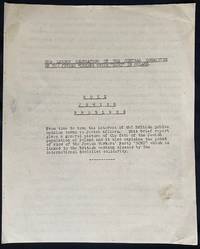
1945réf. 43528No Place London: No Publisher London Delegation of the Bund 1945. No Date 1945 1st Edition. Original Stapled Paper Wrappers Small 4to 17 pages. Mimeograph production. Early 1945 Bundist report aimed at the British public on the impact of six years of Nazi extermination policy on Polish Jewry. "From time to time the interest of the British public opinion turns to Jewish affairs. This brief report gives a general picture of the fate of the Jewish population of Poland and it also explains the point of view of the Jewish Workers' Party 'BUND' which is linked to the British working classes' by the international Socialist solidarity" From the front cover. This early 1945 report to the British public on the destruction of and resistance by Polish Jewry lays out the brutal numbers and facts of ghettoization and then extermination as well as a detailed history of Bund-led Jewish resistance to the Nazis and to deportations to the camps. The mimeograph production and many typographical errors lend a kind of open authenticity to the document that of exiled Jewish trade unionists addressing their British comrades in England. It begins: "The Jewish nation has borne tremendous sacrifices in this war. Several million Jews have been first tortured in a sic inhuman manner and then murdered - several millions that is many times more than the losses suffered by the much more numerous communities of the British Empire and the United States put together. Polish jews sic suffered the greatest losses. There were nearly three and half millions of them living in six hundred Polish cities and towns not counting villages. First they were deported by the Germans to the few ghettos established by them in Poland. Soon afterwards the ghettos were emptied in turn and their 'deported' population was murdered in extermination camps and death chambers." The publication lists the figures for "the ten biggest ghettos of Poland" noting that "In these towns alone the Germans murdered more than one million Jews. Incidentally in all of them with the exception of Cracow Lwow and Czestowchowa 'Bund' was the dominant Jewish party. Out of the nearly three and half millions of Polish Jews there is only a small fraction left today. A small number of survivors have been saved from death by the victorious advance of the Soviet Army. The remainder of the Jews who are still alive under the German Occupation are either in concentration and forced labour comps or in hiding among the Polish population with whom they are fighting in the ranks of the underground movement. Those survivors address to us constant appeals for help and rescue." The solution at this point in the war is that "We must - and our brothers in Poland demand it - we must put such fear into the Germans that they stop the murders of Jews and all the other people whom they still hold in their weakening clutches." The authors are careful at this point to be clear that they do not see Zionism and the immigration of surviving Jews to Palestine as the goal for survivors and post-War Jewish life. They demand immediate assistance and reparations for survivors the criminalization of all antisemitic activity which "should be considered as an attack against the fundamental principles of democracy" and the reconstruction of Jewish life under Socialism in the countries where Jewish refugees now find themselves or in their countries or origin. "Immigration should be free and should not be regulated according to the nationality or religion of the emigrant. Any attempts at presenting the emigration of Jews as a separate problem and considering it as a means of solving the Jewish question always lead to anti-Jewish discrimination." .PALESTINE. does not offer a solution of the Jewish question. Even if one takes into consideration that millions of Jews have been murdered the present Jewish population of Palestine comprises at the most 5% of the number of Jews all over the world. Palestine does not solve the question of anti-semitism either. The majority of Jews will remain dispersed in many countries and in those countries the Jewish question will have to be solved on the spot and anti-semitism extirpated. Palestine is a country of the Jews living there and of the non-Jews who are her inhabitants. We believe that in the same way as we wish to see it in other countries in Palestine also the Jewish minority should build its future on a collaboration with the non-Jewish majority having at the same time a guarantee of a full equality of rights and a complete freedom of its own national and cultural development. We are not a homeless people. The home of the Jews is in the countries in which they live and with which they are linked by many ties. In the same way as for British Jews Britain is their homeland to which they are attached and which they do not want to give up and for American Jews the U.S. A. and French Jews France so for Polish Jews their homeland is Poland. The attitude towards Jews in various countries should be based on the principle that a country is a common homeland for the whole of its population irrespective of origin and religion. The fate of the Jewish population is irrevocably linked to that of the countries it inhabits. It means for the Jews in every country the necessity of fighting for the country's freedom prosperity progress and development as these are a condition of the Jews' own freedom prosperity progress and development. For us as a Labour Party of the Jewish population of Poland it means a fight for the freedom and independence of our country that if sic is of Poland and the building of her future and at the same time the future of Polish Jews on democratic and Socialist principles." The authors then outline the long history of the Bund's underground resistance work against the Nazis" including much on the Warsaw Ghetto Uprising. "In its activities which started on the first day of the occupation the 'Bund' collaborated with the Polish Workers' Underground Movement in the same way as before the war it collaborated with the Polish Socialist Party" including work within the trade union movement and among Jewish youth including 'regularly publishing our clandestine papers eight of them appearing every month.' To achieve this aim fighting detachments of the party were being developed and the whole organisation which from the very first has been proclaiming the idea of an armed struggle against the occupier began to prepare to oppose the 'deportations' to the extermination camps by an armed action. In October 1942 began the last phase of these preparations. The 'Bund' underground movement and the so-called Jewish National Committee an organisation comprising various Zionist groups got together and while preserving their political differences established a Co-ordination Committee and the joint 'Jewish Armed Resistance Organisation' Z.O.B. From that time onwards the armed struggle of the Jewish population in Poland has been led by this resistance organisation. In January 1943 the streets of the Warsaw Ghetto were the scene of the first armed engagement which lasted for several days.Space does not allow us to tell the full story of this rising which in any case had better be written in Poland and not abroad. According to our latest reports from Poland those few remaining survivors of the rising in the Warsaw Ghetto have been writing the story of the events in which they have taken part. After this rising fürther acts of Jewish armed resistance were reported from Poland;" these further acts are then listed and include: "BIALYSTOK In this city the Jews who before the war had been strongly under the influence of the 'Bund' put up a fierce resistance when the Nazis began to liquidate the ghetto in mid- August 1943. The armed rising lasted a month and was conducted with remarkable heroism. TREMBLIN sic This death camp where the Nazis had murdered hundreds of thousands of Jews was completely destroyed at the beginning of August 1943 by the Jews who were there at the time. They attacked the German guards and killed the entire Nazi unit thirty men strong. They seized the ammunition set fire to all the camp buildings and damaged electric cables. Afterwards two hundred Jews escaped to the neighbouring forest. u>SOBIBOR Heroism characterising the Tremblinka revolt marked also the rebellion of Jews at another extermination camp at Sobibor. The Jews revolted there in October 1943 and a large number of them escaped from the camp. General strike in the Lódz ghetto. In February 1943 a general strike broke out in the Lodz ghetto because of German executions. The strike was successful and the executions ceased. MAY DAY 1944 The few survivors of the 500000 Jews of the Warsaw Ghetto who had found refuge among the Polish population the 'Aryan' quarters of Warsaw have not ceased the struggle. Members of the Jewish Workers Movement in Warsaw and in other parts of Poland have even succeeded in organising this year special May Day celebrations. In Warsaw alone five armed Jewish May Day meetings took place." Additional battles between the Jewish-Polish underground and Nazi forces are described as well as underground Jewish resistance newspapers-including one still publishing several thousand copies per issue "distributed in Warsaw and in the provinces" in early 1945. "According to other reports the Jewish survivors of Warsaw organised themselves in fighting detachments. One detachment was named 'Michal Klepfisz' after the hero of the 'Bund' one of the leaders of the rising in the Warsaw ghetto.This detachment distinguished itself particularly during the severe fighting with the Germans for the Old City quarter of Warsaw. General Bor the Commander of the Warsaw uprising gave the detachment special recognition and stated that it alone had killed three hundred Germans and captured a large amount of German arms and ammunition. The other Jewish detachment was fighting under the name of 'Berek Joselewicz' well known historical figure of the Kosciuszko insurrection in Poland in 1794. This detachment took part in the siege and occupation of the main Warsaw post office building. General Bor reported that this Jewish detachment captured more than hundred Germans. 'Even now' it would be difficult to find words which would testify better to the continuity of action and of the struggle waged by the Jewish Workers' Movement irrespective of circumstences sic. After three battles in Warsaw after the slaughter of millions of Jews and the loss of the most valued comrades this movement is still fulfilling its difficult task of fighting th oppression and bringing help to the victims of the Germans." The publication gives a brief introductory history of the Bund appropriate for a British reader which events from the recent past such as: 1936. 'Bund' organised a political strike to protest against anti-Jewish riots which took place in the little town of Przytyk. Hundreds of thousands joined the strike which was supported by many Polish Socialists and by workers organised in Polish Trade Unions. 1938-39. During the municipal elections the majority of the Jewish population in the big cities and in many towns of Poland voted for 'Bund'. In Warsaw out of twenty Jewish municipal councillors 17 belonged to the 'Bund' and only three represented other parties. Finally the authors offer other details about the Bund its strength its publications and its various cultural and political activities concluding with great impact with a description of the "well known Medem Sanatorium for children at Miedzesyn near Warsaw.The sanatorium remained open until 1942 when the Germans 'deported' all the children to extermination camps. The sanatorium's staff were allowed to choose between staying at their posts or accompanying the children. They all chose the latter and together with the children left by a death-train for the notorious Treblinka Camp." OCLC: 504396338. OCLC locates only 1 copy worldwide British Library none in North America or Israel. Light wear and toning very well preserved Very Good Condition. Rare and important. PBERL-1-12-XX. No Place [London]: No Publisher [London Delegation of the Bund] unknown
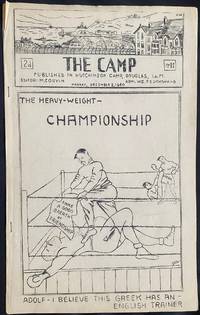
1940réf. 43530Hutchinson Internment Camp Isle Of Man 1940. 1st edition. Original Mimeographs with staples legal size 4to 7 double-sided leaves. Includes essays stories poetry and camp news with most creators identified only by their initials. This issue features a cover cartoon of a boxing ring with Hitler trying to revive a KO'd Mussolini a victorious "Greek" boxer in the other corner assisted by his coach. The cartoon references the Greek military expulsion of Fascist Italy from Greece in November 1940. The title reads "The Heavy-Weight-CHAMPIONSHIP Adolf- I believe this Greek has an English Trainer" "The Camp" was a newsletter produced by the inmates of Hutchinson Internment Camp in Douglas Isle of Man. Hutchinson was one of several prisons established during World War II on the Isle of Man to intern Britain's enemy aliens. Hutchinson in particular was known for its "artistic" inmates many of whom were well known such as Kurt Schwitters and Fred Uhlman. See: Chappell Connery. Island of Barbed Wire. London: Hale 1984; en.wikipedia.org/wiki/Hutchinson_Internment_Camp Contents include: - "Freedom continuation" an essay by Ulli Hirsch This was his copy - "Peter feeds pigeons and seagulls" by Peter Zlunder with illustrations by "DOL - "Behind the Scene" by O.H. Scholz an explanation of how the camp canteen operates - "Camp Officials Outing" by M.C. about a "guarded" outing through the area villages and countryside - "The Stars Look Down" by H.F.A: "One of the things Internment did not take away from us nay which it gave to us in an improved condition is the spectacle of the nightly sky." - "Going to it" by H.F.A. A bit of camp news about a new laundry work on a new hall etc. - "Punsh for children" by M. Corvin a short Punch and Judy play which was going to be performed but "had to be cancelled." - "Barbed Lyric" by K.E.H. A poem about an artist's barbed-wire sculpture - "Epilogue" by K.E.H. A poem about an art exhibition at the camp with illustrations by G.K. Indeed the camp's most famous resident was dada artist Kurt Schwitters; another issue we have examined Issue Nr. 8 includes a front page announcement of the second Art Exhibition which will include "The Story of the Flat and Round painted by Schwitters." One online essay on Schwitters' time at Hutchinson Camp see fampeople.com/cat-kurt-schwitters_6 suggests he contributed an article to the "The Camp" in December 1940-possibly this issue-but we could not locate the article. Scarcity: We located only one listing on OCLC which at first glance appears to list actual holdings OCLC: 613336283 at 2 libraries in Germany. However a note in the record indicates "Repr.: London: Wiener/ Hrsg.: Freimut Schwarz" seemingly an indication that these are reproductions from the Wiener Library in London. OCLC lists 2 other digital/microfilm holdings as well at LBI & USHMM; an examination of the USHMM online catalog suggests they have a few original issues though it is unclear which ones; this issue Nr 11 is not listed. In addition the Wiener Library's online catalog not listed in OCLC shows that they do hold six later issues which they have also issued as microfilm Nrs. 18-23 and not including this issue. Very Good Condition. Rare and Very Important. PBERL-1-13. Hutchinson Internment Camp, Isle Of Man unknown
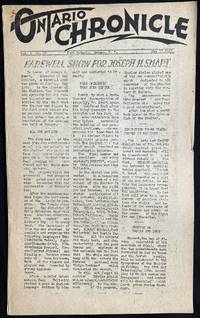
1945réf. 43532Oswego N.Y. : Fort Ontario Fort Ontario Emergency Refugee Shelter 1945. 1st edition. Original stapled mimeograph sheets. 4to Legal Size 6 pages. In English with German and "Yugoslavian" Bosnian Summary pages !. On June 12 1944 after the liberation of southern Italy Pres. Roosevelt established a temporary haven for 1000 European Jews and other refugees at Ft. Ontario near Oswego N.Y. With the help of the National Refugee Service they published their own periodical the Ontario chronicle. Stories include: -Farewell Show for Joseph H. Smart -Exhibition to be Transferred to New York Refugee Art Exhibit -Chevuot on May 18 and 19th -Day of Prayer at the Shelter -Spring Concert -Six Refugee Students to Graduate in June from Oswego High School -The Chess Club Now at the Yugoslav Club -Czechoslovak Jews at Terezin A resident has a list which can be checked for friends and family -Refugees Participate in Methodist Church Program in Oswego -Considerable Interest for Cultural Films Presented & discussed weekly -After the German Defeat -Books Recommended -Jewish Music Week "The Fort Ontario Emergency Refugee Shelter also known as 'Safe Haven' located in Oswego New York was the first and only refugee center established in the United States during World War II. From 1944 to 1945 the shelter housed 982 refugees from Nazi-occupied Europe of whom 912 were Jewish and the others were not. The effort was called "Safe Haven". The refugee shelter is now the Safe Haven Holocaust Refugee Shelter Museum. The shelter was established by the War Refugee Board. Including non-Jewish refugees was a way for the Roosevelt Administration to make the project palatable to the American public. Fort Ontario.At various points.was a British fur trading post then an active military post for the US Army.then an educational camp for people who were illiterate before finally being closed on March 15 1944. Oswego New York which had benefited from the revenue that came from the soldiers at the fort sent a delegation to Washington D.C. to ask for the fort to be reopened. The answer was to reopen the fort as a Refugee Shelter. The War Refugee Board WRB was responsible for creating the camp selecting the occupants and the overall policy until the closure of the camp on June 6 1945. While creating and implementing their policies the War Refugee Board always kept in mind the possible influence of the Fort Ontario Emergency Refugee Shelter on other larger refugee concerns. The War Relocation Authority.had been responsible for formulating and implementing policies in the Japanese Relocation Centers. During the 1930s and '40s there was a large amount of antisemitism and opposition to immigration in the United States with a poll in 1943 showing that 78% of American opposed letting in refugees while several polls between 1940 and 1945 showed 31-48% of American sympathized with or supported antisemitism. This viewpoint was opposed by Jewish groups several Christian groups the YMCA many in the media and many politicians. To appease the latter groups while not upsetting the former too much President Roosevelt decided to set up a small refugee camp which was just a token concession and not a significant change in policy. On June 12 1944 the Fort Ontario Emergency Refugee Shelter was established in Oswego New York by order of President Franklin D. Roosevelt and was operated by the War Relocation Authority. It was the first and only refugee center established in the United States. In August 1944 the shelter received 982 refugees of whom 93% were Jewish with the majority of the rest being Greek with the majority of the remainder being Catholics the group consisted of 369 Yugoslavians 237 were Austrian 146 were Poles 96 were German 71 were Czechs the rest came from other groups. A big concern with the establishment of the camp was the issue of immigration. However President Roosevelt made clear that immigration laws were not going to be ignored. The refugees would merely be in the United States not citizens of the United States. They would have no visa status. President Roosevelt also assured Congress that the Army would not permit any refugee escapes. Initially plans were made to install spotlights along the existing 6-foot chain-link fence as well as having 150 armed guards around the camp perimeter. Neither of these measures were implemented. Because of their immigration status as "guests" the refugees would not be able to work and they would not be allowed to travel beyond Oswego. When Germany surrendered on May 6 1945 twenty-four days after President Roosevelt's death the question of what to do with the camp became a pressing issue. Internment was becoming increasingly difficult to support. The problem was whether to return the refugees to their home countries or to admit them into the United States. Most of the refugees wanted to stay. In fact 60% of them had active immigration cases pending. A subcommittee voted to close the camp and the shelter was closed in February 1946. Some refugees chose to return to Europe whether to find family members or under the impression that their homes and businesses still remained as they had left them. Some were desperate to remain in the United States and not return to a country where they believed they had no future. Those from Central and Eastern Europe did not want to return to their countries that were now under Soviet occupation. Many were granted permanent or temporary status and allowed to stay in the country sometimes ending up in the homes of family or friends. Others would later start a new life in newly formed Israel in 1948. When it came to selecting the refugees who would be permitted to come to the United States there were special criteria established by the WRB and President Roosevelt. Special Representative Leonard Ackermann along with Ruth Gruber a reporter traveled to Italy to conduct the selection and then bring those selected to the port at Naples. The criteria established for the refugees were that they should be refugees for whom no other havens were available. Roosevelt also stated that the group should include mostly women and children - able-bodied men of military age would not be included - along with a couple rabbis half a dozen doctors and enough skilled workers to maintain the camp. Pregnant women who were in their third trimester could not be let onboard the ship because there were no facilities in the likely event the latter was to go into labor. Some women made an effort to hide their pregnancy in order to get into the ship. Refugees who had fled Yugoslavia who were communist sympathizers or had political ties to Josip Broz Tito were not allowed. Only those who swore loyalty to Yugoslavia's monarch Peter II and wanted nothing to do with Tito Joseph Stalin and the Communist Party were accepted. Upon arriving at Fort Ontario many of the refugees were surprised scared and angered to see that the fort was surrounded in barbed-wire topped fences. They felt that they had left Europe expecting to be brought to safety and freedom but had instead been brought to another concentration camp. For the first month the refugees were not allowed to leave the camp. Even relatives who had traveled to Oswego were not allowed to enter the camp and they had to visit with their relatives through the chain-link fence. Some local citizens from Oswego visited the camp to welcome the newcomers passing sweets and gifts through the fence and people from Syracuse Utica Tupper Lake Sackets Harbor Mexico Rome Poland Russia Frankfort Ilion Watertown and Queensbury of Jewish Catholic or Protestant descent came to give parcels or donations of clothes food and even toys for the children. In the Fort Ontario Emergency Refugee Shelter there were 496 "units" which are defined as either families or unaccompanied individuals. The refugees had undergone great trauma and as a result needed to recuperate. Nearly 100 of the refugees had been imprisoned in Buchenwald or Dachau which some managed to escape. Of the 982 refugees that lived in the refugee camp at Fort Ontario 187 were under the age of 16 and 116 were over the age of 60. A large majority of the group was Jewish while others were Roman Catholic Protestant and Greek and Russian Orthodox. Religious differences - as well as differences due to age and nationality - caused tension among the refugees in the camp. While in the camp many complained about the loss of freedoms they encountered there. There were confiscations by U.S. Customs censorship of their mail and they were also unable to leave the camp. In September however the quarantine was lifted. Residents of the camp received 6 hour passes to Oswego. Thousands of visitors poured into the camp. On September 20 1945 Eleanor Roosevelt accompanied by Mrs. Henry Morgenthau Jr. visited the camp" Wikipedia: en.wikipedia.org/wiki/Fort_Ontario_Emergency_Refugee_Shelter A short film about the camp can be viewed online at www.youtube.com/watchv=lNHX7C9HiUc See also: Weiden Philipbar More Than a Token: American Immigration Policy The Fort Ontario Emergency Refugee Shelter and the Perils of Indifference. 2019 https://www.academia.edu/40009971 Mack America's Only Refugee Camp for Survivors of the Holocaust. 2019 mjhnyc.org/blog/americas-only-refugee-camp-for-survivors-of-the-holocaust OCLC: 970902337 & 9296502. OCLC locates only 4 holdings worldwide U Rochester USHMM Bar Ilan LBI none at any Ivy League Institution. All holdings which can be checked online are incomplete. Lacks staples toning otherwise Very Good Condition. Rare and Very Important. A displayable museum-quality piece PBERL-1-14-KK. Oswego, N.Y. : Fort Ontario [Fort Ontario Emergency Refugee Shelter] unknown
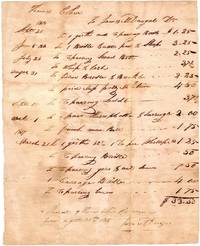
1817réf. 43332Chillicothe OH 1817. Original double-sided sheets total 4 sides 2 leaves one folded as a legal document with document title "Thomas Cohen Account with J McDougal $33.50" on the verso. The Rental agreements reads: "Chillicothe August 7th 1817 The Article made & interred sic: entered in this Day & Date above Ritten sic: Written witness that I Wm Nichols Have Rented of Thos Cohen of Chillicothe one House & Lot at twenty four feet at front on water Street formiley sic the John Walker a man of illeg town name & being the west quarter of indicated Lot No 214 & adjoining the Lot that Sawyer Chrigttow Now lives on for whitch sic I am to pay said Cohen five Dollars pur sic month for three months & as mutch sic illeg as may be a greed on between my self and His agent Testified James Inglish___________________Wm Nichols X His mark" Thomas Cohen's account ledger with James McDougal lists 14 purchases dated between Sept 1815 and March 1817 for what appears to be tack horse equipment including bridles a "bridle coat pad and straps" a "whip and lash" saddles etc. The account totaling $33.50 was closed out Aug 25 1817 "Received of Thomas Cohen the above in full" and signed "James McDougal." Toby Brief the executive director and curator for the Columbus Jewish Historical Society notes in a 2019 article in the Columbus Ohio Jewish News that "Thomas Cohen. was born in Virginia to a Jacob Cohen and became a silversmith. He was in Chillicothe Ohio by 1815. He was advertising in the local paper. He then left and became the mayor of St. Louis . There is a lot of discussion about whether he was Jewish. It's pretty clear that his paternal line was Jewish." Brief notes that until recently "the first Jew to settle in Ohio is commonly believed to be Joseph Jonas an English-born Jew who arrived in Cincinnati in 1817" but with the evidence of Thomas Cohen the silversmith in Chillicothe "We're not so sure about that" Columbus Jewish News: July 31 2019: https://share.google/2UdsU0WyyHXMt7v3h. See also https://www.columbusjewishhistory.org/histories/jews-first-capital-history-chillicothes-jewish-families Not surprisingly Cohen's rental agent for his property in the document the "testifyer" witness on the rental agreement "James Inglish born at Shippensburg Pennsylvania Aug. 9 1768 was an early settler of Chillicothe and one of its pioneer lumber dealers" ohiogenealogyexpress.com/ross/rossco_bios_1917/rossco_bios_1917_a.html. James Inglish shows up in other documents related to Chillicothe and nearby Pickaway County from this period. See for example: Richard Clough Anderson Papers 1782-1905 1912-1914 https://files.archon.library.illinois.edu/ihlcsfa/andersonrc.pdf; "Chancery and Common Pleas Court Records: Fayette County Ohio: 1828-1878" https://www.seekingmyroots.com/members/files/H008985.pdf; Genealogy of John Burgett and Catherine Henderson https://freepages.rootsweb.com/~hutch/genealogy/PURGETT/BurgettTwo.htm Interestingly the tenant Wm. Nichols signs with "His mark" an "X" an indication that Nichols was illiterate. An example of Thomas Cohen's silverwork can be seen at https://live.jeffreysevans.com/online-auctions/jeffrey-evans/thomas-cohen-probably-virginia-coin-silver-tablespoon-6802298 Chillicothe played an important role in the westward expansion of the early United States. "In 1796 Nathaniel Massie laid out the town of Chillicothe on the Scioto River. Massie a Virginian originally laid 456 lots on his own land to establish Chillicothe promising free plots to the first 100 settlers. Chillicothe became the center of political life in the Northwest Territory attracting prominent politicians and later Governors of Ohio; Thomas Worthington and Edward Tiffin. In 1800 Chillicothe became the capital of the Northwest Territory and in 1802 hosted the Ohio Constitutional Convention later becoming the first capital of Ohio at statehood in 1803. Chillicothe remained Ohio's capital until 1810 when it was briefly moved to Zanesville only to return to Chillicothe two years later. In 1816 however the capital of Ohio was moved permanently to Columbus in order to be closer to the geographic center of the state" chillicotheoh.gov. Folds and light toning as expected. Heavy rag paper and ink remain bright and strong. Very Good Condition. Displayable and important. BK5 AMR-72-8. unknown
1913réf. 43311New York: Al Malsin 1913. No Date 1913. 1st edition. Original wallet-style limp leather binding with 'popper' closer on flap and upper cover marbled endpapers and gilt edges. 16mo pocket-sized 166 16 pages plus 3 unnumbered leaves of plates with illustrations. 4 1/8 x 2 7/8 inches. Includes index and "baby record" forms at rear for recording vital birth and growth information for the parent's first four children. Early mother's pocket guidebook by Belle Israels Mosowitz née Lindner 1877-1933 whom the New York Times at the time of her death dubbed the most powerful woman in U.S. politics. Date is inferred from text reference to the author's book "The child" which first appeared in 1913. Features maternity products by Lane Bryant Inc. "Belle Moskowitz's career is unique in American politics. After two decades as a settlement worker social and civic reformer and labor mediator in the early 1920s she became one of New York governor Alfred E. Smith's closest advisers. She organized his campaigns and served as a strategist in his "kitchen cabinet." When he ran for president in 1928 she was by far the most powerful woman in the national Democratic Party-the only Jewish woman and the only woman unconnected to a prominent family to achieve such standing" Jewish Women's Archive. "A Modern Mother's Experience" is full of practical information gathered first-hand by Belle then a mother of three and presented in two sections--health and care of the expectant mother and health and care of the newborn child. Publisher Al Malsin notes in his introduction that the book "gives not only all necessary advice and guidance answering many intimate perplexing questions e.g. what kind of corset to wear but gives hundreds of 'mother-know-hows' which will prove invaluable aids to every young wife or mother." Wearing the right corset was apparently important enough that the author included two photos as illustration. Moskowitz "was a Jewish-American progressive reformer and political advisor in the early 20th century.Born.in Harlem.She was raised in an Ashkenazi Jewish family; her parents were Isidor Lindner and Esther Freyer. religious immigrants from East Prussia. Isidor was a cantor at Temple Israel the first synagogue in Harlem. As a young girl Belle Lindner would have been exposed to the charitable activities of the temple's female Sisterhood a group which collected money organized sewing for the poor and worked with United Hebrew Charities. The Sisterhood also organized a 'Working Girl's Vacation Fund' and a 'Working Girl's Club' to improve the qualities of life for women living in the city. These activities have much in common with Lindner's later advocacy for young working-class women and recreational opportunities. In 1900 at the age of 23 Belle Lindner became a social worker at the Educational Alliance an organization whose primary focus was cultural assimilation for Jewish immigrants. She held various appointments there eventually becoming director of entertainments and exhibits. After leaving the Alliance Lindner now Belle Israels wrote for the United Hebrew Charities and Charities a social work journal for which she later became an editorial assistant. She also joined the New York section of the Council of Jewish Women another organization that helped Jewish immigrants. With her role as chair of the philanthropy committee her focus was welfare work. She oversaw sick and poor children at a hospital on Randall's Island and visited troubled girls in reformatories. In 1907 Belle Israels joined the first board of directors for the New York branch of the Travelers' Aid Society an organization formed with the aim of protecting solo female travelers from trafficking and other situations that threatened their safety. Her first effort at social reform was to clean up and license the city's commercial dance halls which she saw as places that got young working girls into trouble. Working through the Council of Jewish Women-New York Section by 1910 she had won laws that regulated dance hall conditions including fire and safety and the selling of alcoholic drinks. The New York Times stated 'These laws did more to improve the moral surroundings of young girls' than any other single social reform of the period.her first major project was: The Lakeview Home for Girls which opened for permanent use 1911. The Lakeview was located on Staten Island and gave young women temporary shelter as well as aid in finding work. In the 1912 presidential election Belle Israels publicly aligned with the platform of Theodore Roosevelt's Progressive Party which emphasized labor protections and occupational safety. In a letter to fellow reformer Lillian Wald she stated that 'social reform has the services of America's first publicity man Roosevelt and our ideas will become common currency'. In 1913 after the Triangle Shirtwaist Factory fire and the year of this work's publication .She and her second husband Henry Moskowitz.worked closely together in the investigations following the Triangle Shirtwaist Factory fire.In addition Israels began working to promote the grievances of workers. She mediated disputes between the Garment District unions and employers as a grievance clerk for the Dress and Waist Manufacturing Association. She was fired from this role for ruling in favor of labor unions in a majority of cases. In addition to her work as a labor mediator in the Garment District Israels also worked privately as an industrial mediator writer and advisor. In a flyer for her business she offered counseling for factory planning and employment management that would benefit both employees and employers. She wrote 'Discontented or poorly trained workers unsuited to their jobs threaten the peace of the shop. Whatever threatens peace threatens profit.' She was said in the New York Times to have resolved over 10000 grievance cases. Following America's entry into World War I in April 1917 Belle Israels now Moskowitz observed that there was no female counterpart to the all-male Mayor's Committee on National Defense to coordinate the wartime efforts of various women's groups across New York City. She successfully proposed such a group to Mayor John Purroy Mitchel leading to the formation of a Committee of Women on National Defense. Moskowitz served as group secretary and thought through plans for the mass entry of women into the workforce in the event of a loss of male labor due to the draft. In the 1918 New York gubernatorial election Belle and her second husband Henry Moskowitz pivoted.to backing Democratic candidate Al Smith for governor. Although Smith had ties to the Tammany Hall machine which the Moskowitzes had opposed in their previous political advocacy his support of labor issues aligned with their own. For example following the Triangle Shirtwaist Factory fire a push for factory safety standards legislation which both Belle and Henry had helped lobby for led Smith to co-sponsor the bill that established a Factory Investigating Commission. Belle Moskowitz's work during this election began her partnership with Smith which lasted for over a decade. Smith connected with Moskowitz through her work as an industrial mediator and writer. She became one of Smith's most intimate advisors and also worked as his publicist and he kept her close at hand throughout his eight years as governor of New York State. Visitors would note her presence in the corner of his office during critical meetings. Witnesses reported that Smith would even defer to her on major legislative proposals waiting for her approval before making final decisions. She advised him throughout the process of enacting broad reforms for the state of New York that would later inspire and direct Franklin Delano Roosevelt in the development of the New Deal during his presidency in 1932. During her time working with Al Smith Moskowitz mentored both Robert Moses and a young Anna M. Rosenberg in the art of wielding power behind the scenes. When Smith became the Democratic Party candidate for President in 1928 Moskowitz worked as his campaign manager. In this role she has been proposed as the first woman to manage an American presidential campaign. She later worked as his press agent during his attempt for renomination in 1932. In 1928 following Smith's unsuccessful run for the presidency Moskowitz opened her own public relations firm Publicity Associates one of the first firms independently founded by a woman." Her son "Josef would go on to become Ethiopian emperor Halie Selassie's public relations counsel. Moskowitz's funeral at New York's Temple Emanu-El was attended by more than 3000 people. Rabbi Stephen S. Wise delivering her eulogy said that Moskowitz would 'stand out in the history of American life and politics as the woman citizen never selfish and never unwise.' Edward Bernays the 'father of public relations' considered Moskowitz a pioneer in the field; the two had a friendly rivalry over who was first to use the title 'public relations counselor' to describe their professional role. He names her among a group of influential publicity figures in women's organizations in his book Propaganda. In 2009 the National Jewish Democratic Council gave its first 'Belle Moskowitz' award to Ann Lewis" Wikipedia. For more on Moskowitz see Perry Elisabeth Israels 1987. Belle Moskowitz: Feminine Politics and the Exercise of Power in the Age of Alfred E. Smith. Oxford University Press. Other sources are listed in the Wikipedia entry. OCLC: 907213297. OCLC locates only 2 copies worldwide UCLA Harvard. Rare. Previous owner's notes in form at rear at rear. Excellent condition a beautiful copy of a very rare book showing both personal and professional insights from the most politically powerful American woman Jewish or otherwise of the early 20th Century. Touch of light worming to rear endpapers otherwise Very Good Condition. Very Rare and Very Important. BK5 AMR-72B-8-XX. New York: Al Malsin unknown
1985Very Good Very Good English Original bdg. Dust wrapper. 4to. (29 x 22 cm). In English. 157, [3] p., color and b/w ills. Türkiye Sise ve Cam Fabrikalari A.S. Ancient Glass Collection. Türkiye Sise ve Cam Fabrikalari A.S. Ancient Glass Collection.
1998Fine English Paperback. Pbo. Roy. 8vo. (24 x 17 cm). In English. [iii], 122 p. The political and economic experience of a liberal entrepreneur.
2009New English Paperback. Pbo. Roy. 8vo. (24 x 16 cm). In Turkish. 442 p. Sani ve Türkçe divani. Ubeydullah Han ö.1539 sairi.
2009New Turkish Paperback. Pbo. 4to. (30 x 21 cm). In Turkish. [10], 127 p., b/w ills. Anadolu Selçuklu figürlü dirhemleri. H. 699-701 / M. 1299-1302. Seljuq of Rum figural dirhams. 699-701 A.H. / 1299-1302 C.E. 300 copies were printed. Contents; Preface; Intro.; Seljuks of Anatolia; The Latter period; Catalogue; An unpulished dirham; depictions of human head; Bafa, Milas; Finike; Döger; Map; Abbrev.; Bibliography.
2009New English Paperback. Pbo. 4to. (30 x 21 cm). In English. [10], 127 p., b/w ills. Seljuq of Rum figural dirhams. 699-701 A.H. / 1299-1302 C.E. 300 copies were printed. Contents; Preface; Intro.; Seljuks of Anatolia; The Latter period; Catalogue; An unpulished dirham; depictions of human head; Bafa, Milas; Finike; Döger; Map; Abbrev.; Bibliography.
2014New English Paperback. Pbo. Cr. 8vo. (20 x 14 cm). English Edition of Dökmen's 'Kelebekler ve insanlar'. 240 p. Butterflies and people.