163 522 résultats
19858.5 x 1 x 5.5 Inches
1951Book has minor shelfwear and rubbing. Top corners are bumped. Light browning to textblock. ; 160 pages
1964A few pages corner creased. DJ has some rubbing and tears. ; Argonaut Library of Antiquities
réf. 156612Nijmegen, Alfa, 1978.
1994Very light shelfwear. ; 360 pages; Despite Alexander the Great's unprecedented accomplishments, during the last seven years of his life, this indomitable warrior became increasingly unpredictable, sporadically violent, megalomaniacal, and suspicious of friends as well as enemies. What could have caused such a lamentable transformation? This biography seeks to answer that question by assessing the role of alcohol in Alexander the Great's life, using the figure of Dionysus as a symbol of its destructive effects on his psyche. The unique methodology employed in this book explores various aspects of Alexander's life while maintaining an historical framework. The exposition of the main theme is handled in such a way that the biography will appeal to general readers as well as scholars.
2004Very faint shelfwear. ; 11.8 X 8.9 X 0.4 inches; 150 pages
réf. 154283London, Futura Publications Ltd., 1978.
1985réf. 1318884Darmstadt, Roether, (1985). Gr.-8vo. 735, (1) S. m. zahlr. Abb. (Deutsche unter anderen Völkern 11). OLwd m. OUmschl. (1 Einbd-Ecke min. gestaucht)
1970The Biography of Alexander Woollcott, 1887-1943, journalist, reporter, drama critic, book critic who also wrote plays and appeared in plays and films. Very popular with some people, very unpopular with some others. With Index A little browning to pastedowns.
1975Spine is faded. Slight discoloration to boards. ; Orientalia Lovaniensia Analecta 3; 233 pages
réf. 82725Hildesheim, N.Y., Olms, 1971.
réf. 64586Roman. Bln., Wegweiser Verlag, (1940).
1921réf. 004605Schenectady NY: The Author 1921. Book. Near Fine. Cloth. SIGNED AND INSCRIBED BY AUTHOR. Second & Enlarged Edition. SIGNED AND INSCRIBED BY AUTHOR on front endpage -"The Hon. Will H. Hays Postmaster General with the compliments of the author. see page 304 BW Rogers Tayler". Page 304 contains the poem "Roosevelt's Last Message" which begins "Hays: see him! He must go to Washington." Will Hays managed Warren G. Hardings successful campaign for the Presidency of the U.S. and was subsequently appointed Postmaster General. After a year in that position he resigned to become most famously known as the first President of Motion Picture Producers and Distributors of America MPPDA which under his guidance published a blacklist of actors and workers studios should not hire inserted moral clauses into actors' contracts and published an informal list of suggested guidelines for film producers. Reverend Tayler wrote this book during his tenure as Rector of St. George's Episcopal Church Schenectady from 1905-1924. Near Fine the slightest of cloth wear at the spine tips. A quite lovely Presentation Copy. The Author Hardcover
1921réf. 004605Schenectady NY: The Author 1921. Book. Near Fine. Cloth. SIGNED AND INSCRIBED BY AUTHOR. Second & Enlarged Edition. SIGNED AND INSCRIBED BY AUTHOR on front endpage -"The Hon. Will H. Hays Postmaster General with the compliments of the author. see page 304 BW Rogers Tayler". Page 304 contains the poem "Roosevelt's Last Message" which begins "Hays: see him! He must go to Washington." Will Hays managed Warren G. Hardings successful campaign for the Presidency of the U.S. and was subsequently appointed Postmaster General. After a year in that position he resigned to become most famously known as the first President of Motion Picture Producers and Distributors of America MPPDA which under his guidance published a blacklist of actors and workers studios should not hire inserted moral clauses into actors' contracts and published an informal list of suggested guidelines for film producers. Reverend Tayler wrote this book during his tenure as Rector of St. George's Episcopal Church Schenectady from 1905-1924. Near Fine the slightest of cloth wear at the spine tips. A quite lovely Presentation Copy. The Author Hardcover books
2012New English Paperback. Pbo. Roy. 8vo. (24 x 17 cm). In French. 248 p. Prononciation des mots étrangers Prologue : Pour une approche comparatiste de l'histoire bulgare Introduction : Pourquoi Alexandre Exarh? I. UNE FAMILLE BULGARE OTTOMANE (1683 - 1836). Ch.1. Les Bulgares à l'époque ottomane Ch.2. Espaces, réseaux et inter communication chez les Bulgares Stara Zagora au début du XIX° siècle Ch. 3. Les exarques de Stara Zagora : origine et statut Ch. 4. Famille et parentèle. 59 Ch. 5. Formation, solidarités, mobilités Indications bibliographiques de la première partie II. LES PUISSANCES ET LES BULGARES (1836-1847) Ch.6. La crise d'Orient, les Tanzimat et les nationalités chrétiennes de l'Empire Ch. 7.La France, les Polonais, les Bulgares (1836-1862) Ch. 8. Paris et la promotion politique de la Bulgarie (1836 - 1846) Ch. 9. Naissance d'une conscience : Les textes français Ch. 10. Londres ou la promotion publique de la Bulgarie (1846) Ch. 11. Ambiguïtés russes Indications bibliographiques de la deuxième partie III. LES BULGARES (1847 - 1864) Ch.12. Les Bulgares avant tout ! La philosophie politique d'A. Exarh Ch. 13. Carigrad, ville des empereurs, capitale des Bulgares Ch. 14. La relance de la revendication ecclésiastique (1847 - 1860) Ch. 15. L'aventure scolaire (1847 - 1853) Ch. 16. L'aventure éditoriale : le Carigradski vestnik et l'édition (1850 - 1864) Indications bibliographiques de la troisième partie IV. BULGARIE. UTOPIES ET REALITE (1863 - 1891) Ch.17. La question bulgare: de la transition à la rupture Ch. 18. Diplomate (1861-1877) Ch.19. Prétendant Ch. 20. Dernières années. Indications bibliographiques de la quatrième partie CONCLUSION GENERALE: Cabinet-portrait. Glossaire.
1950Former owner's bookplate on ffep. Crhiping to wraps and textblock. Pages uncut. ; 451 pages; 446 pp. with index and fold-out map
réf. 20936Lausanne, Guilde du Livre, (1964).
réf. 90448Neuilly-Sur-Seine, Dargaud, 1973.
réf. 116472Paris, Fayard, (1951).
réf. 90445Paris, Bruxelles, Sequoia-Elsevier, (1969).
réf. 1531626408.Ghardcover. Good. Access codes and supplements are not guaranteed with used items. May be an ex-library book. hardcover
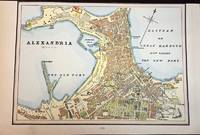
1888réf. M5504Toronto: Home Knowledge Association 1888. Very Good upper margin trimmed closely. Notes: Detailed Map of Alexandria Egypt nicely hand coloured. Alexandria is Egypt's principal seaport the second largest city after Cairo and the largest city on the Mediterranean coast. Founded in 331 BC by Alexander the Great Alexandria is one of the largest and most important cities of antiquity and a leading centre for science culture and scholarship. It’s nicknamed the "Bride of the Mediterranean" and "Pearl of the Mediterranean Coast". Size : 170x240 mm 6.75x9.5 Inches Coloring: Printed in Color with some hand colouring Category: Maps City Maps; Maps Africa North Egypt Home Knowledge Association unknown
2014Until recently, popular biographers and most scholars viewed Alexander the Great as a genius with a plan, a romantic figure pursuing his vision of a united world. His dream was at times characterized as a benevolent interest in the brotherhood of man, sometimes as a brute interest in the exercise of power. Green, a Cambridge-trained classicist who is also a novelist, portrays Alexander as both a complex personality and a single-minded general, a man capable of such diverse expediencies as patricide or the massacre of civilians. Green describes his Alexander as "not only the most brilliant (and ambitious) field commander in history, but also supremely indifferent to all those administrative excellences and idealistic yearnings foisted upon him by later generations, especially those who found the conqueror, tout court, a little hard upon their liberal sensibilities."This biography begins not with one of the universally known incidents of Alexander's life, but with an account of his father, Philip of Macedonia, whose many-territoried empire was the first on the continent of Europe to have an effectively centralized government and military. What Philip and Macedonia had to offer, Alexander made his own, but Philip and Macedonia also made Alexander form an important context for understanding Alexander himself. Yet his origins and training do not fully explain the man. After he was named hegemon of the Hellenic League, many philosophers came to congratulate Alexander, but one was conspicuous by his absence: Diogenes the Cynic, an ascetic who lived in a clay tub.Piqued and curious, Alexander himself visited the philosopher, who, when asked if there was anything Alexander could do for him, made the famous reply, "Don't stand between me and the sun." Alexander's courtiers jeered, but Alexander silenced them: "If I were not Alexander, I would be Diogenes." This remark was as unexpected in Alexander as it would be in a modern leader. For the general reader, the book, redolent with gritty details and fully aware of Alexander's darker side, offers a gripping tale of Alexander's career. Full backnotes, fourteen maps, and chronological and genealogical tables serve readers with more specialized interests. Book
2012New English Paperback. Pbo. Roy. 8vo. (24 x 17 cm). In English. First published in Greek in 1785. 124 p. Ills. Acknowledgements INTRODUCTION 1. The Author of the Libel: Georgios Nikolaou Soutsos (ca. 1760-1816) 2. The Target of the Dramatic Libel: Alexandros Mavrokordatos Firari (1754-1819) 3. Alexandrovodas the Unscrupulous (1785): A Three act Satirical Libel I. Brief outline of the plot II. The dramatis personae Male Characters Female Characters III. The monologues IV. The language V. Class-consciousness vs. ethnic awareness VI. The philosophy of the ruler: Machiavellianism, atheism, and freemasonry 4. European Theater in the Eighteenth Century 5. Realities and Prospects of Theater East of Europe 6. Overall Assessment of Alexandrovodas the Unscrupulous 7. Conclusion BIBLIOGRAPHY THE TEXT OF ALEXANDROVODAS THE UNSCRUPULOUS GLOSSARY INDEXES.
réf. 75-4639Pasadena CA: The Pasadena Art Museum 1964. 4to. Soft Cover ca. 75 pp. B&W and Color Plates. Very good with Creasing Age Toning Pasadena, CA: The Pasadena Art Museum, 1964 paperback