361 164 résultats
1926Very Good English Paperback. Demy 8vo. (22 x 14 cm). In German. 56, [1] p. Zur indischen Erkenntnistheorie. Die Lehre von der Wahrnehmung nach den Nyâyasûtras III, 1. Signed and inscribed by Ruben.
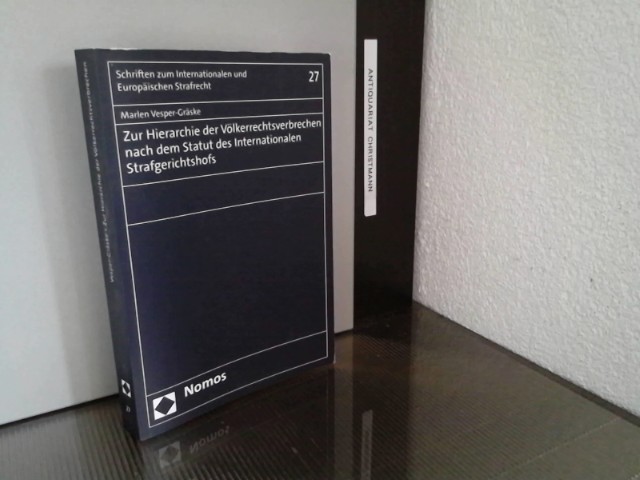
réf. 28575Baden-Baden : Nomos 2016. 385 Seiten ; 23 cm Broschur, Softcover/Paperback, Exemplar in gutem Erhaltungszustand, Neupreis in Euro: 99,--
1914Very Good English Paperback. Pbo. Roy. 8vo. (23 x 16 cm). In German. [viii], 80, [4] p. Zur Geschichte und Beurteilung der Papierzölle im Zolltarif von 1902.
1889réf. 1074014Tübingen, L. Fr. Fues, 1889. 4to. 74 S., 1 Karte. Rückenbroschur (etwas angestaubt u. lichtrandig).
1892réf. 1268284Heidelberg, 1892. 81, (3) S. OBroschur.
Single-sheet chromolithographic print. With numerous illustrations of military uniforms in 9 groups. Captioned at head on the stone. Plus original leaf of text with explanatory notes. Print trimmed bit close on 3 sides. In fine condition. ~ Extract from Meyers Konversations-Lexikon. Signed by Richard Knötel on the stone. Beautifully illustrated military uniforms of various armies and forces. With dense colours and excellent gloss. An authoritative manual on chromolithography in 1885 (Colour and Colour Printing, by W. D. Richmond) asserts the need for at least 9 separate stones to achieve such richness, but in fact the number of stones used was often more than 20. The print measures 20x26.5 cm image size.
Single-sheet chromolithographic print. With numerous illustrations of military uniforms in 7 groups. Captioned at head on the stone. Plus copied leaf of text with explanatory notes. Print trimmed close on 3 sides. In a very good condition. ~ Extract from Meyers Konversations-Lexikon. Signed by Richard Knötel on the stone. Beautifully illustrated military uniforms of various armies and forces. With dense colours and excellent gloss. An authoritative manual on chromolithography in 1885 (Colour and Colour Printing, by W. D. Richmond) asserts the need for at least 9 separate stones to achieve such richness, but in fact the number of stones used was often more than 20. The print measures 20x26.5 cm image size.
1900réf. 1513089Leipzig, 1900. Gr.-8vo. 100 S. OBr. (unaufgeschnitten, Umschl. m. Randläs.).
1957Two parts in one volume. Crown quarto. Pp. xv, 144; 110. Plus large folding table. Original printed stiff wrappers; signature to first blank. In a very good condition. ~ First edition. Printed as manuscript. Loosely inserted is a copy of a related article in German, dated 1942.
1873réf. 1307039Kreuznach, Voigtländer, 1873. 4to. 1 Bl., 38 S. Rückenbroschur (Titelblatt etwas lichtrandig, minimal fleckig).
193418.5x12.5 cm. 143 pages. Softcover. Cover slightly chafed, slightly stained. Spine slightly chafed. Binding slightly visible on one page. Else in good condition.
1913réf. 1259456Marburg, 1913. 87, (1) S. Br.
1892Octavo. Pp. vi, 80. Hardcover, bound in contemporary cloth and marbled boards, original printed wrapper laid-down, old shelf tickets to spine, old military institutional stamps to cover and title; bit foxed. In a very good condition. ~ First edition. Ernst von Hoffbauer (1836-1905), Prussian general of artillery.
1887réf. 1206084Salzburg, Kerber, 1887. 4, 97, (3) S. OBr. (Umschl. etwas braunfleckig u. am Fuß m. kl. Fehlstelle, unbeschnitten).
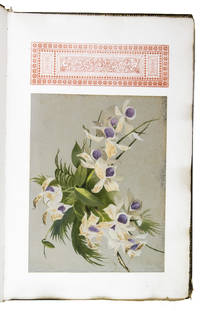
1896réf. ABC_48884Colophon: Amsterdam 1896. Large folio ca. 51 x 33 cm. Calligrafie und Druck von Johan. K. Koning Contemporary gold-tooled burgundy leather the front board with a large gold-stamped monogram as a centrepiece the intertwined initials of the couple: AJ and EdR with the date "24-26 August" above and the year "1896" below lettered in gold both boards show a single fillet frame along the outer edges gold-tooled turn-ins beige watered silk endleaves. Wedding album comprising five manuscript texts of occasional plays 4 in German 1 in Dutch written in a neat cursive in blank ink on thick laid paper each illuminated with a 4-line decorated initial in red blue and white on a gold/bronze field richly decorated with penwork in black ink extending down into the inner margin. Each text is preceded by a letterpress title leaf set in neo-Gothic type also used for the general title several text leaves and the colophon. Further with 1 gouache illustration on grey paper sheet size ca. 32 x 24.5 cm mounted on the first leaf showing a bouquet of flowers 14 printed ephemera relating to the "Polterabend" wedding-eve party and the wedding on single or double leaves in various sizes the wedding announcement/introduction to the wedding-eve party and attached is a photo of the couple in a circular frame of red wax 5 menu cards the lyrics to 6 German songs a musical score by the German composer Wilhelm Aletter 1867-1934 and an announcement of the comic opera Des Teufels Antheil by the French composer Daniel Auber 1782-1871 performed by the Frankfurter Opernhaus on 25 August 1896 in Frankfurt am Main. Also with two manuscript wedding speeches in German written in black ink on paper two mounted albumen prints the first showing two actors dressed as a Frisian farmer and his wife and the other showing a man in Chinese dress 56 large ornamental vignettes printed in red or blue throughout 17 ornamental tailpieces printed in black blue and red and some dried flowers mounted on several leaves. 60 ll. A sumptuously executed wedding album presented to the Dutch groom August Janssen 1865-1918 and his bride Ella de Ridder 1877-1951 produced in honour of their wedding celebrations which took place on 24-26 August 1896 in Frankfurt am Main Germany. Most of the album concerns their "Polterabend" the wedding-eve party similar to present-day bachelor-/bachelorette parties except for the bride and groom joining together in the festivities. The main event now associated with a Polterabend is the smashing of porcelain by the wedding guests in order to bring luck to the couple's marriage but in general the evening is filled with plays and songs written and performed for the couple by their family and friends.A few performing actors were members of the Janssen-family a Dutch business family who had amassed their fortune with the tobacco cultivation in the former Dutch East Indies. They were also known for their generosity and philanthropic activities in the Netherlands. At the head of this family was the German-Dutch merchant Peter Wilhelm Janssen 1821-1903 one of the founders of the Deli Maatschappij in Sumatra and father of the groom who was his second son. His eldest son Christian Wilhelm Janssen 1860-1927 was married to Susanna Dorothea Anna Rehbock 1862-1933. Her brother the Dutch merchant Heinrich Carl Rehbock 1865-1938 was married to Caroline Janssen 1871-1951 one of the five daughters of Peter Wilhelm Janssen. Among the other actors were the brother of the bride Gustave von Ridder 1874-1956 the German playwright Hermann Otto Rudolf Presber 1868-1935 the German lawyer Paul Roediger 1859-1938 and his Dutch wife Julie Louise Charlotte Elink Schuurman 1875-1961 the sisters Anna Maria Humser 1876-1974 and Elisabeth Else Humser 1872-1967 daughters of the German lawyer and politician Gustav Adolph Humser 1836-1918 who was chairman of the Frankfurt city council at the time of the wedding celebration.The groom August Janssen 1864-1918 started his business career at trade offices in Bremen and London. He subsequently left for the former Dutch East Indies where he founded several enterprises. His wealth enabled him to engage in philanthropic activities. For example the municipality of Baarn benefited from his generosity he erected two public swimming pools there at his own expense. The bride Ella Elisabeth de Ridder 1877-1951 was the only daughter of the Belgian-German merchant August Cornelius de Ridder 1837-1911 known for his distinguished art collection of mainly Dutch and Flemish paintings of the 17th century which he built at his house at Kronberg near Frankfurt am Main. The famous Anglo-Hungarian artist Philip Alexius de László 1869-1937 painted Ellas portrait in 1903 in Baarn at the house of Hendrik Cornelis van den Honert 1854-1916 the successor of Peter Wilhelm Janssen as director of the Deli Maatschappij in 1898. De László had also painted her mother Johanna Elisabethe Louise May 1853-1942 around 1898 and two of her children in 1908.A unique wedding album of two members of prominent German-Dutch business families written and printed in 1896 as a special single copy publication. The album was produced in Amsterdam by Johan K. Koning who took care of the calligraphy of the texts and the printing of the divisonal titles explanatory leaves and vignettes.The spine and edges and corners of the boards show signs of wear with some minor loss of material at the foot of the sipne and the tips of the corners of the boards the leather is somewhat faded adn scratched all without affecting the general clarity of the tooling or the integrity of the binding. The watered silk on the first free flyleaf is torn some offsetting to the blank versos of the leaves and some glue residue on the leaves with dried flowers. Otherwise in good condition. hardcover
1929réf. 1511845Jena, 1929. 59 S. OBr.
1855réf. 1142420Stuttgart, Köhler, 1855. 87, (1) S. OKart. (angestaubt, Rücken überkl.).
1901réf. 1016305Marburg, 1901. 80 S. Br.
1955Very Good English Paperback. Pbo. Roy. 8vo. (24 x 17 cm). In French. 140-154 pp. Zur anthropologie des Islam. [Separatum Anthropologie religieuse].
1961réf. 1082731München, 1961. 262 S. Br.
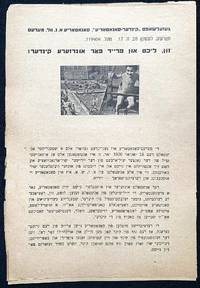
1938réf. 43519Gezelshaft "Kinder-Sanatorye" Sanatorye A.N. Vl. Medem 1938. No Date 1938. 1st edition. Original photographic paper wrappers 12mo 5 pages. In Yiddish. Title translates as "Sun Light and Joy for our Children!" A rare Holocaust-era fundraising brochure for the Medem Children's Sanatorium in Warsaw "the only Jewish Children's Sanatorium in Poland." The 1938 fundraising campaign was accompanied by the re-release with an English-language prologue of Aleksander Ford's 1936 Yiddish-language Film on the children of the Sanitorium entitled "Mir Kumen On." The title translates as "We are Coming" but for the film was translated into English as "Children Must Laugh" and is viewable online at www.youtube.com/watchv=vozD_XbGHGA. The restored film was featured at the Museum of Modern Art's To Save and Project: The 14th MoMA International Festival of Film Preservation in 2016. The Medem Sanatorium was an "Educational and clinical facility for children and young adults at risk for tuberculosis. This sanatorium which functioned in Miedzeszyn near Warsaw between 1926 and 1942 was named after Bundist leader Vladimir Medem 1879-1923 and was the best-known establishment of the Bund and of TSYSHO the Central Yiddish School Organization in Poland. The clinic was funded by donations from Jewish unions in Poland and American Jewish workers' organizations" as well as the Joint Bund Melbourne. The pamphlet describes the harsh realities of life for Jewish children before they come to the Sanatorium reporting that "Up to 75% come from proletarian and working classes" with many coming from homes where 6 7 8 even 10 12 or 16 people live together in one room. "More than 65% of the total number of children do not experience a separate bed. Over 45% of Warsaw's children live in apartments without electricity without plumbing and without sewerage. it is therefore no wonder that tuberculosis is spreading among these children to such a terrible extent. The history and philosophy of the Sanatorium are also described in detail: "The environment and language of education is Yiddish.The healing resources of the Institution are: air sun nutrition good self-esteem of children constant medical and sanitary supervision an atmosphere of rationalism etc. A quartz lamp local pharmacy laboratory red carpet forest dentist's cabinet etc. are available for use by the children. The educational methods of the sanatorium are based on the basic idea that the child's body can be healed and cured only when the self-esteem of the child and his mood are happy and satisfied therefore in caring for the welfare of the weak child his spirit is constantly taken care of. The educational strategies of the sanatorium are: creating appropriate groups of people: raising the cultural level of the children; Encouraging the children to take charge of the institution; bring them closer to nature; develop their aesthetic and musical sense; develop the necessary areas of hygiene acquaint the children with the world and Jewish literature; Develop in them love and understanding for sports; Make the life of the children useful and pleasant." Across multiple buildings and acres of fields and woods the slots for 130 children in the Winter and 200 in the Summer provide access to "the natural history museum a building for chicken breeding.a fruit orchard and a garden with one farm.a toboggan gate skating rink skiing etc. In all these facilities like chickens bees silk breeding etc. the children take an active part." The fundraisers note that as of January 1 1938 7563 children had been served over 21 years-and every year that number is growing with 755 children served in 1937 alone. They explain that while the majority of children come from Warsaw over 1100 had come from the provinces a number which "is constantly growing." The proposal then is for expansion of a property purchased in Warsaw the year prior as well as the development of centers in other Jewish centers in Poland. In the now dystopian year of 1938 the Medem Sanatorium wants to develop these new urban complexes "mainly for children who come back from the sanatorium but their health condition their social situation requires the necessity of continued medical and general assistance and supervision." In this new center in urban Warsaw already "the children spend half a day they receive food medical and dental assistance hygienic and educational supervision help in preparing the school lessons" as well as training in workshops art classes musical auditions a choir etc. are also introduced. "The popularity of this new institution is despite the short time of its existence enormous. Unfortunately we are also not in a position to satisfy even a part of the requests which are constantly growing in number. The management of the sanatorium therefore decided in the near future to establish another similar institution in Warsaw and 3 similar institutions in the province. In the first phase in Lodz Bialystock and Lublin. The economic crisis and the particularly difficult situation in which the Jewish masses find themselves has a grave impact the health condition of the masses of Jewish children" and the center is deluged with "Thousands of messages from parents.This situation demands for the management of theSanatorium A new task: to expand and rebuild the institution in order to to enable additional thousands of children to enter the friendly and joyful walls of the Medem sanatorium." Goals for the coming Spring of 1938 include: "A new pavilion with 100 seats." A sports and play area arranged according to the requirements of the latest medicine and hygiene. The construction of the new building will enable the admission of 230 children in the winter and 350 in the summer." So a fundraising campaign is underway already being "conducted throughout the country and everywhere with great success. Everywhere in all strata of the population it was met with a lot of sympathy with a much warmer and sincere relationship." We appeal to all those who follow these lines of thinking.For the construction of the Medem sanatorium. We know the situation and are clear-eyed about it: the time is difficult and the task to which we set ourselves is not an easy one. But we are sure of its success because this action is an action for the health for the future of our children." We were unable to locate any copies anywhere on OCLC nor using standard online searches. Bottom quarter of the final page is removed-as it is on the one other example of this pamphlet we have examined. This suggests either a tear-off donation coupon or perhaps a removed section referencing a now-passed event. We present this rare pamphlet as "complete as issued." Toning as expected very light edgewear to outer margin about Good Condition. Exceedingly rare. PBERL-1-8-XX. Gezelshaft "Kinder-Sanatorye" Sanatorye A.N. Vl. Medem unknown
1988Fine English Paperback. Pbo. Dust wrapper. Roy. 8vo. (24 x 17 cm). In German. [4], 30 p., b/w ills. Zum Zypern-konflikt, (1987 / 88).
1997réf. 1512374Göteborg, 1997. Gr.-8vo. 241 (recte: 242) S., 1 Bl. (Göteborger germanist. Forschungen 38). OKart. (St. auf Titel).
1894Octavo. Pp. ix, 272. Plus 6 folding sheets of maps and plans printed with additional colours, in rear pocket, mostly with splits along folds due to paper's low quality. Set in Gothic type. Hardcover, bound in contemporary pebbled half cloth and marbled boards, spine gilt, shelf ticket to spine, old institutional stamps to title, first inner hinge cracked but firm. In good condition. ~ First edition. Very rare. WorldCat OCLC locates a single institutional copy in Germany, that in Deutsche Nationalbibliothek.
1948réf. 63285Leipzig : Harrassowitz 1948. 45 S. ; 8° Broschiert, Einband lichtsschattig, sonst Exemplar in gutem Erhaltungszustand