Bernard MandevilleBiblio.com
595 resultados
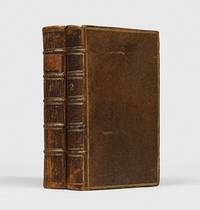
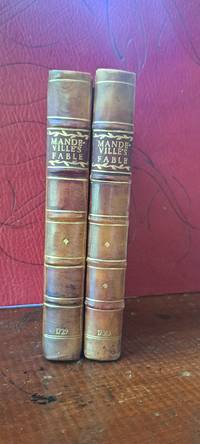
1729ref. 11Barnard Mandeville published a pamphlet on "the Grumbling Hive" in 1705. This was then included in "The Fable of the Bees" in 1714 which itself went through six editions and important additions A second volume was published in 1729 in the form of a dialogue between Horatio and Cleomenes and presents a proposed history of civil society based upon Mandeville's views of human nature. Mandeville was a leading public intellectual of the early 1700's. His influence continues as an a icon of Libertarianism Hayek himself a follower. In the eighteenth century his respondents and critics is a long list including Adam Smiith and Rousseau. His thesis that Vice was a productive force in the economic wellbeing of a comunnity seems harmless on its face but Mandeville presented his view while critiqueing his own society both in its moral hypocricy and the failure to produce results Vol. of this set isthe sixth and last edtion wih all the added essays etc from the precedin geds. Then in 1729 Maneville published Fable of the Bees Part II. These six dialogue were quickly reprinted. This is Vol ii of this set and completes Mandevilles authorized text. This set is the final definitive edition of Mandevilles unfolding editions of the Fable vol 1, Tonson; vol 2.Roberts hardcover
2001ref. 238613Reno.: Western Book / Journal Press. 2001. First edition. . Soft cover. . Fine copy. As new. . Folio. . Illustrated. Important reference work. Very scarce in this condition. Inscribed by the author "To Jan: God loves you too! 2005 Vesta Avis Mandeville". Western Book / Journal Press. paperback
ref. mon0000258041Cornell University Press 31/03/2016 00:00:01. hardcover. Very Good. 3.2995 in x 24.6193 in x 14.9746 in. Cornell University Press hardcover
2018ref. 1-3337469809hansebooks 2018. Paperback. New. 444 pages. 8.50x5.99x1.00 inches. hansebooks paperback
2012ref. SKU0635090Oxford University Press 2012-09-07. paperback. New. 7x5x0. New Textbook Ships with Tracking Oxford University Press paperback
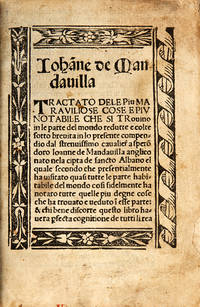
ref. 112964Venice Manfredo Bonelli 26 January 1505. . 8vo; title within decorative woodcut border 4-line decorative woodcut initial to A2 2-line initials elsewhere some toning and soiling small repair to fore-edge of title bookplate to front pastedown; later full vellum gilt lettering to spine on brown morocco title-piece minor worming to extremities and endpapers; collation: A-EE4; ff. 112. Rare Italian edition we can only trace 4 copies in institutional collections worldwide. Rare 16th-century Italian edition of the world's first best-selling travel book. Although largely fictitious the journeys are based upon travellers' tales extant in the fourteenth century and as such are of considerable interest. Purchas considered Sir John Mandeville to be akin to Marco Polo in terms of importance 'the greatest Asian Traveller that ever the World had' Pilgrimes III p65. His travels take the reader through Turkey Armenia Persia Tartary Arabia India and China and gave many Europeans their first taste of the Near and Middle East as well as the East Indies. Little is known of Mandeville himself however he claims to have been an English Knight who travelled between 1322 and 1356 serving under both the Sultan of Egypt and the Great Khan. Although traditionally attributed to Mandeville in reality the work was an English version of a text known as Itinerarium of which the original ascribed to Jean d'Outremeuse was probably written in Anglo-Norman French. All pre-1725 editions of Mandeville are scarce and editions such as this in a vernacular language particularly so. We can trace only 4 copies in institutional collections worldwide: 1 in the British Isles BL 1 in North America Houghton Library Harvard and 2 in Italy Biblioteca Regionale Universitaria Messina and Biblioteca Comunale Augusta Perugia. USTC 839970. Venice, Manfredo Bonelli, 26 January 1505. hardcover
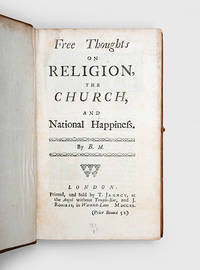
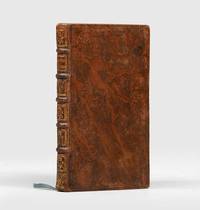
1720ref. 168926London: Printed and Sold by T. Jauncy and J. Roberts 1720. First edition of the author's forceful argument for the secularization of British politics his most substantial and wide-ranging political tract. This copy comes from the library of John Wallop Lord Viscount Lymington 1690-1762 a Whig politician who was an ally of Robert Walpole and bears his armorial bookplate on the front pastedown. Bernard Mandeville 1670-1733 grew up and studied in the Netherlands before settling in England at some point after the Glorious Revolution. Free Thoughts walks a fine line between advocating religious toleration and criticising the practices of the English priesthood advocating a Whiggish support of secularized constitutional government. "Despite the objections of the pious history and a growing segment of influential opinion were on Mandeville's side; and the ensuing years of the eighteenth century were to see an increasing acceptance in practice if not always in theory of the secularization of politics he so forcefully advocated in the Free Thoughts on Religion the Church and National Happiness" Cook p. 92. Two variants of the first edition are known. This example contains page xix correctly numbered - no priority has been identified. The book was reissued in 1721 and 1723 with new editions in 1729 and 1731 and was translated into French Dutch and German. The shelf label reads "Dr Mandevi Works Vol:1" indicating that this volume originally formed part of a collected set. Octavo 190 x 114 mm. Wood-engraved head- and tailpieces. Contemporary panelled calf spine with raised bands forming six compartments brown morocco label lettered in gilt edges sprinkled red. Light bumping and wear slight cracking to front joint holding firm minor browning to endpapers and outer margins of contents: a very good copy. ESTC T59022. Richard Cook Bernard Mandeville 1974. hardcover
1988ref. 1-0865970750Liberty Fund 1988. Paperback. New. reprint edition. 1044 pages. 9.25x6.25x3.00 inches. Liberty Fund paperback
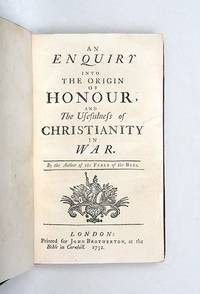
1732ref. 158809London: Printed for John Brotherton 1732. First edition of the author's last book; the final instalment of a long string of incendiary treatises which incensed his contemporaries. Following his tracts attacking Christian ethics defending brothels and opposing charity schools Mandeville here turns to the readiness with which Christianity can be perverted to militarism and asserts that honour is no more than pride. As with his Fable of the Bees Part II 1729 an entirely different work to the first part the treatise takes the form of a dialogue between two interlocutors Cleomenes and Horatio. "Mandeville repeated his view that the passions of pride and shame are both forms of self-liking. Honour and worldly religion are treated as devices that are useful for socializing humans. Honour is discovered to be even less demanding than virtue or the artificial courage discussed in the Fable of the Bees. The work again reveals Mandeville's anti-clericalism in his account of how a perverted version of the truly peaceful doctrine of Christianity can be used to motivate soldiers" ODNB. Octavo 184 x 115 mm. Late 19th-century half sheep and pebble-grain cloth spine ruled gilt in compartments black leather label sprinkled edges. Joints and corners rubbed head of spine with tiny chip. Margins trimmed a little close; a crisp clean copy. ESTC T59021; Kaye pp. 440ff. hardcover
1732ref. 158851London: Printed for John Brotherton 1732. First edition of the author's last book. The final instalment of a long string of incendiary treatises which so incensed his contemporaries following his tracts attacking Christian ethics defending brothels and opposing charity schools Mandeville here turns to the readiness with which Christianity can be perverted to militarism and asserts that honour is no more than pride. As with his Fable of the Bees Part II 1729 an entirely different work to the first part the treatise takes the form of a dialogue between two interlocutors Cleomenes and Horatio. "Mandeville repeated his view that the passions of pride and shame are both forms of self-liking. Honour and worldly religion are treated as devices that are useful for socializing humans. Honour is discovered to be even less demanding than virtue or the artificial courage discussed in the Fable of the Bees. The work again reveals Mandeville's anti-clericalism in his account of how a perverted version of the truly peaceful doctrine of Christianity can be used to motivate soldiers" ODNB. Octavo 197 X 123 mm. Contemporary panelled speckled calf red morocco label sprinkled edges. Ownership inscription of J. Arscott dated 1732 to title engraved armorial bookplate of Sir William Molesworth to front pastedown. Small chip to head of spine joints and corners a little rubbed; a crisp clean copy. ESTC T59021; Kaye pp. 440ff. unknown
1732ref. 158464London: Printed for J. Tonson 1732 & 1733. Private vices as public virtues Seventh edition stated sixth of the first part second edition of the second part of Mandeville's best-known work demonstrating through a parable of bees renouncing all luxury and seeing their hive collapse that the Christian ascetic philosophy cannot lead to a prosperous economy and social system and consequently that individual vices of vanity and greed are virtues for the community. The work originated in 1705 as a poem titled The Grumbling Hive expanded into the first book-length edition in 1714 and revised by Mandeville in further editions. Part II first published in 1729 matches the length of the first part and comprises six dialogues in which Cleomenes instructs Horatio as to the Fable's true meaning. Mandeville's implication that religion was damaging to social welfare was contentious and in 1723 the work was declared a public nuisance by the grand jury of Middlesex and Mandeville himself accused of blasphemy. Undeterred he addressed his accusers in the London Journal and published a pamphlet defending himself against such charges; the contents of this "Vindication" are included in the present edition of Part I along with Mandeville's Essay on Charity Schools claiming that educating the poor above their station was in nobody's interest and his Search into the Nature of Society further espousing the Fable's themes. Mandeville would spend the rest of his life justifying his work to its many critics yet it was still characterized well after his death as "the wickedest cleverest book in the English language" in the diary of Henry Crabb Robinson June 1812. The book had an enduring influence on the science of economics in pointing out what was self-evident to many but never before put so boldly - that expenditure on luxuries the incentives created by the desire for social betterment and the need for profit all form the basis of the economic system and social order around it. Adam Smith though denouncing Mandeville in his Theory of Moral Sentiments followed his central thesis that the individual's self-interest works to the good of the whole. Keynes was influenced by Mandeville in his notion of the "paradox of thrift" that withholding spending reduces demand and harms the economy. Friedrich Hayek in a lecture of 1966 to the British Academy called Mandeville a "Master Mind" in recognising that individuals seeking to advance their own interests create a "spontaneous order" which can form a society without the need for a controlling state. 2 vols octavo 191 x 121 mm. Contemporary calf ruled in gilt with vol. numbers to third compartments vol. I with manuscript label in second compartment. Contemporary ownership signature of one Alexander Duff to title pages. Light rubbing and slight chip at head of spine of vol. II small loss bottom fore corner of Part I leaf L1 2D7. Very good copies. ESTC N8073 & T77578. unknown
1727ref. 133505London: A. Moore 1727. First edition in French of Mandeville's A modest Defence of publick stews or an essay upon whoring as it is now practis'd in these kingdoms a treatise against prostitution being an expansion of his pragmatic approach to morality first espoused in The Fable of the Bees. Octavo 161 x 95 mm. Contemporary mottled calf boards with blindstamp double rule border spine decorated gilt in compartments red morocco label gilt rule to board edges marbled endpapers red edges. Small chip at head of spine extremities lightly rubbed occasional light spotting; a very good copy. hardcover
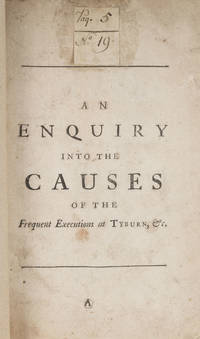
1725ref. 728381725. Executions and the Causes of Crime Mandeville Bernard 1670-1733. An Enquiry Into the Causes of the Frequent Executions at Tyburn: And A Proposal for Some Regulations Concerning Felons in Prison And the Good Effects to be Expected from Them. To which is Added A Discourse on Transportation And a Method to Render that Punishment More Effectual. London: Printed and Sold by J. Roberts 1725. xvi 55 1 pp. Octavo 7-3/4" x 5". Stab-stitched pamphlet in recent plain wrappers. Moderate toning to interior light foxing finger smudges and minor tears to a few leaves some soiling to half-title which has an early label reading "Pag. 5 No. 19" and verso of final leaf. $1500. Only edition. Mandeville's vivid account of the wretched state of public executions in England and the causes of crime introduced several themes that would be explored further by Henry Fielding Adam Smith and Adam Ferguson. Mandeville was an Anglo-Dutch social philosopher political economist and satirist. His most important work and the source of his fame is The Fable of the Bees 1714 an allegorical study of social behavior. OCLC locates 3 copies in North American law libraries Library of Congress University of Iowa Yale. English Short-Title Catalogue T61379. unknown
2020ref. x-0813944368Univ of Virginia Pr 2020. Hardcover. New. 832 pages. 9.00x6.50x2.25 inches. Univ of Virginia Pr hardcover
1895ref. 4098Westminster: Archibald Constable & Co 1895. Hardcover. Very Good. Limited edition of 1000 numbered copies of which this is copy number 78. Royal octavo. Pp. xxx 414. Printed on laid paper title in red and back frontispiece and 25 wood-engraved plates numerous initials ornaments and vignettes. Bound in half brown morocco over cloth boards spine divided into six panels with double gilt rules framing each compartment gilt lettering direct marbled endpapers top edge gilt others with deckle edges. Minor rubbing to extremities occasional traces of marginal foxing to leaves deckle edges browned but overall a very nice copy. Archibald Constable & Co hardcover
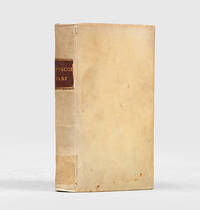
1767ref. 130765Cosmopoli: All'Insegna della Riforma. Nel secolo della dissolutezza. 1767. First edition in Italian of Mandeville's A modest Defence of publick stews or an essay upon whoring as it is now practis'd in these kingdoms a treatise against prostitution being an expansion of his pragmatic approach to morality first espoused in the Fable of the Bees. Octavo 170 x 110 mm. Contemporary vellum red morocco label lettered gilt "Opuscoli vari". Spine label chipped occasional light foxing paper unevenly browned. Kaye I p. xxxi. OCLC locates 3 copies only at the Clark Library UCLA New York Public Library and the Bibliothèque nationale. hardcover
1924ref. 9022351Oxford: Clarendon Press 1924. Hardcover. Very good. One of 25 presentation copies printed on India paper and bound in the publisher's original green cloth over boards as two volumes in one spine and cover stamped in gilt. Spine is slightly faded but legible. Lightly rubbed at the edges and extremities. All edges gilt. Facsimile illustrations. With a commentary critical historical and explanatory by F. B. Kaye. From the library of R.S. Crane with a signed and dated presentation to him by the author on the ffep. Clarendon Press hardcover
ref. DADAX0719081750New unknown
ref. 61015508Liberty Fund Incorporated . Papeback. New. pp. 1044 Liberty Fund, Incorporated unknown
ref. A9783487071770Hardback. New. hardcover
ref. B9783752437447Hardback. New. hardcover
ref. B9781498089166Paperback / softback. New. paperback
ref. 88673Cambridge Cambridge University Press 1985. 8° X 183 S. Kart. Rücken min. beschienen Stempel a. Innendeckel erste 10 S. m. Unterstreichungen tlw. in roter Tinte Ausschnitt des OUs auf hint. Innendeckel montiert. EA. = Ideas in Context. 010 Cambridge, Cambridge University Press, 1985 unknown
ref. 89265New Brunswick Transaction Books 1987. 8° VI 248 S. OLwd. m. OU Stempel a. Innendeckel 3 S. m. Anstreichungen meist in Blei- tlw. in Farbstift Ausschnitt des OUs auf hint. Innendeckel montiert. Erstausgabe. 010 New Brunswick, Transaction Books, 1987 unknown
2007ref. BN169585MED COM 2007. 2007. Softcover. GUIDE PRATIQUE D ANATOMIE DU CHEVAL 0000 GUIDE PRATIQUE D ANATOMIE DU CHEVAL 0000 Clayton Hilary Mary; Flood Peter F.; Rosenstein Diana S.; Mandeville David MED COM paperback