1901réf. 891941901. DESIGN KOSUGI Sugimura & YOKOI Tokifuyu designers. DAI NIHON BIJUTSU ZUFU 4 vols. Tokyo Yoshikawa Hanshichi Meiji 34 1901. 4 plate volumes orihon folding albums illustrated with 154 pages of color woodcut. 25.1 x 18.5 cm Complete as such BUT not including the 4 text volumes. A lovely compendium of traditional design. Very good colors impression and condition. Volume 4 is split at one fold; its rear cover is detached and its front cover attached with a tissue repair. unknown books
1961réf. 83851New York: Atheneum 1961. First Edition. First Printing. Octavo 22cm; blue cloth-covered boards with titling stamped in gilt on spine; bright red topstain; yellow endpapers; dustjacket; xii23-3675pp. Faint foxing to fore-edge of textblock else Near Fine. Dustwrapper designed by Bill English with photograph by Jean Hollyman unclipped priced $4.95 with trivial surface wear else Near Fine. A strikingly fresh copy with no loss of color to spine panel of dustjacket. Contents include Book the First Education for the Citizen and Book the Second The Citizen and the World and follows high school student "Mollymauk" as he navigates karate hypnosis and meeting the wishes of his dream girl. Its satirical film adaptation 1966 was produced directed and co-written by George Axelrod and starred Roddy McDowall Tuesday Weld and Lola Albright. Hine coauthored projects with his wife Sesyle Joslin and the pair also published works with the pseudonym G. B. Kirtland. 83851. Atheneum unknown books
1959réf. 43760Gouda: Drukkerij v/h Koch & Knuttel 1959. First edition. Softcover. g to vg. Large quarto 11 3/4 x 8". Unpaginated. 24pp 3 transparent colored acetate pages. Original photo-illustrated wrappers. Illustrated title page. This splendidly produced booklet was intended as a promotional New Year's gift of publisher Koch & Knuttel in Gouda Holland the hometown of photographer and designer Piet Marée who designed the said booklet. This work contains 9 full-page b/w photographic reproductions of artwork by Belgian Avant-gardist artist Pierre Toebente 1919-1997 whose entire oeuvre addresses only one major theme namely the human being of which he chose three aspects: the female body the child and the mask. Eight of the nine artworks featured in this booklet are wooden masks and the last one depicts a female torso also executed in wood. Photographs and book design by the famed Dutch graphic designer Piet Marée 1903-1999. Minor shelf wear along edges of wrappers. Little discoloration spot at upper margin of half-title. Text in Dutch. Wrappers in overall good to good interior in very good condition. Drukkerij v/h Koch & Knuttel unknown books
2015réf. 1973First Edition. Artists' book 136 pp. : illustrations in color. Small 4to. Near fine. Illus. stiff wraps with unique collage element on the front cover. 1973 Winant's first major artists' book which includes texts by Matthew Brannon Moyra Davey Courtney Fiske Jim Fletcher Kenneth Goldsmith Jonathan Griffin Geoffrey Hilsabeck Michael Ned Holte Sarah McMenimen Anna Livia Alexander Provan Ross Simonini and John Yau. Per the 2016 review by PhotoEye the work is named after the 1974 Phillip Roth book of the same title yet "My Life as a Man makes no apparent contextual reference to Roth's book but the cover does appear as a small image multiple times in Winant's book. From the opening sequence which groups an image of a naked woman laying face down on a table under the watchful eyes of a team of male doctors with various other images of men gazing at woman it's clear the work offers a pointed critique of the ways in which the female form and gestures are controlled and imaged." Though the edition size is unstated the work is very rare and each copy comes with a unique collaged image on the cover and a folded poster of nearly completed New York Times crossword puzzles by Winant's mother. Horses Think Press books
1963réf. 167273New York: Self published 1963. Vintage subscription advertisement for the seminal proto-Fluxus manifesto utilizing George Maciunas' eye-catching designs and advertising a price of $2.98. INSCRIBED and dated by editor La Monte Young in manuscript pencil: "To - / 97 XII 19 5:03:31 PM NYC / La Monte Young." La Monte Young is one of the most influential experimental composers of the modernist era and is primarily remembered today as one of the originators of minimalist drone music. Several of Young's compositions were collected in various Fluxus editions beginning in the early 1960s including "Trio for Strings" from the "FLUXUS 1" anthology. Single card measuring 2.5 x 10.25 inches glued at the ends and folded to form an open cube. Faint rubbing else about Fine. Self published unknown books
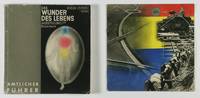
1935réf. 55920Berlin: Gemeinnützige Berliner Ausstellungs- Messe- und Fremdenverkahrs-G.m.b.H. 1935. First edition. Softcover. vg. Protected by modern mylar. Being educated at the Bauhaus in Weimar from 1921-1925 among others by Johannes Itten Paul Klee and Wassily Kandinsky Herbert Bayer had been appointed the head of the Bauhaus workshop Print and Advertising in Dessau in 1925. After the takeover by the Nazis in 1933 Bayer and his staff dorland studio worked for the Nazis designing exhibition literature as well as propaganda material. His first design of an exhibition and its catalog was for the groundbreaking NS-Exhibition "Die Kamera - Ausstellung für Fotografie The Camera - Exhibition for Photography." The second major project was the 1934 exhibition "Deutsches Volk - Deutsche Arbeit German People - German Work." Again he and his "dorland studio" designed the exhibition catalog. And in 1935 the third exhibition "Das Wunder des Lebens" followed by the exhibition "Deutschland" on the occasion of the Summer Olympics in 1936. This collection of three items relate to the exhibition "Das Wunder des Lebens" propaganda for the racial ideology of the National socialists. It was shown in Berlin at the Kaiserdamm and the Deutsche Hygiene-Museum Dresden in 1935 and traveled to other locations e.g. Vienna and Krakow. The exhibition was another step into the direction taken with the exhibition "Deutsches Volk - Deutsche Arbeit" in Berlin 1934. The exhibition "Das Wunder des Lebens" introduced new exhibition techniques around the theme "Der Mensch The Human." The major themes of this extensive exhibition were "Die Lehre vom Leben The Teachings of Life" with its hightlight sculpture "The Vitreous Human" produced of "Cellon" a cellulose acetate "Träger des Lebens Bearer of Life" featuring the German family and finally the "Erhaltung des Lebens The Preservation of Life" exhibiting facts about the health system in Germany. One of the highlights of the exhibition was the so-called Mikrovivarium a collection of small life-forms visible only through a microscope. Next to the thematic description of the exhibition the leaflet contains general information about the exhibition and two maps with information on transportation to the location within and from outside Berlin. Extremely scarce leaflet for the exhibition in near fine condition. 1. Amtlicher Führer durch die Ausstellung Das Wunder des Lebens. Berlin 1935 Kaiserdamm. Octavo. 160 viii 32pp. Original wraps with photomontage cover by Herbert Bayer. Official guide for the exhibition "The Miracle of Life." An important work by Bayer who designed both the exhibition "The Miracle of Life" and the exhibition catalog. Illustrated throughout with photographs and diagrams. Laid in two b/w postcards of the exhibition one of the the "Honor Hall" at the exhibition. Light weaar along edges of wraps minor chips and creasing and 0.5" closed tear at tail of spine. Wraps in overall good interior in very good condition. 2. Octavo. 20pp. Original color-illustrated stapled booklet. Elaborate avant-garde design incorporating various styles e.g. photomontage surrealist and constructivist elements. Designed by Herbert Bayer. The booklet with its modern visual aesthetics propagates the Nazi utopia of an Aryan society. The text is a romanticized though detailed version of the exhibition themes "Die Lehre vom Leben The Teachings of Life Träger des Lebens Bearer of Life and Erhaltung des Lebens The Preservation of Life" with an extraordinay visual display reproduced in high-quality color offset. Missing the cover. Light wear along edges. Overall in very good condition. 3. Three photo-postcards announcing the 1935 exhibition "Wunder des Lebens" in Berlin one featuring a photograph of the sculpture "Der gläserne Mensch" another showing one of the galleries of the exhibition in Berlin both in b/w and printed by Industrie-Fotografen Klinke & Co. Berlin. The third b/w photo-postcard features the "Ehrenhalle Honor Hall" of the exhibiton "Das Wunder des Lebesn" without photo credit. Dr. Herbert Michel department supervisor at the museum emphasized health as the great treasure of the individual and therefore the people at large. He strikes the typically nationalistic cords in depicting "the human as the highest organism a living example of the leadership principle. as part of the people he is obligated to develop his body to its highest capacity to acquire all inherited assets. The purpose of this exhibition is to help understand this concept." The guide contains chapters elaborating on the various functions of the body supported by b/w reproductions of photographs from the exhibition including a photograph of the Museum. There are no references to originators of exhibited works. Front cover with minor creasing. Some age toning of block. Wraps and interior in overall very good condition. Gemeinnützige Berliner Ausstellungs-, Messe- und Fremdenverkahrs-G.m.b.H. unknown books
1942réf. 58639Washington DC: El Coordinador de Asuntos Interamericanos 1942. Poster. Good. A suite of three WWII posters 20" x 14". Each poster has been mounted to a thin cardboard. With some creasing and occasional small losses from the edges. The largest loss is from the top right corner of the "palabra" poster measuring 4" x 3". The posters also have a general layer of light glue-staining. Three American WWII posters depicting the themes of Freedom of Worship Freedom from Want and Freedom of Speech. These posters were meant to highlight Franklin D. Roosevelt's four freedoms here three and to sway Latin American opinion against Germany Italy and Japan. The Spanish text at the foot of each poster reads: "One of the 4 liberties for which the allies fight." Edward McKnight Kauffer 1890-1954 was an American artist and graphic designer who worked mostly in the realm of poster art. He was born in Montana however he moved to England and became an expatriate. He was very influential in Europe however he was only known in the United States by a handful of those well versed in the study of design. Interestingly despite his obscurity in America in 1937 the Museum of Modern Art gave him a prestigious one-man show. At the time of the exhibition copy agents were continuing the tradition of using posters with romantic imagery and only a few designers were able to gain any attention from breaking free of this type of imagery. Still remaining in obscurity Kauffer returned to England only returning to New York City after the war broke out in 1940. He only received honors in the United States posthumously when he finally received an AIGA award. Russian born American artist Alexey Brodovitch 1898-1971 was most known for holding the art director's position at Harper's Bazaar fashion magazine during the years of 1934-1958. Like Kauffer Brodovitch played a significant role in introducing the United States to a substantially simplified modern design already popular in Europe. While at Harper's Brodovitch used art created by Man Ray Salvador Dali and A.M. Cassandre. Brodovitch received an AIGA award in 1987. Three boldly modern posters created by two artists who helped pioneer the modern poster in the United States with its symbolic imagery and social relevance. El Coordinador de Asuntos Interamericanos unknown books
1923réf. 004668London: Martin Secker first two issues Cecil Palmer third issue. Printed by Vincent Brooks Day & Son 1923. First edition. Wraps for first issue hardcover paper pastedown second two issues. Very Good. Literary journal with extraordinary roster of contributors including Max Beerbohm Siegfried Sassoon T. E. Lawrence John Doyle Enoch Soames Robert Graves John Crowe Ransome John Masefield John Galsworthy Thomas Hardy Walter de la Mare Rockwell Kent Vachel Lindsay Edwin Lutyens William Nicholson etc. 4to. 32 by 25 cm. Mostly poetry with also a mix of stories dialogues etc. and lovely plates quite a few in color. All produced handsomely and though short-lived the confluence of talent marks these as an unique undertaking. Minor edge chips to wraps of the first volume. Chips along the joints and the spine of the second. Within the leaves are age toned with some scattered light foxing. Martin Secker (first two issues), Cecil Palmer (third issue). Printed by Vincent Brooks, Day & Son unknown books
1940réf. 46606Berlin: Vereinigte Verlagsgesellschaften Franke & Co. KG 1940. First edition. Softcover. Very good condition. Quarto. 8pp. Original photo-illustrated wraps with white lettering on cover. Illustrated promotional supplement of the periodical Illustrierter Film-Kurier in gravure. The 1940 film "Der ewige Jude" is a propaganda documentary about the world Jewry after an idea by Eberhard Taubert. As part of Goebbels' anti-Semitic strategy this film followed the 1937 art exhibition "Der ewige Jude" in Munich and the publication of a book in the same year and with the same title both with derogatory captions asserting the "degenerate Jewish race." Goebbels took an active role in the production of the film and insisted on Fritz Hippler as the director for the film. After the invasion of Poland Goebbels instructed Hippler to send camera crews to Poland to collect footage of Polish Jews. The film starts with an "impressive" foray through the Jewish ghettos in Poland depicting the Jews in filthy living conditions making a living through profiteering instead of honest work. The footage was manipulated in a way to show the Jews as originating in Palestine and from there flooding the earth drawing parallels to the way rats spread through new territory stressing the Jew's ability to adapt to various life styles. The promotional is illustrated with photomontages depicting Jews from various walks of life Polish street scenes a Rabbi holding up a knife in line with the brutal depiction of a Shechita as the face of Jewry juxtaposed with gleaming pictures of content German people and thankfulness towards a government willing to solve the "Jewish problem." Text in German. Slight wear along edges small closed tear at bottom of last page and some minor chipping along edges. Vereinigte Verlagsgesellschaften Franke & Co. KG unknown books
réf. 156601N.p.: N.p. 1980. Archive of 133 vernacular photographs from an custom automotive upholstery shop the "Auto Seat Cover Co." located in Harrisburg Pennsylvania housed in acrylic photo sleeves in a photo album circa 1961-1983. The majority of the photographs in the archive appear to date from the 1970s capturing before and after photographs and ornate custom automotive upholstery in acrylic cloth and leather. Archive also includes six photographs of the company's trade show booth circa late 1960s four photographs of the interior of the business circa early to mid 1960s as well as five photographs of the flooding of the business likely the Harrisburg flood of 1972 and three photographs of a home upholstery job circa early 1970s. 3.5 x 2.5 inches to 4.5 x 3.25 inches the majority approximately 3.5 x 3.5 inches. Very Good plus to Near Fine overall. Photo Album 12.75 x 8.5 inches. Near Fine. N.p. unknown books
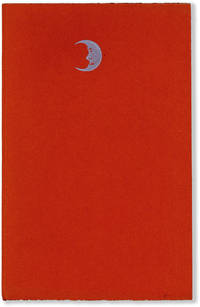
réf. 65888West Burke VT: Janus Press 1976. First Edition. One of 150 copies unsigned as issued. Orange wrappers with silver moon decoration printed in two colors with double-page cut-out endpapers; 8vo. ".designed handset in Monotype Times Roman printed torn cut and bound by Claire Van Vliet at the Janus Press on and of Kozu Fabriano and Canson paper. The endpapers are the topiary gardens of Levens Hall Westmorland England. This is copy no 85." Back cover almost imperceptibly sunned along the front edge else Fine unopened. Claire Van Vliet's work has been heavily collected for over 50 years well before she won an early MacArthur Foundation "genius" grant in 1989 with many institutions subscribing. This title particularly elusive in the trade. Janus Press unknown books
1930réf. 42955Philadelphia 1930. Very good. Extensive custom catalogue containing metal fixtures and display equipment for hardware stores published by David Lupton's Sons a steel company based in Philadelphia. The catalogue includes suggestions for store layout providing examples of merchandise display on Lupton display cases and shelving with extensive diagrams showing the proper distribution of for example various-sized shovels on a particular shelving unit. From a stamp appearing several times throughout the album and on a piece of laid-in marketing ephemera which reads "Bowes Hardware & Plumbing 425 Danforth Ave Toronto" this particular album was almost certainly compiled by Lupton for Bowes as part of its "Store Planning Service" referred to on the album's cover. A fascinating example of the marketing and merchandizing of U.S. hardware store equipment and a glimpse into the process of starting a North American small business during the height of The Great Depression. Hardcover. Oblong 4to. album. Screw-bound leather-covered boards with publisher's text in printed in gold to front cover. Holds photos diagrams text and paint swatches all affixed to 29 dark-gray stiff leaves divided into four sections. Appears almost entirely complete with corners of several captions torn off. Album about very good overall with many affixed papers toned from age or glue-stained but all remain readable. Sound overall. Additionally laid-in are 21 clippings and advertising ephemera relating to hardware stores including several in Toronto. unknown books
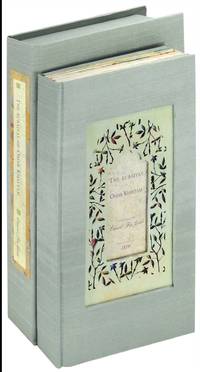
réf. 36224Freeville NY: Carol Schwartzott 2007. Hard Cover. Fine in very good box. Hard Cover. 5 of 25 copies signed and numbered by the book artist. This is a particularly beautiful version of the famous Rubaiyat. In her artist's statement Schwartzott writes that as a collector of Rubaiyats she began to toy with creating her own version in 2006. "The book is divided into seven segments each separated by a divider of hand-marbled Japanese paper. The first contains the title page and introduction and the last an artist's statement bibliography and colophon. The remaining five are dedicated to the seventy-five quatrains of FitzGerald's first edition. Each contains a vellum window reminiscent of a Persian archway that opens to reveal my version of a miniature painting." Bound in light blue Japanese cloth with an intricate wood cut out to front board. The pristine interior was laser printed with archival ink onto Mohawk Via vellum and Moab Entrada paper. The prints were then finished with color pencil paint gold and silver leaf. Housed in clamshell box covered in the same cloth as the book. There is a light crease to the upper left corner of the box otherwise in fine condition. Unpaginated. ARTB/122122. Carol Schwartzott unknown books
1925réf. 877511925. DESIGN Shimomura TAMAHIRO. TAMAHIRO GASHU. Kyoto & Tokyo: Unsodo Taisho 14 1925. Single sheets cord-bound into illustrated boards with a printed paper title label. 36.2 X 25.3 cm. There are 16 pages of color woodblock printed designs and 30 pages of bw collotypes. One of the hybrid design books that Unsodo created in the 20s and 30s. Very clean and bright in the original publisher's slipcase. A very unusual and late effort by Tamahiro 1878-1926 an important Unsodo designer who began his work for them at the turn of the century. Even more unusual in such lovely original condition. Complete. unknown books
1939réf. List01103Holyoke and Northfield: Litho Inc. / American Youth Hostels 1939. First Edition. Includes: Bicycle for Adventure on the Youth Hostel Trail. Holyoke Massachusetts c. 1939: Valley Litho Inc. Lithographed poster 19 x 25 inches; Take to the A.Y.H. Trail. Northfield 1939: American Youth Hostels . Lithographed poster 17 x 22 inches; Hostellers Know.Northfield 1939: American Youth Hostels Inc. Lithographed poster 17 x 22 inches. All are signed “Isabel” in images. Excellent condition overall with some toning small chips and various wear to margins but overall quite well preserved. Near Fine. Isabel and Monroe Smith a married couple from Northfield Massachusetts started the American Youth Hostel movement in 1933 after gaining inspiration from Richard Schirrman’s German Hosteling Organization. The movement grew quickly with thirty hostels operating throughout New England within the first year. The first hostel was the Northfield Chateau a large mansion on Birnham Road that was eventually demolished in 1963. The network of chaperoned hostels created the opportunity for safe bicycle-based travel as shown in the posters offered here. Offered here are three early posters from the movement designed by Isabel Smith each with her signature in the image. All posters are variations on the cycling theme. One of them states that “When the grand day’s bicycling is done… no fare can compare with the Royal ‘Hostellers’ Own.” Smith’s design aesthetic is quite accomplished and we are surprised to find no examples of these in institutional collections. Overall a visually compelling group uncommon. Litho Inc. / American Youth Hostels unknown books
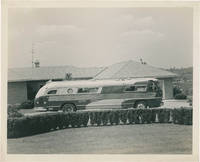
1954réf. 160645Loudonville OH: The Flxible Company 1954. Archive of 22 vintage photographs of the Flxible Land Cruiser motorhome circa 1954. Of the 22 photographs in the collection 17 bear stamps on the versos six bear annotations noting serial number and descriptions and eleven bear stamps noting the serial number model and company. The collection includes one photograph of the exterior of the motorhome and 21 photographs of the very mid-century modern interior frequently with models in various positions demonstrating the vehicle's comfort and luxury. Eight of the photographs note a serial number beginning with "B53" and one photograph notes a serial number beginning with "B54" likely indicating production in 1953 and 1954. Founded in 1913 in Loudonville Ohio Flxible was a manufacturer of motorcycle sidecars funeral cars ambulances intercity coaches and transit buses. In 1948 Flxible introduced its Land Cruiser model a standard 29 passenger Clipper shell with an elaborately furnished interior heralding a new era in recreational vehicles and introducing the motorhome to the American public during the automobile boom of the 1950s and 1960s. Notably the vehicle proved popular with R&B and country musicians providing a comfortable and practical vehicle for touring preceding the arrival of the modern tour bus. The company sold its Land Cruiser division to Custom Coach Corporation in 1955 and discontinued marketing the finished conversions while continuing to manufacture the shells of the vehicles. The last Flxible vehicles were produced in 1995 and the company declared bankruptcy in 1996. 10 x 8 inches. Very Good plus with approximately half the photographs with faint cracking to the emulsion and four with even toning. The Flxible Company unknown books
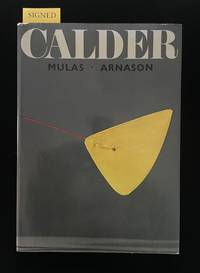
réf. 013557NY: Viking 1971. Hardcover. Near Fine/Near Fine. Presentation copy by Calder to author and art historian Arnason. Inscribed with Icelandic spelling of Arnason's name in blue ink on the ffe by artist Calder to H. Harvard Arnason who wrote the critical text and Arnason's wife Elinor: "to Elinor and Hahvrarhd Arnaasonn Goda Knjda. Sandi Calder Hotel Stanhope Hope for lunch" H. Harvard Arnason 1909 - 1986 was Canadian-born of Icelandic immigrant parents. As an art-historian educator and museum administrator he served as executive at the Guggenheim Museum in NYC in the 1960s and authored many books; his "History of Modern Art" 1968 remains the authoritative textbook on the topic. Near fine in dustjacket. Viking hardcover books
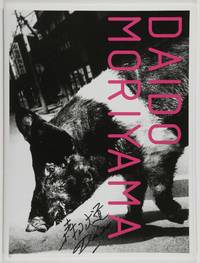
2004réf. 48646London: Guiding Light/Michael Hoppen Gallery 2004. Limited first edition. Softcover. near fine. 1/100. 15 1/2 x 11 1/2". Elephant folio. 82pp. 2. Unbound folded leaves. House in a lined translucent and re-sealable electrostatic shielding bag with a hand-numbered sticker on the front. Printed photo-illustrated b/w wrapper with pink lettering on the front cover. #95 from a limited edition of 100 numbered copies with a signed original 8x10" b/w print. Print protected in plastic. This copy is also signed by the photographer on the front cover of the publication in black marker. A large scale catalog issued in conjunction with the exhibition Daido Moriyama: Vintage Prints at the Shine Gallery and Michael Hoppen Gallery London held February 2004. Profusely illustrated throughout with finely printed large scale b/w photographic reproductions after unpublished images from the acclaimed Japanese photographer's work. Initial text from photographer William Klein and gallerist Michael Hoppen on the interior front cover. From the publisher: "A collection of rare vintage prints from Moriyama's own personal collection providing a substantial body of work from the 1960's 70's and 80's previously unseen in public. A stray dog is caught in strong shadows against a high-contrast background piercing the viewer with an unwavering gaze. The best-known image of Moriyama it encapsulates perfectly the detached observation and raw unsettling style of this highly influential Japanese photographer. Along with Eikoh Hosoe and Kikuji Kawada Moriyama has gone from being one of Japan's most radical and rebellious photographers to being one of it's most celebrated and important visual artists today the Japanese equivalent of Robert Frank. Recently Moriyama has had important retrospectives at the San Francisco Museum of Modern Art the Shimane Art Museum Kashiro Art Museum Japan and the Fondation Cartier." Catalog and print both in near fine condition overall. Guiding Light/Michael Hoppen Gallery unknown books
1894réf. 013830Boston: Copeland and Day 1894. First Edition Thus. Hardcover. Very Good. As stated on the colophon the first complete edition this one of 500 copies on French paper with lettering and decorations by Bertram Grosvenor Goodhue in a custom inlay leather binding by Virginia Chester signed and dated 1911. Full dark green crushed morocco elaborately decorated front and rear covers and their versos aeg. Executed in Art Nouveau style perfectly appropriate to Goodhue's decorations. Signed by Chester with gilt pressed conjoined initials VC flanked by 19 and 11 for 1911 at the bottom of the rear inside cover. Spine moderately worn corners worn joints too more noticeably to front and shallow loss at spine ends more noticeably at top. Chester dropped out of university in Illinois in 1902 due to illness and took up bookbinding as a hobby. She never returned to college but continued professionally with bookbinding studying in Chicago with Gertrude Stiles in New York with Helen Haskell and in Paris with Henri Mulhae and Jules Domont. Around 1912 or so she returned to the Chicago and opened her own bookbinding studio in the Fine Arts Building. Penciled at the bottom of the fly leaf is perhaps her notes or a collector's: "Virgina Chester / Chicago/ 1024 Fine Arts Bldg/ code/ 11/28/13/ code". This binding appears to have been influenced by French design and technique. Copeland and Day hardcover books
1947réf. 39069Fanara Egypt: Der Tribüne 1947. First edition. Softcover. g to g. Folio. Unpaginated. 11 leaves. Original illustrated wrappers. This rare issue of "Schlemil" a German POW Camp Newspaper provides a first-hand account of the feelings and emotions of the men as well as their day-to-day activities during their internment in Fanara Egypt. This issue the fourth was the first published in 1947 issues 1-3 were published in 1946. The last issue No. 8 was also also published in 1947 shortly before the prisoners were shipped home 1947 through 1948. Of all the German POW camps camp 307 had the highest rate of German mortality. The reason can primarily be found in the harsh climatic conditions. Indeed unlike to the soldiers of the Africa corps who were fit for the tropics the soldiers who were taken prisoners in Italy Greece and its islands had many difficulties with the climate in Egypt. Hot wind and sandstorms in spring great heat in summer and severe cold in the winter impaired life in the strange climate. This led to the well known "Declaration of the captured Lutheran Pastors in Egypt". The front cover of this copy of "Schlemihl" features a drawing depicting a German POW painting a newlywed couple with the year 1947 at the upper left corner. The illustrator must have expressed to see his wish come true being freed and shipped home and marry his sweetheart. The newspaper contains poetry and short stories with a strong anti-Nazi stance. There are 5 other illustrations throughout the whole issue. Each leaf is printed on recto only. Some age-toning and creasing to wrappers with tiny chipping and closed tear at upper front and back cover. Upper corner slightly creased throughout. Text in German. Wrappers in overall good interior in good condition. Declaration of the captured Lutheran Pastors in Egypt: The captured Lutheran Pastors in Egypt moved by the emotional situation of their fellow prisoners in the Middle East which has become extraordinarily critical and in obedience to their sworn duties of office would like to make the following declaration before the British authorities before the German public before their fellow prisoners and also before the Christians of the world. For at least the last two and a half years and for the most part substantially longer periods German Prisoners of War have been held in the Middle East whose number at this time amounts to more than 60 000. They have been put to work in a climate which for half the year is positively unbearable for a European. Through the long duration of imprisonment through the separation from their relatives through the bad news from home through the impossibility of effectively helping them their relatives and for many the “C” people through the completely immeasurable continuance of their imprisonment the emotional burden of these prisoners has reached a degree which gives grounds for the gravest fears for the future. The symptoms which are already manifesting themselves are shocking enough: the incidences where prisoners break down emotionally so completely that they become mentally ill are increasing. Alone in one Work Company 2719 of 5000 men no fewer than six prisoners have been admitted to the appropriate department of the British military hospital because of mental illness. Above all the cases are increasing where prisoners are ending their own lives which appear unbearable to them. In the last month in just one of the three British Military Districts in Egypt five cases of suicide are known to us. This is because the majority of Prisoners of War in the Middle East have come to a total collapse of trust in the promises and declarations of the British custodial powers. The emotional strain which has arisen from this among the Prisoners of War is extreme. The most important reasons to name only these few which have led to this crisis are the following: 1. At the end of last year more than eighteen months after the capitulation the Prisoners of War were advised of the Repatriation Plan as it was to be binding for the year 1947. This Repatriation Plan gave the individual the opportunity to envisage within an admittedly broad framework according to his score and his political classification his return home. This plan has not been carried out. On 30 September 1947 the British Government announced that it would be necessary for it to reduce the repatriation to a fraction of the planned quota because of shortages of ships. Can one think ill of Prisoners of War that they held the following declaration which had been printed in the papers for some time against the British Prime Minister Attlee: that the work of the Prisoners of War at this time was the only available reparation from Germany and could not be done without Or that they received the impression from the speech to the Lower House on March 27 of the Member of Parliament for Ipswich Mr. R.R. Stokes that the reason for the sluggish pace of the repatriation from the Middle East is that the local British authorities held the manpower of the Prisoners of War to be so indispensable that they would simply have to wait for repatriation Can one think ill of the German Prisoners of War who due to previous experience are already full of mistrust today take into consideration that the almost complete halt to repatriation will not just last until the end of the year but that probably the closing date for repatriation the end of 1948 won’t be adhered to With great and honest thankfulness the Prisoners of War of the Middle East have experienced the intervention for the easing of the lot of the captured and their speedier return home by men of the British public above all from a great number of Bishops the Member of Parliament Stokes a man such as Viktor Gollancz and finally a group of more than sixty Lower House members. In the Middle East hardly any of this has come about and the result is growing bitterness and hopelessness instability and despair amongst the Prisoners of War. 2. A further and exceedingly grave burden for the morale and emotional bearing of the Prisoners of War lies in the recently released regulation that in future Prisoners of War will only be allowed to take in the vicinity of ten pounds of approved luggage to Germany. Germany faces another winter of starvation. Thousands of Prisoners of War have saved their hard earned tiny wages for months and years and have allowed themselves nothing in order to be able to bring a few tins of fat which is lacking most and other foodstuffs to their relatives. Many came to terms with the repeated deferment of their repatriation and found themselves a new mainstay by telling themselves: I can help my relatives to at least a small extent by sending along foodstuffs especially fat with returning comrades. Because of the new announcement all this is brought to nought. It has aroused bitterness particularly because it is so completely incomprehensible. The foodstuffs in question are in the markets in Egypt and can be obtained in the camp canteens in great quantities to be used by the Prisoners of War at will. Why should they not be able to save these and take them home No one is hurt by this and the money which is spent stays in the country. Finally particularly destructive and embittering is the thought that contrary to the natural development of things where the treatment of Prisoners of war should be gentler and better with the growing interval since the end of the war it is only becoming sharper and more severe. The Prisoners of War can absolutely not understand that they who have actually already have been discriminated against through their late return home are further discriminated against in the hardest and most burdensome way by the aforementioned announcement while the comrades who were lucky enough to return home earlier could take such foodstuffs so vitally necessary for a starving Germany freely and without limits. 3. A further hardship and exceedingly heavy emotional burden is the treatment of the Prisoners of War who have placed under “Automatical Arrest” A.A. namely those whose identity is suspected to be that of a wanted war criminal or those who are needed as witnesses in such a case. They are held in custody here indefinitely often being unable to discover why and without sentence. Despite the fact that the British authorities have had at least two years and often considerably longer at their disposal to prove identities and make investigations in countless cases the affected Prisoners of War are put under “A.A.” only hours before their repatriation. In two cases men were even fetched down from the repatriation ship a procedure which it is hardly too harsh to characterise with the expression “emotional abuse”. Apart from all rules about humanity this kind of procedure also contradicts all accepted laws in the Allied countries in that Prisoners of War are punished for being war criminals when they haven’t been convicted. Indefinite imprisonment for a Prisoner of War who has waited for repatriation according to a classification and score is nothing other than punishment. An example: A Prisoner of War rank Oberfeldwebel Staff Sergeant was placed under “A.A.” in December 1945 without being given any notice because he was mistaken for his brother a Leutnant Second Lieutenant who had died in the war. His assertions were not believed. He pointed out that a comrade of his dead brother could be found in the same camp and could be interrogated about this. This was refused. Only after the intervention of a Lower House member Mr. Stokes who was approached about it was the case taken up. The interrogation of the commandant was carried out and the affected person released although subject to the agreement of a superior central office. He has still not been repatriated to this day despite being scheduled for repatriation by British doctors since April because of severe asthma. That is one of several dozen cases. It is understandable that the feeling of complete absence of rights emotionally oppresses particularly these Prisoners of War and brings them to despair. 4. The Prisoners of War gratefully acknowledge that the vast majority of commandants of camps and of work companies honestly strive to lighten their burden through good food through the improvement of canteens and recreation rooms through sporting events radio cinema theatre and musical performances and also through opportunities for further education. They have complete understanding for the fact that because of their special situation in Egypt their freedom of movement cannot be as extensive as in England itself. What they do not understand however is the severity of punishment with which often only a trifling offence is often only punished by mistake. In many cases the admissible maximum penalty – twenty-eight days’ detention - is lengthened. In most of the cases the severity of the punishment bears no relationship to the severity of the misdemeanour. An example: In recent times a Prisoner of War was punished with fourteen days’ detention and loss of Work Points ie the extension of his captivity by many months because he had accidentally and not on purpose had the command post flag of a passing British military car. Examples of this sort could be continued for a long time. The severity of such penalties have a particularly hard emotional effect on the Prisoners of War who are in the third to fifth year of their captivity none of them any longer in complete possession of their emotional resilience. They therefore experience these punishments as more severe than another person would. We captured Lutheran Pastors in Egypt have hitherto purposely kept silent before the public about the completely unnecessary cases of severity and the partly open injustice for example physical mistreatment of Prisoners of War in the Detention Centres. We have tried through personal calls at the responsible British departments to do away with these things in the belief that this was about the unauthorised actions of a subordinate authority such as they appear in every human community. We asked ourselves earnestly whether we could continue to keep silence in the present situation. In thinking this we considered that one had - and rightly so - reproached our Nation and our Lutheran Church with silence when we should have spoken out. In the Stuttgart Declaration of October 1945 the Lutheran Church did penitence for this failure before the whole world. From this in earnest self-examination we came to the opinion that in further silence toward the injustice that has happened and still does happen to the Prisoners of War in the Middle East we would be guilty before the office of spiritual care which is our command before our consciences before our Lutheran Church in Germany and our German People and not least before God the Lord in front of whose Judgment Seat we will all one day need to answer for ourselves. We would have to be silent if our opponents in the past war had told us that they wanted to fall upon us in the name of revenge and retaliation. Then we would only have been able to say to our fellow captives: See where unlawfulness and Godlessness lead; see how the dreadful law of retaliation makes itself felt! In that case we could only have bowed dumbly before the deserved justice of God. But our former opponents did not say this. Rather they ceremoniously proclaimed that in the names of justice and humanity and in the spirit of Christendom with their unchanging qualities they had gone into the war and brought it to an end. In this spirit they would lead our people in a new way. That however gives us the courage and the right; today it lays the holy duty upon us as spiritual carers for our fellow captive brothers with all the earnestness of our duty of care to beg their leading personages and their responsible authorities to no longer passively watch the injustice that has been and is still being done to the Prisoners of War in the Middle East but rather to remedy the great spiritual need and despair which daily continue to gain ground through practical effective and quick measures. We have the bitter and serious concern that otherwise our fellow captives in the Middle East will lose the ultimate and best thing that we in the spirit of Christ so dearly wanted to show them how many have already lost it!: the belief and trust that in this world not power not the spirit of vengeance and retribution not the justice of the strong have the last word; rather that co-existence in the spirit of right justice humanity reconciliation and brotherly helpfulness within nations and between nations is possible. In the name and by order of the captured Lutheran Pastors in Egypt. Signed Norbert Rückert Dean of Pastors for the Middle East P.W. Camp 380 11 October 1947. Der Tribüne unknown books
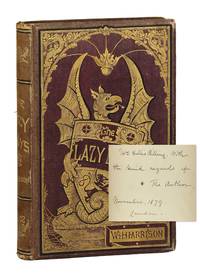
1877réf. 30067London: William H. Harrison 1877. Very Good. London: William H. Harrison 1877. First Edition. Octavo 18.5cm.; publisher's purple pictorial cloth designed by Florence Claxton elaborately embossed in gilt and black all edges gilt black glazed endpapers; iv5-156pp. Cloth a bit scuffed and worn along extremities with brief exposure at corners and spine ends spine cloth faded brief split to rear joint rear hinge cracked but holding textblock slightly shaken in binding else a Very Good bright example. Inscribed on front flyleaf to the American medium "Mrs. Hollis Billing With the kind regards of The Author / November 1879. London." Scarce collection of humorous poems and vignettes by the British author and editor of The Spiritualist. Running in the London Spiritualist circles Harrison would presumably have made the acquaintance of the inscribee American medium Mary Hollis Billing and her husband who served on the 1877 Committee of the Theosophical Society in London. Contents only glancingly Spiritualist though true to form the imprint provides the publication date based on different calendars: A.D. 1877 Popular Chronology; A.M. 5877 Torquemada; A.M. 50800077 Huxley. Like many Spiritualists of the day Harrison was especially interested in photography and several pieces in this volume relate to the art and science of the form. Notably "The Lay of the Photographer" describes in nineteen stanzas the chemical transformations of pyroxylin iodine and silver to develop photographs. Needless to say the poem is not very good. Advertisements for the present work attribute the cover design to British illustrator cartoonist and fringe Pre-Raphaelite Florence Claxton 1838-1920. One contemporary reviewer aptly describes the book as "handsomely-bound and griffin-guarded" Liverpool Daily Courier. William H. Harrison unknown books
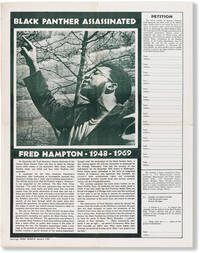
1970réf. 62907Detroit: People Against Racism 1970. First Edition. Original illustrated poster with text and photographic portrait of Hampton offset printed in black and dark green on white stock measuring 44.5cm x 57cm 17.5" x 22.5". Light wear and a few thin strips of toning to extremities two old folds smoothed out with a few tiny edge tears and some toning to upper half on verso; unbacked; Very Good. Attractive copy of this poster issued in the months following the death of Fred Hampton Chairman of the Black Panther Party's Illinois chapter and Deputy Chairman of the national BPP. Given his position and his involvement with both the NAACP and SNCC Hampton's profile was rising rapidly at the national level; he was assassinated on December 4 1969 while sleeping in his apartment during a raid by a tactical unit of the Cook County IL State Attorney's Office in conjunction with the Chicago Police Department and the FBI. This poster issued by the Detroit-based People Against Racism includes a petition along the right edge calling for the creation of an investigating commission to determine responsibility for the murders with spaces for names and signatures and a plea for funds. OCLC notes 4 holdings Yale Northwestern U.Kansas Wisconsin Historical and we find 2 others at OMCA and the Hoover Institution. People Against Racism unknown books
1918réf. 869371918. DESIGN ODA Kazuma artist and designer. OYO ZUAN Gekkan Dai-ichi-go. Tokyo Papiyon Zuansha Taisho 7 1918. Folio-sized wrappers 34.5 x 24.2 cm. This "Practical Design" monthly features the work of Oda Kazuma 1882-1956 in this its first issue. This issue features articles on the use of electric lights at night for advertising with a note at the end on some recent advertising posters that have appeared. Obviously a periodical by professionals for professionals in the design and advertising world. Not a world one usually thinks of Oda Kazuma belonging to but here he turns his talents at lithographic printmaking to more practical ends with sevarl examples of advertising designs and commercial art. Very good condition throughout. Very unusual. unknown books
réf. 45451New York: Arista Records 1975. Good. New York: Arista Records 1975. Original record store poster 86x61cm printed offset lithograph reproducing Robert Mapplethorpe's iconic photographic portrait of Smith which also appeared on the album's sleeve. Old fold lines with subsequent rubbing to paper stock ragged pinholes at corners uneven dampstaining. Overall a Good only example of this extremely rare poster with heavy signs of use either at a record shop or equally likely a dorm room. Promotional poster to Patti Smith's first solo album "Horses" released at the end of 1975. The album recorded at Electric Lady Studios and produced by the former Velvet Underground member John Cale was one of the earliest releases under the Arista Records label. Arista founded in 1974 by Clive Davis quickly established itself as a force in the 1970s music scene signing Barry Manilow Aretha Franklin Patti Smith and Dionne Warwick all in quick succession. "Horses" while not a runaway hit was an instant classic respectably reaching no. 47 on the Billboard 200 with songs like "Gloria" "Redondo Beach" and "Free Money." We find no copies of this poster in the trade auction records or OCLC as of September 2025 though we do locate an example at MoMA attributing the design to Bob Heimall. Arista Records unknown books
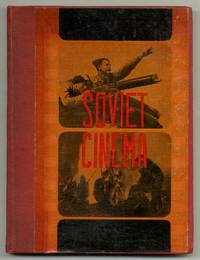
1935réf. 553702Moscow: VOKS 1935. Hardcover. Near Fine. First edition. Design and photomontage by V. Stepanova and A. Rodchenko. Quarto. 312 12pp. Text in English. Quarter red leather and cloth with paper illustration over boards. Endpapers illustrated with film images on photo paper. Extensively illustrated with innovatively illustrated half-title and title page with film illustrations in color tipped-in celluloid sheet with Stalin's silhouette a folding plate of a theatre and audience etc. Publication celebrating an overview of the Soviet cinema with contributions by many profiles of filmmakers mention of the industry in Soviet Union vassal states etc. Near fine. VOKS hardcover books