593 résultats
1933réf. 900971933. DESIGN FUJII Tatsukichi 藤井é”å‰ designer. SÔSAKU SENSHOKU ZUANSHÛ 創作染色図案集. A Collection of Designs for Dyework Tokyo & Osaka: Bungado Showa 8 1933. Large portfolio 41 x 31 cm. decorative cloth covered clasped chitsu case with a printed decorative label all enclosed in the publisher's folding cardboard outer box. A 4 page fascicle of preliminaries and a table of contents. With the chitsu design the cover design 3 preliminary page designs and 61 designs on the 50 content fascicles. The designs are primarily in color woodcut printed on both paper and occasionally cloth. A beautiful production here in almost perfect condition. Fujii Tatsukichi 1881-1964 was one of the most important reformers of the traditional arts in Japan. His creativity touched nearly every area: lacquer pottery papermaking dyeing - his influence was enormous. This scarce and lovely portfolio of his original designs helps to illustrate why he was so important. This deluxe production cost 25 yen in 1933 - a princely sum during the depths of the Depression in Japan. Complete. unknown books
1815réf. 832561815. DESIGN Matsuoka Tokikata; Honma Hyakuri. SHOKUMON ZUE. 7 vols. privately published by Hyakuri apparently from 1815-25 as a completion of work begun by Tokikata in the late 18th very early 19th century. 19.3 x 26.9 cm string-bound Japanese-style fukuro toji with printed paper title labels - all bindings match. Hundreds of beautiful color textile designs reproduced in color woodcut. Nobleman Ladies Ceremonial dress Brocades Imperial costumes all are covered. Important and quite scarce as few sets were produced. Some worming otherwise the overall condition is very good. unknown books
1908réf. 884571908. DESIGN Sugiura HISUI designer. MITSUKOSHI; MITSUKOSHI TIMES; OSAKA MITSUKOSHI Tokyo & Osaka 1908-1923. Western-style magazines 24.9 x 18.4 cm decorated wrappers. Lovely covers most by Sugiura Hisui 1876-1965 or designed under his supervision. Hisui is the most important figure in the development of Japanese commercial art in the 20th century the progenitor of "Taisho Chic" and a force to be reckoned with as a practical designer at Mitsukoshi and an educator at the Japan School of Art the Imperial School of Fine Art and the Tama Imperial School of Art which he co-founded. He even spent two years in Europe in the early 20s researching design. He created many portfolios of design examples for professionals wrote treatises on the principles of design and was a tireless creator of posters and magazine covers. He began work at Mitsukoshi in 1908 as a design consultant in charge of cover art for the house organ MITSUKOSHI TIMES. When MITSUKOSHI magazine began in 1912 he had already been promoted to head of design for the company a year earlier and stayed in that position for decades. His artwork graced the covers of many magazines over the years but it was his work for MITSUKOSHI and MITSUKOSHI TIMES and OSAKA MITSUKOSHI that began his design career. We are offering here a group of issues of those magazines most with his brilliant cover art. The magazines as a form of trade catalog and guide to fashion for the well-heeled clientele of Mitsukoshi department store were intrinsically ephemeral. They are hefty magazines a vade mecum for the bon ton with pictures of summer frocks kimono fabrics morning coats shoes - with instructions on how they should be cleaned stored worn. With pictures and prices and order sheets. Useful and used then thrown away they are seldom found today. A gathering of this size is quite unusual especially as it begins with issues of MITSUKOSHI TIMES from 1908 - the year that Hisui took over design reponsibilities for the house organ. The issues: MITSUKOSHI TIMES 11 issues from 1908-13 Oct & Nov Meiji 41 1908; V.8 #s 4 & 6; V.10 #s 9 & 11; V.11 #s 4 7 11 & 14 V.12 #3. MITSUKOSHI 31 issues from 1912-1923 V.2 #4; V.4 #s 5 6 7 & 8; V.5 #s 4 5 7 & 8; V.6 #s 2 & 11; V.7 #s 6 7 & 8; V.8 #s 2 3 4 5 & 7; V.9 #s 4 5 6 7 9 & 12; V.10 #s 4 6 & 12; V.11 #11`; V.12 #3; V.13 #6. OSAKA MITSUKOSHI 2 issues V.4 #8 1915 a. unknown books
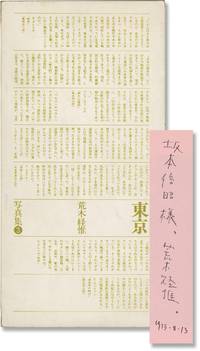
réf. 166381Tokyo: Fukusha Shudan Geribara 1973. First Edition. Softcover. First Edition one of 1000 copies. INSCRIBED in the year of publication from Nobuyoshi Araki to Nobuaki Sakamoto on the front endpaper. The third volume in Araki's following "Sentimental Journey" 1971 and "Okinawa: Sentimental Journey: Continued" 1971. A collection of photographs of women masturbating each image presented just below a photograph of Tokyo crowds waiting for the traffic light to change at crosswalks. A worthy follow-up to Araki's 1971 breakthrough collection "Sentimental Journey." Very Good plus in perfect-bound wrappers in a custom cloth folding case with bone clasps in the Japanese style. Parr and Badger I. Roth The Open Book: A History of the Photographic Book from 1878 to the Present. 802 photo books from the Auer collection. Araki: Self Life Death. A Book of Araki Books! 1970-2005. Japanese Photo books of the 1960s and '70s. Japanese Photo books 1912-1990. Fukusha Shudan Geribara unknown books
1901réf. 1717801901. NAKAMURA Gyokushu. Miyama no shiori. 2 volumes. 250 x 160 mm. Kyoto: Honda Unkido 1901. An exquisite collection of designs probably created as patterns for kimonos. In fine condition and extremely rare. Some of the plates have a distinctly modernist feel. There is some soiling but the stunning plates are immaculate. OCLC lists The National Diet Library and the Wolfsonian. unknown books
1965réf. 122002N.p.: N.p. 1965. A dazzling collection of ten original pressbooks designed by Saul Bass documenting the majority of the famed title and ad designer's work with director Otto Preminger in the 1950s 60s and 70s. Several of the pressbooks defy the conventions of pressbook design with custom shapes to represent items in keeping with the films for which they were made: "Advise and Consent" resembles a briefcase "In Harm's Way" is designed as a dossier with a string tie "The Cardinal" as a parcel and "Bunny Lake is Missing" as a newspaper. Other key titles in the collection include "Anatomy of a Murder" "Bonjour Tristesse" "Exodus" and "The Man with the Golden Arm." For most of the pressbooks in this collection we have never seen another example. A fascinating example of the advertising work done by the premiere title and ad designer of the twentieth century. Various sizes ranging from Very Good to Near Fine condition. Complete details available on request. N.p. unknown books
1916réf. 143509N.p.: N.p. 1916. Vintage Swiss one sheet lithograph poster made to promote the 1916 opening of Speck's Orient-Cinema in Zurich during the heart of the silent film era. Designed and illustrated by costume and commercial designer Ernst Deutsch-Dryden. The poster's illustration portrays well-dressed clientele watching a Western movie likely meant to represent a US import. During this period there was a push in Zurich as in all large European and American cities to build lavish new cinemas to accommodate the constantly growing public demand for films and elegant movie houses in which to view them. 27 x 39 inches. Linen backed with no extra linen borders with slight restoration at the folds and edges. Archivally framed with UV plexi. N.p. unknown books
réf. 36848Easthampton MA: Cheloniidae Press 1990. Hardcover. Fine. Hardcover. Number 21 of 100 xxi/c copies in the deluxe edition signed and numbered by illustrator and book designer Alan James Robinson. There were also 26 copies bound in quarter leather. This magnificent book was undertaken by the press as a celebration of its tenth anniversary. It is one of the great achievements of Robinson's Cheloniidae Press one of the most respected American private presses. Founded in 1979 the press went through several incarnations during its existence. The constant throughout was the artistry of Alan James Robinson who became famed for his superlative wood engravings and etchings of animals birds the sea and more. The original text for this edition was written by Arthur F. Kinney who was then the Thomas W. Copland Professor of Literary History at the University of Massachusetts and an extensive publisher and lecturer on Shakespeare. From the prospectus: this book "focuses on popular bird and animal lore and the way Shakespeare turns it into lines of haunting and indelible beauty by describing the familiar and unfamiliar ideas about many creatures and by showing how Shakespeare used these ideas to shape character and plot in his plays.Shakespeare's imaginative use of observed detail and magical fantasies is matched by the intricate and mysterious wood engravings of Robinson." Beautifully bound by noted binders Claudia Cohen and Sarah Creighton in full rust morocco with the title stamped in gilt on the front panel within a blind rule at the outer edge of the covers raised bands and leather hinges. Illustrated with 54 wood engravings depicting the birds and beasts found in Shakespeare's plays and poems plus two portraits of the Bard: one etching and one wood engraving. The book is accompanied by an additional suite of 56 signed and numbered prints from the illustrations. There is also an original watercolor of a Barnacle goose that is not known or called for in the prospectus. They are housed in a linen covered portfolio. The prospectus is also included. There are beautiful hand marbled endpapers by Faith Robinson. The book was printed on special Cheloniidae Rag paper carrying the press watermark that is the exact size of the First Folio of 1623. The type is Centaur and Arrighi set by M&H Type in San Francisco with additional hand composition by Arthur Larson. The book was letter press printed by master printer Harold Patrick McGrath. Housed in a custom clamshell box in near fine condition covered with beige linen with a brown leather spine label. The book is In fine condition. Book is 10.5 x 16 inches. Box is 11 x 17 inches. iv 87 single fold pages. PRI/102423. Cheloniidae Press hardcover books
1938réf. 55160МоÑква Moscow: Музеиа-Ð’Ñ‹Ñтавки Охраны МатеринÑтва и МладенчеÑтва Museums and Exhibitions of Motherhood and Childhood Protection 1938. First edition. Hardcover. g to vg-. Folio. Unpaginated 113 double-sided leaves. Original blue cloth with gilt lettering and yellow circular embossed bas-relief on the front cover designed by Anna Yuzhakova. Spine with blind-stamped illustration and lettering. Binding protected in modern mylar. Housed in its original blue cloth slipcase with a circular windowed cutout for the bas-relief. Photo-illustrated endpapers. The title page is a double-page spread with modernist typography and title text appearing in 10 additional languages including Ukrainian Belorussian Bulgarian Armenian Georgian Turkmen Azerbaijani Uzbek and others. Following the title page are four pages of introductory text and then a fold-out with woodcut illustrations in black by Nikolai Piskarev 1892-1959 showing images of the Russian revolution revealing photographic portraits of Lenin and Stalin when opened. The work is profusely illustrated throughout with countless photographic images beautifully printed in b/w and sepia-toned gravure. The book's overall design and layout was the work of Yakov Babushkin b.1907 which displays a wide variety of artistic and conceptual flourishes. Throughout the book are many smaller half-width multipage inserts artistic insets and fold-outs as well as extensive photomontages and large double-page spreads. Final leaf contains extensive contributor's credits. The publication features the work of a long list of contributors including noted photographers such as Olga Ignatovich 1905-1984 and Elizaveta Ignatovich 1903-1983 - both sister of pioneering Soviet photographer and photojournalist Boris Ignatovich cinematographer and filmmaker Alexander Frolov 1904-1962 and Solomon Tules among many others. This lavishly produced piece of Soviet photo-propaganda praising the state's maternity and child-care institutions and services. Published on the 20th anniversary of the establishment of the department for the Protection of Motherhood and Infancy Okhrana Materinstva i Mladenchestva or OMM the book showcases the state's initiatives to support mothers and and their young children in the and promote the importance of Motherhood as a vital role within Soviet society. Documented are women's centers hospitals early childhood education and summer camps among countless other state-controlled entities from across many different republics of the Soviet Union Russia Ukraine Belarus Georgia Azerbaijan Armenia Kazakhstan Kyrgyzstan Uzbekistan and Tajikistan. The work one of 5 notable Soviet photo-books issued between 1933 and 1938 focussing on women and women's issues in the USSR. Binding with light bumping and rubbing to extremities including some light abrading to the very bottom of the front cover. Interior with starting at the interior front cover. Sporadic light staining to the endpapers and interior covers. Persistent light stain along the bottom of the book block visibly affecting the bottom of most pages throughout. Images are otherwise still mostly clean and vibrant. Binding fairly tight overall. Binding and interior in good to very good- condition overall. Scarce. Bibliographic reference: Heiting and Karasik The Soviet Photobook 1920-1941 p. 380. A scarce work with only 6 known copies woldwide on OCLC. Музеиа-Ð’Ñ‹Ñтавки Охраны МатеринÑтва и МладенчеÑтва (Museums and Exhibitions of Mother hardcover books
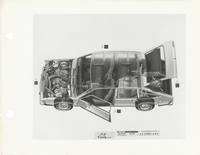
réf. 158941Detroit MI: General Motors 1980. Substantial archive of over 750 General Motors GM design assembly and advertising photographs 23 contact sheets of vehicles and parts photographs and 100 print advertising proofs and mockups from the Chevrolet Motor Division of General Motors dating from 1973 through 1980. Nearly all the materials in the archive are overlaid with Campbell Ewald Advertising Agency watermarks or bear GM Photographic stamps on the bottom margins or versos. Materials also frequently note catalog numbers and dates in manuscript pencil and ink. Detailed inventory and additional images available upon request. Please contact us directly. A vast and insightful archive of distinctly 1970s GM automotive design and marketing. The photographic prints in the archive include approximately 550 photographs and design renderings of vehicles parts and accessories as well as emblems and logos with material relating to the Bel Air Camaro Caprice Chevelle Chevette Citation Impala Malibu Monte Carlo Monza Nova and Vega models. Of particular note are 100 proofs and mockups for print advertisements for various Chevrolet vehicles markedly reflecting the era's fuel crisis and imposing international compact car market. Photographs largely 11 x 8.5 inches with some photographs 10 x 8 inches. Advertising proofs and mockups are all on standard letter-size paper. Near Fine overall with some light edgewear and light creasing at the corners. General Motors unknown books
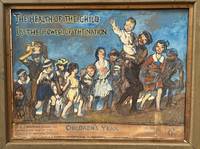
1918réf. 25017April 1918. Unique. As accomplished; tacked into a frame easily removed. Very good; some buckling. Excellent color. 17 1/4 x 23 1/4 inches painted surface. Gouache on paper board. The original art for the Year of the Child poster. Signed by Mora. The "year of the child" was declared by Woodrow Wilson to be 1918. This the result of the failure rate of recruits to the armed services in their medical examinations. Wilson's declaration was the first step in efforts to improve the health of the public and especially young men. The execution fell to the US Children's Bureau and Woman's Committee of the Council of National Defense. The Bureau was established in 1912 to " . investigate and report upon all matters pertaining to the welfare of children and child life among all classes of our people and shall especially investigate the questions of infant mortality the birth rate orphanage juvenile courts desertion dangerous occupations accidents and diseases of children ." It became a center for public health initiatives. The Council was established in 1916 to coordinate resources and industries for the war effort. Numerous subordinate agencies and committees were formed. Evolving out of the National American Woman Suffrage Association the Woman's Committee - in structure and resource - was almost pre-formed. As a result it was very effective in marshalling the clubs and associations of women across the nation to further Wilson's purpose. Pursuant to this Francis Luis Mora designed this poster to advertise the bureau the poster was issued with modified text well into the 1930s - see LC website for the entry as well as poster work for the bond campaigns for the Liberty Loan boards under the direction of the Committee for Public Information. He was a well established artist and illustrator before and after WWI with numerous public and private commissions. unknown books
1909réf. 912721909. DESIGN Kamisaka SEKKA artist. MOMOYOGUSA. Kyoto: Unsodo Meiji 42 1909. Volume one of three. 30.1 X 22.5 cm. Most consider it the finest Japanese design book of all time this exquisite suite of double-page color-printed woodblocks is printed and overprinted using opaque and metallic inks to produce a sumptuous surface. This is an early impression. The condition is internally quite good with almost none of the gutter fading and metallic ink transfer common to this work. One of the better printings we have seen. Complete as issued with all 20 prints from volume one included. Has the original printed title label The mica patterning from the front cover is gone. unknown books
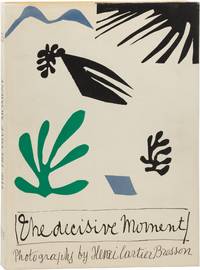
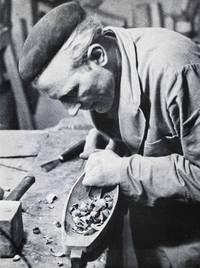
1952réf. 165340New York: Simon and Schuster 1952. First Edition. First Edition. Board and jacket design by Henri Matisse. Original "captions" booklet laid in as issued. One of the most influential collections of twentieth century street photography a testament to Henri Cartier-Bresson's unique and discerning eye and his ability to capture the emotive nature of his subjects. Near Fine in a spectacular Near Fine dust jacket. In a custom green clamshell box with a black leather label on the spine also Fine. The best copy of this title we have ever seen. Oversize volume shipping billed at cost. Simon and Schuster unknown books
1928réf. 1723681928. SOVIET PROPAGANDA DESIGN. Za oboronu SSSR For Defence of the USSR. 48 pp. illustrated with 32 full page plates printed in red and black. Small folio 275 x 200 mm. bound in publisher's wrappers illustrated by Czech artist P. Skala. Moscow: Izdatel'stvo AKHRR: Shkola FZU pri 1-i Obraztsovoi tipografii 1928. A remarkable collection of Soviet imagery intended as instruction for decorating workers' clubs reading huts and use during rallies. The illustrations include fully decorated interiors concepts for 'hands-on' attractions such as a 'rayok' or Russian peep show shooting galleries and quiz shows. Most of the imagery is in the constructivist style but also includes numerous caricatures of western fat cats fascists and even a Ku Klux Klan member which would have been inspiration for costume design. Rare OCLC finds just one copy at the Bibliotheque Nationale de France. The leaves with illustrations have an even toning from the printing process else a fine copy with the errata slip and unusually printed on fine thick paper. unknown books
1965réf. 48080Arnsberg and Dortmund Germany: Arbeitsgemeinschaft Gestaltendes Handwerk 1965. First edition. Hardcover. Near fine condition. Duodecimo 6 1/8 x 8 1/2". Unpaginated app. 100 leaves each three volumes. Original screw-bolted brown cloth with gray lettering on spines. Text printed to handmade paper in variant colors: black brown gray blue cream yellow green burnt Sienna and umbra photographs printed to glossy white paper. With lists of full and associate members of the workshop at front printed in white on black paper. Complete catalog of "Werkstattporträt Workshop Portrait" in three volumes a joint venture of the Project Group Creative Crafts for the Districts of Arnsberg and Dortmund Germany from 1961 to 1965. Participants of this project included craftsmen and women from the fields of pottery weaving embroidery bookbinding lathe work carpentry photography painting and sculpting. An extraordinary project presenting a state-of-the-art view of craftsmanship and art in Eastern Westfalia in the 1960s illustrated with 309 b/w photographs. Albert Renger-Patzsch participated in this project not only as a photographer see portrait 10 but provided one-hundred and forty-five of the three hundred and eleven photographs of works of other participants including portrait photographs for the catalogs "Werkstattportrait." Renger-Patzsch had worked as press photographer for the Chicago Tribune before publishing his title 'Crassula" with the Auriga-Verlag in the series 'Die Welt der Planze' in 1924. He had his first museum exhibition in 1927. His second book "Die Welt ist schön" became his best-known publication. During the 1930s he remained in Germany and made photographs for the German industy and in advertising. His archive was destroyed during W.W.II. In 1944 he moved to Wamel North Rhine-Westfalia and lived there for the rest of his life. The catalog is structured in twenty-nine chapters 0-271 introducing artists and craftsmen and women including one introductory chapter with eight photographs and a final chapter with six photographs. The object of the project was to further the exchange of knowledge and experience collaboration in research shared leisure time and visits of the workshops and studios of participants. Regional and national exhibitions and publications were arranged to help find buyers for the created work. The introductory chapter includes lists of full members and associate members. Each of the twenty-seven workshop portraits includes an introductory leaf for the respective participant describing the workshop or studio and the career including particulars about the techniques and material used by the artist with captions on the objects captured in eight b/w offset reproductions of photographs by Albert Renger-Patzsch and others on verso. Each set of photographs includes a portrait of the respective artist. Following each set of photographs a page with contact information of the artist and photo-credits for the work displayed. The final chapter is entitled "Workshop Portrait." It includes a brief description of the workshop taking place from April 1961 to December 1965 six b/w photographs of workshop exhibits and a list of all participants with contact information. The last page of this chapter an address by Walter Römhildt states the conclusion of this project and announces the continuation of publications of the series "werkstattforum" at his new office the "Beratungsstelle für Handwerksform bei der Handwerkskammer Hannover." Participants of the project "werkstattportait" will automatically receive those publications. Content with participating artists: portrait 0: Introduction of the project with photos by Renger-Patzsch 9 portrait 1: Hildegard Bäumer weaver Siegen photos by Renger-Patzsch 6 and Foto-Besser Siegen 3 portrait 2: Ignatius Geitel Glass painter Bochum with Klischees by Titze & Lorenz Gelsenkirchen 9 portrait 3: Karl Josef Hoffmann sculptor Attendorn with photos by Renger-Patzsch 9 portrait 4: Anneliese Kretschmer photographer Dortmund photos by Anneliese Kretschmer 9 portrait 5: Udo Dickerhoff carpenter Bochum photos by Renger-Patzsch 8 Sabine Renger 1 and Christian Bathe Münster 1; with two transparencies. portrait 6: Ingeborg and Bruno Asshoff potters Bochum photos by Renger-Patzsch 10 Dagmar Korn Düsseldorf 2 and Helmut Hering Dortmund 2 portrait 7: Martha Wurm embroider Wattenscheid photos by Photo-Soeding J. Müller Soest 11 portrait 8: Otto Pickhan turner Mollseifen photos by Renger-Patzsch 9 portrait 9: Irmgard Timmermann weaver Soest photos by Photo-Soeding J. Müller Soest 9 H. Musmann Lage 1 and Renger-Patzsch 1 portrait 10: Albert Renger-Patzsch photographer Wamel photos by Sabine Renger Wamel 1 Renger-Patzsch 11 Klischees by Titze & Lorenz Gelsenkirchen; portrait 11: Andrea Böhm picture weaver Lüdenscheid w/o photo-credits 10 portrait 12: Päule Jelich goldsmith Iserlohn photos by Schmidt Lueg Iserlohn 11 and Foto Melchers Herne 1 portrait 13: Wolfgang Kruse turner Hamm photos by Schmidt Lueg Iserlohn 10 portrait 14: Wolfgang Kreutter sculptor Dödesberg photos by Bert Brösel Siegen 1 Heidersberger Wolfsburg 2 Schmidt Lueg Iserlohn 9 portrait 15: Marianne Proll bookbinder Hagen photos by A. Bach Hagen 6 Renger-Patzsch 8 portrait 16: Heinz Abendroth metal smith Dortmund photos by Rolf Schmieding Dortmund 9 Dinstühler Dortmund 1; portrait 17: Liesel Bellmann sculptor Dortmund photos by Gerd Schlitzer Dortmund 4 W. von Frankenberg Dortmund 1 Rolf Schmieding Dortmund 3 and Heller Telgte 1 w/o credit 3 portrait 18: Karl Jlling metal smith Mallar photos by Renger-Patzsch 10 portrait 19:Dieter Pieper goldsmithLüdenscheid photos by Werkstätten Carl Golderer Pforzheim 24 portrait 20: Marieluise Quade painter and graphic designer Lüdenscheid photos by Carl Huth Lüdenscheid 2 w/o credits 7 portrait 21: Waldemar Wien sculptor Kierape 1 photos by Renger-Patzsch 13 portrait 22: Christel Humpert potter Bochum photos by Renger-Patzsch10 portrait 23: W. K. A. Weisheit carpenter Plettenberg-Oesterau photos by Renger-Patzsch 9 portrait 24: Günter Hülshoff potter Rosemarie Hülshoff batik both Wangern photos by Renger-Patzsch 14 portrait 25: Josef Severin metal smith Anröchte/Krs. Lippstadt photos by Renger-Patzsch 6 and Sabine Renger 4 portrait 26: Gisela Lohse weaver Hagen photos by Renger-Patzsch 11 portrait 27: Johannes Scharfenstein carpenter Meschede photos by Renger-Patzsch 10 and Foto-Zwietasch Kornwestheim 1 "werkstattportrait" with Klischees by Tietze & Lorenz Gelsenkirchen 6 Text in German. Minor wear overall with some red underlining of text in Römhildt address on last page. Translation of werkstattportrait 10: "Albert Renger-Patzsch born on June 22m 1897 graduated at the Humanistic Gymnasium studied chemistry until the preliminary examination after that he became the head of the photography department of the Folkwang Publisher in Hagen and Darmstadt. Since 1925 independent photographer in Bad Harzburg; first exhibition at Kestner-Gesellschaft in Hannover in 1925; first publication: "Die Halligen" in 1927 worked from 1929-1944 in Essen after that in Wamel near Soest. Following his title "Die Welt ist schön" he published monographs of cities and architecture books on marked-off landscapes and other topics. Renger=Patzsch works are in the collections of the MOMA New York the Eastman House in Rochester the Gernsheim Collection in London the Copper-Engraving Collection of the National Library in Paris and the Photo-Museum in Dresden. He was awarded the David Octavius Hill Medal of the G.D.L. in 1957 the Culture-Award of the German Society for Photography Cologne in 1960 and the Golden Society Medal of the Vienna Photographic Society in 1961. Renger-Patzsch is seen as the father of "Neue Sachlichkeit" in photography. In his book "Die Welt ist schön" he introduces a program with the goal to deter photography from engaging in a race with painting and reflect on its own medium. His notion that photography based on its mechanical structure is better suited to do justice to an object portrait it as an artistic individual pertains to large fields of photography today. Arbeitsgemeinschaft Gestaltendes Handwerk hardcover books
réf. 11222Santa Monica & Minneapolis: Danger! Books & Indulgence Press 2004. Deluxe/Limited Editions. Various. Fine. Deluxe/Limited Editions. Various. Moody's short story Surplus Value Books #13 is a comic parody of a bookseller's modern rare book catalogue. The story unfolds as the galley proofs of the involved book catalogue where the prices accorded the items for sale are contrasted with the personal and idiosyncratic values assigned to them by the bookseller. "This intricate collaboration is an expanded treatment of a text originally published by Rick Moody and David Ford as an artist's book in 1999. Taking the form of a bookseller's catalogue Moody's novella which is also reprinted in his 2000 collection Demonology lays bare the fragile psyche of its narrator whose fractured and overwrought book descriptions often veer into personal territory returning particularly to his obsession with a college classmate Anna Feldman. The deluxe edition includes corrected page proofs of the text complete with "hand corrections" by the author reproduced typographically by Wilbur "Chip" Schilling and sections that appear to have been manually "whited out." Each item in the portfolio supports the text of the story-from the straightjacket that holds the book and the narrator's "release papers" from a private mental hospital to the a collection of objects that relate directly to the entries including a Star Wars action figure Scrabble tiles and a baseball card. The text is aptly described by Hadley-based bookseller Ken Lopez: "Moody has created a hilarious and touching self-contained world where the values accorded to the items for sale dollars and the values inherent in them significance artistry passion are in running comic contrast." Exhibition statement Smith College The overall design and printing was undertaken by Wilbur "Chip" Schilling Daniel Kelm and David Ford Kelm with assistance from "other mechanics" at the Wide Awake Garage. In creating the OCD-adjacent box Kelm created a void filled with a blank because "any obsessive would want to have the regular edition too." He then noted laughing that would leave no place for the blank and wondered what would be done with that. While not called for a standard issue of the limited first edition one of 700 copies is included. Tight bright and unmarred. Folio resin coated cloth box mixed media including vinyl plastic cloth metal paper wood leather etc. fo 49x23x10cm. Numbered limited editions. Danger! Books & Indulgence Press unknown books
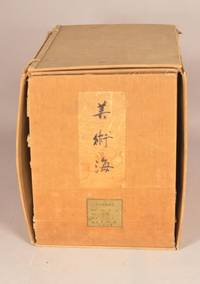
1903réf. 911311903. DESIGN UNSODO 芸艸堂 Publisher. BIJUTSUKAI 美術海. Kyoto Unsodo 24.0 x 16.3 cm 61 numbers of the 70 numbers printed in the BIJUTSUKAI design series Numbers 1 thru 61 Originally issued in 70 volumes in the early 1900s. Number one was published on January 1st Meiji 36 1903 Number 61 in 1905. Over 1200 color woodblock printed designs. A remarkable achievement by most of the important designers of the day. Bijutsukai printing is always good the early printings here are extraordinary In very good condition though number one is a bit tired. Enclosed in an old clasped chitsu case. There is quite a bit of confusion about this series BIJUTSUKAI and the SHIN-BIJUTSUKAI series which followed it. They are two different sets of design. The BIJUTSUKAI was printed under the general rubric of Shinbijutsukai but they are two different works pubished with two different series titles and numbering. Early printings of the BIJUTSUKAI have become unusual such a long run of the individual issues unheard of. unknown books
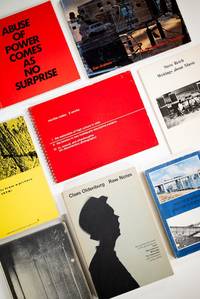
2013réf. 51839Halifax NS Canada: NSCAD Press et al 2013. A comprehensive collection of publications and other documents from the Nova Scotia College of Art and Design NSCAD an unexpected yet tremendously important center of conceptual art and postminimalism throughout the 1970s. Beginning as a nondescript art school in 1887 nothing about this small Halifax institution presaged the enormous international influence that the school would exert when Garry Neill Kennedy took over as NSCAD's president in 1967 at age 32. The school's subsequent and unprecedented creative direction must be credited to Kennedy who with a budget of $62000 turned the school away from its previous provincialism toward the influential international posture it would maintain for the next decades. This stature was due in no small part to the faculty and visiting artists that Kennedy brought to the school including Vito Acconci Sol LeWitt Dan Graham Martha Rosler Jenny Holzer Daniel Buren Hans Haacke Yvonne Rainer Robert Frank Robert Morris Dara Birnbaum Seth Seibelaub Lucy Lippard Robert Smithson Gerhard Richter Eric Fischl Lawrence Weiner Joseph Beuys and Claes Oldenburg among many others. The geographical location of NSCAD on the transatlantic route between New York and Europe aided in its access to the international scene. This brought many visiting artists who instead of appearing only for a talk or lecture used the opportunity for longer residencies exhibitions and collaborations with the school. Notably Joseph Beuys's first trip to North America was not to New York but to Halifax as a visiting artist at NSCAD. During its heyday between the late '60s and '70s NSCAD's teaching philosophy radically changed. Starting with the removal of a lettered grading system NSCAD became the first degree-granting art school in Canada advocating an intense engagement on all ends of the art-making spectrum between professional and student artists. NSCAD also documented its own significance through the publications of its press as well as the numerous invitations and catalogues produced by its galleries in conjunction with the shows and exhibitions it mounted during this period. This combination of publications exhibitions and collaborations generated by the school in many ways made it a contemporary Black Mountain College - and its subsequent influence has proved no less significant. Indeed in 1973 ART IN AMERICA proclaimed NSCAD "the best art school in North America" and thirty-five years later a major exhibition at the Art Gallery of Nova Scotia and publication by MIT Press wryly celebrated NSCAD as "The Last Art College." The NSCAD Press began operations in 1972. Initially led by Kaspar Koenig and then by Benjamin Buchloh the Press published 26 titles between 1982 and 1987 including now rare and important works by Jenny Holzer Steve Reich Michael Snow Donald Judd Dan Graham Martha Rosler Gerhard Richter Carl Andre Lawrence Weiner and others. All are present in this collection - many in their rare hardcover editions. The collection also documents two other canonical aspects of NSCAD. The first the "Projects Class" was developed by David Askevold one of Kennedy's new young hires. In the spirit of the school's new direction of dismantling traditional teaching methods the class invited artists to submit proposals for students to undertake under the artists' guidance. A rare complete set of cards documenting the first instantiation of this class from 1969 is present in its original envelope and includes submissions from artists Robert Barry Mel Bochner James Lee Byars Jan Dibbets Dan Graham Douglas Huebler Joseph Kosuth Sol LeWitt Lucy R. Lippard and Robert Smithson among others. The collection also includes materials from the Lithography Workshop under the direction of Gerald Ferguson who had insisted on hiring Askevold. The workshop's goal was not only to train students in printmaking but to produce prints for renowned artists both local and international. It allowed a space for NSCAD students to develop alongside professional artists taking their printmaking from initial concept to final execution. The workshop encouraged exploration of mediums and invited not only visual artists but performers writers dancers musicians and other famous and emerging creatives to make one-off projects. More than half a dozen pieces explicitly attributed to the workshop are present including work from Emmett Williams Huebler and Lawrence Weiner. But perhaps the most significant components of this collection are the ephemeral documents invitations flyers postcards posters catalogues produced by NSCAD's legendary Mezzanine Gallery which operated between 1970 and 1973 under the directorship of Charlotte Towsend-Gault. This remarkable program produced ground-breaking contemporary art projects exhibitions events and residencies by such artists as Bas Jan Ader Dan Graham John Baldessari "I Will Not Make Any More Boring Art" Tony Shafrazi Eleanor Antin Charlotte Moorman Sol LeWitt Martha Rosler Donald Judd On Kawara Martha Wilson and many others. These are almost to an item uncommon with most scarce and many quite rare. As a group the roughly 90 Mezzanine Gallery items included here would be virtually impossible to reassemble now. In 2006 Printed Matter NYC presented an exhibition of this material under the curatorship of AA Bronson. The present collection includes not only all of the material shown in that exhibition but other documents acquired subsequent to it. The collection also includes later ancillary and reference materials. Taken as a whole it documents all aspects of the most critical years at a key institution that served as both incubator and promoter for some of the most important and influential art in the second half of the 20th century. Some 155 items in all. Generally very good or better overall with most of the ephemera near fine or better. All carefully and neatly housed in a series of archival enclosures. A complete inventory is available. (NSCAD Press, et al) unknown books