Biblio.com

10.207 Ergebnisse
1808Best.-Nr. 006372London: Longman Hurst Rees and Orme 1808. Hardcover. Very Good. Vol. 2 published in 1810. 2 volumes: vii 1 524 p. frontispiece and 62 leaves of engraved plates; viii 444 30 p. frontispiece and 95 leaves of plates one folded: one in-text engraving; 29 cm. Original brown boards; both spines are covered in brown library repair tape with title and call number written in white on spine. Pages are untrimmed. Former owner's name on blank page preceding frontispiece in each volume: "H. Hunt." Oval stamp on front fixed endpaper of Dickinson College Library. Embossed stamp of that library on title pages. Modern endpapers. This is complete with the 159 leaves of plates called for in the list of illustrations and one engraving in text. In Very Good Condition: edges rubbed; solid library spine repairs; occasional foxing primarily in margins; otherwise clean and tight. Longman, Hurst, Rees, and Orme hardcover
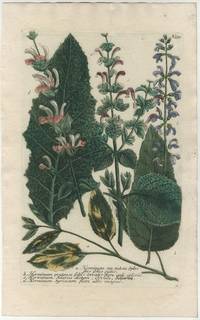
1745Best.-Nr. 860Regensburg: H. Lentz and H.G. Neubauer et al. 1745. First edition. Mezzotint engraving printed in color finished by hand 12.75 x 8.25 inches platemark approx; 15.25 x 9.5 inches overall approx. Neatly disbound in some earlier century else a very vibrant example of a hand colored mezzotint engraving. The individual botanicals in this plate are: a. Horminium seu salvia Sylevestris foliis pictis b. Horminium pratense foliis serratis flore coeli coloris c. Horminium Sclarea dictum Orvale Scharlen d. Horminium syriacum flore albo magno. The print is showcasing the differences between cultivated garden Clary Sage Horminum and its wild woodland counterpart Salvia sylvestris. Drawn from Johann Wilhelm Weinmann's Phytanthoza Iconographia this dazzling print is part of a riotous celebration of plants trees shrubs herbs flowers fruits mushrooms and trailing vines. Printed in color and delicately finished by hand the series stands among the earliest triumphs of color printing and marks the first published collection to feature the work of George Dionysus Ehret one of the eighteenth century's most admired botanical artists. Other artists/engravers included in this work are Bartholomaus Seuter Johann Elias Ridinger and Johann Jakob Haid. In Great Flower Books Satcheverall Sitwell refers to this set as the "pioneering work of botanical prints engraved to be inked in color." Very good. . NISSEN2126. DUNTHORNE 327. SITWELL/BLUNT Great Flower Books p. 151 166. . H. Lentz and H.G. Neubauer, et al. unknown
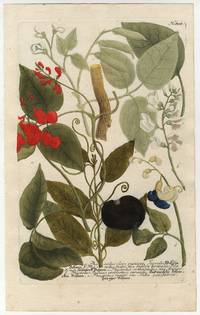
1745Best.-Nr. 855Regensburg: H. Lentz and H.G. Neubauer et al. 1745. First edition. Very good. Mezzotint engraving printed in color finished by hand 12.75 x 8.25 inches platemark approx; 15.25 x 9.5 inches overall approx. Left edge retains sewing stabs neatly disbound in some earlier century else a very vibrant example of a hand colored mezzotint engraving. The individual botanicals in this plate are: a. Phaseolus flore puniceo b. Phaseolus major c. Phaseolus orthocaulus d. Phaseolus Indicus e. Phaseolus major seu Faba purgatrioc. Drawn from Johann Wilhelm Weinmann's Phytanthoza Iconographia this dazzling print is part of a riotous celebration of plants trees shrubs herbs flowers fruits mushrooms and trailing vines. Printed in color and delicately finished by hand the series stands among the earliest triumphs of color printing and marks the first published collection to feature the work of George Dionysus Ehret one of the eighteenth century's most admired botanical artists. Other artists/engravers included in this work are Bartholomaus Seuter Johann Elias Ridinger and Johann Jakob Haid. In Great Flower Books Satcheverall Sitwell refers to this set as the "pioneering work of botanical prints engraved to be inked in color." . NISSEN2126. DUNTHORNE 327. SITWELL/BLUNT Great Flower Books p. 151 166. . H. Lentz and H.G. Neubauer, et al. unknown
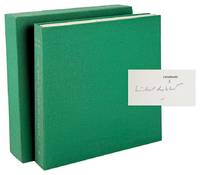
1987Best.-Nr. 001669New York: Limited Editions Club 1987. Hardcover. Fine. Hafftka Michael. 2 53 5 p. 4 leaves of lithographed plates; 30 cm. Sewn and bound in vellum paper wrappers with yapp edges and the author's name printed in black on the spine; sewing bands are visible on the wrapper sides. Clamshell box is covered in light grey cloth with a small printed label on the spine bearing the author's name. Edges of box are black; lined with black felt. This is number 198 of a limited edition of 800 copies. Set in monotype Walbaum at the Out of Sorts letter foundery in Mamaroneck N.Y. and printed on mould-made Magnani paper at the Shagbark Press in South Portland Me. The lithographs were printed on hand-made Japanese paper at Trestle Editions N.Y. City. The book design was by Benjamin Shiff. Hand-sewn and hand-bound by Carol Joyce. Signed by the artist at the colophon. In Fine/Fine Condition. Limited Editions Club hardcover
1839Best.-Nr. 052209London: William S. Orr & Co. 1839. 1st Edition 1st Printing. Hardcover. Very Good. Xxiii 356 Pp. First Printing 1839. Full Morocco Gilt And Stamped In Blind Yellow Endpapers All Edges Gilt. Plates Tissue Guards With Subject Titles. Slight Usage Tiny Repairs To Corners Furbished. Captions Printed On The Tissue Guards. Binding Is Early Or Original Wear But Nicely Refurbished New Morocco Spine Label Hinges Intact And Solid. Contents Very Clean Light Foxing To A Few Plates But Almost All Are Entirely Clean And With Clean Intact Tissue Guards. Wordsworth Was The Youngest Son Of The Rev. Dr. Christopher Wordsworth Master Of Trinity And A Nephew Of The Poet William Wordsworth. He Was The Younger Brother Of The Classical Scholar John Wordsworth And Charles Wordsworth Bishop Of Saint Andrews Dunkeld And Dunblane. He Was Educated At Winchester And Trinity Cambridge. Like His Brother Charles He Was Distinguished As An Athlete As Well As For Scholarship. He Won The Chancellor's Gold Medal For Poetry In 1827 And 1828. He Became Senior Classic And Was Elected A Fellow And Tutor Of Trinity In 1830; Shortly Afterwards He Took Holy Orders. He Went For A Tour In Greece In 1832-1833 And Published Various Works On Its Topography And Archaeology The Most Famous Of Which Is "Wordsworth's" Greece 1839. In 1836 He Became Public Orator At Cambridge And In The Same Year Was Appointed Headmaster Of Harrow A Post He Resigned In 1844. In 1844 Sir Robert Peel Appointed Him As A Canon Of Westminster 1844-1869. He Was Vicar Of Stanford In The Vale Berkshire 1850-1869 And Archdeacon Of Westminster 1864-1869. In 1869 Benjamin Disraeli Appointed Him Bishop Of Lincoln Which He Retained Until His Death In 1885. William S. Orr & Co. hardcover
1982Best.-Nr. 1917Boston: Beacon Press 1982. First edition. Paperback. Fair. Folio oversized paperback first edition in fair condition. A dampstained copy with light brown staining in small patches along the top and bottom edges accompanied by minor upward warping - the book does not lay wholly flat. General wear to the cover edges and a minor crinkle at the spine column about 4 inches above the heel. The binding is solid and all posters and pages are clean and intact inspite of not laying flat. 32 pages mostly made up of full page poster style representations of Corita Kent's magnificent and inspirational artwork. Hard to find in any condition and priced accordingly. Beacon Press paperback
1914- Lucien Vogel éditeur, Paris Juin 1914, 36,5x24cm, une feuille. - Double original color print, printed on vergé paper, signed in the plate. An original print used to illustrate the Gazette du bon ton, one of the most attractive and influential 20th century fashion magazines, featuring the talents of French artists and other contributors from the burgeoning Art Deco movement. A celebrated fashion magazine established in 1912 by Lucien Vogel, La Gazette du bon ton appeared until 1925, with a hiatus from 1915 to 1920 due to the war (the editor-in-chief having been called up for service). It consisted of 69 issues printed in only 2,000 copies each and notably illustrated with 573 color plates and 148 sketches of the models of the great designers. Right from the start, this sumptuous publication "was aimed at bibliophiles and fashionable society," (Françoise Tétart-Vittu, "La Gazette du bon ton", in Dictionnaire de la mode, 2016) and was printed on fine vergé paper using a type cut specially for the magazine by Georges Peignot, known as Cochin, later used (in 1946) by Christian Dior. The prints were made using stencils, heightened in colors, some highlighted in gold or palladium. The story began in 1912, when Lucien Vogel, a man of the world involved in fashion (he had already been part of the fashion magazine Femina) decided, with his wife Cosette de Brunhoff - the sister of Jean, creator of Babar - to set up the Gazette du bon ton, subtitled at the time: "Art, fashion, frivolities." Georges Charensol noted the reasoning of the editor-in-chief: "'In 1910,' he observed, 'there was no really artistic fashion magazine, nothing representative of the spirit of the time. My dream was therefore to make a luxury magazine with truly modern artists...I was assured of success, because when it comes to fashion, no country on earth can compete with France.'" ("Un grand éditeur d'art. Lucien Vogel" in Les Nouvelles littéraires, no. 133, May 1925). The magazine was immediately successful, not only in France but also in the United States and Latin America. At first, Vogel put together a team of seven artists: André-Édouard Marty and Pierre Brissaud, followed by Georges Lepape and Dammicourt, as well as eventually his friends from school and the School of Fine Arts, like George Barbier, Bernard Boutet de Monvel and Charles Martin. Other talented people soon came flocking to join the team: Guy Arnoux, Léon Bakst, Benito, Boutet de Monvel, Umberto Brunelleschi, Chas Laborde, Jean-Gabriel Domergue, Raoul Dufy, Édouard Halouze, Alexandre Iacovleff, Jean Émile Laboureur, Charles Loupot, Chalres Martin, Maggie Salcedo. These artist, mostly unknown when Lucien Vogel sought them out, later became emblematic and sought-after artistic figures. It was also they who worked on the advertising drawings for the Gazette. The plates put the spotlight on, and celebrate, dresses by seven designers of the age: Lanvin, Doeuillet, Paquin, Poiret, Worth, Vionnet and Doucet. The designers provided exclusive models for each issue. Nonetheless, some of the illustrations are not based on real models, but simply on the illustrator's conception of the fashion of the day. The Gazette du bon ton was an important step in the history of fashion. Combining aesthetic demands with the physical whole, it brought together - for the first time - the great talents of the artistic, literary, and fashion worlds; and imposed, through this alchemy, a completely new image of women: slender, independent and daring, which was shared by the new generation of designers, including Coco Chanel, Jean Patou, Marcel Rochas, and so on... Taken over in 1920 by Condé Montrose Nast, the Gazette du bon ton was an important influence on the new layout and aesthetics of that "little dying paper" that Nast had bought a few years earlier: Vogue. [FRENCH VERSION FOLLOWS] Estampe double originale en couleur, tirée sur papier vergé, signée en bas à gauche de la planche. Gravure originale réal
1914- Lucien Vogel éditeur, Paris Juin 1914, 36,5x24cm, une feuille. - Double original color print, printed on vergé paper, signed in the plate. An original print used to illustrate the Gazette du bon ton, one of the most attractive and influential 20th century fashion magazines, featuring the talents of French artists and other contributors from the burgeoning Art Deco movement. A celebrated fashion magazine established in 1912 by Lucien Vogel, La Gazette du bon ton appeared until 1925, with a hiatus from 1915 to 1920 due to the war (the editor-in-chief having been called up for service). It consisted of 69 issues printed in only 2,000 copies each and notably illustrated with 573 color plates and 148 sketches of the models of the great designers. Right from the start, this sumptuous publication "was aimed at bibliophiles and fashionable society," (Françoise Tétart-Vittu, "La Gazette du bon ton", in Dictionnaire de la mode, 2016) and was printed on fine vergé paper using a type cut specially for the magazine by Georges Peignot, known as Cochin, later used (in 1946) by Christian Dior. The prints were made using stencils, heightened in colors, some highlighted in gold or palladium. The story began in 1912, when Lucien Vogel, a man of the world involved in fashion (he had already been part of the fashion magazine Femina) decided, with his wife Cosette de Brunhoff - the sister of Jean, creator of Babar - to set up the Gazette du bon ton, subtitled at the time: "Art, fashion, frivolities." Georges Charensol noted the reasoning of the editor-in-chief: "'In 1910,' he observed, 'there was no really artistic fashion magazine, nothing representative of the spirit of the time. My dream was therefore to make a luxury magazine with truly modern artists...I was assured of success, because when it comes to fashion, no country on earth can compete with France.'" ("Un grand éditeur d'art. Lucien Vogel" in Les Nouvelles littéraires, no. 133, May 1925). The magazine was immediately successful, not only in France but also in the United States and Latin America. At first, Vogel put together a team of seven artists: André-Édouard Marty and Pierre Brissaud, followed by Georges Lepape and Dammicourt, as well as eventually his friends from school and the School of Fine Arts, like George Barbier, Bernard Boutet de Monvel and Charles Martin. Other talented people soon came flocking to join the team: Guy Arnoux, Léon Bakst, Benito, Boutet de Monvel, Umberto Brunelleschi, Chas Laborde, Jean-Gabriel Domergue, Raoul Dufy, Édouard Halouze, Alexandre Iacovleff, Jean Émile Laboureur, Charles Loupot, Chalres Martin, Maggie Salcedo. These artist, mostly unknown when Lucien Vogel sought them out, later became emblematic and sought-after artistic figures. It was also they who worked on the advertising drawings for the Gazette. The plates put the spotlight on, and celebrate, dresses by seven designers of the age: Lanvin, Doeuillet, Paquin, Poiret, Worth, Vionnet and Doucet. The designers provided exclusive models for each issue. Nonetheless, some of the illustrations are not based on real models, but simply on the illustrator's conception of the fashion of the day. The Gazette du bon ton was an important step in the history of fashion. Combining aesthetic demands with the physical whole, it brought together - for the first time - the great talents of the artistic, literary, and fashion worlds; and imposed, through this alchemy, a completely new image of women: slender, independent and daring, which was shared by the new generation of designers, including Coco Chanel, Jean Patou, Marcel Rochas, and so on... Taken over in 1920 by Condé Montrose Nast, the Gazette du bon ton was an important influence on the new layout and aesthetics of that "little dying paper" that Nast had bought a few years earlier: Vogue. [FRENCH VERSION FOLLOWS] Estampe double originale en couleur, tirée sur papier vergé, signée en bas à droite de la planche. Gravure originale réal
1924- Lucien Vogel éditeur, Paris 1924-1925, 36x24cm, une feuille. - Double original color print, printed on vergé paper, signed in the plate. An original print used to illustrate the Gazette du bon ton, one of the most attractive and influential 20th century fashion magazines, featuring the talents of French artists and other contributors from the burgeoning Art Deco movement. A celebrated fashion magazine established in 1912 by Lucien Vogel, La Gazette du bon ton appeared until 1925, with a hiatus from 1915 to 1920 due to the war (the editor-in-chief having been called up for service). It consisted of 69 issues printed in only 2,000 copies each and notably illustrated with 573 color plates and 148 sketches of the models of the great designers. Right from the start, this sumptuous publication "was aimed at bibliophiles and fashionable society," (Françoise Tétart-Vittu, "La Gazette du bon ton", in Dictionnaire de la mode, 2016) and was printed on fine vergé paper using a type cut specially for the magazine by Georges Peignot, known as Cochin, later used (in 1946) by Christian Dior. The prints were made using stencils, heightened in colors, some highlighted in gold or palladium. The story began in 1912, when Lucien Vogel, a man of the world involved in fashion (he had already been part of the fashion magazine Femina) decided, with his wife Cosette de Brunhoff - the sister of Jean, creator of Babar - to set up the Gazette du bon ton, subtitled at the time: "Art, fashion, frivolities." Georges Charensol noted the reasoning of the editor-in-chief: "'In 1910,' he observed, 'there was no really artistic fashion magazine, nothing representative of the spirit of the time. My dream was therefore to make a luxury magazine with truly modern artists...I was assured of success, because when it comes to fashion, no country on earth can compete with France.'" ("Un grand éditeur d'art. Lucien Vogel" in Les Nouvelles littéraires, no. 133, May 1925). The magazine was immediately successful, not only in France but also in the United States and Latin America. At first, Vogel put together a team of seven artists: André-Édouard Marty and Pierre Brissaud, followed by Georges Lepape and Dammicourt, as well as eventually his friends from school and the School of Fine Arts, like George Barbier, Bernard Boutet de Monvel and Charles Martin. Other talented people soon came flocking to join the team: Guy Arnoux, Léon Bakst, Benito, Boutet de Monvel, Umberto Brunelleschi, Chas Laborde, Jean-Gabriel Domergue, Raoul Dufy, Édouard Halouze, Alexandre Iacovleff, Jean Émile Laboureur, Charles Loupot, Chalres Martin, Maggie Salcedo. These artist, mostly unknown when Lucien Vogel sought them out, later became emblematic and sought-after artistic figures. It was also they who worked on the advertising drawings for the Gazette. The plates put the spotlight on, and celebrate, dresses by seven designers of the age: Lanvin, Doeuillet, Paquin, Poiret, Worth, Vionnet and Doucet. The designers provided exclusive models for each issue. Nonetheless, some of the illustrations are not based on real models, but simply on the illustrator's conception of the fashion of the day. The Gazette du bon ton was an important step in the history of fashion. Combining aesthetic demands with the physical whole, it brought together - for the first time - the great talents of the artistic, literary, and fashion worlds; and imposed, through this alchemy, a completely new image of women: slender, independent and daring, which was shared by the new generation of designers, including Coco Chanel, Jean Patou, Marcel Rochas, and so on... Taken over in 1920 by Condé Montrose Nast, the Gazette du bon ton was an important influence on the new layout and aesthetics of that "little dying paper" that Nast had bought a few years earlier: Vogue. [FRENCH VERSION FOLLOWS] Estampe double originale en couleur, tirée sur papier vergé, signée en haut à droite de la planche. Gravure originale réali
1914- Lucien Vogel éditeur, Paris Juin 1914, 36,5x24cm, une feuille. - Double original color print, printed on vergé paper, signed in the plate. An original print used to illustrate the Gazette du bon ton, one of the most attractive and influential 20th century fashion magazines, featuring the talents of French artists and other contributors from the burgeoning Art Deco movement. A celebrated fashion magazine established in 1912 by Lucien Vogel, La Gazette du bon ton appeared until 1925, with a hiatus from 1915 to 1920 due to the war (the editor-in-chief having been called up for service). It consisted of 69 issues printed in only 2,000 copies each and notably illustrated with 573 color plates and 148 sketches of the models of the great designers. Right from the start, this sumptuous publication "was aimed at bibliophiles and fashionable society," (Françoise Tétart-Vittu, "La Gazette du bon ton", in Dictionnaire de la mode, 2016) and was printed on fine vergé paper using a type cut specially for the magazine by Georges Peignot, known as Cochin, later used (in 1946) by Christian Dior. The prints were made using stencils, heightened in colors, some highlighted in gold or palladium. The story began in 1912, when Lucien Vogel, a man of the world involved in fashion (he had already been part of the fashion magazine Femina) decided, with his wife Cosette de Brunhoff - the sister of Jean, creator of Babar - to set up the Gazette du bon ton, subtitled at the time: "Art, fashion, frivolities." Georges Charensol noted the reasoning of the editor-in-chief: "'In 1910,' he observed, 'there was no really artistic fashion magazine, nothing representative of the spirit of the time. My dream was therefore to make a luxury magazine with truly modern artists...I was assured of success, because when it comes to fashion, no country on earth can compete with France.'" ("Un grand éditeur d'art. Lucien Vogel" in Les Nouvelles littéraires, no. 133, May 1925). The magazine was immediately successful, not only in France but also in the United States and Latin America. At first, Vogel put together a team of seven artists: André-Édouard Marty and Pierre Brissaud, followed by Georges Lepape and Dammicourt, as well as eventually his friends from school and the School of Fine Arts, like George Barbier, Bernard Boutet de Monvel and Charles Martin. Other talented people soon came flocking to join the team: Guy Arnoux, Léon Bakst, Benito, Boutet de Monvel, Umberto Brunelleschi, Chas Laborde, Jean-Gabriel Domergue, Raoul Dufy, Édouard Halouze, Alexandre Iacovleff, Jean Émile Laboureur, Charles Loupot, Chalres Martin, Maggie Salcedo. These artist, mostly unknown when Lucien Vogel sought them out, later became emblematic and sought-after artistic figures. It was also they who worked on the advertising drawings for the Gazette. The plates put the spotlight on, and celebrate, dresses by seven designers of the age: Lanvin, Doeuillet, Paquin, Poiret, Worth, Vionnet and Doucet. The designers provided exclusive models for each issue. Nonetheless, some of the illustrations are not based on real models, but simply on the illustrator's conception of the fashion of the day. The Gazette du bon ton was an important step in the history of fashion. Combining aesthetic demands with the physical whole, it brought together - for the first time - the great talents of the artistic, literary, and fashion worlds; and imposed, through this alchemy, a completely new image of women: slender, independent and daring, which was shared by the new generation of designers, including Coco Chanel, Jean Patou, Marcel Rochas, and so on... Taken over in 1920 by Condé Montrose Nast, the Gazette du bon ton was an important influence on the new layout and aesthetics of that "little dying paper" that Nast had bought a few years earlier: Vogue. [FRENCH VERSION FOLLOWS] Estampe double originale en couleur, tirée sur papier vergé, signée en bas à gauche de la planche. Gravure originale réal
1920- Lucien Vogel éditeur, Paris Mars 1920, 24x37cm, une feuille. - Double original color print, printed on vergé paper, signed in the plate. An original print used to illustrate the Gazette du bon ton, one of the most attractive and influential 20th century fashion magazines, featuring the talents of French artists and other contributors from the burgeoning Art Deco movement. A celebrated fashion magazine established in 1912 by Lucien Vogel, La Gazette du bon ton appeared until 1925, with a hiatus from 1915 to 1920 due to the war (the editor-in-chief having been called up for service). It consisted of 69 issues printed in only 2,000 copies each and notably illustrated with 573 color plates and 148 sketches of the models of the great designers. Right from the start, this sumptuous publication "was aimed at bibliophiles and fashionable society," (Françoise Tétart-Vittu, "La Gazette du bon ton", in Dictionnaire de la mode, 2016) and was printed on fine vergé paper using a type cut specially for the magazine by Georges Peignot, known as Cochin, later used (in 1946) by Christian Dior. The prints were made using stencils, heightened in colors, some highlighted in gold or palladium. The story began in 1912, when Lucien Vogel, a man of the world involved in fashion (he had already been part of the fashion magazine Femina) decided, with his wife Cosette de Brunhoff - the sister of Jean, creator of Babar - to set up the Gazette du bon ton, subtitled at the time: "Art, fashion, frivolities." Georges Charensol noted the reasoning of the editor-in-chief: "'In 1910,' he observed, 'there was no really artistic fashion magazine, nothing representative of the spirit of the time. My dream was therefore to make a luxury magazine with truly modern artists...I was assured of success, because when it comes to fashion, no country on earth can compete with France.'" ("Un grand éditeur d'art. Lucien Vogel" in Les Nouvelles littéraires, no. 133, May 1925). The magazine was immediately successful, not only in France but also in the United States and Latin America. At first, Vogel put together a team of seven artists: André-Édouard Marty and Pierre Brissaud, followed by Georges Lepape and Dammicourt, as well as eventually his friends from school and the School of Fine Arts, like George Barbier, Bernard Boutet de Monvel and Charles Martin. Other talented people soon came flocking to join the team: Guy Arnoux, Léon Bakst, Benito, Boutet de Monvel, Umberto Brunelleschi, Chas Laborde, Jean-Gabriel Domergue, Raoul Dufy, Édouard Halouze, Alexandre Iacovleff, Jean Émile Laboureur, Charles Loupot, Chalres Martin, Maggie Salcedo. These artist, mostly unknown when Lucien Vogel sought them out, later became emblematic and sought-after artistic figures. It was also they who worked on the advertising drawings for the Gazette. The plates put the spotlight on, and celebrate, dresses by seven designers of the age: Lanvin, Doeuillet, Paquin, Poiret, Worth, Vionnet and Doucet. The designers provided exclusive models for each issue. Nonetheless, some of the illustrations are not based on real models, but simply on the illustrator's conception of the fashion of the day. The Gazette du bon ton was an important step in the history of fashion. Combining aesthetic demands with the physical whole, it brought together - for the first time - the great talents of the artistic, literary, and fashion worlds; and imposed, through this alchemy, a completely new image of women: slender, independent and daring, which was shared by the new generation of designers, including Coco Chanel, Jean Patou, Marcel Rochas, and so on... Taken over in 1920 by Condé Montrose Nast, the Gazette du bon ton was an important influence on the new layout and aesthetics of that "little dying paper" that Nast had bought a few years earlier: Vogue. [FRENCH VERSION FOLLOWS] Estampe double originale en couleur, tirée sur papier vergé, signée en bas à droite de la planche. Gravure originale réalisée pour l'
1920- Lucien Vogel éditeur, Paris Mars 1920, 24x37cm, une feuille. - Estampe double originale en couleur, tirée sur papier vergé, signée en bas à droite de la planche. Gravure originale réalisée pour l'illustration de La Gazette du bon ton, l'une des plus belles et des plus influentes revues de mode du XXème siècle, célébrant le talent des créateurs et des artistes français en plein essor de l'art déco. Célèbre revue de mode fondée en 1912 par Lucien Vogel, La Gazette du bon ton a paru jusqu'en 1925 avec une interruption durant la Guerre de 1915 à 1920, pour cause de mobilisation de son rédacteur en chef. Elle se constitue de 69 livraisons tirées à seulement 2000 exemplaires et est illustrée notamment de 573 planches en couleurs et de 148 croquis représentant des modèles de grands couturiers. Dès leur parution, ces luxueuses publications « s'adressent aux bibliophiles et aux mondains esthètes » (Françoise Tétart-Vittu « La Gazette du bon ton » in Dictionnaire de la mode, 2016). Imprimées sur beau papier vergé, elles utilisent une police typographique spécialement créée pour la revue par Georges Peignot, le caractère Cochin, repris en 1946 par Christian Dior. Les estampes sont réalisées grâce à la technique du pochoir métallique, rehaussées en couleurs et pour certaines soulignées à l'or ou au palladium. L'aventure commence en 1912 lorsque Lucien Vogel, homme du monde et de la mode - il a déjà participé à la revue Femina - décide de fonder avec sa femme Cosette de Brunhoff (sur de Jean, le père de Babar) la Gazette du bon ton dont le sous-titre est alors « Art, modes et frivolités ». Georges Charensol rapporte les propos du rédacteur en chef : « En 1910, observe-t-il, il n'existait aucun journal de mode véritablement artistique et représentatif de l'esprit de son époque. Je songeais donc à faire un magazine de luxe avec des artistes véritablement modernes [...] J'étais certain du succès car pour la mode aucun pays ne peut rivaliser avec la France. » (« Un grand éditeur d'art. Lucien Vogel » in Les Nouvelles littéraires, n°133, mai 1925). Le succès de la revue est immédiat, non seulement en France, mais aussi aux Etats-Unis et en Amérique du Sud. À l'origine, Vogel réunit donc un groupe de sept artistes : André-Édouard Marty et Pierre Brissaud, suivis de Georges Lepape et Dammicourt ; et enfin ses amis de l'École des beaux-arts que sont George Barbier, Bernard Boutet de Monvel, ou Charles Martin. D'autres talents viennent rapidement rejoindre l'équipée : Guy Arnoux, Léon Bakst, Benito, Boutet de Monvel, Umberto Brunelleschi, Chas Laborde, Jean-Gabriel Domergue, Raoul Dufy, Édouard Halouze, Alexandre Iacovleff, Jean Émile Laboureur, Charles Loupot, Charles Martin, Maggie Salcedo. Ces artistes, inconnus pour la plupart lorsque Lucien Vogel fait appel à eux, deviendront par la suite des figures artistiques emblématiques et recherchées. Ce sont ces mêmes illustrateurs qui réalisent les dessins des publicités de la Gazette. Les planches mettent en lumière et subliment les robes de sept créateurs de l'époque : Lanvin, Doeuillet, Paquin, Poiret, Worth, Vionnet et Doucet. Les couturiers fournissent pour chaque numéro des modèles exclusifs. Néanmoins, certaines des illustrations ne figurent aucun modèle réel, mais seulement l'idée que l'illustrateur se fait de la mode du jour. La Gazette du bon ton est une étape décisive dans l'histoire de la mode. Alliant l'exigence esthétique et l'unité plastique, elle réunit pour la première fois les grands talents du monde des arts, des lettres et de la mode et impose, par cette alchimie, une toute nouvelle image de la femme, élancée, indépendante et audacieuse, également portée par la nouvelle génération de couturiers Coco Chanel, Jean Patou, Marcel Rochas... Reprise en 1920 par Condé Montrose Nast, la Gazette du bon ton inspirera largement la nouvelle composition et les choix esthétiques du « petit journal mourant » que Nast avait racheté quelques années auparavant : le magazine Vogue. [FRENCH
1913- Lucien Vogel éditeur, Paris Juin1913, 36,5x24cm, une feuille. - Double original color print, printed on vergé paper, signed in the plate. An original print used to illustrate the Gazette du bon ton, one of the most attractive and influential 20th century fashion magazines, featuring the talents of French artists and other contributors from the burgeoning Art Deco movement. A celebrated fashion magazine established in 1912 by Lucien Vogel, La Gazette du bon ton appeared until 1925, with a hiatus from 1915 to 1920 due to the war (the editor-in-chief having been called up for service). It consisted of 69 issues printed in only 2,000 copies each and notably illustrated with 573 color plates and 148 sketches of the models of the great designers. Right from the start, this sumptuous publication "was aimed at bibliophiles and fashionable society," (Françoise Tétart-Vittu, "La Gazette du bon ton", in Dictionnaire de la mode, 2016) and was printed on fine vergé paper using a type cut specially for the magazine by Georges Peignot, known as Cochin, later used (in 1946) by Christian Dior. The prints were made using stencils, heightened in colors, some highlighted in gold or palladium. The story began in 1912, when Lucien Vogel, a man of the world involved in fashion (he had already been part of the fashion magazine Femina) decided, with his wife Cosette de Brunhoff - the sister of Jean, creator of Babar - to set up the Gazette du bon ton, subtitled at the time: "Art, fashion, frivolities." Georges Charensol noted the reasoning of the editor-in-chief: "'In 1910,' he observed, 'there was no really artistic fashion magazine, nothing representative of the spirit of the time. My dream was therefore to make a luxury magazine with truly modern artists...I was assured of success, because when it comes to fashion, no country on earth can compete with France.'" ("Un grand éditeur d'art. Lucien Vogel" in Les Nouvelles littéraires, no. 133, May 1925). The magazine was immediately successful, not only in France but also in the United States and Latin America. At first, Vogel put together a team of seven artists: André-Édouard Marty and Pierre Brissaud, followed by Georges Lepape and Dammicourt, as well as eventually his friends from school and the School of Fine Arts, like George Barbier, Bernard Boutet de Monvel and Charles Martin. Other talented people soon came flocking to join the team: Guy Arnoux, Léon Bakst, Benito, Boutet de Monvel, Umberto Brunelleschi, Chas Laborde, Jean-Gabriel Domergue, Raoul Dufy, Édouard Halouze, Alexandre Iacovleff, Jean Émile Laboureur, Charles Loupot, Chalres Martin, Maggie Salcedo. These artist, mostly unknown when Lucien Vogel sought them out, later became emblematic and sought-after artistic figures. It was also they who worked on the advertising drawings for the Gazette. The plates put the spotlight on, and celebrate, dresses by seven designers of the age: Lanvin, Doeuillet, Paquin, Poiret, Worth, Vionnet and Doucet. The designers provided exclusive models for each issue. Nonetheless, some of the illustrations are not based on real models, but simply on the illustrator's conception of the fashion of the day. The Gazette du bon ton was an important step in the history of fashion. Combining aesthetic demands with the physical whole, it brought together - for the first time - the great talents of the artistic, literary, and fashion worlds; and imposed, through this alchemy, a completely new image of women: slender, independent and daring, which was shared by the new generation of designers, including Coco Chanel, Jean Patou, Marcel Rochas, and so on... Taken over in 1920 by Condé Montrose Nast, the Gazette du bon ton was an important influence on the new layout and aesthetics of that "little dying paper" that Nast had bought a few years earlier: Vogue. [FRENCH VERSION FOLLOWS] Estampe originale double en couleur, tirée sur papier vergé, signée en bas à droite dans la planche. L'une des plus belles
1915- Lucien Vogel éditeur, Paris 1915, 37,7x24,5cm, une feuille. - Original color print, printed on vergé paper, signed in the plate. An original print used to illustrate the Gazette du bon ton, one of the most attractive and influential 20th century fashion magazines, featuring the talents of French artists and other contributors from the burgeoning Art Deco movement. A celebrated fashion magazine established in 1912 by Lucien Vogel, La Gazette du bon ton appeared until 1925, with a hiatus from 1915 to 1920 due to the war (the editor-in-chief having been called up for service). It consisted of 69 issues printed in only 2,000 copies each and notably illustrated with 573 color plates and 148 sketches of the models of the great designers. Right from the start, this sumptuous publication "was aimed at bibliophiles and fashionable society," (Françoise Tétart-Vittu, "La Gazette du bon ton", in Dictionnaire de la mode, 2016) and was printed on fine vergé paper using a type cut specially for the magazine by Georges Peignot, known as Cochin, later used (in 1946) by Christian Dior. The prints were made using stencils, heightened in colors, some highlighted in gold or palladium. The story began in 1912, when Lucien Vogel, a man of the world involved in fashion (he had already been part of the fashion magazine Femina) decided, with his wife Cosette de Brunhoff - the sister of Jean, creator of Babar - to set up the Gazette du bon ton, subtitled at the time: "Art, fashion, frivolities." Georges Charensol noted the reasoning of the editor-in-chief: "'In 1910,' he observed, 'there was no really artistic fashion magazine, nothing representative of the spirit of the time. My dream was therefore to make a luxury magazine with truly modern artists...I was assured of success, because when it comes to fashion, no country on earth can compete with France.'" ("Un grand éditeur d'art. Lucien Vogel" in Les Nouvelles littéraires, no. 133, May 1925). The magazine was immediately successful, not only in France but also in the United States and Latin America. At first, Vogel put together a team of seven artists: André-Édouard Marty and Pierre Brissaud, followed by Georges Lepape and Dammicourt, as well as eventually his friends from school and the School of Fine Arts, like George Barbier, Bernard Boutet de Monvel and Charles Martin. Other talented people soon came flocking to join the team: Guy Arnoux, Léon Bakst, Benito, Boutet de Monvel, Umberto Brunelleschi, Chas Laborde, Jean-Gabriel Domergue, Raoul Dufy, Édouard Halouze, Alexandre Iacovleff, Jean Émile Laboureur, Charles Loupot, Chalres Martin, Maggie Salcedo. These artist, mostly unknown when Lucien Vogel sought them out, later became emblematic and sought-after artistic figures. It was also they who worked on the advertising drawings for the Gazette. The plates put the spotlight on, and celebrate, dresses by seven designers of the age: Lanvin, Doeuillet, Paquin, Poiret, Worth, Vionnet and Doucet. The designers provided exclusive models for each issue. Nonetheless, some of the illustrations are not based on real models, but simply on the illustrator's conception of the fashion of the day. The Gazette du bon ton was an important step in the history of fashion. Combining aesthetic demands with the physical whole, it brought together - for the first time - the great talents of the artistic, literary, and fashion worlds; and imposed, through this alchemy, a completely new image of women: slender, independent and daring, which was shared by the new generation of designers, including Coco Chanel, Jean Patou, Marcel Rochas, and so on... Taken over in 1920 by Condé Montrose Nast, the Gazette du bon ton was an important influence on the new layout and aesthetics of that "little dying paper" that Nast had bought a few years earlier: Vogue. [FRENCH VERSION FOLLOWS] Estampe originale en couleur tirée sur papier vergé, signée en bas à droite dans la planche. Robes de Beer, Lanvin, Paquin, Callot
1915- Lucien Vogel éditeur, Paris 1915, 37,7x24,5cm, une feuille. - Original color print, printed on vergé paper, signed in the plate. An original print used to illustrate the Gazette du bon ton, one of the most attractive and influential 20th century fashion magazines, featuring the talents of French artists and other contributors from the burgeoning Art Deco movement. A celebrated fashion magazine established in 1912 by Lucien Vogel, La Gazette du bon ton appeared until 1925, with a hiatus from 1915 to 1920 due to the war (the editor-in-chief having been called up for service). It consisted of 69 issues printed in only 2,000 copies each and notably illustrated with 573 color plates and 148 sketches of the models of the great designers. Right from the start, this sumptuous publication "was aimed at bibliophiles and fashionable society," (Françoise Tétart-Vittu, "La Gazette du bon ton", in Dictionnaire de la mode, 2016) and was printed on fine vergé paper using a type cut specially for the magazine by Georges Peignot, known as Cochin, later used (in 1946) by Christian Dior. The prints were made using stencils, heightened in colors, some highlighted in gold or palladium. The story began in 1912, when Lucien Vogel, a man of the world involved in fashion (he had already been part of the fashion magazine Femina) decided, with his wife Cosette de Brunhoff - the sister of Jean, creator of Babar - to set up the Gazette du bon ton, subtitled at the time: "Art, fashion, frivolities." Georges Charensol noted the reasoning of the editor-in-chief: "'In 1910,' he observed, 'there was no really artistic fashion magazine, nothing representative of the spirit of the time. My dream was therefore to make a luxury magazine with truly modern artists...I was assured of success, because when it comes to fashion, no country on earth can compete with France.'" ("Un grand éditeur d'art. Lucien Vogel" in Les Nouvelles littéraires, no. 133, May 1925). The magazine was immediately successful, not only in France but also in the United States and Latin America. At first, Vogel put together a team of seven artists: André-Édouard Marty and Pierre Brissaud, followed by Georges Lepape and Dammicourt, as well as eventually his friends from school and the School of Fine Arts, like George Barbier, Bernard Boutet de Monvel and Charles Martin. Other talented people soon came flocking to join the team: Guy Arnoux, Léon Bakst, Benito, Boutet de Monvel, Umberto Brunelleschi, Chas Laborde, Jean-Gabriel Domergue, Raoul Dufy, Édouard Halouze, Alexandre Iacovleff, Jean Émile Laboureur, Charles Loupot, Chalres Martin, Maggie Salcedo. These artist, mostly unknown when Lucien Vogel sought them out, later became emblematic and sought-after artistic figures. It was also they who worked on the advertising drawings for the Gazette. The plates put the spotlight on, and celebrate, dresses by seven designers of the age: Lanvin, Doeuillet, Paquin, Poiret, Worth, Vionnet and Doucet. The designers provided exclusive models for each issue. Nonetheless, some of the illustrations are not based on real models, but simply on the illustrator's conception of the fashion of the day. The Gazette du bon ton was an important step in the history of fashion. Combining aesthetic demands with the physical whole, it brought together - for the first time - the great talents of the artistic, literary, and fashion worlds; and imposed, through this alchemy, a completely new image of women: slender, independent and daring, which was shared by the new generation of designers, including Coco Chanel, Jean Patou, Marcel Rochas, and so on... Taken over in 1920 by Condé Montrose Nast, the Gazette du bon ton was an important influence on the new layout and aesthetics of that "little dying paper" that Nast had bought a few years earlier: Vogue. [FRENCH VERSION FOLLOWS] Estampe originale en couleur tirée sur papier vergé, signée en bas à droite dans la planche. Robes de Jenny, Beer, Worth, Doeuillet
1914- Lucien Vogel éditeur, Paris Mai 2014, 36,5x24cm, une feuille. - Double original color print heightened with gold, printed on vergé paper, non signed. An original print used to illustrate the Gazette du bon ton, one of the most attractive and influential 20th century fashion magazines, featuring the talents of French artists and other contributors from the burgeoning Art Deco movement. A celebrated fashion magazine established in 1912 by Lucien Vogel, La Gazette du bon ton appeared until 1925, with a hiatus from 1915 to 1920 due to the war (the editor-in-chief having been called up for service). It consisted of 69 issues printed in only 2,000 copies each and notably illustrated with 573 color plates and 148 sketches of the models of the great designers. Right from the start, this sumptuous publication "was aimed at bibliophiles and fashionable society," (Françoise Tétart-Vittu, "La Gazette du bon ton", in Dictionnaire de la mode, 2016) and was printed on fine vergé paper using a type cut specially for the magazine by Georges Peignot, known as Cochin, later used (in 1946) by Christian Dior. The prints were made using stencils, heightened in colors, some highlighted in gold or palladium. The story began in 1912, when Lucien Vogel, a man of the world involved in fashion (he had already been part of the fashion magazine Femina) decided, with his wife Cosette de Brunhoff - the sister of Jean, creator of Babar - to set up the Gazette du bon ton, subtitled at the time: "Art, fashion, frivolities." Georges Charensol noted the reasoning of the editor-in-chief: "'In 1910,' he observed, 'there was no really artistic fashion magazine, nothing representative of the spirit of the time. My dream was therefore to make a luxury magazine with truly modern artists...I was assured of success, because when it comes to fashion, no country on earth can compete with France.'" ("Un grand éditeur d'art. Lucien Vogel" in Les Nouvelles littéraires, no. 133, May 1925). The magazine was immediately successful, not only in France but also in the United States and Latin America. At first, Vogel put together a team of seven artists: André-Édouard Marty and Pierre Brissaud, followed by Georges Lepape and Dammicourt, as well as eventually his friends from school and the School of Fine Arts, like George Barbier, Bernard Boutet de Monvel and Charles Martin. Other talented people soon came flocking to join the team: Guy Arnoux, Léon Bakst, Benito, Boutet de Monvel, Umberto Brunelleschi, Chas Laborde, Jean-Gabriel Domergue, Raoul Dufy, Édouard Halouze, Alexandre Iacovleff, Jean Émile Laboureur, Charles Loupot, Chalres Martin, Maggie Salcedo. These artist, mostly unknown when Lucien Vogel sought them out, later became emblematic and sought-after artistic figures. It was also they who worked on the advertising drawings for the Gazette. The plates put the spotlight on, and celebrate, dresses by seven designers of the age: Lanvin, Doeuillet, Paquin, Poiret, Worth, Vionnet and Doucet. The designers provided exclusive models for each issue. Nonetheless, some of the illustrations are not based on real models, but simply on the illustrator's conception of the fashion of the day. The Gazette du bon ton was an important step in the history of fashion. Combining aesthetic demands with the physical whole, it brought together - for the first time - the great talents of the artistic, literary, and fashion worlds; and imposed, through this alchemy, a completely new image of women: slender, independent and daring, which was shared by the new generation of designers, including Coco Chanel, Jean Patou, Marcel Rochas, and so on... Taken over in 1920 by Condé Montrose Nast, the Gazette du bon ton was an important influence on the new layout and aesthetics of that "little dying paper" that Nast had bought a few years earlier: Vogue. [FRENCH VERSION FOLLOWS] Estampe double originale en couleur rehaussée à l'or, tirée sur papier vergé, non-signée. Quelques petites tac
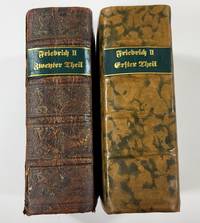
1760Best.-Nr. 047298Tubingen Germany: Johann Ulrich Cotta 1760. In German. Two thick volumes first and second parts both title pages dated 1760. Volume I has been professionally rebound in the same style as the second. Extensively illustrated with full page and folding engravings including folding tables and maps frontis portraits of the emperor and eagle engraving on title pages. Full mottled leather with newer gilt and dark green spine labels raised spine bands all edges tinted red original marbled endpapers with additional new endpapers in first part. Part I is 1000 pages and is very good with faint dampstains to the lower corners of pages 993-1000 very minor worming to the bottom of one folding table short closed tear to one map. Part II has some edgewear and small area of worming to the outer edge of the front cover 28 1024 pages margins of two folding maps trimmed a little closely. Overall quite a nice set sturdy bindings good to very good throughout. Hard Cover. Good. 12mo - over 6¾" - 7¾" tall. Johann Ulrich Cotta Hardcover
1887Best.-Nr. DEMO013716IBoston: Roberts Brothers 1887. Deluxe Limited edition. Hardcover. Very Good. Wilhelm von Kaulbach. 4to 342 pages new full dark morocco leather spine label original pictorial top cover bound in at rear .top edge gilt fore-edge untrimmed; ex libris A. Freiberg of Cincinnati. No. 224 of 400 copies printed for America of the English Edition De Luxe. Twelve India Proof steel engravings after Joseph Wolf engraved by Augustus Fox. Modern form of the traditional legend of REINHART FUCHS. "Under the veil of animals the symbolic representations of the diverse passions of men stand boldly in relief ." Roberts Brothers hardcover
1912Best.-Nr. 20639Paris: Librairie Damascène Morgand Eduoard Rahir Succr 1912. First Edition #262 of350 copies signed. 1 vols. Thick 4to. Boiund in 3/4 green morocco marbled boards te.g. Some waterstaining bottom edge of last 100 pages minor else Very Nice. First Edition #262 of350 copies signed. 1 vols. Thick 4to. Librairie Damascène Morgand, Eduoard Rahir, Succr unknown
1912Best.-Nr. 20639Paris: Librairie Damascène Morgand Eduoard Rahir Succr 1912. First Edition #262 of350 copies signed. 1 vols. Thick 4to. Boiund in 3/4 green morocco marbled boards te.g. Some waterstaining bottom edge of last 100 pages minor else Very Nice. First Edition #262 of350 copies signed. 1 vols. Thick 4to. Librairie Damascène Morgand, Eduoard Rahir, Succr unknown books
1937Best.-Nr. 37606London: Golden Cockerell Press 1937. Hardcover. Very Good. Hardcover. Number 82 of 150 signed copies. There was also an unlimited edition. This is an interesting and pretty book from the Golden Cockerell Press published early in this noted press's history. It is stunningly illustrated with six black and white engravings by Clifford Webb 1895 - 1972 the English artist and engraver. Quarter bound in brown Niger leather with gilt titling to spine and cream cloth covers. Some foxing to front cover and light sunning to top of spine. Printed in Caslon's Old Face type on Arnold's handmade paper. A nice copy in very good condition. Measures 6 x 9 inches. 109 pages plus colophon. PRI/111324. Golden Cockerell Press hardcover
1937Best.-Nr. 37606London: Golden Cockerell Press 1937. Hardcover. Very Good. Hardcover. Number 82 of 150 signed copies. There was also an unlimited edition. This is an interesting and pretty book from the Golden Cockerell Press published early in this noted press's history. It is stunningly illustrated with six black and white engravings by Clifford Webb 1895 - 1972 the English artist and engraver. Quarter bound in brown Niger leather with gilt titling to spine and cream cloth covers. Some foxing to front cover and light sunning to top of spine. Printed in Caslon's Old Face type on Arnold's handmade paper. A nice copy in very good condition. Measures 6 x 9 inches. 109 pages plus colophon. PRI/111324. Golden Cockerell Press hardcover books
1808Best.-Nr. Flo539Good copy of this classic of equestrian humour Incomplete copy with nine plates of 12 in the first book and 12 of 17 in the second book An Academy for Grown Horsemen; containing the Completest Instructions for Walking Trotting Cantering Galloping Strumbling and Tumbling with Annals of Horsemanship: Containing Accounts of Accidental Experiments and Experimental Accidents both Successful and Unsuccessful Communicated by Various Correspondents. The text has been attributed to the artist Henry Bunbury and Francis Grose the antiquarian and compiler of a Classical Dictionary of the Vulgar Tongue. In the 19th century the humorous text was ascribed to Grose in Catalogue of the library of the late Sir Francis Feeling 1836 John Bohn's Catalogue of English Books 1843 Samuel Halkett's Dictionary of the Anonymous and Pseudonymous Literature of Great Britain 1882 D.C. Sapp's The Honey Jar 1898 etc. John C. Riely however in The Age of Horace Walpole in Caricature 1973 claims that Grose only contributed the introduction. Henry William Bunbury 1750-1811 "drew chiefly in pencil or black and red chalk; but although he seems to have used the needle he was never successful as an etcher and his designs were generally reproduced by engravers mostly in stipple or dot. The three works by which he is best known belong to 1787: A Long Minuet The Propagation of a Lie and the volume of equestrian misadventures called An Academy for Grown Horsemen by Geoffrey Gambado. In 1791 appeared the Annals of Horsemanship a kind of sequel to the Academy for Grown Horseman." D.N.B. His other published works include Angelica Kauffman's Angelica's Ladies Library 1794 Bunbury's Illustrations of Shakspear engraved by Bartolozzi 1796 Tales of the Devil 1801 etc. Brown quarter leather binding rubbed and scuffed spine with gilt title and decorative tooling marble boards rubbed and torn book block solid. Some fingermarks and general grubbiness throughout slight spotting to text and plates a couple of plates with neat paper repairs to rear. The copper plates mostly clean and bright one with partial handcolour by a previous owner. Still a fun trot throught the miseries of horse-riding in the late 18th century W. Baynes hardcover
1977Best.-Nr. 36980Paris: A Parole Donnee 1977. Fine/Fine. Paris: "A Parole Donnée" 1977. First Edition Limited to 10 copies including original engraving printed on both Arches and Japon papers of which this is no. 1. Small square quarto 16.5cm; loose as issued in original pale grey printed dust jacket housed in original emerald green cloth chemise and slipcase; 16pp.; two color engravings signed with limitation by the artist. A Fine example. Additionally signed by the poet Bohbot on colophon in rear. Issued as the third volume in the poet's "A Parole Donnée" series. The plates were signed by Bryen shortly before his death in May of 1977. The book was released posthumously in September. No copies in OCLC as of October 2025. A Parole Donnee unknown
1977Best.-Nr. 36980Paris: A Parole Donnee 1977. Fine/Fine. Paris: "A Parole Donnée" 1977. First Edition Limited to 10 copies including original engraving printed on both Arches and Japon papers of which this is no. 1. Small square quarto 16.5cm; loose as issued in original pale grey printed dust jacket housed in original emerald green cloth chemise and slipcase; 16pp.; two color engravings signed with limitation by the artist. A Fine example. Additionally signed by the poet Bohbot on colophon in rear. Issued as the third volume in the poet's "A Parole Donnée" series. The plates were signed by Bryen shortly before his death in May of 1977. The book was released posthumously in September. No copies in OCLC as of October 2025. A Parole Donnee unknown books