Roubaud, Benjamin (dit Benjamin)Livre Rare Book

10.990 Ergebnisse
Best.-Nr. 25267Planche HT parue dans La Caricature politique, morale, littéraire et scénique, volume 6, 28 novembre 1833 (Planche n°335)- Lithographie - Œuvre: Hauteur: 27.2cmx Largeur: 35.8cm - Image: Hauteur: 20.9cm x Largeur: 27.9cm - Titre en bas au centre : « Voyez Messieurs et Dames ! » ; légende plus bas au centre : « Voyez comme il est bien dressé, il donne la patte à tout le monde et se met à genoux et reçoit toujours avec un nouveau plaisir les petites // étrennes de la société. » ; indications : en ht à gche : « La Caricature (Journal) N°159 [160]. », en ht à dte : « Pl. 333. » [erreur de numérotation, planche 335] - Dans la lettre : « chez Aubert, galerie véro dodat. » [éditeur], « Lith. de Becquet, rue Furstemberg 6. » [imprimeur] ; dans l’image, en bas à gche, signature : « Benjamin » [Benjamin Roubaud, dessinateur]Description iconographique:Dans une arène entourée de palissades de bois, Louis-Philippe est représenté avec un corps d’ours et une tête humaine, vue de dos, mais reconnaissable au haut toupet. L’explication de la pl. précise que Benjamin Roubaud a voulu montrer « le système de la paix à tout prix, dans un ours qui danse et qui fait le beau à volonté, sous le knout d’un Cosaque qui le tient enchaîné, et au son du fifre et du tambour qu’un Anglais fait sonner » (Guillaume IV, roi du Royaume-Uni ?). C’est sur un parapluie posé sur ses épaules que le roi fait reposer ses bras. A terre, à gche, gît un chapeau décoré de la cocarde tricolore. Derrière la palissade, une foule de monarques assistent au spectacle et semblent contents, à en juger par leur mine réjouie, « depuis le colosse d’Autriche jusqu’à la colossillonnette d’Espagne » (in explication). On peut notamment reconnaitre Méhémet Ali. L’explication spécifie que la pl. vise à montrer « la double nature d’un Système qui a toute la rudesse d’un ours envers les patriotes de l’intérieur, et toute sa gentillese et son obéissance pour les hommes de la sainte-alliance », faisant allusion en cela à l’attitude répressive et belliqueuse de Louis-Philippe envers le peuple français, et au contraire, sa docilité dans les affaires internationales, Louis-Philippe ayant mené une politique étrangère de non-intervention afin de se concilier les bonnes grâces des grands royaumes (notamment des trois pays formant la Sainte-Alliance). Cf. congrès de la Sainte-Alliance à Münchengraetz en septembre 1833.Personne / Personnage représenté:Louis-Philippe Ier, roi des Français
1978Best.-Nr. 66269CBMonte Carlo, Éditions André Sauret, 1978. 4°. 33 x 25 cm. 340 und 374 Seiten. Original-Leinenbände mit Original-Schutzumschlägen und Original-Klarsichtumschlägen.
GUY LE PRAT.. 1984. In-8 Carré. Broché. Bon état. Couv. légèrement passée. Dos satisfaisant. Intérieur acceptable. 223 pages. Quelques illustrationsen noir et blanc hors texte.
ISBN : 2852050019. Guy Le Prat. 1984. In-8 Carré. Broché. Bon état. Couv. convenable. Dos satisfaisant. Intérieur frais. 223 pages. Collection 'Valeurs-refuge'. Nouvelle édition revue et augmentée.
1862Best.-Nr. E0171Paris, Didot, 1861-1862. , 90, 123, 32, 110, 100 Tafeln. , 263, 232, 111+45, 213, 230 S. 6 Bde. (von 8). Marmorierte Halblederbände der Zeit mit goldgeprägtem Rücken u. Rückenschildchen. Guter Zustand, Decke leichr berieben, Leder leicht fleckig, Ecken etwas bestoßen.
1955Best.-Nr. 27200Paris France: Bibliotheque Nationale. As New. Paperback. FREE UPGRADE to Courier/Priority Shipping Upon Request - IN STOCK AND IMMEDIATELY AVAILABLE FOR SHIPMENT - AS NEW THE TEXT BLOCK IS PRISTINE CLEAN UNMARKED AND IN EXCELLENT CONDITION - - Volume 8. -- with a bonus offer--; T-ROUX . 1955. Bibliotheque Nationale paperback
1785Best.-Nr. 14776A Nap in the Country, the print on top, represents the mid-day rest of a rustic pair, who, while their sheep are calmly grazing and their dog is keeping faithful watch, are, beneath the shadows of spreading trees, indulging in forty winks in the open country, after their early morning toils. A Nap in Town, the print on bottom, which may also be taken as an afternoon siesta, though equally luxurious, is not enjoyed under such healthy conditions as the preceding the town pair are taking their repose with as much lazy ease as the circumstances will permit. Encadrée Bon Londres Samuel Alken 1785 38,5 x 25,5 cm
1807Best.-Nr. 14775This sketch, which is characterised by the artist's usual spirit when dealing with kindred subjects, represents the situation of a rustic swain, whose philanderings have landed him in the midst of the perplexities of a double dilemma. It is seemingly 'washing day,' and the gallant intruder has effected his admission to court the graces of a pretty maiden, who is thrown into consternation at the risk to which her suitor, by an awkward contretemps, is suddenly exposed. The pair have evidently been disturbed at the moment the lady was engaged in drawing a mug of ale for the refreshment of her admirer ; in the confusion, the tap of the beer barrel is still left running, and all the maid's solicitude is centred in the position of her swain, who has incautiously taken refuge in the copper. A very disagreeable-looking old beldame is kindling a blazing fire in the stove, while a buxom wench is working away at the pump, which is pouring gallons of water into the unlucky Lothario's place of concealment. The youth is hesitating midway between the ordeals of fire or water, and he is struggling to effect his escape from both, at the risk of exposure and its consequences. " Encadrée Bon Londres Thomas Tegg 1807 44 x 34 cm
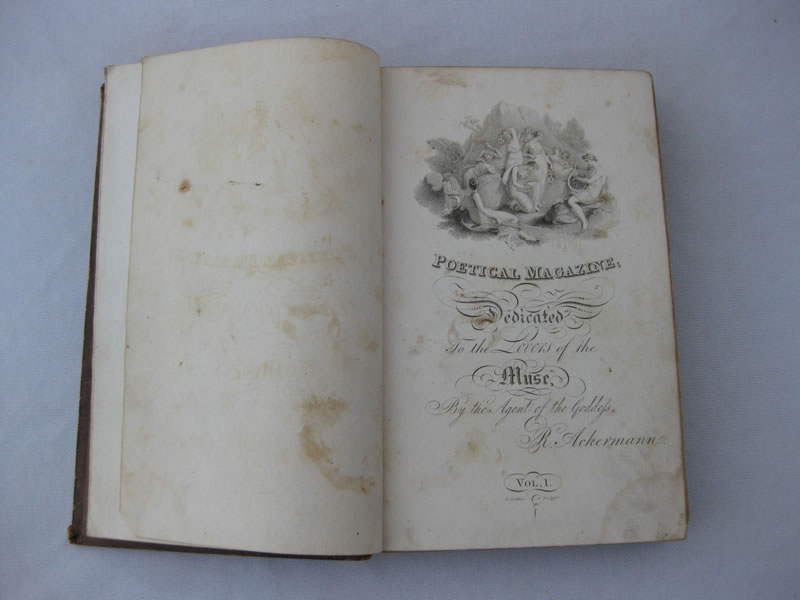
1809Best.-Nr. 120914(R. Ackermann). (May to October 1809). IV, Seite 5 bis 404 and 4 pages Index. With an engraved title page and 11 hand-coloured plates. Späterer, schlichter Halbleder-Einband mit Rückentitel. (Einband etwas berieben. Papier u. Tafeln teils etwas fleckig u. wellig Eine Tafel mit Fehlstelle am unteren Rand). 21x14 cm
Best.-Nr. 15158Épreuve sur beau papier filigrané. en feuille Très bon Paris 14,5 x 10,5 cm
Best.-Nr. 15162Épreuve sur beau papier filigrané. en feuille Très bon Paris 14 x 10 cm
Best.-Nr. 9499Club Francais Du Livre Edition originale numérotée 3924 sur 4000 (reservé aux membres de l'associés du Club Français du Livre) illustrée de nombreuses reproduction en noir d'estampages chinois de la dynastie Han. Textes d'auteurs chinois datant, pour la plupart, d'avant Jésus-C. Bel exemplaire.
198015x22.5 cm. 156 pages. Paperback. In good condition.
1950Best.-Nr. 55275London: The Collectors Book Club 1950. Limited edition. Hardcover. Good- to fine condition. 1/100. Folio. Unpaginated with six tissue-guarded copper engravings. Original green Morroco with five inch black cloth strip laid to covers gilt decorated grape motif across front cover and raised bands with gilt ruling on spine. Gilt top edge. Purple ribbon marker. Title page printed in red-brown. Signed by the artist on dedication page. Printed with the permission of the University Presses of Oxford and Cambridge. Contains six beautiful copperplate engravings by the decorated Dutch sculptor Ru van Rossem well known for his sculptures pen drawings lithographs wood and copper engravings as well as set and costume designs. Printed on English handmade paper by John Roberts Press engravings on Japanese vellum. A pupil of Jam van Tongeren and Arend Hendriks Ru van Rossem 1924-2007 taught at the Great Yarmouth College of Art while he lived in England. For almost twenty years he was a lecturer at the Tilburg Academy and among other awards was appointed Knight of the Order of the Netherlands Lion in 2003. Spine and left Moroccan panel on front cover faded with very light wear at along edges slightly more pronounced at head and tail of spine. Some offsetting of leather edges to endpapers. Binding in good- interior in very good to fine condition. The Collectors Book Club hardcover
1950Best.-Nr. 55275London: The Collectors Book Club 1950. Limited edition. Hardcover. Good- to fine condition. 1/100. Folio. Unpaginated with six tissue-guarded copper engravings. Original green Morroco with five inch black cloth strip laid to covers gilt decorated grape motif across front cover and raised bands with gilt ruling on spine. Gilt top edge. Purple ribbon marker. Title page printed in red-brown. Signed by the artist on dedication page. Printed with the permission of the University Presses of Oxford and Cambridge. Contains six beautiful copperplate engravings by the decorated Dutch sculptor Ru van Rossem well known for his sculptures pen drawings lithographs wood and copper engravings as well as set and costume designs. Printed on English handmade paper by John Roberts Press engravings on Japanese vellum. A pupil of Jam van Tongeren and Arend Hendriks Ru van Rossem 1924-2007 taught at the Great Yarmouth College of Art while he lived in England. For almost twenty years he was a lecturer at the Tilburg Academy and among other awards was appointed Knight of the Order of the Netherlands Lion in 2003. Spine and left Moroccan panel on front cover faded with very light wear at along edges slightly more pronounced at head and tail of spine. Some offsetting of leather edges to endpapers. Binding in good- interior in very good to fine condition. The Collectors Book Club hardcover books
1730Best.-Nr. 7560BB4 Bde. Amsterdam, Wetstein & Smith, 1730. 8°. Titel in Rot und Schwarz. (1) Bl., XXXVIII, 484 S.; (3) Bl., 495 S.; (3) Bl., 426 S.; (3) Bl., 507 S.Mit gest. gef. Frontispiz von J. Folkema nach B. Picart, gest. Titelvignette, gest. Kopfstück von G. F. Debrie, 10 gef. Karten, 68 Kupfertafeln (davon 51 gef.) nach Merian, Scheuchzer u. a. Kalblederbände der Zeit mit reicher Rückenvergoldung, zwei Rückenschildchen und Stehkantenverg.
1714Best.-Nr. 7878CB4 Bände. Leiden, Pierre van der Aa, 1714. Kl.-8°. (18) Bl., 220 (recte 224) S.; (2) Bl. S. 221–228, 233–434; (2) Bl. S. 435–676; (2) Bl., S. 677–1027. Mit gest. Titelblatt (doppelblattseitig), 1 gest. Frontispiz (doppelblattseitig), 68 (davon 50 gef.) und 5 (von 6) gef. Kupferkarten. Lederbände der Zeit mit reicher Rückenvergoldung.
1778Best.-Nr. 7902CBNouvelle édition. 2 Bände. Neuchâtel, Fauche, 1778. 4°. (4), IV, 454, (2) S.; (4), 391, (1) S. Mit 2 gest. Frontisp. und 77 Kupfertafeln (davon 15 gef.) Lederbände der Zeit mit Rückenschild und Rückenvergoldung.
1924- Lucien Vogel éditeur, Paris 1924, 19,5x25cm, une feuille. - Original color print, printed on vergé paper, signed in the plate. An original print used to illustrate the Gazette du bon ton, one of the most attractive and influential 20th century fashion magazines, featuring the talents of French artists and other contributors from the burgeoning Art Deco movement. A celebrated fashion magazine established in 1912 by Lucien Vogel, La Gazette du bon ton appeared until 1925, with a hiatus from 1915 to 1920 due to the war (the editor-in-chief having been called up for service). It consisted of 69 issues printed in only 2,000 copies each and notably illustrated with 573 color plates and 148 sketches of the models of the great designers. Right from the start, this sumptuous publication "was aimed at bibliophiles and fashionable society," (Françoise Tétart-Vittu, "La Gazette du bon ton", in Dictionnaire de la mode, 2016) and was printed on fine vergé paper using a type cut specially for the magazine by Georges Peignot, known as Cochin, later used (in 1946) by Christian Dior. The prints were made using stencils, heightened in colors, some highlighted in gold or palladium. The story began in 1912, when Lucien Vogel, a man of the world involved in fashion (he had already been part of the fashion magazine Femina) decided, with his wife Cosette de Brunhoff - the sister of Jean, creator of Babar - to set up the Gazette du bon ton, subtitled at the time: "Art, fashion, frivolities." Georges Charensol noted the reasoning of the editor-in-chief: "'In 1910,' he observed, 'there was no really artistic fashion magazine, nothing representative of the spirit of the time. My dream was therefore to make a luxury magazine with truly modern artists...I was assured of success, because when it comes to fashion, no country on earth can compete with France.'" ("Un grand éditeur d'art. Lucien Vogel" in Les Nouvelles littéraires, no. 133, May 1925). The magazine was immediately successful, not only in France but also in the United States and Latin America. At first, Vogel put together a team of seven artists: André-Édouard Marty and Pierre Brissaud, followed by Georges Lepape and Dammicourt, as well as eventually his friends from school and the School of Fine Arts, like George Barbier, Bernard Boutet de Monvel and Charles Martin. Other talented people soon came flocking to join the team: Guy Arnoux, Léon Bakst, Benito, Boutet de Monvel, Umberto Brunelleschi, Chas Laborde, Jean-Gabriel Domergue, Raoul Dufy, Édouard Halouze, Alexandre Iacovleff, Jean Émile Laboureur, Charles Loupot, Chalres Martin, Maggie Salcedo. These artist, mostly unknown when Lucien Vogel sought them out, later became emblematic and sought-after artistic figures. It was also they who worked on the advertising drawings for the Gazette. The plates put the spotlight on, and celebrate, dresses by seven designers of the age: Lanvin, Doeuillet, Paquin, Poiret, Worth, Vionnet and Doucet. The designers provided exclusive models for each issue. Nonetheless, some of the illustrations are not based on real models, but simply on the illustrator's conception of the fashion of the day. The Gazette du bon ton was an important step in the history of fashion. Combining aesthetic demands with the physical whole, it brought together - for the first time - the great talents of the artistic, literary, and fashion worlds; and imposed, through this alchemy, a completely new image of women: slender, independent and daring, which was shared by the new generation of designers, including Coco Chanel, Jean Patou, Marcel Rochas, and so on... Taken over in 1920 by Condé Montrose Nast, the Gazette du bon ton was an important influence on the new layout and aesthetics of that "little dying paper" that Nast had bought a few years earlier: Vogue. [FRENCH VERSION FOLLOWS] Estampe originale en couleur tirée sur papier vergé, signée en bas à droite dans la planche. Gravure originale réalisée pour l'illus
Best.-Nr. 5245Excudit de KILIAN Georg Chrystoph (1709 - 1781) 485 x 370 très bon
1972Best.-Nr. ART7213M1972, Bonvent, Genève. In-8 relié carré, 127pages, nombreuses illustrations.
1711Best.-Nr. 002657Lugduni Batavorum (Leide, Leyde), Apud Petrum Van der Aa, Bibliopolam, 1711 In-folio (41 x 27 cm), (1) ff., 15 pp., (8) pp., veau marbré, dos à six nerfs orné, pièce de titre de maroquin rouge, triple filet à froid entourant les plats, double filet doré sur les coupes, tranches rouges (reliure d'époque). Illustré d'un frontispice, un portrait de l'auteur, 1 vignette de titre, 4 vignettes dans le texte, et 60 planches gravées. Première édition en latin du "Cabinet des raretés de l'île d'Amboine" (Amboinsche Rariteitkamer), publié en hollandais en 1705 ; l'auteur, atteint de cécité, est ici représenté dans son cabinet. Précieux exemplaire provenant de la famille de Charles de MONTESQUIEU, de la bibliothèque du Château de la Brède, avec l'ex-libris des Secondat, barons de la Brède et de Montesquieu, "Virtutem Fortuna Secondat, Ex Bibliotheca Bredanense", et les initiales C. M. à l'encre. Bel exemplaire. // Folio (41 x 27 cm), (1) ff., 15 pp., (8) pp., marbled calf, spine tooled raised on six bands, red morocco title label, triple blind fillet borders on covers, double gilt fillet on turns-in, red edges (contemporary binding). Illustrated with a frontispiece, a portrait of the author, 1 vignette on title, 4 vignettes in the text, and 60 engraved plates. First edition in latin of the "Ambonese Curiosity Cabinet" (Amboinsche Rariteitkamer), first published in german in 1705 ; the author, blind, is here depicted in his office. Precious copy from Charles de MONTESQUIEU family, from the "Château de la Brède" library, with the book-plate of the Secondat, barons de la Brède et de Montesquieu "Virtutem Fortuna Secondat , Ex Bibliotheca Bredanense", and initials C. M. hand-written. Fine copy (Nissen ZBI 3520)
1868Best.-Nr. 2416CBDarmstadt, Gustav Georg Lange, (1868). 4°. 85 S., 20 Tafeln. Roter Maroquinband mit Goldprägung.
1870Best.-Nr. 7509CB1 Band (von 3). Darmstadt, Gustav Georg Lange, 1870. 8°. 320, (2) S. Mit Titelvignette und 62 Stahlstichtafeln. Blind- und goldgeprägter roter Orig.-Lederband mit dreiseitigem Goldschnitt.
1861Best.-Nr. 7238AB3 Bände. Darmstadt, G.G. Lange, 1861–1866. 8°. 2 Bl., 319 S.; 2 Bl., 300 S.; 2 Bl., 408 S. Mit 3 gestochenen Titeln mit Vignetten und 195 Stahlstiche von L. Rohbock mit Ansichten aus der Schweiz. Blaue, goldgeprägte Orig.-Leinenbände.