Livre Rare Book

10.930 risultati
rif. 500297379Sans date.
1913- Lucien Vogel éditeur, Paris Septembre 1913, 19x24,5cm, une feuille. - Original color print, printed on vergé paper, signed in the plate. An original print used to illustrate the Gazette du bon ton, one of the most attractive and influential 20th century fashion magazines, featuring the talents of French artists and other contributors from the burgeoning Art Deco movement. A celebrated fashion magazine established in 1912 by Lucien Vogel, La Gazette du bon ton appeared until 1925, with a hiatus from 1915 to 1920 due to the war (the editor-in-chief having been called up for service). It consisted of 69 issues printed in only 2,000 copies each and notably illustrated with 573 color plates and 148 sketches of the models of the great designers. Right from the start, this sumptuous publication "was aimed at bibliophiles and fashionable society," (Françoise Tétart-Vittu, "La Gazette du bon ton", in Dictionnaire de la mode, 2016) and was printed on fine vergé paper using a type cut specially for the magazine by Georges Peignot, known as Cochin, later used (in 1946) by Christian Dior. The prints were made using stencils, heightened in colors, some highlighted in gold or palladium. The story began in 1912, when Lucien Vogel, a man of the world involved in fashion (he had already been part of the fashion magazine Femina) decided, with his wife Cosette de Brunhoff - the sister of Jean, creator of Babar - to set up the Gazette du bon ton, subtitled at the time: "Art, fashion, frivolities." Georges Charensol noted the reasoning of the editor-in-chief: "'In 1910,' he observed, 'there was no really artistic fashion magazine, nothing representative of the spirit of the time. My dream was therefore to make a luxury magazine with truly modern artists...I was assured of success, because when it comes to fashion, no country on earth can compete with France.'" ("Un grand éditeur d'art. Lucien Vogel" in Les Nouvelles littéraires, no. 133, May 1925). The magazine was immediately successful, not only in France but also in the United States and Latin America. At first, Vogel put together a team of seven artists: André-Édouard Marty and Pierre Brissaud, followed by Georges Lepape and Dammicourt, as well as eventually his friends from school and the School of Fine Arts, like George Barbier, Bernard Boutet de Monvel and Charles Martin. Other talented people soon came flocking to join the team: Guy Arnoux, Léon Bakst, Benito, Boutet de Monvel, Umberto Brunelleschi, Chas Laborde, Jean-Gabriel Domergue, Raoul Dufy, Édouard Halouze, Alexandre Iacovleff, Jean Émile Laboureur, Charles Loupot, Chalres Martin, Maggie Salcedo. These artist, mostly unknown when Lucien Vogel sought them out, later became emblematic and sought-after artistic figures. It was also they who worked on the advertising drawings for the Gazette. The plates put the spotlight on, and celebrate, dresses by seven designers of the age: Lanvin, Doeuillet, Paquin, Poiret, Worth, Vionnet and Doucet. The designers provided exclusive models for each issue. Nonetheless, some of the illustrations are not based on real models, but simply on the illustrator's conception of the fashion of the day. The Gazette du bon ton was an important step in the history of fashion. Combining aesthetic demands with the physical whole, it brought together - for the first time - the great talents of the artistic, literary, and fashion worlds; and imposed, through this alchemy, a completely new image of women: slender, independent and daring, which was shared by the new generation of designers, including Coco Chanel, Jean Patou, Marcel Rochas, and so on... Taken over in 1920 by Condé Montrose Nast, the Gazette du bon ton was an important influence on the new layout and aesthetics of that "little dying paper" that Nast had bought a few years earlier: Vogue. [FRENCH VERSION FOLLOWS] Estampe originale en couleur, tirée sur papier vergé, signée en bas à gauche de la planche. Gravure originale réalisée pour
1913- Lucien Vogel éditeur, Paris 1913, 19,5x25cm, une feuille. - Original color print, printed on vergé paper, signed in the plate. An original print used to illustrate the Gazette du bon ton, one of the most attractive and influential 20th century fashion magazines, featuring the talents of French artists and other contributors from the burgeoning Art Deco movement. A celebrated fashion magazine established in 1912 by Lucien Vogel, La Gazette du bon ton appeared until 1925, with a hiatus from 1915 to 1920 due to the war (the editor-in-chief having been called up for service). It consisted of 69 issues printed in only 2,000 copies each and notably illustrated with 573 color plates and 148 sketches of the models of the great designers. Right from the start, this sumptuous publication "was aimed at bibliophiles and fashionable society," (Françoise Tétart-Vittu, "La Gazette du bon ton", in Dictionnaire de la mode, 2016) and was printed on fine vergé paper using a type cut specially for the magazine by Georges Peignot, known as Cochin, later used (in 1946) by Christian Dior. The prints were made using stencils, heightened in colors, some highlighted in gold or palladium. The story began in 1912, when Lucien Vogel, a man of the world involved in fashion (he had already been part of the fashion magazine Femina) decided, with his wife Cosette de Brunhoff - the sister of Jean, creator of Babar - to set up the Gazette du bon ton, subtitled at the time: "Art, fashion, frivolities." Georges Charensol noted the reasoning of the editor-in-chief: "'In 1910,' he observed, 'there was no really artistic fashion magazine, nothing representative of the spirit of the time. My dream was therefore to make a luxury magazine with truly modern artists...I was assured of success, because when it comes to fashion, no country on earth can compete with France.'" ("Un grand éditeur d'art. Lucien Vogel" in Les Nouvelles littéraires, no. 133, May 1925). The magazine was immediately successful, not only in France but also in the United States and Latin America. At first, Vogel put together a team of seven artists: André-Édouard Marty and Pierre Brissaud, followed by Georges Lepape and Dammicourt, as well as eventually his friends from school and the School of Fine Arts, like George Barbier, Bernard Boutet de Monvel and Charles Martin. Other talented people soon came flocking to join the team: Guy Arnoux, Léon Bakst, Benito, Boutet de Monvel, Umberto Brunelleschi, Chas Laborde, Jean-Gabriel Domergue, Raoul Dufy, Édouard Halouze, Alexandre Iacovleff, Jean Émile Laboureur, Charles Loupot, Chalres Martin, Maggie Salcedo. These artist, mostly unknown when Lucien Vogel sought them out, later became emblematic and sought-after artistic figures. It was also they who worked on the advertising drawings for the Gazette. The plates put the spotlight on, and celebrate, dresses by seven designers of the age: Lanvin, Doeuillet, Paquin, Poiret, Worth, Vionnet and Doucet. The designers provided exclusive models for each issue. Nonetheless, some of the illustrations are not based on real models, but simply on the illustrator's conception of the fashion of the day. The Gazette du bon ton was an important step in the history of fashion. Combining aesthetic demands with the physical whole, it brought together - for the first time - the great talents of the artistic, literary, and fashion worlds; and imposed, through this alchemy, a completely new image of women: slender, independent and daring, which was shared by the new generation of designers, including Coco Chanel, Jean Patou, Marcel Rochas, and so on... Taken over in 1920 by Condé Montrose Nast, the Gazette du bon ton was an important influence on the new layout and aesthetics of that "little dying paper" that Nast had bought a few years earlier: Vogue. [FRENCH VERSION FOLLOWS] Estampe originale en couleur tirée sur papier vergé, signée en bas à gauche dans la planche. Gravure originale réalisée pour l'illus
1913rif. 54590Lucien Vogel éditeur | Paris Septembre 1913 | 19 x 24.50 cm | une feuille
1913rif. 43236Lucien Vogel éditeur | Paris 1913 | 19.50 x 25 cm | une feuille
1913rif. 89418Lucien Vogel éditeur | Paris Septembre 1913 | 19 x 24.50 cm | une feuille
1870rif. 256761870 Le Charivari,1870 -Lithographie -- Œuvre:- texte imprime au dos,bon etat.-- Trait carré: Hauteur: 23.7cmx Largeur: 20.2cm - Œuvre: Hauteur: 43.5cm PAGE DE UNE : En en-tête à gauche : "TRENTE-NEUVIEME ANNEE" ; en en-tête à droite : "SAMEDI 5 MARS 1870" ; en dessous, centré : "LE CHARIVARI" - PAGE 3 : En haut de l'image, centré : "PORTE ST MARTIN / LUCRECE / BORGIA" ; signature en bas à gauche de l'image : "H. D." ; en bas à droite de l'image : "8" ; en dessous de l'image à gauche : "A. de Vresse, r. Rivoli, 55" ; en dessous de l'image à droite : "Lith. Walter Fes. r. Paradis Pre, 28". ; et en dessous : "-Mon Révérend, avant de proclamer l'infaillibilité des Papes, prenez-moi une contre-/marque pour ce qui se joue la-dedans"iconographie:Illustration pour le périodique Le Charivari du 5 Mars 1870 ayant pour thème la pièce de théâtre de Victor Hugo "Lucrèce Borgia".
1836rif. 4705BBZürich, Orell Füssli & Compagnie, 1836. 8°. (2) 368 S., (9) Bl. (leere Seiten für Notizen). Pappband der Zeit mit handschriftl. Rückentitel. + Wichtig: Für unsere Kunden in der EU erfolgt der Versand alle 14 Tage verzollt ab Deutschland / Postbank-Konto in Deutschland vorhanden + Siebenter Band.
1836rif. 4703BBZürich, Orell Füssli & Compagnie, 1836. 8°. 392 S., (9) Bl. (leere Seiten für Notizen). Pappband der Zeit mit handschriflt. Rückentitel. + Wichtig: Für unsere Kunden in der EU erfolgt der Versand alle 14 Tage verzollt ab Deutschland / Postbank-Konto in Deutschland vorhanden + Achter Band.
1837rif. 4704BBZürich, Orell Füssli & Compagnie, 1837. 8°. 505 S. , (9) S. (leere Seiten für Notizen). Pappband der Zeit mit handschr. Rückentitel. + Wichtig: Für unsere Kunden in der EU erfolgt der Versand alle 14 Tage verzollt ab Deutschland / Postbank-Konto in Deutschland vorhanden + Zehnter Band.
1838rif. 4706BBZürich, Orell Füssli & Compagnie, 1838. 8°. 496 S. Pappand der Zeit mit handschriftl. Rückentitel. + Wichtig: Für unsere Kunden in der EU erfolgt der Versand alle 14 Tage verzollt ab Deutschland / Postbank-Konto in Deutschland vorhanden + Eilfter Band.
1836rif. 4705BBSiebenter Band. Zürich, Orell Füssli & Compagnie, 1836. 8°. (2) 368 S., (9) Bl. (leere Seiten für Notizen). Pappband der Zeit mit handschriftl. Rückentitel.
1836rif. 4703BBAchter Band. Zürich, Orell Füssli & Compagnie, 1836. 8°. 392 S., (9) Bl. (leere Seiten für Notizen). Pappband der Zeit mit handschriflt. Rückentitel.
1837rif. 4704BBZehnter Band. Zürich, Orell Füssli & Compagnie, 1837. 8°. 505 S. , (9) S. (leere Seiten für Notizen). Pappband der Zeit mit handschr. Rückentitel.
1838rif. 4706BBEilfter Band. Zürich, Orell Füssli & Compagnie, 1838. 8°. 496 S. Pappand der Zeit mit handschriftl. Rückentitel.
2018Acquaforte elettrochimica / Electrochemical etching. L'incisione è stata realizzata presso la Kansas State University (Manhattan, Kansas) Timbro a secco dell'Artista. Firma, titolo e numerazione a matita. Esemplare p.d.a.. Cm 30,5x22,5 (Foglio 53x38). . . Ottimo (Fine). . Edizione originale di 25 es. numerati e firmati . .
1957rif. 003106Paris Hotel Drouot 1957 In-4 Broché
197730 page exhibition catalogue. 8 7/8"w x 8 1/2"h. Sticker residue on front cover.
rif. 49448Chicago Terra Museum of American Art 1984 in 4 (28,5x24) 1 volume reliure toilée brique de l'éditeur, jaquette illustrée en couleurs, 159 pages et cahier d'addenta volant in fine(pp. 8, 3 colour illus). Ex dono manuscrit sur la première page de garde. First Edition. Bon exemplaire
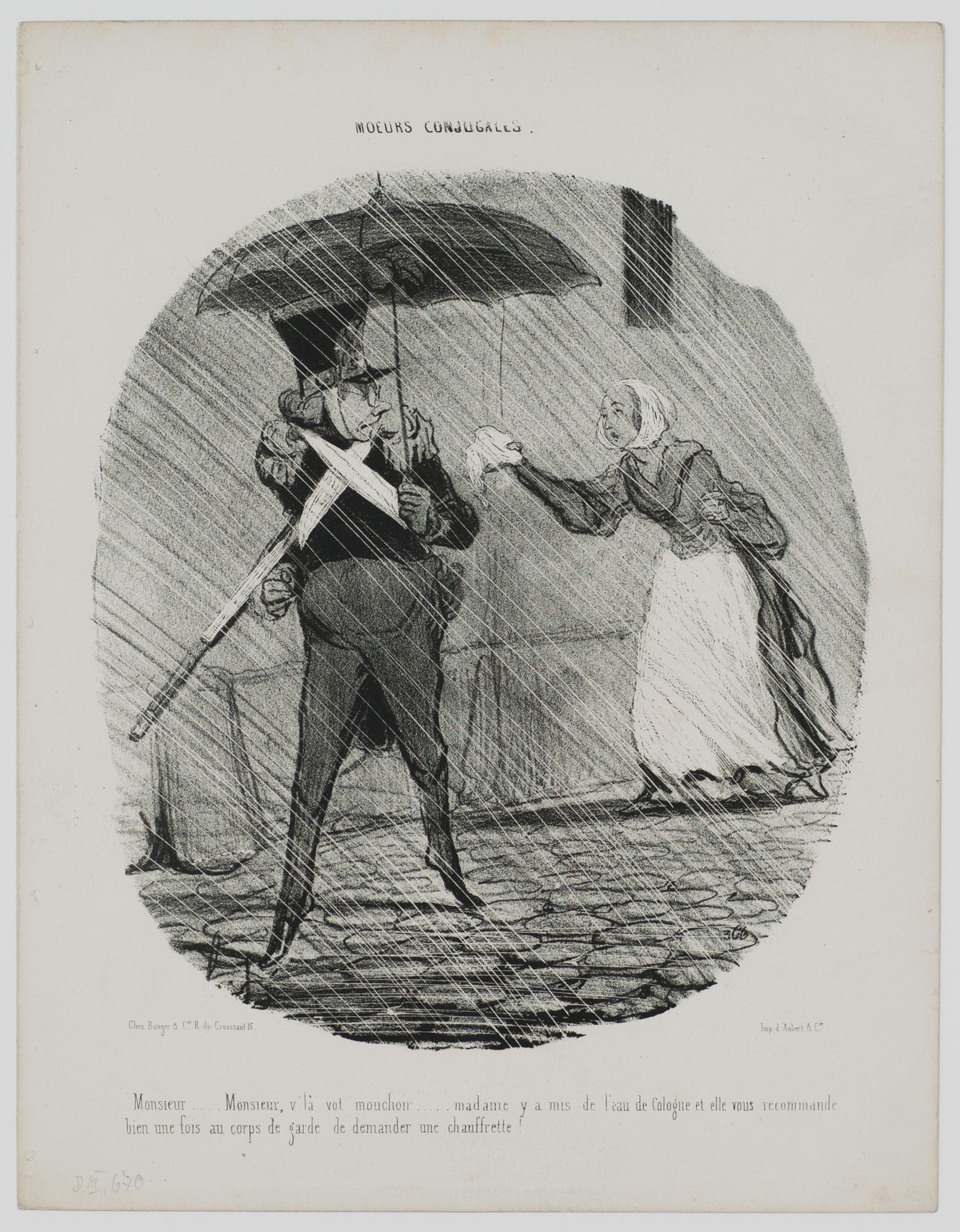
rif. HD-083o.J. (Monsieur, Monsieur, hier ist Ihr Taschentuch. Madame hat etwas Eau de Cologne drauf getan, und sie empfiehlt Ihnen, gleich nach Ankunft bei der Garde um einen Fusswärmer anzusuchen). Lithographie, auf chamoisfarbenem Velin, mit den Adressen: Chez Bauger & Cie., R du Croissant 16, sowie: Imp. d?Aubert & Cie. Blattgröße 34,3:26,5 cm. ? Mit Heftspuren im linken Rand. Literatur: Daumier-Register 670; Delteil 670. No. 47 der Folge ?Moeurs Conjugales?, erschienen 27.04.1842 in ?Le Charivari?. ? Sur blanc!
1832rif. 256111832 Planche HT parue dans La Caricature morale, religieuse, littéraire et scénique, volume 3, 2 février 1832, (Planche n°133);taches en marges.-Lithographie- Œuvre: Hauteur: 27cmx Largeur: 35.6cm - Image: Hauteur: 18.7cmx Largeur: 22.5cm - Titre en bas au centre : « Monsieur Budget et Mademoiselle Cassette / se promenant aux Tuilleries [Tuileries] » ; indications, en ht au centre : « La Caricature (Journal) / N°66. », en ht à dte : « Pl. 133. »- Dans la lettre : « Lith. de Delaporte » [imprimeur], « On s’abonne chez Aubert, galerie véro dodat. » [éditeur]Inscription - Sur la robe de la femme, une série de chiffres correspondant à des sommes mirobolantes- « Ces deux être abstraits, gras de la maigreur de tous, et dont chacun, même le Sans-Culotte, retrouve toujours la main dans un coin de son gousset ». Il s’agit d’une représentation caricaturale de Louis-Philippe, figuré extrêmement gros, comme engraissé par l’argent que "La Caricature" lui reproche de prendre aux Français par le biais des taxes et impôts. Il est représenté de dos (mais est reconnaissable au toupet et aux favoris). Il donne le bras à une femme, incarnation de la « Cassette », c'est-à-dire du budget, voire même de la liste civile du roi. Sa robe est tricolore (bleu, blanc et rouge). Elle aussi de dos, elle tourne la tête vers le spectateur. Les deux obèses personnages se promenent dans le jardin des Tuileries. La pl. critique l’amour de l’argent, voire l’avarice du roi des Français. A l’arrière-plan à gche, le pavillon des Tuileries, surmonté du drapeau tricolore.
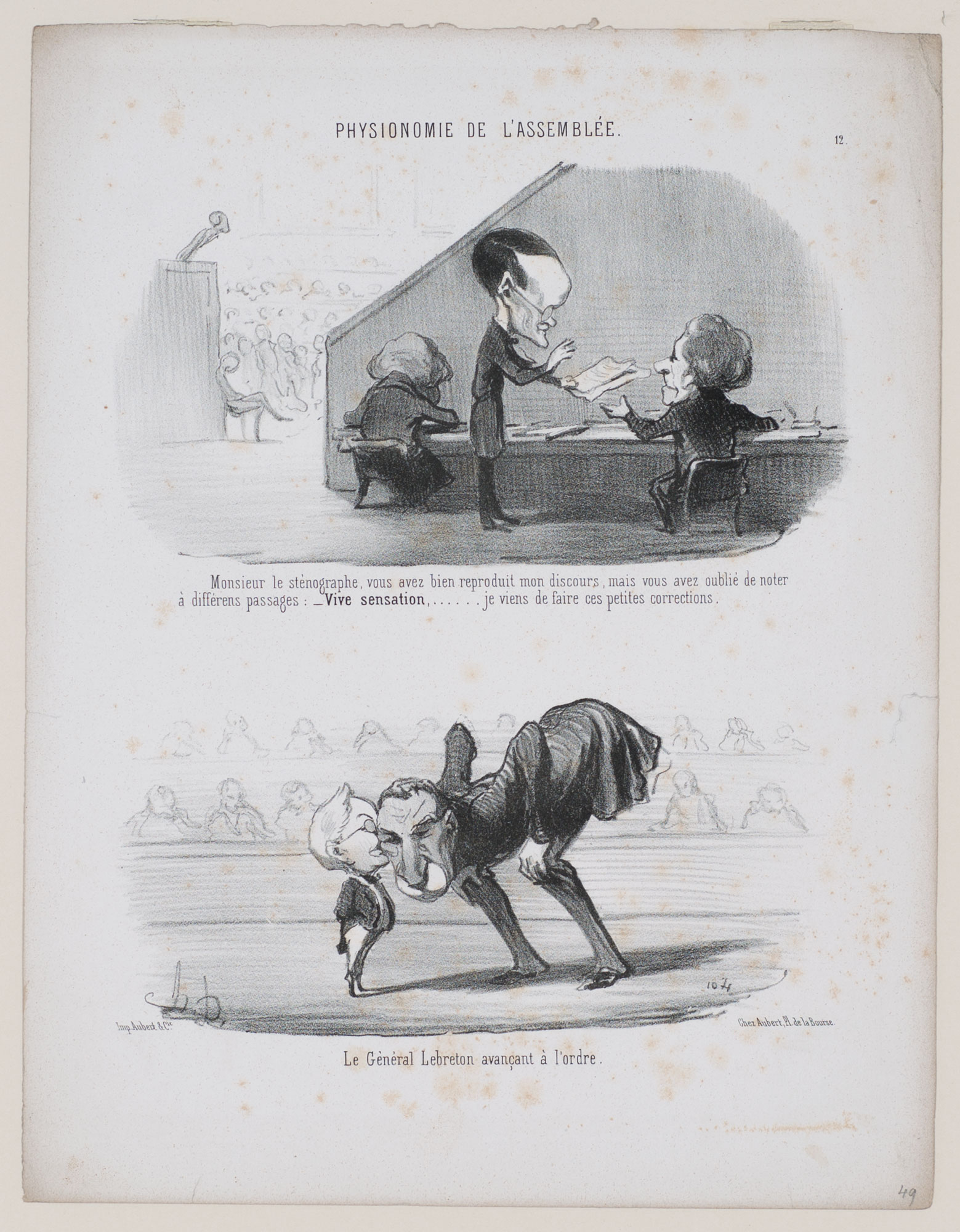
rif. HD-206o.J. Herr Stenograph, Sie haben meine Rede sehr gut widergegeben, aber wie es scheint, haben Sie bei verschiedenen Passagen versäumt hinzuzufügen:.... "lebhafte Emotionen des Abgeordneten"..... Ich habe mir erlaubt diese kleinen Veränderung zu ergänzen. General Lebreton empfängt seine Befehle. Lithographie, auf chamoisfarbenem Velin, mit den Adressen: Chez Aubert, Pl. de la Bourse., sowie: Imp. Aubert & Cie. Darstellungsgröße 25,9:21,8 cm, Blattgröße 35,7:27,6 cm. Literatur: Daumier-Register 1958 II (von 2); Delteil 1958 II (von 2), Blatt Nr. 12 der Serie ?PHYSIONOMIES DE L'ASSEMBLÉE.?, erschienen 30.11.1849 in ?LE CHARIVARI?. ? Sur blanc!
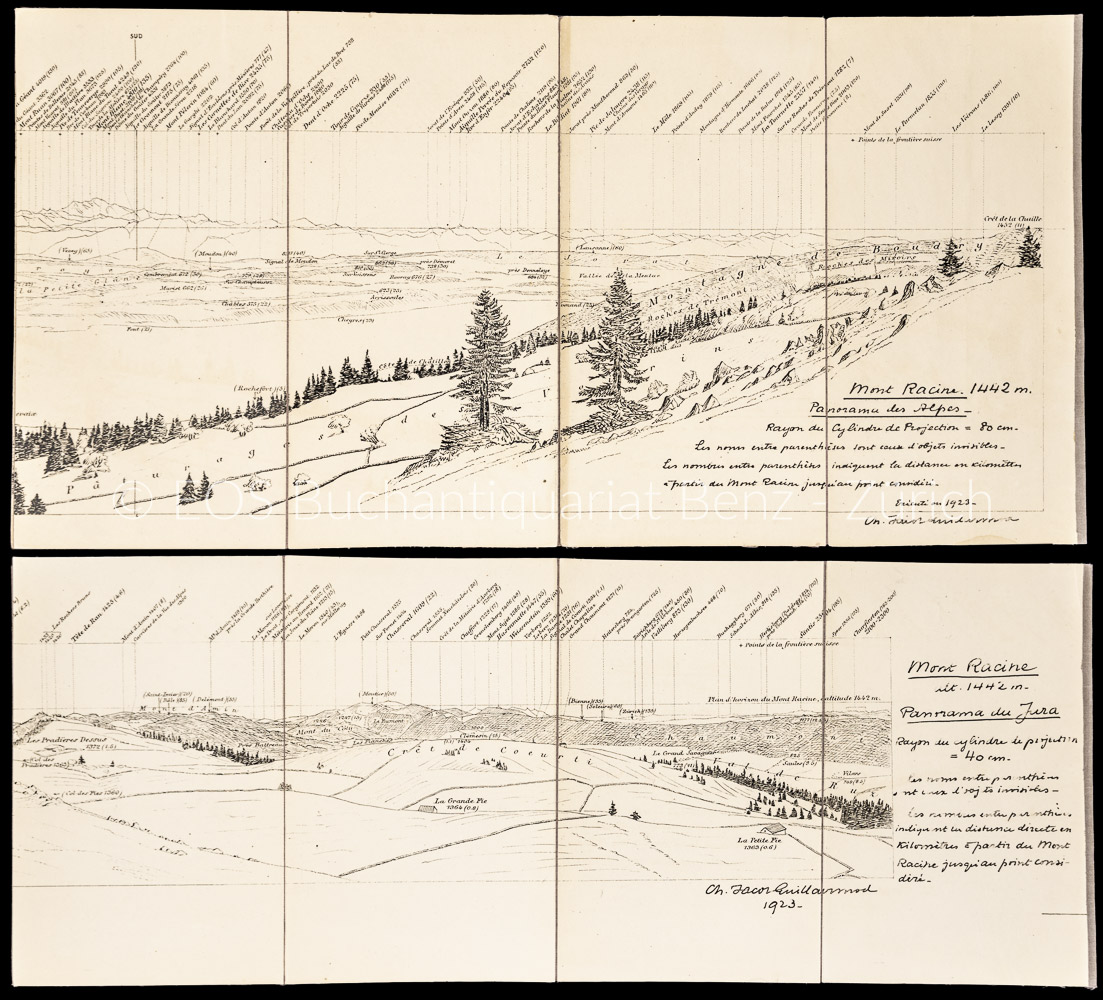
1923rif. 730DGLa Chaux-des-Fonds, W. Perrenoud, 1923. Lithgraphie. Alpenpanorama: 23 x 184 cm. Jurapanorama: 18 x 184 cm. + Wichtig: Für unsere Kunden in der EU erfolgt der Versand alle 14 Tage verzollt ab Deutschland / Postbank-Konto in Deutschland vorhanden +, A
1923rif. 730DGLa Chaux-des-Fonds, W. Perrenoud, 1923. Lithographie. Alpenpanorama: 23 x 184 cm. Jurapanorama: 18 x 184 cm.
1930rif. 015683Paris Editions Jeanne Walter 1930 in-48° broché, couverture rempliée, chemise et étui de l'éditeur