LEYDEN Lucas VanLivre Rare Book

10 207 résultats
réf. 5146De la suite Jésus Christ et les Apôtres représentés debout. Copie en contre partie de Bartsch 98 11 x 7 au trait carré
réf. 5145De la suite Jésus Christ et les Apôtres représentés debout. Copie en contre-partie, petites marges. Bartsch 93 11 x 7 au trait carré
réf. 5140De la suite Jésus Christ et les Apôtres représentés debout. Copie en contre partie de Bartsch 90 11 x 7 au trait carré
réf. 5142De la suite Jésus Christ et les Apôtres représentés debout. Copie en contre partie de Bartsch 96. 11 x 7 au trait carré
réf. 15156Épreuve sur beau papier filigrané. en feuille Très bon Paris 13 x 8,5 cm
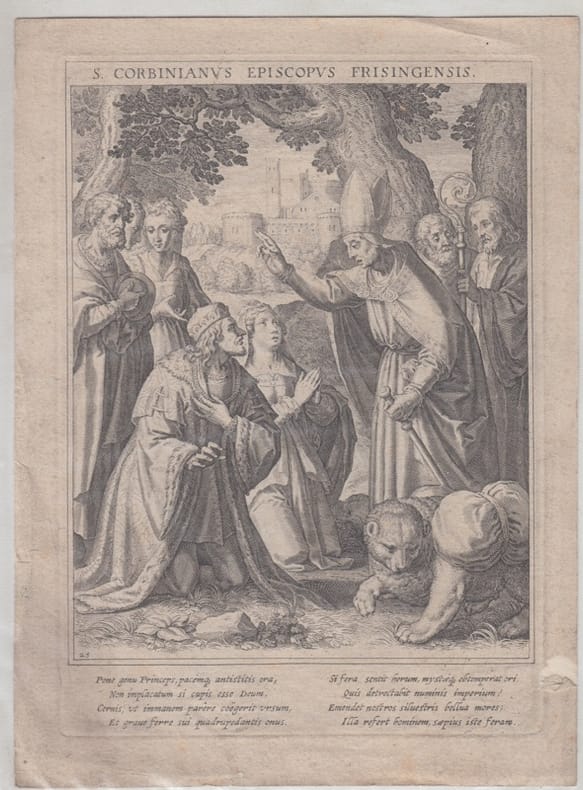
1615réf. 279631615 1615. '25. S. CORBINIANUS EPISCOPUS FRISINGENSIS.'Copperplate engraving on hand laid (verge) paper. Watermark: not visible on sheet . Sheet size: 19,5 x 27,5 cm. (7,7 x 10,8 inch). Image size: 15 x 21,5 cm. (5,9 x 8,5 inch).From 'Bavaria Sancta .', by Matthäus Rader, published in Munich. Condition: good, given age.
réf. 5143De la suite Jésus Christ et les Apôtres représentés debout. Copie en contre partie de Bartsch 94 11 x 7 au trait carré
1660réf. 7316Très belle épreuve à grandes marges sur beau papier vergé filigrané. Bartsch XXI - 3. Épreuve à l’adresse “Vincentius Billy formis Romae”. l’estampe a pris uniformément l’eau. c. 1660 29,6 x 43,3 cm.
réf. 5136De la suite Jésus Christ et les Apôtres représentés debout. Copie en contre partie de Bartsch 89 11,2 x 7 au trait carré
Folio (270 x 387 mm). (6), 92, (2) pp. With 2 plates of engraved music and 8 (including frontispiece) coloured aquatints by or after Bonatti, Castellini, Gallina, and Pallagi. Contemporary ruby-red morocco, elaborately gilt with gilt inner dentelle and giltstamped arms to both covers. Green moirée silk endpapers. Green silk divider. Only edition. Of all of Gironi's publications, all of which are of a similar nature, the present work on Greek music is one of the rarest, published in only 30 copies and printed on strong, very wide-margined wove paper. This is the dedication copy for Marie Louise, Archduchess of Austria and Duchess of Parma (1791-1847), the wife of Napoleon and daughter of Francis I (1768-1835), first Emperor of Austria, with a printed dedication dated May 1825 and sumptuously bound with the Austrian arms on both covers. - "Cette dissertation n'étant point destinée au commerce, il n'en a été tiré que trente exemplaires, et l'auteur en a fait hommage à une dame à l'occasion de son mariage. Les gravures sont d'après les dessins de peintres célèbres" (Brunet). - The eight hand-coloured aquatints, showing costumes and musical instruments, are blindstamped with Giulio Ferrario's monogram ("Il costume antico e moderno"). An entirely complete copy, showing only some slight spotting and some foxing to margins. Old catalogue description pasted to lower free endpaper. Traces of professional restorations to spine and hinges. Latterly in the collection of the legendary French maître coiffeur Louis Alexandre Raimon (1922-2008), hairdresser to film stars and aristocracy, with his ownership stamp to first free endpaper ("Collection Alexandre de Paris"). Brunet II, 1615. Graesse III, 89. OCLC 13996001.
réf. 14658Grand sacrifice fait à Diane par Xénophon au retour de la chasse.D'après Pietro da Cortone. en feuille, ancienne restauration au milieu en haut. Bon Rome Rossi 50 x 39 cm
réf. 11732Très belle épreuve. en feuille Bon Londres et Paris Fisher 15,5 x 11,4 cm au trait carré. Marges 23,7 x 18,58 cm.
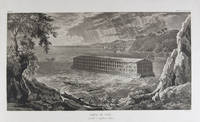
1833réf. 18856Milano: Fortunato Stella e Figli 1833. First Italian edition. Hardcover. f to vg. Oblong folio 12 6/8 x 18 1/2". 1 leaf Title 38 leaves Plates 1 leaf List of content. Original half morocco over burgundy paper covered boards. Gold lettering and tooling on spine. Rare first Italian edition of Paul-Louis-Bernard Drach's atlas volume of his "Sainte Bible de Vence" a series which was originally published in 27 volumes in Paris from 1827 to 1833. The striking 38 engraved plates featured in this atlas are composed of 13 maps by A. R. Fremin and 25 engravings signed by Falkeisen Angelini and Lanzani. The engraved plates have been laid down on beautiful hand-made paper and describe the following: 1. Map of the place of Eden Mesopotamy and Persian Gulf; 2. Noah's Arch construction; 3. Noah's Arch; 4. Map of the land divided among Noah's sons; 5. The Babel Tower; 6. Map of the Land of Canaan; 7. Map of Jews' Pilgrimage; 8. The Jerusalem Sahnedrin; 9. The Temple of Jerusalem plans and sections; 10. The Temple of Jerusalem square plan; 11. Map of ancient Jerusalem; 12. The Temple of Salomon; 13. The Temple's foundations; 14. The East Gate; 15. The Buildings of the Temple; 16. Musical Instruments of the Jews; 17. Hebrew Alphabet; 18. Jew's Vestments and worship's objects; 19. Two Menorah; 20. High Priest's vestments and Golden Menorah; 21. Moses' Tabernacle; 22. The Loaves of Proposition; 23. Plan and section of the Tabernacle; 24. The encampment of the Israelites; 25. Map of the Holy Land South; 26. Map of the Holy Land North; 27. Map of Syria; 28.Map of Israel under Salomon; 29. Plan of the House of the Forest of Lebanon; 30. The House of the Forest of Lebanon; 31. The Bronze Sea; 32. The Washings; 33. The Altars of the Holocausts; 34. Map of the Persian Empire; 35. Map of the Land of Canaan according to Ezechiel; 36. Map of Herod's Reign; 37. Zachary's Vision; 38. Map of the travels of Saint Peter and Saint Paul. The plates measure appr. 12 1/2 x 18 1/4" image size appr. : 9 1/2 x 14 6/8". Binding rubbed on covers and along edges. Head and tail of spine chipped. Previous owner's Ex-libris Calvin Bullock on inside of front cover. Minor and sporadic foxing along paper margin not affecting plates. Title and captions in Italian. Binding in overall fair interior in very good plates in near fine to fine condition. About the author: "David Paul Drach aka Paul-Louis-Bernard Drach after his conversion 1791-1865 was a Catholic convert from Judaism and librarian of the College of Propaganda in Rome. Drach received his early education from his father who was a rabbi. After spending some time in various Talmudic schools he became a teacher at Rappoltsweiler though only sixteen years of age. The love of the secular sciences brought him to Paris where he was welcomed by his coreligionists and became tutor in a wealthy Jewish family. His reputation as a teacher brought him Christian pupils; and this may have had some influence on his subsequent conversion; in fact he had always manifested some leaning toward Christianity. Drach had already begun the study of Greek and Latin so as to become acquainted with the Christian doctrines in their original sources. Struck by the accusation of some of the Fathers that the Jews had corrupted the Hebrew text he began a comparative study of the Hebrew and the Septuagint which study he continued in spite of the remonstrances of the president of the Central Consistory. Drach was received into the Catholic faith in 1823 together with his two daughters and his son Paul who afterward became a priest and a distinguished Biblical scholar. In 1827 Drach accepted the position of librarian of the Propaganda in Rome which position he held until the year of his death." From the Jewish Encyclopedia. Fortunato Stella e Figli hardcover books
1833réf. 18856Milano: Fortunato Stella e Figli 1833. First Italian edition. Hardcover. f to vg. Oblong folio 12 6/8 x 18 1/2". 1 leaf Title 38 leaves Plates 1 leaf List of content. Original half morocco over burgundy paper covered boards. Gold lettering and tooling on spine. Rare first Italian edition of Paul-Louis-Bernard Drach's atlas volume of his "Sainte Bible de Vence" a series which was originally published in 27 volumes in Paris from 1827 to 1833. The striking 38 engraved plates featured in this atlas are composed of 13 maps by A. R. Fremin and 25 engravings signed by Falkeisen Angelini and Lanzani. The engraved plates have been laid down on beautiful hand-made paper and describe the following: 1. Map of the place of Eden Mesopotamy and Persian Gulf; 2. Noah's Arch construction; 3. Noah's Arch; 4. Map of the land divided among Noah's sons; 5. The Babel Tower; 6. Map of the Land of Canaan; 7. Map of Jews' Pilgrimage; 8. The Jerusalem Sahnedrin; 9. The Temple of Jerusalem plans and sections; 10. The Temple of Jerusalem square plan; 11. Map of ancient Jerusalem; 12. The Temple of Salomon; 13. The Temple's foundations; 14. The East Gate; 15. The Buildings of the Temple; 16. Musical Instruments of the Jews; 17. Hebrew Alphabet; 18. Jew's Vestments and worship's objects; 19. Two Menorah; 20. High Priest's vestments and Golden Menorah; 21. Moses' Tabernacle; 22. The Loaves of Proposition; 23. Plan and section of the Tabernacle; 24. The encampment of the Israelites; 25. Map of the Holy Land South; 26. Map of the Holy Land North; 27. Map of Syria; 28.Map of Israel under Salomon; 29. Plan of the House of the Forest of Lebanon; 30. The House of the Forest of Lebanon; 31. The Bronze Sea; 32. The Washings; 33. The Altars of the Holocausts; 34. Map of the Persian Empire; 35. Map of the Land of Canaan according to Ezechiel; 36. Map of Herod's Reign; 37. Zachary's Vision; 38. Map of the travels of Saint Peter and Saint Paul. The plates measure appr. 12 1/2 x 18 1/4" image size appr. : 9 1/2 x 14 6/8". Binding rubbed on covers and along edges. Head and tail of spine chipped. Previous owner's Ex-libris Calvin Bullock on inside of front cover. Minor and sporadic foxing along paper margin not affecting plates. Title and captions in Italian. Binding in overall fair interior in very good plates in near fine to fine condition. About the author: "David Paul Drach aka Paul-Louis-Bernard Drach after his conversion 1791-1865 was a Catholic convert from Judaism and librarian of the College of Propaganda in Rome. Drach received his early education from his father who was a rabbi. After spending some time in various Talmudic schools he became a teacher at Rappoltsweiler though only sixteen years of age. The love of the secular sciences brought him to Paris where he was welcomed by his coreligionists and became tutor in a wealthy Jewish family. His reputation as a teacher brought him Christian pupils; and this may have had some influence on his subsequent conversion; in fact he had always manifested some leaning toward Christianity. Drach had already begun the study of Greek and Latin so as to become acquainted with the Christian doctrines in their original sources. Struck by the accusation of some of the Fathers that the Jews had corrupted the Hebrew text he began a comparative study of the Hebrew and the Septuagint which study he continued in spite of the remonstrances of the president of the Central Consistory. Drach was received into the Catholic faith in 1823 together with his two daughters and his son Paul who afterward became a priest and a distinguished Biblical scholar. In 1827 Drach accepted the position of librarian of the Propaganda in Rome which position he held until the year of his death." From the Jewish Encyclopedia. Fortunato Stella e Figli hardcover
1920réf. 000012714Leipzig / Wien = Vienna: Bibliographisches Institut 1920. Paperback. Near Fine. Oblong 8vo. 14 cm x 16.5 cm. Unpaginated. Brown paper wrappers printed in red and black. Illustrated with 22 black and white images of towns and landmarks from the state of Saxony. Minor wear to the extremities. Bibliographisches Institut paperback
1558réf. 14690Quatrième gravure d'une série consacrée à l'histoire de Pierre et Jean. D'après Marten van Heemskerck. Excudit de Cock de 1558. En feuille. Ancienne réparation dans l'angle supérieur droit. Moyen haarlem Cock 1558 23,5 x 22 cm
réf. 10815Estampe bien dans le goût de cet artiste montrant une scène de buveurs de caffé, de fumeurs et de joueurs de billard en plein-air. Coloris ancien. Rousseurs surtout en marges, menus accidents. En feuille Bon XVIIIè 21,5 x 31 cm
Very uncommon edition by Farrar, Straus and Young with light wear to covers, some fading, former private library stamp inside front and back covers, phone number on front end paper, three pages are printed over as printer's error, illustrations are wood engravings by Ilya Schor. 118 pages. Binding is solid and square, text/interior is clean and free of marking of any kind.
1954réf. 28152AB(Zürich), (Buchdruckerei Börsigs Erben), 1954. 4°. 70 n.n. Bl. Mit 1 mont. photogr. Porträt, 1 Orig.-Radierung von Ponziano Togni und zahlr. Abb. nach Illustr. von Willi Suter. Goldgepr. Orig.-Halblederband. + Wichtig: Für unsere Kunden in der EU erfolgt der Versand alle 14 Tage verzollt ab Deutschland / Postbank-Konto in Deutschland vorhanden +
1954réf. 28152AB(Zürich), (Buchdruckerei Börsigs Erben), 1954. 4°. 70 n.n. Bl. Mit 1 mont. photogr. Porträt, 1 Orig.-Radierung von Ponziano Togni und zahlr. Abb. nach Illustr. von Willi Suter. Goldgepr. Orig.-Halblederband.
réf. 6890'Pub Jan. 29 1821 by S W Fores 41 Piccadilly'. NOT in George. Dimensions of paper 27.5 x 41 cm. Dimensions of image 20.5 x 31.5. On aged grubby paper with wear to extremities. Image entire but with one closed tear intruding from right across 3 cm of the blue background and three closed tears the longest 4cm horizontally across a central vertical crease. A splendid full-length figure of Wellington entirely undamaged in full military uniform with boots red coat with gold epaulettes white breeches gloves and sword flees hands in air and plumed hat falling to the ground from a giant pig with three human heads. The pig is saying 'What call a Meeting of a County legally convened - A Farce' to which Wellington replies 'no no not a Farce a Comedy no a Tragedy - a Melo Drama D-n it any thing but a Farce no I was thinking on the Bill.' Unsigned: possibly a proof. The context of the print is unclear but Wellington's country residence was Stratfield Saye House near Basingstoke Hampshire. See Image 'Pub Jan. 29 1821 by S W Fores 41 Piccadilly'. unknown
réf. 1085Regy [Reggio d'Émilie] : 1730. UNE RARE MATRICE SUR CUIVRE ITALIENNE DU XVIIIE SIÈCLE
1914- Lucien Vogel éditeur, Paris Février 1914, 19x24,5cm, une feuille. - Original color print, printed on vergé paper, signed in the plate. An original print used to illustrate the Gazette du bon ton, one of the most attractive and influential 20th century fashion magazines, featuring the talents of French artists and other contributors from the burgeoning Art Deco movement. A celebrated fashion magazine established in 1912 by Lucien Vogel, La Gazette du bon ton appeared until 1925, with a hiatus from 1915 to 1920 due to the war (the editor-in-chief having been called up for service). It consisted of 69 issues printed in only 2,000 copies each and notably illustrated with 573 color plates and 148 sketches of the models of the great designers. Right from the start, this sumptuous publication "was aimed at bibliophiles and fashionable society," (Françoise Tétart-Vittu, "La Gazette du bon ton", in Dictionnaire de la mode, 2016) and was printed on fine vergé paper using a type cut specially for the magazine by Georges Peignot, known as Cochin, later used (in 1946) by Christian Dior. The prints were made using stencils, heightened in colors, some highlighted in gold or palladium. The story began in 1912, when Lucien Vogel, a man of the world involved in fashion (he had already been part of the fashion magazine Femina) decided, with his wife Cosette de Brunhoff - the sister of Jean, creator of Babar - to set up the Gazette du bon ton, subtitled at the time: "Art, fashion, frivolities." Georges Charensol noted the reasoning of the editor-in-chief: "'In 1910,' he observed, 'there was no really artistic fashion magazine, nothing representative of the spirit of the time. My dream was therefore to make a luxury magazine with truly modern artists...I was assured of success, because when it comes to fashion, no country on earth can compete with France.'" ("Un grand éditeur d'art. Lucien Vogel" in Les Nouvelles littéraires, no. 133, May 1925). The magazine was immediately successful, not only in France but also in the United States and Latin America. At first, Vogel put together a team of seven artists: André-Édouard Marty and Pierre Brissaud, followed by Georges Lepape and Dammicourt, as well as eventually his friends from school and the School of Fine Arts, like George Barbier, Bernard Boutet de Monvel and Charles Martin. Other talented people soon came flocking to join the team: Guy Arnoux, Léon Bakst, Benito, Boutet de Monvel, Umberto Brunelleschi, Chas Laborde, Jean-Gabriel Domergue, Raoul Dufy, Édouard Halouze, Alexandre Iacovleff, Jean Émile Laboureur, Charles Loupot, Chalres Martin, Maggie Salcedo. These artist, mostly unknown when Lucien Vogel sought them out, later became emblematic and sought-after artistic figures. It was also they who worked on the advertising drawings for the Gazette. The plates put the spotlight on, and celebrate, dresses by seven designers of the age: Lanvin, Doeuillet, Paquin, Poiret, Worth, Vionnet and Doucet. The designers provided exclusive models for each issue. Nonetheless, some of the illustrations are not based on real models, but simply on the illustrator's conception of the fashion of the day. The Gazette du bon ton was an important step in the history of fashion. Combining aesthetic demands with the physical whole, it brought together - for the first time - the great talents of the artistic, literary, and fashion worlds; and imposed, through this alchemy, a completely new image of women: slender, independent and daring, which was shared by the new generation of designers, including Coco Chanel, Jean Patou, Marcel Rochas, and so on... Taken over in 1920 by Condé Montrose Nast, the Gazette du bon ton was an important influence on the new layout and aesthetics of that "little dying paper" that Nast had bought a few years earlier: Vogue. [FRENCH VERSION FOLLOWS] Estampe originale en couleur, tirée sur papier vergé, signée en bas à gauche de la planche. Gravure originale réalisée pour l
1914réf. 89461Paris Février 1914 | 19 x 24.50 cm | une feuille
réf. 11373Très impressionnante gravure de ce strasbourgeois qui exerça à la fin du XVIIè siècle. Cette estampe fait partie d'une série représentant des hommes saints, voire des Saints. Chaque planche est dans un grand encadrement baroque. En feuille Très bon 59 x 44 cm