Pillsbury Fine PrintsBiblio.com

10.815 risultati
rif. 18-0332New York: Pillsbury Fine Prints 1990. 8vo. ca 50 pp. Very Good. Soft back. Pages fine. Color and B&W plates. Scarce. Price list present. From the library of Pasquale Iannetti as indicated by stamp and lending card on front pages. New York: Pillsbury Fine Prints, [1990]. unknown
1923rif. 0014721923 A Paris, Chez Gaston Boutitié, 1923. Deux volumes in-quarto (234 X 283) demi-maroquin carmin à coins, dos lisse orné de deux larges caissons dorés à encadrement de filets gras et perlés, auteur, titre et tomaison dorés, date en queue, filet doré sur les plats, tête dorée, plats de la couverture et dos conservés (BERNASCONI). Craquelures sur quelques centimètres au mors supérieur du second plat du premier tome.
rif. 37543Paris Chez Gaston Boutitie & Cie, Editeurs d'Art 1923 in 4 (28,5x22,5) 2 volumes brochés en faux-feuillets, sous chemises cartonnés de l'éditeur (les étuis manquent)). Ce catalogue décrit et reproduit 271 pièces de l'oeuvre gravé de l'artiste, reproduites en phototypie. Edition bilingue avec le texte français et anglais. Auguste Brouet, 1872 -1941, graveur français. Tome 1: Estampes n° 1 à 141, texte préliminaire et 141 planches hors-texte sous serpentes légendées. Tome 2: Estampes n° 142 à 271, 130 planches hors-texte sous serpentes légendées. Tiré à 1030 exemplaires numérotés, celui-ci un des 100 exemplaires sur papier d'Arches avec une eau-forte originale de Auguste Brouet en deux états, justifiés et signés par Auguste Brouet. Bon exemplaire ( Photographies sur demande / We can send pictures of this book on simple request )
1923Ensemble de deux volumes de format in 4° de 8 ff.; une eau-forte originale numérotée; 141 planches reproduites en phototypie avec serpentes protectrices explicatives; 4 ff. pour le tome 1. Pour le tome II: 4 ff.; planches 142 à 271 reproduites en photypie; 4ff.. Reliure de l'éditeur en demi maroquin noir à longs grains; dos à quatre nerfs, caissons richement ornés et dorés, titres dorés, dates en pied; décor de filets dorés sur les coins; têtes dorées; non rogné. Couvertures entièrement conservées. Tirage total à 1030 exemplaires; celui-ci N°132 sur vélin, second papier. Rousseurs en marge de la gravure originale sans atteinte à l'oeuvre sinon exemplaire frais en état quasi neuf. Joint une photographie de l'artiste.
1923rif. 11472paris Boutitie et Cie 1923 2 Ensemble de deux volumes de format in 4° de 8 ff.; une eau-forte originale numérotée; 141 planches reproduites en phototypie avec serpentes protectrices explicatives; 4 ff. pour le tome 1. Pour le tome II: 4 ff.; planches 142 à 271 reproduites en photypie; 4ff.. Reliure de l'éditeur en demi maroquin noir à longs grains; dos à quatre nerfs, caissons richement ornés et dorés, titres dorés, dates en pied; décor de filets dorés sur les coins; têtes dorées; non rogné. Couvertures entièrement conservées.
rif. 22030Chez Gaston Boutitie & Cie, éditeurs d’art, Paris, 1923.
1963rif. 1227294Berlin, Propyläen, (1963). Gr.-8vo. 190 S. m. zahlr. Abb. OLwd m. OUmschl. (Umschl. m. geringen Landläsuren).
1956rif. 29076illustrated with prints by John Woodhouse Audubon and others. HBDJ 1956. 1st edition 8vo; VG/VG- Beautiful pictorial green 7& Black cloth covered boards; hardcover; 210 pages; B/W illustrations; illustrated with prints by John James Audubon John Woodhouse Audubon and others. Supplemented with drawings by Paul Galdone; a very good clean tight copy in a rubbed pictorial dust jacket WITH Much Rub to Back of DJ. TRAVELED AROUND WITH THEIR Father meeting Hunters trappers & Voyageurs Often spe nding a Nite with INDIANS They shuttled Back & Forth Across Atlantic Ocean To LONDON TO SUPERVISE PLATE-MAKING & to Paris. NY: Lothrop. Lee & Shepard Co INC hardcover
1940rif. 3010CB1940. Gr.-8°. (54) Bl. Mit 3 Tafeln (Originalzeichnungen) sign. AP. G. und 12 mont. Fotografien (9 x 7 cm). Leinenband der Zeit. + Wichtig: Für unsere Kunden in der EU erfolgt der Versand alle 14 Tage verzollt ab Deutschland / Postbank-Konto in Deutschland vorhanden +, Einband Orig. und Fotos
1940rif. 3010CB1940. Gr.-8°. (54) Bl. Mit 3 Tafeln (Originalzeichnungen) sign. AP. G. und 12 mont. Fotografien (9 x 7 cm). Leinenband der Zeit.
2018This is an about very good softcover copy with light wear. Completely clean. Soft creases to back cover and pages. Text in French and English. Essay by Serge Lemoine. This is a sale catalog for an auction held at Artcurial in Paris on May 23, 2018. The sale consisted of Japanese prints that were assembled by a private collector in the late 19th and early twentieth centuries. This man lived in Paris and was introduced to Siegfried Bing and Hayashi Tadamasa two well known art dealers specialising in Japanese prints. 49 prints in the sale. All illustrated in color. No prices realized sheet, just price estmates for each lot. 11" high X 8" wide, 60 pages. This book will be securely packed and shipped with tracking.
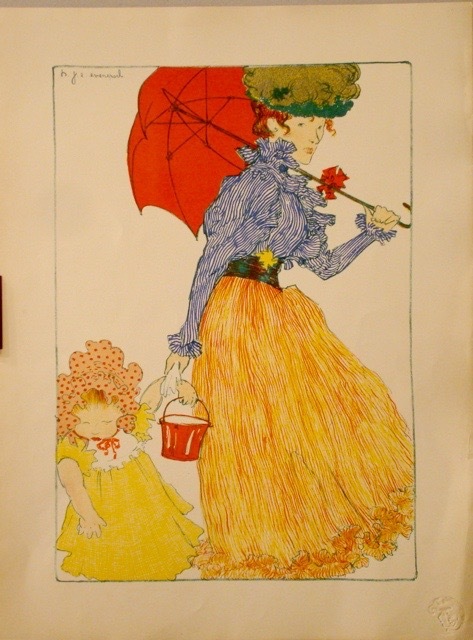
1897rif. 6110Belle épreuve parue dans le numéro 7 (novembre 1897) de l’Estampe Moderne. Notre épreuve porte le timbre sec de l’Estampe Moderne en bas à droite. Parfait état. L’Estampe Moderne a paru de mai 1897 à avril 1899. Cadre et passe-partout Très bon Paris L’Estampe Moderne 1897 33 x 25,5
1914- Lucien Vogel éditeur, Paris 1914, 38,1x24,5cm, une feuille. - Original color print, printed on vergé paper, signed in the plate. An original print used to illustrate the Gazette du bon ton, one of the most attractive and influential 20th century fashion magazines, featuring the talents of French artists and other contributors from the burgeoning Art Deco movement. A celebrated fashion magazine established in 1912 by Lucien Vogel, La Gazette du bon ton appeared until 1925, with a hiatus from 1915 to 1920 due to the war (the editor-in-chief having been called up for service). It consisted of 69 issues printed in only 2,000 copies each and notably illustrated with 573 color plates and 148 sketches of the models of the great designers. Right from the start, this sumptuous publication "was aimed at bibliophiles and fashionable society," (Françoise Tétart-Vittu, "La Gazette du bon ton", in Dictionnaire de la mode, 2016) and was printed on fine vergé paper using a type cut specially for the magazine by Georges Peignot, known as Cochin, later used (in 1946) by Christian Dior. The prints were made using stencils, heightened in colors, some highlighted in gold or palladium. The story began in 1912, when Lucien Vogel, a man of the world involved in fashion (he had already been part of the fashion magazine Femina) decided, with his wife Cosette de Brunhoff - the sister of Jean, creator of Babar - to set up the Gazette du bon ton, subtitled at the time: "Art, fashion, frivolities." Georges Charensol noted the reasoning of the editor-in-chief: "'In 1910,' he observed, 'there was no really artistic fashion magazine, nothing representative of the spirit of the time. My dream was therefore to make a luxury magazine with truly modern artists...I was assured of success, because when it comes to fashion, no country on earth can compete with France.'" ("Un grand éditeur d'art. Lucien Vogel" in Les Nouvelles littéraires, no. 133, May 1925). The magazine was immediately successful, not only in France but also in the United States and Latin America. At first, Vogel put together a team of seven artists: André-Édouard Marty and Pierre Brissaud, followed by Georges Lepape and Dammicourt, as well as eventually his friends from school and the School of Fine Arts, like George Barbier, Bernard Boutet de Monvel and Charles Martin. Other talented people soon came flocking to join the team: Guy Arnoux, Léon Bakst, Benito, Boutet de Monvel, Umberto Brunelleschi, Chas Laborde, Jean-Gabriel Domergue, Raoul Dufy, Édouard Halouze, Alexandre Iacovleff, Jean Émile Laboureur, Charles Loupot, Chalres Martin, Maggie Salcedo. These artist, mostly unknown when Lucien Vogel sought them out, later became emblematic and sought-after artistic figures. It was also they who worked on the advertising drawings for the Gazette. The plates put the spotlight on, and celebrate, dresses by seven designers of the age: Lanvin, Doeuillet, Paquin, Poiret, Worth, Vionnet and Doucet. The designers provided exclusive models for each issue. Nonetheless, some of the illustrations are not based on real models, but simply on the illustrator's conception of the fashion of the day. The Gazette du bon ton was an important step in the history of fashion. Combining aesthetic demands with the physical whole, it brought together - for the first time - the great talents of the artistic, literary, and fashion worlds; and imposed, through this alchemy, a completely new image of women: slender, independent and daring, which was shared by the new generation of designers, including Coco Chanel, Jean Patou, Marcel Rochas, and so on... Taken over in 1920 by Condé Montrose Nast, the Gazette du bon ton was an important influence on the new layout and aesthetics of that "little dying paper" that Nast had bought a few years earlier: Vogue. [FRENCH VERSION FOLLOWS] Estampe originale en couleur tirée sur papier vergé, signée en bas à droite dans la planche. Gravure originale réalisée pour l'illustration d
1914rif. 51297Lucien Vogel éditeur | Paris 1914 | 38.10 x 24.50 cm | une feuille
1986rif. 847121986 Editions Minerva - 1986 - In-4, cartonné, couverture illustrée en couleurs - 128 p. - Nombreuses illustrations en couleurs hors-texte
1899rif. 131798Tokio, T. Hasegawa, Meiji 32 1899 In-12 18 x 14 cm. Reliure japonaise, [32] pp., 14 estampes sur bois en couleurs sur papier crêpe HoSho par Yoshimune Arai. Ouvrage peu fréquent sur les conteurs publics japonais publié en français trente ans seulement après l’avènement de l’ère Meiji. Pliures angulaires.
Maniera a zucchero originale. Lastra 1966, stampa 1989 Timbro a secco dell'Editore Giorgio Upiglio. Stampata su carta BFK Rives. Certificazione di autenticità sul retro firmata dalla moglie Lou Larin Lam. Non firmata dall'Artista. Esemplare 4/15. Cm 30x36,5 (Foglio 59x80). . . . . Tiratura 120. .
1893rif. 261561893 Les peintres-lithographes : album trimestriel de lithographies originales et inédites 1893 - belle epreuve sur chine. tres claires rousseurs. toutes marges dimension feuille : 320 x 460mm.. timbre,Lithographie. 295 x 355 mm. (Duvivier 16). tirage à 100 ex.
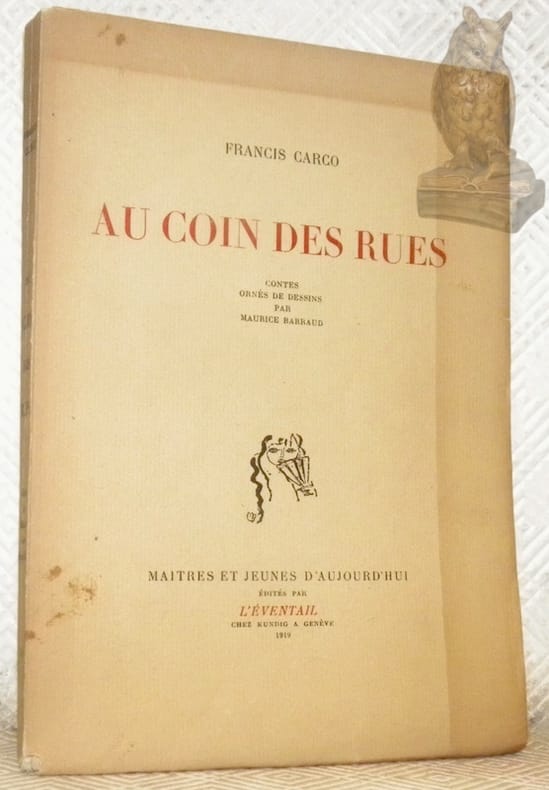
rif. 121045Genève, L’Eventail chez Kundig 1919, 205x145mm, frontispice, 167pages, broché. Couverture rempliée. Dédicacé sur la page de faux-titre à François Laya (l’éditeur de la collection Maitres et jeunes d'aujourd’hui) et avec un dessin originale à la plume de Francis Carco. Achever d’imprimer le 31 decembre 1918. Edition originale sur papier (vergé) à la cuve, numérotée n° 6 / 20. Petites taches sur les deux plats et deux bords du premier plat insolé. Intérieur propre. Non rogné. Bel exemplaire.
1924- Lucien Vogel éditeur, Paris 1924, 19,5x25cm, une feuille. - Original color print, printed on vergé paper, signed in the plate. An original print used to illustrate the Gazette du bon ton, one of the most attractive and influential 20th century fashion magazines, featuring the talents of French artists and other contributors from the burgeoning Art Deco movement. A celebrated fashion magazine established in 1912 by Lucien Vogel, La Gazette du bon ton appeared until 1925, with a hiatus from 1915 to 1920 due to the war (the editor-in-chief having been called up for service). It consisted of 69 issues printed in only 2,000 copies each and notably illustrated with 573 color plates and 148 sketches of the models of the great designers. Right from the start, this sumptuous publication "was aimed at bibliophiles and fashionable society," (Françoise Tétart-Vittu, "La Gazette du bon ton", in Dictionnaire de la mode, 2016) and was printed on fine vergé paper using a type cut specially for the magazine by Georges Peignot, known as Cochin, later used (in 1946) by Christian Dior. The prints were made using stencils, heightened in colors, some highlighted in gold or palladium. The story began in 1912, when Lucien Vogel, a man of the world involved in fashion (he had already been part of the fashion magazine Femina) decided, with his wife Cosette de Brunhoff - the sister of Jean, creator of Babar - to set up the Gazette du bon ton, subtitled at the time: "Art, fashion, frivolities." Georges Charensol noted the reasoning of the editor-in-chief: "'In 1910,' he observed, 'there was no really artistic fashion magazine, nothing representative of the spirit of the time. My dream was therefore to make a luxury magazine with truly modern artists...I was assured of success, because when it comes to fashion, no country on earth can compete with France.'" ("Un grand éditeur d'art. Lucien Vogel" in Les Nouvelles littéraires, no. 133, May 1925). The magazine was immediately successful, not only in France but also in the United States and Latin America. At first, Vogel put together a team of seven artists: André-Édouard Marty and Pierre Brissaud, followed by Georges Lepape and Dammicourt, as well as eventually his friends from school and the School of Fine Arts, like George Barbier, Bernard Boutet de Monvel and Charles Martin. Other talented people soon came flocking to join the team: Guy Arnoux, Léon Bakst, Benito, Boutet de Monvel, Umberto Brunelleschi, Chas Laborde, Jean-Gabriel Domergue, Raoul Dufy, Édouard Halouze, Alexandre Iacovleff, Jean Émile Laboureur, Charles Loupot, Chalres Martin, Maggie Salcedo. These artist, mostly unknown when Lucien Vogel sought them out, later became emblematic and sought-after artistic figures. It was also they who worked on the advertising drawings for the Gazette. The plates put the spotlight on, and celebrate, dresses by seven designers of the age: Lanvin, Doeuillet, Paquin, Poiret, Worth, Vionnet and Doucet. The designers provided exclusive models for each issue. Nonetheless, some of the illustrations are not based on real models, but simply on the illustrator's conception of the fashion of the day. The Gazette du bon ton was an important step in the history of fashion. Combining aesthetic demands with the physical whole, it brought together - for the first time - the great talents of the artistic, literary, and fashion worlds; and imposed, through this alchemy, a completely new image of women: slender, independent and daring, which was shared by the new generation of designers, including Coco Chanel, Jean Patou, Marcel Rochas, and so on... Taken over in 1920 by Condé Montrose Nast, the Gazette du bon ton was an important influence on the new layout and aesthetics of that "little dying paper" that Nast had bought a few years earlier: Vogue. [FRENCH VERSION FOLLOWS] Estampe originale en couleur tirée sur papier vergé, signée en bas à droite dans la planche. Gravure originale réalisée pour l'illus
1924- Lucien Vogel éditeur, Paris 1924-1925, 18x24cm, une feuille. - Original color print heightened with palladium, printed on vergé paper, signed in the plate. An original print used to illustrate the Gazette du bon ton, one of the most attractive and influential 20th century fashion magazines, featuring the talents of French artists and other contributors from the burgeoning Art Deco movement. A celebrated fashion magazine established in 1912 by Lucien Vogel, La Gazette du bon ton appeared until 1925, with a hiatus from 1915 to 1920 due to the war (the editor-in-chief having been called up for service). It consisted of 69 issues printed in only 2,000 copies each and notably illustrated with 573 color plates and 148 sketches of the models of the great designers. Right from the start, this sumptuous publication "was aimed at bibliophiles and fashionable society," (Françoise Tétart-Vittu, "La Gazette du bon ton", in Dictionnaire de la mode, 2016) and was printed on fine vergé paper using a type cut specially for the magazine by Georges Peignot, known as Cochin, later used (in 1946) by Christian Dior. The prints were made using stencils, heightened in colors, some highlighted in gold or palladium. The story began in 1912, when Lucien Vogel, a man of the world involved in fashion (he had already been part of the fashion magazine Femina) decided, with his wife Cosette de Brunhoff - the sister of Jean, creator of Babar - to set up the Gazette du bon ton, subtitled at the time: "Art, fashion, frivolities." Georges Charensol noted the reasoning of the editor-in-chief: "'In 1910,' he observed, 'there was no really artistic fashion magazine, nothing representative of the spirit of the time. My dream was therefore to make a luxury magazine with truly modern artists...I was assured of success, because when it comes to fashion, no country on earth can compete with France.'" ("Un grand éditeur d'art. Lucien Vogel" in Les Nouvelles littéraires, no. 133, May 1925). The magazine was immediately successful, not only in France but also in the United States and Latin America. At first, Vogel put together a team of seven artists: André-Édouard Marty and Pierre Brissaud, followed by Georges Lepape and Dammicourt, as well as eventually his friends from school and the School of Fine Arts, like George Barbier, Bernard Boutet de Monvel and Charles Martin. Other talented people soon came flocking to join the team: Guy Arnoux, Léon Bakst, Benito, Boutet de Monvel, Umberto Brunelleschi, Chas Laborde, Jean-Gabriel Domergue, Raoul Dufy, Édouard Halouze, Alexandre Iacovleff, Jean Émile Laboureur, Charles Loupot, Chalres Martin, Maggie Salcedo. These artist, mostly unknown when Lucien Vogel sought them out, later became emblematic and sought-after artistic figures. It was also they who worked on the advertising drawings for the Gazette. The plates put the spotlight on, and celebrate, dresses by seven designers of the age: Lanvin, Doeuillet, Paquin, Poiret, Worth, Vionnet and Doucet. The designers provided exclusive models for each issue. Nonetheless, some of the illustrations are not based on real models, but simply on the illustrator's conception of the fashion of the day. The Gazette du bon ton was an important step in the history of fashion. Combining aesthetic demands with the physical whole, it brought together - for the first time - the great talents of the artistic, literary, and fashion worlds; and imposed, through this alchemy, a completely new image of women: slender, independent and daring, which was shared by the new generation of designers, including Coco Chanel, Jean Patou, Marcel Rochas, and so on... Taken over in 1920 by Condé Montrose Nast, the Gazette du bon ton was an important influence on the new layout and aesthetics of that "little dying paper" that Nast had bought a few years earlier: Vogue. [FRENCH VERSION FOLLOWS] Estampe originale en couleur finement rehaussée au palladium, tirée sur papier vergé, signée en bas à dr
1924rif. 43198Lucien Vogel éditeur | Paris 1924 | 19.50 x 25 cm | une feuille
1921rif. 54861Lucien Vogel éditeur | Paris 1921 | 18 x 24 cm | une feuille
1921- Lucien Vogel éditeur, Paris 1921, 18x24cm, une feuille. - Original color print, printed on vergé paper, non signed. An original print used to illustrate the Gazette du bon ton, one of the most attractive and influential 20th century fashion magazines, featuring the talents of French artists and other contributors from the burgeoning Art Deco movement. A celebrated fashion magazine established in 1912 by Lucien Vogel, La Gazette du bon ton appeared until 1925, with a hiatus from 1915 to 1920 due to the war (the editor-in-chief having been called up for service). It consisted of 69 issues printed in only 2,000 copies each and notably illustrated with 573 color plates and 148 sketches of the models of the great designers. Right from the start, this sumptuous publication "was aimed at bibliophiles and fashionable society," (Françoise Tétart-Vittu, "La Gazette du bon ton", in Dictionnaire de la mode, 2016) and was printed on fine vergé paper using a type cut specially for the magazine by Georges Peignot, known as Cochin, later used (in 1946) by Christian Dior. The prints were made using stencils, heightened in colors, some highlighted in gold or palladium. The story began in 1912, when Lucien Vogel, a man of the world involved in fashion (he had already been part of the fashion magazine Femina) decided, with his wife Cosette de Brunhoff - the sister of Jean, creator of Babar - to set up the Gazette du bon ton, subtitled at the time: "Art, fashion, frivolities." Georges Charensol noted the reasoning of the editor-in-chief: "'In 1910,' he observed, 'there was no really artistic fashion magazine, nothing representative of the spirit of the time. My dream was therefore to make a luxury magazine with truly modern artists...I was assured of success, because when it comes to fashion, no country on earth can compete with France.'" ("Un grand éditeur d'art. Lucien Vogel" in Les Nouvelles littéraires, no. 133, May 1925). The magazine was immediately successful, not only in France but also in the United States and Latin America. At first, Vogel put together a team of seven artists: André-Édouard Marty and Pierre Brissaud, followed by Georges Lepape and Dammicourt, as well as eventually his friends from school and the School of Fine Arts, like George Barbier, Bernard Boutet de Monvel and Charles Martin. Other talented people soon came flocking to join the team: Guy Arnoux, Léon Bakst, Benito, Boutet de Monvel, Umberto Brunelleschi, Chas Laborde, Jean-Gabriel Domergue, Raoul Dufy, Édouard Halouze, Alexandre Iacovleff, Jean Émile Laboureur, Charles Loupot, Chalres Martin, Maggie Salcedo. These artist, mostly unknown when Lucien Vogel sought them out, later became emblematic and sought-after artistic figures. It was also they who worked on the advertising drawings for the Gazette. The plates put the spotlight on, and celebrate, dresses by seven designers of the age: Lanvin, Doeuillet, Paquin, Poiret, Worth, Vionnet and Doucet. The designers provided exclusive models for each issue. Nonetheless, some of the illustrations are not based on real models, but simply on the illustrator's conception of the fashion of the day. The Gazette du bon ton was an important step in the history of fashion. Combining aesthetic demands with the physical whole, it brought together - for the first time - the great talents of the artistic, literary, and fashion worlds; and imposed, through this alchemy, a completely new image of women: slender, independent and daring, which was shared by the new generation of designers, including Coco Chanel, Jean Patou, Marcel Rochas, and so on... Taken over in 1920 by Condé Montrose Nast, the Gazette du bon ton was an important influence on the new layout and aesthetics of that "little dying paper" that Nast had bought a few years earlier: Vogue. [FRENCH VERSION FOLLOWS] Estampe originale en couleur, tirée sur papier vergé, non-signée. Gravure originale réalisée pour l'illustration de La Gazette du bon ton, l'une des plus b
1995rif. 3876Sans lieu [chez l'artiste] 1995 in-4 en feuilles Sans lieu, [chez l'artiste], 1995 (imp. Point & Marge). 33 x 21,5 cm, 7 gravures en taille-douce hors texte - 1 f. de justification, en feuilles sous chemise cartonnée et illustrée au premier plat.