BAUDELAIRE, Charles - VAN DONGEN, KessLivre Rare Book
1 882 résultats
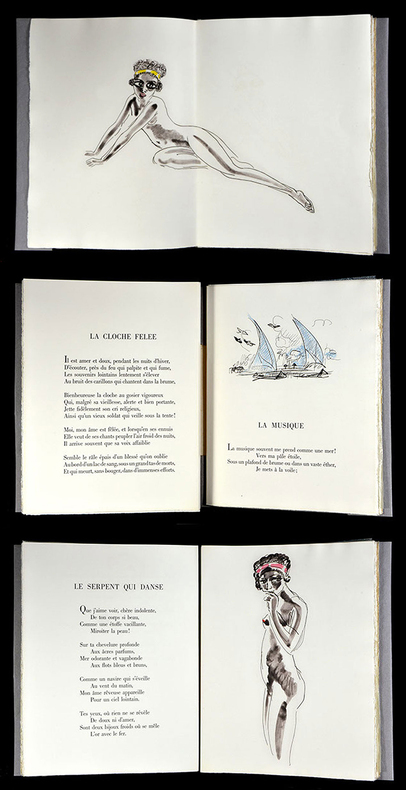
1968réf. 3122Paris Pierre de Tartas 1968. 1 volume in-folio (37,5 x 28 cm), en feuilles, sous couverture papier d'Auvergne grise rempliée et coffret éditeur de toile bordeaux. Avec 15 EAUX-FORTES ORIGINALES DE VAN DONGEN DONT UN FRONTISPICE TIRÉ EN NOIR, 2 DOUBLE-PAGE, 2 HORS-TEXTE ET 10 COMPOSITIONS DANS LE TEXTE, L'ENSEMBLE EN COULEURS. - Tirage limité à 270 exemplaires, celui-ci le n° 257 sur vélin d'Arches, signé par l'artiste, l'éditeur et portant bien le cachet d'authenticité requis. Note : Cette sélection de "poèmes immortels" des Fleurs du Mal, avec une préface de Jean-Paul Sartre, constitue le dernier livre illustré par Kess Van Dongen. -- ENGLISH DESCRIPTION: Paris Pierre de Tartas 1968. 1 folio volume (37.5 x 28 cm), in loose sheets, in an Auvergne paper cover and the burgundy cloth publisher's box. With 15 ORIGINAL ETCHINGS BY VAN DONGEN INCLUDING A FRONTISPIECE PRINTED IN BLACK, 2 DOUBLE PAGES, 2 OUF-OF-TEXT AND 10 COMPOSITIONS IN THE TEXT, ALL IN COLOR. - Limited edition of 270 copies, this one number 257 on Arches paper, signed by the artist, the publisher and bearing the required stamp of authenticity. This selection of "immortal poems" from Les Fleurs du Mal, with a preface by Jean-Paul Sartre, constitutes the latest book illustrated by Kess Van Dongen. The copy offered here is in mint condition.
1818réf. 86072Méquignon - Marvis | Paris 1818 | 14 x 21.50 cm | 12 volumes reliés
1927réf. 421031927 Paris. La Roseraie. 1927. 1 volume in-4 non rogné, plein veau bleu canard partiellement poncé, créant des figures géométriques bleu-turquoises sur les plats se prolongeant sur le dos, dos lisse avec titre en queue à l’oeser bleu, doublure en veau bleu canard à motifs, gardes de peau de velours bleu, couvertures et dos conservés, sous chemise en demi-veau bleu à bandes et étui. Reliure signée Anick Butré, 2007.
1801réf. 90455Sans nom d'éditeur | Paris s. d. [1801] | 19.3 x 25 cm | Relié
1730réf. 41454A Paris, Chez Briasson, 1730. 2 tomes en 1 vol. in-12 de (22)-317-(5) pp. ; (2)-295-(13) pp., basane blonde, dos orné à nerfs (reliure de l'époque).
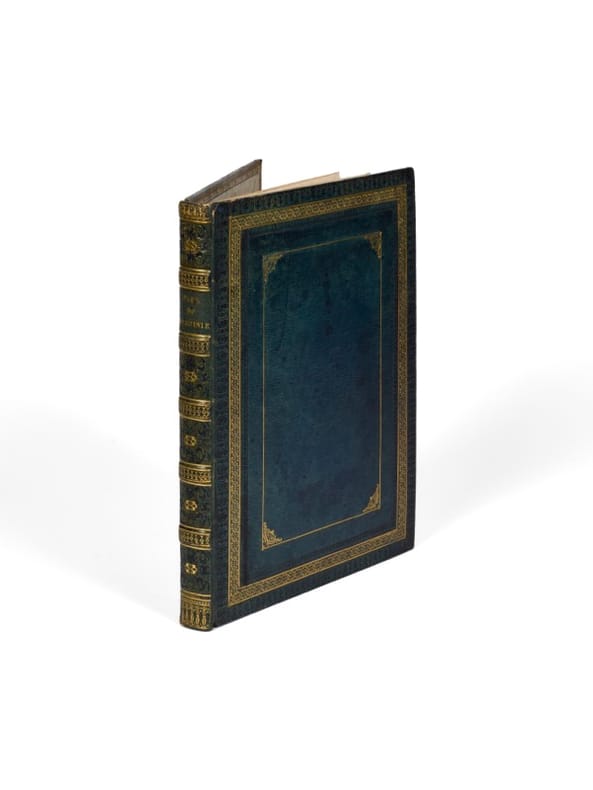
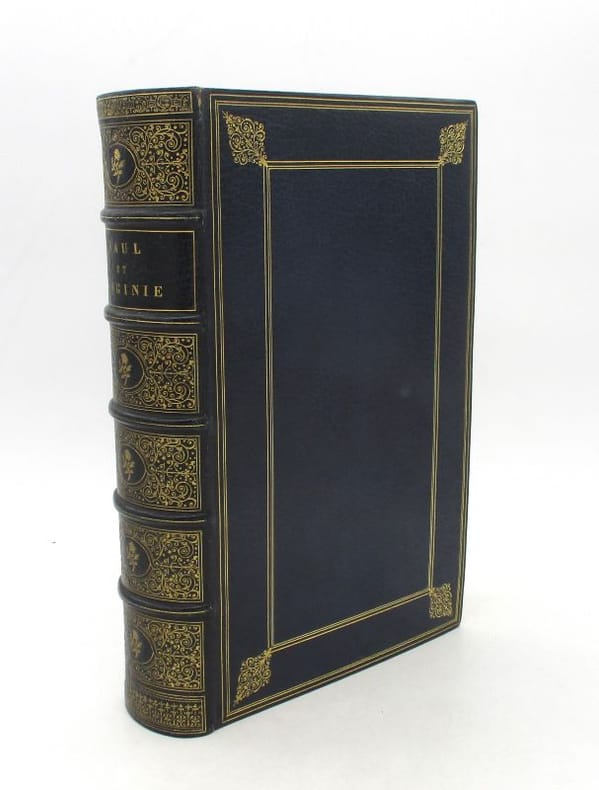
réf. 30088Paris De l'Imprimerie P. Didot l'aîné 1806. 1 vol. 235 x 320 mm de faux-titre front. titre xcii 194 p. et 3 f. Maroquin bleu à long grain plats à encadrements ornés de larges roulettes et filets à froid et dorés dos richement orné roulette intérieure tranches dorées reliure signée de Simier R. du Roi. . La plus luxueuse édition illustrée de Paul et Virgnie en partie originale et qui fixe le texte définitif. Elle est illustrée d'un portrait de l'auteur et de 6 planches hors texte gravées sur cuivre par Bourgeois de la Richardière Bovinet Mecou Prot Ribault Roger et Tillement. . Les éditions de Paul et Virginie sont nombreuses : c'est le best-seller de l'époque dès le XVIIIe siècle. Si l'édition la plus célèbre est évidemment la fameuse édition Curmer de 1838 richement illustrée et destinée à un large public la plus luxueuse et la plus belle des éditions est éditée trente ans auparavant par l'imprimerie de Firmin Didot en 1806 sur un beau papier d'Essone. Une édition à l'opposé de la Curmer : peu d'illustrations un tirage très limité un grand format et un prix élevé. Les exemplaires en sont le plus souvent luxueusement reliés par les meilleurs ateliers de l'époque. Cette édition est supervisés par l'auteur y adjoignant un préambule inédit où il revient sur la création des gravures oeuvre de Lafitte « Enfance de Paul et Virginie » Girodet « Le Passage du torrent » Baron Gérard « Arrivée de M. de la Bourdonnais » Moreau le jeune « Les Adieux de Paul et Virginie » Isabey « Les tombeaux » et Prudhon pour la plus célèbre d'entre elles : « Le Naufrage de Virginie ». « Comment M. Prud'hon a-t-il pu renfermer de si grands objets dans un si petit espace où a-t-il trouvé les modèles de ces mobiles et fugitifs effets que l'art ne peut poser et dont la nature seule ne nous présente que de rapides images . Si M. Prud'hon réussit par la pureté de ses crayons et l'élégance de ses formes à rendre des divinités il intéresse encore davantage selon moi en représentant des mortelles . Il est selon moi le La Fontaine des dessinateurs. » C'est la dernière édition parue du vivant de l'auteur et revue par ses soins. Cachet armorié au faux-titre non identifié ; ex-libris Joël Dupont ancien conservateur du Musée Barbey d'Aurevilly. Bel exemplaire très frais. Cohen 993 ; P. Thoinet « Répertoire bibliographique et iconographique de Paul et Virginie » Bulletin du bibliophile n° 41 1961 p. 167 « rien n'égale la noblesse de cette composition in-4. . C'est à mon avis une très belle réussite de l'art du livre ». Paris, De l'Imprimerie P. Didot l'aîné, 1806. 1 vol. (235 x 320 mm) de faux-titre, front., titre, xcii, 194 p. et [3] f. Maroq unknown
1806réf. 30088La plus luxueuse édition, en reliure de Simier Paris, De l'Imprimerie P. Didot l'aîné, 1806. 1 vol. (235 x 320 mm) de faux-titre, front., titre, xcii, 194 p. et [3] f. Maroquin bleu à long grain, plats à encadrements ornés de larges roulettes et filets à froid et dorés, dos richement orné, roulette intérieure, tranches dorées (reliure signée de Simier R. du Roi). La plus luxueuse édition illustrée de Paul et Virgnie, en partie originale et qui fixe le texte définitif. Elle est illustrée d'un portrait de l'auteur et de 6 planches hors texte, gravées sur cuivre par Bourgeois de la Richardière, Bovinet, Mecou, Prot, Ribault, Roger et Tillement.
1838réf. 16110Paris, L. Curmer (25 rue Sainte-Anne), 1838. In-8 de LVI-458 pp. 1 f. (table des matières) et 6 ff. (table des noms, placement des gravures), cuir de Russie bleu nuit, jeu de sept filets dorés et à froid, gras et maigres encadrant les plats, fleurons rocailles dorés au centre des plats, ex-dono sur le premier plat, dos lisse richement orné de fers rocailles et d’un mascaron dorés, contreplats et gardes de papier moiré bleu azur à cadres ornés dorés, coiffes et coupes filetées dorées, chemise en papier marbré et étui cartonné (reliure de l'époque).
1818réf. 86072Paris: Méquignon - Marvis 1818. Fine. First Collected Edition of Bernardin de Saint-Pierre in 12 Untrimmed Volumes Méquignon - Marvis Paris 1818 14 x 21.50 cm 12 volumes reliés First collected edition partly first edition of the works of Bernardin de Saint-Pierre published in Paris by Méquignon-Marvis in 1818 four years after the authors death. Twelve octavo volumes printed by L.-T. Cellot. The illustration comprises a frontispiece portrait of Bernardin drawn by Girodet-Trioson and engraved by Frédéric Lignon together with 26 hors-texte plates after Girodet Desenne Lafitte Moreau le Jeune Prudhon Vernet and Isabey; these include a folding map of the Atlantic hemisphere and several botanical plates. As is often the case with this edition the engravings have been bound in a somewhat irregular order several suites having their own numbering; the set is nevertheless complete. Contemporary Bradel-style bindings in red half Russia leather smooth spines ruled in gilt boards covered with paper imitating Russia leather green paper endleaves. Untrimmed. Scattered foxing and some soiling to a few boards. A handsome uniformly bound set the bindings well preserved. By 1818 Bernardin de Saint-Pierre was already far more than simply the author of Paul and Virginia: around the novel that had made his reputation were now gathered his travel writings the Études de la nature the Harmonies political texts essays fragments and several works that had remained in manuscript. Across twelve volumes Aimé-Martin thus presented an oeuvre far broader than the one preserved in the public imagination by the success of the novel. Paul and Virginia nevertheless remains at the heart of the collection. Aimé-Martin follows la belle édition in-4° publiée par lauteur en 1806 while reusing several compositions originally devised for the illustrated editions of 1789 and 1806. Around this already celebrated text however he adds the Harmonies de la nature first published posthumously in 1815 together with a body of manuscript material brought into this large collected edition for the first time. At the beginning of the final volume Bernardin returns to one of the decisive encounters of his life: Au mois de juin de 1772 un ami mayant proposé de me mener chez J.-J. Rousseau il me conduisit dans une maison rue Plâtrière. The Essai sur J.-J. Rousseau thus opens a sequence in which education Socrates the Jardin des Plantes and several of Bernardins scientific projects soon follow; as the volume progresses the author of Paul and Virginia gives way to a much broader figure - moralist traveller observer of nature and man of projects. These twelve volumes thus bring Bernardin de Saint-Pierre out from the shadow of his own masterpiece: around Paul and Virginia finally unfold the voyages nature Rousseau the manuscripts and projects of a writer whom the nineteenth century could now read in the full breadth of his work. Méquignon - Marvis hardcover
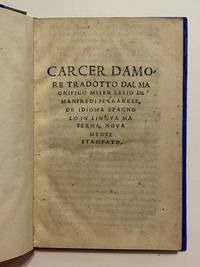
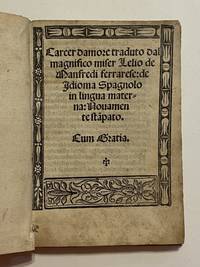
1525réf. 4542Venice: Gregorio di Gregorii 1525. Very good. Small 8vo 143 x 95 mm. 44 ff. Collation: A-E8 F4 COMPLETE title-page with light toning fols. A1-2 with unimportant wormholes in blank gutter margin. Very attractive late 19th- or early 20th-century blue embossed boards gray cloth spine. In excellent condition the paper crisp and fresh. ITALIAN POST-INCUNABLE EDITION OF THE CARCEL DE AMOR ONE OF THE MOST ENDURING OF ALL LATE MEDIEVAL ROMANCES. Written in Spanish in the late 15th century the work is a key example of the "star-crossed lovers" romance tradition. It combines allegory with chivalric narrative while its epistolary form intensifies the themes of distance miscommunication and emotional crisis. Widely popular it was quickly translated and circulated across Europe as is attested by this Italian translation published in Venice in 1525. The story continues to be celebrated for its emotional intensity and its refined articulation of courtly love. The romance was first translated into Italian by Lelio de Manfredi of Ferrara in 1514 and represents a moment when literature language and print culture intersected across political and cultural borders. For years the story was reshaped and redistributed in Renaissance Europe and contributed to a shared literary tradition. On the title-page of our edition we find only Manfredi's name and the dedicatee is Isabella d'Esta his former pupil. The translator has added his own closing epistle to the Carcel de Amor which praises Isabella; the author's name Diego de San Pedro is nowhere to be found. The Carcel de amor is told almost entirely through letters speeches and monologues rather than dialogue. It centers on Leriano a young nobleman in love with Laureola daughter of the King of Macedonia. His condition is figured as an allegorical "PRISON OF LOVE" and he communicates with her only through a mediator. A rival Persio sometimes Theseus/Perseus accuses Laureola of having an affair leading to her imprisonment. Leriano rescues her and kills his rival but Laureola ultimately rejects him in a letter. In despair he chooses to starve himself to death but not before delivering a speech in praise of women. CATALOGUER'S NOTE: Italian translations of the Carcel de Amor "Carcer Damore" are uncommon. We have located just three copies of ANY Italian language post-incunable edition at auction in the last century: 1518: sold at Ader Paris 2024 1521: sold at Sotheby's London 1970 1518: sold through Quaritch Catalogue 494 1934. EDIT16 CNCE 44982. See. Gregorio di Gregorii unknown
1525réf. 4542Venice: Gregorio di Gregorii 1525. Very good. Small 8vo 143 x 95 mm. 44 ff. Collation: A-E8 F4 COMPLETE title-page with light toning fols. A1-2 with unimportant wormholes in blank gutter margin. Very attractive late 19th- or early 20th-century blue embossed boards gray cloth spine. In excellent condition the paper crisp and fresh. ITALIAN POST-INCUNABLE EDITION OF THE CARCEL DE AMOR ONE OF THE MOST ENDURING OF ALL LATE MEDIEVAL ROMANCES. Written in Spanish in the late 15th century the work is a key example of the "star-crossed lovers" romance tradition. It combines allegory with chivalric narrative while its epistolary form intensifies the themes of distance miscommunication and emotional crisis. Widely popular it was quickly translated and circulated across Europe as is attested by this Italian translation published in Venice in 1525. The story continues to be celebrated for its emotional intensity and its refined articulation of courtly love. The romance was first translated into Italian by Lelio de Manfredi of Ferrara in 1514 and represents a moment when literature language and print culture intersected across political and cultural borders. For years the story was reshaped and redistributed in Renaissance Europe and contributed to a shared literary tradition. On the title-page of our edition we find only Manfredi's name and the dedicatee is Isabella d'Esta his former pupil. The translator has added his own closing epistle to the Carcel de Amor which praises Isabella; the author's name Diego de San Pedro is nowhere to be found. The Carcel de amor is told almost entirely through letters speeches and monologues rather than dialogue. It centers on Leriano a young nobleman in love with Laureola daughter of the King of Macedonia. His condition is figured as an allegorical "PRISON OF LOVE" and he communicates with her only through a mediator. A rival Persio sometimes Theseus/Perseus accuses Laureola of having an affair leading to her imprisonment. Leriano rescues her and kills his rival but Laureola ultimately rejects him in a letter. In despair he chooses to starve himself to death but not before delivering a speech in praise of women. CATALOGUER'S NOTE: Italian translations of the Carcel de Amor "Carcer Damore" are uncommon. We have located just three copies of ANY Italian language post-incunable edition at auction in the last century: 1518: sold at Ader Paris 2024 1521: sold at Sotheby's London 1970 1518: sold through Quaritch Catalogue 494 1934. EDIT16 CNCE 44982. See. Gregorio di Gregorii unknown books
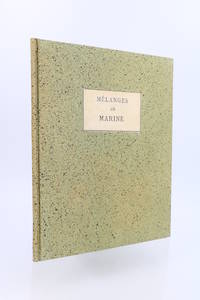
1801réf. 90455Paris: Sans nom d'éditeur 1801. Fine. Sans nom d'éditeur Paris s. d. 1801 19.3 x 25 cm Relié Rare group of six fascicules all in the original edition.Bradel-style binding in green mottled boards smooth unlettered spine printed title label mounted at the centre of the upper cover; modern binding.Not recorded by Polak. Apparently no copy located in the CCFr.A stain at the head of the title page.This curious compilation bearing almost no identifying information appears to be particularly rare.It contains:- 1. A notice to mariners concerning the change in the lighting of the lighthouse in the Bay of the Somme scheduled for 25 Pluviôse Year IX 14 February 1801.- 2. An instruction on filters for purifying water signed by the health officers Dubrueil Thaumur Dupré and Billard.- 3. A notice on naval provisions signed by Rivoire.- 4. A description of the sillomètre an instrument for measuring longitude at sea addressed to the editor of the Moniteur by the former journalist Charles Mozard 17551810 who had served as Commissioner of Frances commercial relations in Boston from 1794 to 1799 and was at that time among the contributors to the Moniteur.- 5. A discourse by Bernardin de Saint-Pierre delivered at the Institut Nautical experiments and dietary and moral observations proposed for the benefit and health of sailors on long-distance voyages. This contribution had already been printed in La Décade philosophique littéraire et politique of 30 Vendémiaire Year IX 22 October 1800.- 6. Two practical notices on means of preserving ships from fire water and rats. The nature of these texts and their immediate sources suggest that this publication was probably conceived as a trial maritime periodical intended to make available sea-related articles previously published in other journals. For reasons unknown the experiment was not continued a circumstance that is fairly common in the history of periodicals. Sans nom d'éditeur hardcover
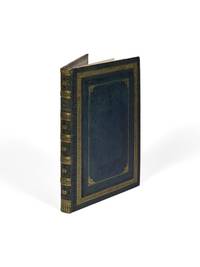
réf. 22663Paris, L. Curmer, 1838. In-4, LVI-458 pp. 78 pl., maroquin bleu nuit de Capé, décor doré à la Duseuil sur les plats, dos à nerfs orné de caissons dorés, bordure intérieure ornée de dentelle dorée, tranches dorées, étui bordé (quelques petites rousseurs, petits frottements à l'étui).
1838réf. 45390Paris L. Curmer 1838 In-4, chagrin vert bouteille, initiales frappes or au centre des plats dans un large encadrement de filets et fers dors, dos nerfs finement orn petits fers et filets pousss or, filets or sur les coupes; encadrements intrieurs orns de filets dors, doublures et gardes de papier glac crme ornes d'une composition imprime couleur argent, tte dore, non rogn (Quinet).La perle des livres illustrs du XIXe sicle, comme le qualifie Brivois. Son illustration comporte environ 400 vignettes in texte et 29 planches hors texte, graves sur bois par les meilleurs graveurs franais et anglais d'aprs Meissonier, T. Johannot, Franais, etc. L'ouvrage comporte galement une carte colorie de l'le de France et 7 portraits hors texte, gravs sur acier d'aprs Lafitte, Meissonier et T. Johannot. Toutes les planches hors texte sont tires sur chine coll et accompagnes d'une serpente en papier rose avec une lgende imprime. Bel exemplaire en reliure de l'poque, l'adresse de la rue Richelieu, avec les portraits du Docteur et de Mme de La Tour gravs respectivement d'aprs Johannot et Meissonier
1518réf. 4543Venice: Georgio de Rusconi 1518. Very good. Small 8vo 145 x 97 mm. 48 ff. Collation: A-F8 COMPLETE some soiling traces of damp in outer margins of D1-F8 for which SEE IMAGES. Old 18th-century vellum. In excellent unsophisticated condition. ITALIAN POST-INCUNABLE EDITION OF THE CARCEL DE AMOR THE MOST IMPORTANT SPANISH NOVEL OF COURTLY LOVE. Written in the late 15th century the work is a key example of the "star-crossed lovers" romance tradition. It combines allegory with chivalric narrative while its epistolary form intensifies the themes of miscommunication and emotional crisis. Widely popular it was quickly translated and circulated across Europe as is attested by this Italian translation published in Venice in 1518. The story continues to be celebrated for its emotional intensity and its refined articulation of courtly love. The romance was first translated from the Spanish into Italian by Lelio de Manfredi of Ferrara in 1514 and represents a moment when literature language and print culture intersected across political and cultural borders. For years the story was reshaped and redistributed in Renaissance Europe and contributed to a shared literary tradition. On the title-page of our edition we find only Manfredi's name and the dedicatee is Isabella d'Esta his former pupil. The translator has added his own closing epistle to the Carcel de Amor which praises Isabella; the author's name Diego de San Pedro is nowhere to be found. The Carcel de amor is told almost entirely through letters speeches and monologues rather than dialogue. It centers on Leriano a young nobleman in love with Laureola daughter of the King of Macedonia. His condition is figured as an allegorical "PRISON OF LOVE" and he communicates with her only through a mediator. A rival Persio sometimes Theseus/Perseus accuses Laureola of having an affair leading to her imprisonment. Leriano rescues her and kills his rival but Laureola ultimately rejects him in a letter. In despair he chooses to starve himself to death but not before delivering a speech in praise of women. CATALOGUER'S NOTE: Italian translations of the Carcel de Amor "Carcer Damore" are uncommon. We have located just three copies of ANY Italian language post-incunable edition at auction in the last century: 1518: sold at Ader Paris 2024 1521: sold at Sotheby's London 1970 1518: sold through Quaritch Catalogue 494 1934. EDIT16 CNCE 66997. Georgio de Rusconi unknown
1518réf. 4543Venice: Georgio de Rusconi 1518. Very good. Small 8vo 145 x 97 mm. 48 ff. Collation: A-F8 COMPLETE some soiling traces of damp in outer margins of D1-F8 for which SEE IMAGES. Old 18th-century vellum. In excellent unsophisticated condition. ITALIAN POST-INCUNABLE EDITION OF THE CARCEL DE AMOR THE MOST IMPORTANT SPANISH NOVEL OF COURTLY LOVE. Written in the late 15th century the work is a key example of the "star-crossed lovers" romance tradition. It combines allegory with chivalric narrative while its epistolary form intensifies the themes of miscommunication and emotional crisis. Widely popular it was quickly translated and circulated across Europe as is attested by this Italian translation published in Venice in 1518. The story continues to be celebrated for its emotional intensity and its refined articulation of courtly love. The romance was first translated from the Spanish into Italian by Lelio de Manfredi of Ferrara in 1514 and represents a moment when literature language and print culture intersected across political and cultural borders. For years the story was reshaped and redistributed in Renaissance Europe and contributed to a shared literary tradition. On the title-page of our edition we find only Manfredi's name and the dedicatee is Isabella d'Esta his former pupil. The translator has added his own closing epistle to the Carcel de Amor which praises Isabella; the author's name Diego de San Pedro is nowhere to be found. The Carcel de amor is told almost entirely through letters speeches and monologues rather than dialogue. It centers on Leriano a young nobleman in love with Laureola daughter of the King of Macedonia. His condition is figured as an allegorical "PRISON OF LOVE" and he communicates with her only through a mediator. A rival Persio sometimes Theseus/Perseus accuses Laureola of having an affair leading to her imprisonment. Leriano rescues her and kills his rival but Laureola ultimately rejects him in a letter. In despair he chooses to starve himself to death but not before delivering a speech in praise of women. CATALOGUER'S NOTE: Italian translations of the Carcel de Amor "Carcer Damore" are uncommon. We have located just three copies of ANY Italian language post-incunable edition at auction in the last century: 1518: sold at Ader Paris 2024 1521: sold at Sotheby's London 1970 1518: sold through Quaritch Catalogue 494 1934. EDIT16 CNCE 66997. Georgio de Rusconi unknown books
réf. 103376Kenya, Ouganda, France (Génillé), juillet-octobre 1905, in-4, [1]-72 ff. tapuscrits et [3] ff. de table volants; 1 dessin à l'aquarelle en front, 93 photos argentiques contrecollées, 2 plans de trophées dessinés, 1 carte dépl. volante montée sur carton fort (déchirure centrale, sans perte), Demi-basane verte et étui de l'époque, monogramme "A.M" doré en pied du dos (dos insolé et décollé en partie), Précieux et rare journal tapuscrit d'un safari en Afrique de l'Est, rédigé à la première personne par une femme, Suzanne Cochin (1886-1930) : il s'agit du récit d'un voyage de 103 jours mené en compagnie de deux cousins d'une famille de la bourgeoisie française, Guy de La Motte Saint-Pierre (1871-1945) et son futur époux Henri (Henry) de La Motte Saint-Pierre (1881-1915). L'exploratrice y relate leur périple, leurs installations quotidiennes et leurs parties de chasse. Le récit est agrémenté de lettres et notes rapportées par Guy de La Motte, notamment ses traques à l'éléphant et au lion. L'ouvrage est illustré d'une aquarelle de la main de Suzanne en frontispice ("Campement de Djabiné au Kinantop") et de nombreuses photographies originales argentiques de petit et moyen formats (de 90 x 80 mm à 175 x 120 mm env.), représentant les paysages, villages et campements, la flore locale (baobab, bananiers, plantations de cocotiers, papyrus...), les habitants (guides-chasseurs, femmes du village de 'Mtondia, guerriers Massaï, chasseurs Kavirondo), des missionnaires, ainsi que les animaux abattus et les chasseurs posant près de leurs dépouilles. La plupart des clichés ont été réalisés par les voyageurs, sauf mention contraire : quelques-uns sont des agrandissements de photographies professionnelles. Trois feuillets volants tapuscrits indiquent les légendes des photographies. L'ouvrage s'accompagne d'une carte dépliante contrecollée sur carton, volante, sur laquelle sont indiqués en rouge les trajets des chasseurs français : par voie ferrée et par steamer; par étapes de la caravane; et les raids des principales grandes chasses. En tête de volume est contrecollé un carton d'invitation à une projection de vues prises par un conférencier anonyme, « X. », au cours de son « Voyage dans l'Est Africain Équatorial », à la Société Nationale d'Horticulture de France, le samedi 26 mai 1906. La carte a été délivrée par MM. Guy et Henry de La Motte Saint Pierre.* Les feuillets 67-72 comportent des tableaux de la faune rencontrée. En fin de volume, deux schémas dessinés à la plume précisent l'emplacement des trophées installés au retour des La Motte Saint-Pierre dans leurs salons à Génillé (Indre-et-Loire). ____________________________ La première partie du voyage se fait sur la côte (2-19 juillet); la seconde sur les hauts-plateaux (20 juillet - 20 septembre) et la troisième sur le Victoria Nyanza, avec le retour dans la foulée (21 septembre - 13 octobre). Ensemble, Suzanne, Henry et Guy suivent la piste de l'ivoire, traquent et tuent rhinocéros, hippopotames, oryx, lions, cobes ou encore gazelles; ils abattent des oiseaux et des servals par opportunité. Guy se révèle chasseur chevronné. Suzanne piège et tire les oiseaux. On voit les chasseurs français négocier des bijoux, objets et armes avec les habitants. On apprend par ailleurs qu'ils sont tenus de respecter les "game regulations", qui interdisent de tuer les femelles de certaines espèces; Guy note avec ironie et dédain que les chasseurs locaux Kavirondo du lac Victoria, eux, ne respectent pas cette règle lors de leurs propres parties de chasse (p. 61). Au fil des pages, on découvre la condition de femme dans une telle expédition ? Suzanne déplore notamment de ne pas pouvoir participer à la chasse au éléphants, qui "ne se prête pas davantage aux goûts sportifs d'une 'faible femme' " (p. 4); on découvre son goût pour la végétation tropicale et ses occupations d'aquarelliste, on apprend Couverture rigide
1537réf. 4403Venice: Francesco Bindoni & Mapheo Pasini compagni 1537. 8vo 145 x 94 mm. 48 leaves. Italic types. Large title woodcut of the prison of love in flames 19 woodcut text illustrations printed from 13 blocks most showing two scenes; initial spaces with guide letters unrubricated. 19th-century green straight-grained morocco sides with double fillet border enclosing central gold-blocked arms of Gómez de la Cortina his gilt crowned ciphers in the corners gilt edges. Provenance: Joaquin Gómez de La Cortina 1st Marquis de Morante 1808-1868 supralibros & bookplate; with Quaritch their collation note at end; sold in 1996 to Kenneth Rapoport bookplate. Lelio Manfredi’s Italian translation of the Carcel de amor 1st ed. 1492 was among the most popular sentimental romances of its time. Many wept over the thwarted love of the noble Leriano and Laureola heir to the throne of Macedonia. Captive in an allegorical tower of love communicating with his beloved only through mediators the hero eventually renounces her in order to preserve her honor threatened by a rival’s false aspersions. There are duels and battles Leriano stops eating and finally dies after shredding and swallowing her letters. The tragedy touched a nerve and dozens of editions appeared in Spain as well as translations into Italian French English Catalan and in the 17th century German. Few remembered the true author whose name is omitted from most of these editions. One of several Castilian romances that were widely adapted and translated into other western European languages the Carcel de amor was the only one to appear first in print and to be consistently illustrated. It permeated the European reading public. The tale is told through letters and monologues rather than dialogue and much has been written about its hybrid forms and elaborate rhetoric “a reflection of vernacular humanism and a fictional tour de force of rhetorical precepts” Francomano p. 10 and about its literary sources and later influence or lack of it: While many scholars note its influence on the development of later European Renaissance fiction through its use of epistolary exchanges and of a narrative voice L’autore who acts as intermediary as well as its tragic ending and exploration of class differences between the lovers one commentator has called it “a dead-end in the history of literature” A. West: “In general the Prison of Love is a book of vestiges: of ways of believing that no longer obtain of customs that already were dying out of a manner of writing soon to be eclipsed by the realism of the picaresque novel.” The humanist Lelio Manfredi d. 1528 translated the work into Italian at the request of Isabella d’Este to whom the printed editions are dedicated the first appearing in Venice in 1514. Eight more editions of his translation are recorded by USTC all but one Venetian the last in 1546. This edition is the third of four recorded editions by the partners Fr. Bindoni & Maffeo Pasini who specialized in vernacular literature and devotional works. The title woodcut used in the Bindoni and Pasini editions is a close copy of woodcuts from earlier Venetian editions see for example an anonymously published Spanish edition from 1523 Sander 6729 not in USTC whose title is reproduced in the Heredia catalogue vol. 2 no. 2468. Its iconography dates to the earliest Spanish editions as does that of the small primitive text woodcuts which relate to the text and are based on the more elaborate cuts from the Spanish incunable editions cf. Deyermond. Blind copying was the order of the day: note the anachronism of a cheaply printed edition of the 1530s retaining blank initial spaces with guide letters to be filled by nonexistent rubricators or illuminators who by this late date would only have been hired to embellish costly imprints or luxury manuscripts. I locate two US holdings of this edition UCLA and Folger and six holdings of other editions of Manfredi’s translation. USTC 854438; EDIT-16 CNCE 66994; Sander 6732 note; Palau 293388; Brunet V 112. Not in Essling. Cf. Alan Deyermond “The Woodcuts of Diego de San Pedro's Cárcel de Amor 1492-1496” Bulletin hispanique 2002 104-2: 511-528; Emily Francomano The Prison of Love: Romance Translation and the Book in the Sixteenth Century Toronto 2018; Adrian West “On Translating Diego de San Pedro's The Prison of Love” Asymptote Oct. 2012 online. Francesco Bindoni & Mapheo Pasini, compagni unknown
1537réf. 4403Venice: Francesco Bindoni & Mapheo Pasini compagni 1537. 8vo 145 x 94 mm. 48 leaves. Italic types. Large title woodcut of the prison of love in flames 19 woodcut text illustrations printed from 13 blocks most showing two scenes; initial spaces with guide letters unrubricated. 19th-century green straight-grained morocco sides with double fillet border enclosing central gold-blocked arms of Gómez de la Cortina his gilt crowned ciphers in the corners gilt edges. Provenance: Joaquin Gómez de La Cortina 1st Marquis de Morante 1808-1868 supralibros & bookplate; with Quaritch their collation note at end; sold in 1996 to Kenneth Rapoport bookplate. Lelio Manfredi’s Italian translation of the Carcel de amor 1st ed. 1492 was among the most popular sentimental romances of its time. Many wept over the thwarted love of the noble Leriano and Laureola heir to the throne of Macedonia. Captive in an allegorical tower of love communicating with his beloved only through mediators the hero eventually renounces her in order to preserve her honor threatened by a rival’s false aspersions. There are duels and battles Leriano stops eating and finally dies after shredding and swallowing her letters. The tragedy touched a nerve and dozens of editions appeared in Spain as well as translations into Italian French English Catalan and in the 17th century German. Few remembered the true author whose name is omitted from most of these editions. One of several Castilian romances that were widely adapted and translated into other western European languages the Carcel de amor was the only one to appear first in print and to be consistently illustrated. It permeated the European reading public. The tale is told through letters and monologues rather than dialogue and much has been written about its hybrid forms and elaborate rhetoric “a reflection of vernacular humanism and a fictional tour de force of rhetorical precepts” Francomano p. 10 and about its literary sources and later influence or lack of it: While many scholars note its influence on the development of later European Renaissance fiction through its use of epistolary exchanges and of a narrative voice L’autore who acts as intermediary as well as its tragic ending and exploration of class differences between the lovers one commentator has called it “a dead-end in the history of literature” A. West: “In general the Prison of Love is a book of vestiges: of ways of believing that no longer obtain of customs that already were dying out of a manner of writing soon to be eclipsed by the realism of the picaresque novel.” The humanist Lelio Manfredi d. 1528 translated the work into Italian at the request of Isabella d’Este to whom the printed editions are dedicated the first appearing in Venice in 1514. Eight more editions of his translation are recorded by USTC all but one Venetian the last in 1546. This edition is the third of four recorded editions by the partners Fr. Bindoni & Maffeo Pasini who specialized in vernacular literature and devotional works. The title woodcut used in the Bindoni and Pasini editions is a close copy of woodcuts from earlier Venetian editions see for example an anonymously published Spanish edition from 1523 Sander 6729 not in USTC whose title is reproduced in the Heredia catalogue vol. 2 no. 2468. Its iconography dates to the earliest Spanish editions as does that of the small primitive text woodcuts which relate to the text and are based on the more elaborate cuts from the Spanish incunable editions cf. Deyermond. Blind copying was the order of the day: note the anachronism of a cheaply printed edition of the 1530s retaining blank initial spaces with guide letters to be filled by nonexistent rubricators or illuminators who by this late date would only have been hired to embellish costly imprints or luxury manuscripts. I locate two US holdings of this edition UCLA and Folger and six holdings of other editions of Manfredi’s translation. USTC 854438; EDIT-16 CNCE 66994; Sander 6732 note; Palau 293388; Brunet V 112. Not in Essling. Cf. Alan Deyermond “The Woodcuts of Diego de San Pedro's Cárcel de Amor 1492-1496” Bulletin hispanique 2002 104-2: 511-528; Emily Francomano The Prison of Love: Romance Translation and the Book in the Sixteenth Century Toronto 2018; Adrian West “On Translating Diego de San Pedro's The Prison of Love” Asymptote Oct. 2012 online. Francesco Bindoni & Mapheo Pasini, compagni unknown books
1878réf. CLL-40Paris, Lemerre, 1878 In-4 de 1 f. bl., (2)ff., 240 pp., (2)ff., 1 f. bl., maroquin marine janséniste, dos à nerfs, doublures de maroquin citron orné d'un semis de motifs floraux de maroquin vert et pourpre mosaïqué posé sur une treille de losanges dorés, gardes de soie brochée vert et or, coupes et bordures décorées, tranches dorées sur témoins, couvertures conservées, étui bordé (Marius Michel).
1930réf. 3857Ambroise Vollard, Paris 1930. Fort in-4 (330 x 255 mm) en feuilles sous couverture papier japon impérial illustrée d'une gravure à pleine page, deux chemises à dos plat de parchemin blanc, titrées or au dos, étuis bordés. 94 EAUX-FORTES ORIGINALES DE RAOUL DUFY dont une à pleine page pour la couverture, 16 en hors-texte et 26 à pleine page y compris celle pour la table des gravures entièrement gravée. 1 des 65 exemplaires sur japon supernacré, celui-ci faisant partie des 30 sur ce papier enrichis d’une suite des eaux-fortes sur vergé Montval (n° 57), paraphé à l'encre par l’artiste et l’éditeur à la justification. Il s’agit du second papier après 30 exemplaires sur japon ancien. La suite est conservée dans une chemise et un étui, identiques à ceux du volume de texte. Très rare exemplaire de tête à l'état de neuf, très pur. "Un hymne au port de Marseille et à la mer". Une réussite majeure de l'artiste et de l'éditeur Ambroise Vollard. ref : Rauch : Les Peintres et le Livre n° 47 ; The Artist and the Book n° 93 ; Chapon : Le Peintre et le Livre. L'âge d'or du livre illustré en France 1870-1970, P. 73 ; Centre Georges Pompidou : https://www.centrepompidou.fr/cpv/resource/ck4yxbo/razK8b4
1795réf. 3334The scarce first edition of Helen Maria Williams' translation of Saint-Pierre's best-selling Paul et Virginie. This English translation was also to prove enormously popular with many printings in England but this first appearance thought to have been printed in Paris at the English press of Williams' lover John Hurford Stone is scarce. Additionally this copy includes the suite of six engraved plates found only in a few copies. In 1792 two years after her first visit to Paris Helen Maria Williams returned to live there permanently. Her salon on the rue Helvétius became a meeting place not only for her Girondist circle but also for a large number of British American and Irish radicals writers and public figures including Mary Wollstonecraft Thomas Paine Joel Barlow and Charles James Fox. It was at this time that she became involved with John Hurford Stone 1763-1818 a radical English coal dealer who was working as a printer in Paris. Their involvement caused huge scandal in England as Stone was married. He divorced his wife in 1794 and it may be that he was married to Williams in the same year. On October 11th 1793 during tea with Bernardin de Saint-Pierre Williams had learnt that all British citizens in France were to be arrested following the French defeat at Toulon. The next day she and her family were taken to the Luxembourg prison where they stayed until 26th October when they were moved to the English Conceptionist Convent otherwise known as the Couvent des Anglaises. It was here that Williams began this translation. She was released in April of the following year on the condition that she left Paris: she and Stone went together to Switzerland until they were able to return to Paris in 1795 when Stone printed the completed work. Of the copies listed in ESTC only three copies Virginia Morgan and Penn have the plates although the BN copy also has the plates. Of the Morgan copy John Bidwell writes in their catalogue: 'Given the French origins of the paper type plates and binding and the quality of the typesetting this edition was printed in Paris almost certainly at the English press of the expatriate radical John Hurford Stone who was living with Helen Maria Williams at the time. Cf. Madeleine B. Stern "The English Press in Paris and its successors" PBSA 74 1980: 307-89'. Adding another level to the interchange of nationalities in this edition although French the type was of English origin being cast from Baskerville's punches by the Dépôt des caractères de Baskerville in Paris established by Beaumarchais in 1791 and closed c.1795–6. Beaumarchais a great admirer of Baskerville purchased the bulk of the Birmingham printer's punches from his widow after his death John Dreyfus 'The Baskerville punches 1750–1950' The Library 5th series 5 1951 26–48. 'The following translation of Paul and Virginia was written at Paris amidst the horrors of Robespierre's tyranny. During that gloomy epocha it was difficult to find occupations which might cheat the days of calamity of their weary length . In this situation I gave myself the task of employing a few hours every day in translating the charming little novel . and I found the most soothing relief in wandering from my own gloomy reflections to those enchanting scenes of the Mauritius which he has so admirably described . the public will perhaps receive with indulgence a work written under such peculiar circumstances; not composed in the calm of literary leisure or in pursuit of literary fame; but amidst the turbulence of the most cruel sensations and in order to escape from overwhelming misery' Preface signed Helen Maria Williams Paris June 1795. 8vo pp. ii viii 2 9-274 with six stipple engraved plates by Lingée Lefebvre and Clément two after designs by Dutailly tissue guards to all but one of the plates some scattered foxing the text printed on mixed stock much of which is slightly blue-tinted and watermarked 'P Lentaigne' occasional light spotting small marginal hole on D1 one gathering sprung in contemporary calf worn at extremities head and foot of spine chipped roll tool border to covers within double fillet gilt corner fleurons and circles gilt flat spine gilt in compartments blue morocco label lettered in gilt both covers badly scratched with bright marbled endpapers and gilt edges. ESTC t131741 listing BL Bodleian Wisbech; Cornell Harvard Morgan Penn Princeton Smith College Toronto UCLA Chicago Illinois Virginia and Yale. Cohen-de Ricci 932 calling for only 5 plates; no details given in Garside Raven & Schöwerling see note on HMW's translation in 1788:71. John Hurford Stone at the English Press.
1878réf. ST16926Paris: Printed by Ch. Unsinger for Alphonse Le Merre 1878. No. 12 OF 50 COPIES on Whatman paper and 50 copies on paper de Chine. 225 x 140 mm. 8 7/8 x 5 5/8". 2 p.l. 240 pp. 2 leaves.With notice of the author's life and notes on the text by Anatole France. FINE DARK BLUE JANSENIST CRUSHED MOROCCO BY MARIUS MICHEL stamp-signed in gilt on front doublure raised bands gilt titling CITRON MOROCCO DOUBLURES GILT AND INLAID diagonal gilt fillets intersecting to form lozenge-shaped compartments each containing an inlaid dark purple violet bud or flower on a slender gilt stem the intersection of the fillets inlaid with a small or large violet leaf the panel enclosed by a frame of repeated curling leaf tools leather hinges pale green patterned silk endleaves marbled flyleaves all edges gilt fore edges untrimmed. With original printed paper wrappers bound in. Portrait frontispiece and six etchings all before letters by P. E. A. Hédouin. A Large Paper Copy. Text framed in red. Tail margin of portrait with light pencilled inscription signed by the artist. ◆Trivial imperfections if you are very unkind but A VERY FINE COPY especially clean fresh and bright internally in a virtually unworn binding. The austere exterior of this Jansenist binding encloses a riot of luxury where the exquisite inlaid floral doublures by Marius Michel fils the stately margins of the Large Paper Copy printed on thick smooth Whatman paper and the elegant illustrations by Edmond Hédouin add to the allure of Saint-Pierre's popular romance. First issued in 1788 and subsequently widely translated and often printed "Paul et Virginie" is the tale of two childhood friends on the unspoiled French island colony of Mauritius who grow up to fall in love. Their island paradise governed by socialist principles embraced by a contented populace living in harmony serves as an allegory for the corrupting influence of the French upper classes on the innocent "child of nature." Bernardin de Saint-Pierre 1737-1814 was a botanist as well as a literary writer and spent time in Mauritius studying its flora. His love of the tropical island and the influence of his friend and mentor Jean-Jacques Rousseau are both evident in the present work. Our edition benefits from the notes on the text and on the life of the author by prominent man of letters Anatole France 1844-1924 who would win the 1921 Nobel Prize for literature "in recognition of his brilliant literary achievements characterized as they are by a nobility of style a profound human sympathy grace and a true Gallic temperament." Considered the best binder of his generation as well as the founder of modern French bookbinding Henri Marius Michel 1846-1925 began his career in the atelier established by his father Jean in Paris in 1849 where they produced distinguished work in the prevailing historical styles for two decades. After the father's death in 1890 the firm came to even greater prominence when Henri began producing bindings in a completely new and original style that did nothing less than change the course of modern bookbinding in France. According to Duncan & De Bartha Henri believed passionately "that bookbinding needed a new vocabulary of ornamentation in order to express the mood and spirit of contemporary authors." The "vocabulary of ornamentation" he developed was based on nature the revolutionary "La Flore Ornamentale" style that he unveiled at the 1878 International Exposition. The doublures here give a hint of this new style using a delicate violet motif for the repeating mosaic design. [Printed by Ch. Unsinger for] Alphonse Le Merre unknown
1878réf. ST16926Paris: Printed by Ch. Unsinger for Alphonse Le Merre 1878. No. 12 OF 50 COPIES on Whatman paper and 50 copies on paper de Chine. 225 x 140 mm. 8 7/8 x 5 5/8". 2 p.l. 240 pp. 2 leaves.With notice of the author's life and notes on the text by Anatole France. FINE DARK BLUE JANSENIST CRUSHED MOROCCO BY MARIUS MICHEL stamp-signed in gilt on front doublure raised bands gilt titling CITRON MOROCCO DOUBLURES GILT AND INLAID diagonal gilt fillets intersecting to form lozenge-shaped compartments each containing an inlaid dark purple violet bud or flower on a slender gilt stem the intersection of the fillets inlaid with a small or large violet leaf the panel enclosed by a frame of repeated curling leaf tools leather hinges pale green patterned silk endleaves marbled flyleaves all edges gilt fore edges untrimmed. With original printed paper wrappers bound in. Portrait frontispiece and six etchings all before letters by P. E. A. Hédouin. A Large Paper Copy. Text framed in red. Tail margin of portrait with light pencilled inscription signed by the artist. ◆Trivial imperfections if you are very unkind but A VERY FINE COPY especially clean fresh and bright internally in a virtually unworn binding. The austere exterior of this Jansenist binding encloses a riot of luxury where the exquisite inlaid floral doublures by Marius Michel fils the stately margins of the Large Paper Copy printed on thick smooth Whatman paper and the elegant illustrations by Edmond Hédouin add to the allure of Saint-Pierre's popular romance. First issued in 1788 and subsequently widely translated and often printed "Paul et Virginie" is the tale of two childhood friends on the unspoiled French island colony of Mauritius who grow up to fall in love. Their island paradise governed by socialist principles embraced by a contented populace living in harmony serves as an allegory for the corrupting influence of the French upper classes on the innocent "child of nature." Bernardin de Saint-Pierre 1737-1814 was a botanist as well as a literary writer and spent time in Mauritius studying its flora. His love of the tropical island and the influence of his friend and mentor Jean-Jacques Rousseau are both evident in the present work. Our edition benefits from the notes on the text and on the life of the author by prominent man of letters Anatole France 1844-1924 who would win the 1921 Nobel Prize for literature "in recognition of his brilliant literary achievements characterized as they are by a nobility of style a profound human sympathy grace and a true Gallic temperament." Considered the best binder of his generation as well as the founder of modern French bookbinding Henri Marius Michel 1846-1925 began his career in the atelier established by his father Jean in Paris in 1849 where they produced distinguished work in the prevailing historical styles for two decades. After the father's death in 1890 the firm came to even greater prominence when Henri began producing bindings in a completely new and original style that did nothing less than change the course of modern bookbinding in France. According to Duncan & De Bartha Henri believed passionately "that bookbinding needed a new vocabulary of ornamentation in order to express the mood and spirit of contemporary authors." The "vocabulary of ornamentation" he developed was based on nature the revolutionary "La Flore Ornamentale" style that he unveiled at the 1878 International Exposition. The doublures here give a hint of this new style using a delicate violet motif for the repeating mosaic design. [Printed by Ch. Unsinger for] Alphonse Le Merre unknown books
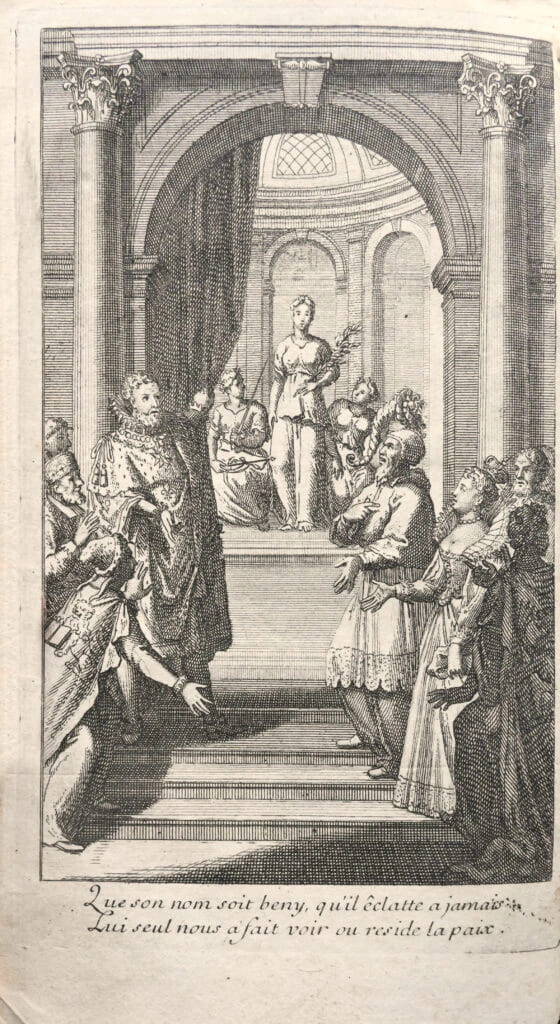
réf. LCS-A63Précieux exemplaire conservé dans sa reliure de l’époque. Utrecht, Antoine Schouten, 1713. - Projet pour rendre la paix perpétuelle entre les souverains chrétiens, pour maintenir toujours le commerce libre entre les nations, pour maintenir toujours le commerce libre entre les nations, pour affermir beaucoup davantage les maisons souveraines sur le trône, proposé autrefois par Henry le grand. Utrecht, Schouten, 1717. 3 volumes in-12, I/ (1) portrait de l’auteur, (3) ff.., xxiv pp., 400, (10); II/ (1) gravure à pleine page, (1) f. de titre, 423 pp., (9) pp.; III/ xxxiv pp., (10) pp., 455 pp., (4) pp., 4 gravures hors-texte à pleine page dont une dépliante. Veau brun, filet à froid autour des plats, dos à nerfs richement ornés, coupes décorées, tranches marbrées. Reliure de l'époque. 165 x 93 mm.