Bible StoriesABAA
20 811 résultats
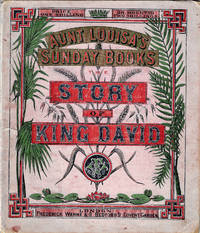
1870réf. 011459London: Frederick Warne 1870 24 pgs including covers printed on one side. 10.5 x 9 inches. Color printed stiff covers with small loss covers soil spine archivally reinforced light finger soil. The story of King David told in text attributed to Laura Valentine and 12 half-page color illustrations engraved by Edmund Evans. Date based on institutional holdings. Pictorial Wraps. Good/No Jacket. Illus. by Edmund Evans Engr. Square 4to. Frederick Warne books
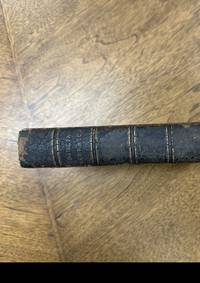
1868réf. 85012New York: American Bible Society 1868. Hardcover. Good. 2 vols. 844p. 24cm. Somewhat worn flexible black leathercovers. 25cm. Joints and other extremities rather heavily rubbed. Splitting at bottom of front joint on Vol. 1. Gift inscription. Contents sound and clean. All edges gilt. A large print edition of the Protestant Bible. American Bible Society hardcover books
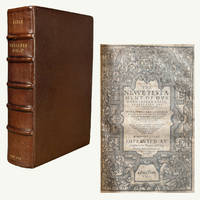
1592réf. U74Description General title page 1592 in facsimile with an architectural border featuring a lion and a dragon. First leaf of Tables bound in before Genesis. Text in two column black letter. Complete set of woodcut illustrations and maps. Woodcut architectural title featuring Lady Justice and Mercy before Psalms. Includes Apocrypha as issued. New Testament with Tomson's revision and title page 1591 with design like general title. Woodcut first chapter initials head- and tailpieces throughout. Collation A4-A1A4 A-Z6 Aa-Zz6-Qq6 Aaa-Zzz6; Aaaa-Zzzz6; 5A-5M2. Lacks general title Adam and Eve engraving and final leaf of Job title and Job leaf in facsimile. Binding Rebound in brown morocco. Spine with five blind-lined raised bands and the words "Bible" "Breeches Bible" and "Pre 1700" in gilt. Plain endpapers. Condition Prelims soiled with loss of a words and repairs; A1 repaired to fore-edge costing a few letters of text with missing text and sidenotes in manuscript; F6Xxx4-6 marginal repair; final leaf of Apocrypha and NT title page guarded; final leaf of Revelation strengthened to edges; browning and soiling; occasional marginal damp stains; trimmed only touching upper border or sidenotes on a handful of occasions. Provenance "James France Manly born Dec 14 1820" to foot of Second Title page; verso of NT title page with extensive description of the Manley family. References Herbert 210. Christopher Barker hardcover books
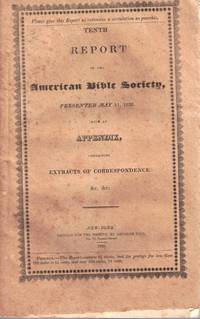
1826réf. 72399NY: Printed for the Society by Abraham Paul 1826. Paperback. Very good. Paperback. xii 136 pages. Foxed throughout with some minor loss at the bottom of the front else very good. Contents include list of officers agents reports from various Bible societies Domestic and Foreign correspondence Bible distribution financial information and more. John Jay was President of the Society when this report was published. Printed for the Society by Abraham Paul paperback books
1936réf. 55022New York: Limited Editions Club 1936. Limited edition. Hardcover. Very good- to fine condition. 5 octavo volumes. 1 of 1500 sets published. Original blue cloth with gilt tooling on front and rear covers gilt lettering on spines in original glassine jackets; housed in gilt paper-covered slipcase with white lettering on blue labels of spines. Blue edges. Decorative initials in red and black. Printed on specially made paper with a "Limited Editions Club" watermark. Entire work printed especially clear without verse numbers for easier reading. Production and publication designed by George Macy one of the founders of the Limited Editions Club in 1929 to produce elegant editions of classic as well as modern literature and printed under the supervision of Julian E. Berla. Some light wear of slipcases along edges and lightly rubbed. Glassines aged yellow and frail. Glassines with some chipping and medium to large closed tears volume one glassine split down the spine. Else these books are in near fine to fine condition. Limited Editions Club hardcover books
1627réf. 18927Frankfurt: Matthaeus Merian 1627. First edition. Hardcover. Very good. Matthaeus Merian. Oblong folio leaves: 20.6 by 31.2 cm; plates: 10 to 11.5 by 14.5 to 15.5 cm. Engraved titlepage borders without letterpress; 231 of 233 engraved plates printed on the rectos with no printed text depicting biblical scenes from the Old and New Testaments lacks Gen. XIX: Lot and his daughters after the destruction of Sodom and Gomorrah; Exod. VIII & IX: The plague of frogs. Recent marbled calf lightly rubbed at extremities bordered in blind; gilt-tooled spine with raised bands gilt lettering pieces. Occasional light stains and smudges especially at the outermost leaves and almost entirely restricted to the blank margins; old mostly marginal repairs and reinforcement of tears to about 30 leaves Matt. IV plate with loss of about 10 words of manuscript text. Protected by wide margins the plates are clean fresh and bright with relatively few minor blemishes. Housed and protected in a custom luxurious modern leather clamshell box. Rare suite of biblical illustrations printed before letter perhaps as proofs comprising 231 of 233 engraved plates from the Icones Biblicae of Matthaeus Merian the elder 1593-1650. The engravings are printed on large paper and lack any printed text. They are preceded by a leaf of the engraved title borders to the first part in which the central cartouche which would have contained a letterpress title and imprint is here blank. Neat manuscript annotations appear throughout: atop each engraving is a brief title along with a notation of the biblical book and chapters; beneath each engraving are six-lines of rhyming verse in German; at the top corners are leaf numbers in Arabic numerals. All are penned in black ink in the same old cursive German hand. The engraved title leaf is not included in the manuscript foliation. The first three leaf numbers and several others among the first 23 leaves are obscured by wear or later marginal repairs. The foliation ends at leaf 233 and is discontinuous where one would expect to find numbers 15 and 38 corresponding to the missing plates noted above. As noted by Wütrich only four of the 233 plates are signed by Merian all in the New Testament series. Each of these signed plates appears in our suite: Matthaei I. - page 7; Johannis VIII. - page 65; Matthaei XXVII. - page 101; Apocalyps. IX. - page 145 header titles and page numbers from the first edition. The first editions were published at Frankfurt in four parts between 1625 and 1627. The Pentateuch series was published in 1625. The second part illustrating the Old Testament books from Joshua to Kings appeared in 1626. These first two series were published under the name of Merian's father-in-law the printer and bookseller Johann Theodor de Bry 1561-1623 whose heirs retained title to the business. The third part illustrates the remainder of the Old Testament and Apocrypha; the fourth the New Testament. These last two parts were published in 1627 under the engravers's own name. Verses in Latin German and French accompany each plate in the three Old Testament series the French verses being omitted in the 1627 New Testament series. While the eminent Swiss draughtsman and engraver Matthaeus Merian is best known for his topographical depictions of the German speaking lands which appeared in the Theatrum Europaeum his novel selection of biblical stories and innovative stylistic approach revealed in the present series of plates proved highly influential ushering in a new age of copperplate engraving in Bible illustration. Merian broke with the century-long tradition of woodcuts which had accompanied countless editions of Luther's German Bible. Even as he drew on the Bible illustrations of Jost Amman Hans Holbein Virgil Solis and Tobias Stimmer Merian greatly expanded the traditional iconographic and compositional repertoire. The Old Testament alone contains 23 prints depicting stories that had never before been the subject of an engraver. While earlier New Testament woodcuts focused on the Book of Revelation Merian now provided a rich series of plates to illustrate the Gospels and Acts of the Apostles as well. Merian had an obvious preference for crowd scenes and battles along with some of the novelistic features of the Old Testament such as Jacob's lentil dish Solomon and Shulamit in the Song of Songs or the apocryphal story of the Dragon in Babylon. Merian sometimes provides local color from his home town of Basel as in his depiction of Solomon's Temple Consecration in which despite the baroque redesign the Basel Cathedral with the old choir is easily recognizable. The costumes and gestures of Merian's biblical characters display a baroque fantasy of the ancient Near East as reflected in the theater of his day; in depicting cities and buildings however Merian generally prefers to follow contemporary models. In individual cases such as Bathsheba's Bath he succumbed to the temptation as an engraver and artist to show off his skills in a magnificent fashionable palace and garden complex. All-in-all Merian's engravings initiated a development in Bible illustration "that led further and further away from the didactic Reformation purpose of Bible pictures to purely artistic-representational purposes and finally ended in the well-known pathos of the German Romantic Nazarenes" Schmidt. In the first few decades after their appearance these Bible plates were widely copied throughout Europe especially in the Netherlands and France Poortman. The first folio Bible to use Merian's copper plates to illustrate the text was published by the heirs of Lazarus Zetzner at Strasbourg in 1630. Subsequent editions of the "Merian Bible" were published at Frankfurt where Merian had taken over his father-in-law Johann de Bry's business. For over a century as Merian's heirs continued to publish new editions this would become "the most widespread German illustrated Bible in southern Germany Basel and Alsace primarily in wealthy households" Schmidt. After the demise of the Merian publishing house in 1727 the bookseller Philip Heinrich Hütter acquired the copper plates which he used to illustrate a Catholic Bible edition published at Frankfurt in 1740 Poortman. A very notable instance of transposing Merian's biblical engravings into another context occurs in the famous and oft-reprinted Amsterdam Haggadah the ritual for the Jewish Passover meal first published in 1695. The engravings were made by Abraham ben Jacob a former Protestant preacher who converted to Judaism. Introducing skills he had earlier acquired when working outside the Jewish community Abraham ben Jacob "widened the scope of Jewish book illustration" Rosenau and introduced new elements into the traditional iconography of the Haggadah. "He chose many of the same incidental scenes as had appeared in the Venice Haggadot 1599-1604 but he drew them afresh basing his work on the biblical pictures in the Icones Biblicae by Matthew Merian" EJ. Among them was the image of the Temple of Solomon in Jerusalem. As Merian used a wide variety of prototypes Rosenau suggests that the two free-standing columns Jachin and Boaz depicted at the front porch of the Temple in Merian's engraving and Abraham ben Jacob's adaptation may have ultimately been derived from the woodcuts which accompany Estienne's Bible Paris 1540 based upon the scholarship of Franciscus Vatablus. In Das druckgraphische Werk von Matthaeus Merian d. Ae. 1993 L. H. Wüthrich describes a "Spezialausgabe ohne Drucktext" complete with 233 biblical engravings located in Darmstadt at the Hessische Landesbibliothek 31/643. This "separate edition without text or a series of proofs" which he describes has three notable features: 1 an undated first edition title page of the second part Pars II of the Old Testament which has been "corrected. by crossing out or shaving" to read "Pars I"; 2 the first edition title page of the New Testament series dated 1627; 3 an engraving of the The Fall of Man probably after Johann Theodor de Bry which later appears in Gottfried's Chronicle part 1 1629/1630 but which differs from that found in most copies of the first edition Wütrich 1a. The copies containing this plate after de Bry Wütrich 1aa. were likely printed in 1626. Further research perhaps locates only one other suite of Merian plates without text at the Herzog August Bibliothek Wolfenbüttel catalogued under two call numbers: the Old Testament series dated 1626-1627 comprising 157 leaves including an engraved title A: 30.1 Geom. 2 "Ausg. ohne Text von Ps. 1 und 2." = VD17 23:289608V and the New Testament series dated 1627 comprising 78 leaves including an engraved title A: 30.1 Geom. 3 "Ausg. ohne Text" = VD17 23:655618H. The catalogue entry for the Old Testament series references Wütrich's "Spezialausgabe ohne Drucktext." Surprisingly the key images provided for this entry illustrate the same three notable features of the "Spezialiausgabe" which Wütrich located at Darmstadt !. Our suite of plates is provided with a single blank engraved title leaf the one used for the first series of the Old Testament plates which lacks any letterpress. The third plate which depicts the Fall of Man is here in Merian's style and is the image more commonly found in the first printings Wütrich 1a. In the first edition of the Icones Biblicae the title page notes "Mit Versen und Reymen in dreien Sprachen geziert und erkläret Durch Johann Ludwig Gottfried" decorated and described with verses and rhymes in three languages by Johann Ludwig Gottfried. In the first three parts of Icones Biblicae Gottfried's German verses are in four lines with a rhyme scheme of ABBA. In the fourth part the New Testament the German verses are modified to six lines with a rhyme scheme of AABCCB. The manuscript verses in German which accompany each of the 231 plates in our suite differ from both of these formats being composed in six lines of iambic hexameter with a rhyme scheme of ABABCC. To give a sense of how these versions differ the four lines of the German printed verses which accompany the first plate The Creation may be compared with the following transcript of the written verses which describe this scene in our set. in the first edition of Merian's Bilderbibel Im Anfang Gott Erschuff den Himmel und die Erden Die Wasser und das Meer das Liecht der Sternenschein Die Vögel Fisch Gewürm alle Thier groß und klein Warauß sein Gütigkeit und Kraft erkant mag werden. the hand of anonymous versifier Im Anfang schuff der Herr den Himmel und die Erden Das Licht die Sonn den Mond die Sternen und das Meer Gras Bäume Laub und Kraut und was genannt mag werden Von Thieren Vögel Fisch in ihrem grosen Heer Nur durch ein einig Wort: Ich kan hieraus erkennen O Gott! dein ew'ge Krafft und dich den Schöpffer nennen. Watermark: flambeau surrounded by garland Provenance: laid-in typed description on a half-sheet bearing the early twentieth-century letterhead of Harry A. Levinson Rare Books: "There appears to be no record of another such copy of proofs before letter." References: L. H. Wüthrich Das druckgraphische Werk von Mattaeus Merian d. Ae. Basel: Bärenreiter 1993 vol. 3 p.16: "Spezialausgabe ohne Drucktext;" Enc. Jud. 2nd ed. 8:215; W. C. Poortman Bijbel en Prent 's-Gravenhage 1986 2:56-59; H. Rosenau Vision of the Temple London: Oresko 1979 pp. 135; 146f. Ph. Schmidt Die Illustration der Lutherbibel Birsfelden/Basel 1977 pp. 304-329; VD17 23:289608V and 23:655618H. [Matthaeus Merian] hardcover books
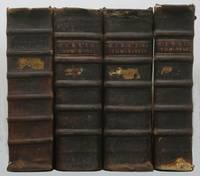
1726réf. 54196Berlenburg: n.p. 1726. First edition. Hardcover. Good. Eight volumes bound in four folio published between 1726 and 1742. All volumes with letterpress title page; sectional half titles; woodcut headpieces. Vol. 1 engraved frontispiece often not present here precedes vol. 7; appropriate engraved title leaves have been supplied from another German bible edition and inserted in vols. 1 3 4 and 5. Text in two columns. Contemporary calf over beveled wooden boards ruled in blind; spines with raised bands gilt morocco lettering pieces paper labels; marbled edges. Catches and clasps perished. Slight remains of paper labels. One volume with vertical crack through center of upper board else covers sound worn at extremities especially spine ends. Text with variable mild embrowning and light foxing occasional mild dampstains but overall clean. A good set complete and sturdily bound. Vol. 1 1726: 12 804 pp. - Vol. 2 1728: 8 880 pp. - Vol. 3 1730: 8; 784 pp. - Vol. 4 1732: 6 858 pp. - Vol. 5 1735: 8 820 pp. - Vol. 6 1737: 8 792 - Vol. 7 1739: 8 600 pp. - Vol. 8 1742: 4 556 44 index pp. with letterpress half-title: Der Berlenburgischen Bible Achter und Letzter Theil. First edition of this rigorous revision of Luther's version in the spirit of mystical Pietism edited by Johann Heinrich Haug d. 1753 and other scholars as is reflected in the main title: Welchem allem noch untermängt Eine Erklärung die den inneren Zustand des geistlichen Lebens oder die Wege und Wirckungen Gottes in der Seelen zu deren Reinigung Erleuchtung und Vereinigung mit Ihm zu erkennen gibt. Underlying everything is an explanation that reveals the inner state of the spiritual life or the ways and effects of God in in souls for their purification enlightenment and union with Him. A theologian and orientalist Haug was expelled from Strasburg for holding an assembly of Philadelphians and other mystic Separatists. He fled to the castle of Casimir Graf von Sayn-Wittgenstein-Berlenburg which had become a refuge for radical pietiests. Remaining there until his death Haug directed a Philadelphian organization that extended throughout western Germany. "He is said to have been a man of great piety and charming personality and was regarded by Count Casimer as a prophet of God" Schaff-Herzog. "The new spirit of mystical Pietism. was fully revealed in the Marburg Bible 1712. The interpretation of type and prophecy in this follows the federal theology of Cocceius that of Canticles and Revelation Madame Guyon. It was the forerunner of a larger work in the same spirit the Berleburg Bible of 1726-42. projected and prepared chiefly by Johann Heinrich Haug. The text is a revision of Luther's with comparison of the English and French versions; the commentary reflects the views of the Philadelphian communities and quotes the mystical books current among them especially Madame Guyon's but its teaching goes back beyond Dippel and Petersen to Jakob Böhme or even to Origen in some points. It lacks unity of belief and of treatment; it is the work not of a single mystic giving voice to his inner convictions but of a propagandist sect with radical tendencies. It is not without value however from different points of view; it edifies by its continual application of Scriptural works to the spiritual life and it prepares the way for historical criticism by an appendix vol. 8 containing apocrypha Old and New Testament pseudepigrapha and postapostolic writings." Schaff-Herzog. Christopher Sauer the agent for the sale of the Berlenburg Bible in the United States used the text as a model for the first German-American Bible 1743. Provenance: Bookplates of United Brethren Historical Society Dayton Ohio. D&M 4239. Jackson S. M. ed. The New Schaff-Herzog Encyclopedia of Religious Knowledge 1908 vol. 2 p. 157; vol. 5 p. 170. Main title and imprint vol. 1: Die Heilige Schrift Altes und Neues Testaments nach dem Grund-Text aufs neue übersehen und übersetzet: Nebst Einiger Erklärung des buchstäblichen Sinnes Wie auch der fürnehmsten Fürbildern und Weissagungen von Christo und seinem Reich und zugleich Einigen Lehren die auf den Zustand der Kirchen in unseren letzten Zeiten gerichtet sind; Welchem allem noch untermängt Eine Erklärung die den inneren Zustand des geistlichen Lebens oder die Wege und Wirckungen GOttes in der Seelen zu deren Reinigung Erleuchtung und Vereinigung mit Ihm zu erkennen gibt. Gedruckt zu Berlenburg im Jahr unsers Erlösers und Ursprungs der heiligen Schrifft JEsu Christi. [n.p.] hardcover books
1839réf. 52150Philadelphia: Bagster & Marshall 1839. First American edition. Hardcover. Good . Octavo. 6 10 778pp. Pointed Hebrew text in two columns the New Testament with only vocal marks. Continuous pagination in Arabic numerals; but separate Hebrew pagination for the Old and New Testaments. Contemporary three-quarter calf over pebbled cloth boards; spine with raised bands ruled and lettered in gilt. Decorative endleaves. Covers rubbed with wear at spine caps and corners. Library pressure stamp at title bookplate and pocket at paste-downs. A good ex-library copy with very clean fresh text throughout. First American edition of this Hebrew Bible earlier published by Samuel Bagster at London in 1835; it contains the first printing of the New Testament in Hebrew translation to appear in the United States. That translation was prepared by the philologist William Greenfield 1799-1831 the editorial superintendent of the British and Foreign Bible Society and first published by Samuel Bagster at London in 1831 D&M no. 5186. In preparing his revised Hebrew version Greenfield was allowed to utilise the London Jews' Society Hebrew New Testament published at London between 1813 and 1817 D&M no. 5170. Among the earliest publications of the society founded in 1809 this version was itself based upon Elias Hutter's Hebrew translation of the New Testament published at Nuremberg in 1599 D&M no. 5111. Prepared by a group of scholars under the supervision of Thomas Fry and William Bengo Collyer this London Jews' Society edition employed only biblical words and translated Old Testament quotations from the Greek not citing them directly from the Hebrew Scriptures. The editor of the New Testament version in the present work appears to have had a notable gift for languages. William Greenfield began his Hebrew studies as a young man while apprenticed to a bookbinder taking lessons from one of his co-workers a Jew with some learning who had been described as "a reader of the law in the synagogue" ODNB. Greenfield subsequently left the business in 1824 in order to devote himself to languages and biblical criticism. His defence of the Serampore Mahratta version of the New Testament in response to an 1829 article in the Asiatic Journal brought him to the attention of the British and Foreign Bible Society who then hired him to superintend their editiorial department. "During his nineteen months in the society's service Greenfield wrote on twelve European five Asiatic one African and three American languages and acquired considerable knowledge of Peruvian African-English Chippeway and Berber" ODNB. His revision of the Hebrew New Testament earlier published by the London Jews' Society was among the last works he undertook for the British and Foreign Bible Society along with the revision of the Modern Greek Psalter as it went through the press. Provenance: Bookplate and other markings including withdrawal stamp of the Library of the Garrett Theological Seminary Evanston Illinois. Full title in Hebrew: ספר הקדש ×•×”×•× תורה × ×‘×™××™× ×•×›×ª×•×‘×™× ×’× כתבי ברית החדשה נעתק מלשון יונית ×ל לשון עברית Philadelphiae: Sumptibus Bagster et Marshall in via vulgo dicta Chestnut Street ad Repositorium Bibliorum Sacrorum etc. quae in linguis antiquis et hodiernis edita sunt. Anno erae Judaicae I rev. C; rev. C DXCIX. References: Goldman Hebrew Printing in America no. 6: "This was the first New Testament published in Hebrew in America." ODNB: "Greenfield William" Gordon Goodwin revised by H. C. G. Matthew. J. R. Marcus "Jewish Americana a Supplement to A. S. W. Rosenbach An American Jewish Bibliography" in: Monographs of the American Jewish Archives 1954 no. 1 no. 164. Cf. Darlow & Moule nos. 5111; 5170; 5186. Bagster & Marshall hardcover books
1962réf. 52438Graz: Akademische Druck-u.Verlagsanstalt 1962. Hardcover. Very good. Two volumes large 8vo: pp. 16 966 6; 2 920 42. Publisher's light blue cloth. A nearly fine clean set with some slight erosion/scuffing at the covers of the second volume. Modern photo-reprint of this celebrated work of early modern biblical scholarship. First published in 1752 it was until the twentieth century regarded as "the most elaborate and valuable of all the critical editions of the New Testament" Orme. Edited by the scholar Johann Jakob Wetstein 1693-1754 a scion of the Amsterdam printing family who produced Gerhard von Maestricht's New Testament of 1711 the original edition includes the editio princeps of two pseudepigraphic works ascribed to Saint Clement of Rome which survive in Syriac. At his native city of Basel in 1713 Wetstein defended a thesis on the various readings of the New Testament. "After collating MSS. in various libraries he at length obtained in 1733 a professorship in the Remonstrants' college at Amsterdam in succession to Le Clerc. In 1730 the Wettstein press published his Prolegomena anonymously and in 1735 he edited for the same firm a revision of G. v. Maestricht's Testament. At length in 1751-2 he produced the critical edition at which he had been labouring for many years. Perhaps in deference to the opinions of his friends Wettstein did not print in his edition the text of Codex A as he seems at first to have intended or a recension of his own but merely reproduced the Elzevir text with very few variations. Immediately below however he indicated the changes which he considered absolutely necessary from which it is easy to construct 'Wettsteins's text.' Nearly all these proposed changed -- which according to Reuss number 159 -- had appeared in previous editions and are generally accepted do-day. . Below this matter stands the critical apparatus the most elaborate which had yet been published giving innumerable variants and citing as authorities for and against these a vast body of witnesses -- MSS. versions early fathers and printed editions. Wettstein introduced the practice of indicating uncial MSS. by roman letters and cursive MSS. by arabic numerals. In the revised and enlarged Prolegomena preceding the text which give some account of his labours and controversies Wettstein displays a marked antipathy to all the earliest MSS. which he suspected of having been corrupted by the Latin versions. The Animadversiones at the end of vol. 2 are more temperate and possess higher value. A distinctive feature of the book is the commentary printed at the foot of the page. This forms a curious treasury of notes illustrating both the matter and the language of the inspired writers by copious extracts from all kinds of authors -- classical patristic and rabbinic". References for the original edition: Dibdin 4th ed. 1: 156. Le Long/ Masch 1 1778: 243-46. Orme Bibliotheca Biblica 465: "Wetsteins's merits as a critic' says Dr. Marsh "undoubtedly surpass the merits of his predecessors: he alone contributed more to advance the criticism of the Greek Testament than all who had gone before him: and this task he performed not only without support either public or private but during a series of severe trials under which a mind of less energy than Wetstein's would infallibly have sunk." Full title and imprint: He Kaine Diatheke Novum Testamentum Graecum editionis receptae cum lectionibus variantibus codicum mss. editionum aliarum versionum et patrum nec non commentario pleniore ex scriptoribus veteribus Hebraeis Graecis et Latinis historiam et vim verborum illustrante Joannis Jacobi Wetstenii. Tomus I -II. Continens quatuor Evengelia. . Epistolas Pauli Acta Apostolorum Epistolas canonicas et Apocalypsin. Amstelaedami ex officinia Dommeriana. MDCCLI. Akademische Druck-u.Verlagsanstalt hardcover books
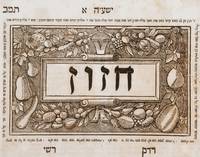
1619réf. 52679Basel: Ludwig König 1619. First edition in part. Hardcover. Good. Eight parts in three volumes folio biblical texts and commentary in four parts continuously foliated; three supplemental sections each with separate foliation; Tiberias 1655 with separate pagination here bound after the Haftarot - Vol. 1: 6 title and prelims 1-228 1 sect. title 234-441 1 blank ff. Vol. 2: 1 sect. title 442-705 3 blank 707 sect. title-837 1 blank ff. Vol. 3: 839 half-title-881 1 blank 883-946; 8 Targum Yerushalmi; last leaf unfoliated; 67 Masorah 1 blank; 1 title 2-36 Haftarot ff.; 8 title and prelims 108pp. Despite the gap in foliation between the first and second parts and numerous errors in foliation throughout the Rabbinic Bible collates complete with all blanks noted in Prijs Die Basler hebräischen Drucke and the Haftarot bound at the end. Largely arranged in two columns of biblical texts in square font surrounded by commentaries in rabbinic Rashi font; biblical texts read from right to left. This copy with collective Hebrew title surrounded by biblical quotations in Hebrew set within elaborate woodcut architectural borders; brief preface in Hebrew by Abraham Braunschweig at the verso. Hebrew sectional titles set within the same woodcut borders for the three other biblical sections and the Haftarot with a plain letterpress half-title for the Five Megillot. Opening word of each biblical book set in large one-third to one-half page cartouche vignettes with elaborate woodcut borders and surrounding letterpress Hebrew text. Main title Jewish date chronogram = 5378 1618-1619. Near-contemporary half calf over speckled boards worn and rubbed; spines with raised bands gilt morocco lettering pieces and old paper labels heavily faded. About two-thirds of the text embrowned ranging from minimal to moderately heavy; worm tracing in a 1- by 2-inch section at leaves 541-553 affecting text. A good complete set notably containing the Ashkenazi Haftarot readings not found in all copies. Sixth Rabbinic Bible in Hebrew: Mikra'ot Gedolot edited by Johann Buxtorf I 1565-1629 professor of Hebrew at the University of Basel and the foremost Christian Hebraist of his era with the assistance of the Jewish scholars Abraham Braunschweig who served as the principal corrector and Mordechai Gumplin of Posen. This was "a truly audacious undertaking for his time" Burnett as no Christian scholar had yet attempted to edit the entire biblical corpus including the Aramaic versions Targumim and masoretic notes. Based mainly on the third Rabbinic Bible published by Daniel Bomberg at Venice in 1546-1548 the editor has carefully incorporated elements from two other Venetian editions. At the verso of the Latin title Buxtorf provides a detailed bibliographical excursus on the earlier Venetian editions and offers a tribute to Bomberg's industry by reprinting the colophon of the second Venetian Rabbinic Bible 1524-1525 at the conclusion of the masoretic appendix with text by the Hebrew grammarian and lexicographer Elijah Levita 1468 or 1469-1549 and a new introduction by Abraham Braunschweig. The design of the sectional titles and separate book title vignettes closely model those of the Venetian editions. "Buxtorf did not plan simply to reprint one of the existing Venice editions but rather to assemble the best features of them all into one work" and "to provide theologians with what he considered the most important tools for interpreting the Old Testament" Burnett. Buxtorf served in an official capacity as Basel's Hebrew censor charged with the oversight of all Jewish printing in the city and insuring that "no 'blasphemies' or slurs against Christians or Christianity appear in any book printed in Basel" Burnett. He carefully edited the Jewish commentaries in the Rabbinic Bible in accordance with this mandate "and removed many words and phrases which had escaped the attention of earlier censors" Burnett. The Rabbinic Bible contains the vocalized Masoretic text of the Hebrew Scriptures with accents and a vocalized Targum an Aramaic paraphrase of the biblical text: Onkelos for the Pentateuch; Jonathan b. Uzziel for the Prophets; and Targum Hagiographa for the Writings. The Hebrew and Aramaic versions are printed in square characters and presented in facing columns at the center of each page. The Jerusalem Targum of the Pentateuch appears as an appendix. In addition to the Aramaic paraphrases the Rabbinic Bible includes a massive scholarly apparatus of biblical commentaries by Rashi Ibn Ezra Baal ha-Turim Jacob b. Asher R. David Kimchi Radak R. Levi b. Gershon Ralbag Saadia Gaon and R. Isaiah along with the Masora a corpus of critical notes on the external form of the Biblical text compiled by Jewish scholars from late antiquity through the medieval era. As frequently occurs a copy of Buxtorf's work on the textual history of the Hebrew Bible Tiberias the 1655 revised edition is bound-in. This work was made possible by the publication in 1538 of Elijah Levita's Masoret ha-Masoret a commentary on the Masora which Buxtorf translated into Latin for his own private use in 1593. While "Buxtorf was concerned with the integrity of the consonantal text and the origin and integrity of the vowel points and accents of the Hebrew Bible from the very beginning of his scholarly career." While he had earlier published a long excursus on the age of the vowel points and accents in his 1609 Thesaurus Grammaticus "Tiberias is Buxtorf's fullest and most impressive work on the history of the biblical text" Burnett. Intended as a reference work for Christian students and scholars interested in studying the Masora Buxtorf was also keen to refute the view advanced by Levita that the Hebrew vowel points were early medieval innovations. Our folio version of Tiberias was intended to accompany the Rabbinic Bible and has the same architectural borders at the title. König also published a quarto edition in the same year but only the folio version includes a critical commentary on the Masora in which Buxtorf proposes various corrections to the Masoretic notes. As noted at the title Buxtorf's faithful study and tireless labor studio fido et labore indefesso yielded notably long-lasting results: "The Basel rabbinical Bible became a standard tool for research among Christian scholars and would remain so. until the end of the nineteenth century" Burnett. A vast array of early modern scholars including Protestants like Johannes Drusius and John Selden as well as Roman Catholics like Robert Bellarmine and Andreas Masius owned a copy or two of the Rabbinic Bible. "Johannes Buxtorf's thoroughly censored "Christian" version of the Rabbinic Bible Basel 1618-19 only made it easier for Hebraists to own copies of their own" Burnett Christian Hebraism in the Reformation Era p.163. A note on the date of publication: "The actual printing began between the mid-August and mid-September of 1618. According to the colophon production ended on the 24 of Ab 379 = August 4 1619 but since this date also appeared on the colophon of the Bomberg Biblia rabbinica edition of 1524-25 reprinted unchanged in the 1546-48 and 1568 editions it is suspect. Prijs suggested that the probable completion date was sometime during Ab of 379 between July 12 and August 10 of 1619" Burnett. References: Biblia Sacra: Burnett 7. Cowley 87. Darlow & Moule 5120 like our copy bound with the 1665 second edition of Tiberias cf. 5093. Davidson Otsar ha-shirah vol.1 p.406 no.8954. Prijs 219. Steinschneider 423 423b. VD17 23:675325G. S. Burnett Christian Hebraism in the Reformation Era Leiden: Brill 2012 p.163. Tiberias: Burnett 114. Prijs 272a. For detailed analyses of both works see: S. Burnett From Christian Hebraism to Jewish Studies Leiden: Brill 1996 pp.169-239 chaps. 6 & 7. Ludwig König hardcover books
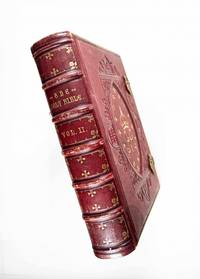
1862réf. 49952Glasgow Edinburgh and London: William Mackenzie 1862. Deluxe Edition. Two volumes folio 450 x 330 mm published between 1862 and 1863. 16 1344pp. 57 unnumbered leaves of albumin prints 230 x 160mm mounted on card stock. Crimson morocco over wooden boards elaborately tooled in gilt and blind; edges mounted in brass double brass clasps with thistle motif; covers with a broad blind-stamped border around a recessed central panel with the crowned cipher of Queen Victoria in gilt; gilt tooled spine with 5 raised bands; a.e.g. marbled endleaves with gilt dentelles. Covers with some mild traces of use; single crease in each marbled endleaf partially detached in second volume; occasional light to moderate foxing mostly confined to the plate mounts; albumin prints in fine condition often with foxing extending about 5mm from the edges into the mount. Overall a very good set with a fine series of photographs notable for their technical achievment. Deluxe edition one of 170 copies complete with all 57 albumen prints. Produced for the 1862 International Exhibition and dedicated to Queen Victoria then recently in mourning for the death of Prince Albert this work appeared at a time when photography though still a laborious and expensive process was just beginning to become a popular activity. Victoria herself was an amateur photographer and "the royal couple had been enthusiastic supporters of photography in England from the beginning; in 1853 they became founding patrons of the Photographic Society Club" K. Fiedorek. Francis Frith 1822-1898 the devout Quaker whose photographic images grace the present work was one of the best-known photographers to work in the Near East and the most commercially successful photographer of the nineteenth century. Finding his elementary studies tedious Frith left school at the age of ten apprenticed with a grocer and eventually started his own business. He later went into printing sold the grocery business to a competitor at a substantial profit and went on to devote himself to photography. "The growing Victorian interest in the East and its exotic and historic attractions caught the attention of this astute businessman" Perez. Between 1856 and 1860 Frith made three photographic expeditions to Egypt Ethiopia Sinai and the Levant accompanied by the engineer Francis Herbert Wenham who provided technical assistance in mechanics and optics. While Perez notes that Frith's "approach was always a strictly commercial one and his concern was to make truthful and accurate views of the area" he readily concedes that "the technical quality of Frith's photographs is superior." Frith employed the new wet collodion process in which glass plate negatives were sensitized exposed and developed while still wet. While technically demanding the process yielded rich detail and broad tones. "Frith's were the first original wet-plate photographs of Jerusalem and the Holy Land to reach a wide English-speaking audience and his pictures of the small Palestinian towns were most likely the first published anywhere" Nir p.66. Perhaps the most novel aspect of this celebrated edition of the Bible and certainly a harbinger of things to come was the way in which the photographer "presented the radical possibility of seeing photographs of the biblical sites alongside related verses of scripture. he sought to defend and promote his faith by conscripting the veracity of science and materialism to his cause and considered photography to be the most effective medium for his campaign" Foster et al. This vision is manifest even in such details as the re-captioning of prints previously offered for sale so that the new descriptions would more clearly reference the King James text. It should be noted that while the printing was still done by hand this was one of the earliest books for which machinery was used for composing. Original publisher's price = 50 guineas. Another version of this work was published at London in 1860-1862 by Eyre & Spottiswoode; sometimes confused with the present work it was issued in 20 parts each containing a single photographic print by Frith. K. Fiedorek A Photographic Bible Fit for a Queen NYPL Blog 2014. Foster Heiting and Stuhlman Imagining Paradise pp. 68-69. Gernsheim Incunabula of British Photographic Literature 1839-1875 p.36 no.184. Herbert The English Bible 1940 1217. Y. Nir The Bible and the Image The History of Photography in the Holy Land 1939-1899 esp. chap. 3: "Early Traveling Landscape Photographers". N. Perez Focus East: Early Photography in the Near East 1838-1885 pp.163-165. William Mackenzie unknown books
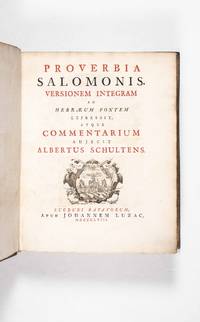
1748réf. 49255Leiden: Jean Luzac 1748. First edition. Hardcover. Very Good. Quarto. 8 cviii 522 60 indices & corrigendapp. Text in two columns with Hebrew text and facing Latin translation interspersed with commentary. Title in red and black with engraved vignette; woodcut ornaments. Contemporary Dutch paneled vellum with blind-stamped vignettes and ruled borders; manuscript title at spine. Covers lightly soiled. Occasional touches of soiling and some leaves with mild embrowning. A very good copy generally crisp and clean. First edition of this comprehensive commentary to the biblical Book of Proverbs by the Dutch semitic language scholar Albert Schultens 1686-1750 who maintained "that the true nature of the Hebrew language and the meaning of many of its words and idioms are to be found chiefly in the Arabic" Orme. Forty-one pages of the indices constitute a brief lexicon and provide Latin as well as Arabic equivalents for more than 1000 Hebrew words. Schultens studied theology and eastern languages at Groningen where he received his degree in theology in 1709. After a brief career as a preacher in Wassenaar he was nominated professor of Hebrew and Jewish antiquities at Franeker in 1713. In 1729 he decamped for Leiden were he was first appointed reader in eastern languages and finally full professor in 1732. At this time a chief concern of Calvinist theologians was to liberate Old Testament exegesis from Jewish Rabbinic as well as Catholic traditions. Schultens' influential and controversial solution was revealed as early as 1706 in his first public thesis Disputatio theologico philologica de utilitate linguae Arabicae in interpretanda S. Scriptura A Theologico-Philosophical Dissertation on the Utility of the Arabic Language for the Interpretation of the Holy Scriptures "a forceful attack" Brugman & Schröder on the Protestant sola scriptura methodology of Biblical exegesis. "With the help of Jacobus Golius' Arabic dictionary he perused with zeal and fervour the Old Testament and wrote prolifically. The lexical superiority of Arabic had led him to a reconsideration of the position of Hebrew: at first he had called Arabic 'the most splendid daughter of mother Hebrew' but in his oration of 1729 he proclaimed Hebrew and Arabic cognate twin sisters. This shocked conservative theologians as an outright profanation of God's Word" Brugman & Schröder. Like his earlier commentary on the Biblical Book of Job one here finds that the "Hebrew text and the Latin translation are all but totally submerged by the extensive commentary in which Schultens draws abundantly on Arabic texts such as the Hamasa an anthology of early Arabic poetry by the ninth-century poet Abu Tammam" Vrolijk & van Leeuwen. Schultens was not without his critics and by 1824 William Orme notes a turning of the tide: "Different opinions are entertained of the correctness of his views and also of his success in applying them; but it is now generally admitted that he carries his notions of the advantage of Arabic learning to the interpretation of the Scriptures too far." Jean Luzac 1728-1777 was a member of a well-known Huguenot family of printers; he published many works for the University of Leiden including three Hebrew books of Albert Schultens. Isaac van der Mijn is noted as the printer at the colophon of the second volume. Provenance: bookplate of the Crozer Theological Seminary - Bucknell Library; bookseller's ticket of Librairie Ancienne et Moderne de Frederik Muller Amsterdam at the front paste-down. References: J. Brugman & F. Schröder Arabic Studies in the Netherlands Leiden: E.J. Brill 1979 p.26f. Fuks/Fuks-Mansfeld 78. Orme Bibl. Biblica p. 390. A. Vrolijk & R. van Leeuwen Arabic Studies in the Netherlands a Short History in Portraits 1580-1950 Leiden: E.J. Brill 2014 pp. 73-79. Jean Luzac hardcover books
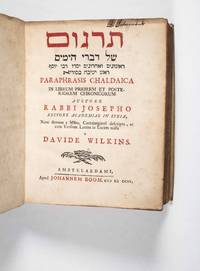
1715réf. 49239Amsterdam: Jan Boom 1715. First edition. Hardcover. Very Good. Small quarto. asterisk4 a-f4 -blank f4 A-3F4 = 235 leaves. 54 415 1 blankpp. Contemporary vellum with exposed thongs boards somewhat bowed spine darkened early manuscript title in Hebrew and Latin at spine. Old owner entry at top margin title memorial label at front paste-down. A very good copy amply-margined with fine crisp text throughout. Important edition of this Aramaic version of the biblical books of Chronicles attributed to Joseph ben Hiyya d. 333 a Babylonian amora and head of the Pumbedita academy near present-day Falluja Iraq. "Ben Hiyya was also distinguished in biblical exegesis and left an Aramaic translation of parts of the Bible which is often quoted. It is not to be assumed however that Joseph translated the whole Bible though the Aramaic translation of the Books of Chronicles is ascribed to him. Enc. Jud. The editio princeps edited from an Erfurt manuscript by Matthias Frederick Beck and accompanied by substantial annotations was published at Augsburg in 1680. "After this David Wilkins gave the public an edition from a Cambridge manuscript of which the text was more pure and more complete. The critic should unite both these editions the former for the value of its learned notes and the latter for its full and accurate text" The Biblical Repertory. The Coptic scholar David Wilkens 1685-1745 was born of Prussian parentage in Memel Lithuania. Little is known about his education in Germany probably in Berlin or how he acquired his knowledge of ancient and Semitic languages which was extensive rather than profound. He referred to the antiquarian Ezechiel Spanheim the elector of Brandenburg's ambassador in England from 1701 to 1710 as his former teacher. By 1707 Wilkins was studying at the Bodleian Library in Oxford and had encountered a group of clerical protectors in London. In 1709 engaged in preparing a history of the patriarchs of Alexandria which remained in manuscript and the editio princeps of the Coptic Bohairic New Testament the Novum Testamentum Aegyptium 1716 he left for the continent. He called on scholars examined manuscripts in Vienna Rome and Paris and stopped in Amsterdam in 1714 to see to the publication of his first works -- an edition of the Aramaic paraphrasis of the books of Chronicles and an Armenian version of the apocryphal third epistle to the Corinthians 1715 -- and of John Chamberlayne's polyglot edition of the Lord's prayer to which he contributed. Wilkins was an industrious scholar. In the three years he spent as librarian at Lambeth he made important contributions to the cataloguing of manuscripts. In 1721 he edited the Anglo-Saxon laws in 1725-6 the complete works of John Selden and in 1731 the Coptic Pentateuch. His main work was his Concilia Magnae Britanniae et Hiberniae an account of British church councils from 446 to 1717. Wilkins had many detractors -- John Gagnier the professor of Arabic at Oxford who deplored his incompetence in Arabic and Hebrew Edward Harley who described him as 'a very great scoundrel' and the cantankerous Thomas Hearne who as librarian at the Bodleian had watched him turn from a young man 'of a civil Courteous and modest behaviour' into 'a vain ambitious man of little judgement tho' great industry' ready to 'do anything in the World for a little Money' Alastair Hamilton: "Wilkens David" -- ODNB online. Provenance: From the library of G.H.A. Juynboll 1935-2010 the celebrated scholar of Islamic Hadith literature with his printed memorial label at front paste-down. Hebrew title: ×ª×¨×’×•× של דברי ×”×™×ž×™× ×¨××©×•× ×™× ×•××—×¨×•× ×™× יסדו ר×ש ישיבה ×‘×¡×•×¨×™× References: The Biblical Repertory 1834 6:248-249. Brunet 3:574 - "Livre recherché et peu commun". Enc. Jud. 10:229. Le Long Bibliotheca sacra 1723 1:92B. Le Long-Masch 2.1 p. 48: "Multo correctior est editio ac praecedens Beckiana." long note in which the relation with the never published version by Clarke is discussed. Cf. D&M 2416: The editio princeps of the Targum on Chronicles printed from an Erfurt MS. and edited with a Latin translation by M. F. Beck Augsburg 1680-3 2 vols 4to. The present edition is "a more complete form of the text from a Cambridge MS. . edited with a Latin translation by D. Wilkins. Jan Boom hardcover books
1862réf. 30751Leipzig; Dresden: A. H. Payne 1862. First edition. Hardcover. g to g. Folio. XII 1588 8pp. Original 3/4 morocco over cloth with gold lettering on spine. Engraved frontispiece in each volume. Decorative initials. Exquisite 19th-century German Bible magnificently illustrated with hundreds of in-text and full-page woodcuts. Moderate rubbing along edges of binding. Pages moderately foxed throughout. Text in German Gothic script. Binding and interior in overall good to good condition. A. H. Payne hardcover books
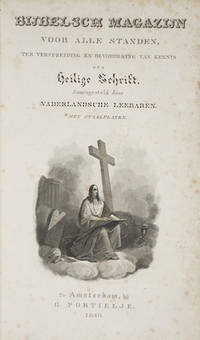
1840réf. 18858Amsterdam: G. Portielje 1840. First edition. Hardcover. g to vg. Two volumes quarto published between 1840 and 1848. 1242pp. 207 x 6. Comtemporary full calf with gold-stamped borders on covers and gold lettering and gilt lettering pieces on spines. Additional steel-engraved title page in each title-page. This striking collection of Bible stories is divided into 2 volumes Old and New Testaments and is profusely illustrated with a total of 312 in-text steel engravings. Minor edge wear on bindings with moderate rubbing along joints and on corners. Sporadic foxing throughout. Text in Dutch. Bindings and interior in overall good to very good condition. G. Portielje hardcover books
1876réf. 68879Stoplen: Gustav Winterib Nênilauktangit 1876-78. Complete New Testament in Labrador Inuttitut Published for the Moravian Mission in Labrador The complete New Testament translated into Inuttitut the Labrador dialect of the Inuktitut language "printed for the British and Foreign Bible Society in London for the use of the Moravian Mission in Labrador." The first section containing Gospels and Acts first appeared in 1876. The second part Romans to Revelations was printed in 1878 and includes a list of errata to the first part and a note. The text was prepared by Theodor Bourquin superintendent of the Labrador mission and edited by J. Ribbach. Early editions of the Gospels were published in 1810 1813 and 1839; Acts in 1816; and Epistles in 1819. A revised edition of the whole New Testament was published for the first time in one volume in 1840 see Darlow & Moule 3508-11 3515 3516. Not in Ayer Linguistics. Large octavo. Original polished calf boards ruled in blind spine gilt. Binding lightly rubbed front hinge professionally restored almost invisibly edges sprinkled red. Text evenly tanned otherwise clean internally. Very good. PILLING ESKIMO p.89. BANKS p.76. LANDE MORAVIAN MISSIONS 59. EVANS 303. DARLOW & MOULE 3522. PILLING PROOF-SHEETS 3831a. hardcover books
1813réf. 45253Somerset Pa.: Friedrich Goeb 1813. The First Bible Published West of the Alleghenies A lovely copy of this highly important German-American bible notable for being the first bible printed west of the Allegheny Mountains. Goeb emigrated from Germany in 1804 settling in western Pennsylvania and establishing himself as a printer first in Chambersburg and later in Somerset. Printed in two columns this bible includes the Old and New Testaments as well as the Apocrypha. The Preface Remarks and Commentaries which accompany some chapters were likely written by Goeb who spent the years from 1810 to 1813 printing this landmark bible almost entirely by himself in his cabin in far-off Somerset. A handsome copy in original condition. Large thick quarto. Contemporary calf with clasps. Minor wear to extremities. Contemporary notations in German on first two preliminary leaves. Some light scattered foxing and toning. A near fine copy. SHAW & SHOEMAKER 27883. BÖTTE & TANNHOF 2004. unknown books
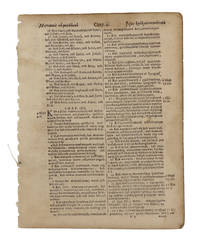
1663réf. 68910Cambridge MA: Samuel Green 1663. Leaf of the 1663 First Edition of the Eliot Bible A leaf from the first edition of the Eliot Indian Bible Mamusse Wunneetupanatamwe Up-Biblium God. published in Cambridge Massachusetts in 1663. This was the first Bible printed in North America and the first Bible in an American Indian language. The printing of this Bible was a monumental undertaking and it took more than two and a half years to set the type and print the work. This leaf contains verses twenty-six through thirty-eight of chapter III all of chapter IIII i.e. IV verses one through forty-four and verses one through fifteen of chapter V of the Gospel of Luke. A keen artifact from the "first Bible printed in the New World and the first example in history of the translation and printing of the entire Bible in a new language Massachuset as a means of evangelism" - Pilling. Small quarto. Minor staining toning and dust soiling including some dampstaining to fore-edge. Edge wear to gutter. Quarter-inch closed tear to top edge affecting one letter of running head on verso without loss. Very good. EVANS 72. FIELD 495. AYER INDIAN LINGUISTICS MASSACHUSETT 1. CHURCH 580. DARLOW & MOULE 6737. PILLING ALGONQUIAN pp.139-52. PRINTING AND THE MIND OF MAN 142. SABIN 22154 22155. SIEBERT SALE 490. WING B2755. ESTC W38287. Hugh Amory First Impressions: Printing in Cambridge 1639-1989 Cambridge MA 1989 pp.39-42. George Parker Winship The Cambridge Press 1638-1692 Philadelphia 1945 pp.208-44. unknown books
1811réf. 41996Philadelphia. 1811. Impressive Early American Bible in Contemporary Bindings An impressive early American Bible in five large volumes styled "the second American edition from the second London edition improved and enlarged" presumably referring to Scott's annotations. With information inscribed regarding the Lear and Storer families of Portsmouth New Hampshire. Quarto. Contemporary calf spines gilt leather labels. Boards a bit scuffed corners lightly worn. Spines slightly scuffed and slightly chipped on some volumes. Light scattered foxing and toning. Information about the Storer family inscribed in the first volume. About very good. SHAW & SHOEMAKER 22356. hardcover books
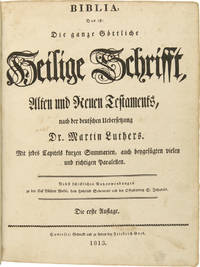
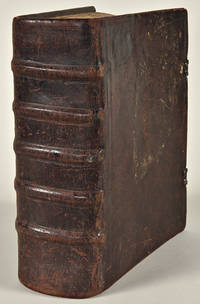
1763réf. 58065Germantown: Christoph Saur 1763. The Second Saur Bible and the First Bible Printed on American Paper The second edition of the first European-language Bible printed in America after the first of 1743 and the first Bible printed on paper made in America. The text is based on Martin Luther's version by way of the thirty-fourth edition of the Halle Bible with Book Three of Edras Book Four of Edras and Book Three of Maccabees supplied from the Berlenburg Bible. The present edition supposedly issued in 2000 copies was printed by Christopher Saur II son of Christopher Saur the elder a native of Wittgenstein Germany. The elder Saur emigrated to Germantown Pennsylvania working variously as a tailor clockmaker and healer before finally turning to printing and publishing. It was he who printed the 1743 first edition. When his father died in 1758 the younger Saur who up until then had overseen the bindery and all English-language publications inherited the business. Under his ownership the business continued to thrive and expand making him "one of the wealthiest men in British America" before seeing his fortunes reversed during the American Revolution ANB. A member of the German Baptist Brethren or Dunkards as they were popularly known the younger Saur would publish a second the present 1763 edition and third 1776 the so-called "Gun-wad Bible" edition of his father's German Bible and in 1773 he would build a paper mill on the Schuylkill River. Next to the cost of labor paper was easily the colonial printer's greatest expense. While the best paper used in colonial British North America had to be imported there was always demand for the lower-grade printing paper used for the bread and butter of the printer's trade: newspapers almanacs pamphlets and more ephemeral publications. Increasingly such paper came to be supplied by a growing number of American paper mills most of which were concentrated in Pennsylvania. It was on such American-made paper that Christopher Saur printed the second edition of this German-language Bible. In 1935 the watermarks on the paper of the Second Saur Bible were identified as those of William Parks the Virginia printer and publisher of the Virginia Gazette who established a paper mill at Williamsburg in 1744. How paper bearing his watermark came to be used in the printing of the second edition of the Saur Bible remains something of a mystery. Parks died in 1750 some thirteen years prior to the publication of the second Saur Bible in 1763. After his death his mill was sold to an unidentified buyer for £96 3s 9d a sum substantial enough to suggest that the mill continued to produce paper. Examples of Parks' paper are notoriously difficult to identify when folded in quarto the watermarks tend to disappear into the folds but although somewhat obscured examples of the Parks watermark can be seen along the gutter of many leaves throughout this copy of Saur's bible. A nice copy of a significant early American Bible. 49922773pp. printed in double columns. Quarto. Contemporary calf over wooden boards metal clasps lacking. Dampstaining and wear to edges of first and last few leaves. Some light soiling to text. Contemporary manuscript notations on endpapers. Very good to near fine. In a cloth box gilt leather label. EVANS 9343. SABIN 5192. SEIDENSTICKER p.61. ARNDT 269. O'CALLAGHAN p.25. HILDEBURN 1877. WRIGHT EARLY BIBLES pp.28-54. RUMBALL-PETRE RARE BIBLES 161. GERMANTOWN AND THE GERMANS BIBLES: 5. Lawrence C. Wroth The Colonial Printer Charlottesville. 1964 p.135. Edwin A.R. Rumball-Petre America's First Bibles with a Census of 555 Extant Bibles Portland Me. 1940 pp.38-50. Rutherfoord Goodwin "The Williamsburg Paper Mill of William Parks the Printer" in Papers of the Bibliographical Society of America Vol. 31 no. 1 1937 pp.31-3 39-44. Thomas L. Gravell and George Miller A Catalogue of American Watermarks 1690–1835 New York. 1979 pp.150 196-7. ESTC W18552. ANB 20 pp.400-1. DAB XVII pp. 416-7. Isaiah Thomas The History of Printing in America New York. 1970 pp.408-417. hardcover books
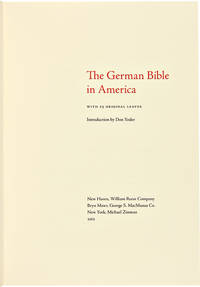
2012réf. 46192New Haven; Bryn Mawr; New York. 2012. A Leaf Book of the German Bible in America The German Bible in America has a long and significant history reflective of the European culture which gave it birth the local conditions of Pennsylvania where it rose to its greatest heights and the rich German-American culture created by emigrants and their descendants in the 19th-century United States. From the first American edition of a Bible in German in 1743 through the late 19th century numerous printers and publishers issued Bibles in various formats ranging from large folios intended for lectern use to smaller versions for personal study. This leaf book celebrates the range and richness of these productions indicative of the world of German culture in America in the 18th and 19th centuries as expressed through its most widely studied text in a series of twenty-five leaves. Each set contains two versions of the descriptive text one in English and the other in German with an introduction by Don Yoder Professor Emeritus of Religious Studies Folklore and Folk-Life at the University of Pennsylvania. Further text describes the printers of each of the leaves the circumstances under which they were printed and other attributes. Each leaf is enclosed in an individual folder. The German Bible in America is issued in an edition of sixty copies with fifty of the regular series and ten additional deluxe copies containing six extra leaves of illustrations from the illustrated Bibles included in the collection. This is one of fifty regular copies numbered by hand. A deluxe issue with six additional illustrated leaves is also available for $3500. 20; 20pp. text in both English and German plus twenty-five original leaves tipped into accompanying folders. Large folio. Fine. In a cloth clamshell box. hardcover books
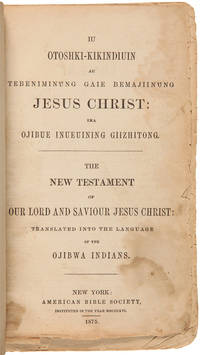
1875réf. 30390New York: American Bible Society 1875. New Testament for the Natives of the Lake Superior Region Third edition after editions of 1844 and 1856. "The A.B.S. Report for 1844 states that this version was made by S. Hall and other missionaries of the A.B.C.F.M. near Lake Superior. J.C. Pilling however in his bibliography of the Algonquian Languages ascribes it to Henry Blatchford." Contemporary calf ornate blind-stamped covers gilt-lettered spine neatly recased. Rubbed. Scattered foxing pencil scribblings on both pastedowns. Small chipped broadsheet of religious hymnals laid in. Good. BANKS p.133. EVANS 580. PILLING ALGONQUIAN p.52. DARLOW & MOULE 3040. AYER INDIAN LINGUISTICS CHIPPEWA 35. PILLING PROOF-SHEETS 396. unknown books
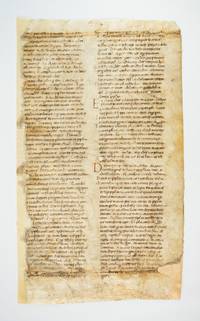
réf. ST20968-02Italy second half of 11th or opening of 12th century. 497 x 294 mm. 19 5/8 x 11 5/8". Double column 58 lines in a late Caroline hand. Running titles in red two two-line initials in red. Portfolio's pastedown with book label of the Schøyen Collection their MS 588. Recovered from a binding and thus with some general soiling and staining to vellum a couple of small holes verso unreadable modern reinforcement and repairs to the gutter and margins affecting a couple of letters at the beginning of a number of lines but the recto quite legible in most places and easily recoverable in the few places where it's not. This impressive leaf was once part of an immense lectern Bible that would have been prominently displayed at a church or monastery ca. 1075-1100. Measuring just under 500 mm. tall its dimensions are almost big enough to be considered an "Atlantic Bible" a distinctive modern designation reserved for massive Bibles produced in the 11th and 12th centuries. Despite the loss of legibility on one side due to the leaf's reuse as binding material the other side displays a lovely rounded Caroline hand with few abbreviations. The text comes from Exodus 8:17-9:21 describing several of the Plagues of Egypt. Our leaf was most recently part of the renowned Schøyen Collection one of the largest and most distinguished private manuscript collections in the world. Started in the 1920s by Norwegian engineer M. O. Schøyen and expanded by his son Martin the collection is particularly strong in paleography and biblical texts. Among its many unique and important manuscript pieces are treasures such as the St. Cecilia Bible the only Carolingian Bible in private hands and fragments of the Dead Sea Scrolls. unknown books
1967réf. 6782Mainz: The Gutenberg Museum 1967. 1 leaf 42 lines in two columns decorated initial D with vine scroll. End of "Song of Songs" beginning of "Book of Wisdom." Mounted in black paper. Facsimile of original in the Gutenberg Museum of Mainz printed for sale at the German Pavilion at Expo '67 the world's fair held at Montreal that year. The Gutenberg Museum unknown books
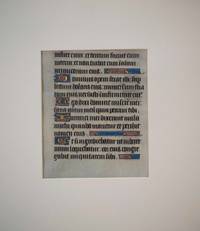
1550réf. 6789ca. 1550. One vellum leaf 125 x 180 mm with text within 80 x 95 mm guidelines. Text in manuscript recto and verso including eight capitals decorated in gold leaf and colors and six spacers also decorated in blue red and gold leaf. Chapter incipit in red. hardcover books