22.858 risultati
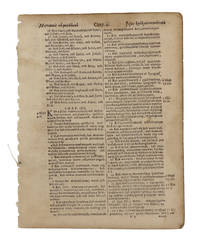
1663rif. 68910Cambridge MA: Samuel Green 1663. Leaf of the 1663 First Edition of the Eliot Bible A leaf from the first edition of the Eliot Indian Bible Mamusse Wunneetupanatamwe Up-Biblium God. published in Cambridge Massachusetts in 1663. This was the first Bible printed in North America and the first Bible in an American Indian language. The printing of this Bible was a monumental undertaking and it took more than two and a half years to set the type and print the work. This leaf contains verses twenty-six through thirty-eight of chapter III all of chapter IIII i.e. IV verses one through forty-four and verses one through fifteen of chapter V of the Gospel of Luke. A keen artifact from the "first Bible printed in the New World and the first example in history of the translation and printing of the entire Bible in a new language Massachuset as a means of evangelism" - Pilling. Small quarto. Minor staining toning and dust soiling including some dampstaining to fore-edge. Edge wear to gutter. Quarter-inch closed tear to top edge affecting one letter of running head on verso without loss. Very good. EVANS 72. FIELD 495. AYER INDIAN LINGUISTICS MASSACHUSETT 1. CHURCH 580. DARLOW & MOULE 6737. PILLING ALGONQUIAN pp.139-52. PRINTING AND THE MIND OF MAN 142. SABIN 22154 22155. SIEBERT SALE 490. WING B2755. ESTC W38287. Hugh Amory First Impressions: Printing in Cambridge 1639-1989 Cambridge MA 1989 pp.39-42. George Parker Winship The Cambridge Press 1638-1692 Philadelphia 1945 pp.208-44. unknown books
1811rif. 41996Philadelphia. 1811. Impressive Early American Bible in Contemporary Bindings An impressive early American Bible in five large volumes styled "the second American edition from the second London edition improved and enlarged" presumably referring to Scott's annotations. With information inscribed regarding the Lear and Storer families of Portsmouth New Hampshire. Quarto. Contemporary calf spines gilt leather labels. Boards a bit scuffed corners lightly worn. Spines slightly scuffed and slightly chipped on some volumes. Light scattered foxing and toning. Information about the Storer family inscribed in the first volume. About very good. SHAW & SHOEMAKER 22356. hardcover books
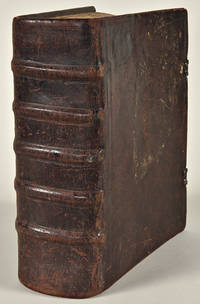
1763rif. 58065Germantown: Christoph Saur 1763. The Second Saur Bible and the First Bible Printed on American Paper The second edition of the first European-language Bible printed in America after the first of 1743 and the first Bible printed on paper made in America. The text is based on Martin Luther's version by way of the thirty-fourth edition of the Halle Bible with Book Three of Edras Book Four of Edras and Book Three of Maccabees supplied from the Berlenburg Bible. The present edition supposedly issued in 2000 copies was printed by Christopher Saur II son of Christopher Saur the elder a native of Wittgenstein Germany. The elder Saur emigrated to Germantown Pennsylvania working variously as a tailor clockmaker and healer before finally turning to printing and publishing. It was he who printed the 1743 first edition. When his father died in 1758 the younger Saur who up until then had overseen the bindery and all English-language publications inherited the business. Under his ownership the business continued to thrive and expand making him "one of the wealthiest men in British America" before seeing his fortunes reversed during the American Revolution ANB. A member of the German Baptist Brethren or Dunkards as they were popularly known the younger Saur would publish a second the present 1763 edition and third 1776 the so-called "Gun-wad Bible" edition of his father's German Bible and in 1773 he would build a paper mill on the Schuylkill River. Next to the cost of labor paper was easily the colonial printer's greatest expense. While the best paper used in colonial British North America had to be imported there was always demand for the lower-grade printing paper used for the bread and butter of the printer's trade: newspapers almanacs pamphlets and more ephemeral publications. Increasingly such paper came to be supplied by a growing number of American paper mills most of which were concentrated in Pennsylvania. It was on such American-made paper that Christopher Saur printed the second edition of this German-language Bible. In 1935 the watermarks on the paper of the Second Saur Bible were identified as those of William Parks the Virginia printer and publisher of the Virginia Gazette who established a paper mill at Williamsburg in 1744. How paper bearing his watermark came to be used in the printing of the second edition of the Saur Bible remains something of a mystery. Parks died in 1750 some thirteen years prior to the publication of the second Saur Bible in 1763. After his death his mill was sold to an unidentified buyer for £96 3s 9d a sum substantial enough to suggest that the mill continued to produce paper. Examples of Parks' paper are notoriously difficult to identify when folded in quarto the watermarks tend to disappear into the folds but although somewhat obscured examples of the Parks watermark can be seen along the gutter of many leaves throughout this copy of Saur's bible. A nice copy of a significant early American Bible. 49922773pp. printed in double columns. Quarto. Contemporary calf over wooden boards metal clasps lacking. Dampstaining and wear to edges of first and last few leaves. Some light soiling to text. Contemporary manuscript notations on endpapers. Very good to near fine. In a cloth box gilt leather label. EVANS 9343. SABIN 5192. SEIDENSTICKER p.61. ARNDT 269. O'CALLAGHAN p.25. HILDEBURN 1877. WRIGHT EARLY BIBLES pp.28-54. RUMBALL-PETRE RARE BIBLES 161. GERMANTOWN AND THE GERMANS BIBLES: 5. Lawrence C. Wroth The Colonial Printer Charlottesville. 1964 p.135. Edwin A.R. Rumball-Petre America's First Bibles with a Census of 555 Extant Bibles Portland Me. 1940 pp.38-50. Rutherfoord Goodwin "The Williamsburg Paper Mill of William Parks the Printer" in Papers of the Bibliographical Society of America Vol. 31 no. 1 1937 pp.31-3 39-44. Thomas L. Gravell and George Miller A Catalogue of American Watermarks 1690–1835 New York. 1979 pp.150 196-7. ESTC W18552. ANB 20 pp.400-1. DAB XVII pp. 416-7. Isaiah Thomas The History of Printing in America New York. 1970 pp.408-417. hardcover books
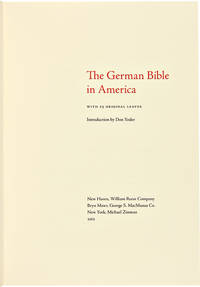
2012rif. 46192New Haven; Bryn Mawr; New York. 2012. A Leaf Book of the German Bible in America The German Bible in America has a long and significant history reflective of the European culture which gave it birth the local conditions of Pennsylvania where it rose to its greatest heights and the rich German-American culture created by emigrants and their descendants in the 19th-century United States. From the first American edition of a Bible in German in 1743 through the late 19th century numerous printers and publishers issued Bibles in various formats ranging from large folios intended for lectern use to smaller versions for personal study. This leaf book celebrates the range and richness of these productions indicative of the world of German culture in America in the 18th and 19th centuries as expressed through its most widely studied text in a series of twenty-five leaves. Each set contains two versions of the descriptive text one in English and the other in German with an introduction by Don Yoder Professor Emeritus of Religious Studies Folklore and Folk-Life at the University of Pennsylvania. Further text describes the printers of each of the leaves the circumstances under which they were printed and other attributes. Each leaf is enclosed in an individual folder. The German Bible in America is issued in an edition of sixty copies with fifty of the regular series and ten additional deluxe copies containing six extra leaves of illustrations from the illustrated Bibles included in the collection. This is one of fifty regular copies numbered by hand. A deluxe issue with six additional illustrated leaves is also available for $3500. 20; 20pp. text in both English and German plus twenty-five original leaves tipped into accompanying folders. Large folio. Fine. In a cloth clamshell box. hardcover books
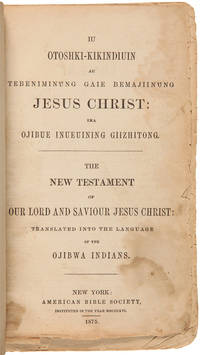
1875rif. 30390New York: American Bible Society 1875. New Testament for the Natives of the Lake Superior Region Third edition after editions of 1844 and 1856. "The A.B.S. Report for 1844 states that this version was made by S. Hall and other missionaries of the A.B.C.F.M. near Lake Superior. J.C. Pilling however in his bibliography of the Algonquian Languages ascribes it to Henry Blatchford." Contemporary calf ornate blind-stamped covers gilt-lettered spine neatly recased. Rubbed. Scattered foxing pencil scribblings on both pastedowns. Small chipped broadsheet of religious hymnals laid in. Good. BANKS p.133. EVANS 580. PILLING ALGONQUIAN p.52. DARLOW & MOULE 3040. AYER INDIAN LINGUISTICS CHIPPEWA 35. PILLING PROOF-SHEETS 396. unknown books
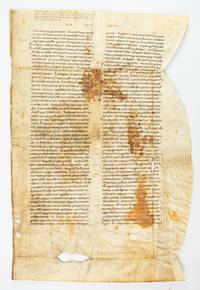
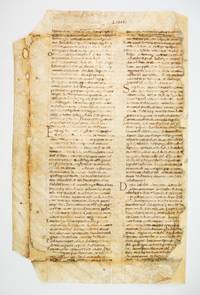
rif. ST20968-02Italy second half of 11th or opening of 12th century. 497 x 294 mm. 19 5/8 x 11 5/8". Double column 58 lines in a late Caroline hand. Running titles in red two two-line initials in red. Portfolio's pastedown with book label of the Schøyen Collection their MS 588. Recovered from a binding and thus with some general soiling and staining to vellum a couple of small holes verso unreadable modern reinforcement and repairs to the gutter and margins affecting a couple of letters at the beginning of a number of lines but the recto quite legible in most places and easily recoverable in the few places where it's not. This impressive leaf was once part of an immense lectern Bible that would have been prominently displayed at a church or monastery ca. 1075-1100. Measuring just under 500 mm. tall its dimensions are almost big enough to be considered an "Atlantic Bible" a distinctive modern designation reserved for massive Bibles produced in the 11th and 12th centuries. Despite the loss of legibility on one side due to the leaf's reuse as binding material the other side displays a lovely rounded Caroline hand with few abbreviations. The text comes from Exodus 8:17-9:21 describing several of the Plagues of Egypt. Our leaf was most recently part of the renowned Schøyen Collection one of the largest and most distinguished private manuscript collections in the world. Started in the 1920s by Norwegian engineer M. O. Schøyen and expanded by his son Martin the collection is particularly strong in paleography and biblical texts. Among its many unique and important manuscript pieces are treasures such as the St. Cecilia Bible the only Carolingian Bible in private hands and fragments of the Dead Sea Scrolls. unknown books
1967rif. 6782Mainz: The Gutenberg Museum 1967. 1 leaf 42 lines in two columns decorated initial D with vine scroll. End of "Song of Songs" beginning of "Book of Wisdom." Mounted in black paper. Facsimile of original in the Gutenberg Museum of Mainz printed for sale at the German Pavilion at Expo '67 the world's fair held at Montreal that year. The Gutenberg Museum unknown books
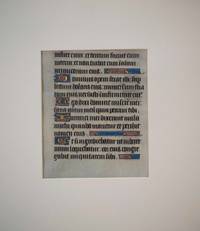
1550rif. 6789ca. 1550. One vellum leaf 125 x 180 mm with text within 80 x 95 mm guidelines. Text in manuscript recto and verso including eight capitals decorated in gold leaf and colors and six spacers also decorated in blue red and gold leaf. Chapter incipit in red. hardcover books
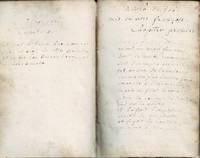
rif. 6651Manuscript on paper bound. 19th century. Good. Octavo 18 cm; 1 78 leaves paginated in manuscript. Latin and French text on facing pages. Bound in waste vellum manuscript in French no longer easily legible. Pages thumbed and toned at edges. Interlinear corrections in text as well as tipped in overleavers with corrected text. All we know of this manuscript book derives from examination of the physical evidence. The text does not correspond to any known French verse translation of the Book of Job so it seems to be a private endeavor. The unprofessional cursive orthography accords stylistically with handwriting typical of the 19th century but the structure and materials of the binding could indicate an earlier origin. The Latin text of the Vulgate appears on the pages facing the translation. Manuscript on paper, bound. hardcover books
1611rif. 6015Coloniae Allobrogum i.e. Geneva : Pierre de la Rovière 1611. 16mo 13 cm; 2 volumes in one. 342 239 1 leaves. Printer's device on title page. Text in Greek with interlinear Latin translation and commentary. Text and commentary within ruled borders. Elaborately gilt-tooled morocco armorial binding of l'abbé Genesse i.e. of Genoa with arms within a central lozenge enclosed in a motto and filigreed in all corners and within ruled borders on both boards; spine with filigreed central panel. Edges gilt. Pages generally toned with scattered foxing; light water stain on covers and in first 100 leaves. Binding reference: Tausin "Dictionnaire des devises ecclésiastiques" 165. Arias Montano librarian of El Escorial was one of the principal editors of the great polyglot edition of the bible issued by the Plantin Press in 1571. He was denounced to the Inquisition for liberality. This edition of the Greek New Testament with Arias's extensive commentary is enclosed in an elaborate French binding flat back extensively tooled bearing the arms of the Abbé Genesse with his motto "Quae est expectatio mea nonne dominus" Psalm 38:8 What is my hope Is it not the lord. Pierre de la Rovière hardcover books
1968rif. 6073Zurich: Arta 1968. #70 of 200 copies signed by the artist. Very Good. 34 cm; 70 10 pages last five blank. Text of the Song of Songs in German. Illustrated throughout with original lithographs by Sigg printed from stone by Emil Mathieu. Printed on hand-made paper by Richard de Bas watermarked "Arta". Pages loose in portfolio as issued and preserved in laid paper chemise. Remains of original slipcase present but non-functional. Else fine. Arta unknown books
1929rif. 6431San Francisco: John Henry Nash 1929. First Edition. First Edition. Folio. Marbled boards with gilt stamped morocco label on the backstrip. 1/300 copies for private circulation. Frontispiece and ornamental borders by William H. Wilke. Jean Hersholt's copy his renowned collection of Hans Christian Andersen housed at Library of Congress with his private bookplate signature and his personal collection accession number on the front pastedown. Frontispiece and ornamental borders by William H. Wilke. Printed on fine woodblock paper. Captions dedication and colophon. A very nice copy with some wear to edges of spine internally fine. John Henry Nash unknown books
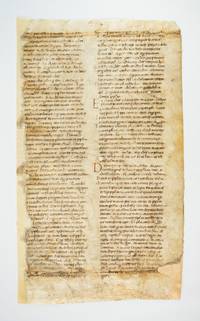
rif. ST20967aItaly late 11th or early 12th century. 485 x 124 mm. 19 1/8 x 12 3/4". Measured at widest part. Double column 53 lines in a rounded proto-gothic hand. Running titles in red. With contemporary or slightly later marginal notations; later inscriptions from its reuse as binding scrap dated 1557 and 1560 noting the volume "no. 181." Recovered from a binding and thus the vellum somewhat wrinkled soiled and with multiple folds some dark staining affecting legibility of several lines--though sense easily recoverable on one side and with effort on the other--a few tiny holes and two larger ones slightly affecting the text. Showing the usual problems associated with re-use but a grand and greatly appealing leaf nevertheless with its handsome script and imposing presence readily apparent. Partly because of its re-use in what obviously would have been a very large binding and more especially because of its age and early script this vast Romanesque Bible leaf is of there is no other way to say it but immense interest. Measuring nearly 20 inches tall it is almost large enough to be considered a so-called "Atlantic Bible" leaf a distinctive modern designation reserved for massive Bibles produced in the 11th and 12th centuries. The script here consists of a highly legible proto-gothic book hand with elegant rounded letter forms. Its overall appearance has much in common with Caroline miniscule including clubbed ascenders a strong "st" ligature and an "f" that extends below the baseline. In addition there are very few abbreviations and the ampersand symbol is used exclusively rather than the Tironian "et" favored in later scripts. The text here is from Deuteronomy 20:5-23:24 containing the final laws that Moses gives to the Israelites before entering the Promised Land. These "second laws" as they are often called include an array of statutes pertaining to sexual relations marriage divorce slavery warfare and inheritance as well as rules for agriculture clothing and diet. Our leaf previously belonged to the renowned Schøyen Collection one of the largest and most distinguished private manuscript collections in the world. Started in the 1920s by Norwegian engineer M. O. Schøyen and expanded by his son Martin the collection is particularly strong in paleography and biblical texts. Among its many unique and important manuscript pieces are treasures such as the St. Cecilia Bible the only Carolingian Bible in private hands and fragments of the Dead Sea Scrolls. unknown books
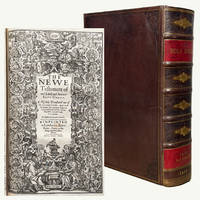
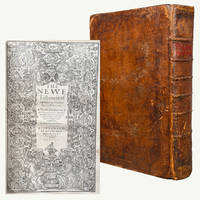
1617rif. U26The Holy Bible Conteyning the Old Testament and the New. Newly Translated Out of the Originall Tongues: And with the former translations diligently compared and revised by his Maiesties Speciall Comandement… Summary: Pulpit Folio approx. 16.25" x 11.25". The third of the five distinct pulpit folios of the King James Version. A complete copy with the Genealogies by John Speed at a fraction of the price of the first edition. Description: General title page 1617. Calendar printed in red and black. The Genealogies by John Speed with title page. The double-page map in facsimile. Text in large two column black letter type with 59 lines to the full column and within a ruled border. With the reading "and she went into the citie" in Ruth 3:15. New Testament title page 1617 with the twelve tribes of Israel on the left and the twelve disciples on the right. The four evangelists with their gospel symbols around the letterpress with the Tetragrammaton the dove and the slain Lamb at the center. Collation: A6 -A1 B4 C6 D4 prelims; A-C6 D2 -D2 Genealogies and map A-Z6; Aa-Zz6 Aaa-Zzz6 Aaaa-Zzzz6 Aaaaa-Ccccc6 Old Testament and Apocrypha; A-Z6 Dddddd6 New Testament. Complete Bible text with only the map supplied in facsimile. Binding: Professionally rebound in brown calf. Covers paneled in gilt and blind. Spine with five raised bands gilt and blind tooling to compartments and with two gilt-lined red morocco labels and the words "Holy Bible" and "1611 3rd issue" lettered in gilt. Endpapers renewed. Condition: Title page laid down with loss to upper left corner; A2-C1 of prelims with marginal corner repair; 5D1-2 NT title and first leaf of Matthew with a few ink blots; 5G2 with ink blot to text obstructing a few letters on recto; 6A-6D with lower corner reinforced to margins; final two leaves of Revelation with loss to border and one letter of text; final leaf soiled and frayed to edges; overall a very nice copy with great margins. Note: The 1611 King James Bible was printed in a 59-line folio format in 1611 1613 1617 1634 and in 1640/39. The 1611 He Bible constituted a distinct edition with the reading "and hee went into the citie" in Ruth 3:15. The second edition 1613 She Bible was printed in subsequent years 1613 1617 1634 1640/39 with the variant "and she went into the citie." The second edition is frequently found in a variant state with leaves mixed in from different years but most here appear to originate from 1617. Arguably the most important book ever published in English. Its influence can best be summed up by G.M. Trevelyan who stated that "for every Englishman who had read Sidney or Spenser or had seen Shakespeare acted at the Globe there were hundreds who had read or heard the Bible with close attention as the words of God. The effect of the continual domestic study of the book upon the national character imagination and intelligence for nearly three centuries to come was greater than that of any literary movement in our annals or any religious movement since the coming of St. Augustine." Macaulay said of it "If everything else in our language should perish the King James Bible would alone suffice to show the whole extent of its beauty and power" PMM 114. References: Herbert 319. PMM 114. Robert Barker hardcover books
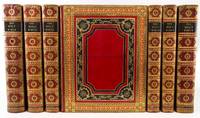
1800rif. ST20221aLondon: T. Bensley for T. Macklin final volume Bensley for T. Cadell & W. Davies 1800 for the six volumes of the Bible 1816 for the Apocrypha. First Printing of this Edition. 480 x 385 mm. 19 x 15 1/8". One leaf in the Apocrypha 3P2 comprising two prologues of Ecclesiasticus invisibly inserted from another copy. Seven volumes comprising the regular Bible in six volumes and the Apocrypha usually not included as a seventh volume. ABSOLUTELY MAGNIFICENT CONTEMPORARY RED NEOCLASSICAL-STYLE STRAIGHT-GRAIN MOROCCO SUMPTUOUSLY GILT AND ONLAID WITH BLUE BY GEORG FRIEDRICH KRAUSS done for Prince Albert Casimir Duke of Saxe-Teschen with repeated "AST" monogram covers with very elaborate frames incorporating 11 plain and decorative gilt rules four onlaid borders of blue morocco and very elegant swirling foliate ornamentation around the central scalloped panel six pairs of raised bands each pair flanking a recessed gilt and blue metope and pentaglyph rule very handsome spine compartments with blue fan-shaped cornerpieces and central gilt-decorated blue medallions within sunburst gilt collars turn-ins with Greek key pattern in gilt striking endleaves of turquoise and green watered silk the Apochrypha endleaves slightly different. With more than 100 allegorical headpieces and tailpieces and some 70 SPLENDID LARGE-FOLIO-SIZE COPPER PLATES after Fuseli Reynolds West and others most plates printed before letters. Tissue guards perhaps later. Herbert 1442 and 1651. First volume with about 30 leaves noticeably foxed the majority of plates offset onto previous and following pages consistent inoffensive offsetting of text on facing pages other trivial imperfections but still a very impressive copy internally with the luxurious paper used for the text both fresh and clean and the engravings richly impressed and with very little foxing. Some unimportant scuffing and rubbing to the leather but all defects minor THE MAGNIFICENT BINDINGS REMARKABLY WELL PRESERVED the heavy volumes completely solid with only insignificant signs of use and THE MOROCCO AND LAVISHLY GILT DECORATION EXTREMELY BRIGHT. AN ALTOGETHER MEMORABLE COPY. The most prodigious form of Scripture in English ever published the Macklin Bible was often put into ornate bindings especially by London binders like Staggemeier and his contemporaries. But however much other sets may glisten the present magnificent example surely stands at or near the front of the line as one of the most lavishly decorated and arresting copies in existence. Its decorative extravagance also testifies to the fact that Macklin's publication was sufficiently admired outside of England to warrant the finest workmanship and the expenditure of great sums of money on artistic resources. The very large and bold type the fine Whatman paper and the series of engravings by some of the most celebrated artists of the period make this an item that is already very desirable. Like the Boydell "Shakespeare Gallery" also printed by Bensley our Macklin Bible is a vast picture book with illustrations that are grand both in size and emotional impact. But it is of course the bindings here that matter the most. Francesco Piranesi is generally given credit for inventing the Neoclassical style when he designed volumes presented to Gustavus III of Sweden during this monarch's visit to Rome in 1783-84. Quickly popular the Neoclassical style was imitated and developed by Staggemeier & Welcher in London by F. W. Standlander in Stockholm and by Georg Friedrich Krauss in Vienna. Krauss was the most prominent Continental binder working in this style of the day and Saxe-Teschen was perhaps his most important client. Products of the Krauss bindery have passed through some of the most distinguished collections over the years particularly those of Fürstenberg and Schäfer; and his bindings have consistently brought remarkable sums of money at auction. It is sufficient to say that the present group of bindings represents the most impressive collection of decorative volumes we have ever offered for sale. The collector for whom these bindings were originally executed Duke Albert of Saxe-Teschen 1738-1822 was the son of Friedrich August II of Saxony and the son-in-law of the empress Maria Theresa. After providing important military and civil service to the Habsburg empire he retired to Vienna in 1795 and afterward devoted himself to the fine arts. He founded the Albertina which now houses the greatest collection of prints in the world and he put together a great library distinguished by the highest taste and most exacting standards. The present copy has the additional distinction of containing what amounts to an extra volume: the Macklin Bible however it is bound most often appears in the marketplace without the Apocrypha appearing here as Volume VII which was not issued until 16 years after the others. It is also of some interest that the bindings of our seven volumes were decorated in an entirely uniform fashion as a close inspection shows something not typical of a set with volumes published so many years apart. The non-uniform endleaves in the final volume here may have resulted from the fact that given the physical size of the books the binder simply ran out of the cloth he had used for lining the first six volumes. The present set was offered though unsold at Sotheby's in 2003 with an estimate of £40-50000 approximately $64000-80000 and in 2005 for £30-40000 approximately $54000-72000. T. Bensley for T. Macklin [final volume Bensley for T. Cadell & W. Davies] unknown books
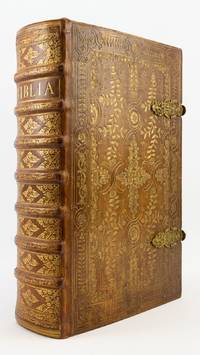
1752rif. ST19424Stockholm: Tryckt af Henrick Christoph Merckell 1724-28; Peter Jöranson Nyström 1752. 422 x 275 mm. 16 5/8 x 11". 30 p.l. 1 leaf section title 234 2 section title 235-604 2 section title 605-908 2 section title 909-1387 1 pp.; 4 p.l. 300 4 301-666 pp. STATELY CONTEMPORARY CALF INTRICATELY GILT IN THE FANFARE STYLE over bevelled wooden boards covers with strapwork frame containing lilies and floral garlands central panel with strapwork rows of floral crosses the spaces between with floral sprays emerging from urns very expertly rebacked preserving original backstrip raised bands spine compartments with flowers-and-pomegranate centerpieces floral cornerpieces gilt lettering two decorative brass clasps catch plates and original straps turn-ins with lattices and floral ornaments marbled endpapers edges gilt and delicately gauffered. Five section titles with engraved vignettes. With ink presentation inscription celebrating the baptism of Claës Georg Listromer on 20th November 1604 and expressing the hope the Book will bring him wisdom as he grows signed by Claës Lindman dated 17th September 1605. A 20th century Swedish inscription below tracing the book's descent through generations of the Listromer family into the 1920s. Darlow and Moule 8821 8826. Slight variations in color of the leather Ffff8 with lower corner torn away not affecting engraving occasional faint offsetting but AN EXTREMELY CLEAN FRESH COPY in a binding bright with gilt. This impressively bound Swedish Bible was a baptism gift that clearly would have outweighed its recipient as Swedish law at the time required an infant be baptized within the first eight days of life. Although hardly practical for personal devotion and study the majestic tome was a treasured heirloom passed down in the same family for 200 years. The beautiful fanfare style seen here emerged in France in the 16th century but remained very popular in Northern Europe into the 18th century particularly for large "lectern" Bibles like the present item. The text here is an extensively annotated edition of the 1618 Gustave II Adolf Bible prepared by a father and son both named Johannes Gezelius who served successively as Bishop of Åbo. The New Testament was first printed in that city in 1711-13 the Old Testament in Stockholm in 1724-28. In our copy the New Testament is a 1752 reprinting. Tryckt af Henrick Christoph Merckell, 1724-28; Peter Jöranson Nyström unknown books
rif. ST20968-01Italy second half of 11th or opening of 12th century. 497 x 294 mm. 19 5/8 x 11 5/8". Double column 58 lines in a late Caroline hand. Running titles in red three two-line initials in red. Recovered from a binding and thus with some general soiling and staining to vellum recto illegible except for part of the headline modern reinforcement to the gutter and margins affecting a couple of letters at the end of a number of lines but the verso quite legible in most places and easily recoverable in the few places where it's not. This impressive leaf was once part of an immense lectern Bible that would have been prominently displayed at a church or monastery ca. 1075-1100. Measuring just under 500 mm. tall its dimensions are almost big enough to be considered an "Atlantic Bible" a distinctive modern designation reserved for massive Bibles produced in the 11th and 12th centuries. Despite the loss of legibility on one side due to the leaf's reuse as binding material the other side displays a lovely rounded Caroline hand with few abbreviations. The text comes from Exodus 23:11-24:18 expounding parts of civil law and Moses' journey to Mount Sinai. Our leaf was most recently part of the renowned Schøyen Collection one of the largest and most distinguished private manuscript collections in the world. Started in the 1920s by Norwegian engineer M. O. Schøyen and expanded by his son Martin the collection is particularly strong in paleography and biblical texts. Among its many unique and important manuscript pieces are treasures such as the St. Cecilia Bible the only Carolingian Bible in private hands and fragments of the Dead Sea Scrolls. unknown books
1763rif. 1230541763. Cambridge: Printed by John Baskerville Printer to the University 1763. Royal folio 573 unnumbered leaves. A2 1 B-13D2 a-e2 f1. English binding of contemporary full blue-green morocco covers with elaborate gilt border backstrip richly gilt with red morocco lettering pieces stamped in gilt "HOLY BIBLE" and at the foot "BASKERVILLE" gilt edges marbled endpapers. Inevitable slight signs of wear on such a huge book but in all a very good unrestored copy internally flawless. § First edition of Baskerville's masterwork in a magnificent contemporary English binding. Third issue of the subscribers' list as usual. "John Baskerville was a monumental figure in the history of English bookbinding and printing with contemporary accounts of his work ethic revealing a man deeply engaged in virtually every aspect of book production. Yet for most of his life and indeed for many decades afterwards he was decried as a mere amateur. Still other sources show an individual with highly idiosyncratic and paradoxical habits -- he lived with Sarah Eaves for nearly two decades out of wedlock; a devout atheist who was buried in his own backyard without Christian ceremony; a man who 'had wit but always against religion and decency'" F.E. Pardoe in John Baskerville of Birmingham: Letter-Founder and Printer 1975. Paradoxically after taking the position of Printer to the University of Cambridge on 1 December 1758 Baskerville produced one of the few great Bibles. It is a true masterwork expertly printed with impeccable attention to ink type spacing paper quality and ease of use. Published on 4 July 1763 "the adjective that inevitably comes to mind is 'noble' and the volume warrants the word. It was conceived and executed on a grand scale. to show that he had now learnt his craft and was able to practice it in a masterly fashion. and the result shows again that Baskerville must be placed in the very top rank of book designers" Pardoe 87. Morison and Day The Typographic Book 1963 write that "Baskerville's folio English Bible printed for the University of Cambridge is the finest presentation of Holy Writ since Richelieu's Latin Vulgate printed at the Imprimerie Royal" 48. Gaskell 26. Herbert 1146. Morison & Day The Typographic Book 48. Huntington Library Great Books in Great Editions 7. Rothschild 2640. Rumball Petre 145. unknown books
1480rif. 4261Ulm: Johann Zainer 29 January 1480. FIRST BIBLE PRINTED AT ULM. Hardcover. Fine. An excellent copy with noble provenance of this magnificent Bible. A very large impressive copy with broad margins preserving numerous deckled edges. The quires are numbered in a contemporary hand in red ink at the foot of leaves. The stub for the canceled blank leaf ll3 the conjugate of leaf ll9 is visible with instructions to the binder. With numerous blue fabric tabs each marking an individual book of the Bible. Rubricated throughout with a few larger red brushwork initials and red and blue Lombard capitals red paragraph marks and capital strokes. The book is adorned with Zainer's distinctive large woodcut initials a larger decorative marginal decoration and a woodcut of Saint Jerome in his study working on the Vulgate. on first text leaf a few corners torn away one affecting the woodcut decoration in the margin; damp-staining in gutter and lower margin some light dust-soiling at ends. Occ. natural paper flaws in the blank margins of the paper ex. Leaf l8 p3 oo8 not affecting the text. Bound in contemporary Moravian binding of blindstamped tanned pigskin over wooden boards nicely rebacked in the mid 19th c. with gilt spine lacking clasps and catches. The leather of the boards is worn with small losses to the leather exposing the wooden boards in two places. The richly-tooled binding features tools associated with a workshop that produced bindings for the monastery see below. Provenance: 1. With an inscription of the Carthusian monastery of the Holy Trinity Brno Moravia dissolved in 1782. 2. Library of the Princes of Liechtenstein bookplate sold in 1949 by Prince Franz Joseph II 1906-1989 to H.P. Kraus. 3. Elaine and Alexandre Rosenberg acquired from H.P. Kraus New York 20 November 1957. The only Bible printed at Ulm in the 15th century by Ulm's first printer in a contemporary binding. This Bible is illustrated with numerous large intricate and unusual woodcut initials. Zainer was likely the brother of Gunther Zainer first printer at Augsburg. Both men were innovators in printed book illustration. With the Canon of Hebrew names printed annotations in the margins of the New Testament and printed summaries at the beginning of each book. An inscription on the recto of the first blank leaf indicates that this Bible was the property of the Carthusian monastery of the Church of the Holy Trinity in Brno Moravia in the 15th c. According to Jiøí Glonek "KnihvazaÄská dílna královopolských kartuziánů" the binding was produced in a workshop in Brno located in a building used by the Carthusians close to St. Jacob's church. The bindery existed from the 1460s until 1516 and produced bindings for the monastery as well as St. Jacob's. Despite the fact that the bindery was located outside of the monastery unlike the bindery at the Carthusian monastery of Olomouc Glonek who has made an in-depth study of the extant bindings concludes that the bindery was operated by the Carthusians. At its height the bindery used over 61 different tools. Among the tools used on the binding of the Ulm Bible are: EBDB s020741 scroll EBDB s020731 dog EBDB s020720 Fabelwesen Glonek 30 palmette. The Carthusian monastery at Brno was founded by the Margrave of Moravia Jan Jindøich younger brother of the Czech King Emperor Charles IV. Jindøich invited the first member of the Carthusian order Gottfried of Enns from the Austrian Charterhouse in Gaming to Brno as early as 1369 and six years later issued the founding charter of the monastery with the consent of his wife Elizabeth and his sons. The foundation charter is dated August 13 1375. The charterhouse was not incorporated into the order until the following year. "It is understood that the Carthusian library was founded together with the monastery; as of 1387 there is a mention that Jan Czapfel a chaplain at the Church of St. Jacob in Brno dedicated his library to the Královo Pole Carthusians. According to this mention the manuscripts in the collection were donated by Jan Czapfel to the Carthusians even earlier. From the end of the fourteenth century there was a bookbinding workshop for the monastery the peak of which dates back to the second half of the fifteenth century. "As part of the religious reforms undertaken by Joseph II the monastery was dissolved by decree on 12 January 1782 along with other monasteries that did not establish a school or a hospital and the brethren of which did not hold a preaching or a priesthood position. The dissolution committee arrived in Moravia six days later. The library at the time possessed fewer than 3000 volumes including manuscripts and incunabula. A total of 145 volumes including manuscripts and incunabula were sent to the Imperial Royal Court Library in Vienna after 10 March 1784. "Books that were not selected for the Court Library in Vienna went to auction which took place from 7 September 1786 to the end of 1790. We do not know exactly which of the auctions the Carthusian books were sold at but they probably went to sale at the first September and October auctions in Brno together with collections from other Brno monastery libraries.Jindr Pavelková The Library Collection of the Brno Charterhouse in the Rajhrad Monastery Library in "Monastic Libraries in East Central and Eastern Europe between the Middle Ages and the Enlightenment"Monastica Historia Volume 5. Johann Zainer, 29 January hardcover books
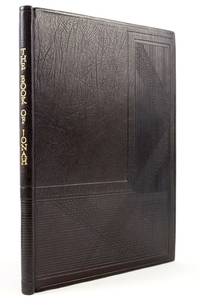
1926rif. ST20084Waltham St. Lawrence: Golden Cockerel Press 1926. No. 48 OF CLXXV COPIES. 258 x 195 mm. 10 1/4 x 7 3/4". 15 3 pp. Understated black crushed morocco by J. Franklin Mowery stamp-signed "JFM 94" on rear turn-in wraparound design of blind-stamped L-shaped panels of intersecting lines smooth spine with vertical gilt lettering leather hinges edges untrimmed. Original illustrated upper cover of dust jacket repaired at one corner bound in at rear. In a matching morocco-lipped slipcase. Title page with large woodcut of the risen Christ four large vignettes in the text four pictorial half borders and four full-page woodcuts all by David Jones printer's device in colophon. Front pastedown with bookplate of Jan van der Marck. Chanticleer 40. A pristine copy. This is a wonderfully--if understatedly--bound copy of one of the most strictly limited Golden Cockerel Press productions. The binding is the work of J. Franklin Mowery retired Head of Conservation at the Folger Shakespeare Library and past president of the Guild of Book Workers. Mowery studied bookbinding under Professor Kurt Londenberg at the Staatliche Hochschule für bildende Künste Academy of Art in Hamburg and trained as a paper conservator under Otto Wächter in Vienna before returning to the U.S. to work at the Huntington Library. According to his article "A Binder's Training" Guild of Book Workers' Journal XX 1981-82 the blind-stamping technique seen here was "particularly favored by Professor Londenberg" and often employed by Mowery for the range of design possibilities it offers. The method uses dies to stamp the patterns: "a photographic process can transfer any black and white image onto zinc plates that are deeply etched and mounted onto type-high metal blocks for heated impressions or onto wood for cold embossing." Mowery stated that lines of the design here represent the driving rain of the storm that struck Jonah's ship. Founded in 1920 with the intention to print fine editions of important well-known books as well as new literary works of merit from young authors the Golden Cockerel Press was purchased in 1924 by the illustrator and wood-engraver Robert Gibbings. "Under his direction" says Cave the Press was "transformed into the principal vehicle for the renaissance of wood-engraved book illustration that took place in the years between the wars." In addition to doing wood engravings himself Gibbings employed a stable of eminent artists including among others Eric Gill Blair Hughes-Stanton John Nash John Farleigh Eric Ravilious and David Jones. The memorable woodcuts are the work of Jones 1895-1974 who had a brief but impressive career as an illustrator before eye strain forced him to abandon engraving in 1930. In his published study of Jones' work Douglas Cleverdon says that in the short time Jones was engraving "he produced a remarkable amount of work of great variety; some witty some mystical; some boldly cut some delicately shaded; some simple to print some virtually impossible. Although he never attained . . . the greatest technical mastery in the conventional sense his prints are nearly always distinguished by their excellence of design personal commitment and absolute individuality." Our binding was commissioned by collector and self-described "radical" museum administrator Jan van der Marck 1929-2010 who championed artists that pushed boundaries--often to the consternation of the museum boards who employed him. Golden Cockerel Press unknown books
1974rif. 336969Franklin Center: The Franklin Mint 1974. Limited. hardcover. fine. Old & new Testaments. Full-page color illustrations throughout reproductions from the 14th century Queen Mary's Psalter held in the British Library. 1250 pages 69 page encyclopedic dictionary and biblical reference guide. Very thick 4to handsomely bound in ornately sculpted sterling silver covers 12 Troy ounces of silver; silk moire endpapers; all edges gilt. Safely housed in original burgundy clamshell drop front box with red velvet cushioning cloth. Includes supplementary notes as well as a small pamphlet with Suggestions for Care along with a polishing cloth. Franklin Center: The Franklin Mint 1974. First edition thus. A fine copy as new and likely unused. The Franklin Mint unknown books
1930rif. 21655Paris: F.L. Schmied 1930. Schmied François-Louis. Small folio 14-1/16 in x 11-1/8. 76 pp. Illustrated with twelve double-page and four single-page colored wood engravings. One of 155 copies printed on Madagascar paper plus 10 for collaborators and 7 on japon. Nasti B15. Full red morocco bound with the pages tipped to hinges cover with a central design after motifs in the book tooled in gilt on inlays of black and maroon morocco dentelles tooled in gilt and with gilt corner onlays gold and black silk moiré endsheets edges rough-gilt bound by Schmied signed on the front turn-in "F.L.S." Chemise and new matching slipcase. Light marginal foxing but in excellent condition.Schmied bound only books of his own creation choosing above all the books of his great years.The subjects of his designs come from the books themselves" Ray The Art Deco Book in France pp. 101-102. "In the introductory note.Théo Schmied points out the natural happiness of the interconnection between his father's cultural tendencies and art of the book and the world of the Near East as it is filtered by the 'inspired' Mardrus translations.throwing light on the the two fundamental aesthetic coordinates we need in order to understand how the details are made subordinate by the elegant decorative unity expressed by the plates that is the purity of the Egyptian graphic art and the will of the Italian primitives. The layout shows either a text harmoniously arranged in respect of double and single plates of various size or a text framed by rules forming a variety of geometrical patterns and decorated by bout de lignes in sienna. The illustrations mainly show subdued and delicate pastel colours" - Nasti. F.L. Schmied unknown books
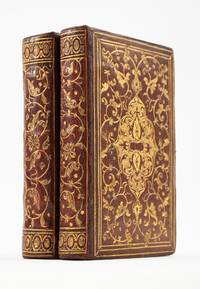
1568rif. ST20921Lutetia Paris: Robert Estienne II 1568. 128 x 87 mm. 5 x 3 1/2". Two volumes. LOVELY CONTEMPORARY RED MOROCCO GILT covers with large central azured arabesque surrounded by curling vines with azured leaves smooth spines with similar vines head and foot of spines with egg-and-dart roll similar to one used by Claude de Picques second volume with faint blind lettering to spine all edges gilt perhaps with some minor early restorations but if so then done with such care as to preclude certainty. Housed in modern suede-lined calf-backed clamshell boxes with magnetic closures. Printer's device on titles and final page decorative initials and headpieces. Front pastedown of volume I with ex-libris of Georgios Arvanitidis. Renouard 171:1; Schreiber 239; Darlow & Moule 4633; Adams B-1670. See: Verron "Les Reliures de l'Entrée de Charles IX à Paris 1572 . . . réalisées par Claude Picques" in Bulletin du Bibliophile 2014 no. 2 pp. 282-98. Just a touch of rubbing to extremities front hinge of second volume open but everything quite tight text with occasional mild browning small spots trivial smudges or tiny worm trails but A BEAUTIFUL COPY clean and fresh internally and the bindings tight and lustrous with very bright gilt With exceptional visual appeal these two precious volumes shining with gilt and containing the Greek New Testament from the renowned Estienne family of printers are of special interest because of their typography their bindings and their provenance. With the expressed goal of printing Greek texts from manuscripts in the royal library at Fontainebleau François I established the post of royal printer in Greek in 1539 appointed Robert Estienne I 1503-59 to the position in 1542 and commissioned the renowned Claude Garamond to cut a new Greek font for this project. To design the type the King called on his own celebrated calligrapher Angelo Vergecio who produced in collaboration with Garamond three different sizes of what came to be called the Royal Types or "grecs du roi." According to Schreiber "These cursive Greek types are universally acknowledged as the finest ever cut." In 1548 and 1549 Robert Estienne issued the press' first Greek Testament known as the "O mirificam" edition for the opening of the dedication to the king in 16mo or "pocket" format using the smaller font of Garamond's "grecs du roi." In 1550 Robert a Protestant moved to Geneva while his son Robert II 1533-70 a Catholic remained in Paris and took over as the royal printer in Greek. Our 1568 Testament--the only one issued by the son--is a reprinting of the "O mirificam" edition but expanded with the critical apparatus from the 1550 folio edition issued by the father. Schreiber notes that our edition is interesting from a typographical point of view as it contains an even more minute version of the already small grecs du roi type for the Table of Chapters. The exceptionally pretty volumes are done in the style of royal binder Claude Picques fl. 1539-78 and employ a decorative roll very similar to one that appears on the spine of the vellum bindings Picques did for "L'Entrée de Charles IX à Paris" 1572. Our volumes once graced the library of Constantinople collector Georgios Arvanitidis 1876-1953 whose library included a number of Estienne Greek editions. They were later in the distinguished library of Frederick B. Adams 1910-2001 director of the Pierpont Morgan Library from 1948-69 and then president of the prestigious Association Internationale de Bibliophilie from 1974-83. And they were featured in the celebrated 1929 Gumuchian catalogue of 398 historically exceptional bindings as item #71. Robert Estienne II unknown books
1613rif. U11The Holy Bible conteyning the Old Testament and the New: Newly translated out of the originall Tongues: And with the former Translations diligently compared and revised by his Majesties Speciall commandement. Summary A textually complete 72-line folio King James She Bible. Bound with Speed's Genealogies in eighteenth century calf. Description Pulpit Folio 15.5" x 10.5". General title page in facsimile. Preliminaries include the Translators to the Reader 11 pp.; Kalendar in red and black 6 ff.; Almanack 1 p. in red and black; The Table and Kalendar Expressing the order of the Psalms and Lessons… 5 pp.; The Names of all the Books… in red and black 1 p. Bound with The Genealogies… by John Speed 34 pp. without the double-page map. Text in two column black letter in smaller type with 72 lines to the full column. Text within ruled border. Each chapter begins with a woodcut initial. New Testament title page 1613 features the Tetragrammaton above the Agnus Dei and the Holy Dove with Matthew and Mark on either side; on the left side are the tents of the twelve tribes and on the right side the twelve apostles; below the letterpress are the Lamb slain along with Luke and John. Many headpieces vignettes and decorated initials throughout. Collation A-B4 -A1 title C6 D4 prelims; A-C6 Genealogies; A-Z6 Aa-Zz6 Aaa-Zzz6 Aaaa-Mmm6 Nnnn6 Bible text. Lacks general title page supplied in facsimile. Binding Eighteenth century calf rebacked and recornered with original spine laid down. Boards paneled in blind. Spine with six raised bands blind stamps to compartments and a red morocco label with the words "Holy Bible" lettered in gilt. Plain endpapers. Condition Light browning and staining but generally clean throughout; trimmed occasionally touching headline; A2 A3 of prelims with lower marginal loss; A4 B6 Kkkk2-5 with marginal fraying or loss not impacting text; Z6 Ss6 NT title with small repair to gutter; Uuu6 with small marginal loss; final leaf of Revelation stained and laid down. Provenance Eighteenth century ownership inscription of Thomas Chisnal to A23. Badder family manuscript record of births from 1765-85 to 3T5v. Note The true 1613 folio edition "easily distinguishable from the other large folio editions by its smaller type" Herbert. The number of leaves are reduced from 732 to 508 and was "no doubt designed as a cheaper alternative for poorer churches" Norton A Textual History of the King James Bible p. 76. This true second folio introduces four readings that have become standard: 'that ye may have' for 'the he may haue' Ez 6:8 'she poured it not' for 'she powred it' Ez 24:7 'as a flower' for 'as floure' 2 Es 15:50 and 'what thy right hand doeth' for 'what they right doeth' Mt 6:3. References Herbert 322; USTC 3005767; ESTC S122066. Robert Barker hardcover books
1901rif. T60The Boke off the Revelacion off Sanct Jhon the Devine done into Englysshe by William Tyndale Summary: A noble private press production of William Tyndale's Book of Revelation under the direction of C.H. St John Hornby. The text follows Tyndale's 1534 translation preserving the language of the earliest printed English New Testament in a setting distinguished by clarity proportion and generous margins. Description: General title page 1587 with printer's device. Each of the four chapters begins within a decorative initial. Text presented in single-column Roman font. Outer margin contains cross-references and few notes. Includes two indexes Tables at the rear. Pagination: 1250797 pp. Collation: par8 A4 B-Z8 Aa-Zz8 Aaa-Zzz8 Aaaa-Iiii8 -Iiii2-8. Textually complete lacking final six leaves of Tables and final blank leaf. Binding: Original limp vellum. Condition: Crisp and clean throughout. Provenance: Philip C. Duschnes Rare Books and bookplate of General Theological Seminary to pastedowns. Note: The Ashendene Press one of the great English private presses of the period alongside the Kelmscott Press and the Doves Press is celebrated for its stately typography and uncompromising craftsmanship. Of the press' 132 books nine were biblical in subject. This book is printed on Ashendene paper made by Batchelor using Fell types on loan from Oxford University. This is the second book produced by the press and the first in two columns and with black an red throughout. References: The Privately Printed Bible pp. 26-27. Ashendene Press hardcover books