55 949 résultats
1923réf. 2224Ernst Ludwig Kirchner 6 May 1880 – 15 June 1938. NEBEN DER HEERSTRASSE. Grethlein & Co. Zürich/Leipzig 1923. First edition with 24 woodcuts by Ernst Ludwig Kirchner integrated with text. 434 6pp. 8vo. Publishers salmon-boards with 1/4 red leather spine. The upper cover with title and vignette in woodcut by Kirchner title in black on back top edge violet. Original RARE dust jacket illustrated by Kirchner. One of the best known books illustrated by Kirchner; the illustrations where printed from the original woodblocks. Excellent copy with the rare dustjacket text slightly but uniformly aged. Dube II 808-831; Lang 174 Rifkind/Davis 1478 Rifkind 103 Vom Jenendstil zum Bauhaus 86: Schauer IIj118: Jentsch 143. Grethlein & Co. hardcover
1708réf. 59576Norimbergae: Norimberge: Impensis Wolfgangi Michahellis Bibliopolae 1708. First Edition. Hardcover. Very Good Clean lIght Wear At Extremities Name Gebhardt Penned To Front Free End Paper German Language Newspaper Clipping From 1938 Laid In/Mylar Protective Cover. Square Octavo Original Marbled Boards With Mylar Protective Cover. Frontis Piece Depicts A Beach With Putti Presenting Cybele With Baskets Of Ammonites Fossil Echinoderms Belemnites Etc. While Neptune Rides On A Shell On The Sea Surrounded By Naiads Bearing Baskets Of Shells’ Six Plates Show Figures Of Some 300 Fossils And Is The Work Of J. G. Puschner. 8.0 6.5 0.66 Bajier Discusses Some Of The Fossils And Minerals Found In The Region Surrounding The City Off Nurnberg German. This Book Was A New Systematic Attempt To Organize The Natural Mineral Objects He Found Around His Home City Into A Coherent Classification. Baier Did Not Believe In Sweeping Theoretical Pronouncements Instead The Specimens Are Fully Described With Many Of The Most Interesting Fossils Depicted On Engraved Plates. He Laid The Foundation for The Investigation of Jurassic Fauna and Of SCientific Paleontology In General And Helped Disprove The Notion The Fossils Were Simple Jests Of Nature. In 1730 Bajier Issued A Supplement To This Volume. A Second EditioN of this Work Was Prepared By Johann’s Son Ferdinand 1707-1788 in 1758. Nissen Z B I 189 Norimberge: Impensis Wolfgangi Michahellis, Bibliopolae hardcover
1719réf. F5OGBDYNZ8OAAmsterdam: Gerard Valk 1719. Very large engraved folding plan comprising 1 1/2 sheets measuring 46 x 83 cm as assembled engraved by Danckert Danckertsz. and his father after drawings by Jacob Vennekool including the two hemispheres of the world map and a celestial map of the constellations of the northern hemisphere each 10 cm in diameter. Very large engraved plan showing the extraordinary cartographic mosaic floor of the Burgerzaal of the Amsterdam City Hall designed by Jacob van Campen with a celestial map in the centre and the magnificent map of the world in 2 hemispheres on either side. The engraving was first published in 1661 and the map shows Tasman's recent discoveries in Australia and Tasmania and depicts California as an island. Many discoveries from his second voyage remained otherwise unpublished until the end of the 17th-century. This engraved representation is all that is left of this cartographical work of art. Wear caused by people walking on the mosaic meant it had to be restored about a hundred years later. When in turn this restoration was damaged the two hemispheres were filled in with plain marble slabs without pictorial representation.The drawing of the floor was made by Jacob Vennekool who worked closely with Van Campen and since his drawings were first published even before the building was completed they may reflect Van Campen's plan more closely than the finished building itself. They also of course show it before the alterations made at various times in later years.Slightly wrinkled in the right margin one fold reinforced and a few tiny spots otherwise in very good condition.l Cf. BAL 533 1st Dutch ed.; Fowler 77 & 274 1st Dutch ed.; Berlin Kat. 2235 1st French ed. Gerard Valk, unknown
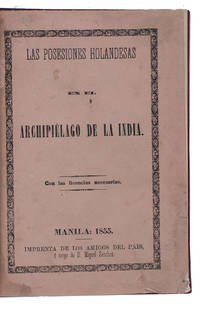
1855réf. D329MFC3UKU0Manila 1855. 8vo. Miguel Sanchez Modern red half calf preserving the original pink lithographed wrappers. 243 1 pp. Rare Spanish translation printed in Manila of an important work on the Dutch East Indies by the famous ornithologist Coenraad Jacob Temminck 1778-1858 director of the Rijksmuseum van Natuurlijke Historie Leiden. The present edition is a translation of a part of Coup d'il general sur les possessions néerlandaises dans l'Inde archipélagique 1846-1849 and focuses on historical ethnographical and socio-economic factors of the Dutch possessions in the East Indies.Very good copy.l Palau 329928. ABE CAT Anthropology & Ethnography unknown
réf. 19944Paris, les éditions G. Crès et Cie, 1927. In-8, 110 pp. 15 pl., en feuilles, couverture originale rehaussée de gouache en couleurs (petits frottements, quelques petites taches éparses).
1807réf. 2114Rage against missions: a landmark anti-colonialist treatise Haarlem Joh. Enschedé en Zoonen & J. van Walré 1807. 4°. 4 X 2 27 1 blank 296 pp. With two engraved medallions on the first title-page. First edition of a landmark Dutch anti-colonialist and anti-missionary treatise. This controversial and heavily criticized work marks a shift in thinking about the Western influence around the world. It is a rare work and here in excellent. Only a few copies are recorded in libraries outside The Netherlands. At the end of November 1803 the Teyler's Religious Society in Haarlem organized a competition. A treatise was to be prepared on the question "What service have missionaries done to the propagation of true Christianity in the past two centuries and what fruit is there been to expected from the present active missionary societies in this regard". On November 30 1804 Haafner's manuscript of 195 pages arrived. This turned out to be the only entry making it inevitable to crown him the prize winner. He was born in Halle in Germany in 1754 came to Amsterdam with his parents in 1765 and left with his father in 1766 for the East Indies. Shortly before arriving in Cape Town Haafner's father died and the twelve-year-old boy was left alone. He was taken into foster care. In 1770 he returned to Amsterdam but the following year he left for Batavia. Via Dutch India he ended up in the British Indies. He spent years on the Coromandel Coast in eastern India traveled in India and Sri Lanka and returned to the Netherlands in 1787. He made bad investments and lost all his money which is why he tried to earn some money as a translator later also as a publicist. His first travelogue appeared in 1806 the present award-winning treatise on missions in 1807 and he died in 1809. After his death his son published many of his father's works with success. Haafner had seen missionaries at work with his own eyes in the Cape Colony in Indonesia and in India. His judgment on missions is damning. He recognized that mission implies cultural destruction and is an illicit interference with other religious beliefs. In his treatise Haafner treats various population groups per chapter. In the first chapter of his essay he deals with missions among the Hottentots. During his years in the Cape Colony he'd gotten to know these people and even had a relationship with a Hottentot girl. He qualified the mission to the Hottentots as a hopeless task. But Haafner not only scathingly judged what he saw with his own eyes of missionary zeal and missionary crime. In his second chapter he writes about the black slaves in the Americas. He vigorously rages against slavery against the capture of slaves in Africa and against the transfer of them to the Americas. In the third chapter Haafner deals with the mission to the Indians in North America and the fourth chapter on the mission among the Hindus in India. His style and eloquence make him the best Dutch writer on this subject before Multatuli and as a polemicist in many ways ahead of him that. This treatise is still a pleasure to read and relevant today. Later editions appeared in 1823 same publisher and 1993 edited by Jaap de Moor and Paul Van de Velde. Haafner's creed is as follows: "I see all people of whatever colour nation and religion as my fellow humans and brothers; whomever thinks the same will not be offended but indeed be pleased that I defend and intercede the innocent and oppressed Indians and seek to load their tyrants with shame". Condition: repair in blank page very minor spotting on a couple pages otherwise an excellent wholly untrimmed copy. Reference: P. van de Velde Wie onder palmen leeft. De sublieme wereld van Jacob Haafner 2008. Enschedé
1708réf. 1603Stockholm 1708. 8vo in 4s. Julius G. Matthiae Contemporary gold-tooled half calf with the title lettered in gold on the spine marbled paper sides. With a woodcut device on the title-page an engraved armorial headpiece to the dedication 19 small engraved illustrations in the text by N. Guerard ca. 5 x 6 cm and woodcut headpieces tailpieces and initials. xvi 138 pp. Nicely produced and finely illustrated first and only edition of a choice selection of fables from Ovid's Metamorphoses translated into Swedish by Jacob Reenstierna the first published Swedish translation of any of Ovids writings. Reenstierna the translator and editor dedicated the book to Charlotte Piper signing the dedication from Norkiöping 10 December 1708. Good copy.l Svenskt biklexicon 1830-1865 vol. M-O p. 184. unknown
1845réf. E4PBJL5NT60TAmsterdam: Coenraad Weddepohl 1845. Original publisher's cloth with a gold-blocked lyre in the centre of each board and a tissue guard over each lithograph gilt edges. Folio. With a lithographed portrait of the artist mounted 8 lithographed plates of stage designs and 9 poems in red decorated letterpress frames the lithographs by Desguerrois & Co. With the 8 plates of stage designs hand-coloured as published. First and only edition of a memorial to the costume and stage designer François Joseph Pfeiffer Jr. 1778-1835 with a biographical sketch by Gerrit van Enst Koning 1794-1853 lithographic portrait lists of his work and coloured lithographs of his stage designs with a poem facing the portrait and each of the stage designs all written for the present book by the famous Dutch author and poet Jacob van Lennep 1802-1868. Pfeiffer was best known for his Romantic stage designs for the Amsterdam Schouwburg city theatre. From 1820 to 1835 he created complete decors for many different plays but none has survived. The lithographs in the present book therefore form an essential primary source for the history of Dutch theatre. Also included is a list of the most important decorations Pfeiffer made for various theatres. A good copy with a few plates lightly browned the leaf on which the portrait is mounted foxed and a few occasional minor stains. Binding slightly faded. An important primary source for the history of Dutch stage design and a feast for the eye with its beautiful hand-coloured stage designs.l NCC 5 copies; Thieme & Becker XXVI p. 528; Waller p. 253. Coenraad Weddepohl, hardcover
1733réf. 001899Londres Jacob Tonson 1733
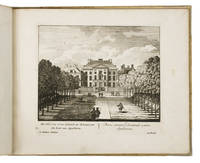
1720réf. ABC_49529Amsterdam: Pieter Schenk 1720. Modern half sheepskin parchment with the manuscript author and title on the spine beige decorative paper sides. Oblong royal 4to ca. 23 x 29 cm. With an engraved dedication also serving as a title-page and 16 unnumbered engraved views 15 x 18.5 cm. A complete set of sixteen views of the magnificent palace gardens mazes fountains sculpture ponds and pavilions of the Royal estate Het Loo near Apeldoorn in the Netherlands the most splendid country estate of King William III of England William of Orange. This estate was the finest example of Anglo-Dutch formal gardens garden art and architecture. Pieter Schenk I 1660-1711 originally published the present views in his six-part Paridisus oculorum 1702 where Het Loo was ''undoubtedly the highlight of the series'' Anglo-Dutch Garden p. 201. The six parts were also issued separately with the dedications to the owners serving as title-pages as is the case here.William of Orange 1650-1702 bought the medieval castle Het Loo in 1684 when he was Dutch head of state and it quickly became his favourite hunting lodge. He had it completely rebuilt under the architect Jacob Roman 1640-1716 beginning in 1686. When William and his wife Mary Stuart were crowned King and Queen of England in 1689 however work on the estate was greatly expanded on a royal scale with sculpture commissioned from Romeyn de Hooghe and the elaborate fountains and gardens shown in the present prints. By the time Schenk produced the present print series just before William's death in 1702 it was one of the world's grandest royal residences. The present set of Schenk's prints is watermarked Strasbourg Bend = IV similar to Heawood 73 & 78 from ca. 1720 so it may have been published by Pieter Schenk II soon after his father's death.The binding shows very slight traces of use. The leaves are very lightly foxed. Otherwise a fine wide-margined copy of the prints of the William of Orange's splendid royal estate Het Loo.l The Anglo-Dutch Garden 68; Hollstein Dutch & Flemish XXV p. 290 1428-1443; Springer Bibl. Overzicht pp. 43-44; STCN 840916604 7 copies 1 incomplete; Wurzbach II p. 576 no. 311 Pieter Schenk, unknown
1935vi, [2], 312 pp. Index. Black and white photographic plates including frontis portrait of Vanderlip who rose from humble beginnings to become head of National City Bank. This work most notable for Chapter XXI entitled 'A Conclave on Jekyl Island' which states: "There was an occasion, near the close of 1910, when I was as secretive, indeed, as furtive as any conspirator... I do not feel it any exaggeration to speak of our secret expedition to Jekyl Island as the occasion of the actual conception of what eventually became the Federal Reserve System." - page 210. Moderate wear to book. Binding intact. Slight lean to spine. Gift greetings, dated 1935, upon front free endpaper. Above-average wear to dust jacket, now in mylar, which lacks a two-inch piece from bottom of spine. Includes news clipping detailing the settlement of Vanderlip's estate. A worthy copy of this historic reference. Book
1954réf. 3174À Paris, Chez l'Auteur 1954. In-folio (385 x 282 mm) en feuilles, 209 pp. sous chemise de papier bleu titrée en jaune sur le dos en parchemin, étui bordé recouvert de papier bleu (emboitage éditeur). 12 GOUACHES ORIGINALES DE MAURICE UTRILLO EN HORS-TEXTE reproduites au pochoir manuel chez Jacomet, Paris. L'ouvrage comporte également des illustrations dans le texte de Lucie Valore, 3 planches en couleurs par Max Jacob, E. Heuze et Pascin, une planche par Chas Laborde, 3 portraits (André Utter par Valadon, Paul Gérard par Leprin, autoportrait de Suzanne Valadon), 5 fac-similés d’autographes (La Goulue, Utrillo, Max Jacob). 1 des 170 ex. sur vélin de Rives (n° 207) réservés aux Bibliophiles Français (Ces exemplaires sont également beaux de coloris). Ouvrage en excellent état et bien complet des 12 pochoirs. - ENGLISH DESCRIPTION: Paris, Chez l'Auteur 1954. A folio volume (385 x 282 mm) in loose sheets, 209 pp. in the blue cardboard editeur slipcase with the title in yellow on the spine. 12 ORIGINAL GOUACHES BY MAURICE UTRILLO OUT-OF-TEXT reproduced with manual stencil at the famous Jacomet studio in Paris. Many in-text drawings by Lucie Valore, Max Jacob, Pascin, etc. and in-text documents. One of 170 ex. on Rives paper (n° 207) reserved for "French Bibliophiles" (These copies have also beautiful in color stencils). Book in excellent condition and complete with 12 stencils.
1923réf. 2224Ernst Ludwig Kirchner 6 May 1880 – 15 June 1938. NEBEN DER HEERSTRASSE. Grethlein & Co. Zürich/Leipzig 1923. First edition with 24 woodcuts by Ernst Ludwig Kirchner integrated with text. 434 6pp. 8vo. Publishers salmon-boards with 1/4 red leather spine. The upper cover with title and vignette in woodcut by Kirchner title in black on back top edge violet. Original RARE dust jacket illustrated by Kirchner. One of the best known books illustrated by Kirchner; the illustrations where printed from the original woodblocks. Excellent copy with the rare dustjacket text slightly but uniformly aged. Dube II 808-831; Lang 174 Rifkind/Davis 1478 Rifkind 103 Vom Jenendstil zum Bauhaus 86: Schauer IIj118: Jentsch 143. Grethlein & Co. hardcover books
1660réf. 6191660. With 47 full-page engraved maps and 3 full-page plates with portraits. 2 Blank pages / 4 Pages / 14 NNP / 223 Pages / 2 NNP / 3 Blank pages / 47 Maps / 3 Engraved Plates This book can only be viewed by appointment. Binding: Contemporary Full Leather Octavo 8vo Height cm: 22 CM Width cm: 29 CM Thickness cm: 4 CM hardcover
1960réf. 21355KINDERBUCHVERLAG 1960. 7. hardcover. Kinder- und Hausmärchen der Brüder Grimm Die KINDERBUCHVERLAG hardcover
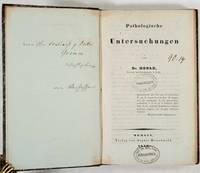
1840réf. 549061840. Berlin Verlag von August Hirschwald 1840 8° VI 274 pp. 2 pp. Verlagsanzeigen Halbledereinband der Zeit mit reichlicher Rückenvergoldung; Rücken neu unterlegt St.a.Tit.; mit eigenhändiger Widmung des Verfassers. Sehr seltene erste Ausgabe mit eigenhändiger Widmung "Herrn Ober Stasbsarzt u. Doctor Grimm . vom Verfasser" auf dem Vorsatzblatt und dem Stempel der "KÖN. PR. MED. CHIR. Frid. Wihl. Institut" auf dem Titelblatt. Jacob Henle 1809-1885 leitet mit seinen "Pathologischen Untersuchungen" eine neue Etappe in der Lehre von den Infektionskrankheiten ein. Der erste Abschnitt dieses Buches enthält die klassische Abhandlung "von den Miasmen und Contagien pp.1-87". Das Kontagium der Ansteckungsstoff muß aus Lebewesen bestehen ähnlich denen der Hefe und der Pilze. Ausgangspunkt dieser Erkenntnis bilden die Forschung auf dem Gebiet der Gärung. -- Henles Arbeit ist ein genialer Entwurf. Seine Reflextionen sind zwingend. Die Theorie des "contagium vivum" wurde später von Robert Koch Henles Schüler glänzend bestätigt. -- Aber Henle konnte 1840 die Lebewesen die er annahm nicht zeigen und man glaubte nur noch was man sah. So blieb diese geistvolle Arbeit seinen Zeitgenossen nur eine Spekulation. "The significance of Henle's book lies in its long opening essay 'Von den Miasmen und Contagien' in which Henle formulated on the basis of deductive reasoning his conviction that living organisms were the cause of contagious and infectious diseases. Drawing upon a wide body of work performed by other researchers on the origin of infectious diseases such as Bassi's recent demonstration of the parasitical nature of muscardine disease of silkworms Henle argued that infectious agents had to be organic in nature since they appeared to multiply from the moment of entering the body a statement supported by the fact that a certain period of incubation usually precedes the outbreak of disease and only organic life has the property of growth. The fact that infectious agents could be destroyed by heat and disinfectants also suggested their animate nature. Henle assumed that each infectious disease had its own etiology but realized that such views would be difficult to prove; he therefore proposed that an agent constantly found in association with a particular disease be isolated and tested in its isolated state to see whether it could produce the disease. 'This approach to the proof of the germ theory Henle communicated to his pupil Robert Koch and was forty years later to become one of the cornerstones of classical bacteriology under the name of "Koch's postulates" ' Foster "He laid down postulates on the aetiological relation of microbes to disease which became fundamentals of bacteriology." Long Foster Medical Bacteriology pp. 8-9; Bulloch History of Bacteriology 163-65; G.Rosen Henle on miasmata and contagia. In Bull. Hist. Med. 1938 907; Howard-Jones Frascatoro & Henle. In Med. Hist. 1977 61-68; Sigerist Große Ärzte 314-320. Brock Milestones in Microbiology pp.76-79; Garrison-Morton 2533; Norman 1051; Waller 4336 unknown
1777réf. 222231777. Aus dem lateinischen übersetzt von F.X. von Wasserberg. - Wien bey Rudolph Gräffer 1777 8° 4 Bl. 242 pp. 6 Bl. Pappband d.Zt.; feines Expl. Sehr seltene erste deutsche Ausgabe dieses dermatologischen Klassikers. BEGRÜNDER DER SYSTEMATISCHEN DERMATOLOGIE! Sehr seltene Deutsche Ausgabe! Dieses 200 Jahre alte Buch ist ein Klassiker der modernen Dermatologie. Es war das erste Werk über Hautkrankheiten das eine große Beachtung fand weil es eine bestimmte Ordnung in die bis dahin herschende Verwirrung der Begriffe brachte. Joseph Jacob von Plenck 1738-1807 Professor in Wien und Buda gründete die Einteilung der Hautkrankheiten auf ihre spezifische Erscheinungsform und die hauptsächlichsten Typen der verschiedenen Erkrankungen. Plenck kennt 115 Hautkrankheiten die er in 14 Klassen unterteilt. Später wird WILLAN der das Plencksche System aufnimmt die Einteilung auf 8 Gruppen zusammenstreichen. - Plenck ist der Begründer der systematischen Dermatologie. Titelblatt und erste Lagen etwas fleuchtfleckig und wurmstichig sonst sehr gut erhaltenes Exemplar dieses sehr seltenen Buches! RARE FIRST GERMAN EDITION! Plenck of Vienna was professor of half a dozen different subjects. In his treatise "Doctrina de Morbis Cutaneis" he classified skin diseases upon the basis of their cutaneous symptoms. "A classification of skin diseases upon the basis of their clinical appearance. Until the time of WILLAN . the greatest authority on dermatology. He mentioned 115 skin diseases and divided them in 14 classes." Garrison & Morton 3982 cf. Schönfeld 43; Richter 177-78; Hirsch-H. IV 590; Pusey Hist. of Dermatology 57-58; Blake 356; Engelmann 434. unknown
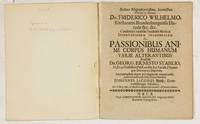
1695réf. 621831695. Halae : Typis Christophori Salfeldi 1695 Kl.4° 16 6 pp. marmor. Broschur; feines Expl. Sehr Selten - Erste Ausgabe! Die hier vorliegenden "Disputatio de passionibus animi" "Über den mannigfaltigen Einfluß von Gemütsbewegungen auf den menschlichen Körper" zeigt daß es Stahl schon zum Beginn seines Wirkens in Halle seit 1694 also um das Problem der psychophysischen Wechselwirkung gegangen ist. Er hat seine Bedeutung seine Auswirkung in der Praxis beobachtet. Man findet hier die Grundlagen der medizinischen Psychologie. Es werden Beispiele für den Einfluß seelischer Erregungen auf den menschlichen Organismus angeführt. In der Einleitung wird hervor gehoben: "So leiten sich von den Leidenschaften des Gemütes in ihrer vielfältigen Bestimmung Leitung oder Änderungen der Bewegungen des menschlichen Körpers auch viele Krankheitsanzeichen her." Die Mehrschichtigkeit seelischer Alterationsstufen das Unverlierbare besonders tiefe Eindrücke wird in der Vorahnung späterer Erkenntnisse Freudausgesprochen: Zugegeben sei "daß der im Erbgang geprägte Prototyp der Leidenschaften und Neigungen des Gemüthes in gewohnheitsmäßiger Festigung nicht ganz umgekehrt werden kann" so vermag doch "die domminierendende Leidenschaft durch eine ihr entgegengesetzte Gewohnheit an die zweite oder gar dritte Stelle verdrängt werden wo sie zwar noch innerhalb der Ordnungen steht gleichwohl ihre Rangstufe wechselt." Es liegt dem in nuce die Idee von der Verdrängung zugrunde. Es wird schließlich empfohlen die psychologischen Beobachtungen bei der Behandlung der Patienten nützlich anzuwenden und zu verwerten indem man den Kranken "viele Ausbrüche des Erschreckens der Furcht des Zornes anhebender Ängstlichkeit durch guten Zuspruch und durch vertrauenserweckende Sicherheit" benimmt. So zieht die Arbeit die Folgerung: "Seelenleiden die von Verletzungen des Körpers herrühren sind oft mit schwerwiegenden und dauernden Folgen verbunden. Doch sie sind zu vertreiben mit der Heilung der Körperschäden." Die Lehre von den symptomatischen Psychosen wird im Ansatz vorweggenommen wenn auch die Terminologie auf einen noch neuen Begriffsterain vortastet. Es sind Gehversuche auf einem noch dunklem Gebiet in der ärztlichen Praxis. Man kann die "Disputatio" als eine frühe Arbeit bezeichnen die sich aus der Sicht des Arztes mit dem Problem psychisch verursachter Störungen von Krankheitsabläufen beschäftigt. Es handelt sich hierbei nicht um Geisteskrankheiten. Es geht vor allem um die körperlichen Einflüsse transitorischer Seelenzustände die man heute in der Lehre von den Neurosen und ihren verschiedenen Erscheinungsformen zusammenfassen würde. Die seit der Antike beknatte Verbindung zwischen Knostitution und Charakter wird auch nach der therapeutischen Seite hin erwogen und berücksichtigt. Es ist der Geist einer naturwissenschaftlichen Betrachtungsweise der sich durch diese Arbeit hindurchzieht. Es zeigt wie vorbeitreffend die Annahme war den STAHL'schen Animismus nur religiös zu interpretieren." "In dem an zweiter Stelle stehenden "Propempticon inaugurale" - es ist eine dem Doktoranden JOHANN JACOB REICH gewidmete Abschiedsrede STAHLS mit angeschlossener Vita REICHS - nimmt STAHL zu dem Thema "De synergeia naturae in medendo" Stellung. Man findet hier alle Merkmale des STAHLschen Systems und erkennt wie sehr der aus der Erfahrung schöpfende Psychologe den Vorrang gehabt hat. So wird eine tiefe Kenntnis des Eigenrhythmus biologischer Abläufe in dem Gedanken ausgesprochen: "Die Natur hat ihr eigenes Zeitmaß und verwendet dieses bei den rhythmischen Vorgängen des Lebens von längerer Zeitdauer so bei der Embryonalentwicklung bei der Geburt Zahnung Pubertät". Die Synergie der Organe unter der Direktion der Lebenskraft enthält im Krankheitsfalle das ärztliche Problem die nützlichen Bewegungen der Naturheilkraft von den eigentlichen Krankheitsbewegungen zu unterscheiden. Der Arzt muß vor allem die Bewegungen erkennen die auf einen nützlichen Zweck abzielen. Theoretische Fragen werden aus dieser Sicht kurzerhand beiseite geschoben und in der für STAHL typischen Art das Leib-Seele-Problem zu einem biologischen Postulat'gemacht : "Es handelt sich nicht um eine Annahme sondern wir beweisen a priori mit der Vernunft daß im Menschen von einer einzigen Seele alle diese Akte und Bewegungen vollzogen werden können. Erfahrung und Vernunft zeigen a posteriori daß diese Zusammenhänge zwischen Leib und Seele in der Tat vorliegen." In diesem Problem sieht STAHL den Inhalt seiner Lebensarbeit: "Darauf werfe ich mich mit ganzer Seele. Dem gilt meine ganze Arbeit. Weder Mühe noch Neid können mich dabei verdrießlich machen. Ich hoffe vielmehr mit dem Problem in würdiger Weise fertig zu werden. Möge die Medizin dann wieder auf ihr rechtes Fundament gestellt sein"!" Diese beiden Texte "vermitteln so ein interessantes Bild der ärztlichen Persönlichkeit STAHLS ihres Temperamentes und ihrer Suche nach den biologischen und psychologischen Gesetzen einer wirksamen Therapie. Er gibt sich mit der Vorstellung einer nur mechanistischen Arzneiwirkung nicht zufrieden. Er nennt die besondere "Chronometrie" biologischer Abläufe das Gesetz der Ganzheit den Begriff des allen Einzelerscheinungen übergeordneten Organismus den Einfluß seelischer Erregungen auf die Vitalbewegungen desselben. Die psychophysische Wechselwirkung wird dem Arzt als praktisch wichtiges Problem gestellt. Jedenfalls hat STAHL bereits im Jahre 1695 alle wesentlichen Gedanken seines medizinischen Systems dargelegt. Die Ansicht er habe erst durch CHRISTIAN WOLF gewichtige Anregungen erhalten ist nicht mehr haltbar. Bereits 12 Jahre vor dem Erscheinen seiner "Theoria medica vera" hat die Forschungsrichtung STAHLS ihr wesentliches Ziel gehabt. Wenn man die Geschichte der medizinischen Psychologie überdenkt so wird man GEORG ERNST STAHL auf Grund der Einsichten in die ärztliche Bedeutung des Psychischen wie schon KORNFELD mit Recht ausgeführt hat an den Anfang einer Erschließung dieses Fachgebietes stellen dürfen. Die Leitsätze am Schluß der "Disputatio" enthalten das historische Fundament dieser neuen erst in unserer Zeit zur Anerkennung gekommenen Wissenschaft." B.J. Gottlieb G.E.Stahl Sudhoffs Klassiker der Medizin pp.18-21 23-47 unknown
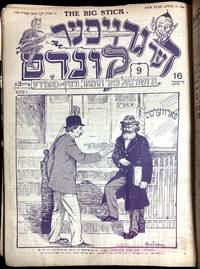
1909réf. 42930New York: Ferlag "Kibets 1909. 1st Edition. Original publisher's binding Folio newspaper. Complete first volume Starting with Vol I Nr 1 of "Der Kibitser" Dec. 15 1908 renamed and renumbered first as Vol I Nr 1 Jan 22 1909 of "Der Groyser Kibetser The big kibetzer" with the following issue of Feb 5 numbered as "3" to correctly follow from the first issue and then with Vol I Nr 6 March 19 1909 onward as "Der Groyser Kundes The Big Stick" or "The Big Prankster." Incidentally the other set of this volume we examined also did not have a Nr 2 so we are confident this is complete as issued. One centerfold cartoon by Zuni Maud see image features "Der Kaptialistisher Tayfel"--the Capitalist Devil-holding back a "mother" by the hair to stop her from interfering as "baby's milk-bottle" is drained off by the "milk-trust" cat. The caption reads "The Capitalist Devil: - to the mother: Never mind madam all in English in Hebrew letters you go to the factory the milk-trust will take good care of your baby." This cartoon-laden periodical was a New York City Yiddish language satirical bi- weekly which ran from 1908 until 1927. The humor paper was issued biweekly this volume for its first 20 months and then weekly after that. OCLC also references another Vol I Nr 1 from April 15 1908 a special S´imhes` Toyreh Simchas Torah issue but this may have been a one-off. Founded by the humorist Yosef Tunkel or Der Tunkeler his pen name meaning 'The Dark One' the paper was taken on by Jacob Marinoff when Tunkel left to work for an established paper in Warsaw. The paper consciously set itself up in opposition to the serious Yiddish-language press of the time such as the socialist Forverts.Naturally more traditional religious Judaism did not escape its satire: The later 1915 "Christmas" edition included a parodic conversation between Jesus and the prophet Elijah. Despite its irreverent attitude to everything it also published poetry by Di Yunge "The Young Ones" poets such as Moyshe-Leyb Halpern and Zuni Maud. At its height it had a circulation of 35000 but folded in 1927 due to flagging sales. Der Groyer Kunds is highlighted in this recent talk by Yiddish comics scholar Eddie Portnoy on the reactions in the Yiddish press to restrictions on Jewish immigration to the US: https://www.yiddishbookcenter.org/collections/archival-recordings/recorded-programs/ybcr-nybc-ybcr-1048/door-slams-shut-reactions-yiddish-press-immigration . SUBJECTS: Yiddish wit and humor -- Periodicals. OCLC: 28297536. Most holdings appear to be fragmentary and do not include these issues. Issue 18 with torn cover. In final issue the bottom margin suffers some loss to the final leaves none to the dramatic front cover though. Damaged boards are loose and most issues are coming loose though the quality paper used has remaind strong and bright much better than standard newsprint would have. Important graphic Yiddish humor from the great migration period. Dramatic and displayable! BK5 YID-43-9A-LEX. [New York]: Ferlag "Kibets unknown
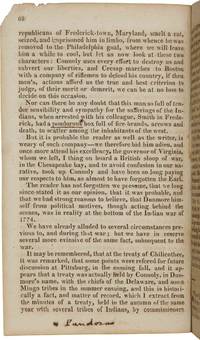
1826réf. 63685Cumberland MD: Printed for the Author by J.M. Buchanan 1826. In Defense of Captain Cresap First edition of this biography of Captain Cresap defending him against charges that he slaughtered Indians before the beginning of the Revolutionary War. In particular Cresap became infamous in the case of the Indian Logan and the murder of his defenseless family in 1774. "This biography of Cresap was written to refute Jefferson's account in Notes on Virginia.The immediate occasion for this now rare book written by the revolutionary officer later clergyman who had married Cresap's widow was the reopening of old sores by Joseph Doddridge in his then recently published Notes on the Settlement and Indian Wars of the Western Parts of Virginia & Pennsylvania from the Year 1763 until the Year 1783 Inclusive of 1824. The defense is complete and the biography is of absorbing interest" - Streeter. Each copy of this edition we have handled features largely identical contemporary manuscript annotations and corrections to the text suggesting that they are made in the hand of the author or publisher. The Streeter copy was bought by Sessler for $650 in 1968. 12mo. Contemporary three-quarter roan over marbled boards spine gilt. Covers worn top outer corner abraded. 19th-century ownership inscription on front pastedown 19th-century gift inscription and authorship attribution on titlepage 19th-century inscription on rear pastedown. Top outer edge of text block abraded affecting only page numbers of first ten leaves. A few contemporary manuscript annotations in the text. Minor age-toning and a few minor dampstains. A decent copy. In a half morocco box. HOWES J32 "b." SABIN 35488. STREETER SALE 1335. FIELD 769. THOMSON 640. AMERICAN IMPRINTS 24967. DAB IV p.538 Cresap. hardcover
1826réf. 316088Cumberland MD: Printed for the Author by J.M. Buchanan 1826. First edition. 8vo. Contemporary half roan and marbled boards spine lettered in gilt. Covers scuffed and worn small semicircular portion of rear cover fire damaged with loss wear extending into final 25 pages at top margin touching a few letters text foxed and faintly dampstained some contemporary pen annotations 1839 ownership inscription on front free endpaper. First edition. 8vo. First edition of this defense of colonial frontiersman Captain Cresap 1742-1775 whom Jefferson echoing others blamed for the murder of the family of the Mingo war chief James Logan during Lord Dunmore's War. Cresap has since been exonerated and the Virginian Daniel Greathouse is now blamed for the massacre of Logan's family. "This biography of Cresap was written to refute Jefferson's account in NOTES ON VIRGINIA.The immediate occasion for this now rare book written by the revolutionary officer later clergyman who had married Cresap's widow was the reopening of old sores by Joseph Doddridge in his then recently published NOTES ON THE SETTLEMENT AND INDIAN WARS OF THE WESTERN PARTS OF VIRGINIA & PENNSYLVANIA FROM THE YEAR 1763 UNTIL THE YEAR 1783 INCLUSIVE of 1824. The defense is complete and the biography is of absorbing interest" Streeter. Streeter Sale 1335; Howes J32; Graff 2185; Sabin 35488; Siebert Sale 379 Printed for the Author, by J.M. Buchanan unknown
2001réf. 514471Anchor Doubleday 2001. Hardcover with Dust Jacket. VERY GOOD/Very Good. As pictured. Lot of 93 titles in the Anchor Bible Series. Some volumes have the owner's name on the front endpaper but all volumes are clean unmarked and with sound bindings; a few volumes lack the dust jackets; some dustjackets show some fading and/or staining to the spines. Uncommonly seen in this quantity since the series was never sold as a set but individually. This set includes a substantial number of the new and revised second series. Since being taken over by Yale most of the volumes in this series are no longer being printed in hardcover and have become quite scarce thus. Shipped professionally in sound sturdy boxes. Expedited and international delivery will require additional fees. Anchor Doubleday hardcover
1665réf. 55379Leiden: J. van Meurs 1665. First edition. Hardcover. Very good condition. Folio. 6 10 290 1 134 1pp. 35 plates including engraved half-title and frontispiece. Bound in three-quarter brown leather over brown textured paper-covered boards. Half-title engraving. Frontispiece engraving. Missing China folding map. The title page printed in red and black with framed engraved vignette. Historiated and decorative initials head- and endpieces. All but one folding plate engraving Ceremonies du Marriage are double-paged and bound in butterfly style. In addition the volume is profusely illustrated with 110 in-text engravings 4 1/4 x 6 1/8" placed at the top of pages. Part II is an illustrated general description of the Chinese Empire. Account of the first Dutch embassy from 1655-1657 by Messrs. Pierre de Goyer and Jacob de Keyser. It is illustrated with a highly accurate description of China and enriched with outstanding copperplate engravings. Compiled by Jean Nieuhoff steward of the embassy translated into French embellished and supplemented with a wealth of fascinating details by Jean le Carpentier historiographer. The goal was to establish a trade agreement on behalf of the Dutch East India Company providing a very accurate description of the cities towns villages seaports and other notable places in China. Text in French. Binding with some wear along edges more pronounced at tail of spine and along half of bottom edge of front cover. Very lightly starting at half-title engraving. Few minor notations in margins. Plate bound in between pp 98/99 with 4 1/4 x 1 3/4 chip at lower foredge not affecting image. Block very lightly age-toned. Binding in fair condition. J. van Meurs hardcover
1700réf. BB1034T'Amsterdam / T'Utrecht: Daniel van den Dalen. François Halma. De wed. van A. van Someren / J. en Wilhelm vande Water. Boekverkopers 1700. Early Reprint. Vellum. Fine. Profusely illustrated edition of Cats's complete collected works first published in 1655. Two folio volumes bound in one each separately paged and signed and each with additional engraved title page bearing a portrait of the author as well as sectional title pages with engraved vignettes. 28666 i.e. 662: 183-184 repeated and 343-348 omitted10; 183906393-608611 pp with full-page portraits of the author and of Anna Maria Schurman three double-page plates and more than 400 superb copper-engraved half- and quarter-page plates most from the original designs of Adrian van de Venne numerous tailpieces of bouquets and historiated initials. Recent period-style full vellum binding by Fitterer mustard lettering piece decorated and lettered in gilt end papers renewed. An exemplary example in a magnificent vellum binding occasional spotting and minor marginal browning else fresh and bright with rich impressions of type and plates. Cats was a Dutch statesman and writer of emblem books a type of popular seventeenth-century literature consisting of woodcuts or engravings accompanied by didactic verses pointing a moral or presenting an ethical concern often related to love and marriage. Dutch artists of the Golden Age including Vermeer used such books as inspiration for motifs in their paintings and prints. The sources upon which Cats draws for this combination of emblem literature and love poetry are chiefly the Bible and the classics and occasionally Boccaccio and Cervantes. His first book Sinne-en minnebeelden "Portraits of Morality and Love" contained 96 emblematic engravings with text in Dutch Latin and French each emblem with a threefold interpretation expressing what were for Cats the three elements of human life: love society and religion. Perhaps his most famous emblem book written in a more homely style than his earlier works is Spiegel van den ouden en nieuwen tyt "Mirror of Old and New Times" with 128 emblematical engravings accompanied by quotations many of which have become household sayings. Two other worksHouwelyk 'Marriage' and Trou-ringh 'Wedding Ring' with 59 platesare rhymed dissertations on marriage and conjugal fidelity. Finally in one of his last books Ouderdom buyten-leven en hof-gedachten "Old Age Country Life and Garden Thoughts" with 27 plates Cats writes movingly about his declining years. Adapted from the Encyclopedia Britannica N. B. With few exceptions always identified we only stock books in exceptional condition. All orders are packaged with care and posted promptly. Satisfaction guaranteed. Fine Editions Ltd is a member of the Independent Online Booksellers Association and we subscribe to its codes of ethics. Daniel van den Dalen. François Halma. De wed. van A. van Someren / J. en Wilhelm vande Water. Boekverkopers unknown
1826réf. 316088Cumberland MD: Printed for the Author by J.M. Buchanan 1826. First edition. 8vo. Contemporary half roan and marbled boards spine lettered in gilt. Covers scuffed and worn small semicircular portion of rear cover fire damaged with loss wear extending into final 25 pages at top margin touching a few letters text foxed and faintly dampstained some contemporary pen annotations 1839 ownership inscription on front free endpaper. First edition. 8vo. First edition of this defense of colonial frontiersman Captain Cresap 1742-1775 whom Jefferson echoing others blamed for the murder of the family of the Mingo war chief James Logan during Lord Dunmore's War. Cresap has since been exonerated and the Virginian Daniel Greathouse is now blamed for the massacre of Logan's family. "This biography of Cresap was written to refute Jefferson's account in NOTES ON VIRGINIA.The immediate occasion for this now rare book written by the revolutionary officer later clergyman who had married Cresap's widow was the reopening of old sores by Joseph Doddridge in his then recently published NOTES ON THE SETTLEMENT AND INDIAN WARS OF THE WESTERN PARTS OF VIRGINIA & PENNSYLVANIA FROM THE YEAR 1763 UNTIL THE YEAR 1783 INCLUSIVE of 1824. The defense is complete and the biography is of absorbing interest" Streeter. Streeter Sale 1335; Howes J32; Graff 2185; Sabin 35488; Siebert Sale 379 Printed for the Author, by J.M. Buchanan unknown books