[India] / [Engraving] / [Lutheranism]. KLEINSCHMIDT, Johann Jacob / RIEDINGER, Johann EliasBiblio.com

56 075 résultats
1730réf. 5023Copperplate engraving 83.5 x 55.5 cm 1 folio. Fold marks minor edge wear otherwise a very good copy in very crisp dark impression. Rare large-format engraved print produced in 1730 as part of the celebrations of the 200th anniversary of the Augsburg Confession 1530 one of the foundational documents of Lutheranism. The subject of the print is the famous Tranquebar Mission in southern India which was established by King Frederick IV of Denmark 1671-1730 and led by the German missionaries Bartholomäus Ziegenbalg 1682-1719 and Heinrich Plütschau 1676-1752 who are noted for having translated the Bible into Tamil and arranged for its printing. The engraving executed by Johann Jacob Kleinschmidt after a design by Elias Riedinger is a splendid example of 18th-century Augsburg printmaking. It takes as its compositional conceit a church altar surmounted by a framed retable. The image above the altar depicts the German missionaries preaching to an audience of natives; in the background of this scene can be glimpsed a statue of 'Biruma oder Brama' Brahma. The elaborately carved frame of the retable is enlivened with vignettes illustrating the successes of the Lutheran mission e.g. an Indian smashing an idol a native being baptized a domesticated elephant symbolizing the people under God's yoke etc. Placed atop the altar are oval portraits of Ziegenbalg and Plütschau their names written in Tamil and the books they translated an Indian bible an Indian catechism and an Indian hymnal. A map of southern India hangs on the front face of the altar. Flanking the altar are two young natives: the boy on the left holds the Danish Royal arms and the boy on the right displays the architectural plan of the New Jerusalem Church in Tranquebar built by the Germans and dedicated in 1719. In front of the altar are fallen symbols of the old dispensation. At the foot of the sheet is a poem in Latin and German celebrating the expansion of the Lutheran faith to all corners of the world. The engraving is one of several quite ambitious broadside prints produced in Augsburg to commemorate the bicentennial of the Augsburg Confession some of which apparently reproduced paintings executed for the occasion. These rather disparate graphic productions were collected by Johann Michael Roth in 1730/31 and released as a small-edition composite volume with an added engraved title page reading Augspurgisches Iubel-Gedächtnüs. The contents of this rather odd production vary greatly from copy to copy. Kleinschmidt's Vorstellung der Evangelisch-Ost-Indischen Kirche engraving apparently was a commercial success because in 1736 citing demand he released a small-format version of the work its composition slightly altered. OCLC locates U.S. examples of the Augspurgisches Iubel-Gedächtnüs at Illinois Duke Getty Stanford Princeton Yale Harvard Emory Concordia Seminary and Cal. State Sutro. The Getty copy includes Kleinschmidt's Vorstellung der Evangelisch-Ost-Indischen Kirch but it is not clear which other examples include this engraving. Drugulin Historischer Bilderatlas 4112; S. Neill A History of Christianity in India. Kleinschmidt
1730réf. 5023Copperplate engraving 83.5 x 55.5 cm 1 folio. Fold marks minor edge wear otherwise a very good copy in very crisp dark impression. Rare large-format engraved print produced in 1730 as part of the celebrations of the 200th anniversary of the Augsburg Confession 1530 one of the foundational documents of Lutheranism. The subject of the print is the famous Tranquebar Mission in southern India which was established by King Frederick IV of Denmark 1671-1730 and led by the German missionaries Bartholomäus Ziegenbalg 1682-1719 and Heinrich Plütschau 1676-1752 who are noted for having translated the Bible into Tamil and arranged for its printing. The engraving executed by Johann Jacob Kleinschmidt after a design by Elias Riedinger is a splendid example of 18th-century Augsburg printmaking. It takes as its compositional conceit a church altar surmounted by a framed retable. The image above the altar depicts the German missionaries preaching to an audience of natives; in the background of this scene can be glimpsed a statue of 'Biruma oder Brama' Brahma. The elaborately carved frame of the retable is enlivened with vignettes illustrating the successes of the Lutheran mission e.g. an Indian smashing an idol a native being baptized a domesticated elephant symbolizing the people under God's yoke etc. Placed atop the altar are oval portraits of Ziegenbalg and Plütschau their names written in Tamil and the books they translated an Indian bible an Indian catechism and an Indian hymnal. A map of southern India hangs on the front face of the altar. Flanking the altar are two young natives: the boy on the left holds the Danish Royal arms and the boy on the right displays the architectural plan of the New Jerusalem Church in Tranquebar built by the Germans and dedicated in 1719. In front of the altar are fallen symbols of the old dispensation. At the foot of the sheet is a poem in Latin and German celebrating the expansion of the Lutheran faith to all corners of the world. The engraving is one of several quite ambitious broadside prints produced in Augsburg to commemorate the bicentennial of the Augsburg Confession some of which apparently reproduced paintings executed for the occasion. These rather disparate graphic productions were collected by Johann Michael Roth in 1730/31 and released as a small-edition composite volume with an added engraved title page reading Augspurgisches Iubel-Gedächtnüs. The contents of this rather odd production vary greatly from copy to copy. Kleinschmidt's Vorstellung der Evangelisch-Ost-Indischen Kirche engraving apparently was a commercial success because in 1736 citing demand he released a small-format version of the work its composition slightly altered. OCLC locates U.S. examples of the Augspurgisches Iubel-Gedächtnüs at Illinois Duke Getty Stanford Princeton Yale Harvard Emory Concordia Seminary and Cal. State Sutro. The Getty copy includes Kleinschmidt's Vorstellung der Evangelisch-Ost-Indischen Kirch but it is not clear which other examples include this engraving. Drugulin Historischer Bilderatlas 4112; S. Neill A History of Christianity in India. Kleinschmidt books
réf. 51-0489Franckforth am Meyn: Bei Cyriaco Jacob zum Barth 1545. 4to. 200 x 282 mm. 71 leaves. Sewn but not bound. Lacks last signature with 4 leaves supplied in color facsimile. Marginal repairs with occasional loss of text; some stains.Zinner 1869. Franckforth am Meyn: Bei Cyriaco Jacob zum Barth, 1545. unknown
1926réf. Arm358Paris Les Chroniques du jour chez Oreste Zeluk 1926 Paris - Les chroniques du jour chez Oreste Zeluk - 1926 - In4 agrafé sous couverture à rabat orange - titres imprimés en bleu- non paginé - 9 compositions en hors texte de Antonio Fornari aquaréllées à la main - Minuscule tirage à 175 exemplaires celui-ci numéroté 20 .Splendide album publié en lieu et place du numéro de Juillet de la revue des Chroniques du Jour , préfacé par l'éditeur Gualtieri di San Lazzaro qui évoque les auteurs Cingria , Max Jacob , James Joyce ( 4 poèmes tirés de " Musique de chambre " et traduits par Auguste Morel ) , André Salmon , Julien Tuvim et Léopold Zborowski .Gualtieri di San Lazzaro ( 1904/1974 ) fondateur de la revue parisienne XXe Siècle fait publier cet ouvrage qui contient le texte inédit de Charles Albert Cingria " Le chat du temple " , deux compositions de Max Jacob , quatre de James Joyce et quatres poèmes d'André Salmon , Julien Tuvim et Léopols Zborowski. Antonio Fornari , peintre scénographe futuriste , expose au début des années 20 avec Balla , Prampolini , Marchi , Paladini et Pannaggi notamment au Winter Club de Turin et à la première exposition futuriste de Macerata ( 1922) .Ensuite il s'installe à Paris ou il travaille autour du livre objet . En 1926 il illustre pour Gualtieri le recueil de poésies que nous vous proposons . Les illustrations oniriques et d'une grande fraîcheur font le charme de cet ouvrage extrêmement rare .
1926réf. Arm358Paris Les Chroniques du jour chez Oreste Zeluk 1926 Paris - Les chroniques du jour chez Oreste Zeluk - 1926 - In4 agrafé sous couverture à rabat orange - titres imprimés en bleu- non paginé - 9 compositions en hors texte de Antonio Fornari aquaréllées à la main - Minuscule tirage à 175 exemplaires celui-ci numéroté 20 .Splendide album publié en lieu et place du numéro de Juillet de la revue des Chroniques du Jour , préfacé par l'éditeur Gualtieri di San Lazzaro qui évoque les auteurs Cingria , Max Jacob , James Joyce ( 4 poèmes tirés de " Musique de chambre " et traduits par Auguste Morel ) , André Salmon , Julien Tuvim et Léopold Zborowski .Gualtieri di San Lazzaro ( 1904/1974 ) fondateur de la revue parisienne XXe Siècle fait publier cet ouvrage qui contient le texte inédit de Charles Albert Cingria " Le chat du temple " , deux compositions de Max Jacob , quatre de James Joyce et quatres poèmes d'André Salmon , Julien Tuvim et Léopols Zborowski. Antonio Fornari , peintre scénographe futuriste , expose au début des années 20 avec Balla , Prampolini , Marchi , Paladini et Pannaggi notamment au Winter Club de Turin et à la première exposition futuriste de Macerata ( 1922) .Ensuite il s'installe à Paris ou il travaille autour du livre objet . En 1926 il illustre pour Gualtieri le recueil de poésies que nous vous proposons . Les illustrations oniriques et d'une grande fraîcheur font le charme de cet ouvrage extrêmement rare .
1934réf. 2110502151001879Benno Schwabe & Co. 1934. Soft Cover. Fine. Number of books: 14 Benno Schwabe & Co. paperback
1976réf. 2091202133213243Editions Andre Sauret 1976. Soft Cover. Fine. Volume: 1 Editions Andre Sauret paperback
réf. 131689aafZürich, Joh. Henrici Lindinner, Bibliopeg. M. DC.LXXX., 1680, in-12° 12 Bl. + 390 S. + 14 Bl., - Etw. stockfleckig, Titelbl. mit Besitzverm. u. repar. Einriß., Exlibris Nazario Pavoni, Spät. Hprgt, mit O.-Rschildchen.
réf. 112277aafParis, (A. Egron, Imprimeur, pour) Librairie de Gide fils, 1823, in-folio, 3 ff. (faux-titre, titre et avis pour placement des planches) + 60 p. + 11 planches de vues lithographiques (par G. Engelmann d'après les aquatintes de S. Weibel) + 1 carte topographique et routière des deux rives du lac de Genève, par A.R. Fremin, gravée par G. Lemaître, en feuilles, avec la couv. de la brochure orig. (avec taches).
1783réf. 54257Vienne Vienna: Rudolph Graffer 1783. Fine. Rudolph Graffer Vienne Vienna 1783 - 1784 12.50 x 20.50 cm relié The two works are both second editions but with the same date as the first so some consider them second impressions. Contemporary half brown sheep vellum corners. Spine with four decorative tools and roulettes. Beige sheep title label. Head-piece worn. Rudolph Graffer hardcover
1770réf. 33417Augsburg: J. J. Haid et fils 1770. Mezzotint engravings on laid paper. Trimmed to platemark on bottom. Charming suite of mezzotints capturing the quiet choreography of eighteenth-century domestic routine. Johann Jacob Haid one of Augsburg's leading printmakers depicts a young protagonist at successive moments: in the morning she adjusts her negligee beside an inviting breakfast service; after dinner she composes her hair and pearls before a mirror; toward evening she slips on her gloves in the open doorway poised between interior refinement and the social world beyond; and at last she settles by glittering candles her veil half-drawn as reading gives way to sleep. The mezzotint medium lends the scenes a painterly softness while the sophisticated articulation of lace jewellery and porcelain situates the figure within a Rococo vocabulary of luxury and polite accomplishment. Haid's French titles underscore Augsburg's role as a transnational centre for the circulation of fashionable imagery during the Enlightenment. Suites such as the present set appealed to middle-class collectors who sought both moral narrative and decorative refinement for the domestic interior. The present set offers insight into the gendered rhythms of leisure consumption and self-presentation that preoccupied contemporary viewers. Cf. Nagler Die Monogrammisten IV 1332 f.; see also exhibition Schwarze Kunst aus Augsburg Augsburg 1997 for the Haid mezzotint corpus. J. J. Haid et fils unknown
1770réf. 33417Augsburg: J. J. Haid et fils 1770. Mezzotint engravings on laid paper. Trimmed to platemark on bottom. Charming suite of mezzotints capturing the quiet choreography of eighteenth-century domestic routine. Johann Jacob Haid one of Augsburg's leading printmakers depicts a young protagonist at successive moments: in the morning she adjusts her negligee beside an inviting breakfast service; after dinner she composes her hair and pearls before a mirror; toward evening she slips on her gloves in the open doorway poised between interior refinement and the social world beyond; and at last she settles by glittering candles her veil half-drawn as reading gives way to sleep. The mezzotint medium lends the scenes a painterly softness while the sophisticated articulation of lace jewellery and porcelain situates the figure within a Rococo vocabulary of luxury and polite accomplishment. Haid's French titles underscore Augsburg's role as a transnational centre for the circulation of fashionable imagery during the Enlightenment. Suites such as the present set appealed to middle-class collectors who sought both moral narrative and decorative refinement for the domestic interior. The present set offers insight into the gendered rhythms of leisure consumption and self-presentation that preoccupied contemporary viewers. Cf. Nagler Die Monogrammisten IV 1332 f.; see also exhibition Schwarze Kunst aus Augsburg Augsburg 1997 for the Haid mezzotint corpus. J. J. Haid et fils unknown books
réf. 632Jacob Abraham Grohusko 1908. First edition. Hardcover book bound in the publisher�s original full cloth gilt. 85 pp. In good condition. Lacks front fixed end page. Front hinge cracked but holding to the book block. A few interior pages contain notations/markings. A few pages with splatter stains. Moderate to heavy wear/soiling/bumping to the cloth covers. Rare. hardcover
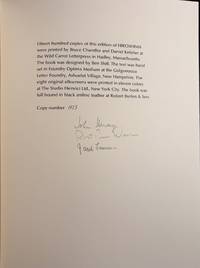
réf. 10484Signed by John Hersey Robert Penn Warren and Jacob Lawrence in pencil to the limitation page. Limited to 1500 copies of which this is number 1423. Illustrated by Lawrence containing eight original silkscreens printed in eleven colors with laid-in tissue guards. Bound in full black aniline leather at Robert Burlen & Son and housed in a black cloth slipcase. Printed by Bruce Chandler and Daniel Keleher at the Wild Carrot Letterpress in Hadley MA. Edges painted black. The Monthly Letter of LEC is laid in. Minor scuffs to the slipcase but overall this is a beautiful fine copy with no previous owners' names or other defacements. 10 x 13.25 in 25.5 x 33.5 cm The Limited Editions Club hardcover
réf. elala2706Lubeck: Jonas Schmidt 1750. First Edition. “This first edition is one of the important and fundamental treatises on ornithology – a work of reference for research scholars. It has been translated into German and utilized in large party by many writers.” Casey Wood Anker 254. Casey Wood p. 419 calling for 7 plates. Nissen 504. Zimmer 353. 4to. pp. 8 p.l. 238. 8 engraved plates 4 folding. engraved vignette on title. Uncut in contemporary stiff wrs. significant foxing & browning throughout Lubeck: Jonas Schmidt, 1750 unknown
réf. 53369n.p.: n.p. 2000. Very good plus. Three autograph letters signed ALS by the iconic American artist with original invitation to his memorial service and reception in New York City. Three handwritten letters one from 1982 and two from 1986 by the celebrated African-American painter of the famed MIGRATION SERIES among many other beloved works. The letters contain Lawrence's congenial responses to Mr. Harold F. Mays Jr. in requests for autographs of books by and about Lawrence. Also included is Mays's invitation to the artist's memorial service held shortly after his death in the year 2000 at Riverside Church in New York. Mays and his partner of more than 50 years Harold Herman owned Two Harolds Antiques in Alexandria VA for many years. The two were a legendary and pioneering interracial gay couple in the DC region. A warm collection of correspondence with a legendary artist with notable provenance. Letters 11'' x 8.5'' each. Original handwritten letters on onion skin paper in blue and black ink; trifolds to leaves from mailing. Two printed cards in original envelope roughly opened. Faint marginal toning to letters. n.p. unknown
réf. 140943874Seattle & London: University of Washington Press 2000. Signed First Edition. First edition limited issue. Signed by Jacob Lawrence on page at front of Catalogue Raisonne unnumbered copy in stated limitation of 250 copies. Two clothbound volumes housed in publisher's black slipcase. Fine in Fine dust jackets light shelf wear to slipcase. A deluxe two volumes survey of the African American artist's work in color. University of Washington Press unknown
réf. 53369n.p.: n.p. 2000. Very good plus. Three autograph letters signed ALS by the iconic American artist with original invitation to his memorial service and reception in New York City. Three handwritten letters one from 1982 and two from 1986 by the celebrated African-American painter of the famed MIGRATION SERIES among many other beloved works. The letters contain Lawrence's congenial responses to Mr. Harold F. Mays Jr. in requests for autographs of books by and about Lawrence. Also included is Mays's invitation to the artist's memorial service held shortly after his death in the year 2000 at Riverside Church in New York. Mays and his partner of more than 50 years Harold Herman owned Two Harolds Antiques in Alexandria VA for many years. The two were a legendary and pioneering interracial gay couple in the DC region. A warm collection of correspondence with a legendary artist with notable provenance. Letters 11'' x 8.5'' each. Original handwritten letters on onion skin paper in blue and black ink; trifolds to leaves from mailing. Two printed cards in original envelope roughly opened. Faint marginal toning to letters. n.p. unknown books
réf. 140943874Seattle & London: University of Washington Press 2000. Signed First Edition. First edition limited issue. Signed by Jacob Lawrence on page at front of Catalogue Raisonne unnumbered copy in stated limitation of 250 copies. Two clothbound volumes housed in publisher's black slipcase. Fine in Fine dust jackets light shelf wear to slipcase. A deluxe two volumes survey of the African American artist's work in color. University of Washington Press unknown books
1612réf. 41530Heidelberg and Leipzig: Gotthard Vögelin 1612. Leather. Good. 8vo mottled green leather and tan hardcover with yapp edges and exposed spine bands at the hinges. Title is very faded on the spine. Translated from Latin to German by Jacob Horst this work covers the "secrets of nature" from the four humors herbology the soul/body connection the influence of stars and more in a fascinating look at early mystical medicine practices. Believe this to be the 1612 edition. The condition of this early occult book is Good binding intact; little to no interior damage; general foxing and toning from age; some light cracking and wear at the creases of the cover particularly the yapp edges. Irregular pagination. Pages 124/125 are labeled 121/425. Pages 152/153 are labeled 152/152; next spread is 153/154. Pages 159/160 are misprinted as 159/161 there is no 160. The antiquarian here would like to note that this book is really cool. Gotthard Vögelin hardcover
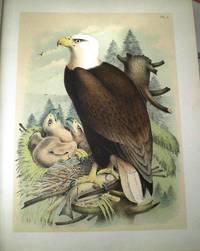
1878réf. 019037Columbus OH: Jacob H. Studer & Co. 1878. First Edition. Hardcover. Contents fresh one long closed tear to a text page in the second volume. Rubbing with some splitting to the leather along the spine edge of the front cover of the first volume but covers firm. Some loss of cloth to the second volume. Very Good with clean bright plates. Theodore Jasper. Two folio 11-3/4" x 15" volumes bound in publisher's half morocco leather with matching morocco corners. The first volume illustrated with 119 lovely chromolithographs drawn and colored from nature by Theodore Jasper; the second volume with 37 tinted lithographs. One of the best as well as one of the last great color-illustrated ornithologies. Later editions especially the 1903 edition have noticeably inferior quality plates. Jacob H. Studer & Co. hardcover books
1813réf. 46988London, Robert Baldwin, 1813 a. 1814. 8vo. 2 contemp. hcalf. Marbled boards. Spines lacks and boards detached. In: ""Annals of Philosophy"" or Magazine of Chemistry, Mineralogy, Mechanics... By Thomas Thomson"". Vol. II and Vol. III. Entire volumes offered. Berzelius' papers: pp. 276-284, 357-368 (the first paper in vol. II), pp. 443-454 (vol. II) a. pp. 51-62, 93-106, 244-257 a. 353-364. (vol. III). Internally fine and clean.
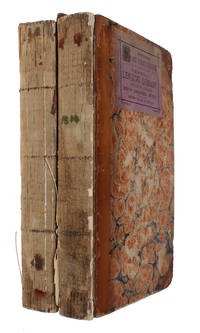
1813réf. 46988London Robert Baldwin 1813 a. 1814. 8vo. 2 contemp. hcalf. Marbled boards. Spines lacks and boards detached. In: "Annals of Philosophy; or Magazine of Chemistry Mineralogy Mechanics. By Thomas Thomson". Vol. II and Vol. III. Entire volumes offered. Berzelius' papers: pp. 276-284 357-368 the first paper in vol. II pp. 443-454 vol. II a. pp. 51-62 93-106 244-257 a. 353-364. vol. III. Internally fine and clean. First printing of these milestone papers in the history of chemistry where Berzelius introduced his famous chemical symbolism whereby an element is generally represented by the first letter of its Latin name or in the event of elements having the same first letter by the first two letters. Even though his atomic symbols were introduced in 1813 see the note on p. 359 in the first paper it was quite a few years before Berzelius's symbols were adopted by the chemistry community. But once accepted they became the new international language of chemistry.Berzelius "contributed more to the development of the atomic theory and to the setting up of accurate values of the atomic weights than did any other worker of the time. Of his contributions moreover to the development of the atomic theory and the advancement of chemical science not the least valuable was the introduction of a chemical symbolism which with slight modification is in use at the present day. By giving his symbols a quantitative meaning - the symbol of an element representing one atomic proportion by weight - it was possible "to show briefly and clearly the number of elementary atoms in each compound and after the determination of their relative weights present the results of each analysis in a simple and easely retained manner". This symbolism was speedily adopted on the Continent but in England only after some considerable time."Findlay "A Hundred Years of Chemistry" p. 14.Parkinson "Breakthroughs" 1813 C. - Leicester & Klickstein "A Source Book in Chemistry" p. 258 ff. - Holmberg 1813:28 a. The volume contains other notable papers THOMAS THOMSON "On the Discovery of the Atomic Theory" pp. 329-338. and JOHN DALTON "Remarks on the Essay of Dr. Berzelius on the Cause of Chemical Proportions" pp. 174-180 Vol. III. hardcover
réf. 009682Aux Editions du Sagittaire, Chez Simon Kra 0 36 volumes in-12 brochés, couvertures rempliées
1816réf. 6007Berlin, Nicolaischen Buchhandlung, 1816-1818. 2 tomes en 1 volume in-8 (202 x 115 mm), XXXVI-464 pp. et XX-380 pp. Reliure d'époque demi-basane, dos lisse orné, coiffe sup. absente, mors et coiffe inf. frottés, bon exemplaire.