56 074 résultats
1903réf. 140943456Nashville: National Baptist Publishing Board 1903. First edition. First edition. iv 298 pp. Bound in publisher's pebbled blue cloth lettered in gilt; appears to be the more modern-looking of at least two variants. Near Fine with light shelf wear age-toning to pages. Born in South Carolina to enslaved parents Jacob Tileston Brown 1863-1947 was one of the first African Americans to write Sunday School literature. He served as editor-in-chief of the National Baptist Convention's Sunday School Publishing Board for 23 years. National Baptist Publishing Board unknown books
1928réf. 140943459Nashville: The Sunday School Publishing Board 1928. First edition. 158 pp. Bound in publisher's green cloth lettered in gilt. Very Good with lettering a little rubbed wear at tips former owner's inscription on front free endpaper. Uncommon. Born in South Carolina to enslaved parents Jacob Tileston Brown 1863-1947 was one of the first African Americans to write Sunday School literature. He served as editor-in-chief of the National Baptist Convention's Sunday School Publishing Board for 23 years. This volume describes itself as "An experimental study observation and suggestion on the deaconship by himself and many of the very best ministers and scholars of the denomination both colored and white. The Sunday School Publishing Board unknown books
réf. 140943874Seattle & London: University of Washington Press 2000. Signed First Edition. First edition limited issue. Signed by Jacob Lawrence on page at front of Catalogue Raisonne unnumbered copy in stated limitation of 250 copies. Two clothbound volumes housed in publisher's black slipcase. Fine in Fine dust jackets light shelf wear to slipcase. A deluxe two volumes survey of the African American artist's work in color. University of Washington Press unknown books
2000réf. 33945Seattle and London: University of Washington Press 2000. Fine/Fine. Seattle & London: University of Washington Press 2000. Limited Edition of 250 signed copies this being number 203. Two quarto volumes 30cm; illustrated dust jackets over red and blue cloth boards with black lettering; 285pp 343pp; color illus. throughout; housed in publisher's slipcase. Jackets are crisp and bright with a couple very faint smudges to surface and light bumping to tail of Catalogue Raisonne. Boards are sturdy and square. Slipcase is sturdy and solid with a few stray scuffs and smudges but no splits or bumps. Publisher's description / UPC slip formerly attached to outer shrinkwrap laid in though cleanly torn in half. Signed by Lawrence without inscription on dedication page. The culmination of six years of research by the Jacob Lawrence Catalogue Raisonne Project the set documents over 900 paintings drawings and murals with essays by eight art historians on Lawrence's work. Lawrence was the first African-American artist to be represented by a New York agency and to have work held in the permanent collection at the Museum of Modern Art. University of Washington Press unknown books
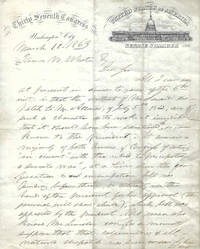
réf. 31330Quarto three pages written on Thirty-Seventh Congress Senate Chamber Illustrated Letterhead formerly folded in very good clean and legible condition. Unpublished letter by Senator Jacob Howard defending Lincoln's Knowledge of William Sewrd's July 5 1862 letter to Charles Francis Adams. An important Reconstruction-era letter written by Jacob M. Howard U.S. Senator from Michigan in which Howard writes at length regarding President Abraham Lincoln and the Emancipation Proclamation especially concerning a letter written by Secretary of State William H. Seward to American Minister to Great Britain Charles Francis Adams July 5th 1862 concerning the Emancipation Proclamation. During his tenure as Secretary of State Seward was at times criticized for transmitting important dispatches to foreign representatives without submitting them to President Lincoln especially to Minister Adams who was a close friend of Seward's. The letter of July 5th became a particular point of contention with content related to the preliminary Emancipation Proclamation which was publicly printed in the Diplomatic Correspondence. Here Howard defends Lincoln who disclaimed any knowledge of it at the time. "Dear Sir All I can say at present in answer to yours of the 6th inst. is that the contents of Mr. Seward's dispatch to Mr. Adams of July 5th 1862 are of such a character as to make it incredible that it should have been sanctioned by or even known to the president. It accuses a majority of both houses of Congress of acting "in concert" with the rebels to "precipitate a servile war" at a time when the confiscation act & emancipation bill was pending before them or actually in the hands of the president for his approval the journal will show which which bill was approved by the president. No man who knows Mr. Lincoln can for a moment suppose that that calumnious & ill natured dispatch was seen by him before it was sent. If the controversy were mine I would ask for no further evidence to overcome the denial of the Times. Again on the 22d Sept the president issued his proclamation announcing his purpose to emancipate the slaves of rebels on the first of Jan '63 This carried the emancipation policy much further than the confiscation act had done – or rather threatened to carry it much further. And with that proclamation in print before him Mr S at the opening of the last session deliberately printed & laid before the world that strange dispatch. Can any further proof be necessary whether to demonstrate the ignorance of Mr. Lincoln of the contents of the dispatch or the animus of its author towards him & towards a majority of Congress There are reasons for your not publishing this note & you will therefore not do so. For the present you have materials enough in the facts I allude to to make out your case against the Times without invoking other aid. … J. M. Howard" Jacob Merritt Howard 1805 – 1871 was born in Shaftsbury Vermont. He graduated from Williams College in 1830 and then studied law in Ware Massachusetts. Two years later he moved to Detroit Michigan where he was admitted to the bar in 1833. In 1835 he married Catherine A. Shaw with whom he had five children. In 1838 Howard was elected as a Whig to the lower house of the state legislature where he was active in revising the state's legal code in investigating Michigan's wildcat banks and in drafting railroad legislation. In 1841 he was elected to Congress. Throughout his tenure as a congressman Howard was an outspoken opponent of slavery. After completing his term he returned to private practice in Michigan. In 1850 when arguing a fugitive slave case before the U.S. circuit court he publicly denounced the Fugitive Slave Law and predicted that the country would eventually come to armed conflict over the issue of slavery. In 1854 Howard joined the new Republican party. He was one of the leading members of the Jackson Michigan convention held on July 6 that organized the new party. As chair of the Committee on Resolutions Howard drafted the party platform which deplored slavery as a social evil and opposed its expansion into the territories. He was reputed to have given the new party its name. The same year he was elected the state attorney general as a Republican. Howard served in this position from 1855 to 1861 when he was elected U.S. senator to replace Kinsley S. Bingham who had died in office. Known in Michigan as "Honest Jake" Howard was considered to be one of the "better constitutional lawyers in the Senate chamber." In the wartime debates in the Senate Howard consistently voted for Radical measures approved President Abraham Lincoln's emergency actions during the secession crisis and advocated "severe exemplary and speedy punishment" of the rebels. He was especially vocal on all matters pertaining to the confiscation of rebel property and the emancipation of slaves. He was one of the most forceful advocates of the 1863 Conscription Act and he served on the Committee on Military Affairs. As a member of the Committee on the Judiciary he drafted a portion of the Thirteenth Amendment. He also made several important speeches in favor of the Civil Rights Act of 1866. Howard opposed President Lincoln's Reconstruction program to readmit southern states on the "10 percent plan" 1863 which stipulated that 10 percent of the state's population had to take an oath of loyalty to the government to qualify for readmission. Howard contended that the federal government had a right to extend military rule over the defeated southern states and advocated extreme retaliatory measures. He argued forcefully that Congress and not the president had the power to judge the proper time and manner of readmitting the seceded states and that Congress also possessed the power to reorganize states upon readmission. Howard served on the Joint Committee on Reconstruction and traveled to Virginia North Carolina and South Carolina to investigate postwar conditions there. Upon Howard's return to Washington the committee submitted a proposal to Congress to amend the Constitution. The committee's proposals actively supported by Howard on the Senate floor passed both Houses of Congress as the Fourteenth Amendment. Although Howard had confidence in Andrew Johnson during the first year of Johnson's term he soon lost faith in the president. When Johnson tried to remove Secretary of War Edwin B. Stanton Howard reacted with outrage and authored the committee's report censuring the decision. During President Johnson's impeachment trial Howard voted to convict. Howard chaired the Committee on the Pacific Railroad from its creation in 1864 until 1871. President Ulysses S. Grant offered him the presidency of the Southern Claims Commission but he declined the post. At the end of his congressional career in 1871 Howard returned to Detroit where he died. In public Howard's image was grave and somewhat portly; his speaking style according to his eulogist Chief Justice John A. Campbell was eloquent but ponderous. Privately however he was a genial pleasant man with a keen sense of humor. According to George W. Julian in reminiscences about the Senate during the Civil War Howard "ranked among the first lawyers and most faithful men in the body and no man had a clearer grasp of the issues of the war." American National Biography vol.11 p. 304. This letter was sold by Anderson Galleries New York November 1927 in their sale of The Lincoln Collection of Emanuel Hertz Sale 2193 15 November 1927 Lot 128. books
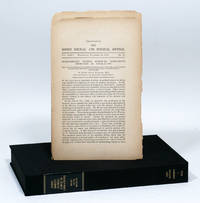
1847réf. 2758Boston 1847. 1st Edition. Original Wrappers. Very Good. FIRST EDITION OFFPRINT of the first announcement of the successful use of anesthesia during surgical operations one of the greatest discoveries of nineteenth-century medicine. A visitor to Boston Massachusetts would be well advised to take a stroll to the Ether Dome at Massachusetts General Hospital to see the amphitheater where surgery without pain began. On October 16 1846 dentist William T.G. Morton publicly performed a painless surgery through the use of general anesthesia thereby transforming surgical medicine and marking one of the greatest advances in medicine one that not only liberated patients from pain but enabled surgeons to perform more extensive operations. Offered here is the first edition offprint of the first announcement of Morton's seminal achievement as reported by Henry Jacob Bigelow in the November 18 1846 issue of The Boston Medical and Surgical Journal Vol. XXXV No. 16 pp. 309-316. Interestingly the offprint omits the last seven paragraphs from the journal article critical of the patent-holders: Drs. Morton and Charles T. Jackson. The redacted paragraphs likely indicates the offprint was issued shortly after the journal. Offprint from: The Boston Medical and Surgical Journal vol. XXXV No. 16. 8 pages. As issued without wrappers. Paper uniformly toned. First and last leaves detached from stitching. Small closed tear in margin of last leaf edges rough. Presented in a handsome custom box. RARE. unknown books
2012réf. 108917London:: Folio Society. As New. 2012. Hardcover. Color illustrations throughout. As new in like slipcase. Still in original shrinkwrap. . Folio Society, hardcover books
1967réf. 216247Amsterdam: Menno Hertzberger 1967. Hardcover. VG/G. Jacket has chips tears and tape repairs around all edges some rubbing and and toning. Book itself is clean and unmarked. Quarto. Hardcover. Red cloth with illustrated jacket. 205 pages illustrations some color. Dutch; Summary in English. Menno Hertzberger hardcover books
1979réf. 1414489New York New York: SUN 1979. First Edition First Printing. Softcover. Octavo v 124 pages. In Very Good condition. Bound in paper covers. Spine light green with black lettering. Light discoloration to spine and top left corner of front cover. Shelved in Case 0. 1414489. Shelved Dupont Bookstore. SUN unknown books
1922réf. 1410161Paris: Emile-Paul 1922. Limited Edition. Hardcover. Octavo 74 pages. In Very Good condition. Bound in full black leather with paneling and gilt lettering to spine. Minor shelf wear. Original front green wrap present within. Light foxing toward front of textblock. Inscribed by Jacob on half title page. Shelved in Case 12. 1410161. Shelved Dupont Bookstore. Emile-Paul hardcover books
1858réf. 1414134Boston: Phillips Sampson and Company 1858. 12mo v 69 pages. In Fair plus condition. Ex-library with library bookplate on front pastedown.Spine is brown without print. Boards in brown cloth gold print blind stamped design; slight wear to spine caps and corners small surface tear to front panel blemishes. Text block has tanning to endpapers short tears at spine to front endpapers occasional light foxing. NOTE: Shelved in Netdesk Column DD. 1414134. FP New Rockville Stock. Phillips, Sampson and Company unknown books
1917réf. 1414138Philadelphia: P. Blakiston's Son & Co 1917. Hardcover. Octavo vii 724 pages. In Fair condition. Spine is grey with faded print small paper label at bottom. Boards in grey cloth; fraying to spine caps and corners toning to spine peripheral toning shelf wear. Text block has cracked front hinge. Illustrated: "With 8 colored plates and 277 illustrations in text"- title page. NOTE: Shelved in Netdesk Column DD. 1414138. FP New Rockville Stock. P. Blakiston's Son & Co hardcover books
1913réf. 1414260München: George W. Dietrich 1913. Hardcover. Quarto 95 pages. In Fair condition. Spine is grey with faded print. Boards in grey cloth gold print; tattering to spine caps and corners tears to hinges smudging/shelf wear. Text block has light tanning to endpapers intermittent spine cracks. Illustrated: color frontispiece ands plates. Text in German gothic/fraktur font. Oversized books. Additional postage necessary for expedited/international orders. Economy International shipping unavailable due to size/weight restrictions. For international/expedited customers please inquire for rates. NOTE: Shelved in Locked Annex in quarto column. 1414260. FP New Rockville Stock. George W. Dietrich hardcover books
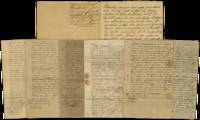
1836réf. List3741New York City 1836. Twelve documents totaling fourteen pages. See description for full inventory. Generally very good to excellent. Cary Ludlow 1736-1814 was a lawyer and merchant from the prominent New York City Ludlow family. In 1768 Ludlow had bought a property at 9 State Street on the Battery with plans to build a mansion there-lower Manhattan was becoming fashionable after the building of the Kennedy Mansion at 1 Broadway by Archibald Kennedy 11th Earl of Cassilis.1 However Ludlow was an ardently pro-Stamp Act Tory and because of this had to flee with his family to England around the outbreak of the Revolutionary War. Upon his return in 1784 he began work on the 9 State Street mansion which was completed around the mid-1790s shortly after the marriage of his daughter Catherine 1767-1849 to Jacob Morton 1761-1836. Later New York City Comptroller and Major General of the New York Militia during the War of 1812 Morton-who also appears in these documents-had been the marshal at George Washington's first inauguration.2 After the Revolutionary War many of New York's high society were moving to lower Manhattan especially on Front Street State Street and Broadway around Bowling Green and the Battery.1 The collection of legal filings offered here document this process of gentrification: they show Ludlow purchasing multiple lots surrounding his property on State Street from members of the lower classes. In particular Ludlow buys lots occupied by John Roorbach a grocer and Richard Anders an oysterman. Roorbach and Anders may have been renters or partial owners as the deals go through Samuel Craig whose occupation is listed as "gentleman" Robert Tuite Kemble formerly an officer of the British Army3 Cornelius Rosevelt likely of the Roosevelt family; also listed as "gentleman" and others. Following Cary Ludlow's death in 1814 the 9 State Street estate passed to Catherine and Jacob Morton and became a social center for the well-to-do epitomized by the 1824 ball the couple threw for the Marquis de Lafayette. However after Jacob Morton's death in 1836 the house became a boarding house; by the 1870s the 26-room mansion was home to "twenty-six Irish families" and Battery Park had become a spot where "roughs played base-ball" and vendors sold "horrible sweetmeats wormy apples and villanous lemonade". 1 The documents offered here illustrate several features of life for the elite during the Early Republic era: first they are primary documents of the gentrification of a neighborhood showing the displacement of its lower-class residents and the consolidation of property in the hands of a small number of wealthy owners; second the names appearing in them-Ludlow Morton Kemble-indicate that other than a small blip during the Revolutionary War financial ties outpaced political ones. State Street property documents: September 20 1794. Purchase and sale agreement between Roorbach and Ludlow for a house and lot on State Street "the street formerly called Copsey Street". Of the £1000 £600 goes to Kemble £200 to Samuel Craig and wife and £200 to Roorbach. 7 ¾ x 12 ½ inches 2pp folded Near Fine. February 7 1795. Release and quitclaim by Roorbach for two lots "in consideration of the sum of Five shillings . paid by Cary Ludlow" which were "mentioned and described in two certain Indentures" one between Cornelius and Catherine Rosevelt and Robert Tuite Kemble and the other between Kemble and Gerard Steddeford. 7 ¾ x 12 ½ inches 1pp folded excellent. February 7 1795. Agreement between Ludlow and Kemble with £500 owed to Kemble for a lot on the Battery bought by Kemble from Steddeford in 1791. 8 x 13 inches 1pp folded and separated at bottom fold with large tear at middle fold very good. February 7 1795. A stipulation that any payments by Ludlow to Roorbach would count towards his debt to Kemble. 8 x 12 ½ inches 1pp folded with several large tears at folds very good. May 4 1795. Indenture between Ludlow and Richard Anderson selling a "small lot" on State Street to Ludlow. The lot is specified as being bordered by the homes of Joseph Correy Stephen Smith and Ludlow likely No. 9. 9 ½ x 14 ¼ inches 2pp folded with some water stains but legible very good plus. June 19 1795. Release and quitclaim by Samuel Craig and his wife Rachel to Ludlow of a lot occupied by Roorbach. 8 x 12 ½ inches 1pp folded excellent to Near Fine. July 17 1795. Agreement between Ludlow and Anders to trade a house owned by Ludlow on Petticoat Lane Marketfield Street for one owned by Anders on State Street. 8 x 12 ¾ inches 1pp folded excellent. Other family documents: April 1775. Legal document signed by Ludlow as plaintiff's attorney in a debt case between Nicholas Ray and Benjamin Davis. 7 ½ x 5 inches 1pp very good plus. January 17 1818. Power of Attorney granted by Ludlow's widow Hester to John and George Morton brothers of Jacob Morton. 8 x 12 ½ inches 1pp excellent. February 28 1825. Grant of commission by Hester Ludlow to John and George Morton on proceeds to Ludlow's estate. 6 ½ x 8 inches 1pp excellent to Near Fine. January 21 1831. Receipt for sale of six shares in Butchers' and Drovers' Bank to Jacob Morton. 3 ½ x 7 ½ inches good. December 1 1836. Title to Vault 136 in the New York City Marble Cemetery for Jacob Martin. 7 x 9 ½ inches excellent. Of interest to historians of development and demographic change in New York City during the Early Republic era. 1 Rodolphe E. Garczynski "Some Old Houses illustrated" Appleton's Journal 8 no. 195 Dec 21 1872 696-699. 2 "Jacob Morton 1761-1836" American Aristocracy https://americanaristocracy.com/people/jacob-morton accessed April 23 2026. 3 "Robert Kemble 1755-1820" American Aristocracy https://americanaristocracy.com/people/robert-kemble accessed April 23 2026. books
1940réf. 1973New York: Delta Omega Society 1940. First English translation. ENGLISH TRANSLATION OF 19TH CENTURY EPIDEMIOLOGIC STUDY OF MEASLES ON THE FAROE ISLANDS. 13.5 x 20.5 cm hardcover brown cloth binding gilt title to spine bookplate of Henry Rust O-Brien M.D. to front paste-down his signature on front free endpaper i-xxxvii 111 pp tables. Very good in custom archival mylar cover. PETER LUDWIG PANUM 1820 – 1885 was a Danish physiologist and pathologist born on the island of Bornholm in Rønne. After completing his medical studies in 1845 Panum assumed a position at Almindelig Hospital in Copenhagen. During 1846 he was chosen by the government to undertake research of a measles epidemic in the Faroe Islands. As a result of his investigations which included examinations of the cultural practices he published a classic treatise titled "Observations Made During the Epidemic of Measles on the Faroe Islands in the Year 1846". Later he studied with Rudolf Virchow at the University of Würzburg 1851 and with Claude Bernard in Paris 1852–53. From 1855 Panum was a professor at the University of Kiel where he established a laboratory for physiology. In 1856 he published his research into what is now known as an endotoxin. This is now acknowledged as the first systematic and scientific studies of endotoxins a substance once referred to as "putrid poison" that was thought to be responsible for symptoms and signs observed in individuals with sepsis. Cited by Pickover in The Medical Book. 250 Milestones in the History of Medicine 2012: ";. Among the most famous epidemiologists of the 1800s were Danish physiologist Peter Panum who studied the spread of measles John Snow the spread of cholera and English physician William Budd the spread of typhoid fever. Panum's studv was of paramount importance being among the first extensive contributions to the modern field of epidemiology. In 1846 the Danish government asked 26-year-old Panum to study the spread of measles in tlie Faroe Islands located in the North Atlanhc Ocean. Although preventable today the anti-vaccine movement is allowing its reappearance. In 1846 measles had not caused death in the Faroe Islands for 65 vears but suddenly more than 6000 of the 1782 inhabitants fell victim to measles. Coastal valleys separated the various populations of the islands so the history of the disease in each small settlement could be studied in isolation from those in the others. By studying the various villages Panum determined that the incubation period for measles was about two weeks. He also supplied evidence of longlasting immunitv by interviewing old people who had been infected many years earlier none of whom contracted measles in 1846. Panum was convinced that measles was spread infectious agents via contaminated articles or by close human contact." PROVENANCE: HENRY RUST O'BRIEN 1891 - 1970 earned his M.D. from the University of Michigan Medical School in 1919. His first tour of duty in Siam was with the Department of Public Health under the Rockefeller Foundation from 1921-1923. His work there focused on effective control of the hookworm. After his return to the U.S. in 1923 he worked as an assistant resident in surgery at the Cincinnati General Hospital in Cincinnati Ohio. In 1925 he was appointed as a missionary to Siam by the PCUSA Board of Foreign Missions. Following his resignation from the Board of Foreign Missions in 1933 O'Brien worked as a government physician and surgeon. He also worked in medical education for the U.S. government and the Pennsylvania Department of Health. Delta Omega Society hardcover books
1981réf. 20850New York: KTAV 1981. First edition. Hardcover. vg. 8vo. xx 348 pp. Dark tan cloth with gold lettering on spine in original decorative dj. Includes a preface list of abbreviations glossary table of transliterations Index to Biblical and Talmudic References and a general index. In English translated from the Hebrew. Age wear and scuffing to corners and edges of dj. Minor bumping to head and foot of spine. Dj in good book in very good condition. KTAV hardcover books
1969réf. 1413894Chicago and London: The University of Chicago Press 1969. Hardcover. Octavo two volumes. In Very Good condition. Black pictorial slipcase has slight plus wear including slight scuffs with rubbing to the edges. Quarter bound black spines with red boards bearing silver lettering to the spines. Boards have very slight wear. Text blocks have very slight wear including faint age toning/foxing to the edges. Frontispiece. Illustrated. CONTENTS: Vol. One "The Tales" 1969 ISBN 0226347883 315 pages -- Vol. Two "The Novel" 1969 ISBN 0226347883 363 pages. NOTE: Shelved in Locked Annex Column CC. Oversized books. Additional postage necessary for international/expedited orders. Economy International shipping unavailable due to size/weight restrictions. For international/expedited customers please inquire for rates. 1413894. FP New Rockville Stock. The University of Chicago Press hardcover books
1959réf. 012617Norman Oklahoma: University of Oklahoma Press 1959. Dust jacket with almost no wear. Small closed tear top of rear panel. Translated from the German and edited by Thomas N. Bonner. Schiel a German scientist was born in 1813. He published his account of the western US journey in German in 1859. Twelve illustrations and a double-page map. 114pp. First English Editiion. Green Cloth. Nearly Fine/Price-clipped Dust Jacket. Octavo. University of Oklahoma Press Hardcover books
1951réf. 011750London: Chatto and Windus 1951. Front cover vignette of antlered buck in gilt. This is a revised and modernized version of the "History of Signboards" with a chapter on modern inn signs by Gerald Millar. Illustrated in black and white with 64 plates of inn signs and 16 plates of billheads. Gift inscription on the front free endpaper. 336pp. with index. . First Edition. Red Cloth Lettered in Gilt. Minor Wear and Soiling./No Jacket. Large Octavo. Chatto and Windus Hardcover books
1812réf. 1356421Boston: Bradford & Read 1812. Hardcover. Octavo xiv 15-344 pages. In Good condition. Bound in contemporary leather with gilt ruling and label bearing gilt titling to spine. Binding shows moderate marking to boards and light wear to spine edges and corners. Text block extensively age toned and foxed. Name of a previous owner "Danl M Dougall" in ink on title page. MF Consignment. 1356421. Special Collections - Downstairs. Bradford & Read hardcover books
1977réf. RH1316Chicago:: University of Chicago Library 1977. 1977. 28 cm. no pagination. Illus. index. Printed wrappers. Very good. University of Chicago Library, 1977). unknown books
1670réf. AH1304Geneva:: Pierre Couet 1670. 1670. Small 8vo. viii 459 1 pp. Printed on very thin paper; some browning or spotting though mostly a clean copy. Original quarter calf spine with gilt-bands green leather spine label marbled boards; some wear to corners. Very good. RARE. First edition. This work made up of 3 chapters falls within the category of Biblical interpretation and criticism. / Girard was a Swiss physician humanist and moralist. He studied at the l'academie de Lausanne. He later wrote Le gouvernement de la sante 1672 ; L'apothicaire charitable 1673; and Harangue de la goutte 1673. His father was a professor of Hebrew. Like his father Girard led a rich and double career in Lausanne as a doctor and a professor of Hebrew 1642-1681. He also gave lessons on medicinal plants for future pastors. See: Gilbert Marion: "Girard des Bergeries Jacob" in: Dictionnaire historique de la Suisse. Pierre Couet, 1670. hardcover books
1974réf. EEG1224Waltham MA:: Mark Press 1974. 1974. Fourth printing. 8vo. 4 vi 153 1 pp. Red cloth. Very good. Mark Press, 1974. hardcover books
1834réf. EEG1023Tubingen:: Heinrich Laupp 1834. 1834. 8vo. x 398 pp. Index. Early quarter gilt-stamped calf German blue paste-paper over boards; spine worn. Title with ownership stamp of the Societe de Lecture de Geneve. Very good. Thirteenth annual. Reviews the contributions from the fields of physics chemistry minerology plant-chemistry biochemistry and geology. / From 1822 until 1841 annual reports were issued regarding articles and studies that advanced knowledge in chemistry minerology geology and other sciences. Berzelius is often credited as one of several founders of modern chemistry. He created a form of chemical notation that remains largely in force today as well as discovering and naming the elements silicon selenium thorium and cerium. He is credited with coining such terms as catalyst polymer and isomer. / "Periodically published bibliographies of chemistry that are of importance to historians include Jacob Berzelius' Jahres-Bericht uber die Fortschritte der physischen Wissenschaften in 20 volumes Tubingen 1822-41. . . " – Andrew Hunter Thornton and Tully's Scientific Books Libraries and Collectors. Heinrich Laupp, 1834. hardcover books
1831réf. EEG1022Tubingen:: Heinrich Laupp 1831 1832. 1831. 2 volumes in 1. 8vo. viii 270; x 353 pp. Early quarter gilt-stamped calf German blue paste-paper over boards; spine worn. Title with ownership stamp of the Societe de Lecture de Geneve. Very good. Tenth and Eleventh annuals. Reviews the contributions from the fields of physics chemistry minerology plant-chemistry biochemistry and geology. / From 1822 until 1841 annual reports were issued to Sweden's parliament regarding articles and studies that advanced knowledge in chemistry minerology geology and other sciences. Berzelius is often credited as one of several founders of modern chemistry. He created a form of chemical notation that remains largely in force today as well as discovering and naming the elements silicon selenium thorium and cerium. He is credited with coining such terms as catalyst polymer and isomer. / "Periodically published bibliographies of chemistry that are of importance to historians include Jacob Berzelius' Jahres-Bericht uber die Fortschritte der physischen Wissenschaften in 20 volumes Tubingen 1822-41. . . " – Andrew Hunter Thornton and Tully's Scientific Books Libraries and Collectors. Heinrich Laupp, 1831, 1832. hardcover books