136 résultats
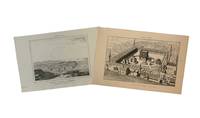
1926réf. 144231926. Gröber Karl. Two Views of the Mosque at Mecca 1926. Pair of original copperplate photogravures depicting the Masjid al-Haram the Sacred or Grand Mosque in Mecca Islam's holiest city and the destination of the annual Hajj pilgrimage. The mosque surrounds the Kaaba toward which Muslims worldwide turn in daily prayer. Published in 1926 the illustrations date from the early period of Saudi rule over Mecca following the city's conquest by Abdulaziz Ibn Saud in 1924. The two views record the mosque from ground-level and elevated perspectives preserving photographic documentation of the sacred precinct before the extensive architectural expansions of the later twentieth century. Gröber Karl photographer. Two Views of the Mosque at Mecca. 1926. Two original copperplate photogravures after photographs by Gröber published in the first edition of a 1926 book containing his text and photographic illustrations. Each sheet measures approximately 8.25" x 10.25" with a printed area of approximately 6.25" x 8.25". The first photogravure presents a ground-level view of the mosque recording its architecture from within the surrounding urban setting. The second provides a bird's-eye view of the mosque showing the sacred complex from an elevated perspective. Both illustrations reproduce the tonal gradations and architectural details of the original photographs through the copperplate photogravure process. The illustrations were published during a decisive period in the modern history of Mecca. Following the collapse of Ottoman authority in the Hejaz during the First World War the city came under Hashemite rule before its capture by Ibn Saud in 1924. In 1926 Ibn Saud assumed the title King of the Hejaz incorporating Mecca into the expanding Saudi state. The paired views record the mosque's architectural setting during this transition preceding the major expansion and redevelopment campaigns undertaken from the mid-twentieth century onward. Both original photogravures are in excellent condition presenting complementary perspectives of the Grand Mosque as reproduced in 1926. unknown
2024réf. x-1032525355Routledge 2024. Hardcover. New. 414 pages. 10.00x7.00x10.00 inches. Routledge hardcover
1847réf. 146231847. Mecca is the birthplace of prophet Muhammad and home to the Kaaba the holiest site while Medina is the second holiest city where the Prophet's Mosque is located.Two original steel engravings titled "Medina et Sepulcre du Prophete" and "Temple de la Mecque" issued in Picturesque Universe Paris: Firmin Didot 1847. Engraved plates measuring approximately 5" x 8.2". These mid-nineteenth-century French views present idealized yet intricately rendered representations of Islam's two holiest cities Medina and Mecca produced for a European readership at a moment of expanding Orientalist travel literature and imperial curiosity about the Islamic world. The Medina engraving offers a panoramic prospect from an elevated vantage point depicting the walled city and the Prophet's Mosque at its center approached by four travelers traversing a mountainous road some mounted on camels. The composition emphasizes distance and pilgrimage situating the sacred city within both devotional and geographic imagination. The companion engraving of Mecca presents a detailed architectural rendering of the Masjid al-Haram complex with the Kaaba prominently centered and surrounded by arcades and ancillary structures the broader urban fabric faintly delineated in the background. Produced at a time when non-Muslim access to these cities was extremely restricted such engravings mediated sacred Islamic space through European print culture shaping nineteenth-century visual conceptions of the Hijaz. As products of a major Parisian press renowned for technical excellence these steel engravings reflect both advances in reproductive printmaking and the period's fascination with global religious and cultural monuments.First engraving with loss to the lower right corner not affecting the primary architectural focal points; light age toning and minor edge wear consistent with issue; second engraving clean and well-preserved with strong plate impression. Overall very good. An evocative pair of mid-nineteenth-century European views of Medina and Mecca documenting the circulation of Islamic sacred geography within illustrated travel literature at the height of Orientalism publishing. unknown
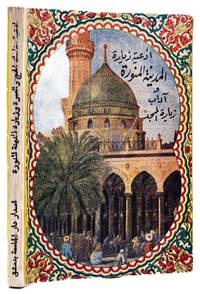
réf. 66333Damascus: University House c.1950s. Small 8vo. 14 x 10.5 cm. pp.191. Publisher's original pictorial wrappers colour-printed with Kaaba to upper cover and Prophet's Mosque Medina to back spine lettered in Arabic script. 16 black & white illustrations including one double-page. Generally a very good copy. Damascus: University House, [c.1950s]. unknown
1790réf. 145711790. Engraved plate titled View Of The Temple of Mecca and accompanying Plan Of The Temple of Mecca circa eighteenth century represents an early modern European visual interpretation of the Kaaba and the Masjid al-Haram in Mecca Islam's most sacred site. Produced for inclusion in eighteenth-century printed works including editions of André du Ryer's French translation of the Qur'an L'Alcoran de Mahomet the engraving reflects European efforts to depict and systematize knowledge of Islamic sacred geography during a period of expanding global contact. The print supports research in Islamic studies the history of book illustration Orientalist visual culture and early modern European representations of non-Christian religious architecture. Engraved plate. Circa 1700s. Approximately 8 x 12 inches. Unmounted and unframed. The foldout plate comprises two distinct but related images: an aerial plan of the sacred precinct at Mecca and a perspectival view of the Kaaba within the Masjid al-Haram. The central structure of the Kaaba is depicted surrounded by arcaded and domed architectural elements characteristic of the sanctuary as understood in the eighteenth century. In the foreground courtyard numerous Muslim worshippers-approximately one hundred figures-are shown engaged in prayer emphasizing both ritual practice and spatial organization. The engraving was issued in connection with eighteenth-century European editions of Islamic texts including Du Ryer's influential translation and reflects the period's hybrid combination of documentary ambition and interpretive stylization. As a visual artifact circulating within early modern printed Qur'anic translations the plate documents how European readers encountered Islam through mediated imagery shaped by travel accounts diplomatic reports and secondhand description. Such engravings played a formative role in constructing Western visual conceptions of Mecca at a time when access to the holy city was restricted to Muslims. The presence of both plan and elevation view demonstrates Enlightenment-era interest in architectural order cartographic precision and comparative religion. Light age-related toning and traces of original fold at center; minor fold wear consistent with issuance as a book plate; image clear with well-preserved engraved detail. Overall very good condition. A significant eighteenth-century engraved representation of the Kaaba and Masjid al-Haram reflecting early European visual engagement with Islamic sacred space. unknown
1921réf. 148161921. Unpublished sepia-toned photograph of pilgrims journeying to Mecca circa 1921 documents the material and spatial realities of the Hajj in the early twentieth century during a period of geopolitical transition in the Arabian Peninsula following the First World War. The image captures a vast encampment of white tents set against a rugged and mountainous landscape outside Mecca visually conveying the scale of pilgrimage infrastructure prior to modern urban expansion. Created during the years immediately preceding the establishment of the Kingdom of Saudi Arabia in 1932 the photograph supports research in Islamic religious practice the history of pilgrimage logistics and British imperial observation of the Hejaz during the inter war period. Photograph. Circa 1921. Approximately 3.5 x 5 inches. Sepia-toned silver gelatin print. The composition presents thousands of white tents clustered across uneven terrain forming a temporary city of pilgrims undertaking the religious journey to Mecca. The mountainous backdrop situates the encampment geographically within the arid environment surrounding the holy city. The photograph originates from the album of a British naval officer who traveled in the region between 1920 and 1923 providing contemporaneous visual documentation from a foreign observer during a time of shifting political authority in the Hejaz following the collapse of Ottoman control. The image appears unpublished and retains the intimate scale characteristic of personal travel albums. As a visual record predating large-scale modernization of pilgrimage facilities the photograph preserves evidence of early twentieth-century Hajj organization material culture and environmental conditions. The presence of an extensive tent city underscores both the enduring continuity of Islamic ritual practice and the logistical complexity of pilgrimage prior to the oil-era transformation of the region. Light age-related curling; minor chipping at lower edge not affecting the image area; surface otherwise clean with strong tonal range. Overall good condition. A historically significant early twentieth-century photograph documenting the lived landscape of pilgrimage to Mecca during a pivotal moment in Arabian political history. unknown
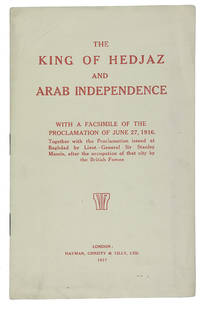
1917réf. F14GSQ01U79OLondon: Hayman Christy and Lilly Ltd. 1917. Original stapled wrappers with red lettering on front wrapper. 8vo. With a photographic portrait of Hussein bin Ali for frontispiece and a folding facsimile proclamation 38 x 28 cm. British pamphlet advertising the independence of Hedjaz from Ottoman rule. The pamphlet includes a facsimile of the proclamation in Arabic pronouncing the Arab peoples free from Turkish domination an introduction about allied involvement the Monroe Doctrine and its role in the region and more basic history behind the eventual writing of the proclamation.Some minor traces of use. In very good condition. Hayman, Christy and Lilly Ltd., unknown
1896réf. 056105Mecca: Hicâz Vilâyet Matbaasi Mecca AH 1314 CE 1896/97. 1896. 1st Edition . Hardcover. Very Good. 8vo - over 7¾ - 9¾" tall. Contemporary quarter purple cloth. 4to. 28 x 20 cm. In Ottoman Turkish and Arabic with sporadic Persian verses. 1 blank page 3 222 p. A label on spine slight wear to spine single leaf of index is loosely inserted. Else a very good and collectible copy "Al-Matba'a al-Miriyya" seal on colophon as a common practice of preventing counterfeits in the period. An exceptionally rare first Mecca edition of a single-volume work containing two celebrated texts representing the final nineteenth-century Turkish commentaries on the Qasîda-i Burda. Authored by Necib Bey of Antioch an Ottoman official who served in the Hijaz the volume was printed at the first press established in the region by Osman Nuri Pasha. The Qasîda-i Burda is a thirteenth-century ode of praise to Muhammad composed by the Egyptian Shadhili mystic al-Bûsîrî. The first two pages of the work are devoted to complimentary letters written for the book by the then Governor of the Hijaz Ahmed Ratib Pasha 1846-1913 and by the Arab scholars Abd al-Jalil Burade and Arif Khan Tashkendi. One of the letters is in Arabic the other in Ottoman Turkish. The final Turkish commentary on the Qasîda-i Burda produced in the nineteenth century belongs to Necib Bey of Antioch d. after 1319/1902 who served as an official in the Hijaz region. Necib Bey held administrative posts at both institutions known as al-Tekiyyât al-Miriyya The Egyptian Tekke charitable imarets established by Mehmed Ali Pasha of Kavala the Khedive of Egypt d. 1265/1849 one in Mecca and the other in Medina. As he himself states in his commentary Necib Bey received his education in Western Anatolia and travelled extensively across a wide geographical area including regions beyond Ottoman territory such as Europe and Russia marking him as a Turkish traveller and scholar of broad experience. In addition to these qualities he was also active as an educator and is known to have tutored members of the elite including Khedive Abbas Hilmi II of Egypt d. 1944 and his brother Mehmed Ali Pasha. Two works by Necib Bey are known both of which are Turkish commentaries on the Qasida-i Burda poems of Ka'b b. Zuhayr and al-Bûsîrî. The first bears the title Is'âd: Shar-i Bânet Su'âd and the second Mukhtaar Tawassul: Shar-i Qasîda-i Burda. These two works were published together in a single bound volume in 1896/97 at the Hijaz Provincial Printing House. The title Mukhtaar Tawassul derives from the fact that this work is an abridgement of the commentary entitled Tawassul by Mekkî Mehmed Efendi d. 1212/1797. The commentary entitled Is'âd takes its name from the Arabic commentary Is'âd 'alâ Bânet Su'âd written by the Egyptian scholar Ibrâhîm b. Muammad al-Bâjûrî d. 1277/1860. The commentator explains this choice of title with the statement: "This commentary being in the nature of a translation of Bâjûrî's commentary has therefore been named Is'âd after its original title." However the diversity of sources evident in the work the inclusion of autobiographical details Sufi narratives poetic examples in three languages and several critical remarks directed at the primary source clearly demonstrate that the text stands much closer to an original composition ta'lîf than to a mere translation tarjama. Gürler. ON THE FIRST PRINTING HOUSE IN THE HIJAZ: The distinctive cultural character of Meccan society as a centre for learning intellectual exchange and scholarly debate was a decisive factor in the introduction of printing to Mecca. This development was welcomed by both scholars and the local population and materialized in 1882 under the auspices of the Ottoman governor of the Hijaz Osman Nuri Pasha. Although the Ottoman government had established the first printing press in the Arabian Peninsula earlier in Sana'a in 1877 1295 AH Mecca became acquainted with printing shortly thereafter in 1300 AH 1882-83 with the founding of an official government press. The Meccan pres Hicâz Vilâyet Matbaasi, Mecca, AH 1314 [CE 1896/97]. hardcover
1914réf. 000555Bagdad: Dar us Salam press 1914 Book. Good. No Binding. 1st Edition. 12mo - over 6¾ - 7¾" tall. Printed on weak paper. The first and only part printed in Bagdad of 3 parts by the author later printed together in Cairo. Very rare printed book in Bagdad during the world war about the political and military history of Bahrain and al-Khalifa. 144 p. Arabic text with one photographic plate of the author. Scarce. Dar us Salam press
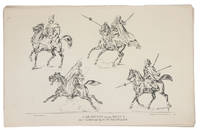
1855réf. GA1LWVIQL20BVienna 1855. Oblong folio 25 x 40 cm. Matthias Trentsensky printed by E. Sieger Loose leaves in a later paper folder. With 19 of 24 numbered leaves containing about 135 lithographic pen-drawings of people animals equipment & gear and goods from a caravan travelling to Mecca each drawing including a base so that one can cut them out paste them on card stock stand them up and arrange them in three-dimensional scenes. Lacking leaves 1-5. ll. 6-24 of 24. All but the first five leaves of a very rare lithographic print series issued in parts. Most copies were probably cut up and perhaps coloured by children and destroyed in play. The human figures to be cut out include Turkish Arabic African and Near Eastern men and women black and white in Islamic clothing some of the men with a variety of firearms spears daggers pipes prayer rugs and other gear and goods. There are also camels horses and donkeys often with their gear for riding or for carrying loads. The wild animals include wolves a hyena and an ostrich. Inanimate objects include containers for water an incense burner baskets chests barrels camel saddles and much more. The series must have provided many children and adults with their first notion of Islamic society and culture and is rich in authentic details.With an occasional pencil mark. Lacking leaves 1-5 but otherwise in remarkable good condition. The whole is slightly browned and the edges somewhat tattered.l Kleine Welt des Bilderbogens: der Wiener Verlag Trentsensky 1977 111; Siefert ed. Paläste Panzer Pop-up-Bücher 2009 with a chapter Die Carawane nach Mecca pp. 31-38; not in KVK; WorldCat. ART ARCHITECTURE & PHOTOGRAPHY DRAWINGS PRINTS & WATERCOLOURS HORSES HUNTING SPORTS & GAMES MIDDLE EAST & ISLAMIC WORLD Arabian Peninsula & Gulf States Games & Sports Islamic Art Culture & Science hardcover
1885réf. 000419Istanbul: Adolphe Braham 1885 Book. Very Good. Hardcover. 8vo - over 7¾ - 9¾" tall. 64 PP FRENCH REPORT. Chapitre 1: djeddah- ses environs- son importance commerciale- eaux- climat- Autorites Turque- Coutumes- Esclavage- Maladies. Chapitre 2: Itineraire de Djeddah a la Mecque- La Mecque- Ses anvironns- Ceremonie du Haram el Cherif- Description de la ville Sainte- Cherif actuel Cherif Abd El Moutaleb. Chapitre 3: Du Pelerinage son origine- Description de cette ceremonie- conditions pour que le Pelerinage soit valable- Pelerinage de 1882. Chapitre 4: Cholera- Congregations religieuses. Together with: Les Russes en Asie Mineure 1723-1877 Par M. Maxime Legrand Paris Imprimerie et Librairie Militaires 1878. 50 pp. bound together in contemporary ornamented hard cover spine slightly chipped. Adolphe Braham hardcover