17 224 résultats
réf. 13982845Amsterdam: Aux dépens de la Compagnie, 1720 3 vol in-12, t. 1: frontispice (manque minime de papier dans la marge), page de titre, (8)-308-(7) pages, 5 planches ( la planche p. 158 mal pliée et déchirée sans manque); t. 2: page de titre, 278-(9) pages, 8 planches, 1 carte; t. 3: page de titre, 176-(2) pages, 15 planches. Reliure plein veau d'époque, dos à 5 nerfs, caissons à fleurons dorés, roulette dorée sur les coupes, coins usés, petit manque de cuir à la coiffe sup. du t.3, petit manque de cuir au dos et au mors du 2ème plat du t.2, sinon bon exemplaire, complet du frontispice, des 28 planches (plusieurs se dépliant) et de la carte dépliante. STRUYS, JAN JANSZOON est un voyageur et navigateur hollandais du 17e siècle.
1816Constantinople, Odessa, Canary Islands, Spain, Italy, 1816-1818. Manuscript journal chronicling two voyages with a British merchant brig called "Exchange," featuring a sixteen-month voyage for trade at the Turkish city of Constantinople and Russian ruled Odessa only five years after the conclusion of the Anglo-Russian War, and two years prior to Odessa becoming a Free Port, being a detailed nautical log made by Peter Cook, a ship's mate twenty-six years of age. Folio. 88 pages, with authorship signature. A purpose-made document produced by J. Robins & Sons of Southwark, for recording nautical data during a sea voyage, completed in manuscript by the marine. Double leafs measuring approximately 21 x 32 cm, watermarked "O & P 1812" and with the Britannia, string-tied with paper wrappers titled in manuscript to front. Together with a single leaf in the same hand, with a hand coloured manuscript drawing of a mariner's compass to recto, and manuscript notes on Traverse Sailing to verso, made by the same hand circa 1805-1810, measuring approximately 21 x 25 cm. Together with the mariner's pensioner ticket, a legal document made on vellum, completed in manuscript, dated and signed on 22 April 1872 by an administrator of the Board of Trade, measuring approximately 19,5 x 25 cm. Some age-toning, a few leafs chipped at margin, otherwise in very good and original condition. Little is known of the vessel or the writer, other than what is revealed in the present documents. Robert Ashton was the commander of the brig, "SS Exchange" whose home port at the time was Plymouth. Peter Cook, born 1790, was a man of short stature, evidently employed by the mercantile marine. He was placed on the Pension List by the Board of Trade at the Port of Milford, Surrey, effective 1 April 1871, and resided in Tenby in Wales. Manuscript
1769réf. 719841769. Lausanne: Francois Grasset & Comp. 1769. Lausanne: Francois Grasset & Comp. 1769. Early French Translation of an Important Document of the Enlightenment Catherine II 1762-1796 Empress of Russia. Balthasar Joseph Anton Felix von 1737-1810 Translator. Instruction Donnee par Catherine II. Imperatrice et Legislatrice de Toutes les Russies a la Commission Etablie par cette Souveraine pour Travailler ala Redaction d'un Nouveau Code de Loix Telle Qu'elle e ete Imprimee en Russe & en Allemand Dans l'Imprimerie Imperiale de Moscow. Nouvelle Edition Augmentee. Lausanne: Chez Francois Grasset & Comp. 1769. xiv 160 i.e. 204 pp. Lacking dedication leaf and copperplate portrait frontispiece. Quarto 7" x 4-3/4". Recent period-style three-quarter calf over marbled boards raised bands and red and black lettering pieces to spine marbled endpapers untrimmed edges. Light rubbing to extremities light fading to spine. Moderate toning light foxing in a few places. $1250. Third French-language edition. An important document of the Enlightenment the Nakaz or Instruction composed by Catherine the Great served to guide the assembly summoned in 1766 to draft a new code of laws for the Russian Empire. Drawn primarily from Montesquieu as well as Rousseau Beccaria and other Enlightenment thinkers the Nakaz condemned torture and capital punishment and endorsed such principles as the equality of all before the law. Published in the principal European tongues between 1767 and 1769 it proved to be a statement to the world as much as a practical legal text. Three editions in French were published in 1769 first in Moscow then in Yverdon with a false St. Petersburg imprint and Lausanne. In 1769 Duc de Choiseul added the "libertine" Nakaz to the list of books prohibited in France. Balthasar the translator of our edition was a Swiss historian and member of the Enlightenment's international "Republic of Letters." His introduction pp. iii-iv is a notable document of the early reception of the Nakaz in Western Europe. Graesse Tresor de Livres Rares et Precieux II:80. unknown
1771réf. 647971771. Amsterdam 1771. 2nd Dutch ed. Amsterdam 1771. 2nd Dutch ed. Scarce Early French-Language Edition of Catherine the Great's Landmark Legal Treatise Issued by Marc-Michel Rey The Premier Publisher of the Enlightenment Catherine II 1762-1796 Empress of Russia. Instruction de Sa Majeste Imperiale Catherine II. Pour la Commission Chargee de Dresser le Projet d'un Nouveau Code de Loix. Amsterdam: Chez Marc Michel Rey 1771. vii 229 pp. Frontispiece engraved copperplate medallion portrait of Catherine II by C.A. Boily. Octavo 7-3/4" x 4-3/4"; 19.68 x 12.06 cm. Contemporary mottled calf blind rules to boards gilt spine with lettering piece edges rouged marbled endpapers. A few minor scuffs to boards moderate rubbing to extremities spine ends worn front joint starting at ends corners bumped and somewhat worn. Light toning to text dampstaining and light foxing to a few leaves internally clean. An attractive copy. $1250. Second Dutch edition. Known universally as the Nakaz or Instruction this monument of legal philosophy was composed by Catherine II between 1764 and 1766 as a guiding manual for the All-Russia Legislative Commission convened in 1767. Intended to replace the outdated Sobornoye Ulozheniye 1649 Muscovite Code the treatise stands as one of the most prominent practical applications of Enlightenment jurisprudence in early modern Europe. Heavily influenced by Montesquieu's De l'Esprit des Lois and Beccaria's Dei Delitti e Delle Pene the text translates radical legal theories into imperial policy. It explicitly advocated for equal protection under the law for all citizens abolition of torture and strict limitation of the death penalty prevention of crime over retributive punishment and judicial proportion between crimes and penalties. Catherine drafted the original text in French and subsequently produced a Russian translation. Following the initial 1767 Moscow printings in Russian and German regional editions proliferated across Europe. The text was famously banned in France by Louis XV due to its radical political liberalism-a censorship event that only increased continental demand. The first Dutch edition was published in Dutch translation in 1769. This 1771 imprint by Marc-Michel Rey represents the first Dutch edition printed in the original French. Publishing from Amsterdam Rey was the principal printer for ra. unknown
1771réf. 648601771. Amsterdam: Chez Marc Michel Rey 1771. Amsterdam: Chez Marc Michel Rey 1771. Attractive Early Amsterdam Edition of Catherine's Nakaz Catherine II 1762-1796 Empress of Russia. Instruction de Sa Majeste Imperiale Catherine II. Pour la Commission Chargee de Dresser le Projet d'un Nouveau Code de Loix. Amsterdam: Chez Marc Michel Rey 1771. vii 229 pp. Copperplate portrait frontispiece. Octavo 7-3/4" x 4-3/4". Later patterned-paper covered boards calf lettering piece to spine patterned endpapers. Minor wear to spine ends and corners front joint starting at ends. Negligible light toning to text dampstaining to bottom and fore-edges of text block very faint in most places in preliminaries somewhat darker. A nice copy. $1250. Second Dutch edition. This important text also known as the Nakaz or Instruction is a statement of legal principles written by Catherine II from 1764 and 1766. Permeated with the ideas of the French Enlightenment and copied mostly from the work of Voltaire Montesquieu and Beccaria it was compiled as a guide for the All-Russia Legislative Commission convened by the Empress in 1767 to create a new code to replace the 1649 Muscovite Code. Revised in consultation with Beccaria Frederick the Great and Voltaire the Nakaz proclaimed the equality of all men before the law and disapproved of the death penalty and torture. Unfortunately her proposed code was never completed. Catherine's manuscript was written in French and she later produced a Russian translation. Editions in German and Russian were published in Moscow in 1767. Several editions followed in nations ranging from Italy to Latvia. The first Dutch edition in Dutch translation was published in Amsterdam in 1769. The 1771 Amsterdam edition was the first Dutch edition in French. It is a scarce imprint. OCLC locates 2 copies in North American law libraries Library of Congress UC-Berkeley. Butler The Nakaz of Catherine the Great 528 entry 28. unknown
1907réf. 653411907. The First Edition of the Nakaz Published in the Twentieth Century Catherine II 1762-1796 Empress of Russia. Chechulin Nikolai Dmitrevich 1863-1927 Editor. Nakaz Imperatritsy Ekateriny II Dannyi Kommissii o Sochinenii Proekta Novago Ulozheniia. St. Petersburg: Izd. Iurid. Knizhnago Sklada "Pravo" 1907. ii cliv 174 pp. Three folding plates of facsimile manuscript leaves. Text of Nakaz in Russian with parallel French translation. Contemporary pebbled cloth light rubbing to extremities with minor wear to spine ends and corners which are bumped. Light toning to text a few leaves have carefully repaired tears. Early inscription and owner inkstamp to title page interior otherwise clean. $1250. The first edition published in the twentieth century. Title two in the series Pamiatniki Russkago Zakonodatel'stva 1649-1832. The Nakaz or Instruction is a statement of legal principles written by Catherine II between 1764 and 1766. It was among her most ambitious and significant undertakings. Infused with the ideas of the French Enlightenment and copied mostly from the work of Voltaire Montesquieu and Beccaria it was compiled as a guide for the All- Russia Legislative Commission convened by the Empress in 1767 to create a new code to replace the 1649 Muscovite Code. Revised in consultation with Frederick the Great and Voltaire the Instruction proclaimed the equality of all men before the law and denounced torture and the death penalty. Unfortunately her proposed code was never completed. The first two editions one with parallel texts in Russian and German were published in 1767. Our 1907 edition may have been inspired by a spirit of reform fired by the Russian Revolution of 1905. OCLC locates 1 copy in a North American law library Columbia. Another copy located at Harvard Law School. Butler The Nakaz of Catherine the Great 526 Entry 19. unknown
1769réf. 719841769. Lausanne: Francois Grasset & Comp. 1769. Lausanne: Francois Grasset & Comp. 1769. Early French Translation of an Important Document of the Enlightenment Catherine II 1762-1796 Empress of Russia. Balthasar Joseph Anton Felix von 1737-1810 Translator. Instruction Donnee par Catherine II. Imperatrice et Legislatrice de Toutes les Russies a la Commission Etablie par cette Souveraine pour Travailler ala Redaction d'un Nouveau Code de Loix Telle Qu'elle e ete Imprimee en Russe & en Allemand Dans l'Imprimerie Imperiale de Moscow. Nouvelle Edition Augmentee. Lausanne: Chez Francois Grasset & Comp. 1769. xiv 160 i.e. 204 pp. Lacking dedication leaf and copperplate portrait frontispiece. Quarto 7" x 4-3/4". Recent period-style three-quarter calf over marbled boards raised bands and red and black lettering pieces to spine marbled endpapers untrimmed edges. Light rubbing to extremities light fading to spine. Moderate toning light foxing in a few places. $1250. Third French-language edition. An important document of the Enlightenment the Nakaz or Instruction composed by Catherine the Great served to guide the assembly summoned in 1766 to draft a new code of laws for the Russian Empire. Drawn primarily from Montesquieu as well as Rousseau Beccaria and other Enlightenment thinkers the Nakaz condemned torture and capital punishment and endorsed such principles as the equality of all before the law. Published in the principal European tongues between 1767 and 1769 it proved to be a statement to the world as much as a practical legal text. Three editions in French were published in 1769 first in Moscow then in Yverdon with a false St. Petersburg imprint and Lausanne. In 1769 Duc de Choiseul added the "libertine" Nakaz to the list of books prohibited in France. Balthasar the translator of our edition was a Swiss historian and member of the Enlightenment's international "Republic of Letters." His introduction pp. iii-iv is a notable document of the early reception of the Nakaz in Western Europe. Graesse Tresor de Livres Rares et Precieux II:80. unknown books
1907réf. 653411907. The First Edition of the Nakaz Published in the Twentieth Century Catherine II 1762-1796 Empress of Russia. Chechulin Nikolai Dmitrevich 1863-1927 Editor. Nakaz Imperatritsy Ekateriny II Dannyi Kommissii o Sochinenii Proekta Novago Ulozheniia. St. Petersburg: Izd. Iurid. Knizhnago Sklada "Pravo" 1907. ii cliv 174 pp. Three folding plates of facsimile manuscript leaves. Text of Nakaz in Russian with parallel French translation. Contemporary pebbled cloth light rubbing to extremities with minor wear to spine ends and corners which are bumped. Light toning to text a few leaves have carefully repaired tears. Early inscription and owner inkstamp to title page interior otherwise clean. $1250. The first edition published in the twentieth century. Title two in the series Pamiatniki Russkago Zakonodatel'stva 1649-1832. The Nakaz or Instruction is a statement of legal principles written by Catherine II between 1764 and 1766. It was among her most ambitious and significant undertakings. Infused with the ideas of the French Enlightenment and copied mostly from the work of Voltaire Montesquieu and Beccaria it was compiled as a guide for the All- Russia Legislative Commission convened by the Empress in 1767 to create a new code to replace the 1649 Muscovite Code. Revised in consultation with Frederick the Great and Voltaire the Instruction proclaimed the equality of all men before the law and denounced torture and the death penalty. Unfortunately her proposed code was never completed. The first two editions one with parallel texts in Russian and German were published in 1767. Our 1907 edition may have been inspired by a spirit of reform fired by the Russian Revolution of 1905. OCLC locates 1 copy in a North American law library Columbia. Another copy located at Harvard Law School. Butler The Nakaz of Catherine the Great 526 Entry 19. unknown books
1771réf. 647971771. Amsterdam 1771. 2nd Dutch ed. Amsterdam 1771. 2nd Dutch ed. Scarce Early French-Language Edition of Catherine the Great's Landmark Legal Treatise Issued by Marc-Michel Rey The Premier Publisher of the Enlightenment Catherine II 1762-1796 Empress of Russia. Instruction de Sa Majeste Imperiale Catherine II. Pour la Commission Chargee de Dresser le Projet d'un Nouveau Code de Loix. Amsterdam: Chez Marc Michel Rey 1771. vii 229 pp. Frontispiece engraved copperplate medallion portrait of Catherine II by C.A. Boily. Octavo 7-3/4" x 4-3/4"; 19.68 x 12.06 cm. Contemporary mottled calf blind rules to boards gilt spine with lettering piece edges rouged marbled endpapers. A few minor scuffs to boards moderate rubbing to extremities spine ends worn front joint starting at ends corners bumped and somewhat worn. Light toning to text dampstaining and light foxing to a few leaves internally clean. An attractive copy. $1250. Second Dutch edition. Known universally as the Nakaz or Instruction this monument of legal philosophy was composed by Catherine II between 1764 and 1766 as a guiding manual for the All-Russia Legislative Commission convened in 1767. Intended to replace the outdated Sobornoye Ulozheniye 1649 Muscovite Code the treatise stands as one of the most prominent practical applications of Enlightenment jurisprudence in early modern Europe. Heavily influenced by Montesquieu's De l'Esprit des Lois and Beccaria's Dei Delitti e Delle Pene the text translates radical legal theories into imperial policy. It explicitly advocated for equal protection under the law for all citizens abolition of torture and strict limitation of the death penalty prevention of crime over retributive punishment and judicial proportion between crimes and penalties. Catherine drafted the original text in French and subsequently produced a Russian translation. Following the initial 1767 Moscow printings in Russian and German regional editions proliferated across Europe. The text was famously banned in France by Louis XV due to its radical political liberalism-a censorship event that only increased continental demand. The first Dutch edition was published in Dutch translation in 1769. This 1771 imprint by Marc-Michel Rey represents the first Dutch edition printed in the original French. Publishing from Amsterdam Rey was the principal printer for ra. unknown books
1771réf. 648601771. Amsterdam: Chez Marc Michel Rey 1771. Amsterdam: Chez Marc Michel Rey 1771. Attractive Early Amsterdam Edition of Catherine's Nakaz Catherine II 1762-1796 Empress of Russia. Instruction de Sa Majeste Imperiale Catherine II. Pour la Commission Chargee de Dresser le Projet d'un Nouveau Code de Loix. Amsterdam: Chez Marc Michel Rey 1771. vii 229 pp. Copperplate portrait frontispiece. Octavo 7-3/4" x 4-3/4". Later patterned-paper covered boards calf lettering piece to spine patterned endpapers. Minor wear to spine ends and corners front joint starting at ends. Negligible light toning to text dampstaining to bottom and fore-edges of text block very faint in most places in preliminaries somewhat darker. A nice copy. $1250. Second Dutch edition. This important text also known as the Nakaz or Instruction is a statement of legal principles written by Catherine II from 1764 and 1766. Permeated with the ideas of the French Enlightenment and copied mostly from the work of Voltaire Montesquieu and Beccaria it was compiled as a guide for the All-Russia Legislative Commission convened by the Empress in 1767 to create a new code to replace the 1649 Muscovite Code. Revised in consultation with Beccaria Frederick the Great and Voltaire the Nakaz proclaimed the equality of all men before the law and disapproved of the death penalty and torture. Unfortunately her proposed code was never completed. Catherine's manuscript was written in French and she later produced a Russian translation. Editions in German and Russian were published in Moscow in 1767. Several editions followed in nations ranging from Italy to Latvia. The first Dutch edition in Dutch translation was published in Amsterdam in 1769. The 1771 Amsterdam edition was the first Dutch edition in French. It is a scarce imprint. OCLC locates 2 copies in North American law libraries Library of Congress UC-Berkeley. Butler The Nakaz of Catherine the Great 528 entry 28. unknown books
réf. 18941137Borba mirov The War of The Worlds Large octavo 7 x 9.5 inches 91 pages; covers worn stamp of tsarist era Tbilisi High School and other library markings on title page pages toned and brittle one leaf detached but present. Translation by K.K Tolstoy. Off-print from Novyi Zhurnal Innostrannoi Literatury where the novel was printed serially earlier in 1898. Later in 1898 this translation was published by Novyi Zhurnal in a smaller more conventional book format. At the end of 1898 a different translation was published in a different periodical and then in book format. WorldCat locates this translation only in the smaller format a single copy in Poland. War of the Worlds has possibly had more influence on Russian literature and culture than any other novel in the English language. At the time of the Revolution Wells was among the most popular foreign writers in Russia -- second only to Verne. Planetary invasion is a perennial theme in Russian science fiction with War of the Worlds firmly at the root. hardcover books
1889In 8° (16,8x12,5 cm); due opere in un volume: (2), 231, (1 b.), V, (1) pp. e (2), 167, (1 b.), III, (1 b.) pp. Legatura coeva in mezza pelle rossa con titolo, iniziali dell’autore, data e filetti in oro ai tasselli ed ai filetti. Dorso a 4 nervi. Iniziali dell’autore in oro anche al piatto anteriore. Qualche leggerissima e rara fioritura, alcune rare note a matita e nel complesso esemplare, in buone-ottime condizioni di conservazione. Seconda edizione della prima opera e prima edizione della seconda opera. Celebre e rara raccolta di poesie del Granduca di Russia, Konstantin Konstantinovic Romanov (Strel'na, 22 agosto 1858 – Pavlovsk, 15 giugno 1915). Nipote dell’Imperatore Nicola I di Russia fu un poeta e drammaturgo di motevole importanza. Quarto figlio del granduca Konstantin Nikolaevic di Russia e della moglie, la principessa Alessandra di Sassonia-Altenburg, Konstantin Romanov nacque nel palazzo di Costantino a Strelna. Nonostante che fin dalla giovanissima età dimostrasse grande predisposizione per la letteratura e assai minor interesse per la corriera militare, venne, come ogni Romanov, avviato a questa carriera nella Marina Imperiale Russa. Nella Marina non rimase a lungo, insoddisfatto dall’ambiente, passando ben presto nell'elitario reggimento Izmajlovskij della Guardia Imperiale dove, fra l’altro, si distinse, durante il servizio. Omosessuale dichiarato, nonostante questo, considerava di primaria importanza i propri “doveri” verso la famigli imperiale e così sposò, nel 1884, la principessa Elisabetta di Sassonia-Altenburg, sua seconda cugina, la quale, con il matrimonio, divenne la granduchessa Elizaveta Mavrikievna (in famiglia meglio conosciuta come Mavra) e dalla quale ebbe nove figli. Come padre e marito fu devoto e sempre attento alle necessità della moglie e dei figli. Pianista di talento, fu mecenate di numerosi artisti e divenne anche, per meriti, presidente della Società Musicale Russa. Amico di Pëtr Il'ic Cajkovskij, è comunque nella letteratura che diede il meglio. Poliglotta, a lui si devono alcune apprezzate traduzioni in russo di grandi classici tedeschi (Schiller e Goethe in primis) ed inglesi (era particolarmente orgoglioso della sua traduzione dell'Amleto). Esperto drammaturgo e poeta, produsse e diresse diverse rappresentazioni teatrali da lui scritte (ed almeno in un caso, vi prese parte anche come attore). Konstantin, insieme alla sua famiglia, fu tra i pochi membri della famiglia reale ad essere sempre accolti con piacere a corte da Alessandro III e dalla zarina Alessandra Feodorovna prima, poi da Nicola II che vedevano nella sua slavofilia artistica e nella sua devozione al dovere, un ottimo esempio, da contrapporre allo stile di vita mondano e frivolo di molti altri granduchi. Proprio per il suo carattere aperto e gioviale, fu uno dei più intimi amici della sorella della zarina, Elizaveta Fëdorovna moglie Sergej Aleksandrovic (fu uno dei pochi membri della famiglia reale ad esser presente al funerali di questi quando il Granduca venne ucciso con un attacco dinamitardo). Se pubblicamente la sua vita era caratterizzata da morigeratezza ed equilibrio, nel privato fu confusionaria e piena di contrasti. Anche la sua omosessualità non venne conosciuta in vita, ma divenne pubblica solo dopo la sua morte quando i suoi diari, videro la luce. Questi scritti schietti e diretti dimostrarono tutta la sensibilità e l’amore del Granduca per sua moglie e la sua famiglia ma anche i suoi sensi di colpa per i tradimenti con altri uomini ai quali non seppe resistere. Nei suoi diari Konstantin Romanov affermò che tra il 1893 ed 1899 egli si astenne dalla pratica di quello che egli definiva come il suo "peccato principale"; però, dopo la nascita del settimo figlio, Konstantin divenne un assiduo frequentatore dei numerosi bordelli maschili di San Pietroburgo. Nel 1904 egli scrisse nel suo diario che «ordinai al mio cocchiere [...] di andare, e continuai a piedi fin dopo la bath-house. Avevo intenzione di proseguire dritto [...] ma prima ancora di raggiungere il ponte Pevceskij, mi girai ed entrai. E così mi ero arreso ancora una volta, senza lottare poi molto contro le mie inclinazioni depravate». Il ciclo di resistenze e capitolazioni alle tentazioni è un tema molto frequente delle pagine di diario di Konstantin Romanov. Strinse diverse lunghe relazioni con uomini ma negli ultimi anni della sua vita, Konstantin scrisse nei suoi diari che la sua omosessualità, diventava sempre meno pressante, sia perché egli aveva raggiunto una propria pace interiore, sia a causa dell'età avanzata e della cattiva salute. Allo scoppio della Prima Guerra Mondiale, la coppia Granducale con l’intero entuorage, fu colta di sorpresa in territorio tedesco mentre era in vacanza. Fatta prigioniera come ostaggio, venne poi liberata su intervento diretto del Kaiser che permise alla famiglia di ritornare in Russia. Accompagnati al fronte, dovettero affrontare a piedi il passaggio dalle linee tedesche a quelle russe, cosa che segno profondamente la salute, già precaria del Granduca. La morte di uno dei figli in guerra segnò di nuovo Konstantin portandolo ad un tale livello di prostrazione che la morte lo colse il 15 giugno del 1915. La morte gli risparmiò di assistere allo sterminio di buona parte della sua famiglia dopo la fine dello Zar e della sua famiglia. Sopravvissero alla “Rivoluzione” solo la moglie e tre dei suoi figli (uno salvato per intercessione di Maksim Gor'kij che aveva cercato di salvare tutti i Romanov). L’opera qui presentata raccoglie i componimenti poetici scritti dal Granduca tra gli anni 1879 e 1888. I suoi componimenti, seppur anonimi, incontrarono il favore della critica, tanto che furono numeorsi gli articoli a lui dedicati su riviste specializzate e altrettanti furono i commenti entusiasti di numerosi celebri poeti russi che li lessero senza sapere chi ne fosse l’autore. Per ragioni legate alla sua posizione nella famiglia imperiale, Konstantin non firmò l’opera se non con le iniziali, anche se verso la fine della sua vita, l’attribuzione divenne pubblica, tanto che moltissime sue opere furono distrutti durante la “Rivoluzione” rendendole rare, quando non rarissime, specialmente quelle stampate prima del 1900 quando ancora, il Granduca, stampava le sue opere, anonime, in poche copie. Si sa ad esempio che la prima edizione dei suoi componimenti (qui presenti in seconda edizione), edita nel 1886, venne stampata in meno di mille copie, non per la vendita, ma regalate direttamente dal Granduca a personalità ed amici a lui vicini. Allo stesso modo si comportò il Granduca per la stampa della seconda parte dei suoi componimenti nel 1889. Stampò, sempre in circa 1000 copie, la seconda raccolta dei suoi componimenti e decise di ristampare alcune copie, in seconda edizione, della prima raccolta da donare a personalità ed artisti che non conosceva ancora, al momento della stampa della prima edizione. Probabilmente Konstantin curò anche la legatura dei volumi, cosa che spiegherebbe la curiosa presenza delle sue iniziali al piatto anteriore del volume che noi presentiamo. Una terza raccolta poetica che raccoglieva i componimenti scritti tra il 1889 ed il 1899 venne pubblicata nel 1901. Rarità bibliografica.
1803réf. 6307CBLondon, Printed for W. Miller, 1803. (9), 73 Bl. Mit 72 (von 73) kol. Kupfertafeln (Punktiermanier) nach Johann Gottlieb Georgi. Halblederband der Zeit.
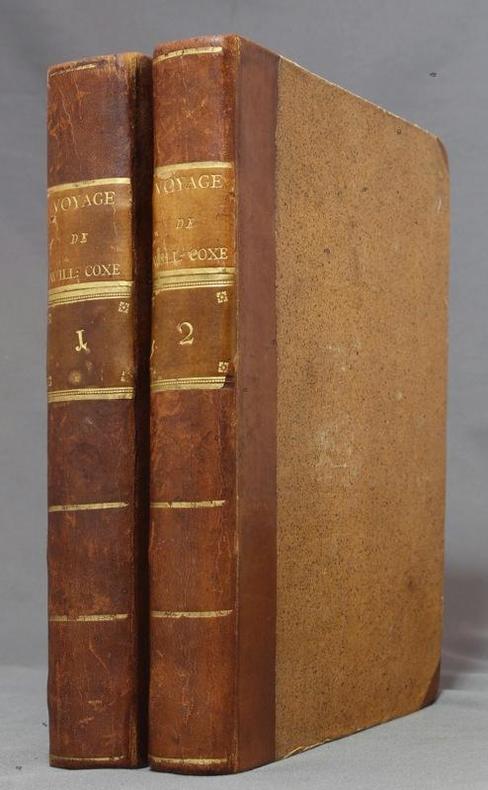
1786réf. 11167A Genève et à Paris, chez Barde, Manget & Comp./ chez Buisson, 1786. 2 volumes in-4 de [2]-VI-[2]-428 et [4]-382-[2] pages, demi-veau brun à coins, dos lisses ornés de filets, fleurons, roulettes, titre ("Voyage de Will: Coxe") et tomaison dorés, étiquettes de titre tabac, de tomaison brunes, tranches teintées vertes. Reliures un peu frottées, haut de 2 feuillets de table des matières déchirés, avec atteinte au texte, en fin du premier volume.
1843réf. 2250Paris, Lib. d’Amyot, 1843. 4 vol. in-12 de XXIV, 392 + 406 + 400 + 426 pp. demi-veau brun glacé, dos à faux-nerfs orné de fleurons, filets et roulettes dorés, tranches bleues. Coiffes frottées avec de légers manques aux coiffes supérieures, un petit manque au dos du vol. 2, charnière 1er plat vol. 1 fendue et dos détaché, rousseurs.
1929réf. 505546Paris: Editions J. Oliven 1929. Book. Good / État Satisfaisant. Soft cover. Signed and inscribed by the Author. Inscribed to previous owner and signed in English by the Grand Duke Alexander of Russia. Text in French. A good copy. . Editions J. Oliven Paperback
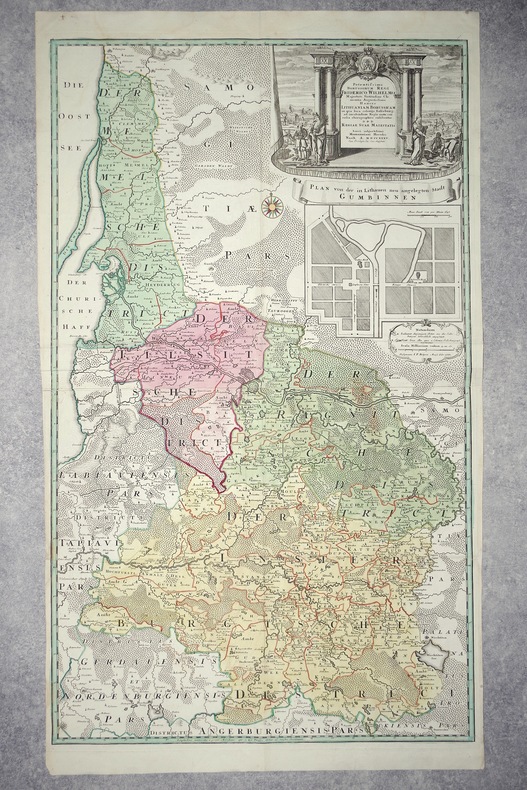
1735réf. 2334NORIMB. (NUREMBERG). HOMMANIANI HEREDES (LES HERITIERS D'HOMANN). 1735. GRANDE ET BELLE CARTE GEOGRAPHIQUE TRES DETAILLEE (96,5 X 58,5 CENTIMETRES ENVIRON, 104 X 61 AVEC LES MARGES) D'UNE REGION DE LA LITUANIE ET DE LA PRUSSE ORIENTALE, COLORIEE A LA MAIN D'EPOQUE, CARTOUCHE DONNANT LE TITRE DE LA CARTE, S'ETENDANT DE KLAIPEDA (MEMEL) DANS LE NORD A GOLDAP DANS LE SUD, TILSIT ET GUMBINNEN. AVEC UN PLAN DE LA VILLE DE GUMBINNEN, AUJOURD'HUI GUSEV, CONSTRUITE PAR FREDERIC-GUILLAUME 1° DE PRUSSE, APRES LES RAVAGES DE LA PESTE EN 1711. BEL ETAT.
1803réf. 6307CBLondon, Printed for W. Miller, 1803. (9), 73 Bl. Mit 72 (von 73) kol. Kupfertafeln (Punktiermanier) nach Johann Gottlieb Georgi. Halblederband der Zeit. + Wichtig: Für unsere Kunden in der EU erfolgt der Versand alle 14 Tage verzollt ab Deutschland / Postbank-Konto in Deutschland vorhanden +, bild
réf. 242326Paris, Ambroise Dupont et Cie, 1828 in-8, [4]-270 pp., demi-chagrin rouge, dos à nerfs, couv. cons. (reliure moderne).
réf. 214189Paris, Rey et Gravier, 1820 3 vol. in-8, VI-355, [4]-387 et [4]-347 pp., avec 12 pl., dont 5 cartes ou plans et 5 vues à l'aquatinte, bradel papier vert, dos orné, dentelle dorée encadrant les plats (reliure de l'époque). Usure des coins, rousseurs. Manque de papier sur les mors grossièrement reteinté. Dos passé. Ex-libris Comte de La Ferronays, Trie-Château.
réf. 208521À Paris, chez Treuttel et Wurtz, an X - 1802 2 vol. in-8, XI-[1]-350 pp. et 405 pp., 2 cartes dépliantes (la Russie européenne et la Russie asiatique), demi-veau blond moucheté à coins, dos lisses ornés, rubans torsadés dorés, pièces de titre et de tomaison, tranches jonquille (rel. de l'époque). Qqs rousseurs sur une carte mais bon exemplaire.
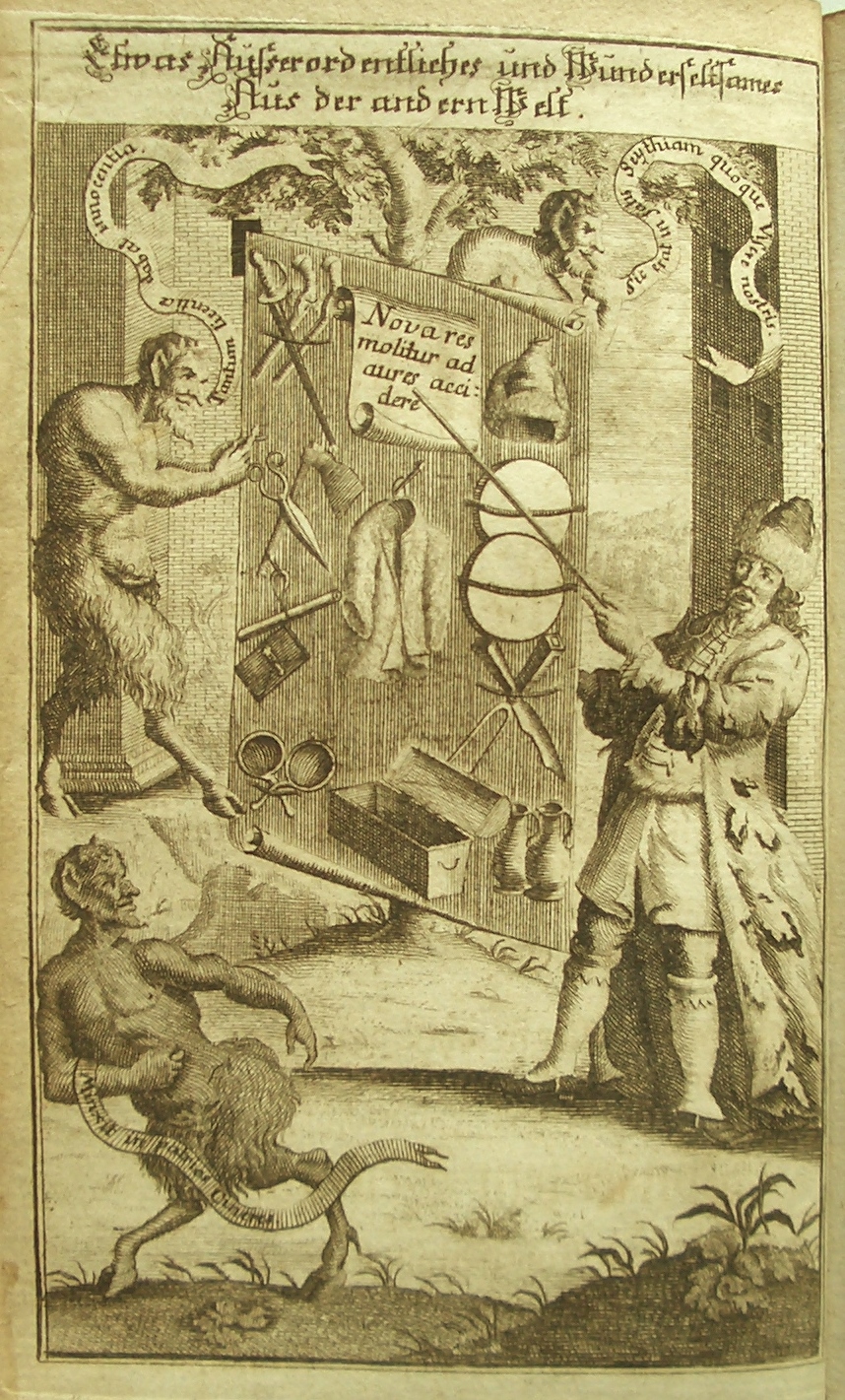
1738réf. 6066]. Mit gest. Frontispiz. Frankfurt u. Leipzig, J. L. Montag, Buchhändler in Regensburg, 1738. 8vo. (16,3 x 10,0 cm). 69 Bl., 816 S., 64 Bl. Register. Halbpergamentband d. Zt. mit Rückenschild u. Sprenkelpapierbezug.
1896In-4°, in brossura editoriale originale con titolo stampato, e invio autografo dell’autore a Mr le docteur Vacca. pp. 40. Inoltre: Prix Lobatchefsky (3° concorso), pp. (4), con autografo dell’autore”Forse a rivederci caro amico a Heidelberg”. E un opuscolo stampato in russo di geometria (pp. 6); e di Vassilief: Les Idees d’Auguste Comte sur la philosophie des mathematiques, estratto, pp. (16), con legatura in cartoncino azzurro. Vassilief (1855-1929) fu uno dei primi esponenti della scuola matematica russa, e presidente della Società di Fisica e MAtematica di Kazan. matematica mathematics fisica physics geometria scienza science russia vacca autografo russo
1692réf. PHO-709Paris, Claude Barbin, Jean Boudot, Georges & Louis Josse, 1692. In-4, plein veau époque, Édition originale, illustrée d'un portrait-frontispice, une carte dépliante de la Sibérie et Kitay, 6 vignettes et 2 planches hors texte gravées en taille-douce par Vallet figurant des traîneaux et des esquifs cosaques , un portrait du dédicataire le général polonais Stanisaw Jan Jablonowski (1634-1702) gravé par Étienne Picart, dit Le Romain (le père du célèbre graveur Bernard Picart). Reliure usagée( à refaire) , plusieurs pages détachées ,mouillures en début d’ouvrage, manque la table des matières et le titre.
réf. 202215Paris, Champion, 1907 gr. in-8 carré, XX-256 pp., nbses ill. in-t., demi-chagrin vert, dos à nerfs, couv. cons. (reliure moderne). Bon exemplaire.