Anatole de DémidoffLivre Rare Book
736 résultats
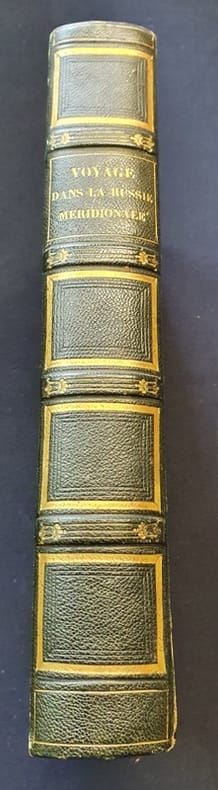
1840réf. 123BtParis Bourdin et Cie 1840 In4 ( 27 X 18 cm ) - demi basane - dos a nerfs - titres dorés - 621 pages - Complet des 24 hors texte tiré sur chine ( dont la partition valaque qui manque souvent ainsi que de la dédicace au Tzar qui manque également souvent )- Rousseurs éparses - le 1er feuillet est presque détaché du corps de l'ouvrage - coins fortement rognés - tranches avec manque de papier - mors i,férieur touché sur 3 cm .
1840réf. 123BtParis Bourdin et Cie 1840 In4 ( 27 X 18 cm ) - demi basane - dos a nerfs - titres dorés - 621 pages - Complet des 24 hors texte tiré sur chine ( dont la partition valaque qui manque souvent ainsi que de la dédicace au Tzar qui manque également souvent )- Rousseurs éparses - le 1er feuillet est presque détaché du corps de l'ouvrage - coins fortement rognés - tranches avec manque de papier - mors i,férieur touché sur 3 cm .
Cm. 23; pp. 8. Privo di brossura. Alone a tutte le pagine. Relazione della presa della fortezza di Oczakov a cui segue elenco dei prigionieri turchi e descrizione del bottino 930/P
Cm. 23; pp. 8. Privo di brossura. Qualche piccolo difetti. Relazione della presa della fortezza di Oczakov a cui segue elenco dei prigionieri turchi e descrizione del bottino 931/P
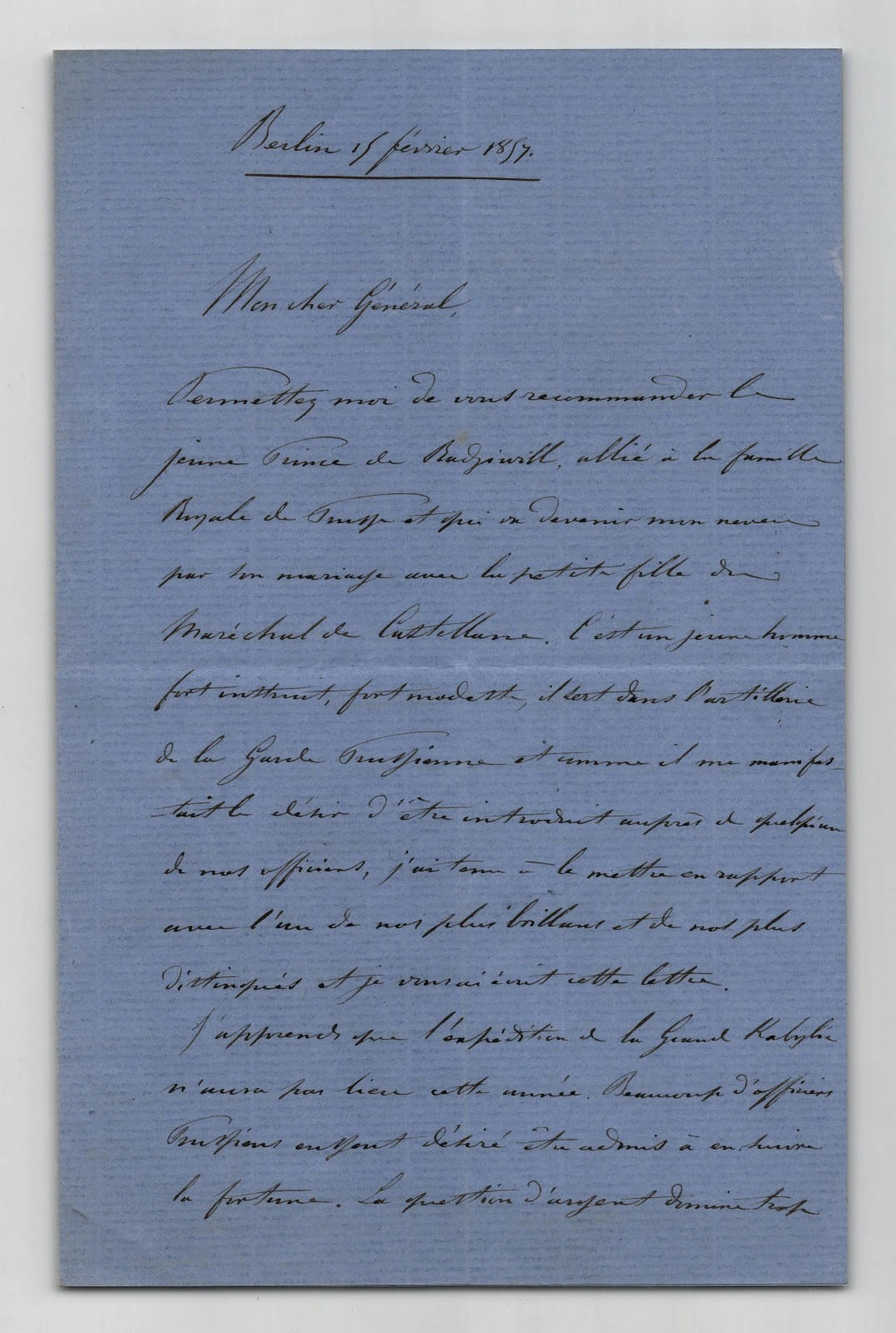
1857réf. boz_007158Lettre autographe signée d’Alexandre-Edmond de Talleyrand-Périgord, 3ème duc de Dino, petit-neveu de Talleyrand, qui servit pendant la guerre de Crimée. La lettre est datée de Berlin, le 15 février 1857. Elle est rédigée à l’encre noire sur double feuillet de papier vergé bleu. Elle est signée « Duc de Dino ». Dans cette lettre adressée à un général français, le duc de Dino recommande le jeune prince Antoine Radziwill, officier de l’artillerie de la Garde prussienne et futur époux de sa nièce Marie de Castellane, petite-fille du maréchal de Castellane. Il évoque le report annoncé de l’expédition de Grande Kabylie et l’intérêt des officiers prussiens pour l’armée française, et rappelle un souvenir commun de la Tchernaïa (écrit Tchernaya dans le texte) . Dimensions : 13,7 x 20,5 cm État : Bel état de conservation, plis inhérents à l'envoi. Voir photos et description pour plus de détails. Nombre de pages : 2 pages
réf. 606532Paris, Paul Ollendorff, 1894. In-8, rel. de l'ép. demi-basane aubergine, dos lisse orné de roulettes dorées, titre doré, tr. mouchetées, X-387 pp. 3ème édition.
1868Very Good English Original bdg. with new spine. Roy. 8vo. (23 x 15 cm). In English. [xxviii], 507 p., 1 folded engraved color plate of Sebastopol from the sea, 12 numerous folded plans and maps. First Edition. Third volume. The invasion of the Crimea: Its origin, and an account of its progress down to the death of Lord Raglan. Vol. III. Kinglake was an English travel writer and historian. He was born near Taunton, Somerset, and educated at Eton College and Trinity College, Cambridge. He was called to the Bar in 1837, and built up a thriving legal practice, which, in 1856, he abandoned to devote himself to literature and public life. His first literary venture was Eothen; or Traces of travel brought home from the East (London: J. Ollivier, 1844), a very popular work of Eastern travel, apparently first published anonymously, in which he described a journey he made about ten years earlier in Syria, Palestine and Egypt, together with his Eton contemporary Lord Pollington. Elliot Warburton said it evoked "the East itself in vital actual reality" and it was instantly successful. However, his magnum opus was THE INVASION OF THE CRIMEA: Its Origin, and an Account of its Progress down to the Death of Lord Raglan, in 8 volumes, published from 1863 to 1887 by Blackwood, Edinburgh, one of the most effective works of its class. The History, which Geoff Bocca describes as a book "by which no intelligent man can fail immediately to be fascinated, no matter to what page he might open it" has been accused of being too favourable to Lord Raglan and unduly hostile to Napoleon III for whom the author had an extreme aversion. The town of Kinglake in Victoria, Australia, and the adjacent national park are named after him. A Whig, Kinglake was elected at the 1857 general election as one of the two Members of Parliament (MP) for Bridgwater, having unsuccessfully contested the seat in 1852. He was returned at next two general elections, but the result of the 1868 general election in Bridgwater was voided on petition on 26 February 1869. No by-election was held, and after a Royal Commission found that there had been extensive corruption, the town was disenfranchised in 1870.
1880Very Good English Original bdg. with new spine. Roy. 8vo. (23 x 15 cm). In English. [xviii], 482, [24] p., 1 folded sketch map frontispiece. First Edition. Sixth volume. The invasion of the Crimea: Its origin, and an account of its progress down to the death of Lord Raglan. Vol. VI. Kinglake was an English travel writer and historian. He was born near Taunton, Somerset, and educated at Eton College and Trinity College, Cambridge. He was called to the Bar in 1837, and built up a thriving legal practice, which, in 1856, he abandoned to devote himself to literature and public life. His first literary venture was Eothen; or Traces of travel brought home from the East (London: J. Ollivier, 1844), a very popular work of Eastern travel, apparently first published anonymously, in which he described a journey he made about ten years earlier in Syria, Palestine and Egypt, together with his Eton contemporary Lord Pollington. Elliot Warburton said it evoked "the East itself in vital actual reality" and it was instantly successful. However, his magnum opus was THE INVASION OF THE CRIMEA: Its Origin, and an Account of its Progress down to the Death of Lord Raglan, in 8 volumes, published from 1863 to 1887 by Blackwood, Edinburgh, one of the most effective works of its class. The History, which Geoff Bocca describes as a book "by which no intelligent man can fail immediately to be fascinated, no matter to what page he might open it" has been accused of being too favourable to Lord Raglan and unduly hostile to Napoleon III for whom the author had an extreme aversion. The town of Kinglake in Victoria, Australia, and the adjacent national park are named after him. A Whig, Kinglake was elected at the 1857 general election as one of the two Members of Parliament (MP) for Bridgwater, having unsuccessfully contested the seat in 1852. He was returned at next two general elections, but the result of the 1868 general election in Bridgwater was voided on petition on 26 February 1869. No by-election was held, and after a Royal Commission found that there had been extensive corruption, the town was disenfranchised in 1870.
2003Fine Russian Paperback. Demy 8vo. (21 x 14 cm). In Russian. 107, [1] p. 3000 copies were printed. 2094 / 3000. 'Geray' family with Turkish rooted of Crimean Khanate and their genealogical tree with biographies. Rare.
1990In-8° (cm. 21,1x14), pp. 111, (3). Cartoncino leggero editoriale, ill. b.n. Un invio a penna al front. Il Fascismo, la Repubblica Sociale e la Resistenza torinese al BORGO CRIMEA, alla FIAT ecc. ALASIA, sindacalista, politico e partigiano, aderì alle Brigate Matteotti divisione Bruno Buozzi, che presero parte alla liberazione di Torino. Personalità di spicco della CGIL torinese ed esponente del PCI. Deputato, tra i fondatori di Rifondazione Comunista.
1973Very Good English Paperback. Roy. 8vo. (24 x 17 cm). In English. pp. 207-217. Some corrections on text by pencil. Muscovite-Ottoman relations in the sixteenth and seventeenth centuries. [Separatum 'Humaniora Islamica': An annual publication of Islamic studies and the humanities. Vol. 1/1973].
1999New English Paperback. Roy. 8vo. (24 x 17 cm). In English. 192 p. A precarious balance: Conflict trade, and diplomacy on the Russian-Ottoman frontier.
1998New English Paperback. Pbo. Roy. 8vo. (24 x 17 cm). In English. [vii], 177 p. Between Russians, Ottomans and Turks: Crimea and Crimean Tatars.
1940Very Good Turkish Paperback. Roy. 8vo. (24 x 17 cm). In Turkish. [viii], 212, [4] p., example plts. of firmans and documents in Ottoman script. Topkapi Sarayi Müzesi arsivindeki Altin Ordu, Kirim ve Türkistan hanlarina ait yarlik ve bitikler. Firmans and documents related to Turkestan, Crimea and in Ottoman Turkish from Topkapi Museum Collection.
1940Very Good Turkish In modern cloth bdg. Roy. 8vo. (24 x 17 cm). In Turkish. [viii], 212, [4] p., example plts. of firmans and documents in Ottoman script. Topkapi Sarayi Müzesi arsivindeki Altin Ordu, Kirim ve Türkistan hanlarina ait yarlik ve bitikler. Firmans and documents related to Turkestan, Crimea and in Ottoman Turkish from Topkapi Museum Collection.
1966Very Good Turkish Paperback. Roy. 8vo. (24 x 17 cm). In Turkish. [vii], 207, 869] p., 1 map. Türkiye ve Idil boyu. 1569 Astarhan Seferi, Ten-Idil Kanali ve XVI-XVII. yüzyil Osmanli-Rus münasebetleri. First Edition.
2011New New Turkish Original bdg. Dust wrapper. Roy. 8vo. (24 x 17 cm). In Turkish. [xvi], 204, [70] p. Türkiye ve Idil boyu. 1569 Astarhan Seferi, Ten-Idil Kanali ve XVI-XVII. yüzyil Osmanli-Rus münasebetleri. Second Edition.
19338vo., First Edition, with a coloured frontispiece and 18 monochrome plates on 16 some mild spotting (rather heavier on title and last few leaves, neat signature on front free endpaper; original black cloth, gilt back, a very good, firm copy. The letters are those of Captain Strange Jocelyn serving with the Scots Fusilier Guards. Includes a bibliography. Turan 485.
1997New English Original bdg. HC. Roy. 8vo. (24 x 17 cm). In English. 198, [2] p., ills. Reform within Islam: The Tajdid and Jadid movement among the Kazan Tatars, (1809-1917). Conciliation or conflict? While Tatar reformism has attracted many scholars, its religious aspect has been neglected. A misleading portrait of the Tatar reformers is conveyed, by either underestimating their impact or overlooking their religious concerns. This study, therefore, is primarily concerned with the revivalist aspect of the Tatar renaissance and the effectiveness of the reformist Tatar 'ulama' in the transitional period of Tatar society. I wish to acknowledge my deep gratitude to Professor Edward A. Allworth and Professor Kathleen R. F. Burrill for their extremely valuable criticism, advice, and encouragement. I am also grateful to Professors Pierre Cachia, Richard W. Bulliet, Peter S. Cowe, and Mark L. Von Hagen. Their observations clarified issues and broadened my field of vision. I especially want to thank Pardis Minuchehr, who helped me a great deal with her critical questions and discussions, as well as Arye Barkai, Caroline Sawyer, Recep Senturk, and Shahrbanou Tadjbakhsh for their comments. In addition, for their special courtesy in offering valuable pictures and visual sources important for this work, I want to thank in particular Professor Nadir Devlet and Dr. Nesrin Sariahmetoglu. This dissertation uses the following transliteration systems: 1. For Kazan Tatar in Arabic script, Professor Edward Allworth's Nationalities of the Soviet East: Publications and Writing Systems (New York and London: Columbia University Press,1971) .2. For the Russian Cyrillic alphabet, The Chicago Manual of Style system.3. For Ottoman Turkish and Modern Turkish and Arabic, the International Journal of Middle East Studies system. In the English transliteration of Arabic letters, a simplified system is used without diacritics, except for ' for 'ayn and ' for hamzah.
1964Very Good Turkish Paperback. Cr. 8vo. (20 x 14 cm). In Turkish. 15, [1] p., b/w ills. Ismail Gaspirali. Ölümünün 50. yildönümü münasebetiyle bir etüd. A booklet printed on memory of 100th anniversary of death of Turkish intellectual Ismail Gaspirali, (1851-1914).
1730Very Good Turkish, Ottoman (1500-1928) Original b/w map from Kitab-i Cihannuma which is one of the most important Turkish incunabula. Oblong large 4to. (31 x 37 cm). In Ottoman script. It shows Venice and Venetian Bay and Algerian shores at North Africa (Maghrib). Toponyms are in Turkish with Arabic letters. Written directions (Simal, Cenûb, Sark and Garb) on corners of the map, and decorative compass on Mediterranean Sea. Scale can be seen at left upper side (El-mikyas: Mil-i Islâmiyân Mil-i Frençe, and Mil-i Italiya]. It's one of the thirteen maps and plates from the book of Cihannuma. The story of Cihannuma can be considered as an effort to keep up with the speed that knowledge spread around the world at a time when literacy was highly limited. Kâtip Çelebi began to rewrite Cihannuma in 1654. During the next six years, he added to his books the knowledge he gained from the books he read. Kâtip Çelebi was vastly influenced by nonreligious positive knowledge, especially by the Atlas and later the Atlas Minor of Gerardus Mercator. He had the book translated from Latin to Turkish by a French recruit andenriched his own book with the new information. He brought together in Cihannuma the knowledge of geography and astronomy existing in Western sources (1654). Cihannüma has 13 charts and 27 maps. Mercator's maps are distinguished by their distinct properties. However, there are such maps which depict Istanbul, Anatolia, the Caucasus and the Orient that have to have been borrowed from other sources and there are those with relatively less detail that might have been prepared by Muslim geographers. Sources cite Ahmed El Kirimî (Ahmed the Crimean) and Galatali Migirdich as mapmakers for Cihannüma. Their names are placed on the maps. Another name that is mentioned is Tophaneli Ibrahim. Researchers agree on the fact that he is Ibrahim Müteferrika. Perhaps he wished to hasten the printing of the book. Perhaps he enjoyed making this contribution to a book he half owned. There is one map in Cihannüma which definitely does not belong to Mercator. Nor is there any information that it was originally charted by Müteferrika's team. Historians state that the 'invertedness' can be found in other maps made by Muslim cartographers. Since it is amap of Turkey, the difference can easily be perceived. The Mediterranean coasts of Turkey are at the top of the map while the Black Sea coasts are at the bottom. The compass on the map correctly indicates the North. The map seems to be inverted but it is not considered scientifically wrong to draw maps in this fashion...". (Source: Boyut; Kitab-i Cihannuma). Extremely rare.
réf. 18549Lyon, Ballay et Conchon, 1855, 1 pliée. affiche de 55 x 44 cm, illustrée (aigle impérial couronné et ailes déployées, posé sur des rameaux de chêne) ;
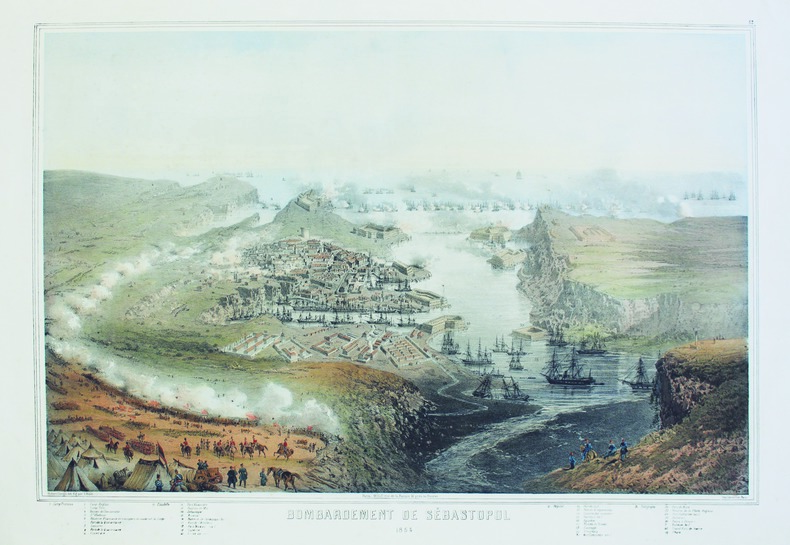
1860réf. LBW-6358Paris, Wild, [vers 1860]. Lithographie originale (45,5 x 61,5 cm).
réf. 345957 pages 1/2 in8 - En tête: "Ministre d'Etat et de la Maison de l'Empereur" - bon état -
réf. 3459612 pages in8 - En tête: "Ministre d'Etat et de la Maison de l'Empereur" - bon état -