CERCHA (Maksymilian i Stanislawa), KOPERA (Feliks)Livre Rare Book

4 187 résultats
réf. 594174Kraków-Warszawa, Druk. W. L. Anczyca i Spolki, 1904. 3 vol. in-folio, rel. moderne demi-papier velours blanc à coins, dos lisse, titre & tomaison rouge et noir en long, tête dorée ; 308-XXXVII pp. en continu, texte sur 2 colonnes, qq. figures dans le texte, très nombr. planches de dessins, dont quelques-unes colorées.
19461st edition. Original Paper Wrappers, 8vo 32 pages. In Hungarian. Title translates as, Those who Died and Fought for the Honor of our People. Heavily illustrated catalog of an exhibit in Budapest, 1946, to illustrate the persecution of the Hungarian Jews during World War II. Printed entirely on glossy paper, this catalog includes 55 photos, facsimiles, and other images from the exhibition, primarily anti-Nazi Hungarian Jewish artwork and posters, but also anti-Semitic posters, death cam photos, and scenes of new life in Palestine. The picture material was collected by the Jewish Agency for Palestine Documentation Department in January 1946 (translated from page 2) . The Foreword notes (translated) that The first anniversary of the liberation of the Budapest ghetto has arrived. It is time to bring to the world the terrible documents of the tragedy of Judaism and put the still unbelievers who turn their heads into thinking; those who do not believe because they do not want to believe. But not only the persuasion of the doubters is the goal of this attempt, but also of recalling over and over again for those who forget quickly. This is the purpose of this sad picture book, with all the cries, complaints and death blows coming from all sides. These pictures are just dull shadows of reality. Subjects: Jews--Persecutions--Hungary--History--20th century. Holocaust, Jewish (1939-1945) --Hungary--Exhibitions. OCLC: 1022126577. OCLC lists just one copy anywhere (NLI) . Light wear to wrappers, old dampstains to margins, but no images or text affected. Very Rare and important. (HOLO2-139-13U)
19471st edition. 4to, Original Paper Wrappers, 8 pages each issue, 13 numbers in 12 separate issues, as published. In Yiddish. Title translates as Bulletin of the Bund. Complete run of this early post-Holocaust iteration the Bunds monthly newsletter (also serving Kindred Jewish Socilaist Organizations), reflecting the concerns of its membership of secular Polish Holocaust survivors as well as pre-war immigrants to the US. Full of interesting articles including: Reports and declarations from the World Bund Conference in Brussels, including declarations on Antisemitism the workers movement, etc; The 1947 Socialist conference in Zurich; Bund activity in postwar-Poland, Belgium, Italy, France, Brazil, and Argentina; Jewish Socialists in Rumania; Bund Resolutions on the Camps; German Socialists and the Jewish Question; Professor Hirsh and Palestine; Discussion in the Bun on the Status of Palestine; On the Bundist Youth Movement in Poland; Special Camps; The Bulletin of the Bund [ie this periodical] in the [DP] Camps; Five Years in the Warsaw Ghetto, by Bernard Goldshtein; Bundist Academy in the Gan Eden Camp in New York; A Memorial for the Bund at the Congress of the French Socialists; etc. The General Jewish Labour Bund in Lithuania, Poland and Russia (Yiddish: algemeyner yidisher arbeter-bund in lite, poyln un rusland), generally called The Bund or the Jewish Labour Bund, was a secular Jewish socialist party.... founded in Vilnius on October 7, 1897 ..In 1917 the Polish part of the Bund, which dated to the times when Poland was a Russian territory, seceded from the Russian Bund and created a new Polish General Labor Bund which continued to operate in Poland in the years between the two world wars .The Bund sought to unite all Jewish workers in the Russian Empire into a united socialist party, and also to ally itself with the wider Russian social democratic movement to achieve a democratic and socialist Russia. The Russian Empire then included Lithuania, Latvia, Belarus, Ukraine and most of present-day Poland, areas where the majority of the world's Jews then lived. They hoped to see the Jews achieve a legal minority status in Russia. Of all Jewish political parties of the time, the Bund was the most progressive regarding gender equality, with women making up more than one-third of all members. The Bund actively campaigned against anti-Semitism. It defended Jewish civil and cultural rights and rejected assimilation. However, the close promotion of Jewish sectional interests and support for the concept of Jewish national unity (klal yisrael) was prevented by the socialist universalism of the Bund. The Bund avoided any automatic solidarity with Jews of the middle and upper classes and generally rejected political cooperation with Jewish groups that held religious, Zionist or conservative views. Even the anthem of the Bund, known as "the oath" (di shvue in Yiddish), written in 1902 by Sh. An-ski, contained no explicit reference to Jews or Jewish suffering. At the heart of the vision of the future of the Bund was the idea that there is no contradiction between the national aspect on the one hand and the socialist aspect on the other. As a strictly secular organization, the Bund renounced the Holy Land and the sacred language (Hebrew) and chose to speak Yiddish .In its early years the Bund had remarkable success, gaining an estimated 30,000 members in 1903 and an estimated 40,000 supporters in 1906, making it the largest socialist group in the Russian Empire . the Bund was a founding collective member at the RSDLP's first congress in Minsk in March 1898. For the next 5 years, the Bund was recognized as the sole representative of the Jewish workers in the RSDLP, although many Russian socialists of Jewish descent, especially outside of the Pale of Settlement, joined the RSDLP directly .The Bund generally sided with the party's Menshevik faction led by Julius Martov and against the Bolshevik faction led by Vladimir Lenin during the factional struggles in the run-up to the Russian Revolution of 1917 .In the Polish areas of the [Russian] empire, the Bund was a leading force in the 1905 revolution. At that time the organization probably reached the height of its influence. It called for an improvement in living standards, a more democratic political system and the introduction of equal rights for Jews. At least in the early stages of the first Russian Revolution, the armed groups of the "Bund" were likely the strongest revolutionary force in Western Russia. During the following years, the Bund went into a period of decay .The Bund eventually came to strongly oppose Zionism, arguing that emigration to Palestine was a form of escapism. The Bund did not advocate separatism. Instead, it focused on culture, rather than a state or a place, as the glue of Jewish nationalism. . The Bund also promoted the use of Yiddish as a Jewish national language and to some extent opposed the Zionist project of reviving Hebrew. The Bund won converts mainly among Jewish artisans and workers, but also among the growing Jewish intelligentsia. It led a trade union movement of its own. It joined with the Poalei Zion (Labour Zionists) and other groups to form self-defense organisations to protect Jewish communities against pogroms and government troops. During the Russian Revolution of 1905 the Bund headed the revolutionary movement in the Jewish towns, particularly in Belarus and Ukraine ..In 1921, the Communist Bund [in the USSR] dissolved itself and its members sought admission to the Communist Party....Many former Bundists, like Mikhail Liber and David Petrovsky, perished during Stalin's purges in the 1930s. The Polish Bundists continued their activities until 1948. During the latter half of the 20th century the Bundist legacy was represented through the International Jewish Labor Bund, a federation of local Bundist groups around the world .Among the exiled Bundists who went on with Socialist politics in America was Baruch Charney Vladeck (18861938), elected to the New York Board of Aldermen as a Socialist in 1917 [and] 1937 [and] manager of The Jewish Daily Forward Moishe Lewis (18881950)....the father of David Lewis (19091981), a leader of the New Democratic Party in Canada .David Dubinsky (18921982), though never formally a member of the party, had joined the bakers' union, which was controlled by the Bund, and was elected assistant secretary within the union by 1906 ..He later became a member of the Socialist Party of America, helped found the American Labor Party in 1936 and was from 1932 till 1966 the leader of the International Ladies' Garment Workers' Union ..under the name Max Goldfarb, David Petrovsky (18861937) was a member of the Central Committee of the Jewish Socialist Federation of America, a member of the Socialist Party of America, and the labor editor of The Forward (Wikipedia). SUBJECT(S): Jews -- United States -- Periodicals. Jewish socialists -- New York (State). Jewish labor unions. OCLC: 234327189. OCLC: 234327189. OCLC-Worldcat lists 6 holdings worldwide (NYPL, NLI, YIVO, Harvard, Yale, USHMM), though some listings may be for partial runs. Light wear, Very Good Condition. Rare and important complete set. (Yid-33-51)
In Venetia, per Giovan. Griffio, 1569, in-4, pergamena coeva con residui di laccetti, pp. 254. Piatti semi-staccati, qualche mancanza, sciolte le prime carte, con difetti minori. Iniziali, diagrammi di formazioni di battaglia e 12 figure xilografiche nel testo. Una nota coeva (formula apotropaica a difesa del volume?) manoscritta in inchiostro al piatto anteriore. Nonostante all'esemplare manchino l'intera segnatura a8 (contenente frontespizio, dedicatorie al duca di Parma Ottavio Farnese e al nobiluomo Marc' Antonio Fiubbi, Accademico Stordito come l'autore) e le carte 2E2 e 2I4 (c. bianca) siamo riusciti a stabilire tramite impronta che si tratta della rara 1a edizione di quest'opera apparsa in 3 versioni: questa, stampata nel 1569 da Griffio; quella del 1570, che a partire dall'invenduto acquistato da Giolito di Ferrarij, ristampa con dedicatoria invariata al Farnese ma con 2a prefazione indirizzata al marchese Malaspina, a cura di Tommaso Porcacchi; infine una 3a formata da alcune copie di questa edizione che apparirono anche con marca dell'editore Vincenzo Valgrisio. Assai rara perchè quasi tutte le copie sopravvissute riportano il frontespizio del Giolitti. Il bolognese Mora (c. 1536-1610?), che vantava origini nobiliari nel Cantone dei Grigioni, fu scrittore di militaria (la sua 1a opera, del 1567 è dedicata a Cosimo de' Medici), ma sopratutto uomo d'armi al servizio di Stefan Batory e Sigismund III Vasa; fervente cattolico, considerò suo dovere di militare la difesa della fede cristiana contro l'eresia protestante e contro Turchi e Tatari.
Anton Koberger, Norimberga, 1493. Anton Koberger, Norimberga, 1493. Dal “Liber Chronicarum Nurembergensi”, xilografia, b/n, cm 47,5 x 67,5 circa (il foglio). Difetti nella parte superiore del foglio, al testo e in parte nella zona bianca dell'inciso, peraltro ottima. .
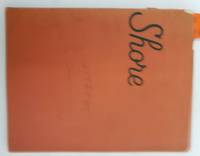
1933réf. 173338New York: Edgar Weyhe 1933. Limited to 200 numbered copies. Paperback. VG with minor coiling to orange dustjacket covers otherwise almost like new except for some separation of spine at the very top. Orange printed dustjacket surrounding a white printed glued wrap-around stiff cover. 54 pp. Two color plates including a signed in pencil lithograph portrait of Shore by Jean Charlot 18 bw photographic reproductions after photographs of the artist's work by Edward Weston 5 smaller bw reproductions which may be lithographs at the head of the text articles. The first color plate may also be a color lithograph but it is not signed. One of Armitage's rarest works. A monograph on the art and career of California modernist painter Henrietta Shore.The portrait by Charlot is signed by the artist. Includes an article by Edward Weston who also photographed the original artworks by Shore. Includes articles by Merle Armitage Edward Weston and an Appraisal by Reginald Poland. Very rare. Forward colophon reads "Two hundred numbered copies of this book designed by Merle Armitage have been printed . by the Will A. Kistler Company . It is set in twelve point Rockwell type and the entire contents of the book is printed by the Artochrome Process. The photographs of the paintings pastels crayons and drawings in this book were made from the originals by Edward Weston. This is copy no. blank"--Colophon./ Descriptive letterpress on versos facing the plates." Edgar Weyhe paperback books
1657réf. PHO-1458A Troyes, par Nicolas Oudot, et se vendent à Paris: Chez François Clousier, 1657. in-4; [6ff. (sur 7: feuillet de dédicace en fac-simile), dont titre, portrait légendé de La Boullaye, préface], 558p., [5ff. Table, fautes, privilège du 12 février 1657]; 33 illustrations sur bois dans le texte dont 16 à pleine page. Reliure d'époque en basane brune, dos à nerfs avec titre , coupes , coiffes et coins usés , frottements. un coin déchiré au titre sans atteinte au texte. Mouillure angulaire au premier portrait P. 73 déchirée avec manque de papier ,sans atteinte au texte. P. 165: manque en coin avec perte de qq mots; PP. 173 et 175: déchirures sans perte de texte; P. 234: manque de papier en pied avec perte de quelques mots; taches d'encre pp. 264 ; pp. 460 à 485: petites galeries de vers marginales en pied. Ex-libris manuscrit Dominium Antonium Biguet. Seconde édition
2004réf. 81275Warsaw Poland: Warsaw City Hall c2004. Presumed First Edition First printing. Wraps. Very good. 48 pages. Oversized 12 inches by 12 inches. Minor wear. Many color illustrations. Hand Signed by the Mayor of Warsaw Lech Kaczynski on page 1. Topics include the Anniversary of the Warsaw Uprising; Business; Cultural Life; Development; Education; Festivals; Gardens and parks; Hotels and restaurants; Investors; Jewish heritage; Key offices; Leisure activities; Museums and galleries; New and older architecture; Old Town; Powazki cemetery; Royal Route; Shopping; Transportation system; Vistula River; Warsaw Mermaid; Yesterday's Warsaw; Zoo; and Warsaw history. Warsaw is the capital and largest city of Poland. The metropolis stands on the Vistula River in east-central Poland and its population is officially estimated at 1.8 million residents within a greater metropolitan area of 3.1 million residents which makes Warsaw the 7th most-populous capital city in the European Union. The city limits cover 517.24 199.71 sq. mi. while the metropolitan area covers 2355.39 sq. mi. Warsaw is a major international tourist destination and a significant cultural political and economic hub. Its historical Old Town was designated a UNESCO World Heritage Site. The city rose to prominence in the late 16th century. The elegant architecture grandeur and extensive boulevards earned Warsaw the nickname Paris of the North. The city was largely destroyed by the Warsaw Ghetto Uprising in 1943 the general Warsaw Uprising in 1944 and the systematic razing by the Germans in advance of the Vistula-Oder Offensive. Warsaw gained the new title of Phoenix City because of its reconstruction after the war. Lech Aleksander Kaczy ski 18 June 1949 - 10 April 2010 was a Polish lawyer and politician who served as the Mayor of Warsaw from 2002 until 2005 and as the President of Poland from 2005 until his death in 2010. Before his tenure as president he previously served as President of the Supreme Audit Office from 1992 to 1995 and later Minister of Justice and Public Prosecutor General in Jerzy Buzek's cabinet from 2000 until July 2001. Born in Warsaw he starred in a 1962 Polish film The Two Who Stole the Moon with his identical twin brother Jaros aw. Kaczy ski was a graduate of law and administration of Warsaw University. In 1980 he was awarded his Ph.D. by Gda sk University. In 1990 he completed his requirements in labor and employment law. He later assumed professorial positions at Gda sk University and Cardinal Stefan Wyszy ski University in Warsaw. During the communist period Kaczy ski was an activist in the pro-democratic anti-communist movement in Poland the Workers' Defence Committee as well as the Independent Trade Union movement. In August 1980 he became an adviser to the Inter-Enterprise Strike Committee in the Gda sk Shipyard and the Solidarity movement. After the communists imposed martial law in December 1981 he was interned as an "anti-socialist element". After his release he returned to trade union activities becoming a member of the underground Solidarity. When Solidarity was legalized again in the late 1980s Kaczy ski was an active adviser to Lech Wa sa and his Solidarity Citizens' Committee in 1988. From February to April 1989 he participated in the Polish Round Table Talks along with his brother. After Solidarity's victory in the 1989 Polish legislative election Kaczy ski became a senator and vice-chairman of the movement. Then in the 1991 Polish parliamentary election he was elected into the Sejm as a non-party member. He was also the main adviser and supporter of Lech Wa sa when the latter was elected President of Poland in December 1990. In 2003 Kaczy ski co-founded the Law and Justice party after splitting from the Solidarity Electoral Action and the Christian National Union along with his brother. Kaczy ski was the party's presidential candidate during the 2005 Polish presidential election. In the first round of voting Kaczy ski received 33.1% of the valid votes. In the second round of voting Kaczy ski received 54.04% of the vote defeating Donald Tusk who received 45.96% of the vote. He was sworn in as President on 23 December 2005. In 10 July 2006 Kaczy ski appointed his brother as Prime Minister of Poland upon the resignation of Kazimierz Marcinkiewicz the brothers then became the first pair of brothers in the world to serve as President and Prime Minister of a country and the only twin brothers to achieve the feat. His brother was succeeded as prime minister by his former presidential rival Donald Tusk. On 10 April 2010 he was killed along with his wife in the crash of a Polish Air Force jet that occurred on a landing attempt at Smolensk North Airport in Russia. He was the first conservative president of Poland since 1922 and the second president to die in office since the assassination of Gabriel Narutowicz. Warsaw City Hall paperback
réf. 139322aafDresden, Walther, 1791, gr. in-8vo, Titelbl. mit gest. Vign. u. Stempel (=III/IV) + V-XVIII (ohne Vortitelbl.) + S. 3 bis 309 + 1 S. leer + 2 Bl. , 3 Textkupferstiche + 1 gef. Kupfertafel u. 1 mehrfach gef. kolor. petrographische Kupferstichkarte sowie 1 gef. Tabelle. Auf Vorsatz hs. Vorbesitzer-Eintrag / exlibris Peter E. Obergfell, Original Halb-Lederband der Zeit mit Rsch. Rotschnitt.
Varsha [i. E. Warsaw]: Di Welt, 1927-37. Paper Wrappers or Cloth, 4to (tabloid format) , 16 pages each issue. Partially Bound in Cloth. Many with photos or Socialist Realism illustrations on cover. This Yiddish Socialist bi-monthly newspaper for Young people ran from Dec. 1, 1922 until sometime in 1948, in various formats at different times. In addition to these issues from 1922-1937 out of Warsaw, the journal was later published instead in Lodz and Paris, and was edited, in succession, by L. Hechtman, J. Mendelsohn, J. Gutgold, & L. Blit. Issues present here are: 1927 [1(38) - 24(60) ]; 1928[1(61) - 24(84) ]; 1929 [ 2(86) -5(89) , 7(91) -10(94) , 12(96) , 13(97) , 16(100) , 18(102) , 19(103) , 21(105) , 22(106) , 25(109) ]; 1930 [2(111) -14(123) , 20(129) ]; 1934 [21(232) ]; 1931[7 (141) , 16(15) , 17(151) ]; 1937[6 (299) ]. SUBJECT(S) : Jewish socialists -- Poland -- Periodicals. Jewish youth -- Poland -- Periodicals. Jews -- Poland -- Periodicals. OCLC lists only 1 holding (NYPL) . Bound volume (1927-1928) has heavily worn boards. All are printed on newsprint, so paper is brown, sometimes fragile, sometimes not, generally not split at the binding but sometimes so. In any case, all wear is at the extreme margins, with, remarkably, no text loss whatsoever. (Y-28)
1906336 pages. "Shows how Slavic indolence has made him (the Polish Jew) the active agent in business and revolution." - from review headline in the New York Times, 19 January, 1907. Tight library binding. Olive-coloured boards with gilt lettering upon backstrip. Several tape repairs to pages. Map of Poland loose but present after title page. Page 95 loose but present. Usual library markings. Moderate wear. A generally sound copy. Book
réf. 3623ESQUELLES EST MONTREE LA SCIENCE DE GOUVERNER LE GENRE HUMAIN EN TOUTES ESPECES D'ETATS PUBLIQUES // ......../// DU COMMENCEMENT , PROGRES, ET EXCELLENCE DE LA POLITIQUE . PAR LOUIS LE ROY DICT REGIUS . AU TRESCHRESTIENS ROY DE FRANCE ET DE POLOGNE HENRY III DU NOM. A PARIS PAR MICHEL DE VASCOSAN IMPRIMEUR DUDIT SEIGNEUR, 1586 Format in 4 relié avec un velin manque sur le plat 454 pages, des manques sur les premieres pages et sur les dernieres , sans gravité de lecture du texte, photos sur demande
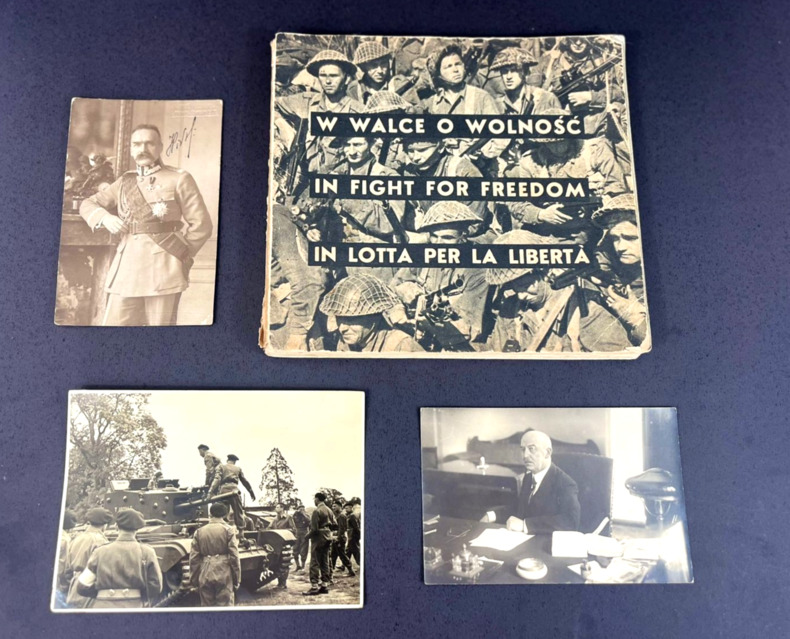
1945réf. 517This is a set which belonged to Janusz Gluchowski, a high-ranking Polish military officer at the time of the WW2. The set contains three original B&W pictures. First one: undated postcard showing Marshal Jozef Pilsudski, signed by himself in black ink, 8.5 x 13.5 cm, with two embossed mentions above and below. Second picture: undated postcard showing Poland President Gabriel Narutowicz, with a written mention on the back. Third picture: 11 x 15.5 cm photograph. General Tadeusz Bór-Komorowski inspecting a British Cromwell tank, accompanied by Polish officers of the 3rd Armored Regiment (3 puk pancerny). The image was captured during an official ceremony in the city of Kelso, Scotland, in the immediate post-war period, on June 15, 1945. The scene shows the General in an observation position, climbing onto the tank while surrounded by Polish soldiers. The tank corresponds to a British model widely used by Polish forces in exile during the Western European campaign. On the reverse, the following handwritten inscriptions appear: VI 1945, Kelso. N. Wódz gen. Bór-Komorowski dokonuje inspekcji 3 p. panc. N. Wódz w towarzystwie bryg. puku na czogu." / June 15, 1945, Kelso The book is an illustrated three-languages (Polish, English and Italian) set commemorating the struggles of the Polish II Corps. Edited by Wyda Rererat [Referat] Kultury i Prasy Kresowej Dywizji Piechoty in Rome, 1945. Oblong book of 21 x 19 cm, unpaginated (144 pp.). Cover detached. Endpapers and first page show Janusz Gluchowski's stamp. In publisher's photographically illustrated wrappers. Each page contains a photographic image or a photomontage accompanied with a short text in three languages. Front cover shows some wear and tear, the binding is a bit loose - we would advise having this book bound. The Polish II Corps was a major tactical and operational unit recruited from Polish deportees in the Soviet Gulags in 1943. First they fought in the Middle East, and in 1944 February they were transferred to Italy and as independent part of the British Army to fight in the Italian campaign, in the battles of Monte Cassino and Ancona and also the Battle of Bologna during the final offensive in Italy in 1945. The book goes through the story of Poland and the later established Polish II Corps, starting with the German and Soviet occupation in 1939. It shows the deportation of Poles to forced labour to the Gulag and, after the Polish-Russian Military Agreement in 1941, the establishment of the Polish Army on Soviet soil, also their military training and their fights in various battles. Janusz Julian Gluchowski was a Major General in the Polish Army during the Second Polish Republic. He was born on August 6, 1888, in Bukowa. He fought in the Polish Legions in World War I, the Polish-Ukrainian War, the Polish-Soviet War, and the invasion of Poland by Nazi Germany, Slovakia, and the Soviet Union in 1939, which culminated in the start of World War II. In his adolescence, he attended high school in Czstochowa. In 1905, he became a member of the Combat Organization of the Polish Socialist Party and was wounded in the hand during an attack near Czstochowa. To avoid arrest by the Russian authorities, he left for Belgium, where he studied at the University of Liège. He returned to divided Poland around 1910 and settled in Austrian Galicia. In 1912 he graduated from the Officers' School of the Riflemen's Association in Stroza, near Krakow. In the early hours of August 1914, he commanded a platoon in Oleandria and was Wadysaw Belina-Pramowski's representative during the legendary attack of the so-called Seven Lancers of Belina (Uaska siódemka). On August 6th, together with the First Cadre Company, he left Krakow and marched to Miechów. In October 1914 he was promoted to Lieutenant (Poruchik) and, in November 1916, to Rittmeister (Cavalry Master). Until 1917 he served in the First Uhlan Regiment of the Polish Legions. After the Oath Crisis (Kryzys przysigowy) he was interned first in Fort Beniaminów and later in Werl. Released in October 1918, he went to Lublin, where, in early November, he formed the Third Ulan Regiment (later renamed the Seventh Ulan Regiment of Lublin). Along with his unit, he fought in the Polish-Soviet War. On May 29, 1920, he was promoted to Polkovnik. He was transferred in July 1920 to Eastern Galicia, taking command of the First Cavalry Brigade, fighting against the Soviets in Galicia and Volhynia. After the war, he remained in this position until 1925, when he was transferred to the Fourth Cavalry Brigade. Promoted to Brigadier General on March 16, 1927. Appointed commander of the Center for Higher Military Studies on June 4, 1930, and three years later, after the death of General Stanislaw Tessaro, he was appointed commander of Military District X in Przemyl. In October 1935, he became Deputy Minister of Military Affairs. In the early days of the 1939 invasion of Poland, Gluchowski ordered General Walerian Czuma to prepare the defense of Warsaw. In mid-September 1939, he fled to Romania. After his escape, he managed to travel to the Middle East and, in January 1941, received orders to go to London. In October 1941, he was appointed Commander of the Training Brigade stationed in Scotland. On September 23, 1943, he was appointed commander of all Polish Army units stationed in Great Britain, except the First Independent Parachute Brigade, which remained under the authority of the Commander-in-Chief. He was promoted to Major General on June 1, 1945. He decided not to return to Soviet-occupied Poland and remained in Great Britain. He frequently criticized the Soviet regime and the Soviet occupation authorities in postwar Poland. Furthermore, he was one of the founders and president of the Jozef Pilsudski Institute in London. He was, therefore, an active member of the Polish community in Great Britain. He was president and honorary member of several Polish veterans' organizations. He died on June 11, 1964, in London, England.
1841réf. 002830Paris et Nancy, Tresse, et Chez Lauteur, 1841
[Torun (Polonia), s.n., 1697-1698], manoscritto su carta, in-4, legatura settecentesca in mezza pelle con punte (spellature diffuse) cc. 221 totali, non numerate (specifica dei vari titoli: cc. [74] ultime 5 bianche - [34] - cc. [60], ultime 2 bianche - [8], ultime 2 bianche - [10] - [6], ultima bianca - [8] - [5] - [16]). Steso in chiara grafia, da una sola mano, in lingue latina (in gran parte) e polacca. Interno in condizioni più che buone. Dell'estensore del manoscritto, Giovanni Francesco Pagnini che studiava a Torun nel 1697, non sappiamo nulla, se non che apparteneva ad un ramo della famiglia Pagnini originaria di Prato, che ebbe ramificazioni a Volterra, Lucca e, appunto, in Polonia. Ben più ampie le notizie disponibili sul suo professore, Raczynski, nato a Podlasie nel 1664, e che negli anni 1697-1708 insegnò retorica a Torun, Lublino e Poznan. La sua opera maggiore è l'"Historia naturalis curiosa regni Poloniae, magni ducatus Lituaniae annexarunque provinciarum" edita nel 1721, che, nonostante sia, in buona parte, una raccolta di descrizioni da varie fonti, costituisce una delle maggiori opere di storia naturale polacche del XVIII secolo. Morì nel 1737 a Danzica. Nel volume da noi presentato segnaliamo il secondo titolo che affronta argomenti intorno alla convivialità e alla gastronomia.
1762réf. 001893Paris Lattré 1762
1864réf. 0001111MELROSE MASSACHUSETTS MASS MA. Good. 1864. Manuscript. On offer are two original manuscript diaries dated 1864 and 1865 by 'Doctor' James W. Poland of Melrose Massachusetts. James W. Poland was a long time Baptist minister in Goffstown New Hampshire when in an attempt to treat himself for some ailment he came up with the formula for a medicine he called Dr. Poland's White Pine Compound. The medicine was a huge success and Dr. Poland found himself in a new career as a proprietary medicine maker. Eventually he also produced Dr. Poland's Cedar Plaster White Mountain Bitters Diarrhea Elixer Hair Preserver Poland's Magic Powders etc. At the time these diaries were written Dr. Poland had moved to Melrose Mass. and was active making some of these medicines especially the Magic Powders. He was selling on his own and also working for Dr. George W. Swett of the New England Botanic Depot in Boston. In 1864 he transferred the rights to some of his medicines to Swett. Dr. Poland's diary entries are short with a note of the weather his or his family's health problems travel mainly to Boston gardening activities purchases sales of the medicines and church activities once in a while he preached in Melrose at the Baptist church. Usually there were no notes of outside events with the notable exceptions of Lincoln's election in 1864 Lincoln's inauguration on March 4 1865 Lee's surrender on April 10th and Lincoln's assassination on April 14th. Dr. Poland writes: "Pres. Lincoln shot by Booth an assassin - Lord Save Us!" He notes his own birthday 57 years old in 1865 and the death of his mother on Nov. 5th of the same year. Included are a number of ephemera items related to Dr. Poland's profession as a maker and seller of proprietary patent or "quack" medicines including: two receipts for pew rental at the First Baptist Society of Melrose; two newspaper clippings of testimonials for the use of Dr. Poland's White Pine Compound; a business license from the U.S. Internal Revenue dated June 1 1863 a tax to help pay for the war; and a page of handwritten advertising copy for Dr. Poland's Specific; a cure for costiveness constipation. Both diaries have written entries in pencil for every day of the year and are overall in G condition.; 16mo - over 5¾" - 6¾" tall; QUACK MEDICINE PHYSICIAN QUACKERY PATENT MEDICINE SNAKE OIL BAPTISTS MASSACHUSETTS MASS MA CIVIL WAR 19TH REGIMENT FORT COLUMBUS YORK HARBOR ANTIETAM FORT SENECA SOCIAL STUDIES GENDER STUDIES HANDWRITTEN MANUSCRIPT DOCUMENT LETTER AUTOGRAPH DIARY JOURNAL LOG KEEPSAKE WRITER HAND WRITTEN DOCUMENTS SIGNED LETTERS MANUSCRIPTS HISTORICAL HOLOGRAPH WRITERS DIARIES JOURNALS LOGS AUTOGRAPHS PERSONAL MEMOIR MEMORIAL PERSONAL HISTORY AMERICANA Als antiquité contrat vélin document manuscrit papier Antike Brief Pergament Dokument Manuskript Papier oggetto d'antiquariato atto velina documento manoscritto carta antigüedad hecho vitela documento manuscrito papel. . unknown
1971réf. 19091971 Atelier Calevaert-Brun, Paris, (1971?). Petit in-folio, 40 xylographies, sous emboitage muet.
réf. 16-5052LuneÌville: Chez Claude-François Messuy 1761 and 1762. Folio. 24.5 x 40.2 cm. Contemporary calf with gilt spine; covers rubbed. 6-188-2-136-XII-2pp. The "compte général" lacks the plan de Nancy and 3 plates of ferronnerie.Cohen 250; OCLC Number: 939437546: While in exile in Lorraine between 1737 and 1766 the Polish King Stanislaw I was granted the title of Duke of Lorraine and Bar and used his position to endow a number of buildings and monuments in Nancy where he had his seat. The designs for the new buildings which included orphanages schools hospitals churches libraries and a new Hote de Ville for Nancy were drawn up by Emmanuel HeÌreÌ who published many of them in his Recueil des plans elevations et coupes tant geometrales qu'en perspective des chateaux jardins et dependances que le Roy de Pologne occupe en Lorraine . 2 vols Paris 1750-1752. In 1753 a supplementary volume was published as Plans et elevations de la Place Royale de Nancy . Paris; q.v. in the Supplement. While HeÌreÌ drew up the plans and oversaw the building work the administration and finances of the King's building programme were overseen by Nicolas LeÌopold Michel 'Controlleur de la Maison du Roi' see page 1 of part 2. The second part of the present work is explicitly said to be a public statement of the accounts kept by Michel. The first part has also been attributed to Michel by Quèrard Rau and France-Lanord see below and by most library catalogues see the Avery Cat. Berlin Kat. and the BM. Gen. Cat although UCBA attributes both parts to HeÌreÌ. Although no firm evidence has been advanced for Michel's authorship of the first part of the text it is highly likely that he was involved. The text describes the buildings not in architectural terms but by detailing their planning and approval by official bodies the specifications for their construction the contracts and estimates drawn up and the administration of the actual building work. In many cases the specifications given to HeÌreÌ and to others are reprinted in full. Thus the first volume is to some extent a collection of official documents relating to the buildings edited together for public presentation and it can be presumed that many of the texts were drawn up under Michel's supervision. It could also be argued that primary responsibility for this part of the work lay with the King himself who had ordered and defined the limits of the works; indeed he is referred to as the 'Auteur' on page 8 of the 'Discourse PreÌliminaire' although this use of the word is more of a homage to Stanislaw's patronage than an actual statement of responsibility for the text. The 'Discourse PreÌliminaire' lavishes much praise on the King for his generosity and public spirit and notes that 'notre Ouvrage est un nouveau preÌsent que le Roi fait à ses Peuples' p.5. The King paid for the publication which is also described as 'donneÌ lieu à un suppleÌment' presumably supplementing HeÌreÌ's own very different work describing the buildings. HeÌreÌ's book contains 63 large-scale engraved plates and was no doubt expensive and the present publication may have been seen at least in part as a way of producing a rather cheaper and more generally accessible advertisement for Stanislaw's good works. For further details of the buildings involved see Julia Rau Emmanuel HeÌreÌ: premier Architecte von Stanislas Leszczynski in Lothringen 1705-1763 Berlin: Mann 1973; and Albert France-Lanord Emmanuel HeÌreÌ: architecte du roi Stanislas Nancy: Presses Universitaires de Nancy 1984. Both of these books reproduce many of the etched illustrations from the present work. Rau attributes both parts to Michel in a note on page 36 but in her bibliography describes them quite wrongly as the second edition of HeÌreÌ's Recueil p.303. In France-Lanord's bibliography both parts are attributed to Michel although they are listed both separately and together. L'auteur est Nicolas-Léopold Michel écuyercontrôleur général de la Maison de Stanislas trésorier des bâtiments de S. M. et premiersecrétaire de ses archives 27 janvier 1718-… Ouvrage qui comprend la construction d'unenouvelle place au milieu de laquelle est érigée la Statue de Louis XV et les Bâtiments que samajesté Polonoise a fait élever dans la Ville de Nancy pour son embellissement ; et le Comptegénéral de la Dépense des Edifices et Bâtiments que le Roi de Pologne Duc de Lorraine et deBara fait construire pour l'embellissement de la Ville de Nancy depuis 1751 jusqu'en 1759.Recueil contenant les arrêts la déclaration de Sa Majesté Très-Chrétienne les concessions.Précis des concessions de Terrains accordés par le Roi de Pologne. V. l'article de StéphaneGaber p. 72 dans le Pays Lorrain de 1985 N° 2. Illustré du plan général de Nancy levé en1758 dépliant ; façades de l'Hôtel de Ville de l'Hôtel des Fermes de l'Hôtel de Mr. Alliot duPavillon du Sr. Jacquet du Pavillon de la Comédie ; Vue des Fontaines et de la Face opposée àl'Hôtel de Ville ; façade de la Porte Royale ; élévations d'une des deux Grilles et Fontainesposées en tours creuses aux angles de la Place Royale de Nancy des Grilles des anglesd'entrée de la Place Royale de Nancy des gardes-corps du grand Balcon du milieu de laFaçade de l'hôtel de Ville dépliant ; statue de Louis XV ; Porte Saint-Stanislas ; Placed'Alliance ; vue perspective de la Carrière depuis l'intendance ; Intendance ; Pavillon pour lesOfficiers de la Garnison l'ensemble en gravure en taille-douceCe recueil est important pourl'histoire sociale française avec la liste détaillée des oeuvres charitables de ce temps et pourl'histoire urbaine avec la description de l'organisation des plans de construction pour une desplus importantes villes européennes au XVIIIe siècle Millard I 155. L'auteur contrôleur de lamaison du roi a soigneusement consigné et magnifiquement représenté le compte desdépenses effectuées par le roi Stanislas depuis 1751 jusqu'en avril 1759 pour l'embellissementde son siège royal nancéien. Le "recueil des fondations" comporte le nouveau supplément de 10ff paginé 188 à 206 qui manque dans certains exemplaires. Le "compte général" est incomplet du plan de Nancy et des 3 planches de ferronnerie. LuneÌville: Chez Claude-François Messuy , 1761 and 1762 unknown
1784réf. 6038Paris, Gueffier, 1784. 2 volumes in-8 de [4]-XVI-396p. ; [4]-474-[2]p., plein veau marbré, dos à nerfs ornés de filets et fleurons dorés, pièces de titre en maroquin rouge. Bel exemplaire en très jolie condition.
1658In 8, cm 18 x 24,5, pp. (4) + 222 + (2) con 5 ( su 6) tavole fuori testo incise all'acquaforte e un'insegna incisa posta all'ultima carta (Diversa per aequora). Manca gran parte della pianta di Mosca. Brunitura uniforme alle tavole. Piena pergamena coeva. Rara edizione italiana di questa traduzione tratta dai Viaggi di Moscovia di Adam Olschlager stampata nel 1646 e edizione originale della Relatione del Barberini, scritta nel 1565 e mai pubblicata. Olearius venne inviato nel 1633 da Federico III Duca di Hoeltein in Russia e in persia, al fine di stringere rapporti commerciali con questi paesi e contiene la descrizione dei paesi attraversati durante il viaggio, descrive la Livonia, Riga, Vvolmar, Dorp, Narva, Caporio, Notemburg, Novogordia ecc. Ampia descrizione di usi e costumi russi, delle udienze pubbliche con le quali furono ricevuti, i ricevimenti degli ambasciatori turchi e tartari ecc. La relazione del Barberini, poi, si presenta sotto forma di lettera al Conte di Nubarola il quale narra della Russia e dei paesi attraversati durante il viaggio. Importante testimonianza del rinato interesse per la Russia di questo periodo ribadito nell'Avvertimento al lettore, nel quale si danno delucidazioni sul paese e note relative all'etimologia di alcune parole. La relazione del Barberini risale al viaggio fatto da questi nel 1564 al fine di vendere allo Zar Ivan il terribile, il brevetto per l'estrazione del sale. Mazzitelli, Slavica biblioteconomica, p. 47 - 49. rhode, 1963, 141.
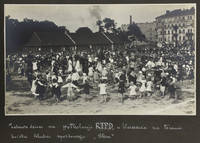
réf. 3728825Poland c.1920s. 21ff. Album. 9½ x 13 inches. Beige cloth with colorful woven onlay; cord-bound. 23 captioned photographs mounted on black cardstock rectos approx. 4¾ x 8¾ inches tissue guards. Brief wear to head and tail of spine and corners; very good. Made by the Workers’ Society of Friends of Children in Warsaw and given to their Chicago branch this 1920s photograph album illustrates the strong link between Poles living in Warsaw and Chicago reflecting the wider story of the Polish diaspora at that time. The album documents that Polish immigrants in Chicago supported social projects back in Poland highlighting the cross-continental connections among Polish communities. The Workers’ Society of Friends of Children was established in 1919 to provide childcare and education centers for workers’ children and the children of the unemployed. The outreach included kindergartens schools summer camps meals and medical care. The album’s photographs show children’s homes and tents kindergarten-age children playing with blocks playtime camp scenes communal meals calisthenics sports clubs and a view of children on a beach along the Vistula River. Places seen include Warsaw the Helena Dłuska Children’s Home in Helenów Broszków Brok and Brest. The album is autographed inside by Tomasz Arciszewski 1877–1955 and Dr. Aleksander Landy 1881–1969 the Society’s founders in Poland. Arciszewski served as founding chairman of The Workers’ Society of Friends of Children Robotnicze Towarzystwo Przyjaciół Dzieci RTPD and along with Landy was an active member of the Polish Socialist Party PPS. Arciszewski served in the Socialist party and became Poland’s 31st Prime Minister. The album’s first image shows children at a Warsaw “Children’s Home” featuring Bolesław Limanowski 1835–1935 PPS co-founder among them. Clear evidence of how Polish immigrants in Chicago supported and engaged with social efforts back in Poland showing the strong international connections among Polish communities worldwide. unknown
1996réf. SBBIH-VJIUKQEW7MLRDom Organizatora 1996. unknown_binding. Good. Our good condition books are generally good for reading but not for gifting or collecting. They could have imperfections such as creasing fanning inscriptions margin notes yellowing staining on edge or cover or pages bumps scuffs etc etc sometimes multiple of these. It's a wide category that encompasses anything that isn't almost-new down to anything that is slightly better than poor. We would NOT recommend gifting Good books - these should be considered reading copies. Our books are dispatched from a Yorkshire former cotton mill. We list via barcode/ISBN so please note that the images are stock images and may not be the exact copy you receive furthermore the details about edition and year might not be accurate as many publishers reuse the same ISBN for multiple editions and as we simply scan a barcode or enter an ISBN we do not check the validity of the edition data when listing. If you're looking for an exact edition please don't order at least not without checking with us first although we don't always have time to check. We aim to dispatch prompty the service used will depend on order value and book size. We can ship to most countries see our shipping policies. Payment is via Abe only. Dom Organizatora unknown
réf. c4661PIÈCE MANUSCRITE , de format in folio oblong, sur velin, de 12 pages, comportant environ 1000 signatures de FEMMES POLONAISES EXILÉES à MOSCOU.La première page est somptueusement illustrée d'un large encadrement peint et doré signé par K. Homolacs, avec le texte soigneusement calligraphié.Toutes les grandes familles polonaises sont représentées. Texte très touchant ( référence à la France “Seconde Patrie“, “Berceau des idées généreuses “, aux “Héros de Verdun “. Charles Richet fut Président de La Ligue pour le rétablissement de la Pologne, il était physiologiste, aviateur ,pacifiste et adepte des sciences occultes.Pièce d'un grand intérêt historique et remarquablement décorative.