4 187 résultats
1700In-4°; pp. (12). 226. (2) Frontespizio allegorico e ritratto di Maria Casimira Sobieski incisi su rame da Hubert Vincent; nel testo stemma Barberini inciso su legno; alcuni quaderni solo leggermente bruniti, per il resto buon esemplare. Unica edizione di questo diario del viaggio che per nove mesi tra il 1698 e il 99 portò a Roma la regina di Polonia Maria Casimira, all’udienza con Innocenzo XII. Il cardinal Barberini, suo protettore a Roma, commissionò questo testo a Antonio Bassani, canonico di Padova, e lo stampò nella sua stamperia privata. Il viaggio della vedova di Giovanni Sobieski fu un vero e proprio pellegrinaggio reale ma anche il suo trasferimento a Roma. Di particolare interesse risultano le descrizioni dei banchetti, delle feste (a Venezia come a Bologna), della tappa alla Santa casa di Loreto, e in generale delle cerimonie e degli omaggi organizzati nelle varie città per l’ingresso della regina. Fumagalli 280.
1750réf. 7546Très célèbres estampes d’après Rigaud, dans son cadre en bois doré d'époque. Belleudy n° 1. Extrêmement rare. C'est l'estampe qui a causé l'exil de Baléchou à Avignon … Paris 1750
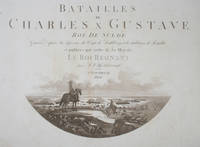
1806réf. 45461Stockholm, 1806. Large folio oblong. (44 x 61 cm.). Contemp. hcalf, covers with marbled paper. Titlelabel in red and gilt pasted on frontcover. Wear to foot of spine, otherwise fine. Engraved titlepage (battle view), engraved plate depicting the Carl Gustav on horseback in front of a battle scene and 11 engraved plates showing battlescenes after Dahlberg's drawings. All engravings in beautiful toned sepia aquatint. A few marginal brownspots. A very fine copy.
1806réf. 45461Stockholm 1806. Large folio oblong. 44 x 61 cm. Contemp. hcalf covers with marbled paper. Titlelabel in red and gilt pasted on frontcover. Wear to foot of spine otherwise fine. Engraved titlepage battle view engraved plate depicting the Carl Gustav on horseback in front of a battle scene and 11 engraved plates showing battlescenes after Dahlberg's drawings. All engravings in beautiful toned sepia aquatint. A few marginal brownspots. A very fine copy. Very scarce first printing of this series of plates aiming at glorifying the Swedish victories showing battlescenes - Warsaw Carnova Columbi Guesne and the crossing of the Belt in Denmark - from the wars against Poland and Denmark 1655-58 in fine engravings by Skjöldebrand. unknown
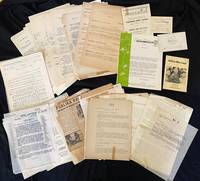
1938réf. 43521New York and Elsewhere: The Committee and Others 1938. Primarily mimeograph on Committee letterhead but also newspaper clippings printed cards pamphlets and other ephemera. A total of 119 pages of mimeographed correspondence reviews clippings and ephemera connected to the promotion and screening in France Belgium the Netherlands and the US of Aleksander Ford's 1936 film "Mir Kumen On" on the children of the Bund's Medem Sanitorium in Poland. "Mir Kumen On" can be translated directly as "We are Coming" though in the US the title was translated as "Children Must Laugh" and in France and Belgium as "Nous Arrivons." The restored film is viewable online at www.youtube.com/watchv=vozD_XbGHGA and was featured at the Museum of Modern Art's To Save and Project: The 14th MoMA International Festival of Film Preservation in 2016. "A rare record of Jewish life in Poland before World War II this 1936 film Mir Kumen On was produced in several language versions as an international fundraiser for the Medem Sanatorium near Warsaw a clinic sponsored by the General Union of Jewish Workers the Bund that provided care and an escape from urban poverty for some 10000 children between 1926 and 1939. Directed in a Soviet-influenced style by Alexander Ford a committed Communist who later became the head of Poland's National Film School the film follows three children as they gradually overcome their emotional withdrawal and distrust and enter the communal life of the institution" MoMA 2016. A massive fundraising campaign for the Sanitorium was undertaken in 1937-38 and the film was shows internationally as a way to build support and solicit funds. This archive includes 81 pages of mostly US mimeograph correspondence and typed reproductions of US film reviews and press references. Most are on letterhead primarily in Yiddish with some English. Intermixed are six original Polish-language press clippings from Poland and one American-Yiddish clipping reviewing the film. Also included are 32 mostly legal-size typed mimeograph pages of reviews of Mir Kumen On from the Paris and Brussels press from 1936-1937 including a typed 5-page legal size summary "Oystsugn fn sic der Frantsoisher un Belgisher Prese Vegn Film 'Mir Kumen On'" with selected excerpts from November 1936-December 1937. Also present are an assortment of other ephemeral items connected to the film's showings in New York and Amsterdam: - "Children Must Laugh: Sound Film Presented by Medem Sanitarium." 4 page pamphlet with 4 photos from the film description its content and purpose and asking for financial support. - "Children Must Laugh" flyer for the film's showing Sunday July 10 1938 at the Sea Gate Brooklyn Educational Center - "Admit One" card to "Private Showing of 'CHILDREN MUST LAUGH' AT PAX FILM STUDIOS 723 Seventh Avenue Manhattan No Date - Yiddish Ticket Card for June 6 1938 program at "de Leeuw" at Valkenburgerstraat 149 in Amsterdam Jewish Quarter. "Theater Skit Performed by the Youth" with the "participation of the famous artist Dora Gerson" and introductory words given by A.J. Landau and P.J. Schmidt. The program is under the auspices of of the "Hilfs-Komitet for Medem-Sanatorye in Poyln." - Color-illustrated fundraising letter from Wm. Marco on "Brown-Marc Coal Coke" Company NYC letterhead dated June 15 1939 referencing "Children Must Laugh" and asking for a donation for the Medem Sanitorium which is now caring for German-Jewish refugee children in Poland. The vast majority of the mimeograph correspondence includes what appear to be filing numbers stamped on each page though some pages do not include the stamped numbers. Conversely most of the film review pages do not include the stamps though a few do. Edgewear to some letters generally no loss toning as expected some tapestains ephemeral items remain in especially nice condition. Very Good Condition overall. Rare and important. BER-1-3. New York and Elsewhere: The Committee and Others unknown
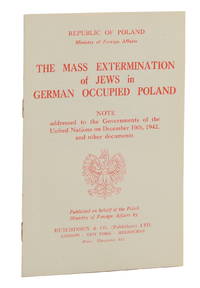
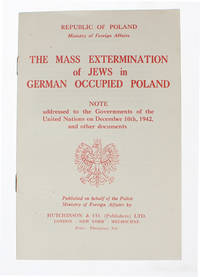
1943réf. 140946511London New York & Melbourne: Hutchinson & Co. Publishers Co 1943. First edition. First edition. 16 pp. Staple bound in publisher's self wraps. Near Fine with a little rusting to staples and staining along spine. A bright attractive copy of a momentous historical document. For the first time this pamphlet publicly disclosed the ongoing Holocaust for an Allied audience in the midst of World War II with information provided by Polish diplomat-tuned-secret-agent Jan Karski. It focused on events in Poland including the Warsaw Ghetto rebellion and mentioned various concentration camps in Eastern Europe. It also contained the text of the Joint Declaration by Members of the United Nations of 17 December 1942 and an excerpt of a statement by Deputy Prime Minister Stanisław Mikołajczyk of 27 November 1942. Rare in commerce. Hutchinson & Co. (Publishers) Co unknown
1698réf. 25082Paris Claude Barbin 1698 in-12 maroquin rouge, dos à nerfs orné, filets et fleurons d'angle dorés encadrant les plats, dentelle intérieure, tranches dorées sur marbrure [Reliure du XVIIIe siècle]
1943réf. 60182London, New York, Melbourne (printed in Great Britain), Published on behalf of the Polish Ministry of Foreign Affairs, (1943). 8vo. Stapled as issued. Title-page printed in red. Stapels with rust, slightly affecting surrounding paper. A very fine, near mint, copy. 16 pp.
1943réf. 60436London, New York, Melbourne (printed in Great Britain), Published on behalf of the Polish Ministry of Foreign Affairs, (1943). 8vo. Stapled as issued. Title-page printed in red. Stapels with rust, slightly affecting surrounding paper. A very fine, near mint, copy. 16 pp.
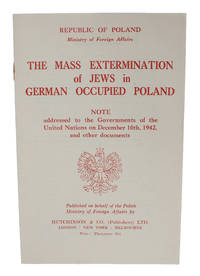
1943réf. 60436London New York Melbourne printed in Great Britain Published on behalf of the Polish Ministry of Foreign Affairs 1943. 8vo. Stapled as issued. Title-page printed in red. Stapels with rust slightly affecting surrounding paper. A very fine near mint copy. 16 pp. The scarce first printing of this hugely important publication which constitutes one of the very first official reports on Holocaust and one of the most accurate accounts that had been presented to the West changing their knowledge of what was actually going on. This seminal pamphlet consists of 1 Raczynski's account of the ongoing Holocaust based among other reports on the eye-witness-report by Jan Karski a Polish Government emissary in occupied Poland who bribed his way into a German concentration camp and witnessed the mass extermination of Jews 2 the seminal "Joint Declaration" by members of the United Nations in which "The above-mentioned Govenments and the French National Committee condemn in the strongest possible terms this bestial policy of cold-blooded extermination. They declare that such events can only strengthen the resolve of all free-loving peoples to overthrow the barbarous Hitlerite tyranny. They reaffirm their solems resolution to ensure that those responsible for these crimes shall not escape retribution and to press on with the necessary practical measures to this end." p. 12 3 an extract of Deputy Prime Minister Mikolajczy's statement on behalf of the Polish Government and 4 the text of Raczynski's broadcast of December 1942 in which pleaded for action wishing to make the public and the Allied nations "understand how real is the tragedy which is taking place not so very far from the shores of this island on the continet of Europe - on the soil of Poland. For more than three years the Germans have consistently done everything they could to hide from the eyes of the world the martyrdom of the Polish nation the like of which has never been known in the history of humanity. But "when we would keep silence the very stones will cry out"." p. 15.While the details were neither complete nor wholly accurate the Allies were aware of most of what the Germans had done to the Jews at a relatively early date. The mass murder of the Jews was of such dimensions however that at first they could not believe the reports that reached them. This quickly changed though.In February of 1942 Jacob Grojanowski an escaped prisoner of the Chelmno extermination camp provided the Oneg Shabbat group with detailed information about what went on at the Chelmno camp. His report became known as the Grojanowski Report. It was smuggled out of the Warsaw Ghetto via the Polish underground and reached London in June of 1942. It is not known exactly what happened to the report at that point but by February of 1942 the United States Office of War Information had decided not to release information about the extermination of Jews thinking that there was a risk of the public viewing the war as only being a Jewish problem. Thus the Grojanowski Report was not released. By at least October of 1942 British radio had broadcast news of the gassing of Jews to the Netherlands and in December 1942 the Western Allies released their Joint Declaration which is printed in the present publication describing and condemning in the strongest manner Hitler's violent attempts at exterminating the Jews of Europe. In 1942 Jan Karski 1914-2000 a Polish World War II resistance movement fighter and later professor at Georgetown University gave his first report to the Polish British and U.S. governments on what was going on in the German extermination camps in Poland.Karski reported to the Polish government in exile i.e. Raczynski who was the Ambassador and one of its most prominent leaders and the Western Allies on the situation in German-occupied Poland. Karski personally met with Franklin Roosevelt and British Foreign Secretary Anthony Eden to explain what went on in Poland and Raczynski wrote up the report. Eventually the American Government confirmed the reports to Jewish leaders in late November 1942 and shortly thereafter they were publicized i.e. in the present publication. Karski's report through Raczynski became one of the most important reports in the history of the Holocaust being a major factor in informing the West. It sparked one of the first official publications from the Allies on the mass extermination of Jews in Poland and resulted in the official reports and condemnations from the Allied countries i.e. the "Joint Declaration" also published here."The purpose of this publication is to make public the contents of the Note of December 10th 1942 addresses by the Polish Government to the Governments of the United Nations concerning the mass extermination of Jews in the Polish territories occupied by Germany and also other documents treating on the same subject. . In the hope that the civilized worlds will draw the appropriate conclusions the Polish Government desire to bring to the notice of the public by means of the present White Paper these renewed German efforts at mass extermination with the employment of fresh horrifying methods." From the Introductory Note p. 3."Most recent reports present a horrifying picture of the position to which the Jews in Poland have been reduced. The new methods of mass slaughter applied during the last few months confirm the fact that the German autorities aim with systematic deliberation at the total extermination of the Jewsih population of Poland and of the many thousands of Jews whom the German authorities have deported to Poland from Western and Central European countries and from the German Reich itself.The Polish Government consider it their duty to bring to the knowledge of the governments of all civilized countries the following fully authentical information received from Poland during recent weeks which indicates all too plainly the new methods of extermination adopted by the German authorities." p. 4. unknown
1943réf. 60182London New York Melbourne printed in Great Britain Published on behalf of the Polish Ministry of Foreign Affairs 1943. 8vo. Stapled as issued. Title-page printed in red. Stapels with rust slightly affecting surrounding paper. A very fine near mint copy. 16 pp. The scarce first printing of this hugely important publication which constitutes one of the very first official reports on Holocaust and one of the most accurate accounts that had been presented to the West changing their knowledge of what was actually going on. This seminal pamphlet consists of 1 Raczynski's account of the ongoing Holocaust based among other reports on the eye-witness-report by Jan Karski a Polish Government emissary in occupied Poland who bribed his way into a German concentration camp and witnessed the mass extermination of Jews 2 the seminal "Joint Declaration" by members of the United Nations in which "The above-mentioned Govenments and the French National Committee condemn in the strongest possible terms this bestial policy of cold-blooded extermination. They declare that such events can only strengthen the resolve of all free-loving peoples to overthrow the barbarous Hitlerite tyranny. They reaffirm their solems resolution to ensure that those responsible for these crimes shall not escape retribution and to press on with the necessary practical measures to this end." p. 12 3 an extract of Deputy Prime Minister Mikolajczy's statement on behalf of the Polish Government and 4 the text of Raczynski's broadcast of December 1942 in which pleaded for action wishing to make the public and the Allied nations "understand how real is the tragedy which is taking place not so very far from the shores of this island on the continet of Europe - on the soil of Poland. For more than three years the Germans have consistently done everything they could to hide from the eyes of the world the martyrdom of the Polish nation the like of which has never been known in the history of humanity. But "when we would keep silence the very stones will cry out"." p. 15. While the details were neither complete nor wholly accurate the Allies were aware of most of what the Germans had done to the Jews at a relatively early date. The mass murder of the Jews was of such dimensions however that at first they could not believe the reports that reached them. This quickly changed though. In February of 1942 Jacob Grojanowski an escaped prisoner of the Chelmno extermination camp provided the Oneg Shabbat group with detailed information about what went on at the Chelmno camp. His report became known as the Grojanowski Report. It was smuggled out of the Warsaw Ghetto via the Polish underground and reached London in June of 1942. It is not known exactly what happened to the report at that point but by February of 1942 the United States Office of War Information had decided not to release information about the extermination of Jews thinking that there was a risk of the public viewing the war as only being a Jewish problem. Thus the Grojanowski Report was not released. By at least October of 1942 British radio had broadcast news of the gassing of Jews to the Netherlands and in December 1942 the Western Allies released their Joint Declaration which is printed in the present publication describing and condemning in the strongest manner Hitler's violent attempts at exterminating the Jews of Europe. In 1942 Jan Karski 1914-2000 a Polish World War II resistance movement fighter and later professor at Georgetown University gave his first report to the Polish British and U.S. governments on what was going on in the German extermination camps in Poland.Karski reported to the Polish government in exile i.e. Raczynski who was the Ambassador and one of its most prominent leaders and the Western Allies on the situation in German-occupied Poland. Karski personally met with Franklin Roosevelt and British Foreign Secretary Anthony Eden to explain what went on in Poland and Raczynski wrote up the report. Eventually the American Government confirmed the reports to Jewish leaders in late November 1942 and shortly thereafter they were publicized i.e. in the present publication. Karski's report through Raczynski became one of the most important reports in the history of the Holocaust being a major factor in informing the West. It sparked one of the first official publications from the Allies on the mass extermination of Jews in Poland and resulted in the official reports and condemnations from the Allied countries i.e. the "Joint Declaration" also published here. "The purpose of this publication is to make public the contents of the Note of December 10th 1942 addresses by the Polish Government to the Governments of the United Nations concerning the mass extermination of Jews in the Polish territories occupied by Germany and also other documents treating on the same subject. . In the hope that the civilized worlds will draw the appropriate conclusions the Polish Government desire to bring to the notice of the public by means of the present White Paper these renewed German efforts at mass extermination with the employment of fresh horrifying methods." From the Introductory Note p. 3. "Most recent reports present a horrifying picture of the position to which the Jews in Poland have been reduced. The new methods of mass slaughter applied during the last few months confirm the fact that the German autorities aim with systematic deliberation at the total extermination of the Jewsih population of Poland and of the many thousands of Jews whom the German authorities have deported to Poland from Western and Central European countries and from the German Reich itself.The Polish Government consider it their duty to bring to the knowledge of the governments of all civilized countries the following fully authentical information received from Poland during recent weeks which indicates all too plainly the new methods of extermination adopted by the German authorities." p. 4. unknown
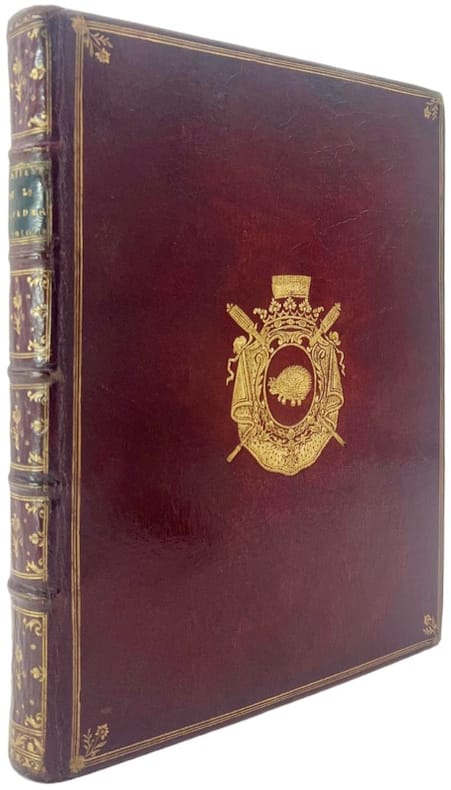
1770réf. 44616, , 1770. In-4 de 141-(3)-293-(3) pp., maroquin rouge, dos orné à nerfs, triple filet doré en encadrement sur les plats, fleurons aux angles, gardes de papier décoré, armes frappées au centre des plats, dentelle intérieure, pièce de titre en maroquin noir, tranches dorées (reliure de l'époque).