26 748 résultats
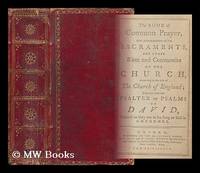
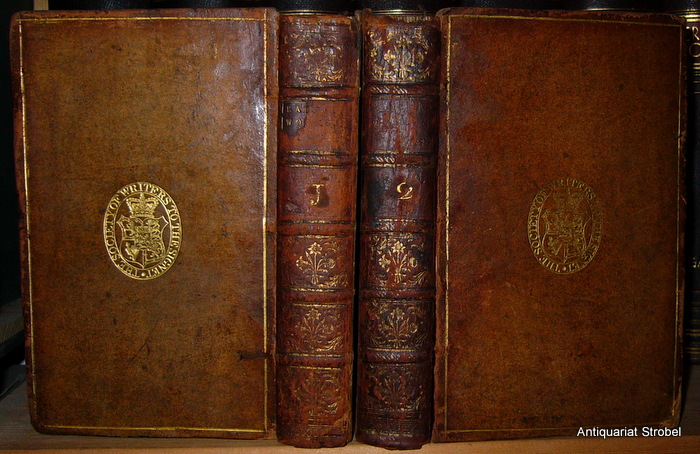
1797réf. 341884London: Printed by C. Whittingham for T. Heptinstall 1797. Hardcover. Near Fine. First edition thus. 12mo. ix 15 347 1 91 5 pp. 19 cm. Issued with a separate title page for A New Version of the Psalms of David by N. Brady and N. Tate H.D. Symonds 1796. In contemporary straight grained black morocco double fillet gilt borders on both boards gilt turn-ins gilt spine title all edges gilt marbled endpapers. Owner's name and address in neat ink on the front paste down. With an attractive contemporary dark red morocco bookplate: "Charlotte Godwin 1798" in gilt with double fillet gilt borders and decorative motif on the front pastedown. Corners bumped with moderate scattered foxing to the text pages else a beautiful fine copy with an interesting early American bookplate. The Godwin family was one of the first to settle in the Eastern Shore region of Virginia. Scarce. OCLC locates only one holding. Printed by C. Whittingham, for T. Heptinstall hardcover books
1835réf. 177521835. Garrison William Lloyd associated. Third Annual Report of the Board of Managers of the New England Anti Slavery Society 1835 an early institutional document of organized abolitionism that records the structure leadership and expanding influence of the New England Anti Slavery Society during a formative stage of the movement. Issued four years after the Society's founding in 1831 under the leadership of William Lloyd Garrison editor of The Liberator the report documents the transition from localized reform efforts to a coordinated national campaign through affiliated societies. The text situates abolition as a moral and political imperative asserting the rapid growth of antislavery sentiment and anticipating legislative abolition. Garrison and Knapp. Third Annual Report of the Board of Managers of the New England Anti Slavery Society. Boston: Garrison and Knapp 1835. First edition. Pamphlet. The report includes the Society's constitution lists of officers detailed subscription and donation records and a treasurer's report alongside rosters of life and honorary members. Named figures include William Lloyd Garrison Moses Brown Thomas Clarkson Josiah Wedgwood and William Wilberforce linking American abolitionist organizing to transatlantic reform networks. The closing statement declares "Thousands and tens of thousands of conscientious persons are already beginning to look upon slaveholding in its true light as an atrocious crime. it will have been abolished by the State legislatures" expressing confidence in the accelerating spread of antislavery conviction. Published in 1835 the same year the New England Anti Slavery Society reorganized into the Massachusetts Anti Slavery Society the report documents a critical moment of institutional consolidation and expansion within the abolitionist movement. The inclusion of financial records and membership lists provides evidence of the material and social networks sustaining reform while the ideological language reflects the shift toward immediatism that defined Garrisonian abolitionism. Later plain wrappers; light wear with clean and stable text. Overall very good condition. unknown
1835réf. 177521835. Garrison William Lloyd associated. Third Annual Report of the Board of Managers of the New England Anti Slavery Society 1835 an early institutional document of organized abolitionism that records the structure leadership and expanding influence of the New England Anti Slavery Society during a formative stage of the movement. Issued four years after the Society's founding in 1831 under the leadership of William Lloyd Garrison editor of The Liberator the report documents the transition from localized reform efforts to a coordinated national campaign through affiliated societies. The text situates abolition as a moral and political imperative asserting the rapid growth of antislavery sentiment and anticipating legislative abolition. Garrison and Knapp. Third Annual Report of the Board of Managers of the New England Anti Slavery Society. Boston: Garrison and Knapp 1835. First edition. Pamphlet. The report includes the Society's constitution lists of officers detailed subscription and donation records and a treasurer's report alongside rosters of life and honorary members. Named figures include William Lloyd Garrison Moses Brown Thomas Clarkson Josiah Wedgwood and William Wilberforce linking American abolitionist organizing to transatlantic reform networks. The closing statement declares "Thousands and tens of thousands of conscientious persons are already beginning to look upon slaveholding in its true light as an atrocious crime. it will have been abolished by the State legislatures" expressing confidence in the accelerating spread of antislavery conviction. Published in 1835 the same year the New England Anti Slavery Society reorganized into the Massachusetts Anti Slavery Society the report documents a critical moment of institutional consolidation and expansion within the abolitionist movement. The inclusion of financial records and membership lists provides evidence of the material and social networks sustaining reform while the ideological language reflects the shift toward immediatism that defined Garrisonian abolitionism. Later plain wrappers; light wear with clean and stable text. Overall very good condition. unknown books
1834réf. 38513Edinburgh: Thomas G. Stevenson 1834. AN EXCEEDINGLY RARE EDITION OF 27 LETTERS ALMOST ALL OF WHICH ARE HOMOEROTIC MISSIVES FROM THE DUKE OF BUCKINGHAM TO KING JAMES I BELIEVED TO BE HIS LOVER. 4 xlii 40 pp. 11 of the letters had been printed before with modernized spelling and often bowdlerized; the other 16 are printed here for the first time. ALL 27 LETTERS APPEAR HERE WITH THE ORIGINAL SPELLING AND COMPLETELY UNEXPURGATED. See David M. Bergeron "King James & Letters of Homosexual Desire" Iowa City: University of Iowa Press 1999 chapter 5. EDITION LIMITED TO ONLY 51 COPIES. 8vo. Fore- and lower edges uncut top edge gilt. Attractively bound by J. Larkins signed in 19th-century half morocco and marbled boards. Some wear to extremities of binding. INTERNALLY FINE AND BRIGHT. An early and important monument in the history of homosexuality in Great Britain. Thomas G. Stevenson hardcover
réf. 20106Printed by John Baskerville Printer to the University Cambridge 1761. First Baskerville edition third title impression with the price of 8s. 6d. on the title page. 8vo 9 3/4 x 6 inches. Contemporary full dark blue calf with wide 1 1/8 inch decorative gilt border to sides spine ornamentally blocked in gilt in 7 compartments and unlettered all edges gilt. Headband a little frayed some rubbing but no cracking to the joints. Overall very good and internally very clean. With the signature of Mary Craven on upper margin of title and another dated 1802 on front fly. Seven Craven family births recorded on rear free endpaper 1806-1843. Armorial bookplate on front pastedown. Printed by John Baskerville, Printer to the University, Cambridge, 1761. unknown
1793réf. 214969Oxford : printed at the Clarendon Press by W. Jackson and W. Dawson printers to the University 1793. 1793 edition. Hardback. Very good copy in gilt-blocked full red aniline calf with gilt decorated border to front and rear boards. Inner gilt dentelles. Spine bands and panel edges somewhat rubbed and dust-toned as with age with gilt-tooling to spine. Marble endpapers with all-edges-gilt. Remains quite well-preserved overall: Internally tight bright clean and strong. Provenance: From the library of Eric George Hatfield Moody with his personalized bookplate to front pastedown. ; 8vo 8"" - 9"" tall; Physical description. : 312 p ; 15 cm ; Notes: Bound with A companion to the altar and Sternhold & Hopkins metrical Psalms. Subject: Church of England - Book of Common Prayer. Notes: Referenced by: ESTC : t182631. Oxford : printed at the Clarendon Press, by W. Jackson and W. Dawson, printers to the University hardcover
réf. 96664London J. Whitlock 1695. Bound in original hard boards with later plain leather spine. Size 8 x 6.5 inches In good condition. Original boards rubbed with a few marks corners worn. New endpapers. First original page detached and is a little tatty on edges. Inside some tanning a few corners turned over and a few minor marks Else generally clean & tight. 316pp London J. Whitlock 1695 hardcover
1739réf. 817F28London: John Baskett 1739 . Leather. Very Good Indeed. 7" by 5". None. Rebound in a bright quarter calf this is a very scarce mid-eighteenth century edition of the Church of England's thirty-nine articles printed alongside a number of further contemporary remarks about the workings and doctrine of the Anglican Church. A very scarce mid eighteenth century printing of the thirty-nine articles of the Church of England - the historically defining statements of doctrines and practices of the church with respect to the English Reformation - and further matters concerning the Anglican church.The articles are printed alongside several parliamentary acts concerning ecclesiastical matters 'His Majesty"s directions for the preserving of unity in the church and the purity of the Christian faith' and the Archbishop of Canterbury"s 'letter to the bishops of his province concerning persons to be ordained or licensed for Curates'.ESTC reference no. T102476Page 155 misnumbered 355 as called for. With the contemporary owner's inscription of 'Peter Coutart 1748' pasted to the head of the title page.Rebound in quarter calf this is an a lovely copy of a very scarce work concerning the practices and doctrine of the Church of England. Rebound in quarter calf with endpapers renewed and marbled paper covered boards. Externally excellent. Internally firmly bound. Former owner's inscription pasted to head of title page. Pages age toned due to paper type. Discolouration to title page with pages otherwise generally clean and bright with only the odd spot. Very Good Indeed John Baskett hardcover
1810réf. 30089AB5 Bände (von 18). London, Vernor, Hood and Sharpe, 1810-1816. 8°. Mit 5 gest. Titeln und 134 Stahlstichtafeln. Lederbände der Zeit mit Rücken- und Deckelverg.
1930réf. WEAU0162Leipzig und Wien, Bibliographisches Institut ca 1870-1930. 8°. braune OLnbde., mit goldener dekorativer Rückenprägung, schwarzer Deckelprägung, marmor. Schnitt, leicht berieben und bestoßen, innen sauber und sehr gut erhalten. "Unter dem Titel Meyers Klassiker-Ausgaben (zunächst Meyers Klassiker-Ausgaben in 150 Bänden) erschien seit 1870 bis in die 1930er Jahre eine Reihe von Werkausgaben klassischer, hauptsächlich deutschsprachiger Schriftsteller. Das Ziel der Buchreihe war es, die wichtigsten Autoren der neueren deutschen Literatur - mit einzelnen Ergänzungen aus anderssprachigen Literaturen - in repräsentativen Ausgaben zur Verfügung zu stellen. Die Zusammenstellungen sollten den dauerhaft gültigen Werkbestand des jeweiligen Autors umfassen. Die Textdarbietung folgte kritischen Editionsstandards. Alle Bände enthalten Erläuterungen und z.T. sehr umfangreiche, kleingedruckte biographische Einleitungen. Den Schwerpunkt der Sammlung bildet die lyrische und dramatische Dichtung innerhalb des Zeitraumes von 1750 bis 1850. Aufgenommen sind ausschließlich Autoren, die im späten 19. Jahrhundert als "klassisch" galten." Aus Wikip. v. 2.12.15.
18155575 (1815) 1st edition. Later Paper Wrappers, 8vo, 10, 10, 2, 2, 56, 56, [1], 6 pages [143 pages total]. Includes the often missing 6-page list of subscribers. The Introduction states that the book was undertaken at the behest of the Rabbi of the Aschkenazic community of London, Solomon Hirschell, together with Raphael di Meldola, Rabbi of the Sephardic community. It also includes the approbation of di Meldola as well as that of Rabbi Solomon ben Zevi Hirsch, the purpose of the work being to protect Jewish children from the inroads of Christian missionaries.The author indicates that the lack of understanding of Judaism among youth is the principle reason why he composed this work. Yet it was intended not just for Jews: Prof. David Ruderman has noted that, "except for its denunciation of Christian missionaries, Cohen's catechism with its English translation, seems to be nothing more than an innocent, uncontroversial presentation of the Jewish faith meant for both Jewish and Christian eyes" (D. B. Ruderman, Jewish Enlightenment in an English Key: Anglo-Jewry's Construction of Modern Jewish Thought, p. 250). Cohen's work was indeed shared with American non-Jews. The Jewish merchant David Isaacs, in his correspondence with Thomas Jefferson, sent the President a copy of the book [see University of Virginia exhibit (2001), To Seek the Peace of the City: Early Jewish Settlement in Charlottesville]. In 1818 Rebecca Gratz offered a copy to her friend Maria Fenno Hoffman, wife of the Attorney General of New York, Ogden Hoffman [see E. Wolf & M. Whiteman, The History of the Jews of Philadelphia, p. 304]. Jacob Marcus Rader lists Cohen's work as one of the Jewish educational books available to Rebecca Gratz when she began operating her Sunday School in Philadelphia [see United States Jewry, 1776-1985, 1-2, p. 393]. A review of this book was printed by Rabbi Yom Tov Benet in his book Tene Bekorim (1767). Shalom ben Jacob Cohen (17721845) himself was a Hebrew writer, poet, and editor. Born in Mezhirech, Poland, he studied German and read the new Hebrew literature, particularly Ha-Me'assef. His first book, Mishlei Agur (1799), was a collection of Hebrew fables in rhyme, with German translation, aimed at teaching Jewish children simple and clear Hebrew. Cohen went to Berlin in 1789 and taught in the Hinnukh Ne'arim school and in private homes. After the publication of several works he renewed the publication of Ha-Me'assef and served as its editor (180911). In 1813 Cohen left Germany, spent a short period in Amsterdam, and moved to London where he tried unsuccessfully to establish a Jewish school. From London, Cohen moved to Hamburg (1816 or 1817), where he spent three controversy-laden years. In a posthumously published poem he attacked the hypocrisy of the "reformists" for their lack of religious belief and national feelings and considered the establishment of the Reform temple in Hamburg an act of blasphemy. However, he refrained from public intervention on this controversy. In 1820 Cohen was invited by Anton Schmid to serve as head proofreader in the Hebrew section of his printing press in Vienna where he remained for 16 years. In 1821 Cohen established the annual Bikkurei ha-Ittim, three issues of which appeared under his editorship. In 1834 he published his poetic work, Nir David, a description of the life of King David, one of the first romantic works in Hebrew literature. In 1836 Cohen returned to Hamburg, where he lived until his death. His last extensive work was Kore ha-Dorot, a history of the Jewish people (1838). His other works include: Mattaei Kedem al Admat Zafon (1807), poetry; Amal ve-Tirzah (1812), an allegorical and utopian drama, a sequel to M.H. Luzzatto's La-Yesharim Tehillah; and Ketav Yosher (1820), a literary miscellany. Roth, Magna Bibliotheca Anglo-Judaica, p. 428, no. 2. Vinograd London 205. Roest 283. BE shin 2421; EJ; CD-EPI 0140837. SUBJECT(S): Judaism -- Juvenile literature. Juvenile works. OCLC: 44005964. OCLC lists 17 copies worldwide, High quality 18th Century paper and internal binding are in exceptionally good condition a very nice copy. (BR-4-2-B-xr)
réf. 96296A Londres et se trouve à Paris, chez l'Auteur et chez Couturier, Imprimeur-Libraire, 1784, 3 parties reliées en 1 volume in-12 de 200x125 mm environ, (1) f., xx-276-(2)ff.-180-80 pages, (1) f., demi veau marbré fauve, dos à nerfs soulignés de filets dorés portant titres dorés sur pièce de titre en maroquin bordeaux, tranches rouges. Edition originale ornée d'une grande carte dépliante de l'Amérique Septentrionale (De la Baie d'Hudson au Mississipi). Petits frottements sur le cartonnage, quelques rousseurs, sinon bon état.
réf. 103214A Lyon, chez les Freres DUPLAIN, rue Mercière, 1751, 3 volumes in-4 de 255x200 mm environ, tome I : 1f. blanc, faux-titre, 1 frontispice, titre en rouge et noir, lxxviij-1f. (approbation, privilège)-668 pages, 1f. blanc, - tome II : 1f. blanc, faux-titre, titre en rouge et noir, 707 pages, 1 f.blanc, - tome III : 1f. blanc, faux-titre, titre en rouge et noir, 748 pages, 1f.blanc, plein veau cognac marbré, dos à 5 nerfs portant titres et tomaisons dorés sur pièces de titres en maroquin bordeaux et tomaisons brunes, ornés de caissons à fleurons et motifs dorés, coupes dorées, gardes marbrées, tranches rouges.Rousseurs et pages brunies, quelques mouillures et petits défauts de marge, un saut dans la numérotation (p. 576 suivie de 587, erreur maintenue jusqu'à la fin) sans manque de page, confirmé par les réclames et signatures, des coions émoussés, une coiffe ébréchée et une autre arasée, petits trous de ver sur les dos, épidermures et frottements, petites taches sur les gardes blanches, sinon belle série, Edition originale de la traduction avec un frontispice gravé et trois vignettes de chapitre gravées également par Delamonce & Joubert.
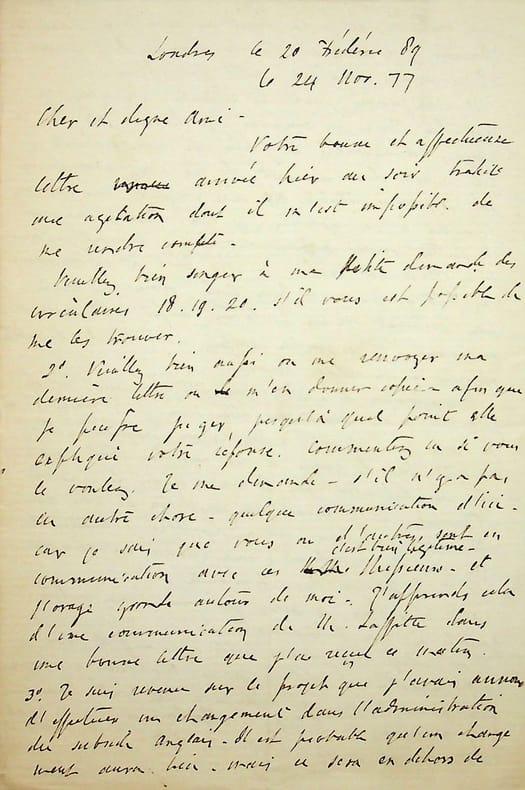
réf. 018959[Positivisme] Richard Congreve (1818-1899), philosophe anglais, figure de proue du positivisme en Angleterre, à l'origine du schisme en 1878. L.A.S. en français, Londres, 20 Frédéric 89 [24 novembre 1877], 4p 1/2 in-8. Au docteur Jean-François Robinet (1825-1899), médecin d'Auguste Comte et important positiviste français. « Cher et digne ami, Votre bonne et affectueuse lettre arrivée hier au soir trahit une agitation dont il m'est impossible de me rendre complète[ment]. Veuillez bien songer à ma petite demande des circulaires 18.19.20 s'il vous est possible de me les trouver. 2° Veuillez bien aussi ou me renvoyer ma dernière lettre ou m'en donner copie afin que je puisse juger jusqu'à quel point elle explique votre réponse. Commentez la si vous voulez. Je me demande s'il n'y a pas eu autre chose - quelque communication d'ici - car je sais que vous ou d'autres, c'est bien légitime, sont en communication avec ces Messieurs et l'orage gronde autour de moi. J'apprends cela d'une communication de M. [Pierre] Laffitte dans une bonne lettre que j'ai reçue ce matin. 3° je suis revenu sur le projet que j'avais annoncé d'effectuer un changement dans l'administration du subside anglais. Il est possible qu'un changement aura lieu mais ce sera en dehors de mon initiation[?]. Le projet avait ses avantages mais je reconnais que ce n'est pas le moment d'y penser. 4° Je prends d'abord votre postscriptum. Je n'ai jamais parlé de retraite.Où avez-vous pris cela. Tout au contraire, je cherche par tous les moyens d'agrandir la sphère de mon activité. Si par hasard, il m'arrivait de me voir abandonné par la presque totalité de mes confrères anglais, ou d'avoir à les quitter, je continuerais toujours de lutter comme auparavant. Il y a vingt-deux ans que j'ai commencé seul. Je suis prêt à recommencer non pas seul mais bien isolé, dans un cercle bien restreint mais peut-être aussi utile que celui qui existe. Et je compte réussir avec l'aide de certains appuis à un certain degré. Ma situation à Londres peut être essentielle - honorée peut-être - mais elle sera, je le crains, ébranlée sous peu par l'action de ces messieurs. Mais en tout état de cause, si ma carrière est brisée, cela ne dépendra pas de moi mais de l'action extérieure. et j'aurais la consolation de voir que cette action extérieure aura développé l'énergie de ceux qui la prendront - une énergie en somme utile à la Religion de l'Humanité. Ainsi, cher ami, je pense que vous serez calmé quant à ma détermination. J'ai rédigé une longue lettre à M. Laffitte que je vais soumettre à certains amis. Elle vous expliquera mon point de vue et cela m'a trop coûté pour que j'y revienne en détail. En attendant, je lui ai répondu ce matin. Maintenant je réponds à votre lettre. Vous avez senti un refroidissement - et vous avec eu raison. À quoi tient-il ? Libre à vous de vous ranger du côté de M. Laffitte, de juger que le statu quo amélioré était le seul admissible. Je puis différer mais enfin votre avis avait beaucoup eu sa faveur. Mais, après tout ce qui s'est passé entre nous, j'ai été choqué de la manière dont vous m'avez présenté l'action de M. Laffitte et aussi de la manière dont préoccupé du soin de me détourné de toute opposition, vous avez interprété mon action. Mais c'était long, et peut-être impossible de débrouiller des difficultés pareilles. (Je remarque en passant que la Fête de l'Humanité n'est pas proprement parlant une fête commémorative d'Auguste Comte - encore moins de sa naissance). Si vous m'aviez dit, je le crois de bonne politique de soutenir M. Laffitte, puisque il faut choisir, je n'aurais eu rien à dire. Votre jugement sur lui m'aurait paru peu conciliable, peut-être, avec cette conclusion. Mais voilà tout. Mais l'argumentation m'a déplu. Je vous l'avoue franchement. Ensuite, quant à ma venue, dans les conditions telles que vous les aviez "rêvées", elle devait avoir envie à une époque plus ou moins éloignée de me substituer à M. Laffitte. Mais dans vis der
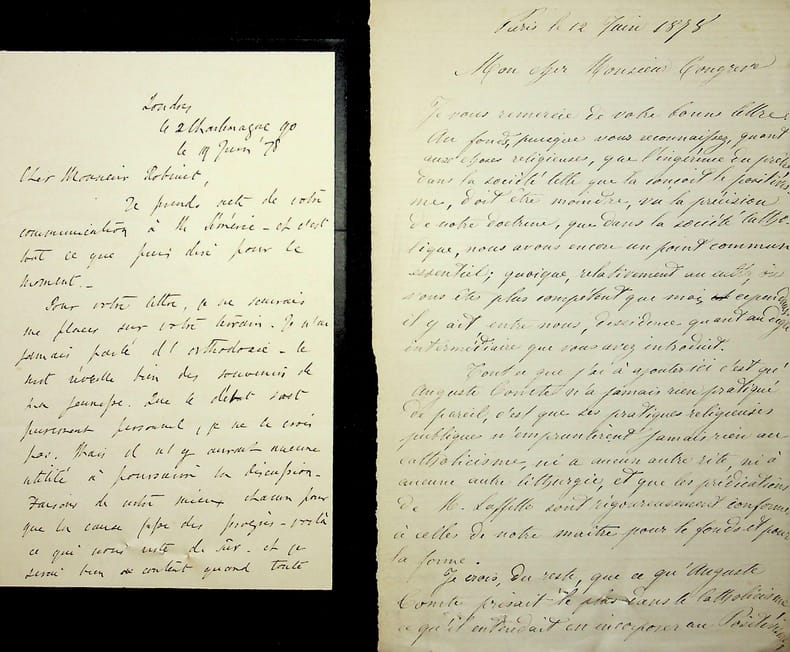
réf. 018960[Positivisme] Richard Congreve (1818-1899), philosophe anglais, figure de proue du positivisme en Angleterre, à l'origine du schisme en 1878. L.A.S. en français, Londres, 2 Charlemagne 90 [19 juin 1878], 2p in-8. Au docteur Jean-François Robinet (1825-1899), médecin d'Auguste Comte et important positiviste français. « Cher Monsieur Robinet, Je prends acte de votre communication à M. Sémérie et c'est tout ce que je puis dire pour le moment. Pour votre lettre, je ne saurais me placer sur votre terrai. Je n'ai jamais parlé d'orthodoxie - le mot réveille des souvenirs de ma jeunesse. Que le débat soit purement personnel, je ne le crois pas. Mais il n'y aurait aucune utilité à poursuivre la discussion. Faisons de notre mieux chacun pour que la causse fasse des progrès - voilà ce qui nous reste de sûr. Et je serai bien content quand toute lutte aura cessé - ce qui ne peut guère manquer d'arriver tôt ou tatd. Mais quel chaos actuel. Je vous transmets le premier versement de cette année. C'est à jeudi ou à vendredi qu'en est l'échéance. Et je ne dois pas être en retard. Reste à voir quelle sera l'influence de nos tiraillements sur le subside. Je m'abstiens de toute prévision. Si je pouvais causer avec vous de tout cela à la bonne heure - mais sur le papier )- bah ! Nous nous associons pour vous exprimer nos meilleurs voeux et sentiments ainsi, bien entendu, qu'aux vôtres. Richard Congreve ». Cette lettre répond à une lettre du 12 juin dont nous avons le brouillon (secrétaire) signé : « Mon cher Monsieur Congreve, Je vous remercie de votre bonne lettre. Au fonds, puisque vous reconnaissez quant aux choses religieux, que l'ingérence du prêtre dans la société telle que la conçoit le positivisme, doit être moindre, vu la précision de notre doctrine, que dans la société catholique, nous avons encore un point commun essentiel ; quoique, relativement au culte où vous êtes plus compétent que moi, cependant, il y ait entre nous, dissidence quant au degré intermédiaire que vous avez introduit. Tout ce que j'ai à ajouter ici c'est qu'Auguste Comte n'a jamais rien pratiqué de pareil, c'est que ses pratiques religieuses publiques n'empruntèrent jamais rien au catholicisme, ni à aucun autre rite, ni à aucune autre liturgie, et que les prédications de M. Laffitte sont rigoureusement conformes à celles de notre maître pour le fonds et la forme. Je crois, du reste, que ce qu'Auguste Comte prisait le plus dans le catholicisme, ce qu'il entendait en incorporer au Positivisme, ce n'était ni le dogme, ni même le culte, mais la base morale et surtout l'organisation politique, la division des deux pouvoirs et l'unité hiérarchique du pouvoir spirituel. Cela dépendait de ce qu'il se plaçait toujours et avant tout au point de vue social. Je ne pense donc pas que M. Laffitte et ceux qui le suivent soient hors de l'orthodoxie, même quant au culte. Et comme d'autre part vous reconnaissez que la scission ne porte pas sur le dogme, il s'en suit qu'elle n'a, en réalité, que des motifs personnels. C'est là, en effet, ce qui m'a toujours paru être le noeud de la question. La majorité des Positivistes l'a compris ainsi, et la scission, à ce qu'il me semble, s'est faite sur des noms propres, le votre et celui de Monsieur Laffitte, et non sur les questions politiques, philosophiques, ou religieuses. [Partie barrée par Robinet] Ceci posé, et je suis certain que vous l'acceptez comme moi, il me reste à exprimer, si délicate que soit la chose, le regret que j'éprouve des procédés qui ont été employés pour consommer la séparation. Au lieu d'aggraver des mécontentements, au lieu d'imaginer un partage de la direction, un coadjutariat, qui s'est aussitôt transformé en sommation faites à Mr [Laffite] [Fin de la partie barrée, il manque probablement une petite partie] C'est là, en effet que m'a finalement paru être le noeud de la question. La majorité des Positivistes semble l'avoir compris ainsi, et la scission s'est
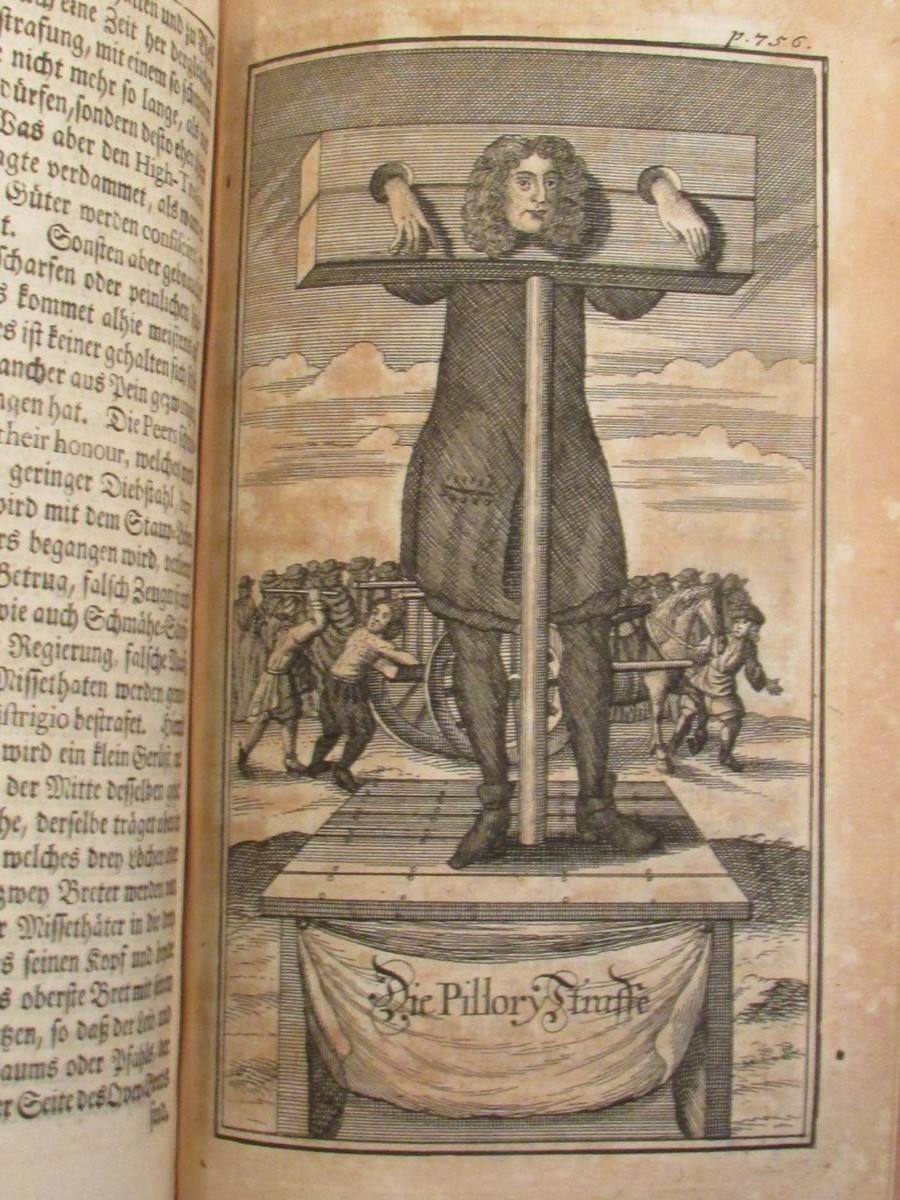
1732réf. SB-22882Bremen, Philipp Gottfried Saurmann, 1732. 44 Bl., 1288 S. Ganzpergamentband der Zeit mit dreiseitigem Rotschnitt. Enthalten sind 14 teils ausfaltbare Kupfertafeln. Erstmals 1694 in Lüneburg erschienenes einschlägiges Werk des lutherischen Theologen Henrich Ludolf Benthem (1661 - 1723) zur englischen Landeskunde, insbesondere zur Geschichte und Verfassung der anglikanischen Kirche sowie zum Schulwesen in England. Inhalt im Überblick: Allgemeine Landeskunde - Wege nach England - Sprachkunst - Londoner Sehenswürdigkeiten - Schulen, Gerichtshöfe, Kunstakademien, Bibliotheken, Kaffeehäuser - Hospitäler, christliche Gesellschaften - vorherrschende Religion - Gottesdienst - Taufe - Konfirmation - Kirchenregiment - Kirchenpersonal - Einteilung in Bistümer - Berufung und Einführung eines Bischofs in England - höheres Schulwesen - Streitigkeiten, Spaltungen der Kirche von der Reformation bis zur Gegenwart - Streitigkeiten zwischen Episkopalen und Presbyterianern - Zeitrechnung, Maß, Gewicht, Münzen, Adel, Namen, Gesetze, Strafen, Gewohnheiten, Spiele, Feierlichkeiten - Gelehrte in England - Konversion Jakobs II zum Katholizismus. Benthem verfaßte noch ein ähnliches Werk über die Niederlande (Hannover 1698).
In-12, broché, couverture papier bleu d'origine, (8), 295 p., exemplaire non rogné, non coupé, tel que paru. Première édition française probablement sortie des presses de M.-M. Rey, dans une édition et une traduction attribuées à d’Holbach. L’ouvrage contient le recueil des pièces composées par Anthony Collins, libre-penseur, élève et ami de Locke, dans la polémique qui s’était engagée entre eux-mêmes, Samuel Clarke et Henry Dodwell, sur l'immatérialité et l'immortalité de l'âme. Selon Bréhier (II, 293) : "Collins montre l’union du matérialisme à la doctrine sensualiste de la connaissance". De très larges extraits de cet ouvrage ont été cités par Naigeon dans "l’Encyclopédie Méthodique". L’ouvrage a été interdit et condamné au feu. (Colon, 'Siècle des Lumières', 69:676. 'Holbach et ses amis', 1553. Peignot, 'Livres condamnés', II, p.214. Vercruysse, p. 32). Exceptionnel exemplaire, tel que paru, non rogné, non coupé.
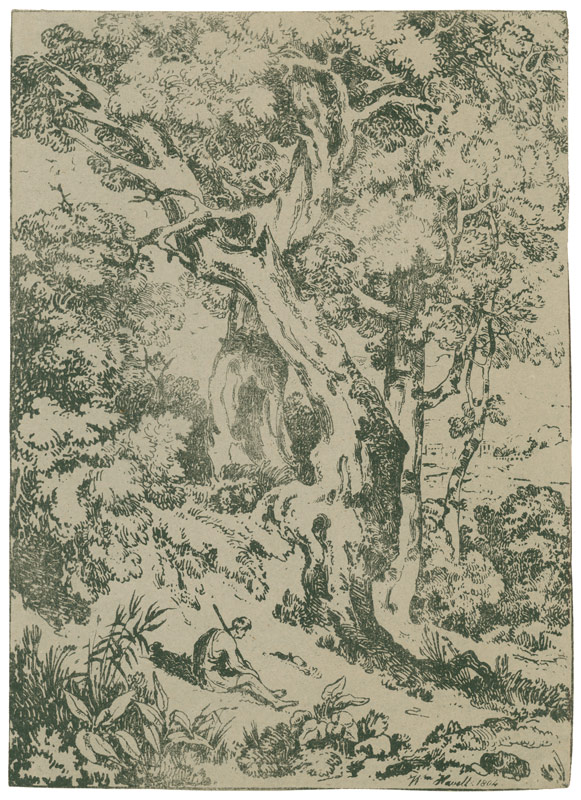
réf. 196-Lo.J. Federlithographie, 1804, auf grauem Bütten. 31:22,2 cm. Literatur: F. Man: Anfänge der Künstlerlithographie in England, 84. 1806 bei Gg.J. Vollweider, London, erschienen. ? Inkunabel der Lithographie!
1792réf. FLEN0035London, Longman, White (et.al.) 1792. Gest.Front., IV, 187, 215; 438; 442; 446; 443; 397; 410; 416; 460; 404; 389; 450 (92)S., marmor. Lederbände d.Zt., Ecken u. Kanten stellenw. ein wenig berieben, die ersten u. die letzten Bl. jeweils etw. stockfl., jedoch gut erhaltener und dekiorativer Satz. / Engrav. Frontis., IV, 187, 215; 438; 442; 446; 443; 397; 410; 416; 460; 404; 389; 450 (92) pp., contemporary marbled leather, edges & corners partially slightly rubbed, each vol. w. slight foxing on first & last pages, still very decorative & in good condition. Erste Ausgabe. / First edition
LONDINI, Ed. Willielmo Wats, imp. A. Mearne, T. Dring, B. Tooke, T. Sawbridge, & G. Wells - 1684 - 1 fort volume in-folio - Reliure plein veau de l'époque avec restauration postérieure maladroite - Frontispice de Mathieu PARIS, Page de titre, (32), 1175 pages & Glossaire & index 36 pages - Bon exemplaire 2 grands Ex-libris armoriés: Sigill Henrici Baker tristram e coll line o ronn (Henry Baker), devise "Fortiger Gerig Cracem" & Thomas Phillips, Middle Hill, Worcestershire ** , devise "Deus Patria Rex"- Envoi rapide et soigné ** Sir Thomas Phillipps, 1er Baronet (2 juillet 1792 - 6 février 1872) - Antiquaire, Bibliophie et collectionneur de livres. Son désir de préserver les manuscrits et livres fut d' avoir assisté à des destructions incessantes. Ce fut donc son activité principale: la collection de manuscrits et ouvrages rares de toutes époques, de tous pays, de toutes langues et de tous sujets. Sa dévotion -pour les livres - était telle qu'il acquit quelque 40 000 livres imprimés et 60 000 manuscrits, sans doute la plus grande collection créée par un seul individu. Une partie des manuscrits a depuis été dispersée ou mise aux enchères chez Sotheby's (juillet 1891, juillet 1892, juin 1893, mars 1895, juin 1896, mai 1897, juin 1898, juin 1899 et juin 1908)
1899réf. AMO-2427Important fragment d'article autographe rédigé pour l'Echo de Paris (vers 1897-1899) Article intitulé : 17 mars - Simplification d'existence des anglo-saxons 6 pages in-8 oblong (long article) - Composée de fragments de feuilles collées les unes aux autres comme cela était le plus souvent le cas pour les manuscrits remis aux compositeurs dans les imprimeries à cette époque. Le feuillet 5 est incomplet de quelques lignes (le dernier morceau de papier en partie basse a été perdu) Voir photos. Provenance : Ancienne collection Bertrand Hugonnard-Roche.
1751réf. 19093London, R. Dodsley, 1751. 1 Bl., CXX, 280 (recte 282) S., 1 Bl.; 1 Bl., 400 S. Mit gestochenem Porträt von L. P. Boitard. 8° (20,5 x 13,5 cm). Leder um 1800 mit Rückenvergoldung, Deckelfileten und goldgeprägten Supralibros auf allen Deckeln.
1817réf. 58380BBParis, Didot für Galignani., (1817). Gross-Folio (49x31 cm). Ca. 120 S. Mit gestochenem Porträt und 24 gestochenen Tafeln von J. Duplessis-Bertaux, Bedruckter Originalpappband [2 Warenabbildungen]
1971réf. mon00005767601971T. unknown_binding. Acceptable. in x in x in. Ex-library book usual markings. Well read with some wear but still very useable. unknown
1683réf. 65703Oxford: printed at the Theatre; London sold by Thomas Guy at ye Oxford Arms on ye westside of Royal Exchange in Cornhil 1683. Folio in 6s 1 leaf unsigned engraved title page a-bâ´ A-MⶠN¹ Aa-HhⶠIi-Mmâ´ Nn-OoⶠPpâ´ Qq² Llâ‚ incorrectly signed L; engraved title page with top 1¼" excised likely to remove a previous owner's name pp. 306 15 7; contemporary and almost certainly original full black paneled goat with gilt floral sprays and lozenges the central gilt panel enclosing a gilt supralibros of a rampant lion holding a patriarchal cross; gilt-decorated spine in 7 compartments black leather label in 1 a.e.g.; small chips and cracks at spine ends joints starting at the ends corners a little smushed the whole rubbed and worn but the binding remains sound. Ostensibly Wing B-3672. Of this issue 328 pages only UCLA and the University of Bristol in OCLC. printed at the Theatre; London, sold by Thomas Guy at ye Oxford Arms on ye westside of Royal Exchange, in Cornhil unknown