79,653 results
2014ref. 851672014. Germany. Federal Ministry of Justice and Consumer Protection. The Rosenburg Fourth Symposium: Examining the Judiciary's Nazi Past - Perpetrators Victims Justice. Presentations Made on 21 October 2014 in the Library Foyer of the Federal Court of Justice Karlsruhe. Berlin: Federal Ministry of Justice and Consumer Protection Division for Public Relations 2014. 100 pp. Softbound color printed. Light shelfwear near fine. $45. "The Rosenburg Symposium on 'Examining the Judiciary's Nazi Past - Perpetrators Victims Justice' held on 21 October 2014 at the Federal Court of Justice in Karlsruhe has impressively accompanied the work of reappraising the Nazi past of the Federal Ministry of Justice and Consumer Protection. The Independent Academic Commission at the Federal Ministry of Justice and Consumer Protection Regarding the Critical Study of the National Socialist Past successfully recruited a number of outstanding personalities who from different perspectives have illuminated how the judiciary handled its own Nazi past during the development of the Federal Republic of Germany" Preface. unknown books
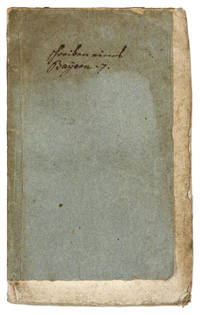
1774ref. 713481774. Nuremberg: Bey Wolfgang Schwarzkopf 1774. Nuremberg: Bey Wolfgang Schwarzkopf 1774. Ways to Abolish Begging Begging. Germany. Schreiben eines Bayern an Seinen Freund uber die Moglichkeit der Ganzlichen Abstellung des Bettelns und der Versorgung der Armen in einem Land. Nuremberg: Bey Wolfgang Schwarzkopf 1774. 55 pp. Octavo 7-1/4" x 4-1/4". Stab-stitched pamphlet in plain wrappers early hand-lettered title to front. Light soiling to exterior some rubbing to extremities with light wear to spine ends and corners. Light toning light foxing in places faint early owner stamp to title page. $500. Only edition. Cast in the form of a letter to a friend this pamphlet discusses the nature of public assistance and ways to abolish begging such punishments for begging and the establishment of work houses. The title of this anonymous work identifies the author as a Bavarian. The dedication is signed "J. Fr. v. E." and the text ends with a statement that it was written "near the Danube in Bavaria." OCLC locates 7 copies 1 in North America University of Pennsylvania. Das Verzeichnis Deutscher Drucke des 18. Jahrhunderts 14542927-003. unknown books
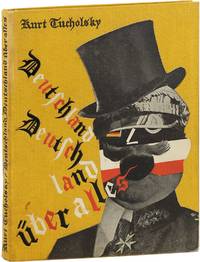
1929ref. 84810Berlin: Neuer Deutscher Verlag 1929. First German Edition. First Printing cloth issue with 1.-20. Tausend printed on title page. Octavo 24cm; yellow decorative cloth with photomontage by John Heartfield applied to covers and titles stamped in black on spine; yellow topstain; 231pp 5; illus; text is in German. Contemporary October 1929 owner's name penciled to front endpaper; slight forward lean light overall dust-soil to cloth with pictorial elements well-preserved and largely unrubbed; browning to endpapers with mild wear to base of spine; a presentable copy Very Good lacking the rare dustjacket. A powerful piece of social criticism by Tucholsky one of the most prominent German-Jewish authors and journalists of the Weimar Republic. Produced with graphic designer John Heartfield Tucholsky managed to combine vicious attacks on everything he disliked about Germany with a declaration of love for his country. He warned of a government with anti-democratic tendencies and the impending threat of National Socialism - a plea almost to revolutionize a dormant country - though his fears were realized in 1933 when Hitler assumed the position of Chancellor of Germany. Axel Eggebrecht one of Tucholsky's contemporaries said of Deutschland: "If this book were to turn out to be quite a big success it might be realized that the dream of awakening is still very vivid in Germany." Deutschland was listed on the Nazis list of censored books and though it did go through a second printing few enough survived destruction. The present example is one of apparently two variant bindings for the first printing with no extablished priority known to us. While the pictorial cloth binding is the variant we have seen and handled most often we note another in yellow cloth without the pictorial elements and titles stamped in black on spine and front cover. A well-preserved example and a high-point of Heartfield's graphic design and layout work. Pachnicke & Honnef 60a-69 p.148-161. Neuer Deutscher Verlag unknown books
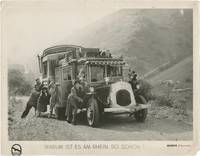
1952ref. 167603Berlin: Rebus Filmverleih 1952. Two vintage oversize studio still photographs from the presumably lost 1952 German film. Approximately 11.75 x 9 inches. Very Good plus. Rebus Filmverleih unknown books
1972ref. 83026N.p.: S.i. 1972. Original lithographed poster with text and illustration offset printed in black on white stock measuring 30.75cm x 43.25cm 12 1/8" x 17". Faint horizontal fold smoothed out at center hint of toning along the upper edge with a few faint tiny marks; Near Fine. A poster taking a jab at both the German police and Hans-Dietrich Genscher 1927-2016 who served as Federal Minister of the Interior at the time of the 1972 Munich Olympics hostage crisis during which members of Black September took nine members of the Israeli Olympic team hostage. A botched rescue attempt by German police at Fürstenfeldbruck air base resulted in a shootout which left one policeman five terrorists and all hostages dead. Not separately listed in OCLC. 83026. S.i. unknown books
1800ref. 760061800. Handsome German Manuscript on the Sources of Civil Law Manuscript. Germany. Legal Education. Einleitung ins Rechtsstudium Introduction to the Study of Law. Germany c.1790. 194 pp. Quarto 7-1/2" x 5-3/4"; 19 x 14.6 cm. Contemporary quarter cloth over marbled boards with cloth-reinforced corners spine featuring blind-tooled fillets retaining faint traces of gilding an early ink volume number "2" and a partially effaced title. Speckled edges. Light rubbing to boards moderate wear to edges and corners. Interior crisp with light uniform toning; text written cleanly on rectos and versos in a tight elegant and remarkably correction-free cursive hand. $1250. Exceptionally neat and well-formatted this manuscript features meticulously organized chapters and sub-sections marked by a clear hierarchy of Roman numerals Arabic numerals and alphabetical subdivisions. The striking lack of corrections suggests it is either a fair copy prepared by a dedicated student or a master copy intended for circulation. While the exact university and author remain unidentified the orthography structural arrangement and binding are distinct hallmarks of late eighteenth-century German academic culture. This volume records a foundational course on the historical and philosophical roots of contemporary civil law. The text opens with a concise philosophical overview of the nature of law before transitioning into expansive sections on broader legal systems-specifically Natural Law-followed by deep detailed examinations of Roman and Canon Law. Ultimately the manuscript provides an invaluable window into the conceptual framework and intellectual pedagogy that shaped legal education in the German states on the cusp of the nineteenth century. unknown books
1975ref. 37881Bloomington: The Lilly Library Indiana University 1975. Softcover. Good. Quarto. Teal blue decorative wrappers. 56 pp. 2 pp. notes on the exhibition by Bareikis laid in. Illustrated. Wrappers worn and foxed with annotation to upper. The Lilly Library, Indiana University unknown books
1899ref. 171411899. Women's Suffrage Germany P. Aug. Rosler. "Wahre und Falsche Frauen Emanzipation Truths and Lies: Women's Emancipation". Written in German. Stuttgart und Wien: Dof Roth'sche Verlagshandlung 1899. Printed by Hieronymus Muhlberger in Augsburg. 60 pages. 9 x 6 in. Original paper wraps. Very rare. At the time that this description is being written no copies are recorded in American institutions. OCLC search results are at best an estimate and can vary over time. An early German language treatise regarding popular myths on women's suffrage and the Women's Question die Frauenfrage. The volume lists the Madonna mother of Christ as one example of virtuous women whom all respect. German women were granted the right to vote and be elected from November 12 1918 immediately after the Armistice of WWI. Handwritten ink annotation on front cover. Front and back cover are detached; pages 1-16 detached; pages 49-60 detached. In good condition. unknown books
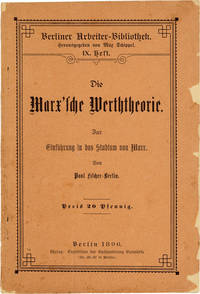
1896ref. 47650Berlin: Expedition der Buchhandlung Vorwärts 1896. First Edition. Octavo 19.5cm.; publisher's orange wrappers printed within typographically decorative border; 52pp.; text printed entirely in blackletter. Some shallow chipping to upper cover fore-edge not approaching text some light soil textblock uniformly toned else a Very Good copy internally clean and sound. At head of title: "Berliner Arbeiter-Bibliothek" IX. Heft. One of a series of educational Marxist pamphlets issued under the banner the "Berliner Arbeiter-Bibliothek" this introducing its readers to the theory of surplus value without having to wade through Marx's original text. Other titles in the series covered the benefits of unionism and labor protection legislation; provided a concise history of the Paris Commune; and included an edition of Bellamy's "Looking Backward. Expedition der Buchhandlung Vorwärts unknown books
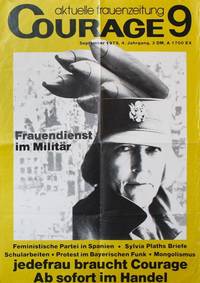
1979ref. 32004Berlin 1979. First Edition. Original photo-montaged advertisement poster 83.5x58.75cm. printed offset in black and yellow on glossy white stock; previous mail folds general wrinkling most heavily along right-hand edge else About Very Good and sound. Advertising poster for the German feminist magazine Courage the image presumably reproducing the cover of the current issue. Contents feature articles on women in the military the feminist movement in Spain and the letters of Sylvia Plath. At bottom of image: "Jedefrau Braucht Courage / Ab sofort im Handel" Every woman needs courage from now on in work. Quite a large poster presumably issued to be displayed at the newsagent. unknown books
1978ref. 9011784Boston: Little Brown 1978. 1st. Hardcover. Book fine Dust jacket fine. The dust jacket has minor chips and closed tears to the extremities. Little, Brown hardcover books
1846ref. 63221846. GERMANY. Verzeichniss im Jahre 1845 in Berlin lebender Schriftsteller und ihrer Werke. Berlin 1846. xii 389 1 p. Cloth-backed boards rubbed at extremities. Biographical sketches of German scholars and writers with the names of their publications. unknown books
ref. 47600Berlin: 1848: Vereins Buchdruckerei. Broadside 27cm x 20cm ca 10-3/4" x 8". Printed in blackletter on white wove stock. Slightly toned with old vertical and horizontal fold-lines; creased at margins; Very Good. Satirical broadside in the form of a fictional speech by King Friedrich Wilhelm IV in which he ironically expresses support for the demands made by liberal parliamentarians at the May 18th Parliamentary Assembly in Frankfurt-am-Main. These included expanded rights for the underprivileged classes including most importantly universal male suffrage; attenuation of executive power; the election of a permanent German parliament and monetary reforms including a unified German currency. The great wave of liberal revolt that washed over the European Continent in 1848 proved short-lived; by 1851 most of the newly-established liberal régimes had been quashed by reactionary movements with radical leaders either imprisoned murdered or driven into exile. Out of this crucible would arise the Franco-Prussian War and the militant Marxist nihilist and anarchist movements of later in the century. A highly evocative document of the first wave of German radical revolt. Rare; OCLC and KVK note three locations only all in Germany. Vereins Buchdruckerei unknown books
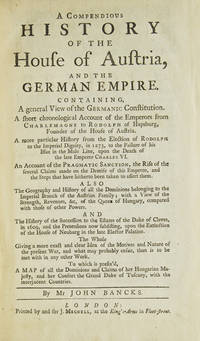
1745ref. 250103London: J. Mechell at the King's Arms in Fleet-street 1745. Includes a coloured folding Map By Emanuel Bowen of the Dominions and Claims of the Queen of Hungary and Her Consort the Grand Duke of Tuscany. vii218-430 pp. 8vo. Contemporary clf front hinge off. Includes a coloured folding Map By Emanuel Bowen of the Dominions and Claims of the Queen of Hungary and Her Consort the Grand Duke of Tuscany. vii218-430 pp. 8vo. ESTC N3058 J. Mechell, at the King's Arms in Fleet-street unknown books
1930ref. 34600Berlin: Reuichbahnzentrale 1930. 1 vols. Folio 39 x 24 inches. Linen backed. 1 vols. Folio 39 x 24 inches. Reuichbahnzentrale unknown books
1790ref. 33996Wien: zu finden bey Artaria Compagnie 1790. 1 vols. 8vo when folded panels ca. 4 3/4 x 8 inches; overall size 34 x x 24 inches. Large map consisting of 28 panels mounted on linen handcolored. Some spotting and soiling tack holes in corners laid into cloth folder reading "Reisekarte von Deutschland. 1 vols. 8vo when folded panels ca. 4 3/4 x 8 inches; overall size 34 x x 24 inches. Showing postal routes. zu finden bey Artaria Compagnie unknown books
1938ref. 70935Berlin Germany: Reichsbund Judischer Frontsoldaten 1938. Folio. 4 pp. Weekly published by a group of Jewish World War I veterans. "The Reichsbund Judischer Frontsoldaten veterans mostly held mainstream views but they emphasized German patriotism alongside articles designed to counter anti-Semitism. The circulation amounted to 17200 readers in 1935 . print copies of this newspaper are held at just four European institutions" U. of Florida Smathers Library exhibit "Gathering Storm: Jewish Life in Germany and Eastern Europe in the 1930s". Includes an article on the Somme campaign. OCLC locates only runs in Germany and France. Poor quality paper browned and chipped around the edges affecting a few letters separated along the spine now two leaves. Quite fragile but a good copy of a scarce Jewish newspaper published as the Nazis built their power. Reichsbund Judischer Frontsoldaten unknown books
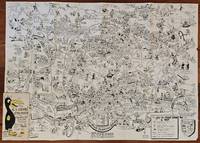
1954ref. BK0099Darmstadt Gemany: Stars and Stripes 1954. Folding pictorial map approximately 2 3¼ x 33 inches unfolded in original illustrated wrappers. OCLC 59284292. Near fine with some wear to wrappers. A wonderfully busy cartoon map of Frankfurt made for American servicemen stationed in Germany during the early Cold War. Byrel "Lefty" Burgess a career U.S. Army engineer and cartoonist fills the city with G.I.s military police beer halls historic buildings street jokes and visual gags while giving particular attention to the extensive American military presence in and around Frankfurt. American sites include barracks the 97th General Hospital WAC quarters Frankfurt High School the PX and residential areas occupied by servicemen and their families. The map ranges from Höchst and Bad Vilbel to Harheim and Offenbach mixing useful street information with caricatures and annotations. Burgess labels historic sites including the Saalhof Karmeliter Kloster Dominikaner Kloster and Drei Königs Kirche while military life and Frankfurt's drinking culture provide much of the humor. Along the upper edge references to places back home-including Texas Chicago Los Angeles Pike's Peak and the Rocky Mountains-reinforce the map's intended audience of Americans temporarily living overseas. Burgess served in the Army Corps of Engineers; he later produced a similarly humorous map of Seoul in 1957. OCLC 59284292. . Stars and Stripes unknown books
1947ref. 37284US Zone: Office of Military Government for Germany U.S. 1947. First and only edition. Hardcover. g. Folio. 2 51 leafs 2pp. index of names 7 leafs exhibit list and certification of reproduction with facsimile signature of Charles E. Bancroft 293 leafs with facsimile reproductions of 137 exhibits. Original half black binder tape over paper covered boards with title pasted on spine and front cover. This rare document is based on a great number of important records which became accessible at the Deutsche Bank's Hamburg branch only after the end of WWII. For the first time information is revealed on some rather unusual transactions which tend to incriminate the bank even further for its participation in spoliation and aryanization from 1933 to 1945. Of particular interest is the description of the manner in which the Deutsche Bank following the Munich agreement of 1938 grasped control of two outstanding Czech banking institutions: the Boehmische Unionbank and the Deutsche Agrar- und Industriebank. This work recounts the Deutsche Bank's participation in the "aryanization" of the German economy from 1932 to 1940 drawing on internal Deutsche Bank records as well as material seized by Allied troops after World War II. It shows how as the Nazis began to rise to power the bank reluctantly purged itself of Jewish directors followed by Jewish employees in response to state pressure. Later the regime enlisted the bank employees' professional skills domestic and foreign relationships and financial muscle to eliminate Jewish control and ownership of German companies. The expropriation was conducted gradually since many hastily seized companies proved worthless without the management of their Jewish former owners and also because this method muted foreign criticism and preserved a veneer of legality. This stands in stark contrast to the brutally simple methods used by the Nazis in occupied countries and after 1941 in Germany as well. The numerous incriminating documents retrieved at the end of the hostilities are reproduced in facsimile. The index of names includes institutions as well as names of high level Nazis and their supporters. Rare! No listing in KVK. Sporadic and minor damp-staining on covers and at upper margin of pages not affecting text. Text in English documents in German. Binding and interior in overall good condition. "After Adolf Hitler came to power instituting the Third Reich Deutsche Bank dismissed its three Jewish board members in 1933. In subsequent years Deutsche Bank took part in the aryanization of Jewish-owned businesses; according to its own historians the bank was involved in 363 such confiscations by November 1938. During the war Deutsche Bank incorporated other banks that fell into German hands during the occupation of Eastern Europe. Deutsche provided banking facilities for the Gestapo and loaned the funds used to build the Auschwitz camp and the nearby IG Farben facilities. Deutsche Bank revealed its involvement in Auschwitz in February 1999. In December 1999 Deutsche Bank along with other major German companies contributed to a US$5.2 billion compensation fund following lawsuits brought by Holocaust survivors.2526 The history of Deutsche Bank during the Second World War has been documented by independent historians commissioned by the Bank. During World War II Deutsche Bank became responsible for managing the Bohemian Union Bank in Prague with branches in the Protectorate and in Slovakia the Bankverein in Yugoslavia which has now been divided into two financial corporations one in Serbia and one in Croatia the Albert de Barry Bank in Amsterdam the National Bank of Greece in Athens the Creditanstalt-Bankverein in Austria and Hungary the Deutsch-Bulgarische Kreditbank in Bulgaria and Banca Commercial Romana in Bucharest. It also maintained a branch in Istanbul Turkey" from Wikipedia. Office of Military Government for Germany (U.S.) hardcover books
1962ref. 197921962. Photographic archive 1962 documenting African American soldiers serving in a United States Army unit stationed in West Germany during the early Cold War period. The images capture both training exercises and daily life on base providing visual evidence of Black military service in an overseas deployment context prior to the escalation of Cold War tensions marked by the Cuban Missile Crisis. The archive supports research into African American participation in the U.S. military racial integration within Army units and the lived experience of soldiers stationed in Europe during the early 1960s. Archive of 20 original black-and-white silver gelatin photographs measuring approximately 3 x 4.5 inches to 5 x 7 inches. The photographs depict a range of activities and settings including a training scene showing an African American soldier crouched with a bazooka positioned on his shoulder alongside another soldier operating a tripod-mounted firearm; this image bears a verso stamp from the "Spec. Serv. Lab. Grafenwohr" identifying processing at a U.S. Army base in Bavaria. Several interior scenes show soldiers gathered in bunk areas socializing reclining on beds and listening to the radio. Multiple photographs include handwritten captions identifying individuals such as "Frazier Flowers Hugh" "Hugh & Hargrow" "Lawrence Hopkins" and "a buddy of mine Walker" indicating personal documentation of unit relationships. Additional images depict Black and white soldiers together in informal settings outdoors including wooded areas and waterfront environments. The largest photograph presents a group of primarily African American soldiers seated in lounge chairs reading newspapers and comics while conversing in a communal leisure space. Produced during a period of evolving military integration following Executive Order 9981 this archive provides insight into both structured training and informal social interaction among enlisted men abroad. The combination of labeled portraits training exercises and leisure scenes offers material for examining camaraderie identity and daily routine within Cold War military life. Light handling wear and minor surface marks; overall very good condition. A cohesive visual record of African American service members stationed in Europe during a formative period in U.S. military and social history. unknown books
1924ref. 187852Paris: J. Schemit 1924. Hardcover. Good heavy shelfwear and fading to boards cloth spines torn light age toning to pages but plates are otherwise clean. Two volume portfolio set red boards with black lettering red cloth spines with black lettering. Each volume has three red ribbon tie closures. Volume 1 xxviii text booklet followed by ccvi bw plates. Volume 2 viii text booklet followed by bw plates ccvii-ccccxv. Rear of volume 2 has a xxiv page booklet. Text is in French. First volume: Serrurerie Monumntale. 206 plates containing 2225 documents from the 12th to the end of the 18th century. Second volume Ferronnerie Ancienne 208 plates containing 2300 documents. Second volume has a table of content booklet in the rear listing all the plates for both volumes. J. Schemit hardcover books
1949ref. 003323Bonn: Federal Republic of Germany 1949. Book. Near Fine. Printed Wrappers. First Printing. Near Fine wrappers lightly age toned. Formally approved on May 81949 and with the signature of the Allies came into effect on May 23 1949 as the constitution of West Germany. SCARCE this document marked the ending of the time of Germany as a legal nonentity as the new West German state the Federal Republic of Germany came into being. Federal Republic of Germany Paperback books
1959ref. 222841959. African American soldier of the 18th Infantry Regiment 1st Infantry Division photographic album compiled in the mid 1950s documenting U.S. Army service in West Germany during the first decade of military integration following Executive Order 9981. The images identify a Black serviceman within Company H of the 18th Infantry Regiment and record daily life military training deployment and social interaction within U.S. Army Europe during the Cold War occupation period. Executive Order 9981 signed by President Harry Truman in 1948 declared equality of treatment and opportunity in the armed services without regard to race color religion or national origin while the Army's transition from segregated to integrated units unfolded over the following years. The album places that institutional change at the level of individual service showing an African American soldier serving alongside Black and white GIs in an overseas Army environment. Photo Album of an African American Serviceman in Postwar Germany 18th Infantry Regiment 1st Infantry Division mid 1950s. Oblong folio photo album containing 102 vernacular silver gelatin photographs primarily 3.5 x 5 in. with some deckled edges mounted recto and verso on black paper. Several photographs are stamped on the verso "Foto-Proplesch Aschaffenburg." Uniforms and insignia identify the compiler as a Black American soldier of the 18th Infantry Regiment 1st Infantry Division stationed in West Germany during the early years of military integration. The 1st Infantry Division shoulder patch the "Big Red One" appears repeatedly on the compiler's left shoulder. Several photographs were taken outside a building marked by a placard reading "H Co. / 18th INF" identifying his assignment to Company H. Military equipment includes M1 steel helmets M1 Garand rifles and at least one M1919 Browning .30 caliber medium machine gun used in training exercises. Jeeps and supply trucks bearing white star U.S. Army markings appear in snowy conditions. One photograph shows the compiler operating a field radio while another records a weapons demonstration or training drill involving mounted infantrymen and commanding officers. Other photographs document barracks life and informal recreation with soldiers posing in military quarters beside tents dining at cafes with local German women and socializing in civilian settings. In one particularly revealing image a group of African American GIs sit with a white woman in a bar sharing cigarettes and beer. The album also contains snapshots apparently made in the United States including photographs of children and women in domestic settings likely family members extending the record beyond military service to the compiler's personal life. The album records the lived experience of racial integration during a pivotal period in the history of the U.S. armed forces. Truman's 1948 executive order established the federal policy of equality in military service while implementation accelerated during the Korean War and the early 1950s; by 1954 the Army had disbanded its last all Black unit. The Army's European command was itself documenting the planning and operation of integration in Germany in a 1956 historical study covering 1952 to 1954. Against this institutional record the photographs show how integration appeared in everyday service: Black and white soldiers training together sharing barracks and leisure spaces appearing together in informal portraits and moving through the military and civilian environments of postwar Germany. The album also preserves the material circumstances of overseas service from field exercises and weapons training to snowy motor pools military buildings cafes and streets in and around Aschaffenburg. The repeated appearance of the 1st Infantry Division insignia the "H Co. / 18th INF" building identification and the Aschaffenburg photographic stamp provide unusually specific points of identification for the compiler's unit and location. The album therefore moves between institutional history and personal experience documenting the implementation of desegregation not as policy alone but through the daily routines friendships leisure training and professional identity of an African American serviceman. Very good condition overall. A concentrated visual record of African American service and interracial military life during the transition from a segregated Army to an integrated U.S. force in postwar Germany. unknown books
1868ref. 1909640th Cong. 2d Sess.: HED245. 1868. 8pp. Disbound. Caption-title as issued. Very Good. HED245. unknown books
1782ref. 5840Berlin: G J Decker 1782. First Edition . As issued. A good copy with some toning and marginal stain. folio. A decree regulating the planting of hedges as property boundaries. G J Decker unknown books