1.806 Ergebnisse
Best.-Nr. Frommann-9783772815799frommann-holzboog Verlag e.K. German Hebrew. Hardcover. New. XII 437 p. 156 x 209 cm. The impact of the Pentateuch edition Sefer netivot ha schalom of which Mendelssohn was in charge and which was published 17801782 in Berlin can be traced back primarily to the Hebrew commentary Biur in which Mendelssohns translation is related to Jewish exegetical tradition and thus justified. The selection from the Biur shows the many facets of Mendelssohns exegetical work. In addition to the commentaries which explain the meaning of the biblical text by explaining the grammar provide comprehensive explanations of the subject matter or discuss halakhic problems those texts are also included which are revealing for Mendelssohns philosophy theology and aesthetics reflections on theodicy revelation biblical poetry thus proving the close connection between exegesis Jewish tradition and Enlightenment. frommann-holzboog Verlag e.K. hardcover
Best.-Nr. Frommann-9783772824951frommann-holzboog Verlag e.K. German. Hardcover. New. CXII 576 p. 154 x 209 cm. The annotations which accompany the German translation of the Biur reveal the close association between this Hebrew commentary and the tradition of Jewish interpretation of the Bible. Proof of the literary sources make Mendelssohns compositional technique transparent and shed light on his exegetical arguments. In addition to quotes from Talmud and Midrash connections are revealed to exegesis in the Middle Ages and the Renaissance to Christian Hebraic studies and historical-critical biblical studies as well as to the knowledge of natural sciences in the 18th century. In the process Yiddish and German translations of the Bible from Luther to the Christian scholars of the 18th century have been incorporated. The commentary also calls attention to links to Mendelssohns philosophical works. frommann-holzboog Verlag e.K. hardcover
Best.-Nr. MC00C-00712Christian Friedrich Voss und Sohn. Collectible - Acceptable. Berlin: Christian Friedrich Voss und Sohn 1785. 1st edition. Volume 1 the only volume published. 16mo hardcover. Half vellum and marbled boards with gilt spine lettering. 380ppxl. German. Good book. Marbled paper on front board torn. Bookplate on front pastedown. Some dampstaining on front leaves. Ink markings on title page and page 119. God Religion Existence Ontology Books in German Inquire if you need further information. Christian Friedrich Voss und Sohn hardcover
2004Best.-Nr. BN5614302004. 2004. Hebräische Schriften I. Deutsche Übertragung Hebräische Schriften I. Deutsche Übertragung Moses Mendelssohn unknown
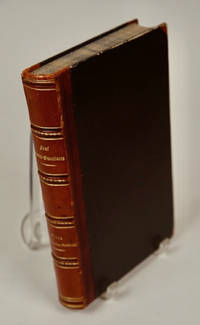
1844Best.-Nr. 40519Leipzig: Fr. Kistner PN 1400 1844. Folio. Modern mid-green boards with original publisher's wrappers laid down to both boards title label gilt to spine. 1f. recto title verso printed excerpt from a letter from Goethe to Mendelssohn 5- 91 i blank pp. Text in German. Engraved. With the overture arranged for piano 4-hands. Annotations in pencil to several leaves. Binding worn and soiled; corners bumped; wrappers with minor loss; free front endpaper slightly creased. Slightly worn and foxed; some corners with minor soiling; blank inner margin of title reinforced with narrow strip of paper; blank lower outer corner of title and following leaf repaired; several leaves with tape repairs to blank margins. Ex-library with small handstamp of the Städische Bühnen Erfurt Bibliothek to verso of title. First Edition. MWV D3 p. 78. Catalogue of the Mendelssohn Papers in the Bodleian Library Oxford III 372. Hoboken Collection Vol. 10 232. Krause pp. 19 28. A secular cantata with text by Goethe the present work treats efforts by the Druids to practice their springtime pagan rituals in the face of rising Christian forces. The original version was completed in 1831 first performed at the home of Mendelssohn's parents and then publicly on 10 January 1833 in Berlin at the Sing-Akademie conducted by the composer. It was later revised in 1843 as a programmatic overture. "The highlights of the 1843 subscription concerts included the première of the revised version of Die erste Walpurgisnacht on 2 February; among the audience was Berlioz then in the midst of his first concert tour who praised the score for its 'apparent confusion that is art perfected'." R. Larry Todd in Grove Music Online. Fr. Kistner [PN 1400] unknown
1844Best.-Nr. 40519Leipzig: Fr. Kistner PN 1400 1844. Folio. Modern mid-green boards with original publisher's wrappers laid down to both boards title label gilt to spine. 1f. recto title verso printed excerpt from a letter from Goethe to Mendelssohn 5- 91 i blank pp. Text in German. Engraved. With the overture arranged for piano 4-hands. Annotations in pencil to several leaves. Binding worn and soiled; corners bumped; wrappers with minor loss; free front endpaper slightly creased. Slightly worn and foxed; some corners with minor soiling; blank inner margin of title reinforced with narrow strip of paper; blank lower outer corner of title and following leaf repaired; several leaves with tape repairs to blank margins. Ex-library with small handstamp of the Städische Bühnen Erfurt Bibliothek to verso of title. First Edition. MWV D3 p. 78. Catalogue of the Mendelssohn Papers in the Bodleian Library Oxford III 372. Hoboken Collection Vol. 10 232. Krause pp. 19 28. A secular cantata with text by Goethe the present work treats efforts by the Druids to practice their springtime pagan rituals in the face of rising Christian forces. The original version was completed in 1831 first performed at the home of Mendelssohn's parents and then publicly on 10 January 1833 in Berlin at the Sing-Akademie conducted by the composer. It was later revised in 1843 as a programmatic overture. "The highlights of the 1843 subscription concerts included the première of the revised version of Die erste Walpurgisnacht on 2 February; among the audience was Berlioz then in the midst of his first concert tour who praised the score for its 'apparent confusion that is art perfected'." R. Larry Todd in Grove Music Online. Fr. Kistner [PN 1400] unknown books
1789Best.-Nr. 28250Berlin: bei Friedrich Vieweg dem álteren 1789.- 3 h. 250 p.; 8º 17 x 11 cm.; buena impresión en letra gótica sobre excelente papel verjurado; Plena Piel valenciana en tonos marrones lomo dorado con filetes y bandas sobre los nervios estuche. Salvo una pequeña marca de humedad en el margen superior de unas 8 hojas que no toca texto su estado es excelente. FILOSOFÃA E HISTORIA DE LA CULTURA Buch auf deutsch bei Friedrich Vieweg, dem álteren hardcover
1990Best.-Nr. DADAX3772810241Frommann-Holzboog 1990-12-31. Bilingual. hardcover. New. 5.83x0.83x8.86. Buy with confidence. Excellent Customer Service & Return policy. Frommann-Holzboog hardcover
1968Best.-Nr. 003280London: The Holland Press 1968 Two volumes complete. Unnumbered copies of a limited edition of 250 copies. Excellent condition. Volume 1: 1008 pages. Volume 2: 1139 pages. Both volumes are protected by thick plastic sleeves. Please note that due to the weight of the books should they need be posted to the outside of South Africa extra postal charges may be required. Size: Approx 7" Wide - 10" Tall The Holland Press hardcover
Best.-Nr. Frommann-9783772815171frommann-holzboog Verlag e.K. German. Hardcover. New. XCIV 503 p. 156 x 209 cm. This volume provides German translations of the texts published in the Hebräischen Schriften I JubA Band 14 Hebrew Writings I. It contains Mendelssohns Kohelet musar Preacher of Morality an early work loosely based on the model of the moral weeklies his commentaries on the logic of Maimonides Bi'ur millot ha-higgajon and on Ecclesiastes in connection the texts written in connection with his Pentateuch edition by such scholars as S. Dubno and N. H. Wessely cf. JubA Band 151 moreover philosophical commentaries letters a poem and documents of the Jewish community in Berlin. The annotated transcription of the list of subscribers reveals a document which is important for the reception history of the Pentateuch edition. Apart from the commentary on Ecclesiastes and the pamphlet on the Pentateuch edition which are published in contemporary translations by Johann Jacob Rabe and Christian Gottlob Meyer this volume provides access to Mendelssohns texts in a new and for the first time complete translation. For translations of the treatise Hanefesch The Soul as well as of the introduction to the Pentateuch edition cf. JubA Volume 31 and Volume 91. frommann-holzboog Verlag e.K. hardcover
1841Best.-Nr. 36202Leipzig: Breitkopf & Härtel PNs 5542 5543 5544 1841. 1f. recto lithographic title verso blank 78; 1f. recto lithographic title verso blank 52 pp.; 1f. recto lithographic title verso blank 66 pp. Music engraved throughout. First Editions later issues of all three works. MWV P3 op. 21; MWV P7 op. 26; MWV P5 op. 27. Krause 135 143 146. Hoboken first issues only. Bound with: Op. 32. Ouverture zum Märchen von der schönen Melusine . Partitur . Pr. 1 Rthlr. 20 Ngr. Leipzig: Breitkopf & Härtel PN 5688 ca. 1857. 1f. recto title verso blank 72 pp. Engraved. First Edition later issue. Hoboken 10 181. Krause 149. Bound with: Op. 95. Ouverture zu Ruy Blas für grosses Orchester . Op. 95. Pr. 2 Thlr. Partitur No. 24 der nachgelassen Werke. Leipzig: Fr. Kistner PN 1837 1851-52. 1f. recto title verso blank 64 pp. Engraved. First Edition. Hoboken 10 290. Krause 153. 19th century mid-tan morocco-backed dark brown textured paper boards raised bands on spine with titling gilt marbled edges light blue endpapers narrow blue silk ribbon marker. Binding slightly worn rubbed and bumped. Minor internal wear. An attractive copy of all five of Mendelssohn's concert overtures. "One of the most gifted and versatile prodigies Mendelssohn stood at the forefront of German music during the 1830s and 40s as conductor pianist organist and above all composer. His musical style fully developed before he was 20 drew upon a variety of influences including the complex chromatic counterpoint of Bach the formal clarity and gracefulness of Mozart and the dramatic power of Beethoven and Weber. Mendelssohn's emergence into the first rank of 19th-century German composers coincided with efforts by music historiographers to develop the concept of a Classic-Romantic dialectic in 18th and 19th-century music. To a large degree his music reflects a fundamental tension between Classicism and Romanticism in the generation of German composers after Beethoven." R. Larry Todd in Grove Music Online. Breitkopf & Härtel [PNs 5542, 5543, 5544] unknown
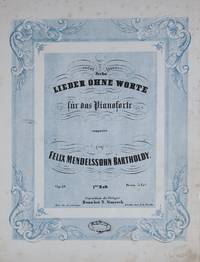
1851Best.-Nr. 40954Bonn . Paris . London: bei N. Simrock . bei M. Schlesinger . chez J. A. Novello PN 3041 1851. 1f. recto title verso blank 3-17 i blank pp. First German edition later issue "chez" rather than "bei" J. A. Novello. MWV SD5 p. 470. Krause 216. Hoboken 10 150. Bound with: Sechs Lieder Ohne Worte Componirt und Fräulein Elise von Woringen zugeeignet . Op. 30. IItes. Heft . Eigenthum der Verleger . Pr. 3 Frs. Bonn . London . Paris: bei N. Simrock . chez N. Mori . chez Schönenberger PN 3204 ca. 1851. 1f. recto title verso blank 3-19 i blank pp. First German edition later issue. MWV SD9 p. 472. Krause 220. Hoboken 10 177. Bound with: Sechs Lieder Ohne Worte für das Pianoforte . componirt und Fräulein Rosa von Woringen zugeeignet . Op. 38. IIItes. Heft . Preis 3 Frs. Bonn . London: bei N. Simrock . bei J. A. Novello PN 3383 ca. 1851. 1f. recto title verso blank 3-19 i blank pp. First German edition later issue. MWV SD9 p. 472. Krause 220. Hoboken 10 177. Bound with: Sechs Lieder Ohne Worte für das Pianoforte . componirt und Fräulein Sophÿ Horsleÿ zugeeignet . Op. 53 . IVtes. Heft . Preis 4 Frs. Bonn . London . Paris: bei N. Simrock . Chez Ewer & Co. . Chez Lemoine PN 3935 1841. 1f. recto title verso blank 3-25 i blank pp. First German edition later issue. MWV SD23 p. 478. Krause 227. Hoboken 10 222. Bound with: Sechs Lieder Ohne Worte für das Pianoforte . componirt und Frau Dr. Clara Schumann geb. Wieck zugeeignet . Op. 62. . Vtes. Heft . Preis 3 Frs 50c. Bonn . Lyon . Mailand . London: bei N. Simrock . bei Benacci & Peschier . bei J. Lucca . bei Ewer & Co. PN 4343 ca. 1860. 1f. recto title verso blank i blank 4-19 i blank pp. First Edition early issue. MWV SD29 p. 481. Krause 231. Hoboken 10 237. Bound with: Sechs Lieder Ohne Worte für das Pianoforte . componirt und Fräulein Sophie Rosen zugeeignet . Op. 67. . VItes. Heft . Preis 3 Frs 50c. Bonn . Mailand . Paris . London: bei N. Simrock . bei J. Ricordi . bei M. Schlesinger . bei Ewer & Co. PN 4478 1845. 1f. recto title verso blank i blank 4-21 i blank pp. First Edition early issue. MWV SD32 p. 482. Krause 236. Hoboken 10 245. 6 volumes. Folio. Contemporary black cloth-backed dark blue boards with titling in manuscript to upper. Titles lithographed on blue ground within decorative blue border music engraved. Provenance Heinrich Dorn 1800-1892 noted conductor composer music critic and teacher of the Schumanns with "H. Dorn" in manuscript to upper outer corner of upper board with his small oval handstamp "H. Dorn Coeln" and handstamp "M. Schloss in Coeln" to foot of titles. Binding slightly worn and soiled with small stains to upper. Some minor foxing soiling small stains and showthrough heavier to some leaves; small dampstain to blank lower margin of final half of volume; inner margins occasionally reinforced; some minor paper repairs. "One of the most gifted and versatile prodigies Mendelssohn stood at the forefront of German music during the 1830s and 40s as conductor pianist organist and above all composer. His musical style fully developed before he was 20 drew upon a variety of influences including the complex chromatic counterpoint of Bach the formal clarity and gracefulness of Mozart and the dramatic power of Beethoven and Weber. Mendelssohn's emergence into the first rank of 19th-century German composers coincided with efforts by music historiographers to develop the concept of a Classic-Romantic dialectic in 18th and 19th-century music. To a large degree his music reflects a fundamental tension between Classicism and Romanticism in the generation of German composers after Beethoven. . The origins of the Lieder ohne Worte of which Mendelssohn published 36 pieces in six volumes between 1832 and 1845 two more volumes followed posthumously remain couched in mystery. Among his earliest piano lieder was one in E♭ written for Fanny's birthday in 1828 Fanny herself composed numerous examples of the genre; the idea of creating songlike piano pieces may have originated in a game Fanny and Felix played in which they apparently added texts to piano pieces. Then too the critical thought of A.B. Marx who explored in his writings of the 1820s the expressive potential and 'definiteness' of instrumental music was not without impact. Most of the lieder fall into three groups pianistic parallels to the vocal categories of solo songs duets and partsongs. The meaning of the new genre perplexed Mendelssohn's contemporaries. Schumann suggested that the composer had produced texted lieder but then suppressed the texts; when the composer's cousin Marc-André Souchay offered to give some of the lieder fanciful titles Mendelssohn replied that he had intended each lied 'just as it stands'. Only a small number of the lieder bear titles from Mendelssohn e.g. the three called Venetianisches Gondellied or his circle e.g. the 'Frühlingslied'; nevertheless later in the 19th century a host of insipid titles accrued to the lieder contributing to the view of Mendelssohn as a composer of overtly sentimental piano music for the parlour." R. Larry Todd in Grove Music Online Dorn "studied the piano singing and composition in Königsberg made several long journeys throughout Germany during which he met Weber in Dresden and completed his studies with Ludwig Berger Bernhard Klein and Zelter in Berlin where his first opera Rolands Knappen was produced successfully in 1826. At the same time he became a co-editor of the Berliner allgemeine Muzikzeitung for which he wrote a spirited defence of the beleaguered Gaspare Spontini. Over the next two decades he built a solid reputation as a conductor of opera holding theatre posts at Königsberg 1828 Leipzig 1829-32 where he taught counterpoint to the young Schumann Hamburg 1832 Riga 1834-43 and Cologne 1844-8. He organized the first music festival of the Russian Baltic provinces in Riga 1836 and directed the Lower Rhine music festivals 1844-7. His most prestigious appointment in 1849 after Nicolai's death was as co-conductor with Wilhelm Taubert of the Berlin Hofoper. After his retirement from that post in 1869 he remained active in Berlin for many years as a teacher and writer." Adelyn Peck Leverett revised by Christopher Fifield in Grove Music Online. bei N. Simrock ... bei M. Schlesinger ... chez J. A. Novello [PN 3041] unknown
1841Best.-Nr. 36202Leipzig: Breitkopf & Härtel PNs 5542 5543 5544 1841. 1f. recto lithographic title verso blank 78; 1f. recto lithographic title verso blank 52 pp.; 1f. recto lithographic title verso blank 66 pp. Music engraved throughout. First Editions later issues of all three works. MWV P3 op. 21; MWV P7 op. 26; MWV P5 op. 27. Krause 135 143 146. Hoboken first issues only. Bound with: Op. 32. Ouverture zum Märchen von der schönen Melusine . Partitur . Pr. 1 Rthlr. 20 Ngr. Leipzig: Breitkopf & Härtel PN 5688 ca. 1857. 1f. recto title verso blank 72 pp. Engraved. First Edition later issue. Hoboken 10 181. Krause 149. Bound with: Op. 95. Ouverture zu Ruy Blas für grosses Orchester . Op. 95. Pr. 2 Thlr. Partitur No. 24 der nachgelassen Werke. Leipzig: Fr. Kistner PN 1837 1851-52. 1f. recto title verso blank 64 pp. Engraved. First Edition. Hoboken 10 290. Krause 153. 19th century mid-tan morocco-backed dark brown textured paper boards raised bands on spine with titling gilt marbled edges light blue endpapers narrow blue silk ribbon marker. Binding slightly worn rubbed and bumped. Minor internal wear. An attractive copy of all five of Mendelssohn's concert overtures. "One of the most gifted and versatile prodigies Mendelssohn stood at the forefront of German music during the 1830s and 40s as conductor pianist organist and above all composer. His musical style fully developed before he was 20 drew upon a variety of influences including the complex chromatic counterpoint of Bach the formal clarity and gracefulness of Mozart and the dramatic power of Beethoven and Weber. Mendelssohn's emergence into the first rank of 19th-century German composers coincided with efforts by music historiographers to develop the concept of a Classic-Romantic dialectic in 18th and 19th-century music. To a large degree his music reflects a fundamental tension between Classicism and Romanticism in the generation of German composers after Beethoven." R. Larry Todd in Grove Music Online. Breitkopf & Härtel [PNs 5542, 5543, 5544] unknown books
1851Best.-Nr. 40954Bonn . Paris . London: bei N. Simrock . bei M. Schlesinger . chez J. A. Novello PN 3041 1851. 1f. recto title verso blank 3-17 i blank pp. First German edition later issue "chez" rather than "bei" J. A. Novello. MWV SD5 p. 470. Krause 216. Hoboken 10 150. Bound with: Sechs Lieder Ohne Worte Componirt und Fräulein Elise von Woringen zugeeignet . Op. 30. IItes. Heft . Eigenthum der Verleger . Pr. 3 Frs. Bonn . London . Paris: bei N. Simrock . chez N. Mori . chez Schönenberger PN 3204 ca. 1851. 1f. recto title verso blank 3-19 i blank pp. First German edition later issue. MWV SD9 p. 472. Krause 220. Hoboken 10 177. Bound with: Sechs Lieder Ohne Worte für das Pianoforte . componirt und Fräulein Rosa von Woringen zugeeignet . Op. 38. IIItes. Heft . Preis 3 Frs. Bonn . London: bei N. Simrock . bei J. A. Novello PN 3383 ca. 1851. 1f. recto title verso blank 3-19 i blank pp. First German edition later issue. MWV SD9 p. 472. Krause 220. Hoboken 10 177. Bound with: Sechs Lieder Ohne Worte für das Pianoforte . componirt und Fräulein Sophÿ Horsleÿ zugeeignet . Op. 53 . IVtes. Heft . Preis 4 Frs. Bonn . London . Paris: bei N. Simrock . Chez Ewer & Co. . Chez Lemoine PN 3935 1841. 1f. recto title verso blank 3-25 i blank pp. First German edition later issue. MWV SD23 p. 478. Krause 227. Hoboken 10 222. Bound with: Sechs Lieder Ohne Worte für das Pianoforte . componirt und Frau Dr. Clara Schumann geb. Wieck zugeeignet . Op. 62. . Vtes. Heft . Preis 3 Frs 50c. Bonn . Lyon . Mailand . London: bei N. Simrock . bei Benacci & Peschier . bei J. Lucca . bei Ewer & Co. PN 4343 ca. 1860. 1f. recto title verso blank i blank 4-19 i blank pp. First Edition early issue. MWV SD29 p. 481. Krause 231. Hoboken 10 237. Bound with: Sechs Lieder Ohne Worte für das Pianoforte . componirt und Fräulein Sophie Rosen zugeeignet . Op. 67. . VItes. Heft . Preis 3 Frs 50c. Bonn . Mailand . Paris . London: bei N. Simrock . bei J. Ricordi . bei M. Schlesinger . bei Ewer & Co. PN 4478 1845. 1f. recto title verso blank i blank 4-21 i blank pp. First Edition early issue. MWV SD32 p. 482. Krause 236. Hoboken 10 245. 6 volumes. Folio. Contemporary black cloth-backed dark blue boards with titling in manuscript to upper. Titles lithographed on blue ground within decorative blue border music engraved. Provenance Heinrich Dorn 1800-1892 noted conductor composer music critic and teacher of the Schumanns with "H. Dorn" in manuscript to upper outer corner of upper board with his small oval handstamp "H. Dorn Coeln" and handstamp "M. Schloss in Coeln" to foot of titles. Binding slightly worn and soiled with small stains to upper. Some minor foxing soiling small stains and showthrough heavier to some leaves; small dampstain to blank lower margin of final half of volume; inner margins occasionally reinforced; some minor paper repairs. "One of the most gifted and versatile prodigies Mendelssohn stood at the forefront of German music during the 1830s and 40s as conductor pianist organist and above all composer. His musical style fully developed before he was 20 drew upon a variety of influences including the complex chromatic counterpoint of Bach the formal clarity and gracefulness of Mozart and the dramatic power of Beethoven and Weber. Mendelssohn's emergence into the first rank of 19th-century German composers coincided with efforts by music historiographers to develop the concept of a Classic-Romantic dialectic in 18th and 19th-century music. To a large degree his music reflects a fundamental tension between Classicism and Romanticism in the generation of German composers after Beethoven. . The origins of the Lieder ohne Worte of which Mendelssohn published 36 pieces in six volumes between 1832 and 1845 two more volumes followed posthumously remain couched in mystery. Among his earliest piano lieder was one in E♭ written for Fanny's birthday in 1828 Fanny herself composed numerous examples of the genre; the idea of creating songlike piano pieces may have originated in a game Fanny and Felix played in which they apparently added texts to piano pieces. Then too the critical thought of A.B. Marx who explored in his writings of the 1820s the expressive potential and 'definiteness' of instrumental music was not without impact. Most of the lieder fall into three groups pianistic parallels to the vocal categories of solo songs duets and partsongs. The meaning of the new genre perplexed Mendelssohn's contemporaries. Schumann suggested that the composer had produced texted lieder but then suppressed the texts; when the composer's cousin Marc-André Souchay offered to give some of the lieder fanciful titles Mendelssohn replied that he had intended each lied 'just as it stands'. Only a small number of the lieder bear titles from Mendelssohn e.g. the three called Venetianisches Gondellied or his circle e.g. the 'Frühlingslied'; nevertheless later in the 19th century a host of insipid titles accrued to the lieder contributing to the view of Mendelssohn as a composer of overtly sentimental piano music for the parlour." R. Larry Todd in Grove Music Online Dorn "studied the piano singing and composition in Königsberg made several long journeys throughout Germany during which he met Weber in Dresden and completed his studies with Ludwig Berger Bernhard Klein and Zelter in Berlin where his first opera Rolands Knappen was produced successfully in 1826. At the same time he became a co-editor of the Berliner allgemeine Muzikzeitung for which he wrote a spirited defence of the beleaguered Gaspare Spontini. Over the next two decades he built a solid reputation as a conductor of opera holding theatre posts at Königsberg 1828 Leipzig 1829-32 where he taught counterpoint to the young Schumann Hamburg 1832 Riga 1834-43 and Cologne 1844-8. He organized the first music festival of the Russian Baltic provinces in Riga 1836 and directed the Lower Rhine music festivals 1844-7. His most prestigious appointment in 1849 after Nicolai's death was as co-conductor with Wilhelm Taubert of the Berlin Hofoper. After his retirement from that post in 1869 he remained active in Berlin for many years as a teacher and writer." Adelyn Peck Leverett revised by Christopher Fifield in Grove Music Online. bei N. Simrock ... bei M. Schlesinger ... chez J. A. Novello [PN 3041] unknown books
1796Best.-Nr. 2330942Berlin: Bey Haude und Spener 1796. Second Edition. Hard Cover. Very Good/No Jacket. Second edition. Sticker on front corner edges rubbed ink name and stamp on endpapers. Scarce - only 12 in OCLC. 1796 Hard Cover. 124 pp. German text. Paper over boards handwritten titles on spine. Mendelssohn's ideas brought about the Haskalah Jewish Enlightenment. This work applies mathematical proofs to metaphysics. It won the author first prize in a Berlin Academy essay contest over Immanuel Kant and Thomas Abbt. Bey Haude und Spener hardcover
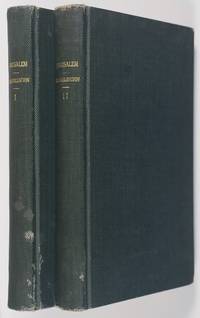
1838Best.-Nr. 50610London: Longman Orme Brown and Longmans 1838. First edition. Hardcover. Good condition. Octavo. ix 329 371pp. Bound in green pebbled cloth with gilt lettering on spine. Marbled edges. Gray endpapers. With preface by the translator Vindiciae Judaeorum: or a letter by Rabbi Manasseh Ben Israel and Mendelssohn's preface to the German translation of "Vindiciae Judaeorum" notes on Mendelssohn's reply remarks on Mendelssohn and a short catalogue of Ben Israel works in volume one. Mendelssohn's "Jerusalem: A Treatise on Ecclesiastical Authority and Judaism" in volume two. Light wear along edges of binding and lightly rubbed. Starting at dedication page of volume one. Longman, Orme, Brown and Longmans hardcover
1796Best.-Nr. 2330942Berlin: Bey Haude und Spener 1796. Second Edition. Hard Cover. Very Good/No Jacket. Second edition. Sticker on front corner edges rubbed ink name and stamp on endpapers. Scarce - only 12 in OCLC. 1796 Hard Cover. 124 pp. German text. Paper over boards handwritten titles on spine. Mendelssohn's ideas brought about the Haskalah Jewish Enlightenment. This work applies mathematical proofs to metaphysics. It won the author first prize in a Berlin Academy essay contest over Immanuel Kant and Thomas Abbt. Bey Haude und Spener hardcover books
1838Best.-Nr. 50610London: Longman Orme Brown and Longmans 1838. First edition. Hardcover. Good condition. Octavo. ix 329 371pp. Bound in green pebbled cloth with gilt lettering on spine. Marbled edges. Gray endpapers. With preface by the translator Vindiciae Judaeorum: or a letter by Rabbi Manasseh Ben Israel and Mendelssohn's preface to the German translation of "Vindiciae Judaeorum" notes on Mendelssohn's reply remarks on Mendelssohn and a short catalogue of Ben Israel works in volume one. Mendelssohn's "Jerusalem: A Treatise on Ecclesiastical Authority and Judaism" in volume two. Light wear along edges of binding and lightly rubbed. Starting at dedication page of volume one. Longman, Orme, Brown and Longmans hardcover books
1979Best.-Nr. 2083002115600381S. Fischer 1979. Soft Cover. Fine. Size: 20cm S. Fischer paperback
Best.-Nr. N2503bBerlin: Akademie Verlag. Original Cloth with Box. Near Fine. 4to. 1929-1932. On volumes 1-3 and 7 11 16 edges and 2 or 3 pages with some foxing. A fine copy in protective dust jacket in the original publishers boxes these with some aging marks . FOR MANY MANY YEARS NOT SEEN COMPLETE AS THIS COPY ON THE MARKET - . Akademie Verlag hardcover
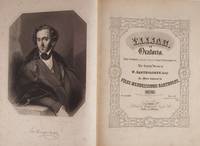
1847Best.-Nr. 40967London . Bonn: Ewer & Co. Newgate Strt. . N. Simrock 1847. Large folio. Full maroon cloth with dark red leather title label gilt to spine. 1f. recto blank verso frontispiece 1f. recto engraved title within decorative border verso blank 1f. recto index verso blank iv typeset libretto 279 i blank pp. Text in English. Music engraved. Small format single-page list of errata bound in following title. The fine frontispiece portrait engraving of the composer is by A.H. Payne and W.C. Wrankmore after Hildebrand. Occasional annotations in pencil including instrument names and tempo indications. Binding slightly worn rubbed and bumped. Light uniform browning; frontispiece slightly foxed and creased at lower outer corner; foxing mainly to margins; minor soiling to blank margins of title; occasional minor soiling to lower outer corners. First English edition first issue with "Newgate Strt." address published in the same year as the first German edition published by Simrock in Bonn. MWV A25. Catalogue of the Mendelssohn Papers in the Bodleian Library III 362. Hoboken 10 253. Elijah to a libretto by J. Schubring was first performed in Birmingham England on 26 August 1846; Schubring also collaborated with Mendelssohn on his earlier oratorio St. Paul. "Mendelssohn was not the only 19th-century composer to revive the oratorio but his two completed works St Paul 1836 and Elijah 1846 were the only representatives of his time to achieve lasting popularity. . With few exceptions Mendelssohn's other sacred works lie largely in the shadow of St Paul and Elijah. . One of the most gifted and versatile prodigies Mendelssohn stood at the forefront of German music during the 1830s and 40s as conductor pianist organist and above all composer. His musical style fully developed before he was 20 drew upon a variety of influences including the complex chromatic counterpoint of Bach the formal clarity and gracefulness of Mozart and the dramatic power of Beethoven and Weber. Mendelssohn's emergence into the first rank of 19th-century German composers coincided with efforts by music historiographers to develop the concept of a Classic-Romantic dialectic in 18th and 19th-century music. To a large degree his music reflects a fundamental tension between Classicism and Romanticism in the generation of German composers after Beethoven." R. Larry Todd in Grove Music Online. Ewer & Co. Newgate Strt. ... N. Simrock unknown
1847Best.-Nr. 40967London . Bonn: Ewer & Co. Newgate Strt. . N. Simrock 1847. Large folio. Full maroon cloth with dark red leather title label gilt to spine. 1f. recto blank verso frontispiece 1f. recto engraved title within decorative border verso blank 1f. recto index verso blank iv typeset libretto 279 i blank pp. Text in English. Music engraved. Small format single-page list of errata bound in following title. The fine frontispiece portrait engraving of the composer is by A.H. Payne and W.C. Wrankmore after Hildebrand. Occasional annotations in pencil including instrument names and tempo indications. Binding slightly worn rubbed and bumped. Light uniform browning; frontispiece slightly foxed and creased at lower outer corner; foxing mainly to margins; minor soiling to blank margins of title; occasional minor soiling to lower outer corners. First English edition first issue with "Newgate Strt." address published in the same year as the first German edition published by Simrock in Bonn. MWV A25. Catalogue of the Mendelssohn Papers in the Bodleian Library III 362. Hoboken 10 253. Elijah to a libretto by J. Schubring was first performed in Birmingham England on 26 August 1846; Schubring also collaborated with Mendelssohn on his earlier oratorio St. Paul. "Mendelssohn was not the only 19th-century composer to revive the oratorio but his two completed works St Paul 1836 and Elijah 1846 were the only representatives of his time to achieve lasting popularity. . With few exceptions Mendelssohn's other sacred works lie largely in the shadow of St Paul and Elijah. . One of the most gifted and versatile prodigies Mendelssohn stood at the forefront of German music during the 1830s and 40s as conductor pianist organist and above all composer. His musical style fully developed before he was 20 drew upon a variety of influences including the complex chromatic counterpoint of Bach the formal clarity and gracefulness of Mozart and the dramatic power of Beethoven and Weber. Mendelssohn's emergence into the first rank of 19th-century German composers coincided with efforts by music historiographers to develop the concept of a Classic-Romantic dialectic in 18th and 19th-century music. To a large degree his music reflects a fundamental tension between Classicism and Romanticism in the generation of German composers after Beethoven." R. Larry Todd in Grove Music Online. Ewer & Co. Newgate Strt. ... N. Simrock unknown books