9 041 résultats
1776Due volumi in un tomo, in-8, pp. (2), VIII, 259; (2), 255. Leg. del tempo p. pelle (alquanto consunta), con fregi oro al dorso, tagli rossi. Prima edizione francese di questa relazione di viaggio, scritta in 38 lunghe lettere dal 14 maggio al primo agosto 1770. Le lettere XIV-XVI nel I. vol. riguardano Malta. . Narbone I, 96. Mira I, 133. Fossati-Bellani I, 94. D'Ancona 582...
1822réf. CJW0802Paris: P. Didot l'ainé second volume Jules Didot l'ainé 1822-26. FIRST EDITION. 641 x 495 mm. 25 1/4 x 19 1/2". Lacking the dedication leaf and subscriber list present in the Abbey copy. Two volumes. Edited by Jean Frédéric d'Ostervald. Contemporary red straight-grain morocco textured paper boards gilt titling on spine edges untrimmed. One map as called for though the Abbey copy has two and 92 ACCOMPLISHED AND BEAUTIFULLY HAND-COLORED AQUATINT PLATES OF SICILIAN VIEWS. Abbey "Travel" 262; Graesse VI 400; Brunet V 1379. ◆Moderate rubbing to joints and elsewhere covers with some scars other minor problems externally but the original bindings entirely solid--and surprisingly so for such an immense book with so many fabulous pictures to look at. Preliminary leaves and text lightly to substantially foxed a half dozen plates with faint overall browning one tissue guard missing the margins of perhaps half the engravings with foxing usually light though noticeable in three or four cases in the second volume but still a very pleasing copy of a beautifully illustrated book the marginal foxing seldom distracting and the engraved images themselves clear and clean afflicted by neither foxing nor the dreaded offsetting from the text. This is an extraordinarily rare copy of one of the most beautiful color plate travel books having to do with Italy. The large and luminous views of Sicily in our two volumes capture the magic of the island as experienced by the traveller of the early 19th century. Sicily's well-preserved Greek temples are of course featured but port scenes Medieval churches picturesque villages and the interior of Etna's crater are also depicted all in exquisite color. The engravings each accompanied by letter press explanations are of great interest and beauty and all but one of them are full-blooded tableaux rather than plans or assemblages of small images. The size of the engraved surface varies on the page as does the distance of the subject from the viewer: we are treated to everything from wide panoramic views to confining inner spaces. While the colors cannot be called pastel they are far from garish with lovely grays typically giving a softness to a scene that often employs subtle shades of yellow blue and green. The plates are memorable for their use of light and shadow to give a convincing feeling of three-dimensionality amidst luminous skies darkened interiors and a number of other variably lit settings. The book was originally published in 24 parts and includes an historical précis by Gigault de La Salle giving an overview of events from antiquity to his own time. Abbey calls the work "the most ambitious of the coloured aquatint books edited by J. F. d'Ostervald" who produced a number of works on the picturesque including two famous oversized editions focusing on regions in France. The book has always commanded a premium price: the unbound sheets were sold at the time of publication for the whopping sum of £34. In his note to the reader Ostervald tells of his search among the portfolios of the artists of Switzerland Germany and England for the perfect materials for this collection. The plates cite the names of the artist and engraver and Abbey notes that "English artists or engravers were responsible for nearly half" of the plates. Among these was Richard Parkes Bonington 1802-28 the tragically short-lived painter whose romantic works were greatly admired by Delacroix. Abbey estimates that about 500 copies of the book were produced and comments that the book is "certainly rare in this country at all events only three copies being reported at auction in the last fifty years." The rarity of the book has not surprisingly increased since Abbey's remark: complete copies with colored plates are still hard to find. P. Didot, l'ainé [second volume Jules Didot l'ainé] unknown
1856524pp., avec illustrations de mm. Rouargues frères (23 planches hors-texte dont 5 en couleurs), 27cm., reliure cart. d'époque (dos en cuir brun avec titre doré, coins et bords usées), feuilles de garde marbrées, cachet sur la première page blanche et sur la page de titre, qqs. rousseurs (texte toujours bien lisible), bon exemplaire, G100114
1856réf. G100114Paris, Morizot s.d. [ca. 1856] 524pp., avec illustrations de mm. Rouargues frères (23 planches hors-texte dont 5 en couleurs), 27cm., reliure cart. d'époque (dos en cuir brun avec titre doré, coins et bords usées), feuilles de garde marbrées, cachet sur la première page blanche et sur la page de titre, qqs. rousseurs (texte toujours bien lisible), bon exemplaire, G100114
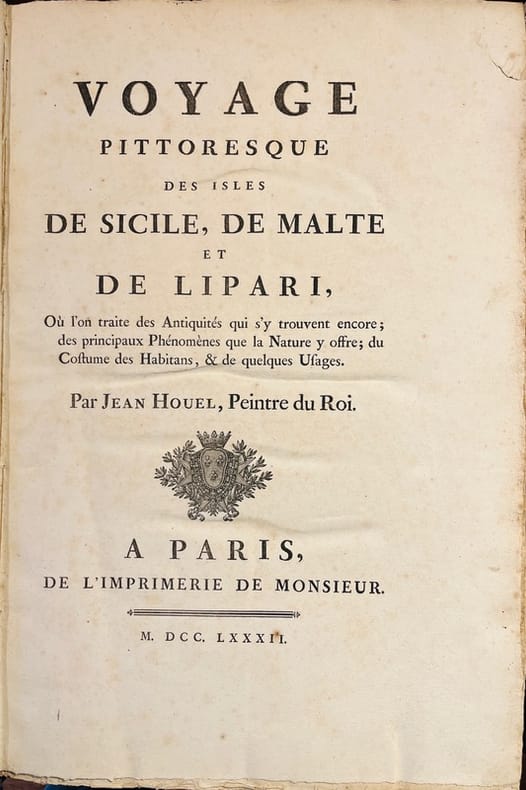
1785In folio (mm. 450x307), mz. pelle coeva con ang., tit. ms. su tassello al dorso. Il volume raccoglie 5 fascicoli con brossura edit. - dal n. XXX al n. XXXIV - con pagine di testo (dalla 63 alla 126) che descrivono 30 tavole incise all’acquatinta con inchiostro bruno - dedicate a Siracusa e dintorni (dal n. 175 al n. 203) e che raffigurano panorami, antichità, scene popolari, ecc. Questo gruppo di tavole è tratto dalla celebre opera sulla Sicilia di Jean Pierre Houel (1735-1813), pittore, architetto e incisore francese, pubblicata fra il 1782 e il 1787 in 4 volumi, ed illustrata da 264 tavole. L’opera di Houel, per il rigore scientifico con cui l’autore realizza piante, sezioni e proiezioni ortogonali degli antichi monumenti, e per le informazioni che offre sugli aspetti antropologici ed etnologici dell’isola, costituisce una preziosa ed ineguagliabile testimonianza della Sicilia del Settecento. L’uso dell’acquatinta nei toni di seppia consentirà a Houel di ottenere incisioni con effetti chiaroscurali più vicini alla sua sensibilità di pittore. Cfr. Cohen, p. 500: “Beau livre rempli d’estampes tirées en bistre de manière à imiter le dessin et curieux en ce que l’auteur a gravé ses propres compositions exécutées d’après nature” - Lewine, p. 247 - Moncada Lo Giudice: “Una delle più sontuose opere grafiche del ‘700 sull’Italia meridionale”. Esemplare ben conservato.
réf. 18751A Paris, de l'imprimerie de Monsieur, 1782 - 1787. 4 volumes grand in-folio de VIII-138; [4]-148; [4]-126; [4]-124 pages, demi-chagrin vert, dos lisses orné de filets et fleurons dorés. Non rogné. Reliures restaurées.
réf. 5244partie méridionale et en Italie partie Septentrionale-Sicile. Deux volumes grand in 8 demi-chagrin rouge à nerfs,titre et caissons dorés,plats percaline rouge,chagrinée.Quadruple filet à froid en encadrement.Premier volume:Faux-titre, frontispice illustré,château Saint Ange,titre avec vignette,524 pages,tranches dorées 23 illustrations hors-texte de ROUARGUES Frères,sous serpentes,dont 5 en couleurs Morizot libraire éditeur 1865,rousseurs plus ou moins fortes habituelles.Deuxième volume mention de nouvelle édition.Faux-titre,VIII,frontispice,titre avec vignette, 535 pages,tranches dorées 23 illustrations hors-texte de ROUARGUES Frères,sous serpentes,dont 6 en couleurs Morizot libraire éditeur sans date,rousseurs plus ou moins fortes habituelles
(Viaggio a Napoli e in Sicilia). DE MUSSET Paul. Voyage pittoresque en Italie. Partie Mèridionale et en Sicile. Paris, Morizot, 1856. 4°, bella leg. m. pelle con tit. e fregi in oro al dorso, tagli dorati; pp. 524. Esemplare privo delle tavole.
DE MUSSET Paul. Voyage pittoresque en Italie. Partie Méridionale et en Sicile. Illustrations de MM. Rouargues Fréres. Paris, Morizot, s.a. Imprimerie Gratiot. In 8vo; pp. 524. Ventitre tavole incise in acciaio di cui cinque con coloritura coeva. Lievi fioriture. Legatura coeva in tela, fregi a secco inquadrano i piatti. Dorso a cordoni con titolo, ricchi fregi in oro e monogramma d’appartenenza. Una deliziosa e dotta guida attraverso le città ed i borghi del Centro Sud d'Italia. Aneddoti su costumanze locali. Vicaire V, 1314.
1865Illustrations de MM. Rouargue Frères. Nouvelle Edition revue et corrigée par l’Auteur. Paris, Morizot 1865. In 8vo gr., pp. 514, con 23 tavv. ill. f. t., dal tratto assai fine, disegnate e incise su acciaio dai fratelli Rouargue e protette da veline, di cui 6 colorate a mano e raffiguranti tipici costumi e mestieri; le restanti sono pittoresche vedute di città, leg. in percallina rossa, titolo e fregi dorati al dorso, contropiatti e fogli di guardia in carta avorio, tagli oro. Questo celebre figurato francese sull’Italia ha rappresentato per lungo tempo l’introduzione più aggiornata a un viaggio nella penisola. Minime tracce alla legatura e un po’ di foxing alle pagine ma discreto esemplare..
1822réf. CJW0802Paris: P. Didot l'ainé second volume Jules Didot l'ainé 1822-26. FIRST EDITION. 641 x 495 mm. 25 1/4 x 19 1/2". Lacking the dedication leaf and subscriber list present in the Abbey copy. Two volumes. Edited by Jean Frédéric d'Ostervald. Contemporary red straight-grain morocco textured paper boards gilt titling on spine edges untrimmed. One map as called for though the Abbey copy has two and 92 ACCOMPLISHED AND BEAUTIFULLY HAND-COLORED AQUATINT PLATES OF SICILIAN VIEWS. Abbey "Travel" 262; Graesse VI 400; Brunet V 1379. ◆Moderate rubbing to joints and elsewhere covers with some scars other minor problems externally but the original bindings entirely solid--and surprisingly so for such an immense book with so many fabulous pictures to look at. Preliminary leaves and text lightly to substantially foxed a half dozen plates with faint overall browning one tissue guard missing the margins of perhaps half the engravings with foxing usually light though noticeable in three or four cases in the second volume but still a very pleasing copy of a beautifully illustrated book the marginal foxing seldom distracting and the engraved images themselves clear and clean afflicted by neither foxing nor the dreaded offsetting from the text. This is an extraordinarily rare copy of one of the most beautiful color plate travel books having to do with Italy. The large and luminous views of Sicily in our two volumes capture the magic of the island as experienced by the traveller of the early 19th century. Sicily's well-preserved Greek temples are of course featured but port scenes Medieval churches picturesque villages and the interior of Etna's crater are also depicted all in exquisite color. The engravings each accompanied by letter press explanations are of great interest and beauty and all but one of them are full-blooded tableaux rather than plans or assemblages of small images. The size of the engraved surface varies on the page as does the distance of the subject from the viewer: we are treated to everything from wide panoramic views to confining inner spaces. While the colors cannot be called pastel they are far from garish with lovely grays typically giving a softness to a scene that often employs subtle shades of yellow blue and green. The plates are memorable for their use of light and shadow to give a convincing feeling of three-dimensionality amidst luminous skies darkened interiors and a number of other variably lit settings. The book was originally published in 24 parts and includes an historical précis by Gigault de La Salle giving an overview of events from antiquity to his own time. Abbey calls the work "the most ambitious of the coloured aquatint books edited by J. F. d'Ostervald" who produced a number of works on the picturesque including two famous oversized editions focusing on regions in France. The book has always commanded a premium price: the unbound sheets were sold at the time of publication for the whopping sum of £34. In his note to the reader Ostervald tells of his search among the portfolios of the artists of Switzerland Germany and England for the perfect materials for this collection. The plates cite the names of the artist and engraver and Abbey notes that "English artists or engravers were responsible for nearly half" of the plates. Among these was Richard Parkes Bonington 1802-28 the tragically short-lived painter whose romantic works were greatly admired by Delacroix. Abbey estimates that about 500 copies of the book were produced and comments that the book is "certainly rare in this country at all events only three copies being reported at auction in the last fifty years." The rarity of the book has not surprisingly increased since Abbey's remark: complete copies with colored plates are still hard to find. P. Didot, l'ainé [second volume Jules Didot l'ainé] unknown books
1822réf. 11087Paris, de l’imprimerie de Jules Didot l’aîné, imprimeur du Roi, 1822-1826. 2 volumes in-plano, [8] pages pour le faux-titre, le titre, la dédicace et l'avis de l’éditeur; 40 pages pour le précis historique de la Sicile, [90] pages de notices; 1 carte et 45 planches; [4] pages pour le faux-titre, le titre; [94] pages de notices, 2 pages de table; 48 planches. Demi-chagrin rouge à coins. Quelques défauts aux reliures (coins frottés, épidermures), rousseurs parfois prononcées. Le doreur a inscrit au dos "Voyage en Cicile"!
17814 vol. in 5 tomi in-folio grande (mm 515x340), stupenda legatura coeva in pieno marocchino rosso, attribuibile con ogni propabilità a Derome le Jeune I dorsi sono assai simili al lotto 2068 dell'asta della Collezione Feltrinelli (Christie's Paris 11/12/2001), con etichetta di Derome. I piatti sono decorati ai piatti con triplici riquadri di filetti e al centro armi in oro di nobile inglese; i dorsi a sette nervi con titolo su duplice tassello e splendida, elaborata decorazione a greche intrecciate, ricche dentelle ai contropiatti e tagli dorati. Lo stemma è quello di John Cust (1779 - 1853), secondo barone Brownlow di Belton (Lincolnshire), nominato Visconte Alforde e Conte Brownlow il 30 settembre 1815, membro del parlamento britannico e comandante di milizia. cfr: https://armorial.library.utoronto.ca/stamp-owners/CUS004 EDIZIONE ORIGINALE con le tavole avanti lettera e su carta grande di questa famosa monumentale opera, illustrata da 5 fioroni ai titoli, dedica inc., 284 magnifiche tavole di vedute, 14 testatine, 96 finali di pag., 6 carte geografiche, 1 pianta topogr., una tavola del phallus, 14 tavole di medaglie, il tutto finemente inciso in rame da Choffard, Duplessis-Bertaux, Saint-Aubin, Saint-Non medesimo, Fessard, Le Bas ed altri artisti dai disegni di Cochin, Fragonard, Huber-Robert ed altri maestri del '700. Il testo descrittivo fu per lungo tempo assegnato all' abate di St.Non, ma studi recenti affermano che quest'ultimo fu solamente l'ideatore e coordinatore dell'impresa mentre autore del testo fu sicuramente il pittore e scrittore D.Vivant-Denon (1747-1826). Le tavole sono in prima tiratura, impresse prima che fossero apposti i titoli. "Une somme topographique et archéologique dans la tradition des védutistes passionnés de l'Italie classique, et par ailleurs un des plus beaux livres à gravures du XVIIIe siècle". Magnifico esemplare, freschissimo.. Cohen-Ricci, 929-930. Ray, French ill. books, n.34: "This is the most ambitious and successful of travel books"..
Quattro tomi in tre voll. in 8° (cm. 20,0) 1 c. n.n. [occhietto] + pp. XLIV + 1 c. n.n. + 1 c.b. + pp. 299(1) + 1 c.n.n. ; pp. 273(1) + 1 c.n.n. + 4 tavv. f.t. più volte ripiegate; pp. 281(1) + 1 c.n.n. ; pp. 124 + 1 c. n.n. + 1 c.b. + 5 tavv. f.t. più volte ripiegate. Legatura Cartone coevo muto un po' ondulato e con abrasioni ai piatti. Interno fresco e nitido ad ampi margini, privo di arrossature. I tomi 3 e 4 sono rilegati in un unico volume. Prima del frontespizio del tomo IV precedono due occhietti dei due tomi che non fu possibile stampare per ragioni contingenti. Infatti un avviso del Libraio precisa quanto segue: "Des circonstances particulieres me forcent a suspendre l'impression de la suite des voyagews de Mr l'Abbé Spallanzani en françois, dont les evenements de la guerre retarderont sans doute la publications des 5 & 6eme volumes en Italien. J'offre ici toute la partie volcanique de ce bel ouvrage, si interessante par la lumiere qu'elle repand sur la volcanologie. Je suis persuade qu'elle fera deirer les belle recherches d'histoire naturelle & les voyages dans les Appennins qui completeront ce livre instructif." Edizione piuttosto rara. Mira, II, 376 non cita questa edizione.
réf. 18386Bern, Haller, 1795-1796.,petit IN8 broche,124 pag. sans les gravures,texte seul,vulcano's and of Lipari. Vesuvius op 15-6-1794
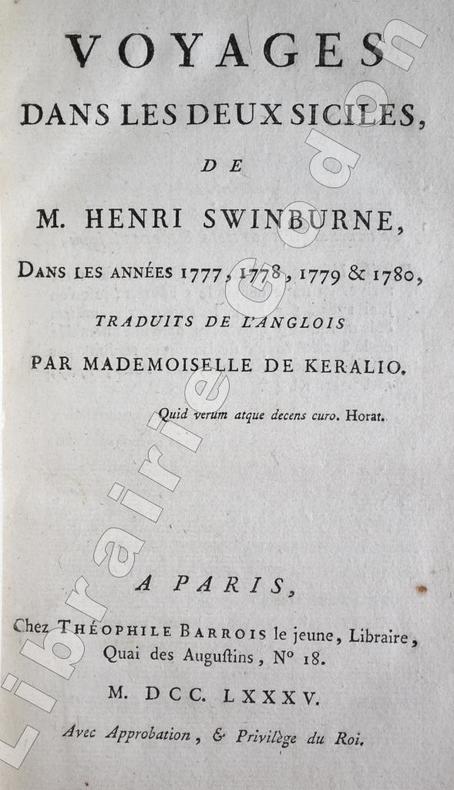
réf. 16291P., Barrois 1785.in8 (20x13cm) veau époque, dos lisse orné, XL, 394pp., 1f., plats épidermés, tout petit manque à la pièce de titre, intérieur très frais.
1778réf. 20371En Suisse, chez les Libraires Associés, 1778. 2 volumes in-8 de XXIV-312 et [4]-359 pages, plein veau marbré, dos lisse ornés de filets et fleurons dorés, pièces de titre et tomaison rouge et verte, tranches et gardes mouchetées.
1802Cm. 20, pp. vii (1) 451 (1). Leg. coeva in mezza pelle, dorso liscio con titoli e filetti in oro. Tagli marmorizzati. Reintegrazioni di pelle alla parte alta del dorso ed alla cuffia inferiore, peraltro esemplare ben conservato. Opera composta in forma epistolare ed indirizzata all'amico Winkelmann e che fu assai apprezzata dagli storici dell'arte e dagli scrittori del tempo che sognavano il Grand Tour. Vedi la bella ed esauriente scheda in D'Ancona (p. 122). Non comune.
198719 cm, br. ill. con risvolti; pp. 51, dedica autografa dell'A. alla 1° c.b
1784Stampa, antica ed originale, con veduta del monte Etna nei pressi di Nicolosi. In alto veduta del vulcano ed in basso veduta a volo d'uccello del vulcano stesso. Autore: Houel inc. e dis.. Luogo: Etna - Sicilia. Anno: 1784. Tecnica: acquatinta. Dimensioni: 345x244.
1786Veduta di una rampa della scalinata, intagliata nella roccia lavica dell'Etna
Veduta tratta dal celebre "Voyage Pittoresque des Isles de Sicile, de Lipari et de Malte.", stampato a Parigi dal 1782 al 1787. Incisione all'acquatinta stampata in seppia, cm 26 x 37,7 (il foglio). Jean Houel (Rouen, 1735 - 1816) fu un eminente pittore, incisore e autore. Trasferitosi a Parigi divenne allievo di Casanova, Le Bas e Le Mire; nel 1774 fu ammesso alla Royal Academy. Tra il 1774 ed il 1778, sotto il patronato del Re di Francia visitò la Sicilia, realizzando una grande quantità di disegni dal vivo di paesaggi, antichità, usi e costumi della Sicilia, delle Eolie e di Malta. Nel 1779, al suo ritorno a Parigi, esibì questi disegni al Salon; ne uscì una pubblicazione dove essi furono tradotti in incisioni, appunto intitolata il "Voyage Pittoresque des Isles de Sicile, de Lipari et de Malte.." pubblicato a Parigi tra il 1782 ed il 1787. L'opera, rara, è importante in quanto costituisce un fondamentale documento per la ricostruzione di molti siti archeologici oggi andati perduti (Cremonini, pp. 129 – 132, 74). Foglio rifilato ai margini, difetti ai margini, una mancanza all'angolo sinistro inferiore bianco.
Ariosa e suggestiva veduta, racchiusa tra lo scosceso roccione a sinistra e gli snelli alberi a destra, presa dai dintorni della cittadina adagiata nella amena vallata visibile sullo sfondo. In primo piano, verso destra, due figurine di viandanti animano la scena.
1822Opera tratta da Voyage pittoresque en Sicile, dedié a son allesse royale M.me la Duchesse de Berry di Achille Etienne Gigault de la Salle, stampato a Parigi, Ostervald, 1822-1826. L’opera consta di 2 volumi in folio grande e rappresenta il maggiore corpus iconografico sulla Sicilia, legato all’espressione pittoresca del vedutismo di ispirazione neoclassica. Achille Etienne Gigault de la Salle (1772-1855), fu consigliere referendario della Corte dei Conti, censore della Biblioteca di Parigi, prefetto dell’Alta Marna. La Salle fece una breve escursione in Sicilia nel 1820; non poté ricavarne che superficiali cognizioni e, per la stesura del suo testo, si affidò soprattutto alle informazioni tratte da letture sulla storia e sui monumenti dell’isola, alla sua matura sensibilità, alle impressioni che gli suggerivano le vivide immagini che era deputato a commentare. Per questo, come giustamente venne osservato, il testo di Gigault de La Salle, introdotto da un sommario storico delle vicende della Sicilia sostanzialmente corretto, più che come espressione di esperienza originale, si segnala per il fedele commento alle illustrazioni e per averne accentuato il valore documentario. L’ideatore del progetto fu l’editore svizzero Jean Fréderic D’Ostervald (1773-1850), che selezionò scrupolosamente molti disegni del conte di Forbin, che in numero di 42 vennero a costituire il nerbo dell’opera, 15 disegni di L. F. Cassas, ed altri di Huber, di Michalon, Frommel, Cockerell ed altri ancora. Dai disegni trasse splendide acquetinte, fatte eseguire da alcuni incisori inglesi e svizzeri (Hégui, Bentley, Himely, Legrand, Salathé, Fielding, Egerton, Bennet, Réeve), chiamati successivamente a Parigi. Acquatinta, buono stato di conservazione. View taken form Achille Etienne Gigault de la Salle’s Voyage pittoresque en Sicile, dedié a son allesse royale M.me la Duchesse de Berry, printed in Paris, Ostervald, 1822-1826. The work consists of two big in folio volumes and represents the main iconographic work on Sicily, very closely connected with the picturesque, neoclassical vedutism. Achille Etienne Gigault de la Salle (1772-1855) was referendary council member of the Corte dei Conti, censor of the Paris Library, prefect of Alta Marna. La Salle made a short trip to Sicily in 1820; he could not bring back home but superficial information, but he then used all the details he could get from his readings to write his own text: he read about the history and the monuments of the island and then used his aesthetic sense and the evocative power of the images he wad due to comment. For that reason, as it has been duly noted, his text, introduced by a summary of historical events in Sicily, is not the expression of a direct experience, but it is more a faithful commentary to the pictures. The author of the whole project was the Swiss publisher Jean Fréderic D’Ostervald (1773-1850), who personally selected 42 drawings of the Count Forbin, which can be considered the core of the work; 15 drawings of L. F. Cassas, and others by Huber, Michalon, Frommel, Cockerell and many others. From these drawings he realized beautiful etchings, carved by some Swiss and English engravers (Hégui, Bentley, Himely, Legrand, Salathé, Fielding, Egerton, Bennet, Réeve). C.F. Abbey Travel I 262 p.38; CF Brunet v, 1379; Cremonini pp. 164/166,96.
1836Stampa, antica ed originale, con veduta panoramica di Bagaria ed golfo di Palermo, delineata da Ch. Pensée da uno schizzo di Mr. ie Vic.te Alp.sa de Morogues. Inserita nell'opera "Souvenir de la Sicilie par Mr. ie Vic.te Alp.sa de Morogues" litografata a Parigi dalla litografia Lemercier e pubblicata da Alp.se Gatineau, editore in Orléans, nel 1836. Stampata su carta cina, foxing ai margini