2,021 results
ref. B200650-1London Victoria Miro Gallery & Coracle Press 1987. Multiple. Edition limited to 50 copies signed and numbered by the artist and author in the colophon. A collaborative edition of text and image in which a poem by Cutts is set within a complex multiple by Tuttle in "wood aluminum canvas paper wire ink paint" as noted in the colophon and the ensemble encased in a lidded wooden box. Contents comprise the Cutts text "the green/ calyx of/ the petals/ of wallpaper/ &" printed in red on a large folding sheet or irregular dimensions the verso of which features a spray painting by Tuttle in blue; a unique large handcut gold-painted canvas construction by Tuttle with wire elements initialled by the artist on the verso; and a section of colored wallpaper. A colophon printed on brown kraft paper matching that of the Cutts poem wrapped around a floating panel is attached to the interior of the lid of the box. The box imprinted with the title features two decorative aluminum clasps at the sides designed by Tuttle cast from twisted cigarette foil papers. Box dimensions: 495 x 353 x 74 mm. ca. 19 1/2 x 13 7/8 x 3 inches. In this copy the two staples which originally attached one edge of the text to the canvas construction have been removed making accessible all elements of the ensemble. The Cutts text is reinforced with tape at the central fold. London (Victoria Miro Gallery & Coracle Press), 1987. books
1930ref. 59487New York: Horace Liveright 1930. Second Printing same year as the first. Octavo 21cm; black cloth with titles stamped in gilt on spine and front cover; illustrated endpapers; 1213-3093pp; illus. Inscribed by the author in year of publication the half-title page: "To Erskine and Sara / with never-ceasing affection / Sincerely & fraternally / Michael Gold." Further inscribed by Wood: "From Erskine & Sara to their dear friend Max Rosenberg - echoing the above - The Cats / July 1930." A tight clean copy in the original cloth binding; board corners lightly bumped and a few mild taps to board edges the endpapers illustrated after woodcuts by Howard Simon. Solidly Very Good lacking the scarce dustwrapper. A great association copy inscribed by Gold to one of the leading leftist intellectuals and authors of his time. Wood 1852-1944 was a self-styled anarchist aesthete and painter. As an attorney in the 1920s he defended a number of prominent figures on the left including the anarchist lecturer Emma Goldman and contributed prolifically to the radical periodicals of the period. With his second wife Sara Bard Field he was a long-time resident of Los Gatos California and was known for entertaining visitors at the estate "The Cats" mentioned in the present inscription. Interestingly Wood did not have a reputation for sympathy with doctrinaire Marxist thought; it seems unlikely that Gold would have written Wood such an effusive inscription even a few years later as during the Great Depression he would rise to become one of the leading apparatchiks in the CPUSA. Horace Liveright unknown books
1884ref. 55054Wien Vienna and Berlin: IM K.K. Schulbocher-Verlag / Gedruckt Von AD. Schulze 1884. Very good. First edition of this Austrian lesson books for blind children part of the famed series from the noted publisher containing both Braille and an embossed Latin alphabet showing the field's move toward the Braille system. Though Braille is now the dominant alphabet for the blind "the system was not given an immediate welcome" note Carter and Morison in PRINTING AND THE MIND OF MAN; indeed Braille was one of several competing writing and printing systems for the blind until 1878 when an international congress for blind education in Paris selected it as the standard. Even so the output of pedagogical materials did not immediately pivot to Braille. This volume captures that transition with a title page in raised letter and - more importantly - a raised latter key to the Braille system which follows mounted to a stub at the beginning of the book a snapshot of the slow but deliberate shift to the new standard. Austria has been called the "cradle of education for the blind" owing to its early establishment of K.K. Blinden-Erziehungs-Institut a school for the blind in Vienna in 1804 Monroe and its associated press. The editor of this volume from the press Simon Heller was director of the Israelitischen Blindeninstituts which specialized in the education of blind Jewish children. Austrian books for the education of the blind are now difficult to find. One of the largest collection of such books Alexander Mell's was "almost completely destroyed by the Nazis" in Word War II a fate that was common for many such collections Stuckey. 13'' x 10''. Quarter brown cloth with marbled boards. 144 pages with Braille embossment to rectos and versos. Spine cloth sunned label perished. Some staining internally unobtrusive. Front hinge started at top. Else sound. IM K.K. Schulbocher-Verlag / Gedruckt Von AD. Schulze unknown books
ref. 158138Universal City: Universal City Studios 1979. Archive of three draft scripts for the 1981 film including a First Draft script a Final Draft script and a "Second Revised Final Draft Screenplay / Added Scenes and Retakes" partial script for the 1981 film dated between June 29 1979 and February 13 1981. The first two drafts are under the working title "Family Dream." Two of the three scripts show an annotation in manuscript ink amending the film's title on title page. A cynical ex-convict is hired to drive a group of orphaned special needs children and their schoolteacher across the country from Philadelphia to Seattle growing closer to the group in the process and gaining a new outlook on life. Set in Philadelphia and Washington shot on location in Carnation Ellensburg and Snohomish Washington. First Draft: Under the title "Family Dream." Green titled wrappers noted as First Draft on the front wrapper rubber-stamped copy No. 00545 dated June 29 1979. Title page present noted as First Draft with credits for screenwriter Roger L. Simon. 129 leaves with last page of text numbered 128. Mimeograph duplication rectos only. Pages Very Good plus wrapper Near Fine bound with three gold brads. Final Draft: Under the title "Family Dream." Red titled wrappers noted as Final Draft on the front wrapper rubber-stamped copy No. 00545 dated September 21 1979. Title page present noted as Final Draft with credits for screenwriters Roger L. Simon and Lonne Elder III. 121 leaves with last page of text numbered 120. Mimeograph duplication rectos only. Pages Near Fine wrapper Near Fine bound with three gold brads. "Second Revised Final Draft Screenplay / Added Scenes and Retakes" partial script: Under the working title "Richard Pryor's New Movie Formerly: Family Dream." Salmon titled wrappers noted as Second Revised Final Draft Screenplay / Added Scenes and Retakes on the front wrapper dated February 13 1981. Title page present dated February 13 1981 noted as Second Revised Final Draft with credits for screenwriter Roger L. Simon and story by Richard Pryor. With pink and blue revision leaves throughout. 59 leaves with last page of text numbered 57. Xerographic duplication rectos only with pink and blue revision pages throughout dated 2/13/81 and 2/18/81. Pages Very Good plus wrapper Very Good plus bound with three gold brads. Universal City Studios unknown books
ref. 95258n.p.:: n.p. Near Fine. 2018. Hardcover. Color and black and white photographs throughout. Limited edition folio. SIGNED by Paul Simon. Near fine in blue cloth with white and black lettering. No dust jacket as issued. . n.p., hardcover books
1714ref. 39159A Bourdeaux ie. The Hague: James L'Aveugle 1714. First Edition. 12mo pp. viii 508. Bound in contemporary calf neatly rebacked in antique style little rubbed some minor foxing soiling a very good tight copy. Rosenberg "A" Gove 217-219; Cioranescu 62587; Barbier IV 1103; Atkinson 'The Extraordinary Voyage in French Literature' p. 70; Rosenberg pp. 84-5. The genuine first edition falsely dated. An important imaginary journey to Australia called a "landmark" by Atkinson. Based on a variety of real voyages the descriptions are believable and realistic. The author offers a detailed account of making a camp building a raft. While the book did not range much beyond the confines of the traditional Utopias of the times it did however include "living fossils" giant birds and strange flora that survived from prehistoric eras arguably making it one of the first modern Lost World novels. After being shipwrecked on the continent the narrator and a friend pressed on and developed a farm in "a plentiful fruitful country" until forced to flee by a treacherous woman. Tyssot de Patot 1655-1727 was a Huguenot who lived most of his life in Holland where he pursued a career as professor of Mathematics at the Athenaeum Illustre in Deventer the capital of the province of Overijssel. James L'Aveugle unknown books
1644ref. 59351Hagae-Comitis: I. Burchornius 1644. New edition. 12mo 191. Bound in contemporary full brown calf with marble end papers rubbed along the hinges slight losses to ther spine lacks the leather label little toning to the title page but genrally a very clean tight copy. Erdman page 183; Graesse vol. 2 p. 409.; Brunet IV 81.; Alle The Concept of Women Vol. 3 pp 164-66. . The "Disputatio" was first issued under the title: "Disputatio nova contra mulieres. It was a satire on the Socinian method of argument. Acidalius 1567-1595 German scholar and critic born in Brandenburg who embraced Catholicism and was much esteemed for his Roman commentaries comments on the religious group of Sociniens who asserted that women are not men ie. thinking and reasonable beings. Gedik responded that if women were as noted by Acidalius then they would not be humans! All of these books were first issued in the 16th century. Erdmann mentions just the one of them. I. Burchornius unknown books
1941ref. 41150London; New York; Toronto: Oxford University Press 1941. First edition. Hardcover. g to vg. Folio 15 1/4 x 12". XVI 279 1pp Text 56 leaves Plates; 10pp Supplement. Original gilt-stamped olive cloth with gold lettering to spine. Title page with printed Chinese seal in red. A printed 10-page supplement published in 1941 laid in at rear. "The volume begins with an Introduction and a general description of the collection. These are followed by a description of each painting and the translation of its seals and inscriptions. At the end of the book is a chapter on seals their carving and use together with the photographic reproduction of 115 seals and a key with their translation and the identification of their owners and Biographical Notes on the painters commentators poets and seal-owners connected with the paintings. There are also an Index of Chinese names words terms and seals with their Chinese characters and English Indexes of proper names seals in translation and miscellanea covering such subjects as calligraphy its styles and use as an art form; discussion of paper and silk and of signatures; duties of officials legends and stories connected with the paintings; paintings ancestral animals birds flowers and plants religious subjects and their use on special occasions and for special purposes symbols and symbolism; technique brush strokes materials used and preparation of and methods used for Buddhist paintings buildings flowers etc and by individual painters" from the publishers. Of the 56 collotype plates featured in this work 48 deal with paintings and are composed of 36 full-page monochrome plates 3 full-page color plates 7 manifold monochrome plates and 2 manifold color plates. The remaining plates are composed of 5 full-page plates of calligraphy and 3 full-page plates of seals. The paintings in the collection date from pre-T'ang times to the Ch'ing Dynasty some of them among the greatest Chinese paintings known. Among them are the great landscape by Hsia Küei and such recorded paintings as "An Assembly of Birds on a Willow Bank" attributed to Huang Ch'üan; "Snow River and Returning Boat" by Emperor Hui Tsung; "An Orchid in Autumn" by Chêng Ssu-hsiao; "Mountains and Water" by Mi Fei; "A White Prunus in Blossom" by Wang Mien etc. Minor to moderate shelf wear. Binding in overall good interior in very good condition. Oxford University Press hardcover books
1837ref. 1071961837. Cornopolis: Imprimerie de l'Encorné i.e. Lille: printed for the author chez Bloquel c. 1837. 12mo 3-107 1pp. With a folding hand-colored frontispiece. Printed on yellow paper bound with three "sermons" at the end. Early quarter calf marbled boards bookplate of E. Alexander. § Very rare and amusing treatise on cuckoldry; known in at most 4 copies Univ. of Chicago plus 3 in France. No copy recorded at auction or through the trade except for this one ex-Nina Musinsky. Musinsky's long note accompanies this copy: "First edition of an illustrated spoof printed on yellow paper. it provides plentiful anecdotes of adultery featuring cuckolds from every walk of life from Kings to shopkeepers. the book belongs to a tradition of French cuckold satires of which the earliest example.was published in 1708. bound in at the end are three facetious sermons.". unknown books
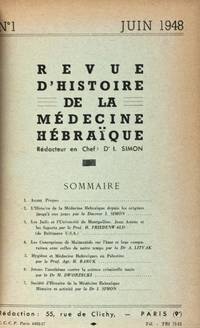
1963ref. 36970Paris: Société d'Histoire de la Médecine Hébraïque 1963. First edition. Hardcover. g. Quarto. Original tan cloth with gold lettering on spines. Original wrappers bound in. Complete collection of all the 62 issues published during the first 16 years of the "Revue d'Histoire de la Médecine Hébraïque." Each issue contains important studies on the history of medicine among Jews. With prestigious contributions by Harry Friedenwald Mark Dworzecki Esti Freud Salomon R. Kagan Roger Cattan Lazare Mayersohn Prof. F. S. Bodenheimer Henri Baruk Rabbi Elie Munk Meyer Sal Prof. Mayer A. Halevy Prof. Walther Riese Jean Choukroun Hadas I. Achel Rachel Minc Prof. Werner Silberstein Jacques Launay etc. The first volume gathers all the issues published between 1948 and 1953 No 1 to 15 bis the second volume contains all the issues published between 1953 and 1956 No 16 to 34 issues No 35 to 50 for the third volume and issues No 51 to 62 for the last volume. Binding of first volume sunned and slightly foxed. Minor shelf wear. Moderate age-toning along paper margin. Text in French. Bindings and interior in overall good condition. Société d'Histoire de la Médecine Hébraïque hardcover books
ref. 160845Burbank CA: Jerry Bruckheimer Films 1996. Draft script for the 1997 film. Copy belonging to an unknown cast or crew member with their annotations in manuscript ink on the front wrapper and throughout noting scenes with special effects. A recently paroled ex-con finds himself traveling home on a prison transport plane also carrying a group of high-risk criminals to a supermax prison. Midway through the flight the prisoners escape their constraints and hijack the plane forcing the ex-con to work with police officers on the ground to lead the plane to safety. Shot on location in Elkhart and Goshen Indiana in Mill Canyon Moab Salt Lake City Ogden and Wendover Utah and in Las Vegas and West Wendover Nevada. Blue wrappers with title noted in manuscript ink on the front wrapper. Title page present dated 5/9/96 with credit for screenwriter Scott Rosenberg. 122 leaves with last page of text numbered 120. Xerographic duplication rectos only. Pages Near Fine wrapper Very Good plus bound with two gold brads. Jerry Bruckheimer Films unknown books
1938ref. 151968Paris: Paris Film 1938. Vintage oversize double weight reference photograph from the 1938 film showing actors Jean Gabin and Julien Carette. Based on the 1890 social realist novel by Emile Zola. Director Jean Renoir's film remains true to the proletarian source material while grafting on elements of film noir and his own humanist philosophy. One of the director's biggest commercial successes with a powerful lead performance by Jean Gabin. Remade in the US by Fritz Lang in 1954 as "Human Desire." 15.75 x 12 inches. Very Good plus with creasing to far bottom corners with a small bruise on right side small crease to top right and a very small closed tear in top margin. Criterion Collection 324. Godard Histoires du cinema. Grant France. Rosenbaum 1000. Paris Film unknown books
1855ref. 53792Philadelphia: Bicking & Guilbert 1855. First edition. Softcover. Very good. Octavo. 43 1 blankpp; 2 maps 1 folding. Contemporary blue title wrappers lightly chipped at extremities lettered in black. Stain limited to top margin throughout latter half else a very good copy text clean and crisp. First edition of this rare Brief of Title. The Gratz family of merchants and community leaders in Philadelphia was founded by Barnard Gratz 1738-1801. As a young man he emigrated from Germany to London where he was briefly employed as a clerk. Shortly after relocating to Philadelphia in 1754 he went into business as a merchant in the coastal and West Indian trade and formed around 1760 a lasting partnership with his brother Michael who was involved in the Indian and fur trade as well as land speculation. The two brothers helped found the first synagogue in Philadelphia. Two of Michael's sons Simon Gratz 1773-1839 and his brother Hyman 1776-1857 carried on the family business. Apart from his ongoing involvement with the Jewish Congregation Mikveh Israel "Simon was among the founders of the Pennsylvania Academy of Fine Arts" Morais and "a director of the Pennsylvania Botanical Garden" Rosenbloom. Includes a three-page extract from the will of Simon Gratz dated February 16 1839 with his instructions for the disposition of the 71 acres of his estate contained in "the four tracts of land mentioned at the beginning of this Brief." As noted in the present brief p. 28 The Farmers and Mechanics Land and Building Association received its Charter of Encorporation on March 17 1852 acquiring by purchase the Willington Estate from Louisa Gratz Edward Gratz David Gratz and Elizabeth Gratz on April 16 1852. Provenance: The business card of Henry Tunison Jr. "Real Estate Agent and Collector of House and Ground Rents. S. E. Corner 18th & Spruce Streets Philadelphia" has been mounted at the bottom of the front wrapper; Mr. Tunison's manuscript entry appears at the top. A rare item not indexed in OCLC which does however locate two copies of an 1871 edition at Hebrew Union College and the University of Michigan; Singerman is also only aware of the 1871 printing noting copies at the American Jewish Historical Society and the Library Company of Philadelphia. References: Cf. Singerman Judaica Americana no. 2256 ed. 1871. For the Graz family see: H.S. Morais The Jews of Philadelphia 1894 p. 25. J.R. Rosenbloom A Biographical Dictionary of Early American Jews 1960 pp. 47-48. Bicking & Guilbert unknown books
ref. 4078SIMON CAMERON 1799-1889. Cameron was an important nineteenth-century politician. In addition to serving as a Senator from Pennsylvania for eighteen years in three separate periods he was Lincolns Secretary of War from 1861 to 1862. Archive. 39 pieces. 1831-1889. An archive of letters and other documents signed by Simon Cameron including numerous signed as U.S. Senator from Pennsylvania. There is also one letter written to Cameron as Secretary of War. The recipients are primarily fellow politicians particularly those with Pennsylvania origins. Topics include business politics law and pleasantries. Letters date from the beginning of his political career through the last year of his life. All are signed Simon Cameron unless otherwise noted. All are in very good condition or better unless otherwise noted. unknown books
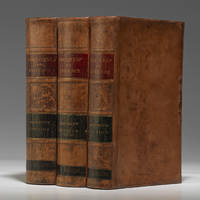
1866ref. 1278981866. GREENLEAF Simon. A Treatise on the Law of Evidence. Boston: Little Brown 1866-68. Three volumes. Octavo contemporary full tan calf red and black morocco spine labels. $2200.Early edition of Greenleaf's classic treatise one of the foundational works of American law in handsome contemporary calf bindings.Greenleaf taught law at Harvard starting in 1833 eventually becoming Dane professor of law in 1846 after the death of Joseph Story to whom the Treatise is dedicated. The Treatise was first published in 1844-46 and immediately became the undisputed authority in its field going through countless editions over the next century. ""Until the appearance of Professor Greenleaf's Treatise upon Evidence the Bar in the United States were wholly dependent upon English works for the information in this department of the law"" Marvin 347. Early owner signatures early bookdealer ticket.Interior generally clean joints expertly repaired handsome contemporary calf expertly restored. unknown books
ref. 12346About 30 text pages printed on cream Zerkall laid paper and 134 engravings printed from the original blocks on Zerkall white smooth paper. With signed proof of the frontispiece in an envelope laid in. Folio quarter green morocco and pattered boards morocco spine label lettered in gilt; silk and patterned paper slipcase. One of 55 Deluxe copies from a total edition of 175. Deluxe edition with frontispiece proof signed numbered and dated by the artist. A complete chronological listing of all Brett's engravings from 1961 to the time of publication. Simon Brett is acknowledged as one of the masters of wood engraving of the past half-century. Barbarian Press hardcover books
ref. 140948230New York: Schlangekraft Inc. / Barnes Graphics Inc 1977. First Edition. Fine. First edition limited issue #619 of 666 copies. Signed by publisher L.K. Barnes in red ink on acknowledgments page. lvi 218 3 pp. Bound in publisher's full black leather stamped in silver all edges silver black ribbon bookmark. Very light toning to title page and front free endpaper verso else Fine. The deluxe first edition issued simultaneously with the first trade edition of the Simon Necronomicon. The grimoire is typically attributed to the American occult author and historian Peter Levenda and has references to H.P. Lovecraft's Cthulu mythos and the writings of Aleister Crowley. Schlangekraft Inc. / Barnes Graphics, Inc unknown books
1580ref. 49122Geneva: Jean de Laon 1580. First edition. Hardcover. Nearly Fine. Three volumes octavo.Vol. I: π2 3 4 π3-4 blank π4 6 a-3k8 3l4 blank 3l4 3m8 3n4 = 476 leaves. 24 901 27pp. Vol. II: A8 2A-3F8 3G2 3H8 3I3 blank 3I2 and 3I3 = 437 leaves. 16 836 22 indexpp. Vol. III: π1 B2 3 B4 A1 C2 Au lecteur π2 blank 2A-3G8 3H4 2A4 2B2 258 leaves 16 480 8 index 12 erratapp. N.B.: while the text is complete and continuous collations of preliminary leaves in volumes 1 and 3 are irregular.; printer's device at each title; 6 errata leaves for the entire work at the end of the third volume. Complete with all four blanks noted in Adams and one additional vol. 2: 3I3. Later polished calf; richly gilt spine with gilt-stamped lettering piece; triple gilt filets at covers; board edges ruled; edges stained red; inner dentelles; marbled endleaves. Occasional mild foxing. Tiny worm hole sometimes obscuring a letter in early leaves of the first volume. A nearly fine handsomely bound set. First edition of the celebrated 'Livre d'Or du Protestantisme français'. It is of primordial importance for the period 1521-1563 and among of the chief source books for the history of French- and Swiss Protestantism during the sixteenth century. Long attributed to the Calvinist theologian Théodore de Bèze 1519-1605 it is now generally assumed to have been written by his fellow Calvinist theologian humanist translator and writer Simon Goulart 1543-1628 based on materials gathered by de Bèze since 1565. Provenance: With a wonderful bookseller's handwritten bill Mr. Scherff libraire Ave de l'Oratoire S. Honoré No. 6 dated 1 Décembre 1821 offering the set for fr. 39. Full title and imprint: Histoire ecclesiastique des eglises reformees au royaume de France en laquelle est descrite au vray la renaissance & accroissement d'icelles depuis l'an M.D.XXI. iusques en l'annee M.D.LXIII. leur reiglement ou discipline Synodes persecutions tant generales que particulieres noms & labeurs de ceux qui ont heureusement trauaillé villes & lieux où elles ont esté dressees auec le discours des premiers troubles ou guerres ciuiles desquelles la vraye cause est aussi declaree. Divisee en trois tomes ayans chasque Tome leurs tables. De l'Imprimerie de Iean Remy. A Anvers 1580. References: Adams B 917 under Beza. Index Aureliensis 118.737 under Bèze De. BM STC Dutch p. 77 under: France - Refored Churches "ascribed to T. de Bèze and N. des Gallars". Belgica Typographica 1457 under: Histoire "Toegeschreven aan S. Goulart ook wel aan Th. De Bèze". Chaix-Dufour-Moeckli 98: "Ouvrage collectif faussement attribué à Th. de Bèze et mis en oeuvre par Simon Goulart. Mlle Droz a démontré que l'imprimeur était en réalité J. de Laon". Gardy De Bèze 222: "Ainsi que l'a établi Geisendorf cette histoire a été compilée en partie avec des matériaux que Bèze prenait soin de réunir dès 1565 et le travail de compilation semble s'être déroulé à Genève sous sa haute direction; mais Bèze n'a jamais cessé d'en parler dans sa correspondance comme d'une oeuvre anonyme". Jean de Laon hardcover books
1876ref. 13221Erlangen & Stuttgart: Ferdinand Enke 1876. FIRST EDITION. With 9 lithographed plates 2 chromolithographs; wood engraved text illustrations. Half morocco over marbled boards; front blank leaf lacking large library label on first paste-down paper is brittle and occasionally chipped on a few fore-edges. First edition of this historic landmark in urology. In 1869 Simon performed the first successful intentional nephrectomy on a woman patient. That date marks the beginning of renal surgery which he here describes in great detail in Volume I. The second volume issued five years after the first treats the subject of kidney surgery on both injured and diseased kidney. He had proved that one healthy kidney can take over the entire excretion process. The illustrations are remarkable. Simon 1824-1876 was a distinguished German surgeon who first served as a military physician. He specialized in the fields of gynecology orthopedics and military surgery publishing a well known work on gunshot wounds. As professor of surgery at Rostock he published monographs on gynaecological plastic surgery as well as numerous other literary works in many areas of surgery. Ferdinand Enke unknown books
ref. 310212Stanford CA 1982. Approximately 150 pen and ink and pencil partial and complete drawings including five hand-colored pieces. 2 vols. 4to. Fine. Approximately 150 pen and ink and pencil partial and complete drawings including five hand-colored pieces. 2 vols. 4to. A fun and fascinating look into the creative process of Samuel Michael "Sam" Simon 1955-2015 a dynamic and versatile force in American television who won nine Primetime Emmy Awards eight of which were for his work on the iconic animated sitcom The Simpsons. Sketchbook One still has it's Stanford Bookstore price tag and dates to 1977 Simon's final year at Stanford when he worked as a newspaper cartoonist for the San Francisco Chronicle and The San Francisco Examiner before becoming a storyboard artist at Filmation Studios. Sketches include sports-themed cartoons comic strip ideas for submission to Playboy and Cosmo magazines and various other characters and story concepts. Sketchbook two dates to circa 1980-1982 and includes the loose pages of concept art for "Wags" a cartoon about a group of talking dogs with a related page of concept notes. Other drawings in the sketchbook include concept sketches for "Best of the West" a short-lived ABC sitcom where Simon worked as a writer in 1981; cartoon renderings of Danny DeVito and Christopher Lloyd from the hit sitcom "Taxi" where Simon served as executive story editor showrunner producer and writer from 1981-1983; and several personal drawings of ideas for a friend's birthday party invitation. unknown books
1826ref. 253Halle: Journal für Chemie und Physik 1826. 1st Edition. Hardcover. Good. FIRST EDITION of the experimental proof of Ohm's law "the fundamental law of electric circuits" Dibner 63. Ohm "made a study of the laws of galvanic currents and while investigating the relative conductivity of metals finally discovered the relation known as 'Ohm's law' which underlies all electrical theory and measurement. The experimental proof of this law was first published in a paper in Schweigger's Journal fur Chemie und Physik vol. xlvi. 1826 under the title of Bestimmung des Gesetzes nach welchem Metalle die Contactelektricität leiten" Peck and Colby The New International Encyclopedia. "The following year Ohm published a book entitled Die Galvanische Kette mathematisch bearbeitet Berlin 1827. It contained a theoretic deduction of Ohm's law and became far more widely known than his article of 1826 giving the experimental deduction. In fact his experimental paper was so little known that the impression long prevailed and still exists that he based his law on theory and never established it empirically. This misapprehension accounts perhaps for the unfavourable reception of Ohm's conclusions" Cajori A History of Physics. In: Journal für Chemie und Physik. Hrsg. v. J. S. C. Schweigger u. W. Schweigger-Seidel vol. 46 pp. 137-166. Halle: 1826. The whole volume offered. Octavo modern cloth. Some dampstaining throughout; occasional browning. Provenance: with library and de-accession stamps on series title from the prestigious Gmelin Institute after 1996 part of the Max Planck Institute. Journal für Chemie und Physik hardcover books
1803ref. 307354London: Printed by A. Strahan for T. N. Longman and O. Rees T. Cadell and W. Davies and J. Murray and S. Highley 1803. First Edition. With 3 folding maps 25 plates most hand-colored some folding and 14 vignettes most in color in volume I; plus 26 of 27 plates most are hand-colored some folding 14 vignettes mostly hand-colored and 3 folding maps in volume II. xxiii 1 552; xxx 2 523 pp. 2 vols. Thick 4to. Modern half black morocco and marbled boards. Lacking plate 4 in volume 2. First Edition. With 3 folding maps 25 plates most hand-colored some folding and 14 vignettes most in color in volume I; plus 26 of 27 plates most are hand-colored some folding 14 vignettes mostly hand-colored and 3 folding maps in volume II. xxiii 1 552; xxx 2 523 pp. 2 vols. Thick 4to. "An extremely charming colour plate book which deserves a place in every colour plate book collection for its numerous attractive coloured vignettes an unusual feature". Abbey Travel 222; Cat. Rusica P59; Tooley 357; Cox Volume 1 p. 199 Printed by A. Strahan for T. N. Longman and O. Rees, T. Cadell and W. Davies, and J. Murray and S. Highley unknown books
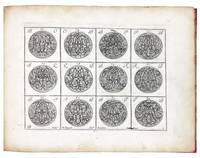
1704ref. 41629London: Printed for the Author in the Old Palace Westminster; and Sold by W. Rogers and H. Rhodes in Fleet Street; E. Harris and B. Barker in Westminster-Hall 1704. Oblong 4to. 8 x 10 inches. First edition. I-IV A4 B-M4 I-IV. 56 ff. 1-112. 112 pp. 56 copper engraved plates 50 each with 12 cyphers; 6 other engraved plates with text in French and English. Coronets Frontispiece Title English Advertisement French Advertisement 50 Leaves of Cyphers. Frontispiece reads: "A book of cyphers composed by Col. Parsons. Imprimatur Carlisle. E. M. 1703." Priced bound at 12 shillings. 18 leaves with extensive contemporary ink manuscript penmanship editions on versos. Bound to style in quarter 18th-century morocco over 18th-century marble paper boards Extensively annotated first edition Parsons's enigmatic cypher book draws on heraldy cryptography and typography and led a craze for monogrammatic systems of which many imitators followed. "Such cyphers were extremely popular on both sides of the Atlantic during the late seventeenth and early eighteenth centuries. For inspiration in preparing clients' personal designs engravers typically relied on guides by designers such as William Parsons's New Book of Cyphers." - DDW Parsons's New Book of Cyphers was at the forefront of a publishing craze for cyphers in the 1700s; it was the fourth such book to be printed and dozens of nearly identical ones followed. Samuel Sympson released books with the exact same title as the present in 1739 and 1750. Phillip Barraud meanwhile had the good taste in 1782 to change Parsons's title by one word to "A New Book of Single Cyphers." Cyphers were used to create heraldic devices and monogrammatic signatures to embroider on clothing use as trademarks or store signs or to incorporate into bookplates as many book collectors have and continue to do. Cyphers differ from monograms in that the individual aspects of a cypher system can be exchanged without affecting the overall system; the letterforms in monograms must be redesigned each time. The cypher system with its internal algorithmic rules and capacity for change can easily encrypt secret messages and has done so from mysterious medieval codices like the Voynich Manuscript to the communiques of British generals during the American Revolution to the blockchain and "crypto" today. Cyphers were so faddish in the 1700s that people kept albums full of printed cyphers they had collected from their family friends and celebrities of the period. Cyphers in other words were treated something like autographs something like business cards something like keepsakes and they were devices people and their families identified with strongly. The 600 engraved cyphers across 56 plates in this first edition of Parson's book each show how to interlink two separate letters within Parsons's larger system of encipherment. Parsons gives instructions in both French and English on how to use them to compose longer texts. Parsons comments severely in his preliminary "Advertisement" preface that the earlier works on the subject contained only half the required number of cyphers necessary to complete their alphabets. By extrapolating from Parsons's text and his supplied two-letter cypher building-blocks one could create cyphers of any length that would maintain a consistent coherent design and be able to be deciphered if one knew the system. This book of cyphers seems oriented toward a striving merchant class not an aristocracy born into their family's symbols from the beginning of their lives. Anyone with access to pen and paper could make a cypher of their initials using this book. This interpretation is bolstered by the early-19th century ink manuscript editions found in the book. Numerous pages of repetitive handwriting exercises express upright moral sentiments: "By a commendable deportment we gain reputation." "Compassionate men never prove extortioners." "A flattering companion is a dangerous enemy." "Brave spirits promote the public good." These didactic lines were copied out of Fisher's The American Instructor: or Young Man's Best Companion . . . How to Qualify Any Person for Business without the Help of a Master. More manuscript editions present includes numerous pages of budgetary ledgers for a construction worker or carpenter an architectural sketch calligraphic practice lyrics from a song called "Mr. Clark and His Bacon" by G. Colman and two poems: "The Essex Spark" and "The Model." Parsons was the younger son of a baronet and attended Christ Church Oxford. He entered the army in 1682 and took part in the Glorious Revolution in 1688. Afterward he turned to publishing especially popular works of learning. His translation of Guillaume Marcel's Tablettes chronologiques chronological tables listing the dates of Kings Popes and Emperors ran through many editions. Parsons helped produce a new set of globes but none survive. For the present work Parsons commissioned Michel Tauvel an engraver in the Strand to work on his cypher designs in 1698. Permission to print the complete work was finally given in 1703. The finished book engraved throughout includes a fine frontispiece engraved by Simon Gribelin to Parsons's design and a title-page and text leaves by Joseph Nutting. Parsons's own cipher is visible in the bottom left-hand corner of each leaf. Berlin Katalog 5315. Collins "The Modern Monogram" Print Magazine 08.06.19. DDW "No. 14 Waiter" in American Silver in the Art Institute of Chicago p.59. ESTC T116152. Francis Edwards Catalog No.800. Hale Treasures from Lord Fairhaven's Library at Anglesey Abbey cat.8 pp.58-9. O'Donoghue "Nutting Joseph" in DNB 18885-1900 Vol.41. Printed for the Author, in the Old Palace Westminster; and Sold by W. Rogers and H. Rhodes in Fleet Street; E. Harris and B. Bar unknown books
ref. 420881New York: Saturday Morning 1978. Softcover. Near Fine. First edition. Edited by Simon Pettet. Tall octavo. Unpaginated. Stapled wrappers with illustrated covers by David Morris. Some modest age-toning on the wrappers else near fine. This copy with a printed limitation at the bottom of the front cover: "This is number 4 in a set of 10 signed editions." Signed by virtually all of the contributors including Pettet John Cage Ted Berrigan Allen Ginsberg Anne Waldman Peter Orlovsky Gerard Malanga Alice Notley John Giorno Dick Higgins Ron Padgett Carl Solomon Eileen Myles Maggie Dubris John Godfrey Jim Brodkey Bob Rosenthal Michael Scholnick Gary Lenhart Harris Schiff Annabel Levitt Michael Lally Maureen Owen Greg Masters Bob Holman Rose Lesniak Paul Violi Tom Savage Steve Carey and artist David Morris. Perhaps most amusing is an angry contribution by Kathy Acker purporting to be a public service announcement by the Chase Manhattan Bank of North America Signed by Acker as "The Chase Manhattan Bank of North America." Berrigan's signature notes himself as "Ted Berrigan on Ibogaine." The only signature that appears to be lacking is that of contributor Ray Bremser. Seemingly the last issue of this short-lived poetry zine. OCLC locates just two runs four issues of Vol. I and this double issue of Vol. II and only one in the U.S. with no mention of the limitation. Undoubtedly rare and a considerable achievement in corralling so many of the contributors to sign the issue in what might be considered an exercise in "herding cats. Saturday Morning unknown books
1759ref. 137120Paris: J. Barbou 1759. Full period French binding in Calf five raised bands gilt ornamentation on spine author and title in gilt on red leather spine label in second compartment. 8vo. Full period French binding in Calf five raised bands gilt ornamentation on spine author and title in gilt on red leather spine label in second compartment. 263 pages. First edition Bigmore and Wyman p.228. Minor soiling to the text block else a fine copy. In this volume Fournier sets out to prove that Gutenberg was not the inventor of the printing press by examining the history of printing. He believes that the technology Gutenberg made popular existed long before the German printer's work. "Peter Simon Fournier a French engraver and letter-founder was born at Paris 1712 and died 1768. He studied under Colson painter of the Academy of Saint Luc and devoted himself first to the art of wood-engraving; he afterwards as an engraver on steel rendered himself famous in all countries. In some of his works he seeks to prove that Gutenberg is not the inventor of printing and maintains that long before Gutenberg engraving on wood had been employed for printing images and inscriptions; that during his residence in Strasburg Gutenberg attempted the application of this art to the printing of books and that on his return to Mayence he first printed the Donatus and the Catholicon of Johannes de Janua with engraved and solid blocks. Fournier's ingenious theories were ably refuted by Baron Heinecken in his "Idée Générale d'une Collection complette d'Estamples" Leipsic: 1771" Bigmore & Wyman p 229. J. Barbou unknown books