2,021 results
1758ref. 263129Paris: Chez de Bure 1758. First. hardcover. good. l'Histoire Naturelle; les Moeurs Coutumes & Religion des Naturels. folding map of the Gulf of Mexico 40 engraved plates including the folding plan of New Orleans lacks large folding map of Louisiana. 3 volumes. 16mo contemporary mottled calf gilt spines spines and some edges of covers worn on all volumes shellac applied to all spines ex-lib lacks errata leaf in volume I. Paris: Chez de Bure 1758. First Edition. "One fo the most useful contemporary authorities on French Louisiana. Le Page du Pratz lived there for 16 years and his detailed description is one of the main sources of his period." Streeter Sale 127. "Relation based on a residence from 1718 to 1734 valuable for showing French claims to the southern territory east of the Mississippi and for particulars concerning Indian nations there." Howes L-266. Ex libris from the library of the American Chamber of Commerce in Paris with their bookplate on the front and back endpapers of each volume. Clark I: 75. Graff 2462. Field 910. Sabin 40122. Raines p. 73. Chez de Bure unknown books
ref. 20681 p.l. 140 pp. 8vo attractive antique half-calf & boards. Paris: Mauger & Hubert An VII 1799. The very rare sale catalogue of duplicates from the library of Mérard 1749-1812 man of letters. He was born into a very rich family and for a number of years was in charge of the residence of the future Louis XIII. After retiring from his public duties in 1782 he concentrated on his growing collection of books and commissioned editions printed in severely limited numbers. Guigard wrote Vol. II p. 351: “San l’amour des livres Mérard de Saint-Just serait complètement oublié.” In 1783 he issued a famous catalogue limited to 25 copies. The catalogue is an odd combination of books which were present in his library books no longer in his library and books which he desired for his library including some completely imaginary books. His collection was not large but fine. Mérard did not have the taste for editio princeps except for Aldines but preferred the best editions with careful editing. He bought books from many of the great collections of the 18th century — Pompadour de Boze Gaignat Randon de Boisset Mac-Carthy Reagh Gouttard etc. — and selected choicely bound volumes including examples by Padeloup Derôme Roger Payne and Baumgarten. 1079 lots and priced throughout in a contemporary hand. Lacking half-title but a nice copy. â§ Grolier Club Printed Catalogues of French Books Auctions.1643-1830 396. Peignot p. 113. unknown books
1968ref. 557228New York: Studio Duplicating Service / David Merrick 1968. Softcover. Near Fine. Stated "Rehearsal Script". Quarto. Music by Burt Bacharach. Lyrics by Hal David. 154 mimeographed leaves printed on the rectos only in screwbound black Studio Duplicating Service wrappers titled in gilt. Small neat handwritten control number "#80" on titlepage plasticized wrappers are slightly rubbed near fine. A musical comedy in two acts adapted for the theatre from the screenplay of The Apartment by Billy Wilder and I.A.L. Diamond. A wildly successful musical that closed after 1281 performances. OCLC locates two copies likely contemporary scripts with approximately 50 fewer pages Princeton; U of Colorado Boulder. Studio Duplicating Service / David Merrick unknown books
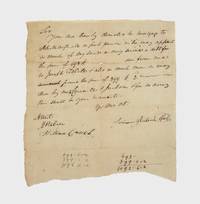
1800ref. 374674Np 1800. 1p. On laid paper. Countersigned by William Couch. Docketed on verso. Old folds torn at bottom blank margin without loss of text. 1p. On laid paper. Countersigned by William Couch. Docketed on verso. "Sir You are hereby directed to mortgage to A. K. Maisahale or such person as he may appoint as much of my land as may secure a debt for the sum of 693£ due from me to Joseph Tidball & also as much more as may secure the sum of 399 & 2c due by me to Carswiule & Jackson & for so doing this shall be your warrant." Scarce autograph by the noted frontiersman soldier and scout noted for his exploits in Kentucky Ohio and western Virginia during the Revolution and the Northwest Indian War. unknown books
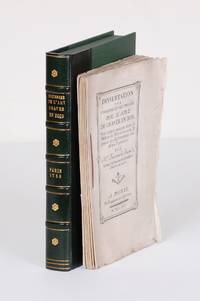
1758ref. 141839Paris: J. Barbou 1758. full brown leather border stamped in blind on the front and rear boards gilt ornaments on spine title in second compartment five raised bands all edges stained red marbled endsheets. small 8vo. full brown leather border stamped in blind on the front and rear boards gilt ornaments on spine title in second compartment five raised bands all edges stained red marbled endsheets. 1ff.-92 3 -263 pages. Pour éclaircir quelques traits de l"histoire de l'Imprimerie & prouver que Guttemberg n'en est pas l'Inventeur. Two works bound in one. Very rare first edition Bigmore and Wyman p.228. Private bookplate of Jackson Burke on the verso of the front free endpaper. Contemporary boards with some rubbing to the spine and extremities corners a bit worn gilt on the spine is lightly flaking evidence of bookplate removal to front and rear pastedowns. Else a fine copy of this very scarce work. Two works bound together. Complete titles are: Dissertation sur l'origine et les progrès de l'art de graver en bois 1758 and De l'origine et des productions de l'imprimerie primitive en taille de bois 1759. Fournier 1712--1768 was born in Paris and trained as a wood engraver. He later turned to steel engraving. In the first essay Fournier sets out to prove that Gutenberg was not the inventor of the printing press by examining the history of printing. He believes that the technology Gutenberg made popular existed long before the German printer's work. The second volume follows this up with further discussion of the origins of woodcut prints. Fournier wrongly disputes the dating of Mr. De Bure le Jeune concerning the Gutenberg Bible but he is the first with the help of an observation by Gerard Meerman to note the progressive increase in the number of lines per page in the early stages of Bible production. J. Barbou unknown books
1851ref. 288814Munich: University of Munich 1851. unbound. very good. Exceedingly rare partly-printed document signed: 1 page folio Munich August 17 1851 an ornate Graduation Certificate for a student attending the University of Munich Polytechnic School signed 'Prof. Dr. Ohm' as the Royal Ministerial Commissioner for Examinations. Fine dark signature and in very good condition with some tiny tears along the right blank margin. Accompanied by a small black and white portrait of Ohm on a separate sheet. At the time he signed this certificate Ohm was also Extraordinary Professor of Physics at the University of Munich. German physicist and mathematician whose experiments using Alessandro Volta's new electrochemical cell led to his discovery of Ohm's Laws. University of Munich unknown books
1758ref. 76869Paris: J. Barbou 1758. unbound cord tied housed in a green half-morocco goat over cloth boards clamshell case spine tooled in gold leaf with title author and date. large 12mo. unbound cord tied housed in a green half-morocco goat over cloth boards clamshell case spine tooled in gold leaf with title author and date. 92 3 pages. Pour éclaircir quelques traits de l"histoire de l'Imprimerie & prouver que Guttemberg n'en est pas l'Inventeur. Very rare first edition Bigmore and Wyman p.227. Unbound textblock lightly soiled with minor creasing at corners. Faint moisture staining throughout with some affecting the text. In this text Fournier sets out to prove that Gutenberg was not the inventor of the printing press by examining the history of printing. He believed that the technology Gutenberg made popular existed long before the German printer's work. Fournier also followed up this text with two additional works which are not present: De l'origine et des productions de l'imprimerie primitive en taille de bois 1759 and Observations sur un ouvrage intitulé Vindiciae Typographicae 1760. These two works provided further discussion of the origins of woodcut prints including a passage refuting popular belief about the origin wood engraving and some ideas for further study. Fournier 1712--1768 was born in Paris and trained as a wood engraver and type founder being a member of the 18th century dynasty of the well-known Fournier family. He later turned to steel engraving. He published a table of the proportions of the different printing characters whose purpose was to propose for all typefaces a fixed measurement in "typographic points" and a systematic gradation. He worked closely with the collaborators of the Encyclopédie providing the printer Le Breton with all the documentation relating to the typographic foundry and plans for his own instruments as well as providing Diderot with his collection of ancient alphabets. Finally after multiple disputes with his Parisian colleagues he became infamous for the printing of his famous Manuel Typographique 1764 1766 just prior to his death. J. Barbou unknown books
ref. 457960Unbound. Fine. Watercolor or gouache on artists board. Signed "W. Simon" in lower right corner. Framed and matted. Image size approximately Measuring 13½" x 16". Unexamined out of the frame but appears fine. Angular and abstract buildings in reds pinks oranges browns. and blues one labeled "Men's Furnishings" another "Times" and two others more cryptically label "B2" and "K4." Walter Augustus Simon 1916 - 1979 was an African-American artist foreign service officer and later an art teacher. He studied at Pratt the National Academy of Fine Arts in Harlem and later at NYU where he was mentored by Hale Woodruff. After serving in the military in WWII and beyond he became one of very few Black foreign service officers serving mostly in the Middle East. Upon returning to the U.S. he completed his education and taught at numerous schools including Atlanta University Georgia State College Virginia State University and Patterson State College. He was known for his abstract oil paintings which have brought as much as $30000 at auction but we prefer his acrylics which are clean exhilarating and direct. unknown books
1537ref. 39475Basel: Johannes Hervagen 1537. Folio. 12 1/2 x 8 inches. Augmented edition. a-d4 a-z6 A-Z6 Aa-Dd6 Ee2. 24 1-599 1. 624 pp. Lacking the woodcut world map attributed to Hans Holbein the Younger and Sebastian Münster. Woodcut printer's devices on title and verso of last leaf historiated initials head and tail pieces woodcut illustrations on pp. 127-29. Title Contents Dedication Grynaeus's Text Index Texts. Contemporary ink manuscript annotations in margins. Contemporary full limp vellum with brown ink manuscript title on spine and remanants of two pairs of leather ties with pill-shaped watermark on laid paper a blue cloth clamshell box with gilt-lettered leather titling-piece on spine A fine example of the most influential collection of early sixteenth-century travel literature. Besides the three voyages of Columbus the present work includes descriptions of those of Petrus Alonzo and Pinzo three of Vespucci's four voyages and Peter Martyr's De Insulis Nuper Inventis. According to Borba the present edition is the first to contain the letter of Maximilian of Transylvania reporting the news of Magellan's voyage p. 585. This augmented edition holds the second and third letters of Cortes and selected letters of Juan Zumarraga the first Archbishop of Mexico. Though the account of Magellan's voyage was originally published in 1522 in a 16-leaf ephemeral edition of a letter addressed to Charles V its appearance in Grynaeus's collection of voyages marks the first time his landmark discoveries appear in an historical context side-by-side with those of Columbus Vespucci and the Portuguese navigators. Adams G1337. Alden 537/14. Borba I. Burmeister 62. Church 123. Harrisse 223. Sabin 34103. European Americana 537/14. Johannes Hervagen unknown books
ref. ST14910London: NdA Press 1980. No. 4 OF 10 COPIES SPECIALLY BOUND BY DESIGNER BOOKBINDERS from an edition of 50 copies signed by the author and artist. 315 x 130 mm. 12 3/8 x 5". 35 1 pp. 4 leaves. Calligraphed text in red and black written out by Sally Johnson on a unique vellum copy and photo-lithographed on BFK Rives paper for this edition. STRIKING MULTI-COLOR MOROCCO INLAID IN AN ABSTRACT DESIGN BY JEFF CLEMENTS covers and spine with wrap-around design composed of brown black taupe and citron morocco with geometric blind rules and a quadrilateral tooled in white on the upper cover DARK GREEN MOROCCO DOUBLURES tooled with a blind geometric design tan suede endleaves. In a custom gray cloth drop-back box with niche for the accompanying cassette tape. Patterned flyleaves frontispiece and six double-page etchings by Natalia d'Arbeloff. With a cassette tape recording of a reading of the play by Charles Turner and Jack LeWhite. A typed letter signed by binder Jeff Clements and a photocopied review of the Designer Bookbinders exhibit in which this binding appeared laid in. ◆In mint condition. Despite the vaguely unpleasant title this is a notable and obviously extremely limited artist's book offered here in a striking binding that is distinctly tall and narrow with design elements inspired by events in the text a dramatic dialogue between a "Shakespearean Superstar and his Understudy." According to the binder's letter to Professor John Burton the original purchaser of the binding "The design is very much based on the narrative itself with references to blindness as in the blind sun in white within the incised leather; the play takes place in a sewer also evident and the lower corner on the back cover is a hint about the mule which appears on the last pages of the play." Perhaps these plot elements are not as compelling as "King Lear" but they certainly are curious. Clements notes further that the binding was completed in 1981 and exhibited in a Designer Bookbinders show and he has enclosed a copy of a review of that show underlining the portion where the critic compares this binding to the paintings of British artists William Scott and Ben Nicholson. Clements 1934-2021 studied at the Plymouth College of Art and Design receiving the National Diploma in Design in 1955 and continued his education in bookbinding at the Central School of Arts and Crafts. He became a fellow of Designer Bookbinders in 1957 and served as the organization's president from 1981 to 1983. Since 1988 he has been based in Amsterdam where he operates Binderij Meridiaan with Katinka Keus. British-American artist Natalia or Natalie d'Abeloff is a painter printmaker book-artist cartoonist and teacher but is best known for her livres d'artiste copies of which are held by institutions including the Rijksmuseum the Victoria and Albert Museum and the Library of Congress. The present work represents an early venture into multimedia works an area she has continued to explore in the digital age creating a "Bloggers' Parliament" and authoring a popular web comic. Jerry Jenkins Curator of Contemporary British Published Collections at the British Library notes the many ways the various elements of Abeloff's books--paper print illustrations--and the techniques she employs give her works appeal to a number of senses on a number of levels. With "Fungus and Curmudgeonly" he was impressed by the impact of being able to follow the text while hearing actors perform the roles noting that "this offers an aural immersion into the play along with the performance." She is a Fellow of the Society of Designer Craftsmen and her papers are held by the V&A. NdA Press unknown books
1892ref. 296808New York: COLTON G. W. and COLTON C. B. 1892. unbound. very good. Large folding map mounted on linen 29 1/2 x 37 1/2 inches in very good condition bound with 28 pp of text 10 blank pages. Manuscript notes in pencil. 8vo 3/4 polished calf. New York: G.W. Colton & C.B. Colton 1892. Scarce. Very good . "Real estate speculators shippers and business interests could not agree on the best way to utilize the Harlem river debating whether public works should facilitate traffic across the river or shipping along the river. Coastal trade interests advocated for a Harlem River Canal but their opponents argued that transportation across the river was more important. This map of the river between the Hudson River top and the East River bottom accompanied an unsuccessful proposal to have the state legislature turn the Harlem into a subterranean river and connect Manhattan with the mainland between Third and Eighth Avenues section shaded red." Gotham Center for New York history. Small abrasions along folds. Includes notes for the proposed site for Columbia University. COLTON, G. W. and COLTON, C. B. unknown books
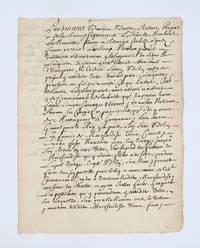
1688ref. 368775Montreal 1688. In French. 2pp. recto and verso on a single leaf. Signed by Perrot Bleinz and notary Benigne Basset. With an English transcription. Quarto. Old folds. Near fine. Provenance: Archibald de Léry MacDonald; Lawrence Lande. Exhibition: An Exhibition of Early Documents and Printed Material Relating to the Beginnings of Trade in North America from the Private Collection of Dr. Lawrence M. Lande McGill University May 30-July 15 1985 with an 8-page exhibition catalogue. In French. 2pp. recto and verso on a single leaf. Signed by Perrot Bleinz and notary Benigne Basset. With an English transcription. Quarto. Scarce seventeenth century voyageur fur trade contract for an expedition to the wilderness to trade with the Ottawa signed by one of the most important early traders and explorers of Canada and the upper midwest. "Partnership agreements such as this one of Nicholas Perrot are of great rarity" Lande. Perrot 1644-1717 was an explorer interpreter trader commandant diplomat and seigneur. He was one of the best-known figures in the early fur trade of New France particularly during the latter part of the 17th century and took possession of large tracts of land in the Great Lakes region in the name of King Louis XIV. His travels commonly took him deep into unexplored territory and he was the first Frenchman to explore the Upper Mississippi in what is now Wisconsin and Minnesota. Perrot arrived in New France about 1660 as a young donné or contracted assistant in the company of Jesuit Missionaries and travelled to the western Great Lakes region where he gained the friendship of the local First Nations people by trading guns for furs believing that they were entitled to defend themselves from their enemies. He also took the opportunity to learn several Native languages which served him well during his career. Perrot soon entered the fur trade full time and began forming business partnerships. He enlisted himself as a translator with government authorities and participated in peacekeeping missions to bring warriors of several First Nations together to sign peace treaties. By 1685 he was appointed Commandant-in-Chief at Bais des Puants present day Green Bay Wisconsin and surrounding regions and travelled to the upper reaches of the Mississippi River in the territory of the Sioux tribes where he built Fort St. Antoine in present-day Minnesota. During the spring of 1687 in preparation for taking part in raids on Indian villages in the Seneca country Perrot left his store of furs with the Jesuits at St. Francois-Xavier mission in present-day Wisconsin. While out with the raid party a fire at the mission destroyed his entire fur inventory valued at more than 40000 livres. Financially ruined Perrot returned to Montreal to deal with creditors and renew partnership agreements like the present. In the summer of 1688 Perrot partnered with Simon Bleinz to undertake an expedition to trade with the Ottawa Indians and other Nations. Perrot had always been a staunch ally of Governor Frontenac and had obtained a fur trade license from the governor for this venture to ensure that his activities were in keeping with the rules and regulations of the trade. The agreement states that Perrot would supply Bleinz with goods food provisions a canoe and other necessary supplies for the voyage and that Bleinz would convey the goods to the trading area and do all that he was able for the success of the partnership. Bleinz had the option of taking at his own expense six shirts two capots or hooded coats of blanket cloth moosehide or other material and one rifle to trade for his own personal profit. The pelts resulting from the venture were to be distributed evenly amongst Bleinz another unnamed associate of the partnership and Perrot. An "apichimon" or bonus of six beaver pelts was to be paid to Bleinz by the partnership upon the successful conclusion of the expedition. "Perrot who was often unappreciated even during his lifetime was France's best representative among the Indians of the west. His knowledge of the languages of the country his natural eloquence the happy blend of daring and coolness that were the essence of his character had made it possible for him to win the esteem confidence and even affection of the Indians. The Potawatomis the Menominees the Foxes the Miamis the Mascoutens and the Sioux granted him with the honours of the pipe of peace the rights and prerogatives enjoyed by their own chiefs. His credit was not less among the Ottawas and the Hurons. During the last four decades of the 17th century at a time when alliance with the nations of the west was indispensable in order to ward off the Iroquois peril and allow access to new territories Perrot thanks to the influence that he had acquired rendered valuable assistance to the colony" Dictionary of Canadian Biography. The present document is from the famed collection of Lawrence M. Lande 1906-1998 detailed as item 107 in his second bibliography of his collection The Founder of our Monetary System John Law Compagnie des Indes & the Early Economy of North America Montreal: 1984. Lande began collecting manuscript material relating John Law the Compagnie des Indes and the fur trade - North America's first economy - as early as the 1960s principally working with dealers Izzy Ehrlich and Alfred Van Peteghem purchasing material from the collections of Thomas Phillips Philip Sang and historian Archibald Lery MacDonald the assemblage of which Van Peteghem termed an "unparalleled feat." All of the printed material and many of the documents were donated by Lande in his lifetime; however a grouping of the manuscript items including the present document were sold by his heirs after his death. Lande Founder of our Monetary System 107 unknown books
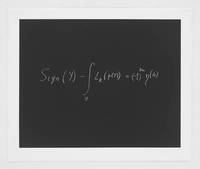
ref. 9325Portland OR: Parasol Press 2014. Limited Edition. Loose Sheets. Fine in Fine Archival Boxes. Limited Edition. Loose Sheets. A collection of 10 aquatints on Rives Paper. Leon Battista Alberti renaissance scholar artist and architect coined the term Concinnitas to connote the beauty found in the confluence of perfect uses of number position and outline. In 2012 Parasol commissioned ten mathematicians physicists and computer scientists including two Nobel Laureates and five Fields Medalists to create etchings of the mathematical expression most meaningful to them. These formulae were then printed by the fine-art print shop Harlan and Weaver as aquatints evoking the look of equations quickly and elegantly sketched in white chalk on a blackboard. Accompanied by an expository essay of each and description card signed by each. Sir Michael Atiyah. Edinburgh University. Fields Medal Enrico Bombieri. Institute of Advanced Study Princeton. Fields Medal Simon Donaldson. Stony Brook University / Imperial College London. Fields Medal Freeman Dyson. Institute of Advanced Study Princeton. Templeton Prize Murray Gell-Mann. Santa Fe Institute. Nobel Prize Richard Karp. UC Berkeley. Turing Medal Peter Lax. Courant Institute NYU. Abel Wolf and Norbert Wiener Prize David Mumford. Brown University. Fields Medal Stephen Smale. City University of Hong Kong. Fields Meda Steven Weinberg. University of Texas. Nobel Prize. Bright and unmarred. Black coated cloth archival boxes prints descriptions cards. 8 are 26 1/8 x 31 5/8 inches. 2 are 31 5/8 x 26 1/8 inches. Illus. b/w plates. Limited edition of 100. Signed by the mathematicians/physicists. Parasol Press unknown books
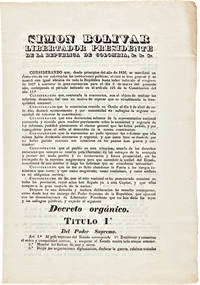
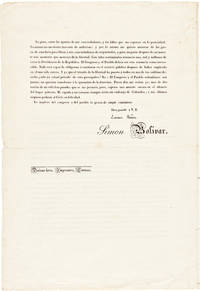
1828ref. 44272Bogotá. August 27 1828. Bolívar Announces He Is Appointing Himself Dictator for Life An extremely rare broadside printing of Bolívar's declaration of dictatorial powers addressed to the people of Gran Colombia together with the Decreto Orgánico issued by him outlining the organization of his new government. The two documents - bearing the same watermark folds and publication date - appear to have been issued together to the Treasury; a contemporary hand has written "Tesoreria" on the first leaf and the wear patterns suggest that they have been kept together for some time. Simón Bolívar was already president and founding hero of Gran Colombia present-day Panama Colombia Ecuador Venezuela and parts of Peru. In February 1827 with the nation floundering and on the point of fragmentation Bolívar had proposed resigning his position as president claiming he had no desire for dictatorial control. The Congress rejected his resignation. After a failed constitutional convention in the summer of 1828 Bolívar declared himself by this decree dictator for life in what was intended as a temporary measure to maintain unification. In the first document Bolívar addresses the "Colombianos" explaining his reasoning for the extraordinary measures granting him absolute power over the government. He also assures his countrymen that he will not remain a dictator any longer than necessary but in the meantime pledges to "commit myself to obey strictly your legitimate desires" in translation. The second document the Decreto Orgánico is the actual document in which Bolivar makes himself dictator laying out six articles granting him absolute power. Both are signed in type by Bolívar. Although the text of these important proclamations was anthologized at an early date and has frequently been republished copies are exceedingly scarce on the market. We were able to locate only one institutional copy of each at the John Carter Brown Library. Folio. Old creases. Minor soiling. Very good plus. In a half morocco and cloth box leather labels. PALAU 32190. POSADA BOGOTANA 1042. hardcover books
1797ref. 006817London: Printed by W. Bulmer & Co. Shakespeare Printing-Office for John & Josiah Boydell and George Nicol. From the Types of W. Martin 1797. First Edition. Full Gilt and Blindstamped Morocco. Near Fine. Folio 32 by 26 cm. cxxxiii 3 213 286 300 pp. 32 hand-colored mezzotint plates within the 3 volumes one plate folding. Among them are three reproductions of Milton portraits including Milton as an infant as a boy and the famous Romney painting of the blind Milton dictating to his daughters this plate being the folding one. To our knowledge this copy of the Boydell Milton is an uniquely hand-colored copy. All the plates other than the Milton portraits are the artwork of Westall. These have an unmistakable affinity to the heroic style of Blake his contemporary. The men and even the women can have exaggerated bulging muscles as found most famously in Michelangelo. As invited by Milton's epic light contends with dark and the illustrations serve up a phantasmagoria of imagery with swirling shadows and specters. The hand-coloring is of a very high caliber and we think greatly enriches the mezzotints. The three volumes contain all the major poetry of Milton -- "Paradise Lost" "Paradise Regained" "Samson Agonistes" "Comus" etc. etc. Note all half-titles are present. Binding of a rich russet/crimson straight-grained morocco with bands of blindstamping and gilt-stamping decoration on the boards and gilt decoration within and on the raised bands. Decoration consists of ruling Greek palmettos and more floral rinceaux bands. Conditiion: morocco binding with minor abrasions and wear. One leaf with repaired tear Vol. II pp. 103/4. Pages generally clean plates bright. All volumes tight. Printed by W. Bulmer & Co., Shakespeare Printing-Office, for John & Josiah Boydell, and George Nicol. From the Types of W. Marti unknown books
ref. 156588London: 4AD 1989. Three early never-issued alternate artwork proof designs for the classic 1989 album. Developed by British graphic designer Vaughan Oliver with photography by Simon Larbalestier. Unique. In 1980 Oliver and photographer Nigel Grierson formed the graphic design partnership 23 Envelope. In 1982 the duo were invited to create sleeve art for the 4AD record label by co-founder Ivo Watts-Russell. Under 23 Envelope and v23 Oliver would give 4AD one of the most acclaimed and distinguished visual identities of any record label of the 1980s and 1990s designing album art for the Cocteau Twins This Mortal Coil Dead Can Dance Colourbox and the Pixies among many others. Oliver managed the graphic design for the Pixies' entire discography during his lifetime with "Doolittle" being the most celebrated. Photographer Simon Larbalestier is best known for his collaborative work with Oliver under 23 Envelope and v23 and provided photography for all the Pixies albums helping to give the band their distinctive and opulent visual style. "Doolittle" was the first Pixies album for which Oliver and Larbalestier had access to the lyrics which "made a fundamental difference" according to Larbalestier and helped determined the photography layout and graphic style. While each of the experimental proofs presented here retain the general overall layout of the released cover each contains both stark and subtle differences. The first proof the most dramatically divergent is printed in a sharp copper with the photograph a pale yellow and the rear cover text a deep blue. The other two proofs experimenting with metallic copper and gold are both notably lighter in tone than the final art but the photograph printed in a gray green is close to Oliver's final design with the rear cover text also in gray-green as opposed to the white of the final design. The layout of the typography is also notably different in all three proofs with the band name much smaller and its accompanying grid nearly indiscernible as is the title placed discreetly above the band's name. Three extraordinary experimental proofs documenting Oliver's process in creating the exceptional art of one of the most celebrated and influential rock albums of all time. 25.25 x 13.75 inches on heavy card stock. Near Fine overall. 4AD unknown books
1827ref. 44267Caracas. February 6 1827. Bolívar Resigns as President of Gran Columbia - But Not Really In this remarkable and rare broadsheet Simón Bolívar tenders his resignation as president of Gran Colombia to the Congress in Caracas Venezuela. By 1827 internal conflicts and political pressures were threatening the stability of the Republic Bolívar had created Gran Colombia present-day Panama Colombia Ecuador Venezuela and parts of Peru. In an attempt to pacify dissenters and preserve the fragile federation Bolívar addressed the Congress offering to step aside and assuring the people that he had no plans to declare himself absolute ruler. In this address Bolívar points to the fact that Gran Colombia is in an advantageous position recognized by the United States and with Great Britain threatening war with Spain. Despite a rosy outlook he notes that suspicions that El Libertador will exert himself as a tyrannical dictator continue to plague the political environment. Thus - in the tradition of George Washington - he is resigning from office. He writes in translation: "In vain do I invoke the example of Washington to defend myself." Though he is not innocent of ambition Bolívar wishes to "remove my fellow citizens from the claws of this fury and free them from uneasiness." Declaring his renunciation to be irrevocable he writes: "My sword and my heart will nevertheless be for Colombia; and with my last breath I will ask heaven to grant her happiness." Despite this declaration the Congress refused to accept Bolívar's resignation. Unable to settle on a new constitution and form of government the Constitutional Convention of 1828 fell apart and Bolívar proclaimed himself dictator for life on August 27. Intended to be a temporary measure to stabilize the government this move resulted in an assassination attempt just a month later. Bolívar died two years later of tuberculosis. Not located in any of the usual sources including Palau and OCLC. An important piece of South American history. Folio. Old fold; slight separation at fold. Light creasing. Very good. In a half morocco box. unknown books
1825ref. 2471825. Folding engraved plate in Vol. IV. Five vols. Large 4to handsome antique blue morocco-backed marbled boards flat spines nicely gilt. Paris: J.B.M. Duprat & others An VII 1798-1825. First edition and a complete set with all the supplements. In this monumental and fundamental astronomical work Laplace -- the "Newton of France" -- codified and developed the theories and achievements of Newton Euler d'Alembert and Lagrange. "Laplace maintained that while all planets revolve round the sun their eccentricities and the inclinations of their orbits to each other will always remain small. He also showed that all these irregularities in movements and positions in the heavens were self-correcting so that the whole solar system appeared to be mechanically stable. He showed that the universe was really a great self-regulating machine and the whole solar system could continue on its existing plan for an immense period of time. This was a long step forward from the Newtonian uncertainties in this respect.Laplace also offered a brilliant explanation of the secular inequalities of the mean motion of the moon about the earth -- a problem which Euler and Lagrange had failed to solve.He also investigated the theory of the tides and calculated from them the mass of the moon."Printing & the Mind of Man 252. A very nice set. Our set has the first state of the titles of Vols. I and II and all the supplements. It lacks the title leaf for the first supplement in Vol. IV. Dibner Heralds of Science 14. D.S.B. XV pp. 273-403. En Français dans le Texte 201. Horblit 63. Roberts & Trent Bibliotheca Mechanica pp. 197-98. unknown books
1827ref. 33731827. One folding engraved plate. iv 245 pp. lacking the errata leaf & leaf of ads. 8vo cont. grey paste-paper boards lower joint with short split at head & foot. Berlin: T.H. Riemann 1827. First edition and a splendid association copy of this pioneering work which contains one of the most important discoveries in electrical science — “Ohm’s law” — the basis of the present system of electrical measurement. Ohm discovered the unit of resistance in an electrical current. This copy belonged to the “Prince of Mathematicians” — Carl Friedrich Gauss — and has the “Gauss-Bibliothek” stamp on the title. It is quite exciting to be able to link two of the greatest 19th-century scientists through an important book like this. “In the field of electrical measurement Ohm was the great pioneer…Ohm’s great contribution — ‘The Galvanic Chain Mathematically Calculated’ — was to measure the rate of current flow and the effects of resistance on the current. ‘Ohm’s law’ — that the resistance of a given conductor is a constant independent of the voltage applied or the current flowing — was arrived at theoretically by analogy with Fourier’s heat measurements 1800-14.”–Printing & the Mind of Man 289. It is known that the publisher was forced to pulp most of the copies of this book due to lack of sales. A very fine and fresh copy. Lacking the errata leaf it clearly was never bound-in and as usual the leaf of ads. With the stamp of the Royal Observatory at Göttingen on free front endpaper with release stamp facing on the front paste-down endpaper and title. â§ Dibner Heralds of Science 63. Horblit 81. Sparrow Milestones of Science 154. Wheeler Gift Cat. 835. unknown books
1827ref. 54811827. Folding engraved plate in Vol. IV. Five vols. Large 4to 281 x 200 mm. cont. polished calf sides panelled in blind & gilt spines decorated in blind & gilt a.e.g. Paris: J.B.M. Duprat & others An VII 1798-1825-1827. First edition a magnificent set on large and fine paper complete set with all the supplements. This is the only large and fine paper set I have ever seen on the market. In this monumental and fundamental astronomical work Laplace — the “Newton of France” — codified and developed the theories and achievements of Newton Euler d’Alembert and Lagrange. “Laplace maintained that while all planets revolve round the sun their eccentricities and the inclinations of their orbits to each other will always remain small. He also showed that all these irregularities in movements and positions in the heavens were self-correcting so that the whole solar system appeared to be mechanically stable. He showed that the universe was really a great self-regulating machine and the whole solar system could continue on its existing plan for an immense period of time. This was a long step forward from the Newtonian uncertainties in this respect…Laplace also offered a brilliant explanation of the secular inequalities of the mean motion of the moon about the earth — a problem which Euler and Lagrange had failed to solve…He also investigated the theory of the tides and calculated from them the mass of the moon.”–Printing & the Mind of Man 252. A magnificent set preserved in two boxes. Our set has the first state of the titles of Vols. I and II and all the supplements the supplement in Vol. V issued in 1827 is on regular paper. â§ Dibner Heralds of Science 14. D.S.B. XV pp. 273-403. En Français dans le Texte 201. Horblit 63. Roberts & Trent Bibliotheca Mechanica pp. 197-98. Sparrow Milestones of Science 125. unknown books
ref. BOH 217FASCINATING MEDIEVAL BOOK OF HOURS WITH EXTENSIVE ILLUMINATIONS BY THREE DIFFERENT ARTISTS. In Latin and some French illuminated manuscript on parchment Southern Netherlands Mons c. 1460 original portion c. 1480-1490 updated. Dimensions 167 x 116 mm. 199 folios lacking one text leaf written by two different scribes in gothic textualis bookhand in single column on 17 lines; BINDING: seventeenth century brown calf over wooden boards spine with four raised bands gold-tooled gilt title "OFFICIU / BEATEM / VIRGIN" partly worn out gilt edges. ILLUSTRATION: 22 full-page miniatures within full rinceaux borders by the Mildmay Master 13 the Master of Philippe de Croÿ 7 and a third Mons illuminator follower of Simon Marmion 2 and 4 small miniatures by the Mildmay Master additional sixteen full rinceaux borders and 5-line initials in pink or blue on burnished gold grounds. The Mildmay Master was responsible for the core of the original manuscript; the artist paints elongated figures with small heads and slender bodies mostly situated on pale yellow tiled grounds. His outdoor landscapes are cursory. Unusual here are his delicate acanthus and floral borders sprinkled with fanciful grotesques. The artist responsible for updating the manuscript is the Philippe de Croÿ Master. He favors tiled floors in brown or gray and white with a generally somber almost grisaille palette with blue and white grey and a burnt brownish orange. A third painter a follower of Simon Marmion intervened during this second campaign. The most skilled of the three illuminators his delicate figures are well-modeled with tiny hands and individualized faces. PROVENANCE: The manuscript was made in Southern Netherlands probably in two different stages. The core of the Hours and the calendar were written in Mons for an unknown patron c. 1460. Then around 1480 the manuscript was updated also in Mons for a couple represented in prayer in the manuscript: Jean Antoine de Mahieu Lord of Bosqueau and his wife Jacqueline de Sivry Lady of Buath; belonged to Jean-Baptiste-Florentin Gabriel de Meyran marquis de Lagoy 1764-1829; inside front cover: "Jean Fransois de Lescluse demeurant a Frasne." CONDITION: ink stain in the margin of f. 1 water stains in lower margins of first 32 leaves colors slightly faded on marginal decoration f. 120v stain in the marginal decoration f. 77v other minor signs of use otherwise in very good condition. Binding condition: leather very rubbed gold tooling worn front cover almost detached hinges of the back cover fragile. Full description and images available. BOH 217 Southern Netherlands, Mons, c. 1460 (original portion), updated c. 1480-1490 books