11 033 résultats
1872réf. 8176Memphis 1872. Original printed wrappers stitched 23pp. Wraps lightly dusted. Very Good. A description of this Arkansas corporation and a review of its mission to provide rail service between Memphis and St. Louis. The report of the chief engineer J.L. Meigs informs on the character of the country traversed by the road. FIRST EDITION. Allen 7806 1 copy. unknown books
1852réf. 19687n 1852. Folded blue folio sheet. 3 1 blank pp. Horizontal fold resulting in one short closed margin tear no loss light wear. Good. The Company's balance sheet showing capital stock debt dividend payable value of equipment and other property data on passengers and freight carried. A report on accidents on the road is included. Not in Felcone whose bibliography includes reports printed in 1853 1854 1857 1858 1859. unknown books
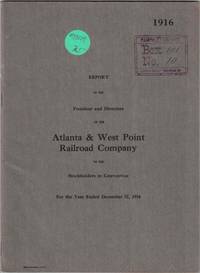
1916réf. 72709Atlanta: Foote & Davies 1916. Paperback. Very good. Paperback. 46pp. Illustrated with one page map in front. Gray paper covers with title on the front. Purple rubber-stamp on the front cover. A good complete example. Foote & Davies paperback books
1868réf. 95331868. The Transcontinental Railroad made possible the winning settlement and development of the American West. It led to a revolution in interstate and international trade opening the markets of the west coast and Asia to the east and Europe while bringing products of eastern or European industry to the growing populace west of the Mississippi and beyond. The railroad caused a great production boom and was in a sense America’s first technology corridor. As it encouraged the growth of American trade and business so too did the railroad impact the nation's public discourse and intellectual life by making it possible to come and go across the length of the continent in just over a week. Now for the first time the beauties and riches of the central part of the continent could be accessed any anyone in days. Nothing was the same afterwards. Many people consider the Transcontinental Railroad the greatest technological feat of the 19th century and one of the most consequential major construction projects ever undertaken. Before the advent of the Transcontinental Railroad a journey across the continent to the west coast meant months of careful preparation and acquisition of a conveyance and supplies then a dangerous six month trek over rivers deserts and mountains all the way risking the loss of necessities and encounters with blizzards and Indians. Alternatively a traveler could hazard a three to six month sea voyage around ferociously stormy Cape Horn which proved a graveyard to many ships or sail to Central America and cross the Isthmus of Panama through the jungle in part by pack animal and in part by rail which took five or six weeks risking exposure to any number of deadly diseases in the crossing. So it is no surprise that interest in building a railroad uniting the east and west coasts of the continent began soon after the advent of the locomotive. Early Trains in the US and the Idea to Build a Train Connecting East and West Coasts The first trains began to run in the U.S. in the 1830s along the East Coast and by the 1840s the nation's railway networks extended throughout the East South and Midwest. The annexation of the western territories including California following the Mexican War the almost immediately subsequent discovery of gold in the region in 1848 the resultant Gold Rush starting in 1849 and statehood for California in 1850 brought momentum to the idea of building a railroad across the nation to the Pacific. Meanwhile thousands of immigrants and miners sought their fortune in the West. During the 1850s Congress sponsored numerous survey parties to investigate possible routes for a transcontinental railroad. No particular route emerged as a clear favorite as the project became yet one more point of contention between the North and South before the Civil War with each wanting the railroad to go through their section. Theodore Judah was a civil engineer who helped build the first railroad in California and he became obsessed with the idea of a transcontinental railroad running through Nebraska Wyoming Utah Nevada and California. In 1859 he drew up letters of incorporation for the Central Pacific Railroad Company. Judah surveyed the route creating maps that he used to bolster a presentation of the scheme he made to Congress in October 1861. Many Congressmen were leery of beginning such an expensive venture especially with the Civil War underway but President Abraham Lincoln a long-time supporter of railroads saw in the proposal an important additional opportunity: to help knit California and the West to the Union. He agreed with Judah and on July 1 1862 Lincoln signed the Pacific Railway Act authorizing land grants and government support which amounted to $32000 per mile of track laid to two companies the Central Pacific Railroad and the Union Pacific Railroad. The Central would start at California’s eastern rail point in Sacramento cross the Sierras go through Nevada and into northern Utah where it would meet up with the Union Pacific. The Central Pacific Railroad spiked the first rail on October 26 1863 and its construction crews began building the line east from Sacramento. At the eastern end of the project Gen. Grenville Dodge and his assistant Peter Dey surveyed the potential route the Union Pacific would take. They recommended a line that would follow Nebraska’s Platt River along the North Fork would then cross the Continental Divide at South Pass in Wyoming and continue along to Green River then head into Utah. President Lincoln favored this route and made the decision that the eastern terminus of the Transcontinental Railroad would be Council Bluffs Iowa across the Missouri River from Omaha Nebraska. The Union Pacific Thomas Durant a medical doctor turned businessman gained control of the Union Pacific Railroad Company in July 1863. Though Durant took the office of vice president he was the actual leader of the railroad. In 1864 Congress passed the second Pacific Railway Act which doubled the size of the land grants and allowed the railroads to sell their own bonds. The Union Pacific began to lay tracks at Omaha Nebraska in July 1865. But Durant's management of the actual building of the rail line was sub par and lacked both organization and people with sufficient knowledge and skills to accomplish its ambitious task. So as 1866 dawned Durant hired Grenville Dodge as chief engineer of the railroad Dodge began advising Durant immediately although he would not leave the service until May and Dodge insisted up front that Jack Casement and his brother be hired to lay the track and actually construct the Union Pacific line. John S. Jack Casement had worked as a railroad contractor on the Ohio Railroad prior to the Civil War. During the war he rose to the rank of General and Brigade commander and was admired for his bravery management skills and railroad experience. Jack and his brother Daniel had formed the firm of J.S. & D.T. Casement; “General Jack” was construction leader while Daniel handled financial matters. Jack and Dan Casement Build the Railroad The Casements came to an understanding with Durant and they agreed upon a proposal letter dated February 6 1866. That letter provided that the Casement firm would ""lay and fill the track on the Union Pacific Rail Road for seven hundred fifty dollars per mile on the following terms and conditions. The Rail Road Company to furnish motive power cars wood and water and tracks for boarding cars and pay for delays of over three consecutive days caused by want of material motive power or other default or neglect of Company. The track to be laid in a good and workmanlike manner and filled and surfaced with material taken from the side of the road the whole to be subject to the approval and acceptance of the Engineer of the Company in charge of the work and the track to be accepted on the completion of every twenty miles and approximate estimates to be made by the Engineer in charge and paid monthly. We will lay the track as fast as required not to exceed one mile per day and will at the option of the Company on ten days notice reduce our gang to a force sufficient to lay one half mile per day. We will furnish engineer men and all other help for the trains used in distribution of material and take the materials for track at any point on the Rail Road within one hundred feet of the track and we will furnish oil waste etc for trains in our employ. All trains used in construction or for any purpose by us are to be run subject to the regulations & schedule time of the Company & under the general control of the Superintendent of the Company. We will make no extra charge in cutting and filling in leveling ties unless it exceeds six inches. No extra charge for putting in frogs and switches for all necessary sidings. And we will place the labor of all our men at the disposal of the Company whenever the delays exceed three days and charge for their time as per our payroll. We will commence as soon as the Company requires & will lay track during the whole of the present season and longer if the Company requires.” This proposal was signed “J.S. & D.T. Casement.” Durant responded to the Casements two days later on February 8 1866. His letter stated: “J.S. & D. T. Casement Painesville Ohio. Gentlemen: Your proposition to the Union Pacific Railroad Company under date of Feb. 6 1866 in relation to track-laying is received and has been considered. The Company decides to regard your proposition and this acceptance as the agreement upon the subject. The Company reserves the right to terminate this arrangement in case you do not perform the agreement on your part. Yours truly Thomas C. Durant V. P."" Jack Casement was responsible for all matters relating to building the Union Pacific. He hired the workers many of whom were former military personal gathered the materials and supplies and went into the field. As during the war his post was at the front in the construction camps which he ran like an army at the end of the line where the work was being done or in his car at the tail of the work train. Scrappy and hard-working he oversaw not just the laying but the grading of the track as well. As one of the necessities of his job to get to and from the work sites the Union Pacific presented him with annual passes to use their cars. Jack Casement’s engraved Union Pacific pass for 1868 used by him to manage and supervise work on the Transcontinental Railroad signed by Company President John D. Perry. This pass was retained by Casement’s descendants until recently when we obtained it directly from them. Under Casement’s leadership the Union Pacific laid 1087 miles of track from Fremont Nebraska west to Utah where the Central Pacific and Union Pacific Railroads met to form the transcontinental railroad. His was a magnificent achievement that compares well with the Central Pacific Railroad which laid 690 miles. On April 9 1869 with construction work nearing a conclusion and both the Union Pacific and Central Pacific needing a meeting point Congress established it as Promontory Summit north of the Great Salt Lake in Utah. Less than one month later on the morning of May 10 1869 locomotives from the two railroads met nose-to-nose to signal the joining of the two lines. At 12:57 p.m. local time at a ceremony planned to connect the railroads Leland Stanford Governor of California and president of the Central Pacific and Durant as vice-president of the Union Pacific were to pound in the golden spike with silver hammers. Both men proved unable to hit the spike so Jack Casement stepped up to do the job accompanied by much cheering from the workers surrounding him. Telegraphers announced the completion of the Pacific Railway. Canons boomed in San Francisco and Washington. Bells rang and fire whistles shrieked as people celebrated across the country. The nation was indeed united. unknown books
2003réf. 2335305The Lakeshores Division Niagara Frontier Region / The National Model Railroad Association 2003. Spiral-Bound Softcover. Good. Corners lightly dog-eared covers creased surface tears on covers. 2003 Spiral-Bound Softcover. 35 pp. plus 2-page appendix with map showing routes of various railroad lines. Oblong - 8 1/2 x 14. Original wrappers plastic comb binding. A collection of detailed plans showing the sides and cross-sections of various railroad buildings throughout the Lakeshores Region with measurements and floor plans. An excellent resource for the model railroader or New York state railroad historian. The Lakeshores Division, Niagara Frontier Region / The National Model Railroad Association paperback books
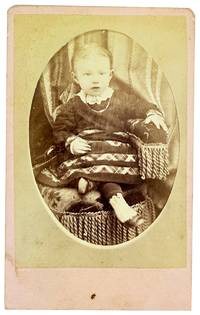
1880réf. 32410N.p.: U.P.R.R. Photograph 1880. Very Good. N.p.: U.P.R.R. Photograph ca. 1880s. Small format albumen carte de visite 8.5x6cm mounted to card measuring 10x6.5cm. Brief smudging else Very Good to Near Fine. Portrait of a seated child about 18 months old. Verso printed in red with an engraved reproduction of the photographer's studio which was housed in a railway car that the photographer S.B. Silvis traveled around on the Union Pacific Railroad line. "Stereoscope & Landscape Views of Notable Points on Line of Pacific R.R. / Always on Hand." We can't find much about Silvis though a notice in Hailey Idaho in late June of 1888 announced that he was in town for a few days to take pictures through the holiday. U.P.R.R. Photograph unknown books
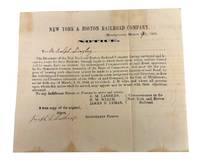
réf. 96260Very Good. Mostly printed broadside notice. 17 x 20 cm. The railro/ad did begin construction but failed in the Panic of 1857. AI says that a different group of investors operating as the New Haven Middletown and Willimantic Railroad Company completed the railroad in 1873 but also ran into financial difficulties. We know nothing about Mr. Linsley. unknown books
1925réf. 95101Ryuzan Chosen: Chosen Railways 1925. Very Good. single sheet folded several times to produce a 12 panel brochure on one side and a map of Heijo with a smaller map of Shingishu-Antung and various small 18 black and white photos around the edge on the other side. 19 x 9 cm. when folded and 38 x 44 cm. when fully unfolded. Text in English. Back cover of folded brochure heavily scuffed and lacking some of the text which briefly described hotels under the management of S.M.R. -- this damage probably occurred when this scarce item was "rescued" from an album or scrapbook. One of the photos surrounding the map shows the Railway bridge built by the Japanese 1909-1911 over the Yalu River between what is now Dandong on the Chinese side and Sinuiju in North Korea. Heij then a modest-sized city is known today as Pyongyang and is the capital of North Korea with a population of more than three million. Chosen Railways was under control of South Manchuria Railway between 1917 and 1925. Chosen Railways unknown books
1916réf. 85287n.p. 1916. Good. 25 x 30cm. Splitting along later vertical fold -- are aound fold reinforced by later strips of acid free paper mending tape. Signed by Secretary and two Directors. Payment and transfer information on back. unknown books
1912réf. 85184n.p. 1912. Hardcover. Good. v 356 46 66p. Rebound in later tan buckram with leather spine labels. 24 cm. Cover somewhat soiled. No jacket. Documents and minutes intended to cover all proceedings "had to effect the merger whereby the present Raleigh Charlotte and Southern Railway Company was formed and its First and Refunding Mortgage authorized." from the Preface. hardcover books
1944réf. 73010n.p. 1944. Paperback. Very Good. 21 12p. Wrapper. 27cm. Moderate cover browning & soil. This is not the actual executed agreement; it is a printed copy of agreement as executed with the signatures rendered in type. paperback books
1952réf. 72847New York 1952. Paperback. Very Good. photos 36p. Wrapper. Softcover. 28cm. paperback books
1940réf. 69647New York 1940. Paperback. Very Good. 126p. White wrapper. 31cm. Some cover soil and browning. Annual Report Form A Large and Medium Steam Roads and Switching and terminal Companies. paperback books
1914réf. 72732Albany: Press of the Brandow Printing Co 1914. Hardcover. Good. illustrations 186p. Hardcover Black cloth. 16cm. Soiling on outer leaves. No Jacket. Press of the Brandow Printing Co hardcover books
réf. 68102Madeira n.d. Paperback. Very Good. illustrations 16p. Softcover in otiginal wrapper. Oblong 17 x 13 cm. One could return by mount by rail or by sleigh. paperback books
1913réf. 72800n.p. 1913. Paperback. Very Good. 93 xxvi p. Gray wrapper. 23cm. Small corner chip on front cover. Six small corrective slips tipped in at various places. paperback books
1864réf. 726451864. Paperback. Very Good. Manchester and Lawrence Railroad Corporation. Five Annual Reports of the Directors for 1864 1868 1870 1874 & 1886. Concord first three or Manchester last two: 1864 1868 1870 1874 and 1886. 10-20 pages per report. Wrappers. 21-23cm. Vertical crease on two reports. paperback books
1971réf. 72907New York 1971. Paperback. Very Good. viii 70p. Blue wrapper lettered and decorated in silver. Blue plastic comb binding. 28cm. The survey seems designed to show that federal ownership of U.S. railways would not make things better. paperback books
1955réf. 74300n.p.: Printed by the Cuneo Press 1955. Paperback. Good. organizational charts double-page map 27p. Wrapper. 31cm. Cover wrinkling and browning. Printed by the Cuneo Press paperback books
1945réf. 72933Philadelphia 1945. Fourth Edition. Hardcover. Very Good. 301p. Pages inserted in a 3-ring notebook with thin flexible cover. 24cm. Cover of notebook scuffed. Some revised sheets dated 1950 have been inserted here and there. hardcover books
1955réf. 72841n.p.: Printed by the Cuneo Press 1955. Paperback. Very Good. organizational charts double-page map 27p. Wrapper. 31cm. Vertical crease. Printed by the Cuneo Press paperback books
1926réf. 72648Washington: GPO 1926. Paperback. Good. vii 1491p. Wrapper. 24cm. Age-toned. Small gouge at bottom of back cover and last several pages. GPO paperback books
1955réf. 74301n.p.: Printed by the Cuneo Press 1955. Paperback. Good. organizational charts double-page map 27p. Wrapper. 31cm. Three holes punched along left side probably for insertion in a notebook. Printed by the Cuneo Press paperback books
1922réf. 69535New York 1922. Paperback. Very Good. 38p. plus 10 folding maps. Wrapper. 27cm. Laid in is a typed Letter signed from the Assistant to the President of the NAORS forwarding this report and mentioning an upcoming hearing before the ICC to consider regulations. paperback books
1944réf. 72914New York: Association of American Railroads 1944. Paperback. Very Good. photos 63p. Wrapper. 28cm. Cover browned around edges. Association of American Railroads paperback books