CHINABiblio.com
28 309 résultats
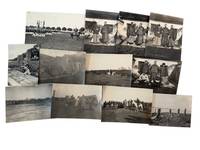
réf. FRE25Oblong Quarto album ca. 15x19 cm. 12 card-stock leaves. Period black lacquered boards with elaborate inlaid motifs. 39 photographs from 75x7 cm to 9x135 cm. Almost all photos are captured in pre-revolutionary Russian. Front board of the album is detachable. Few photos faded rear cover slightly scuffed. otherwise good. Octavo album ca. 215x145 cm. 47 leaves 23 blank. Period green cloth binding. 73 photographs from 55x85 to 165x115 cm. Approximately half of the photos are captioned in Russian. The album is signed ’Sophie Stcherbakof. 26/1/1896 on the half-title’ the next page includes a deduction leaf from Alexei Fedorovich Vedernikov to Maria Fyodorovich and Nikolay Smirnov who got married on 26th of January 1896 in Verny now - Alma-Ata Kazakhstan next to the dedication is a song Vedernikov sang at their wedding on which he was the best man. Also album includes three pasted postcards a collage with three cloth stripes red-blue and white and a praise for ‘matouchka Rossia’ in mix of French and latinized Russian dated 1893 and a red piece of paper with printed in Chinese ‘Badong’ for the name of Badong province and three geographical names from the province in Russian. Few photos are faded and with tears but overall in good condition. The albums are coming from the families of the Russian officers who served in China Central Asia and the Far East in the last two decades of the existence of the Russian Empire. The album share provenance and have belonged together in the collection we acquired them from although it is unclear if the people on the photos are related. The first album is likely complied by lieutenant S.E.Bocharov of the South Manchurian Detachment of the Russian Army. This detachment operated in the Far East until the formation of the Manchurian Army in 1904 at the outset of the Russo-Japanese War. Its roots trace back to late summer and early autumn of 1901 when Russian troops in Northern Manchuria organized and executed operations to capture the last remaining leaders of the hunhuz movement who were still at large. The detachment was commanded by Lieutenant General Tserpitsky. The outcome of the detachment's operations was the capture of the Chinese General Sheu and the surrender of another hunhuz chieftain Fulango. In August 1901 Lieutenant General Tserpitsky relinquished command of the South Manchurian Detachment to Major General Fleischer who had previously commanded it at the beginning of the campaign during the advance on Haicheng. The creation of this album likely dates to this specific period; the photographs depict the detachment's headquarters in Mukden officers and their families a steam locomotive on the railway the Liaohe River in Yingkou a panoramic view of Yingkou and a barracks building under construction. The album also contains two studio photographs of Nagasaki—including a hand-colored image of the customs house—as well as two Japanese studio genre scenes. Individuals mentioned in the album include: Convoy Commander Anisimov Senior Adjutant Vlasenko Officer for Special Duties Vutman Colonel Glinsky and his wife Shura Glinskaya and Lieutenant Vlasenko. The second album is a keepsake album kept by Sophia Sherbakova Ð¡Ð¾Ñ„Ð¸Ñ Щербакова. The album starts in Kazakhstan then we see the couple vacating in Crimea Zeleny Mys and visiting Niagara Falls and New York. The second half of the album is dedicated to their life in China and Siberia: it starts with the street panorama in Badong an image of two Russian officers next to a buddhist temple group of four Russians on the horse-changing station the image of the house with a caption ‘our flat’ a group of Cossacks next to an entrance into a town street and nature views. The final section of the album shows Sophia in Irkutsk in 1914-1916 with one photo captured ‘Kazan’. Overall an interesting collection of photos of pre-1917 Russian activities in the Far East which are rare on the market. hardcover
1830réf. 21949Paris, A. Boulland, 1830. 2 volumes reliés demi-maroquin vert à coins, filets dorés sur les plats, dos richement ornés de filets et fleurons dorés, couvertures et dos conservés. Non rognés. Reliure signée Stroobants.
1995réf. 21833Martigny, Fondation Louis Moret, 1995. Portefeuille en papier noir, dos de toile, premier plat imprimé en blanc.
1932réf. 029968Tianjin/Peiping 1932 Peiyang Press Soft cover
1930Set of four unjoined nautical maps representing China Sea. Two sheets for the Southern Portion and other two for the Northern Portion:1- China Sea Southern Portion compiled from various authorities to 1923, published at the Admiralty 1 November 1881 under the Superintendence of Captain Sir Frederick J. Evans, with small corrections to 19312- China Sea Northern Portion compiled from the latest surveys to 1884, published at the Admiralty 18 September 1882 under the Superintendence of Captain Sir Frederick J. Evans, with small corrections to 1931
1719réf. PHO-2391Paris, chez Étienne Ganeau, 1719. 6 vol. in-12 (17x9,5cm), 4ff.-xxvii-2ff.-454pp.-5ff. (table), 4ff.-354pp.-3ff., 4ff.-402pp., 4ff.-532pp., 4ff.-374pp., 4ff.-512pp., veau moucheté, dos à nerfs orné avec tomaison et pièce de titre, tranches jaspées, exlibris verso 1er plat, écritures aux titre, dos et charnières frottés, coins usés, petit manque plat tome 1 Édition originale L'illustration entièrement gravée sur cuivre h.-t. se compose d'un frontispice, un portrait, et 60 planches, dont dépliantes. Sabin signale 60 planches sans mentionner le frontispice et le portrait. I ; De la Turquie : Frontispice, portrait, mappemonde, 4 pl. dont 1 dépliante ; II. De la Perse : 3 pl. ; III. L'Indostan, 24 pl. ; IV. De la Chine 8 pl. dont 2 dépliantes ; V. Des Isles Philippines 2 pl. ; VI. De la Nouvelle Espagne, 18 pl. dont 3 dépliantes.
1925réf. 276715Berlin: Reimer / Vohsen 1925. 36 S., (6 Bll.)/ 22 S. + ca. 1000 Abb. auf 117 S/W-Tafeln und 7 gefalteten Farb-Tafeln. Quer 4° Ln.mS. *Schnitt minimal fleckig* sonst sehr schöne Expl*.
1900réf. 238861900. German colonial northern China photo archive circa 1900 to 1910 documenting foreign military presence Chinese commercial and social life and the unequal encounters produced by European imperial expansion in the years surrounding the Boxer Rebellion. German occupation of Kiautschou Bay began in 1897 followed by the 1898 lease that placed the territory around Tsingtao under German control for 99 years and established the port as an Imperial German naval and commercial base. The photographs move between colonial military spectacle and less formal encounters as cavalry formations and Chinese prisoners appear alongside merchants transport rural scenes and a European man repeatedly photographed wearing Chinese garments among Chinese men. German manuscript captions identifying Tsingtao and locations in Manchuria connect the group to a German speaking observer traveling through a northern China increasingly shaped by foreign military intervention. Photo archive of 12 silver gelatin photographs approximately 3 x 4 inches each northern China including Tsingtao and Manchuria circa 1900 to 1910. Several photographs depict a European man among Chinese men wearing a long Chinese robe and cap in posed portraits outside a masonry building; in one he stands between two Chinese men similarly dressed while another records a larger group in which Chinese and European subjects wear combinations of local and Western clothing. Other images show a mounted officer passing ranks of uniformed troops carrying standards; groups gathered around loaded wagons or carts; horsemen and spectators assembled across open ground; and broad views of people and animals distributed across a field. Two particularly stark photographs show Chinese men restrained individually against upright wooden stakes in an open landscape their bodies separated at regular intervals along what appears to be a shoreline or field. Some photos with Manuscript German captions on the versos reference to Tsingtao and Manchuria. Germany's presence at Tsingtao belonged to the larger division of Chinese territory into foreign concessions and spheres of influence at the end of the nineteenth century. The Imperial German Navy administered Kiautschou and developed Tsingtao as a planned colonial city and naval base including residential segregation between European and Chinese populations. That colonial project intersected directly with the violence of the Boxer Rebellion in 1900. After the killing of German minister Clemens von Ketteler in Beijing Germany dispatched approximately 20000 troops to China; although the foreign legations had already been relieved when much of the German force arrived German and other international troops subsequently conducted punitive expeditions in which suspected Boxers were executed and villages were looted and burned operations that continued until the Boxer Protocol of September 1901. The photographs of bound prisoners therefore belong to a period in which execution and punitive violence formed a documented component of foreign intervention although the absence of a securely deciphered caption prevents assigning these particular scenes to a specific campaign. The images of a European participant adopting Chinese clothing present another dimension of the colonial encounter recording personal appropriation and performance of local dress within the same photographic record that encompasses military formations prisoners commerce transportation and everyday contact. Light surface wear occasional creasing toning and fading; manuscript verso captions remain substantially legible. Overall in good condition. A German vernacular photographic record of northern China during the era of the Boxer intervention and Kiautschou colonial rule preserving military power coercion commerce and informal cross cultural encounters within the same small format archive. unknown
1900réf. 238861900. German colonial northern China photo archive circa 1900 to 1910 documenting foreign military presence Chinese commercial and social life and the unequal encounters produced by European imperial expansion in the years surrounding the Boxer Rebellion. German occupation of Kiautschou Bay began in 1897 followed by the 1898 lease that placed the territory around Tsingtao under German control for 99 years and established the port as an Imperial German naval and commercial base. The photographs move between colonial military spectacle and less formal encounters as cavalry formations and Chinese prisoners appear alongside merchants transport rural scenes and a European man repeatedly photographed wearing Chinese garments among Chinese men. German manuscript captions identifying Tsingtao and locations in Manchuria connect the group to a German speaking observer traveling through a northern China increasingly shaped by foreign military intervention. Photo archive of 12 silver gelatin photographs approximately 3 x 4 inches each northern China including Tsingtao and Manchuria circa 1900 to 1910. Several photographs depict a European man among Chinese men wearing a long Chinese robe and cap in posed portraits outside a masonry building; in one he stands between two Chinese men similarly dressed while another records a larger group in which Chinese and European subjects wear combinations of local and Western clothing. Other images show a mounted officer passing ranks of uniformed troops carrying standards; groups gathered around loaded wagons or carts; horsemen and spectators assembled across open ground; and broad views of people and animals distributed across a field. Two particularly stark photographs show Chinese men restrained individually against upright wooden stakes in an open landscape their bodies separated at regular intervals along what appears to be a shoreline or field. Some photos with Manuscript German captions on the versos reference to Tsingtao and Manchuria. Germany's presence at Tsingtao belonged to the larger division of Chinese territory into foreign concessions and spheres of influence at the end of the nineteenth century. The Imperial German Navy administered Kiautschou and developed Tsingtao as a planned colonial city and naval base including residential segregation between European and Chinese populations. That colonial project intersected directly with the violence of the Boxer Rebellion in 1900. After the killing of German minister Clemens von Ketteler in Beijing Germany dispatched approximately 20000 troops to China; although the foreign legations had already been relieved when much of the German force arrived German and other international troops subsequently conducted punitive expeditions in which suspected Boxers were executed and villages were looted and burned operations that continued until the Boxer Protocol of September 1901. The photographs of bound prisoners therefore belong to a period in which execution and punitive violence formed a documented component of foreign intervention although the absence of a securely deciphered caption prevents assigning these particular scenes to a specific campaign. The images of a European participant adopting Chinese clothing present another dimension of the colonial encounter recording personal appropriation and performance of local dress within the same photographic record that encompasses military formations prisoners commerce transportation and everyday contact. Light surface wear occasional creasing toning and fading; manuscript verso captions remain substantially legible. Overall in good condition. A German vernacular photographic record of northern China during the era of the Boxer intervention and Kiautschou colonial rule preserving military power coercion commerce and informal cross cultural encounters within the same small format archive. unknown books
1788réf. 35708Paris Buisson 1788 in-8 maroquin cerise à long grain, dos lisse richement orné de filets, tortillons et guirlandes dorés, encadrement de double filet et double guirlande dorés sur les plats, hachuré doré sur les coupes, tranches dorées [Rel. de l'époque], quelques rousseurs
1995réf. 2083002115802311Xiyuan Publishing Company 1995. Soft Cover. Fine. Number of books: 3 Xiyuan Publishing Company paperback
réf. 92437aaf36.5x24.5 cm (passepartout 50x35 cm), 2 planches ensemble, passepartout.
réf. 106076Londres, Fischer, Fils, et Cie. sans date, vers 1840, 280x220mm, reliure d’époque chagrin avec titre, tomaison, filets et ornementations dorés au dos. Plats avec deux encadrements à trois filets dorés et ornementations à froid. Dos légèrement insolé, autrement belle reliure. Inscriptions manuscrites sur le haut de la page de garde supérieure, autrement bel exemplaire avec faibles rousseurs éparses.
1788réf. 51882L’ Auteur & M. Ponce, sd. 1788 In-4 plein velin, dos à nerfs, pièce de titre, tranches marbrées, 24 planches hors-texte sous serpentes & 24 ff. de texte pour l’explication des planches. Rares rousseurs, brunissures marginales et petite humidité angulaire en pied. Bon exemplaire
1879réf. VBF09CHINA PANORAMA OF PEKING during the Celebrations of the Sixtieth Anniversary of the Emperor Kang-He's birthday. Shanghai: Tien-Shin-Chai 1879. Profusely illustrated throughout with 292 pages lithographed with images mostly captioned below in English script and on the side Small 8vo measures: 6 1/8 x 3 3/4 inches 155 x 96 mm original gilt pictorial purple silk wrappers front cover dulled. First edition thus. With 6 page Introduction in English explaining that the festivities being described date back to the western calendar year 1721. Six pages of text as introduction in English at the front and in Chinese at the back. Tien-Shin-Chai, paperback
1879réf. VBF09CHINA PANORAMA OF PEKING during the Celebrations of the Sixtieth Anniversary of the Emperor Kang-He's birthday. Shanghai: Tien-Shin-Chai 1879. Profusely illustrated throughout with 292 pages lithographed with images mostly captioned below in English script and on the side Small 8vo measures: 6 1/8 x 3 3/4 inches 155 x 96 mm original gilt pictorial purple silk wrappers front cover dulled. First edition thus. With 6 page Introduction in English explaining that the festivities being described date back to the western calendar year 1721. Six pages of text as introduction in English at the front and in Chinese at the back. Tien-Shin-Chai, paperback books
réf. 11320Sans lieu ni date (probablement publié en Cochinchine dans les années 1860-1870). 1 grand volume in-4, III->IX + 328 pp., reliure moderne plein cuir bordeaux, page de titre absente, premiers et derniers feuillets fragilisés (déchirures, petits manques de papier, salissures), le corps du texte est en très bon état. L'étude est suivie d'un ensemble de 15 planches sur 16 (la dernière planche est manquante) Les 3 dernières planches sont fragilisées et présentent de légers manques de papier marginaux. L'ensemble est tout à fait correct.
réf. 13503Sans lieu ni date (probablement publié en Cochinchine dans les années 1860-1870). 1 grand volume in-4, III->IX + 328 pp., reliure moderne plein cuir bordeaux, page de titre absente, premiers et derniers feuillets fragilisés (déchirures, petits manques de papier, salissures), le corps du texte est en très bon état. L'étude est suivie d'un ensemble de 15 planches sur 16 (la dernière planche est manquante) Les 3 dernières planches sont fragilisées et présentent de légers manques de papier marginaux. L'ensemble est tout à fait correct.
1843réf. PHO-2119Paris et Londres, Fisher, 4 volumes grand in-4 (28 × 22,5 cm). Reliure de l’éditeur en percaline rouge, plats décorés à froid et à l’or, dos ornés de fers dorés, tranches dorées. Intérieurs propres, légères rousseurs éparses, petits frottements au dos du tome 1, dos légèrement insolés 4 titres gravés et 123 planches gravées sur acier d’après Thomas Allom, tirées avec encadrement et légende, gravées par divers artistes (H. Adlard, C. Bentley, J. Sands, etc.), complet selon les tables avec 3 planches en doublons.
1856réf. 3281ABWashington, Beverley Tucker, 1856. E.A. 3 Bde. 537; 414; 705 S. mit zahlr. kolorierten Lithographietafeln, Holzstichillustr., Sternkarten u.a. Lnbde. d. Zeit., Altersspuren, innen guter Zust.
1947réf. 1473-2Tériade Éditeur, Paris 1947. 1 volume in-4 (307 x 223 mm) en feuilles, 96 pages, couverture illustrée rempliée, chemise-étui de l'éditeur. 68 BOIS ORIGINAUX DE HENRI LAURENS. dont 23 à pleine page et 3 en noir et or, ornements typographiques sur fonds or. Édition : 270 exemplaires numérotés sur vélin d' Arches (40 + 210 + XX), celui-ci l'un des 40 DE TÊTE ENRICHI D'UNE SUBLIME SUITE SUR JAPON ANCIEN (n° 24, signé). Le livre est signé par l'artiste à la page de justification. Bel exemplaire, rarissime avec suite. réf : Brusberg 24.
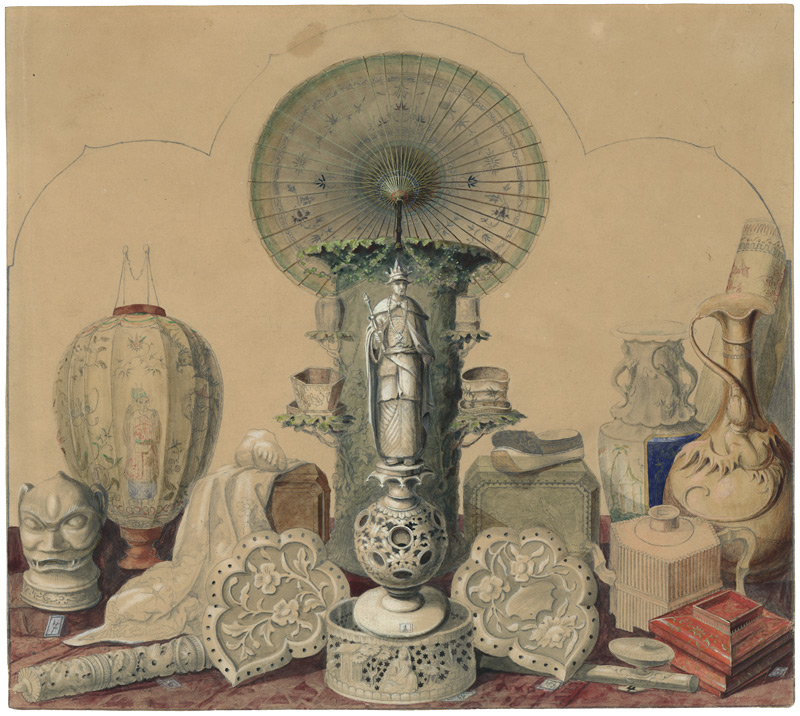
réf. 170-Eo.J. Aquarell über Bleistift, mit Deckweiß gehöht, auf bräunlichem Velin. 21,5:24,3 cm. - Etwas fleckig. Auf altem Untersatz bezeichnet: ?A. Hauptstock in Berlin / Ausstellung chinesischer Gegenstände in Berlin / Reiche Gruppe chinesischer Elfenbeinschnitzereien / und anderer Kunstprodukte. / Aquarell, qu. fol. / des J.G. Lumnitzers Nachlasse zu Brünn. N=208632?.
réf. 10234Shanghai, A.S. Watson, 1922, 3rd edition. 1 volume, folio, VIII-40 pp., original full cloth binding, a very good copy without the usual foxing. This volume is illustrated with 66 photographs on tipped-in plates by the famous photographer Donald Mennie.
réf. 9775Paris, Librairie Plon, Plon-Nourrit et Cie, Imprimeurs-Editeurs, sans date, 1900. 1 volume in folio (28*38 cm), reliure demi-chagrin, à coins, plats cartonnés marbrés, composé de 28 feuilles doubles, très bon état.
réf. 13774Paris, Librairie Plon, Plon-Nourrit et Cie, Imprimeurs-Editeurs, sans date, 1900. 1 volume in folio (28*38 cm), reliure demi-chagrin, à coins, plats cartonnés marbrés, composé de 28 feuilles doubles, très bon état.